1779
The Study On Static And Dynamic Energy Efficient
Optimization Techniques In MANET
P.Thiyagarajan, S.Senthilkumar
Abstract: Mobile Ad-Hoc Networks (MANETs) is ainfrastructure less network where nodes sharing the information with each other directly. Nodes in network join or leave at any time within communication range. The communication between MNs is identified through the routing process. Routing is employed for identifying the path between source and destination to transmit the necessary data packets. R outing protocols is used for efficient data packet transmission in MANET. Energy efficiency is the key concern in routing process due to less power in nodes. An optimization technique is the process carried out iteratively till finding the optimum solution. Many researchers carried out their research on energy efficient static and dynamic optimized routing protocols in MANET. But, the energy consumption and packet delivery ratio performance was not improved by existing techniques. In order to address these problems, different energy efficient static and dynamic optimization techniques were reviewed in this paper.
Index Terms: Mobile Ad Hoc Network, communication, static and dynamic optimization, routing, data packet transmission —————————— ——————————
I INTRODUCTION
MANET is a set of MN without any static substructure. MANET is the self-organizing system with dynamic topology that allows MN interaction in wireless manner without permanent infrastructure. Owing to inadequate resources like processing ability and storage space, it is essential to minimize the routing overhead in MANET with high packet delivery ratio. As battery power of node was limited, Node energy and network lifetime is an essential issue in MANET. Consequently, routing protocols considered the energy as the key resource for MN communication to enhance network lifetime (NL). The survey paper is ordered as: Section 2 describes the survey on different energy efficient static and dynamic optimized routing protocols in MANET, Section 3 shows experimental analysis of existing energy efficient static and dynamic optimized routing protocols in MANET, Section 4 describes existing energy efficient static and dynamic optimized routing protocol comparison in MANET. In Section 5, the drawbacks of existing protocols in MANET are discussed with future direction. The conclusion of the paper is given in Section 6.
II LITERATURE REVIEW
In [1], Ant-based efficient energy and balanced load routing (A-EEBLR) approach was introduced. A-EEBLR approach selected the next hop node. But, the routing time was not reduced using A-EEBLR approach.
An Ad-hoc On-Demand Distance Vector (AODV) protocol with Ant Colony Optimization (ACO) was introduced in [2] to enhance the Quality of Service (QoS) in MANET. The finest route for data delivery was chosen based on pheromone value of path. But, the energy consumption ratio was not reduced. An ant colony-based energy control routing protocol (ACECR) was designed in [3] for improving NL and reducing MN‘s energy level. But, the neighboring node selection was not carried out in routing process. An efficient power aware routing (EPAR) method was introduced in [4] that distinguish the node capability by residual battery power. Less cost path was selected and data rate get controlled. The energy consumption gets reduced and node lifetime gets improved. The designed method identified the path with high lifetime. But, the packet delivery ratio was not improved. LASEERA protocol was designed in [5] for MANET. The designed algorithm reduced the energy consumption and attained better results in delay and delivery ratio. However, the designed method failed to minimize the routing overhead. An Intelligent Energy-aware Efficient Routing (IE2R) protocol was designed in [6] by multi-criteria decision-making approach for increasing the delivery with lesser delay. However, the designed approach has high latency in route path identification for large networks. In [7], Innovative ACO based Routing Algorithm (ANTALG) was introduced. ANTALG enhanced the throughput with lesser delay. But, the designed algorithm failed to improve the network lifetime because the algorithm failed to choose the energy efficient nodes.
III
STATIC
AND
DYNAMIC
ENERGY
EFFICIENT OPTIMIZATION TECHNIQUES IN
MANET
MANET is a set of MN that interacts without predetermined infrastructure. Due to flexible and dynamic environment, MANET is employed in various applications like military communication and disaster area communication. Energy is an essential criterion for decentralized network. In order to improve the network lifetime, best route selection is an essential issue for routing protocols in MANET. Routing is the method of choosing the selecting paths in network to transmit the data. In MANET, routing is a vital part of opting a path as well as sharing the information among the mobile nodes.
__________________________________
Dr.S.Senthilkumar is an Assistant Professor in the Department of Computer science and Engineering at University college of Engineering, Pattukkottai. He received his PhD in computer science and Engineering from Anna university Chennai. His research interests in MANET, Distributed Computing and WSN. He has published more than 25 publications in reputed journals.
1780
A.Ant-based energy efficient and load balancing approach for optimal path convergence in Mobile Adhoc Networks ACO is the meta-heuristic process depending on ant behavior with computational agents to find minimum distant path for finding the food location. A-EEBLR approach was introduced to select the next hop node depending on metrics. With help of QoSmetrics, selection of next hop is identified. The probability recognized the forward and backward ant agents for identifying multiple paths to perform transmission. ACO algorithm was employed for the data packet transmission. The ants seek destination node and stored the node information in pheromone table. The next hop node was preferred with help of metrics. The metric was chosen based on elapse time period for data transfer. The energy drain rate was chosen with help of an index value. The link quality was determined based on successful transmission rate and stop network clogging. In pheromone table, neighbor nodes and destination nodes are denoted in the rows and columns. A probability value was linked with node in pheromone matrix for next hop node selection. The routing was started by source node to find the path from source to destination node. At every intermediary node, forward ant was broadcasted to destination node.
B.Enhanced-Ant-AODV(EAA) for optimal route selection in mobile ad-hoc network A new mechanism combined AODV protocol with ACO for route selection to enhance the QoS. In designed mechanism, optimal route for data delivery was identified through path pheromone value determined based on number of hops and residual energy. The highest pheromone value path was chosen
for data packet transmission.
Enhanced_ANT_AODV(EAA) scheme was introduced for optimal route selection EAA identified an optimal route through link quality, residual energy and hop count. Every node maintained information in routing table. The minimal residual energy was available in the node for intermediary node consideration. When residual energy of node was lesser than threshold energy, it was not taken as intermediary node.
C. Energy routing protocol using Ant Colony for mobile ad hoc networks withvarious node mobility models ACO is functioned based on swarm intelligence for addressing optimization problems. ACO functioned with artificial ants that behave as the packets in MANET. The pheromone content selected the best path in network to transmit the data. The data was transmitted over multiple paths for same destination to achieve load balancing. ACO-based routing algorithm was introduced based on proactive and iterative behavior. The designed algorithm minimized variability and errors through choosing the trusted path. ACECR protocol identified optimal route through optimistic feedback. In ACECR protocol, routing was depending on hop count between nodes based on the node energy. When source node sent data packet to the destination, it verified their pheromone table. When pheromone table not include next node to destination node, source node discovered path. Source node transmit request packet termed as forward ant (Fant). When node collected Fant, it revised node list and record the node where Fant passed. Each node in networks sends Fant packet till destination.
When Fant reached destination node, it generated backward ant (Bant). The destination sent Bant to source node along reverse route.
D.Optimizing Transmission Power and Energy Efficient Routing Protocol in MANETs EPAR method was introduced to distinguish nodes by residual battery power and energy spent during forwarding particular link. A data routing was carried out with high mobility. The minimal cost path was preferred and data rate get organized. The energy consumption gets reduced and node lifetime gets increased. The designed approach identified path having high lifetime for performing data communication. The designed method consumed lesser energy for efficient routing process. The throughput gets improved and the power utilization gets minimized.
E. A Stable and Energy-Efficient Routing Algorithm Based on Learning Automata Theory for MANET LASEERA was introduced for MANET based on new node stability measurement model with energy ratio function. LA theory was self-learning mechanism depending on stochastic process theory. LA improved results by prior knowledge to select the best one from limited set through repeated interactions. LA comprised three essential factors, namely random environment, automaton and feedback system. The automaton selected the action and environment respond to the action with help of feedback signal. Depending on automaton outcome, the feedback signal was partitioned into positive or negative signal. The automatons learned from feedback signal to identify the optimal action.
F. Intelligent energy-aware efficient routing for MANET MANET is a collection of active nodes moving in any direction. An IE2R was introduced with MCDM technique depending on entropy and Preference Ranking Organization METHod for Enrichment of Evaluations-II (PROMETHEE-II) method to identify the best route. MCDM technique and Intuitionist Fuzzy Soft Set IFSS) minimized the improbability and identified energy efficient route for addressing the decision-making problems. The nodes like simple node, junction node, fictitious node, source node and deceased node were used for route detection and maintenance to enhance NL. Route REQuest (RREQ), Route REPly (RREP), Route ERRor (RERR) and HELLO packet handled the route and performed communication without reducing neighbor counts. The selection of neighbor nodes was introduced depending on messages given by nodes. The route maintenance scheme handled the link and node failure. The selection of indicators and routes were carried out for energy efficient routing in MANET.
IV COMPARISON OF ENERGY EFFICIENT
STATIC AND DYNAMIC OPTIMIZED ROUTING
PROTOCOLS IN MANET& SUGGESTIONS
In order to compare the energy efficient static and dynamic routing protocols in MANET, number of MN and data packets is taken to conduct the experimentation. Different parameters are used for performing the energy efficient data packets routing in MANET.
A. Energy Consumption (EC)
1781
node. It is defined as the product of number of MNs and energy utilized by one MN. It is computed in joules (J). It is formulated as,
(1)
From (1), ‗ ‘ denotes the number of MNs.
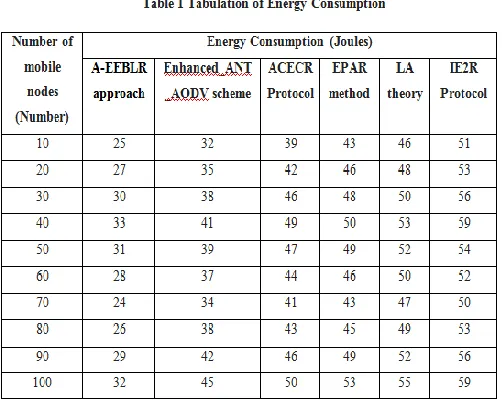
Table 1 describes the EC with respect to different number of mobile nodes varying from 10 to 100. Energy consumption comparison takes place on existing A-EEBLR approach, Enhanced ACO with AODV protocol, ACECR, EPAR method, LA theory and IE2R. The graphical analysis of EC is described in figure 1.
Figure 1 explains the EC comparison for different number of mobile nodes. It is clear that the energy consumption using A-EEBLR approach is lesser when compared to Enhanced ACO with AODV protocol, ACECR, EPAR method, LA theory and IE2R protocol. This is due to the application of ACO algorithm for routing the data packets in energy efficient manner. The ant seeks for destination and preserves information of nodes in pheromone table. The pheromone table was matrix with energy efficient neighbor nodes and destination nodes were denoted for data packet transmission. This in turn helps to reduce the energy consumption. Finally, the energy consumption of A-EEBLR approach is 25% lesser than Enhanced_ANT_AODV scheme, 36% lesser than ACECR Protocol, 40% lesser
than EPAR method, 43% lesser than LA theory and 48% lesser than IE2R Protocol.
B. Routing Time (RT)
Round Time is amount of time consumed for forwarding the data packets from sourceto destination.RT is defined as the difference of starting time and ending time of routing process. It is measured in terms of milliseconds (ms). It is given by,
(2) From (2), the RT is computed. When routing time is lesser, more efficient method is said to be..
Table 2 explains the routing time with respect to different number of data packets varying from 10 to 100. Routing time comparison takes place on existing A-EEBLR approach, Enhanced ACO with AODV protocol, ACECR, EPAR method, LA theory and IE2R protocol. The graphical analysis of routing time is explained in figure 2.
Figure 2 illustrates the routing time comparison for different number of data packets. It is clear that the routing time using Enhanced ACO with AODV protocol is lesser when compared to A-EEBLR approach, ACECR, EPAR method, LA theory and IE2R protocol. This is because Enhanced_ANT_AODV scheme introduced with many factors for optimal route selection. Enhanced-Ant-AODV constructed an optimal route from the source node to destination node. Every node maintained the information in routing table for routing the packets with lesser time
consumption. Finally, the routing time of
1782
lesser than EPAR method, 43% lesser than LA theory and 47% lesser than IE2R Protocol.
C. Packet Delivery Ratio (PDR)
PDR is ratio between number of data packets delivered and total number of data packets sent. It is measured in terms of percentage (%). It is formulated as,
(3) From (3), the PDR is calculated. When the PDR is higher, more efficient the method is said to be.
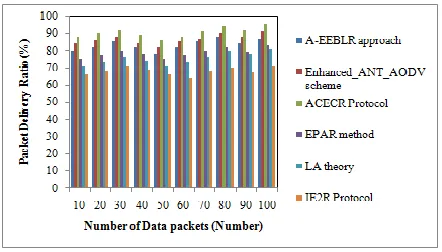
Table 3 explains the PDR with different number of data packets PDRcompareswith existing A-EEBLR approach, Enhanced ACO with AODV protocol, ACECR, EPAR method, LA theory and IE2Rprotocol. The graphical analysis of packet delivery ratio is illustrated in figure 3.
Figure 3 describes the PDR comparison for different number of data packets. It is clear that packet delivery ratio using ACECR is higher when compared to A-EEBLR approach, Enhanced ACO with AODV protocol, EPAR method, LA theory and IE2R protocol. This is due to the application of ACO-based routing algorithm in different ways because of the iterative and proactive behavior. The proposed technique reduced the inconsistency and inaccuracies in networks viaopting the trusted path. This in turn helps to improve the PDR. Finally, the PDR of ACECR protocol is 9% lesser than A-EEBLR approach, 5% lesser than Enhanced_ANT_AODV scheme, 15% lesser than
EPAR method, 20% lesser than LA theory and 33% lesser than IE2R protocol.
V
DISCUSSION
AND
LIMITATIONS
ON
ENERGY EFFICIENT STATIC AND DYNAMIC
ROUTING PROTOCOL IN MANET
A-EEBLR approach selected the next hop node depending on the metrics. The next hop probability detected forward and backward ant agents to identify optimal path for transmission. But, the routing time was not reduced using A-EEBLR approach. AODV protocol combined with ACO to increase QoS for route selection. The optimal route for data delivery was chosen by route pheromone value. The pheromone value of route was computed depending on end-to-end path reliability, congestion and residual energy of nodes. However, the energy consumption was not minimized. EPAR method classified nodes based on the residual battery power during data packets forwarding. The data routing is carried out with high mobility. The less cost path was selected and data rate get controlled. The throughput gets improved and power consumption gets minimized. But, the packet delivery ratio was not improved. ACECR protocol identified best route through positive character of ACO. When source node transmitted data packet to the destination, it verified pheromone table and identified next node in path. In ACECR protocol, routing choice was based on hop count between nodes. ACECR provided better results in balanced EC and NL. However, the neighboring node selection was not carried out in routing process. LASEERA was introduced for MANET with A new node stability measurement model. The node was presented with weighted value for LA. LA theory-based feedback mechanism for MANET environment selected the optimal one for proving the convergence. But, the designed method failed to minimize the routing overhead.IE2R was introduced with MCDM technique depending on entropy and PROMETHEE-II method to find the effective route. But, the designed approach has high latency in route path identification for large networks.
A. Related Works
1783 B. Future Direction
The future work of data packet transmission in MANET is carried out using the dynamic routing protocols. From the study, it is clear that the energy consumption and routing time consumption was less using dynamic routing protocols than the static routing protocols. So, we are planning to introduce the dynamic routing protocols in our future research works.
VI CONCLUSION
A comparison of different existing energy efficient static and dynamic optimization techniques in MANET is studied. From survival study, existingEnhanced_ANT_AODV scheme failed to reduce the energy consumption. The review explains that the neighboring node selection was not carried out in routing process. The routing time was not reduced using A-EEBLR approach. The wide range of experiments on existing techniques describes the performance of many energy efficient static and dynamic optimization techniques in MANET with its limitations. Finally from the survey, the research work can be carried out using dynamic routing protocols for energy efficient optimized routing in MANET.
REFERENCES
[1] ArockiasamyKarmel, VaradarajanVijayakumar and RadhakrishnanKapilan, ―Ant-based efficient energy and balanced load routing approach for optimal path convergence in MANET‖, Wireless Networks, Springer, July 2019, Pages1–13
[2] Dipika Sarkar, Swagata Choudhury and AbhishekMajumder, ―Enhanced-Ant-AODV for optimal route selection in mobile ad-hoc network‖, Journal of King Saud University - Computer and Information Sciences, Elsevier, August 2018, Pages 1-25
[3] Jipeng Zhou, Haisheng Tan, Yuhui Deng, Lin Cui and Deng Deng Liu, ―Ant Colony-Based Energy Control Routing Protocol for MANET under different node mobility models‖, EURASIP Journal on Wireless Communications and Networking, Springer, Volume 105, 2016, Pages 1-8.
[4] L. Femila and M. MarsalineBeno, ―Optimizing Transmission Power and Energy Efficient Routing Protocol in MANETs‖, Wireless Personal Communications, Springer, Volume 106, Issue 3, June 2019, Pages 1041–1056
[5] Sheng Hao, Huyin Zhang, Mengkai Song, ―A Stable and Energy-Efficient Routing Algorithm Based on Learning Automata Theory for MANET‖, Journal of Communications and Information Networks, Springer, Volume 3, Issue 2, 2018, Pages 52–66
[6] Santosh Kumar Das and sachinTripathi, ―Intelligent energy-aware efficient routing for MANET‖, Wireless Networks, Springer, Volume 24, Issue 4, 2018, Pages 1139–115
[7] Gurpreet Singh, Neeraj Kumar and Anil Kumar Verma, ―ANTALG: An Innovative ACO based Routing Algorithm for MANETs‖, Journal of Network and Computer Applications, Elsevier, Volume 45, 2014, Pages 151–167
[8] .Mingchuan Zhang, Meiyi Yang, Qingtao Wu, RuijuanZheng, Junlong Zhu, ―Smart perception and autonomic optimization: A novel bio-inspired hybrid routing protocol for MANETs‖, Future Generation Computer Systems, Elsevier, Volume 81, April 2018, Pages 505-513
[9] Yong Qiang Li, Zhong Wang, QingWen Wang, QingGang Fan, and BaiSong Chen, ―Reliable Ant Colony Routing Algorithm for Dual-Channel Mobile Ad Hoc Networks‖ Wireless Communications and Mobile Computing, Hindawi, Volume 2018, May 2018, Pages 1-10
[10]A. Pratapa Reddy and N. Satyanarayana, ―Energy-efficient stable multipath routing in MANET‖, Wireless Networks, Springer, Volume 23, Issue 7, 2017, Pages 2083–2091
[11]AqeelTaha, RaedAlsaqour, Mueen Uddin, MahaAbdelhaq, Tanzila Saba, ―Energy Efficient Multipath Routing Protocol for Mobile Ad-Hoc Network Using the Fitness Function‖, IEEE Access, Volume 5, 2017, Pages 10369 – 10381