reflux disease, fuss-cry-irritability with sleep
disorder syndrome and irritable infant syndrome
of musculoskeletal origin
Joel Alcantara,
BSc, DC1Renata Anderson,
DC2The mother of a 3-month old girl presented her daughter for chiropractic care with a medical diagnosis of
gastroesophageal reflux disease. Her complaints
included frequently interrupted sleep, excessive intestinal gas, frequent vomiting, excessive crying, difficulty breastfeeding, plagiocephaly and torticollis. Previous medical care consisted of Prilosec prescription medication. Notable improvement in the patient’s symptoms was observed within four visits and total resolution of symptoms within three months of care. This case study suggests that patients with complaints associated with both musculoskeletal and
non-musculoskeletal origin may benefit from chiropractic care.
(JCCA 2008; 52(4):248–255)
k e y w o r d s : GERD, chiropractic, pediatric
Introduction
For the chiropractor attending to the care of the pediatric patient, a number of clinical challenges arise from the simple and realistic reassurance for the parents that chiro-practic care “can help” to making the proper referral to a specialist for co-management and ultimately providing an effective and safe intervention. As demonstrated by
surveillance studies on the use of complementary and al-ternative medicine (CAM) by children,1–5 the patient may
present with multiple symptom complex associated with both musculoskeletal and non-musculosketal origin. In the interest of evidence-based practice on the chiropractic care of children, we describe the successful care of a pediatric patient with multiple symptoms consisting of
1 Research Director, International Chiropractic Pediatric Association, Media, Pa and Private Practice of Chiropractic, San Jose, CA, USA. 2 Private Practice of Chiropractic, Onalaska, WI, USA.
This study was funded by the International Chiropractic Pediatric Association, Media, PA.
Corresponding Author: Joel Alcantara, DC, Research Director, International Chiropractic Pediatric Association, 327 N. Middletown Rd, Media, PA, USA 19603.
[email protected] www.icpa4kidsc.om © JCCA 2008.
Une mère d’une fillette de trois mois s’est présentée chez un chiropraticien avec un diagnostic de reflux gastro-oesophagien chez son nouveau-né. Au nombre des maux dont souffrait sa fillette, on relevait des sommeils interrompus, des gaz intestinaux excessifs, des vomissements fréquents, des pleurs démesurés, de la difficulté à l’allaitement, de la plagiocéphalie et le torticolis. Un traitement médical antérieur a consisté à lui administrer le médicament Prilosec. On a observé une amélioration importante chez le patient au cours de quatre visites et une disparition des symptômes après trois mois de traitement. Cette étude de cas porte à croire que les patients aux prises avec des douleurs
muscolusquelettiques ou non musculosquelettiques pourraient profiter des services d’un chiropraticien.
(JACC 2008; 52(4):248–255)
frequently interrupted sleep, excessive intestinal gas, fre-quent vomiting, excessive crying, difficulty breastfeed-ing, plagiocephaly and torticollis.
Case Report
The mother of a three-month-old female presented her daughter for chiropractic consultation and possible care with a chief complaint of gastroesophageal reflux disease (GERD). At 2 months of age, the patient was diagnosed by her family physician with GERD and prescribed 2 mg/ ml of Prilosec™ (Omeprazole). Instructions were to take 2 cc p.o.q. days at two a day for about six weeks with a follow up visit in eight weeks. Prior to her medical diag-nosis and concurrent with medical care, the patient was attended to by another chiropractor to address complaints of intestinal gas and vomiting. The patient attended a to-tal of 5 visits with the first chiropractor but the infant’s subjective complaints “somewhat improved” without to-tal resolution. According to her mother, the patient suf-fered from frequently interrupted sleep, excessive intestinal gas, frequent vomiting, and excessive crying and difficulty breastfeeding. The patient was described as “very fussy” at feeding time and had difficulty making a complete seal so that she had no desire to breastfeed, re-fused a pacifier or suck on her mother’s fingers or her own. Crying described as a high-pitched sound and vom-iting were noticed as worst after her feedings. When she was picked up or held, the patient would cry excessively and go into full body rigidity and throw herself into an upper body extension (i.e., an arching motion). Accord-ing to the patient’s mother, walkAccord-ing and “bouncAccord-ing” her baby was the only way her daughter would breastfeed. The patient’s frequent interrupted sleep was associated with an almost constant “wiggling” of the body through-out the night. The patient would sleep continuously for only 2 hours during the night with even shorter “nap-time” during the day.
Physical examination of the patient revealed the fol-lowing. The infant was very agitated and displayed the high-pitched painful cries throughout her evaluation. While being held and crying, the patient would go into upper body extension (i.e., arch her back) as described by her mother. Notable examination findings included a pos-itive suckling reflex with no response to stimulus. The patient’s head was observed to be approximately 45º in right rotation with slight left lateral flexion of the cervical
spine. A flattening of the patient’s right occiput (i.e., pla-giocephaly) was noticeable. Further inspection revealed her mandible was “seated” to the right and could explain her inability to make a proper seal for breastfeeding. Moderate blistering on the right lower lip was also no-ticed. The patient’s abdomen was extremely taut with dis-comfort on digital palpation as noticed by the patient’s withdrawal response. Based on a chiropractic examina-tion procedure incorporating postural examinaexamina-tion and static and dynamic palpation of the spine,6 it was
deter-mined that the patient had spinal segmental dysfunctions at the atlas and the 4th thoracic vertebrae.7 The atlas was
determined to have a right posterior rotation and right lat-erality malposition with respect to the C2 vertebral body (VB). The 4th thoracic VB had a posterior malposition with respect to C3VB. Following craniosacral technique procedures,8 cranial distortions of the right parietal and
temporal bones were determined as well as aberrant motion of the mandible at the right temporomandibular joint (TMJ).
With the parent’s consent, the patient was cared for with high velocity low amplitude (HVLA) thrust type spinal manipulative therapy (SMT) characterized as Di-versified Technique9 with technique modification
appro-priate for the patient’s age and size. Chiropractic SMT was applied to the atlas in the following manner. With the patient in the seated position, the clinician’s index finger contacted the right transverse process of the patient’s at-las. An HVLA thrust with a lateral to medial vector and a slight posterior to anterior component was applied (see Figure 1). The patient also received pediatric SMT to cor-rect the posterior malposition of the T4 VB using an in-dex finger contact over the spinous process of the patient’s T4 VB. A posterior to anterior HVLA vector was applied (See Figure 2). With respect to the patient’s cranial distortions; the patient’s parietal, temporal bones and mandible were corrected using Craniosacral Therapy8 (see Figure 3 and 4). Following the patient’s
the positive response to care, the patient was scheduled with a treatment frequency of 3 visits per week for 3 weeks followed by 2 visits per week for 3 weeks and 1 visit per week thereafter. The patient was cared for simi-larly as described for the first visit. With continued chiro-practic care came continued improvement in the patient’s
symptoms. Following her 4th chiropractic visit, the moth-er intimated to the attending clinician that she made an independent decision to take her daughter “off” Prilosec™ due to the noticeable improvement in her daughter’s symptoms. By the 7th visit, the patient was vomiting only once per day as compared to vomiting fol-Figure 1 The patient receiving chiropractic SMT to
cor-rect an atlas malposition
Figure 2 The patient receiving chiropractic SMT to cor-rect the posterior malposition of the T4 vertebral body
Figure 3 The patient receiving cranial-sacral therapy to the parietal bone
lowing after every feeding. The patient was now able to latch on to her mother’s breast more efficiently without pulling off before finishing her feeding. According to the patient’s mother, her daughter began to increase her sleeping time during the night to 4–5 hours at a time as well as increasing the length of her “nap-time” in the day to approximately 2 hours. The infant’s parents also no-ticed that their daughter was not crying as often or for ex-tended lengths of time as before chiropractic care. The patient’s high-pitched, “painful cry” began to subside and replaced by quieter, “whimpering-like” cry. The infant’s whole body began to relax without the body rigidity that was noticed when she was held. The patient’s mother at-tributed her daughter’s improvement to the chiropractic care received. Long term follow up revealed full resolu-tion of symptoms.
Discussion
Several topics are salient for discussion in the case re-ported; particularly for the patient that presents with mul-tiple symptoms concomitant with several diagnoses.
The principal reason for attending chiropractic were symptoms initially attributed to GERD. GERD is a patho-logic process in infants associated with poor weight gain, signs of esophagitis, occult blood loss, anemia, recurrent and persistent respiratory problems, dysphagia and a com-plex of changes in neurodevelopmental patterns. An infant with GERD may likely have more than 5 episodes of re-flux per day, regurgitate approximately 28g per episode, refuse and have problems with feeding, have problems gaining weight and demonstrate increasing irritability.10
GERD may also have otolaryngologic manifestations such as chronic sinusitis and recurrent otitis media.11
Complications include such serious conditions as esopha-geal ulcerations, strictures, and Barrett’s esophagus.12 The
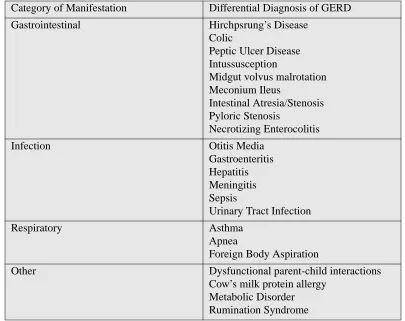
differential diagnosis of GERD involves a variety of dis-orders and is provided in Table 1.13 The definitive
diagno-sis of GERD in the pediatric population is determined by several means although no exact diagnostic protocols exist to accurately diagnose GERD in infants.13 Three tests
fre-quently used to diagnose GERD include 1) intra-esopha-geal pH monitoring, scintography, and intraluminal esophageal impedance; 2) inflammation testing; and 3) the use of symptom-assessment questionnaires. The least invasive of these diagnostic methods of course is the symptom-assessment questionnaire. The attending
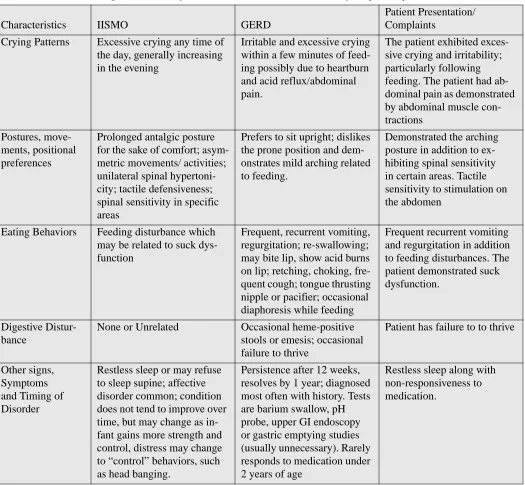
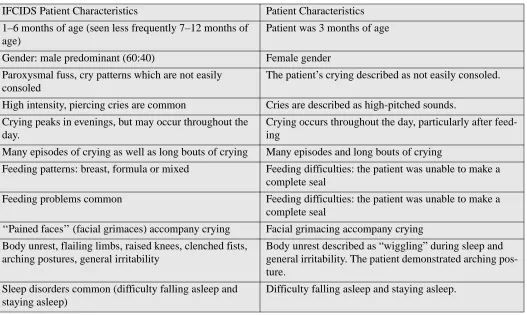
clini-cian in this case report was well aware of the medical di-agnosis of GERD and concurred. The didi-agnosis of GERD was confirmed by the chiropractor based on the patient’s presenting complaints of excessive crying and irritability, which often occurred following feeding. The patient also demonstrated the arching back characteristic of babies with acid reflux as well as vomiting, regurgitation and in-testinal gas. Blistering of the right lower lip may be asso-ciated with the patient’s suckling dysfunction but more than likely may be attributed to acid burns as a result of gastric acid regurgitation. Lastly, the patient did not re-spond to medication, which is characteristic for patients with GERD that are less than 2 years of age. Upon further retrospection, we would also include the diagnosis of irri-table infant syndrome of musculoskeletal origin (IISMO) and infant-cry-irritability with sleep disorder syndrome (IFCIDS).14,15 The diagnostic criteria for IISMO/GERDS
and IFCIDS are provided in Tables 2 and 3. The patient satisfies the diagnostic criteria provided for both IISMO and IFCIDS. The patient’s musculoskeletal complaints of right plagiocephaly and torticollis concomitant with cra-nial distortions and malposition of the mandible may like-ly be more associated with intra-uterine constraint since a right occiput plagiocephaly is not consistent with a torti-collis posture of right rotation and left lateral flexion of the head and neck.16,17 Intra-uterine positional plagiocephaly
occurs more often on the right occiput. The right-sided preference is based on the finding that 85% of vertex pres-entations lie in the left occipital anterior position. As the infant’s head descends into the pelvis, growth of the right occiput and left frontal areas may be limited, leading to potential development of plagiocephaly.18 The
malposi-tion of the mandible is more than likely associated with the plagiocephaly and its concomitant cranial distortions causing an anterior displacement of the ipsilateral TMJ.19
Implications for Chiropractic Care
too general to perform a review of the literature in the context of chiropractic care. We encourage the reader to access the papers by Miller and colleagues14,15 on these
topics as well as the article by Alcantara and colleagues on their review of the sleep disorders in pediatric patients under chiropractic care.20 A literature search of Pubmed
[1966–2007] using the subject heading “gastroesopha-geal reflux disease AND chiropractic” or “GERD AND chiropractic or “acid reflux disease AND chiropractic” with search limits: English, Complementary Medicine, and All Child: 0–18 years, Similarly, MANTIS [1965– 2007] was consulted using similar search terms as above specified to the Chiropractic Discipline, the English lan-guage in Refereed Journals and High Clinical Relevancy. Two articles were found. Jackson21 addressed the clinical
assessment strategies (and augmented by clinical experi-ence) regarding the condition of GERD but provided no
chiropractic treatment strategies or approaches to this condition. Recently, Jonasson and Knapp22 presented the
care of an 8-yr-old boy with gastroesophageal reflux dis-ease. The patient initially presented with complaints of headache and neck pain. Treatment to the patient was de-scribed as chiropractic SMT to the upper cervical spine in combination with cranial therapy and dietary advice (i.e., remove all wheat and dietary products from diet). This approach to care was unsuccessful with the patient re-ferred to a colleague where an eventual diagnosis of GERD was made and referred for medical care.
With respect to the chiropractic technique described in this case report, the use of HVLA-type thrusts are well documented in several clinical trials.23–27 Furthermore,
pediatric chiropractic SMT has recently been found to be safe with only a handful of reported adverse events (i.e., 10 cases) in 104 years of scientific publications based on Table 1 Differential Diagnosis for GERD*
*Modified from Orensterin and colleagues (13).
Category of Manifestation Differential Diagnosis of GERD
Gastrointestinal Hirchpsrung’s Disease
Colic
Peptic Ulcer Disease Intussusception
Midgut volvus malrotation Meconium Ileus
Intestinal Atresia/Stenosis Pyloric Stenosis
Necrotizing Enterocolitis
Infection Otitis Media
Gastroenteritis Hepatitis Meningitis Sepsis
Urinary Tract Infection
Respiratory Asthma
Apnea
Foreign Body Aspiration
Other Dysfunctional parent-child interactions
a systematic review of the literature.28 However, the same
cannot be said of cranial technique and remains to be fully investigated.29 The craniosacral interventions and
health outcomes, the validity of craniosacral assessment, and the pathophysiology of the craniosacral system have
been found to have insufficient evidence. Research meth-ods to conclusively evaluate its effectiveness have not been applied to date.
With respect to generalizations and making cause and effect inferences from the case presented, we caution the Table 2 Diagnostic criteria for IIMSO and GERD in the context of the patient presented (15)
Characteristics IISMO GERD
Patient Presentation/ Complaints
Crying Patterns Excessive crying any time of the day, generally increasing in the evening
Irritable and excessive crying within a few minutes of feed-ing possibly due to heartburn and acid reflux/abdominal pain.
The patient exhibited exces-sive crying and irritability; particularly following feeding. The patient had ab-dominal pain as demonstrated by abdominal muscle con-tractions
Postures, move-ments, positional preferences
Prolonged antalgic posture for the sake of comfort; asym-metric movements/ activities; unilateral spinal hypertoni-city; tactile defensiveness; spinal sensitivity in specific areas
Prefers to sit upright; dislikes the prone position and dem-onstrates mild arching related to feeding.
Demonstrated the arching posture in addition to ex-hibiting spinal sensitivity in certain areas. Tactile sensitivity to stimulation on the abdomen
Eating Behaviors Feeding disturbance which may be related to suck dys-function
Frequent, recurrent vomiting, regurgitation; re-swallowing; may bite lip, show acid burns on lip; retching, choking, fre-quent cough; tongue thrusting nipple or pacifier; occasional diaphoresis while feeding
Frequent recurrent vomiting and regurgitation in addition to feeding disturbances. The patient demonstrated suck dysfunction.
Digestive Distur-bance
None or Unrelated Occasional heme-positive stools or emesis; occasional failure to thrive
Patient has failure to to thrive
Other signs, Symptoms and Timing of Disorder
Restless sleep or may refuse to sleep supine; affective disorder common; condition does not tend to improve over time, but may change as in-fant gains more strength and control, distress may change to “control” behaviors, such as head banging.
Persistence after 12 weeks, resolves by 1 year; diagnosed most often with history. Tests are barium swallow, pH probe, upper GI endoscopy or gastric emptying studies (usually unnecessary). Rarely responds to medication under 2 years of age
reader for the following reasons. As with all case reports, improvement in a patient’s symptoms may be attributed to (a) the natural history, (b) regression to the mean and (c) the result of placebo. Furthermore, both the clinician and the patient (or in this case the patient’s mother) may make incorrect inferences from treatment due to (d) the demand characteristics of the therapeutic encounter and (e) subjective validation. Consider for example the “dog-ma” that the majority of children outgrow their GER or GERD symptoms is challenged.30 Studies now indicate
that childhood GERD may be a risk factor for long-term severe disease sequalae in adulthood.31 There are
find-ings that in infants with acid reflux, after 1 year, despite resolution of symptoms, the histology remained abnor-mal.32 Based on 22 studies, Pace et.al.33 concluded that
placebo is a relatively inactive drug in the short-term treatment of erosive ulcerative reflux and does not appear to change the natural history of the disease.
Conclusion
We reported the successful chiropractic care of a 3-month old female with subjective complaints consistent with GERD in addition to fuss-cry-irritability with sleep disor-der syndrome and irritable infant syndrome of muscu-loskeletal origin. This study suggests to the possibility that similar patients may benefit from chiropractic care.
References
1 Jean D, Cyr C. Use of complementary and alternative medicine in a general pediatric clinic. Pediatrics 2007; 120(1):e138–141.
2 Nyiendo J, Olsen E. Visit characteristics of 217 children attending a chiropractic college teaching clinic. J Manipulative Physiol Ther 1988; 11:78–84. 3 Verhoef M, Papadopoulos C. Survey of Canadian
chiropractors’ involvement in the treatment of patients under the age of 18. J Can Chiropr Assoc 1999; 43:50–57.
Table 3 Diagnostic Criteria for IFCIDS in the context of the patient presented (15)
IFCIDS Patient Characteristics Patient Characteristics
1–6 months of age (seen less frequently 7–12 months of age)
Patient was 3 months of age
Gender: male predominant (60:40) Female gender
Paroxysmal fuss, cry patterns which are not easily consoled
The patient’s crying described as not easily consoled.
High intensity, piercing cries are common Cries are described as high-pitched sounds.
Crying peaks in evenings, but may occur throughout the day.
Crying occurs throughout the day, particularly after feed-ing
Many episodes of crying as well as long bouts of crying Many episodes and long bouts of crying
Feeding patterns: breast, formula or mixed Feeding difficulties: the patient was unable to make a complete seal
Feeding problems common Feeding difficulties: the patient was unable to make a
complete seal
‘‘Pained faces’’ (facial grimaces) accompany crying Facial grimacing accompany crying
Body unrest, flailing limbs, raised knees, clenched fists, arching postures, general irritability
Body unrest described as “wiggling” during sleep and general irritability. The patient demonstrated arching pos-ture.
Sleep disorders common (difficulty falling asleep and staying asleep)
4 Ressel O, Rudy R. Vertebral subluxation correlated with somatic, visceral and immune complaints: An analysis of 650 children under chiropractic care. J Vertebral
Subluxation Res 2004; 2004(1):1–23.
5 Rubin D. Triage and case presentations in a chiropractic pediatric clinic J Chiropractic Med 2007; 6:94–98. 6 Anrig C, Plaugher G, eds. Pediatric Chiropractic.
Baltimore; Williams & Wilkins: 1997.
7 Alcantara J, Plaugher G, Lopes MA, Cichy DL. Spinal Subluxation in Anrig C, Plaugher G, eds. Pediatric Chiropractic. Baltimore; Williams & Wilkins: 1997. 8 Upledger JE, Vredevoogd JD: Craniosacral Therapy.
Eighth Printing. Eastland Press, 1989.
9 Bergmann TF, Peterson DH, Lawrence DJ. Chiropractic Technique: Principles and Procedures. New York: Churchill Livingstone, 1993.
10 Arguin AL, Swartz MK. Gastroesopahageal reflux in infants: a primary care perspective. Pediatric Nursing 2004; 30:45–71.
11 Contencin P, Maurage C, Ployet JJ, et al. Gastroesophageal reflux and ENT disorders in childhood. Int J Ped
Otorhinolaryngology 1995; 32:S135–144.
12 Bortz DL. Atypical presentations and complications of GERD. Am J Managed Care 1997; 3:S12-S15.
13 Orenstein S. Tests to assess symptoms of gastroesophageal reflux in infants and children. Journal of Pediatric
Gastroenterology and Nutrition 2003; 37:S29-S32.
14 Miller J, Caprini-Croci S. Cry baby-why baby: Infant colic; is it time to widen our view? J Clin Chiropractic Pediatr 2005; 6(3):419–423.
15 Miller J. Cry babies: a framework for chiropractic care. Clinical Chiropractic 2007; 10:139–146.
16 Argenta LC, David LR, Wilson JA, Bell WO. An increase in infant cranial deformity with supine sleeping position. J Craniofac Surg. 1996; 7:5–11.
17 Kane AA, Mitchell LE, Craven KP, Marsh JL.
Observations on a recent increase in plagiocephaly without synostosis. Pediatrics. 1996; 97:877–885.
18 Bruneteau RJ, Mulliken JB. Frontal plagiocephaly: synostotic, compensational, or deformational. Plast Reconstr Surg 1992; 89:21–33.
19 St John D, Mulliken JB, Kaban LB, Padwa BL. Anthropometric analysis of mandibular asymmetry in infants with deformational posterior plagiocephaly. J Oral Maxillofac Surg 2002; 60:873–877.
20 Alcantara J, Desilets J. The case study of a 3-yr-old boy with sleep-breathing disorder. Chiropractic J Austr [Accepted for Publication].
21 Jackson S. Gastroesophageal reflux disease Topics in Clinical Chiropractic 1995; 2(1): 24–29.
22 Jonasson AK, Knaap SF. Gastroesophageal reflux disease in an 8-year-old boy: a case study. J Manipulative Physiol Ther 2006; 29(3):245–247.
23 Balon J, Mior SA. Chiropractic care in asthma and allergy. Ann Allergy Asthma Immunol 2004; 93 (Suppl 1): S55–60.
24 Hondras MA, Linde K, Jones AP. Manual therapy for asthma. Cochrane Database Syst Rev. 2002;
(4):CD001002.
25 Wiberg JM, Nordsteen J, Nilsson N. The short-term effect of spinal manipulation in the treatment of infantile colic: a randomized controlled clinical trial with a blinded observer. J Manipulative Physiol Ther 1999; 22:517–522. 26 Grunnet-Nilsson N, Wiberg J. Infantile colic and
chiropractic spinal manipulation. Arch Dis Child 2001; 85:268.
27 Mercer C, Nook B. The efficacy of chiropractic spinal adjustments as a treatment protocol in the management of infantile colic. In: Haldeman S, Murphy B, eds. 5th 28 Vohra S, Johnston BC, Cramer K, Humphreys K. Adverse
events associated with pediatric spinal manipulation: a systematic review. Pediatrics 2007; 119:e275–283. Epub 2006 Dec 18.
29 Green C, Martin CW, Bassett K, Kazanjian A. A systematic review of craniosacral therapy: biological plausibility, assessment reliability and clinical effectiveness. Complement Ther Med 1999; 74(4):
210–217.
30 Gold BD. Is gastroesophageal reflux disease really a life-long disease: do babies who regurgitate grow up to be adults with GERD complications? Am J Gastroenterol 2006; 101(3):641–644.
31 El-Serag HB, Richardson P, Pilgrim P, Gilger MA. Determinants of gastroesophageal reflux disease in adults with a history of childhood gastroesophageal reflux disease Clin Gastroenterol Hepatol 2007; 5(6):696–701.
32 Orenstein SR, Shalaby TM, Kelsey SF, Frankel E. Natural history of infant reflux esophagitis: symptoms and morphometric histology during one year without pharmacotherapy.