A survey of Canadian Alpine ski racing coaches
regarding spinal protective devices
for their athletes
Brynne Stainsby,
BA, DC, FCCS(C)Jeremy Law,
BA, DCAmy Mackinnon,
BSc (Kin), DCCanadian Memorial Chiropractic College, 6100 Leslie Street, Toronto, Canada
Division of Undergraduate Studies, Canadian Memorial Chiropractic College, 6100 Leslie Street, Toronto, Ontario, Canada Corresponding author: Dr. Brynne Stainsby
E: [email protected] T: (416) 482-2340 F: (416) 482-2560 6100 Leslie Street, Toronto, Ontario, Canada, M2H 3J1 ©JCCA 2014
Introduction: Spinal protective devices are a recent
addition to the protective equipment worn by competitive and recreational alpine skiers and snowboarders. Their rate of use is not documented at the time of publication. The objective of this study was to examine the current attitudes and recommendations of Canadian alpine ski racing coaches towards spinal protective devices. Methods: A convenience sample of alpine ski racing coaches across Canada were contacted in each provincial sport governing body in the ski racing community. A ten question online survey was attached to the initial email. Descriptive statistical analysis was utilized.
Results: A total of 29 Canadian alpine ski racing coaches completed the study survey. All participants were familiar with spinal protective devices and 51.7% of respondents reported that they do not actively enforce spinal protective device use with their ski racing athletes. 80% of respondents reported that their Canadian ski racing club did not have guidelines or
Introduction : Les dispositifs de protection de la colonne
vertébrale sont un ajout récent à l’équipement de protection porté par les skieurs alpins et planchistes amateurs tout comme professionnels. Leur fréquence d’utilisation n’est pas connue à la date de cette publication. Cette étude vise à examiner les attitudes et les recommandations actuelles des entraîneurs canadiens de ski alpin de compétition concernant le port de dispositifs de protection de la colonne vertébrale. Méthodologie : Un échantillon de commodité d’entraîneurs de ski alpin de compétition de partout au Canada a été contacté dans chaque organisme provincial directeur du sport de ski de compétition. Le courriel initial a été suivi par un questionnaire en ligne comportant dix questions. On a eu recours à une analyse statistique descriptive.
Introduction:
Spinal protective devices are available for international use, although research on their rate of use, effectiveness, and limitations are lacking.1 These devices have been
de-scribed as equipment that protects an athlete’s back from external forces. Ski coaches help athletes of all ages with equipment and training decisions on a regular basis, and are required to stay familiar with the rules in place for safe activity and fair competition in order to maintain cer-tification. This study aimed to explore the attitudes and actions of Canadian alpine ski racing coaches regarding spinal protective devices. It is our hypothesis that many, if not all, surveyed Canadian alpine ski racing coaches would be familiar with spinal protective devices but that fewer coaches surveyed will respond as enforcing their regular use.
Injuries
Among the competitive alpine ski racing population, Florenes reported that 81% of injuries occurring during the 2007-2008 World Cup competitive season were mod-erate or severe in nature, resulting in time loss of eight to 28 days or greater for those athletes.2 In these athletes,
anterior cruciate ligament injuries were most frequently reported, followed by concussions.2
Although the knee is the most commonly reported lo-cation of acute injury among World Cup alpine ski racers (representing 35% of injuries), lower leg and low back in-juries are the second most common inin-juries reported (22% of reported injuries each). Only 4.5% of the reported low back injuries were regarded as severe, however, resulting in 28 days or more of missed skiing activity.2
Of these reported injuries, 45% occurred during
offi-policies regarding spinal protective device use. 86.2% of respondents were unaware if their provincial sport organization had a policy regarding their use. Discussion: The majority of coaches reporting training athletes aged 10-15, which may help to explain why only half of those surveyed enforce the use of spinal protective devices. This group of athletes may not participate in speed events as frequently as older athletes, where the use of spinal protective devices is more common.
Conclusion: The majority of Canadian Alpine ski coaches report a belief that spinal protective device use is important, however, far fewer enforce their use, or work in an environment with a policy requiring it. Further research is required to determine the differences in beliefs and practice.
(JCCA 2014; 58(4):428-435)
k e y w o r d s: protective, spinal, Alpine, skier, coach
de ski de compétition n’avait pas de directives ou de politiques relatives au port de dispositifs de protection de la colonne vertébrale. 86,2 % des répondants ne savaient pas si leur organisme provincial de sport avait une politique concernant leur utilisation.
Discussion : La majorité des entraîneurs ont déclaré entraîner des athlètes âgés de 10 à 15 ans, ce qui peut aider à expliquer le faible pourcentage de ceux qui imposaient le port de dispositifs de protection de la colonne vertébrale. Ce groupe d’athlètes ne participe pas nécessairement à des épreuves de vitesse aussi souvent que les athlètes plus âgés, chez qui le port de dispositifs de protection de la colonne vertébrale est plus fréquent.
Conclusion : La majorité des entraîneurs canadiens de ski alpin se disent convaincus que le port de dispositifs de protection de la colonne vertébrale est important, mais beaucoup moins font respecter leur port, ou font partie d’un milieu qui a une politique obligeant le port. D’autres recherches sont nécessaires pour déterminer les différences dans les convictions et les pratiques.
(JCCA 2014; 58(4):428-435)
m o t s c l é s : protection, colonne vertébrale, alpin,
cial World Cup competitions, with the remaining injuries occurring during various forms of on-snow training; indi-cating that many accidents and injuries occur outside of competition events.2 It has recently been reported that
in-jury rates of elite alpine skiers are in fact higher than previ-ously thought, suggesting an increased need to investigate this population of athletes.2 Specifically, Franz reported
that most severe spine injuries (fractures, dislocations, subluxations) occurred most often in skiers at the lumbar spine level and encouraged the promotion of back protec-tion along with various other preventative measures.3
It has been found that injury rates increase with rates of speed among recreational and competitive populations.4
As ski racers actively seek out increased rates of speed in all disciplines of competition, it is possible that this population is at greater risk of injury. It may be possible that the number of back injuries in competitive alpine ski racing has changed with the changes in snow prep-aration and increased speeds in all disciplines in recent years.5 Recent high profile deaths of Canadian ski
ath-letes in freestyle and ski cross disciplines highlight the need for more research and advocacy for change in safety measures in snow sports. Alpine Canada is attempting to develop policies to improve safety measures for all ski athletes as evidenced by the Alpine Ski Safety Summits held in 2011 and 2012.6
Protective Equipment
Helmet use in all disciplines is currently mandatory in all competitive disciplines by the Federation International du Ski (FIS).7 Spinal protective devices are allowed for use
under alpine ski racing downhill suits in competition for protective purposes but their use is not currently manda-tory.
In its Specification for Competition Equipment (2012-2013 Edition), FIS defines back protectors as “an addi-tional item of equipment, which protects the athlete’s back against weather and external forces.”1 This section
states “The use of back protections is recommended”, but does not mandate the use of spinal protective devices, as it has for helmet use across all ages and competitions in all disciplines.1 The rate of spinal protective device usage
is currently unknown in competitive alpine skiing, but a survey conducted in Switzerland revealed that 40% of recreational skiers and snowboarders wore a protector de-signed for snowsports.8
According to Schmitt, hard shell spinal protective de-vices are likely more effective protecting against pene-tration injury as shown with the EN1077 standard test for snow sport safety.8 Current spinal protective devices
available for purchase vary in performance with mechan-ical testing that is designed to assess motorcycle protect-ors.8 Impacts or accidents that result in spinal column or
cord damage, however, are likely more severe than im-pacts involved in this common mechanical testing (drop test, EN1621).8 It has been found that the beliefs of the
ef-fectiveness of spinal protectors to prevent spinal vertebral fractures does not match up with the theorized actions of spinal protective devices (hard or soft design) as they only dampen forces to the back and cannot decrease axial loads, such as those experienced in severe flexion.8
Alpine Ski Racing and Back Protection
Alpine Canada, the governing body of alpine ski compe-tition in Canada, does not currently have a rule mandat-ing back protection, and rather follows FIS guidelines on allowing spinal protective device use in competition as stated in its rules of competition.1,9,10 Individual provincial
sport organizations and independent clubs are permitted to introduce their own rules and regulations as decided by their members, permitting that these rules and regulations do not interfere or contradict the rules put forth by Alpine Canada and FIS.1,9,10
Canadian Coaches and Back Protection
Alpine ski coaches work closely with athletes and fam-ilies to determine equipment choices. Further, they are often called upon to enforce mandatory and suggested equipment rules and regulations. Understanding the atti-tudes and beliefs of alpine ski race coaches towards spinal protective devices will provide an understanding of what educated and trained leaders of this sport think of these devices, and how to better educate and promote their use, if indicated, in the future.
Methods and procedures:
Design
Sample Specification
A convenience sample of the target population composed of males and females, was used. The head coaches certified by Alpine Canada were contacted. In order to participate, subjects must self-report Canadian citizenship, be certified as an alpine ski racing coach, and actively coach at the time of survey completion. Subjects were excluded if they did not fit the sample specifications or did not provide consent.
Description of Experimental Maneuver
The survey and instructions for its completion were mailed electronically to the head coaching personnel cer-tified by Alpine Canada. The survey (Appendix A) was provided in the English language only. A total of two identical emails were sent to 135 contacts, each one week apart, with a link to the survey. The email provided a brief outline of the research project being conducted in hopes to gain a better understanding of their current attitudes towards spinal protection.
A qualitative analysis on the survey results was com-pleted.
Results
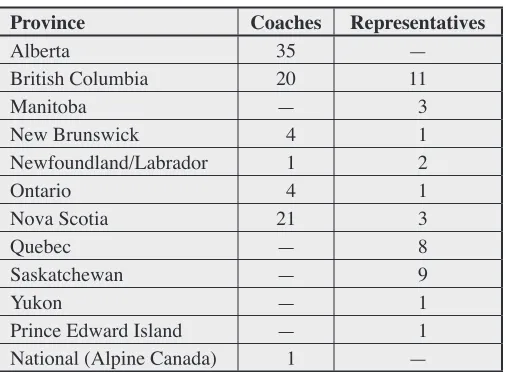
The breakdown for Canadian Alpine provincial contacts is provided in the table below. Contact information was not available for coaches or representatives in the North West Territories and Nunavut.
All 29 respondents were certified coaches through
Canadian Ski Coaches Federation with experience ran-ging from 3-46 years (mean 24.5) and completed all ten questions. 79% of respondents were trained Development Level Canadian Ski Coaches Federation coaches or high-er, with 41% of respondents being Performance Level coaches. Two respondents were CSCF High Performance Level coaches.
With respect to familiarity with spinal protective de-vices, 62.1% reported being “very familiar”, and 37.9% reported being “familiar”. There were no respondents that reported being “not at all familiar” with spinal protective devices (Table 2). The majority of coaches (65.5%) strongly agreed or agreed with the statement “[i]t is important for your athletes to wear a spine pro-tector”, while 13.7% disagreed or strongly disagreed (20.7% neutral) (Table 3). With respect to enforcement of their use, the majority (51.7%) of coaches were neu-tral (Table 4).
The majority of coaches (79.3%) reported there was not a policy regarding spinal protective device use in their club (Table 5), nor was the majority (86.2%) aware of a provincial policy regarding its use (Table 6).
Most coaches reported coaching athletes less than 15 years of age (Table 7). With respect to the frequency of spinal protective device use by athletes in competition, responses were distributed throughout the six potential re-sponses (never, rarely, sometimes, often, most of the time, and all of the time) (Table 8).
Please see appendix B for tables.
Discussion
Safety, risk management, and protection in competitive alpine ski racing may be important issues for alpine ski coaches. Further, risks of injury to the athlete and the responsibility coaches to reduce foreseeable risks for in-jury are important discussion topics for the alpine ski ra-cing community. Coaches may play a major role in mod-erating safety equipment purchases. Encouragement or limitation of safety equipment use by coaches, may affect athletes’ decisions.
The majority of coaches reported that they worked
with athletes ranging between ten to 15 years of age. It is possible that coaches who do not enforce the use of back protection with their athletes are coaching these younger athletes who do not spend much time in training for speed Table 1.
Contact breakdown of Canadian Alpine provincial coaches and representatives. Province Coaches Representatives
Alberta 35 —
British Columbia 20 11
Manitoba — 3
New Brunswick 4 1
Newfoundland/Labrador 1 2
Ontario 4 1
Nova Scotia 21 3
Quebec — 8
Saskatchewan — 9
Yukon — 1
Prince Edward Island — 1
specific disciplines, in which protection may not be indi-cated.
Coaches are largely responsible, or at least relied upon
for athlete safety considerations and equipment recom-mendation. All of the respondents reported being very or somewhat familiar with spinal protective devices, yet most reported that they are not aware of policies regard-ing their use at the club or provincial level. Given the lack of formal policies, it may be hypothesized information regarding spinal protective devices is distributed via the companies that produce these devices. Further investiga-tion is required to determine how these coaches are re-ceiving education regarding back protectors, whether it is from product brand marketing, equipment providers, or another source. Without policies, protocols or enforce-able rules relating to spinal protective devices, it is pos-sible that coaches may believe them to be an unnecessary cost. Interestingly, nearly one third of coaches surveyed report that they disagree or strongly disagree that the use of spinal protective devices are important for their ath-letes, and more than half do not enforce their use. Future studies should correlate these responses with the ages, re-gion, and the discipline(s) participated in by their athletes. Also, in future studies, it would be interesting to better understand the demographic characteristics of the coach-es to determine if trends related to recommendation and enforcement of use may be related to the age, gender, or geographic region of the coach. It would also be useful to determine why these coaches believe spinal protectors are beneficial or not for their athletes, and future studies could inquire specifically to this question.
Limitations
With the lack of research specifically targeting the atti-tudes of alpine ski coaches towards spinal protection, this research is preliminary and the sample size is small (n=29). A total of 135 individuals were contacted via email. It is uncertain if recipients sent the survey to others, therefore, a response rate cannot be calculated. Furthermore, some Canadian provincial websites provided direct coaching staff contact emails, thus proportionately more coaches were contacted directly in Alberta and British Columbia. This may have produced demographic bias depending on whether or not these provinces have been previously exposed to spinal protective devices for alpine skiing or
whether they are even accessible in sporting good stores in that particular province.
It must also be recognized that this survey was only able to gather information regarding the beliefs of coach-es, and may not be reflective of athletes’ practices. It is possible that coaches are unaware of the use of spinal pro-tective use in their athletes. Future studies should address athlete behaviours rather than simply relying on coaches’ reports.
Unfortunately, the survey question that asks re-spondents of their familiarity with spinal protective de-vices does not identify what aspect of spinal protective devices they are familiar with. Given the FIS description of spinal protective devices is currently vague1, the
sur-vey did not provide an explicit definition of these devices in order to gather as much information as possible from respondents in this pilot study. It may be possible coaches are familiar with the fact spinal protective devices exist and are available to buy, they are allowed by FIS rules, or that they are commonly recommended and used in speed events for older athletes. Spinal protective devices are prevalent on the higher-level ski circuits worldwide (without being mandatory or verified for proper fit or specific type). It must be considered, however, that this decision may have led to difficulties with interpretation on behalf of the coaches and future studies should address various devices specifically.
Conclusion
This study sought to examine the rates that Canadian alpine ski coaches recommend and enforce the use of spinal protective devices by their current athletes. This rate was surprisingly low, considering the response of coaches believing that spinal protection was important for their athletes. Very few coaches reported knowing of any current policy in place regarding spine protection use by their respective ski club employer or provincial sport organization. Future studies could explore what clubs do have policies regarding back protection, how they were implemented, and how they are enforced regularly using their coaching staff. Further investigation is required to determine why coaches are implementing spinal protec-tion use for their athletes or not. There are many factors contributing to these attitudes towards spinal protection in Canadian alpine skiing and future research will help to better understand these attitudes.
References
1. FIS SKI [Internet] Switzerland. International Ski Federation; c2012. Specification for competition equipment and commercial markings; 2012 July [cited December 2012]; Section 9 p. 10. Available from: http://www.fis-ski.com/data/document/competition-equipment_1213_aug12.pdf
2. Groff P, Farmer P. Skiing and Snowboarding Injuries. Compass Ontario Injury and Prevention [Internet]. January 2010 [cited November 2012]; 7(1): [about 2pp.]. Available from: http://www.oninjuryresources. ca/downloads/Compass/2010/2010-01-0ICompass-Ski%3ASnowboardFinal.pdf
3. Flørenes T, Bere TL, Heir S, Bahr R. Injuries among male
and female World Cup alpine skiers. Br J Sports Med. 2009; 43(13): 973-978.
4. Franz T et al. Severe spinal injuries in alpine skiing and snowboarding: a 6-year review of a tertiary trauma centre for the Bernese Alps ski resorts, Switzerland. BJSM. 2008; 42(1): 55-58.
5. Prall JA et al. Spine and spinal cord injuries in downhill skiers. J Trauma. 1995;39(6): 1115-1118.
6. ALPINE CANADA ALPIN [Internet] Calgary, Alberta (Canada). Alpine Canada Alpin News; August 27, 2012 (cited April 2013). Available from: http://www. alpinecanada.org/news/2012/alpine-canada-host-second-annual-ski-racing-safety-summit-special-focus-ski-cross 7. Spörri J, KröllJ, AmesbergerG, BlakeO, Müller E.
Perceived key injury risk factors in World Cup alpine ski racing—an explorative qualitative study with expert stakeholders. Br J Sports Med [Internet] 2012 Aug [cited November 2012] Available from: http://bjsm.bmj.com/ content/early/2012/08/08/bjsports-2012-091048
8. Schmitt KU, Liechti B, Michel FI, Stämpfli R, Brühwiler PA. Are current back protectors suitable to prevent spinal injury in recreational snowboarders? Br J Sports Med. 2010;44(11):822–6.
9. FIS SKI [Internet] Switzerland. International Ski Federation; c2012. The International Ski Racing Rules (ICR); 2012 July [cited December 2012]; Section 707 p.85. Available from: http://www.fis-ski.com/data/ document/al_fis_icrfinal.01.8.12-1_final-version_ september-2012_edited.pdf
Appendix A. SURVEY
1. The purpose of this study is to assess the current attitudes of Canadian Alpine ski racing coaches towards spinal protective devices for athletes. Two students in their third year at Canadian Memorial Chiropractic College (CMCC) will be conducting this research project. Your participation in this research study is voluntary and is not mandatory. At any point in time during the survey, you may withdraw
without penalty. This online survey will take approximately 5 minutes. We will not be collecting your name or any other identifying information at any point during the survey. Thus, your responses are completely confidential.
This research project has received research ethics approval from the CMCC research ethics board. Please contact Dr. Brynne Stainsby with any questions or concerns you may have at [email protected].
Clicking on the “agree” button below indicates that: – you have read the above information – you voluntarily agree to participate • Agree
• Disagree
2. What age group do you coach? • < 10 years of age • 10-15 years of age • 15-20 years of age • 20-25 years of age • 25-35 years of age • 35+ years of age
3. What are your coaching certifications? 4. How many years have you been coaching?
5. Are you familiar with spinal protection devices for Alpine Skiing? • Very
• Somewhat • Not at all
6. It is important for your athletes to wear a spine protector: • Strongly Agree
• Agree • Neutral • Disagree • Strongly Disagree
7. Do you enforce the use of back protectors for your athletes? • Yes
• No • Neutral
8. Does your ski club have a back protection policy currently in place? • Yes
• No
• I do not know
9. When competing in alpine ski competitions, your athletes wear back protectors: • All of the time (100%)
• Most of the time (75-100%) • Often (50-75%)
• Sometimes (25-50%) • Rarely (0-25%) • Never (0%)
10. Are you aware of a provincial back protection policy for alpine skiers in your province? • Yes
Appendix B
Table 3.
Coaches’ response to the statement: “It is important for your athletes to wear a spine protector”
Answer Percent (%)Response Response Count
Strongly Agree 37.9 11
Agree 27.6 8
Neutral 20.7 6
Disagree 10.3 3
Strongly Disagree 3.4 1
Table 4.
Enforcement of spinal protector use
Answer Percent (%)Response Response Count
Yes 34.5 10
No 51.7 15
Neutral 13.8 4
Table 5.
Frequency of club level spinal protection policies
Answer Percent (%)Response Response Count
Yes 10.3 3
No 79.3 23
I do not know 10.3 3
Table 6.
Awareness of provincial policies regarding spinal protective devices for Alpine Skiers
Answer Percent (%)Response Response Count
Yes 13.8 4
No 86.2 25
Table 2.
Familiarity with spinal protective devices for Alpine Skiing
Answer Percent (%)Response Response Count
Very 62.1 18
Somewhat 37.9 11
Not at all 0.0 0
Table 7.
Athlete age demographic
Answer Percent (%)Response Response Count
< 10 years of age 10.3 3
10-15 years of age 62.1 18
15-20 years of age 20.7 6
20-25 years of age 0.0 0
25-35 years of age 0.0 0
> 35 years of age 6.9 2
Table 8.
Percentage of athletes wearing spinal protectors in competition
Answer Percent (%)Response Response Count
All of the time (100%) 17.2 5
Most of the time (75-100%) 24.1 7
Often (50-75%) 10.3 3
Sometimes (25-50%) 17.2 5
Rarely (0-25%) 24.1 7