RUNNIG HEAD: THE STABILITY OF DAILY SELF_ESTEEM
Title
Evaluating the Temporal Structure and Correlates of daily self-esteem using a Trait Sate Error Framework (TSE)
Authors
Guido Alessandri, Antonio Zuffianò & Michele Vecchione Sapienza, University of Rome
Brent M. Donnellan University of Texas A&M
John Tisak
Bowling Green State University Word count: 8327
-Guido Alessandri, PhD Department of psychology Sapienza, University of Rome
Corresponding author. +39-06-44427535; fax number: +39-06-4469115
Abstract
This study evaluates the temporal structure of daily self-esteem and the relative contribution of a range of theoretically-motivated predictors of daily self-esteem. To assess self-esteem stability, a daily version of the Rosenberg Self-Esteem scale (RSE, Rosenberg, 1965) was administered to 278 undergraduates for five consecutive days. These short-term longitudinal data were analyzed using the Trait State Error (TSE) modeling framework. The TSE decomposes multi-wave data into three components: (1) a stable trait component, (2) a state component, and (3) an error component. Significant predictors of the trait component of self-esteem observed across five days were: (1) emotional stability, and (2) the congruence between implicit and explicit self-esteem. Significant predictors of the state components of self-esteem were daily positive and negative events. We discuss the implications of these results for future research concerning self-esteem stability.
Self-esteem reflects an overall subjective evaluation of personal worth and self-acceptance (Marsh & O’Mara, 2008; Rosenberg, 1965) and is one of oldest and most popular individual differences constructs in the social sciences (see Donnellan, Trzesniewski, & Robins, 2011 for a review). A considerable amount of research has evaluated the correlates of self-esteem (Baumeister, Campbell, Krueger, & Vohs, 2003; Swann, Chang-Schnieder, & McClarty, 2007; Trzesniewski et al., 2006). Much of this work focuses on associations between the overall level of self-esteem at one point in time and criterion-variables and largely ignores within-person variability in self-esteem. However, an individuals’ level of self-esteem at any single time point reflects both trait and state influences and the stability of self-esteem across short-term periods is an important psychological consideration (Kernis, 2005; Kernis, Cornell, Sun, Berry & Harlow, 1993). Indeed, stable and high levels of self-esteem have been associated with resilience and optimal functioning whereas unstable self-esteem has been associated with maladaptive outcome variables in a number of studies (Kernis, 2003). As currently understood, state self-esteem fluctuates around a relatively fixed level because of both an individual’s appraisal of situational factors, such as positive and negative events in daily life (Greeneier, et al., 1999), and personality traits such as emotional stability (e.g., some people might be more emotionally reactive than others; see Watson, Suls, & Haig, 2002). In short, there is a need to develop a comprehensive understanding of the temporal structure of daily self-esteem and to indentify the correlates of stable high self-esteem. Accordingly, the goal of the present study was to investigate the situational and individual factors that predict the dynamics of daily self-esteem. Theoretical Perspectives
"barometric" self-esteem or the short-term fluctuations in self-image. In empirical studies, trait level and stability of self-esteem are often negatively correlated1 (e.g., r = -.31, Okada, 2010), and genetic and environmental factors contribute to both the level and stability of self-esteem (Kamakura, Ando, & Ono, 2007; Neiss, Sedikides & Stevenson, 2006). In particular, a twin study by Neiss et al. (2006) identified substantial genetic (45%) and non-shared environmental (52%) influences on self-esteem stability. Most importantly, using multivariate genetic analyses these authors found evidence that self-esteem level and stability are separable constructs from a biometric perspective (Neiss et al., 2006). Thus, both aspects of self-esteem – level and stability - are important to investigate.
The model of self-esteem instability developed by Kernis and his colleagues (see Kernis, 2005 for a review) has been particularly influential in this literature. This model makes an important distinction between stable (or secure) versus unstable (or fragile) self-esteem. Kernis and colleagues defined unstable self-esteem as an individual’s dispositional tendency reflecting “fragile, vulnerable feelings of immediate self-worth that are influenced by the vicissitudes of potentially self-relevant events that either are externally provided […] or self-generated […]” (Kernis, 2005, p. 1575; Kernis, Grannemann et al., 1989).
As it stands, measures of self-esteem instability are associated with important psychological outcomes such as anger and hostility (Kernis, Grannemann, et al., 1989), defensive pessimism (Yamawaki, Tschanz, & Feick 2004), depression and instability of negative affect (de Man, Gutierrez, & Sterk, 2001; Hayes, Harris, & Carver, 2004; Kernis et al., 1998; Kernis & Goldman, 2006; Kernis, Paradise, Whitaker, Wheatman, & Goldman, 2000; Roberts & Gotlib, 1997; Roberts & Kassel, 1997; Roberts & Monroe, 1992; Tolpin, Gunthert, Cohen, & O’Neill, 2004), reactivity to daily hassles (Greeneier et al., 1999; Waschull & Kernis, 1996), scarce self-concept clarity (Kernis, et al. 2000), feelings of satisfaction with basic needs (Heppner, et al., 2008), paranoia (Raes & van
Gucht, 2009; Thewissen, et al., 2007), borderline personality disorders (Zeigler-Hill & Abraham, 2006), and post-traumatic stress disorder (Kashdan, Uswatte, Steger, & Julian, 2006). These associations generally hold controlling for trait levels of self-esteem suggesting that there is something uniquely important about the stability of self-esteem across short-term intervals for a wide range of psychological phenomena
Findings supporting the psychological relevance of self-esteem stability naturally lead to questions about the factors that contribute to the stability of self-esteem across short-term intervals. We review empirical evidence supporting a role for daily events, the Big Five personality traits (i.e., Openness to experience, Conscientiousness, Extraversion, Agreeableness, and Neuroticism), the interaction between trait explicit self-esteem and implicit self-esteem, and gender as predictors of self-esteem stability. Our approach in the current study is to evaluate these predictors
simultaneously given that most previous studies have focused on only one or, at best, two of the above factors. Thus, we adopt a much more comprehensive approach than is typical in this literature to clarify the factors that may contribute to daily self-esteem.
Daily events
Personality traits
Trait self-esteem level is correlated with the positive pole of each of the Big Five trait domains (Robins, Hendin, & Trzesniewski, 2001; Robins, Tracy, Trzesniewski, Potter, & Gosling, 2002; Watson, et al. 2002), as individuals high in self-esteem tend to be more open to experience, more conscientious, more extraverted, more agreeable and less neurotic (Erol & Orth, 2011). This suggests that the temperamental elements of personality captured by the Big Five contribute to overall levels of self-esteem, especially the traits of emotional stability (low neuroticism) and extraversion (see Robins et al., 2001; Watson et al., 2002). However, few studies have evaluated the contributions of the Big Five to daily self-esteem. In one of the rare studies that have examined the correlations of the Big Five with a measure of self-esteem instability, Maier et al. (2011) found relatively modest but significant negative correlations with conscientiousness, extraversion, and agreeableness, and modest but significant positive correlations with neuroticism. However, these results need to be replicated. Moreover, controlling for basic personality traits in a comprehensive analysis helps to address concerns that other variables like life events are acting as proxies for the influence of relatively stable dispositional features on self-esteem.
Discrepancies between implicit and explicit self-esteem
Dijksterhuis, & van Knippenberg, 2001). This distinction raises the critical issue of what happens when individuals have discrepant levels of implicit and explicit self-esteem.
Zeigler-Hill (2006) described a fragile or insecure form of self-esteem that is characterized by high trait explicit self-esteem and low implicit self-esteem (but see also Epstein and Morling 1995). Assuming that individuals can simultaneously hold implicit and explicit attitudes toward the self that are inconsistent (e.g. Bosson et al., 2003; Jordan et al., 2003), it is possible that individuals with this form of fragile self-esteem may be more responsive to evaluative events and thus show more instability in daily self-esteem (Zeigler-Hill, 2006). In support of these propositions, empirical results suggest that individuals with congruent high self-esteem (i.e. high in both implicit and explicit measures) possess esteem that was more stable than individuals with low explicit self-esteem or discrepant levels of implicit and explicit self-self-esteem (Kernis, et al., 2005; Zeigler-Hill, 2006). Therefore, we hypothesized that the congruence between implicit and explicit trait self-esteem would predict daily self-self-esteem instability Based on previous results, we expected a significant effect for explicit trait self-esteem, no main effect for implicit self-esteem, but a significant interaction between trait explicit self-esteem and implicit self-esteem.
Gender
Gender differences in trait level of self-esteem have been examined in at least three meta-analyses, indicating a small d = .15 (d = .33 in adolescence) difference such that males tend to report higher levels than females (Kling, Hyde, Showers, & Buswell, 1999; Major, Barr, Zubek, & Babey, 1999; Twenge & Campbell, 2001). In contrast to these seemingly reliable gender
differences, previous research suggests that men and women do not differ in the degree to which their self-esteem tend to be stable over short time periods (e.g., Greeneier et al., 1999; Hayes, at al., 2004; Zeigler-Hill, Chadha, & Osterman, 2008). Drawing on these results, we expected to find males scoring slightly higher than female on trait self-esteem. However, we have no reason to expect any significant moderating role for gender with respect to self-esteem stability.
The goal of the present research was to evaluate the temporal structure and predictors of daily self-esteem. Reports of daily self-esteem were obtained from a sample of 278 college students across five weekdays. The daily diary method (Mehl, Conner & Csikszentmihalyi, 2012) has been used to capture people’s emotional experiences and cognitions within everyday life. At the end of each of day, participants were asked to reflect upon the current day, and to fill out a brief series of measures including a daily self-esteem assessment. We used a latent variable approach to model the structure of daily self-esteem to quantify the stability of self-esteem. We then examined predictors of the important parameters used to model daily self-esteem including gender, daily events, the Big Five domains, and the discrepancy between implicit and explicit self-esteem. These predictors were assessed two weeks prior to the daily diary aspect of the study. We examined predictors
individually and in a final comprehensive model in which the effects of all predictors were considered at the same time, in order to ascertain their unique contributions.
The present study extends previous research in at least two significant ways. First, we use latent variable modeling to obtain a more precise estimate of the stable and unstable components of daily self-esteem. In previous studies, the within-subject standard deviation across the repeated assessments served as index of self-esteem stability, with lower standard deviations indicating more stable self-esteem. However, this procedure has been criticized as prone to measurement bias (Crocker, Sommers & Luhtanen, 2002). To overcome this limitation, we used an integrative model including latent factors capturing: (1) the stable component of daily self-esteem, (2) the fluctuating components of daily self-esteem (or state), and (3) the dependency between closely spaced states, and (4) measurement error. Second, we examined a range of possible predictors of daily self-esteem to provide an integrative perspective on correlates of daily feelings of self-esteem and self-esteem instability.
Participants were 278 undergraduates (79% women) enrolled in two introductory
psychology classes provided with partial course credit for participating. Respondents were free to take part to the research and gave informed consent. The mean age of the sample was 21.08 years (SD = 3.64). Participants completed daily self-esteem measures for five days starting on a Monday. Procedure
Along with other measures not relevant to the present study, participants' basic socio-demographic characteristics, trait self-esteem, implicit level of self-esteem, and personality traits were collected online two weeks before the beginning of the diary study (i.e., the baseline
measures). Participants completed a modified version of the Rosenberg Self-Esteem (RSE) scale to capture daily levels of self-esteem. These reports were collected online at 24-hour intervals (from 8:00 p.m. to 12:00 p.m.) for 5 consecutive weekdays (i.e. from Monday to Friday). To increase participation, participants received an e-mail reminder at 7:55 p.m. each day with a link to a website to complete the daily RSE scale. This approach prevented participants from completing more than a single report in a day, an advantage of electronic dairy studies over most paper and pencil diary studies.
Attrition
Attrition rates were quite low in each day: 0.0% (Monday); 3.24% (Tuesday); 1.08% (Wednesday); 6.83% (Thursday), and 5.03% (Friday). In subsequent structural equation modeling analysis, missing data were handled using Full Information Maximum Likelihood (FIML), which draws on all available data to estimate model parameters without imputing missing values
(Arbuckle, 1996). Baseline Measures
that I have a number of good qualities”). Each item is scored on a 4-point scale ranging from 1=strongly disagree to 4=strongly agree. Alpha coefficient was .85.
Implicit self-esteem. The Implicit Association Test (IAT; Greenwald & Farnham, 2000; Greenwald, McGhee & Schwartz, 1998), implemented online through Inquisit computer program (Millisecond Software, 2000) was used to assess implicit self-esteem. In this test, the stimuli-words of the target-concept categories (Self vs. Others) were the words of self or me versus others or them. The stimuli words for the attribute-dimension (Pleasant vs. Unpleasant) were the emotionally loaded attributes (e.g. positive, good vs. negative, bad). In the IAT, the participants performed two types of categorization tasks, with 5 stimuli for each category. The words were presented in random order within each block of trials. As described by Greenwald et al. (1998), the entire procedure consisted of seven blocks of trials: 1 (Self vs. Others), 2 (Pleasant vs. Unpleasant) and 5 (Others vs. Self) were single categorization blocks of 20 trials, whereas 3-4 and 6-7 were combined blocks (Self or Pleasant vs. Others or Unpleasant) of 20 (3-6) and 40 (4-7) trials. Subjects were requested to respond as quickly and accurately as possible to the stimuli-words that appeared on the monitor. Following Greenwald, Nosek and Banaji (2003), data from blocks 3-4 and 6-7 were used to
compute IAT difference scores, according to the built-in error penalty method. Positive scores indicate high implicit self-esteem and negative scores indicate low implicit self-esteem. The internal consistency of the scale scores was .71. Reliability was estimated by a split-half index through the Spearman Brown formula based on two partial scores, respectively computed from blocks 3 and 6 (20 + 20 trials), and from blocks 4 and 7 (40 + 40 trials).
cross-cultural comparisons (Caprara, Barbaranelli, Bermudez, Maslach, & Ruch, 2000). High correlations between the analogous scales in the BFQ and the NEO Personality Inventory (using both Italian and American samples) provide evidence for the convergent validity of the domain scales (Caprara et al., 1996). Alpha reliability coefficients were .77 for Openness, .81 for Agreeableness, .88 for Emotional Stability, .88 for Conscientiousness, and .80 for Energy/Extraversion.
Daily Measures
Daily Self-Esteem (D-RSE). Following the general procedure outlined by Mehl et al. (2012) for measuring psychological constructs on a daily basis, participants were asked to complete a modified version of the 10-items Rosenberg (1965) self-esteem scale each day. Participants were instructed to give the response that best reflected how they felt at the moment they completed the measure. An example of item was: “I feel I have many things to be proud of”. As for the original Rosenberg scale, each item is scored on a 4-point scale ranging from 1=strongly disagree to 4=strongly agree. Good psychometric properties (in terms of strong measurement invariance and reliability) for the above modified 10-items "daily version" of the standard Rosenberg (1965) general self-esteem scale have been demonstrated by Alessandri, Vecchione, Donnellan, and Tisak (2013). Reliabilities for days 1 to 5 were .86, .88, .89, .89, and .89, respectively.
coefficients across the week varied from .61 (Monday) to .66 (Wednesday) for PLE, and from .61 (Wednesday) to .63 (Friday) for NLE.
Data Analytic Strategy
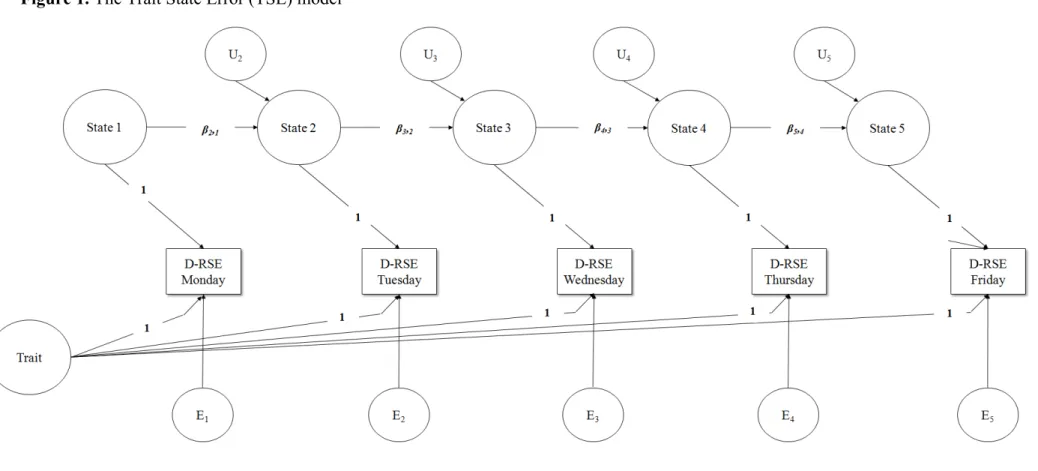
Issues of stability in general self-esteem can be naturally addressed within the framework of Latent State-Trait (LST) models, which allow determining the degree of across-time consistency versus situation-specificity of individual differences in personality (Geiser, Keller, & Lockhart, 2014). LST models are suitable when the underlying longitudinal process is characterized by a stable trait, such as general self-esteem, which may (or not) display short-term, reversible, and situation-specific deviations from the general, trait-level (Tisak & Tisak, 2000). The Trait State Error model (TSE) by Kenny and Zautra (1995, 2001), for example, decomposes multi-wave data into three components: (1) a stable trait component, (2) a state component, and (3) an error
component. This model, as applied to daily self-esteem, is shown in Figure 1. As can be observed, each of the five daily scores of self-esteem is explained by a common trait factor that captures variance that stable across all five days, a unique, state factor that captures variance in self-esteem that carries over from one day to the next, , and factors reflecting occasion-specific variance on self-esteem (including measurement error). . In addition, first-order autoregressive parameters are estimated at the level of the state components of observed scores. This captures the fact that the state factor in the TSE have stability across short term intervals.
According to Kenny and Zautra (1995, 2001), the TSE model was specified as follows: the paths from the trait factor to the observed measures are constrained to 1; the paths from each state factor to its corresponding observed measure are constrained to 1; the variances for all latent variables are freely estimated. In addition, the standard TSE model imposes a stationarity
stability. The stable and state components of self-esteem can then serve as latent variables in subsequent analyses to evaluate predictors of the short-term dynamics of self-esteem
Model evaluation
To investigate the fit of alternative models, Structural Equation Modeling (SEM) was used as the general modeling framework. Parameters were estimated by Full Information Maximum Likelihood (ML) using the Mplus 5.1 program (Muthén & Muthén, 2006). The following criteria were used to evaluate the goodness of fit: χ2 likelihood ratio statistic, Comparative Fit Index (CFI), and the Root Mean Square Error of Approximation (RMSEA) with associated 90% confidence intervals (CI). We accepted CFI values > .95, and RMSEA values < .08 as indicators of adequate fit (Kline, 2010).
Results Preliminary Analyses
To obtain an initial sense of the temporal relations for our variables, we computed
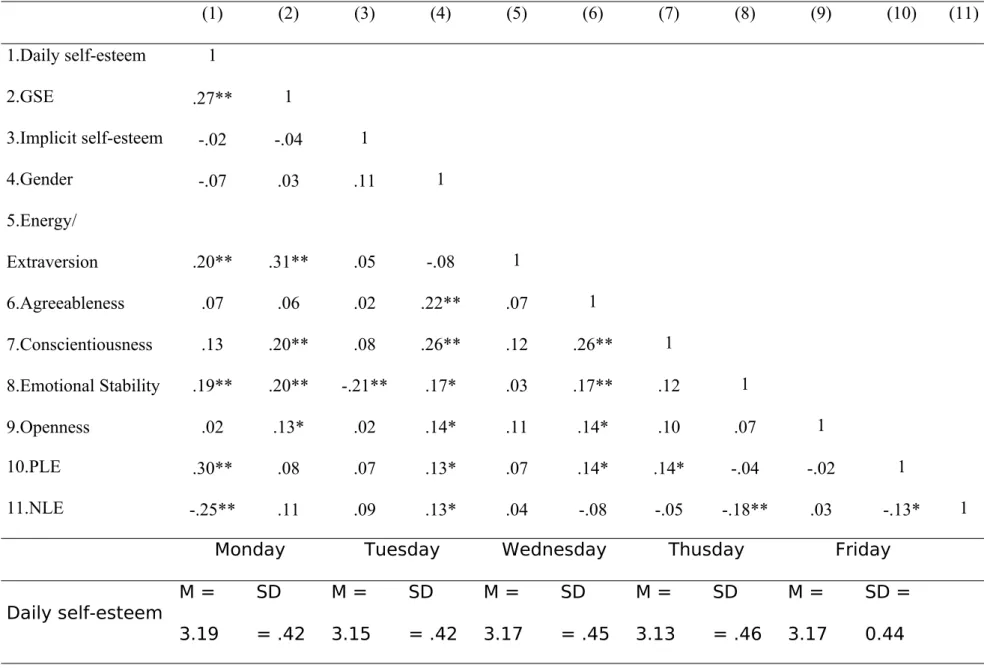
correlations between adjacent time points of self-esteem and life events (both positive and negative) were averaged across the five days2. Coefficients for daily self-esteem (.62, p < .01), PLE (.67, p < .01), and NLE (.33, p > .01) revealed a picture of substantial consistency across the five days. Table 1 presents correlations among daily esteem, PLE, NLE, trait esteem, implicit self-esteem, and the personality traits, averaged across the five days. Correlations were mostly as expected. For example, daily reports of self-esteem were significantly and moderately correlated with trait self-esteem, emotional stability, energy/extraversion, and both positive and negative life events. Both daily and trait levels of self-esteem were uncorrelated with implicit self-esteem. Modeling the Temporal Structure of Daily Self-Esteem
The TSE model fitted the data very well: χ2(11) = 22.60, p = .02, CFI = .98, RMSEA = .06 (90% CI = .02, .10).Standardized trait factor loadings were approximately .73, indicating that 53%
of the variance is shared between the daily self-esteem scores and the trait factor. Standardized state factor loadings were approximately .67, suggesting that 44% of the variance was attributable to a state factor. The autoregressive path coefficient was relatively large and significant (β = .14, p = .002).
Modeling the Effects of Time-Invariant Predictors on Daily Self-Esteem
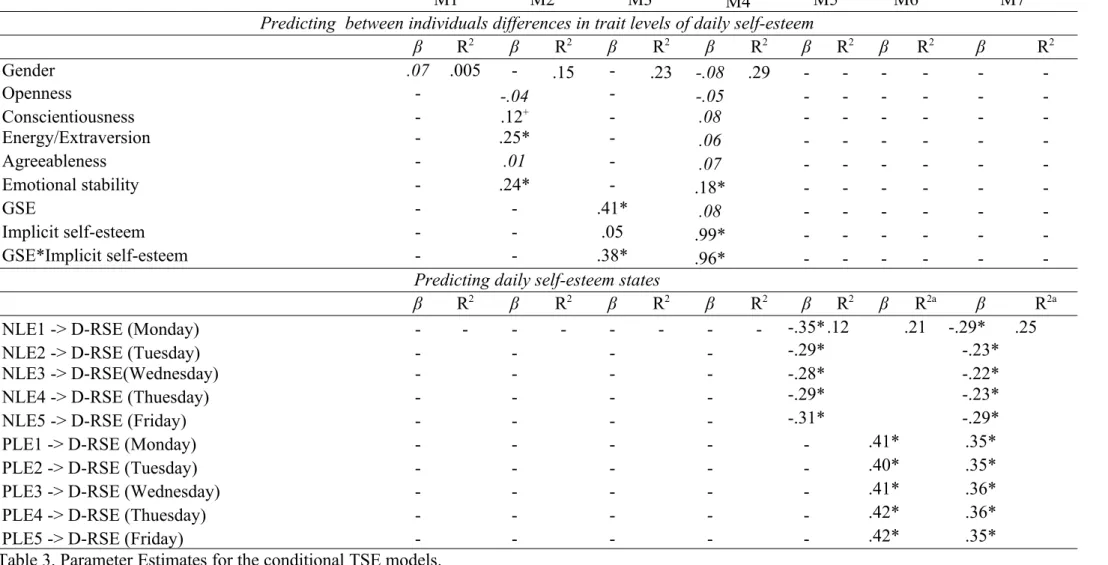
We next tested different conditional TSE models, by investigating the effect of time-invariant predictors (i.e., gender, the Big Five, trait self-esteem, and implicit self-esteem) on
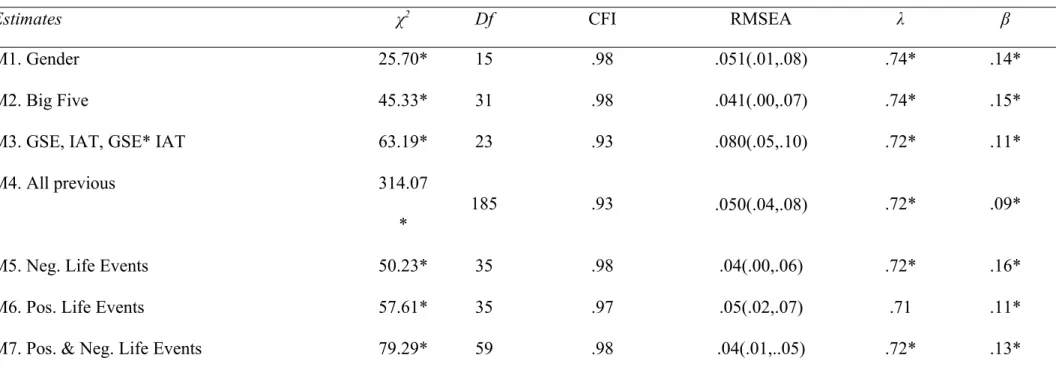
interindividual differences in trait levels of daily self-esteem (Table 2). Model 1 included gender as a predictor; Model 2 included the Big Five domains; Model 3 included trait self-esteem, implicit self-esteem scores, and their interaction; Model 4 included all of these time invariant predictors simultaneously.
simultaneously in Model 4 the unique contribution of extraversion became non-significant. All other effects remained statistically significant.
Modeling the Effects of Time varying covariates on Daily Self-Esteem
Models 5 to 7 investigated the effect of time-varying predictors on daily self-esteem states. Model 5 included only the negative daily events; Model 6 included only the positive daily events; Model 7 included both positive and negative daily events. Again, fit statistics for the models with time varying covariates are presented in Table 2, and relevant parameter estimates are reported in Table 3. In brief, both daily negative and positive events predicted daily self-esteem in Models 5 and 6, respectively. In these models, the daily coefficients for life events were constrained to be equal at each day, and this constraint did not significantly worsen model fit. Thus, life events seemed to have the same influence on each day of the week. Results Model 7, showed that positive daily events have a larger effect on daily self-esteem than negative events.
Testing the Comprehensive Model
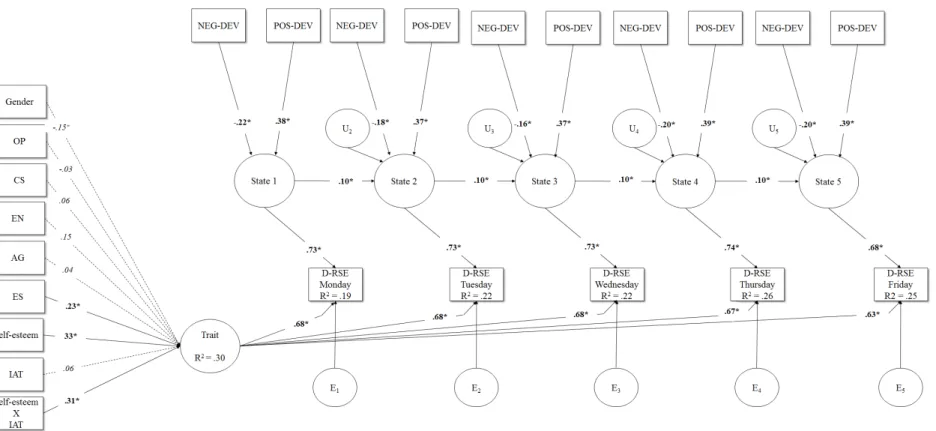
In Model 8 we tested a comprehensive TSE model, χ2(184) = 310.263, p < .01, CFI =.931, RMSEA = .049 (90% CI: .03,.06), in which all covariates were taken into account (see Figure 3). In this final model, emotional stability and the interaction between explicit trait-level and implicit self-esteem remained significant predictors of the stable component of daily self-self-esteem, whereas daily positive and negative events significantly predicted daily self-esteem states.
Discussion
There is considerable interest in moving beyond static investigations of self-esteem to study the dynamics of self-esteem over relatively short periods of time. This approach offers the potential to distinguish between self-esteem that is stable from self-esteem that fluctuates from one day to the next. Emerging evidence suggests that people with high stable self-esteem are resilient to
approach we were able to model the variance of observed individuals' scores of daily self-esteem, and to investigate predictors of stable and transitory aspects of self-esteem using an integrative model. There are several potentially important implications for the current methodological-substantive synergy.
First, the use of latent variable modeling allowed us to disentangle the stable (i.e., trait) and unstable (i.e., states) components of daily self-esteem.. We found that daily self-esteem was
determined significantly both by a latent trait factor, representing the proportion of individuals' self-esteem scores that remain stable across the study period, and by a series of connected consecutive states. The implications of these results are twofold. First of all, these data suggest the need to take into account both the trait component of self-esteem (represented by the latent intercept factor), and the more transitory components of esteem in future studies investigating the stability of self-esteem. Analytic approaches that do not separate stable from more transitory aspects of self-esteem risk confounding two different contributions to observed variation in self-esteem.
Second, our data counteracts arguments suggesting that instability of self-esteem simply reflects measurement error. Loosely speaking, these results agree with the classical account offered by Kernis (2003) about self-esteem instability as an individual difference variable. This level of variance explained by the trait factor (about 50%) in our study is understandable in light of the intensive research design, which involved repeated consecutive assessment over a brief span of time (although they are consistent with the design of other studies that investigated the short-term instability of self-esteem; see Kernis et al., 1993). Nonetheless, we might have found a different pattern (i.e., a potentially higher proportion of variance explained by the states components) if we obtained the repeated assessments across developmentally significant intervals such as the first few weeks of college or during a period of time in which participants learn about major life events (e.g., Crocker, Sommers, et al., 2000).
congruence between implicit and explicit self-esteem, and individual differences in broad
personality dispositions captured by Big Five. One of the advantages of the current study was the relatively large sample size for daily studies. This strategy afforded us greater statistical power to detect effects. This is noteworthy with respect to the significant impact of positive daily events on state self-esteem. The evidence in the current study for the impact of positive events is potentially novel because the effect of positive events on self-esteem instability only approached significance in previous studies (Greenier et al., 1999). Whereas negative daily events lowered state self-esteem, positive daily events bolstered daily individual’s feelings regard oneself. All in all, daily self-esteem was associated with daily events even controlling for personality traits and trait self-esteem. This suggests that perceptions of daily life events are uniquely associated with daily self-esteem apart from relatively stable dispositional tendencies and “trait” levels of self-esteem.
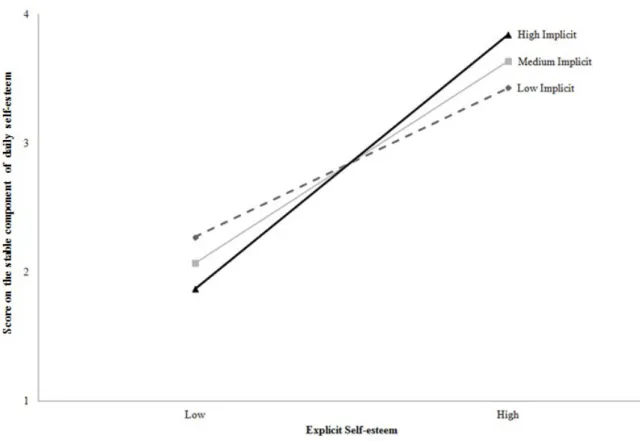
Another noteworthy finding from this study was evidence that trait explicit self-esteem and the interaction with implicit self-esteem measured two weeks before the daily portion of the study predicted daily self-esteem levels. As in previous studies, we found a positive significant correlation between individuals’ absolute level of “trait” self-esteem and stability of self-esteem over a short period of time (Okada, 2010). This effect was qualified by a significant interaction between explicit and implicit self-esteem in predicting the stability of self-esteem (Zeigler-Hill, 2006). High explicit trait self-esteem was correlated with the average level of daily self-esteem only for individuals with medium to high levels of implicit self-esteem. It is tempting to identify in the congruence of high implicit and high explicit trait self-esteem the roots of the secure self-esteem (Kernis, 2003), although the replicability of these findings is likely to be heavily dependent on reliability of implicit measures (in this regard, see LeBel & Paunonen, 2011). Thus, the current study provided evidence of the predictive validity of the interaction between explicit and implicit self-esteem but we believe it is prudent to acknowledge the controversies in this literature.
self-esteem and generally replicate three of the five correlations found in previous studies (Meier, et al., 2011). In general, the Big Five predictors of daily self-esteem were similar to the correlates of trait self-esteem. Indeed, trait self-esteem has been most closely associated with emotional stability, energy/extraversion, and conscientiousness (Robins, et al., 2001; Watson, et al. 2002). It is
important to note that when the effects of all predictors were controlled for, only emotional stability remained a significant predictor of self-esteem stability.
Although the current analyses have strengths in terms of the modeling approach and sample size (with respect to previous studies), there are some notable limitations that should be
acknowledged. It is important to emphasize the nature of the sample and the time frame used in the present design. Future studies using older and more diverse samples are recommended. Results may not generalize to different samples or across different intervals and timing of measurement. For example, it would be useful to assess self-esteem more frequently than once a day, and expand the time interval under investigation beyond five days. A second issue is that most participants had self-esteem scores that were moderate to high in absolute value; only a small percentage of participants had scores that were below the midpoint of the response scale. Thus, it is unclear whether the present findings generalize to samples of participants who have low self-esteem in an absolute sense. Moreover, the low reliability of implicit measures, and the use of only self-reported measures are limitations that can be considered in future studies. A third issue concerns our measures of life events. Although we considered a large variety of positive and negative events, researchers might be interested in assessing the characteristics of stressful events in more detail. Finally, future study should also seek to evaluate if changing response options for daily measures (i.e., from 1-4 to 1-7, for example) to see if this makes them more or less sensitive to detecting daily fluctuations.
References
Aiken, L.S., & West, S.G. (1991). Multiple Regression: Testing and interpreting interactions.
Newbury Park, CA: Sage.
Alessandri, G., Vecchione, M., Donnellan, M.B., &Tisak, J. (2013). An application of the LC-LSTM framework to the self-esteem instability case. Psychometrika, 4,
769-792.10.1007/s11336-013-9326-4
Arbuckle, J.L. (1996). Full information estimation in the presence of incomplete data. In G.A. Marcoulides and R.E. Schumacker (Eds.). Advanced structural equation modeling. Mahwah, NJ: Lawrence Erlbaum Publishers.
Baumeister, R.F., Campbell, J.D., Krueger, J.I., & Vohs, K.D. (2003). Does high self-esteem cause better performance, interpersonal success, happiness, or healthier lifestyles? Psychological Science in the Public Interest, 4, 1–44.doi:dx.doi.org/10.1111/1529-1006.01431
Bosson, J.K., Brown, R.P., Zeigler-Hill, V., & Swann, W.B., Jr. (2003). Self-enhancement tendencies among people with high explicit esteem: The moderating role of implicit self-esteem. Self and Identity, 2, 169-187.doi:10.1080/15298860390208801
Caprara, G.V., Barbaranelli, C., Bermudez, J., Maslach, C,. & Ruch, W. (2000). Multivariate methods for the comparison of factor structures in cross-cultural research: an illustration whit the Italian Big Five Questionnaire. Journal of Cross Cultural Psychology, 31,
437-464.doi:10.1177/0022022100031004002
Caprara, G.V, Barbaranelli, C., & Borgogni, L. (1996). BFQ. Big Five Questionnaire. Manuale. Firenze: Organizzazioni Speciali.
Crocker, J., Sommers, S., & Luhtanen, R. (2002). Hopes dashed and dreams fulfilled:
de Man, A.F., Gutierrez, B.I.B., & Sterk, N. (2001). Stability of self-esteem as moderator of the relationship between level of self-esteem and depression. North American Journal of Psychology, 3, 303-308.
Donnellan, M.B., Trzesniewski, K.H., & Robins, R.W. (2011). Self-esteem: Enduring issues and controversies. In T. Chamorro-Premuzic, S. von Stumm, & A. Furnham (Eds.). The Wiley-Blackwell Handbook of Individual Differences (pp.718-746). New York: Wiley-Wiley-Blackwell. Epstein, S., & Morling, B. (1995). Is the self motivated to do more than enhance and/or verify
itself? In M.H. Kernis (Ed.), Efficacy, agency, and self-esteem (pp. 9–30). New York: Plenum. Erol, R.Y., & Orth, U. (2011). Self-esteem development from age 14 to 30 years: A longitudinal
study. Journal of Personality and Social Psychology, 101, 607–619.doi:10.1037/a0024299 Gable, S.L., Reis, H.T., & Elliot, A.J. (2000). Behavioral activation and inhibition in everyday life.
Journal of Personality and Social Psychology, 78, 1135-1149.doi:10.1037/0022-3514.78.6.1135 Gawronski, B., & Bodenhausen, G.V. (2006). Associative and propositional processes in
evaluation: An integrative review of implicit and explicit attitude change. Psychological Bulletin, 132, 692–731.doi:10.1037/0033-2909.132.5.692
Geiser, C., Keller, B., and Lockhart, G. (2014). First- versus second-order latent growth curve models: some insights from latent state-trait theory. Structural Equation Modeling, 20, 479– 503. doi: 10.1080/10705511.2013.797832
Greenier, K.D., Kernis, M.H., McNamara, C.W., Waschull, S.B., Berry, A.J., Herlocker, C.E., et al. (1999). Individual differences in reactivity to daily events: Examining the roles of stability and level of self-esteem. Journal of Personality, 67, 185-208.doi:10.1111/1467-6494.00052
Greenwald, A.G., & Banaji, M.R. (1995). Implicit social cognition: Attitudes, self-esteem, and stereotypes. Psychological Review, 102, 4–27.doi:10.1037/0033-295X.102.1.4
Greenwald, A.G., & Farnham, S.D. (2000). Using the Implicit Association Test to measure self-esteem and self-concept. Journal of Personality and Social Psychology, 79,
Greenwald, A.G., McGhee, D.E., & Schwartz, J.L.K. (1998). Measuring individual differences in implicit cognition: The Implicit Association Test. Journal of Personality and Social
Psychology, 74, 1464-1480.doi:dx.doi.org/10.1037/0022-3514.74.6.1464
Greenwald, A.G., Nosek, B.A., & Banaji, M.R. (2003). Understanding and using the implicit association test: I. An improved scoring algorithm. Journal of Personality and Social Psychology, 85, 197–216.doi:dx.doi.org/10.1037/h0087889
Hayes, A.M., Harris, M.S., & Carver, C.S. (2004). Predictors of self-esteem variability. Cognitive Therapy and Research, 28, 369–385.doi:10.1023/B:COTR.0000031807.64718.b9
Heppner, W.L., Kernis, M.H., Nezlek, J.B., Foster, J.D., Lakey, C.E., & Goldman, B.M. (2008). Within-person relationships between daily self-esteem, need satisfaction, and authenticity. Psychological Science, 19, 1140-1145.doi:10.1111/j.1467-9280.2008.02215.x
Hetts, J.J., & Pelham, B.W. (2001). A case for the non-conscious self-concept. In G. Moskowitz (Ed.), Cognitive social psychology: The Princeton Symposium on the Legacy and Future of Social Cognition (pp. 105–123). Mahwah, NJ: Erlbaum.
Kamakura, T., Ando, J., & Ono, Y. (2001). A twin study of genetic and environmental influences on psychological traits of eating disorders in a Japanese female sample. Twin Research, 4, 439-442.doi:dx.doi.org/10.1375/136905203322296647
Kashdan, T.B., Uswatte, G., Steger, M.F., & Julian, T. (2006). Fragile self-esteem and affective instability in posttraumatic stress disorder. Behaviour Research and Therapy, 44, 1609-1619.doi10.1016/j.brat.2005.12.003
Kenny, D. A., & Zautra, A. (1995). The trait-state-error models for multiwave data. Journal of Consulting and Clinical Psychology, 63, 52-59.doi:dx.doi.org/10.1037/0022-006X.63.1.52. Kenny, D. A., & Zautra, A. (2001). Trait-state models for longitudinal data. In A. Sayer & L. M.
Kernis, M.H. (2003). Toward a conceptualization of optimal self-esteem. Psychological Inquiry, 14, 1–26.doi:10.1207/S15327965PLI1401_01
Kernis, M.H. (2005). Measuring self-esteem in context: The importance of stability of self-esteem in psychological functioning. Journal of Personality, 73, 1–37.doi:
10.1111/j.1467-6494.2005.00359.x
Kernis, M.H., Abend, T.A., Goldman, B. M., Shrira, I., Paradise, A.N., & Hampton, C. (2005). Self-serving responses arising from discrepancies between explicit and implicit self-esteem. Self and Identity, 4, 311-330.doi:10.1080/15298860500146028
Kernis, M., Bruce, H., Grannemann, B.D., & Barclay, L.C. (1992). Stability of self-esteem: Assessment, correlates, and excuse making. Journal of Personality, 60,
621-644.doi:10.1111/j.1467-6494.1992.tb00923.x
Kernis, M.H., Cornell, D.P., Sun, C.R., Berry, A., & Harlow, T. (1993).There's more to self-esteem than whether it is high or low: The importance of stability of self-esteem. Journal of
Personality, 65, 6.doi:10.1037/0022-3514.65.6.1190
Kernis, M.H., & Goldman, B.M. (2006). A multicomponent conceptualization of authenticity: Theory and research. In M.P. Zanna (Ed.), Advances in experimental social psychology (Vol. 38, pp. 284–357). San Diego, CA: Academic Press.
Kernis, M.H., Grannemann, B.D., & Barclay, L.C. (1989). Stability and level of self-esteem as predictors of anger arousal and hostility. Journal of Personality and Social Psychology, 56, 1013-1023.doi:10.1037/0022-3514.56.6.1013
Kernis, M.H., & Paradise, A.W. (2002). Distinguishing between fragile and secure forms of high self-esteem. In E.L. Deci & R.M. Ryan (Eds.), Handbook of self-determination research (pp. 339–360). Rochester, NY: University of Rochester Press.
Kernis, M.H., Whisenhunt, C.R., Waschull, S.B., Greenier, K.D., Berry, A.J., Herlocker, C. E., et al. (1998). Multiple facets of self-esteem and their relations to depressive symptoms.
Personality and Social Psychology Bulletin, 24, 657–668.doi:10.1177/0146167298246009 Kline, R. B. (2010). Principles and practices of structural equation modeling. New York: Guilford. Kling, K.C., Hyde, J.S., Showers, C.J., & Buswell, B.N. (1999). Gender differences in self-esteem:
A meta-analysis. Psychological Bulletin, 125, 470-500.doi:10.1037/0033-2909.125.4.470 Koole, S.L., Dijksterhuis, A., & van Knippenberg, A. (2001). What's in a name: Implicit
self-esteem. Journal of Personality and Social Psychology, 80, 614-627.doi:10.1037/0022-3514.80.4.669
Jordan, C.H., Spencer, S.J., Zanna, M.P., Hoshino-Browne, E., & Correll, J. (2003). Secure and defensive high self-esteem. Journal of Personality and Social Psychology, 85,
969-978.doi:10.1037/0022-3514.85.5.969
LeBel, E.P., & Paunonen, S.V. (2011). Sexy but often unreliable: Impact of unreliability on the replicability of experimental findings involving implicit measures. Personality and Social Psychology Bulletin, 37, 570-583.doi:10.1177/0146167211400619
Major, B., Barr, L., Zubek, J., & Babey, S.H. (1999). Gender and self-esteem: A meta-analysis. In W. B. Swann Jr., J.H. Langlois, & L.A. Gilbert (Eds.), Sexism and stereotypes in modern society: The gender science of Janet Taylor Spence (pp. 223–253). Washington, DC: American Psychological Association.
Marsh, H.W., & O’Mara, A. (2008). Reciprocal effects between academic self-concept, self-esteem, achievement, and attainment over seven adolescent years: Unidimensional and
multidimensional perspectives of self-concept. Personality and social Psychology Bulletin, 34, 542-552.doi:dx.doi.org/10.1177/0146167207312313
Meier, L.L., Orth, U., Denissen, J.J.A., & Kühnel, A. (2011). Age differences in instability, contingency, and level of self-esteem across the life span. Journal of Research in Personality, 45, 604–612.doi:10.1016/j.jrp.2011.08.008.
Millisecond Software. (2000). Inquisit [Computer software]. Seattle, WA: Author.
Muthén, L., & Muthén, B. (2006). Mplus user’s guide. Los Angeles, CA: Muthén & Muthén. Neiss, M.B., Sedikides, C., & Stevenson, J. (2006). Genetic influences on level and stability of
self-esteem. Self and Identity, 5, 247–266.doi:10.1080/15298860600662106.
Nezlek, J.B., & Plesko, R.M. (2001). Day-to-day relationships among concept clarity, self-esteem, daily events, and mood. Personality and Social Psychology Bulletin, 27, 201-211.doi:10.1177/0146167201272006.
Okada, R. (2010). A meta-analytic review of the relation between self-esteem level and self-esteem instability. Personality and Individual Differences, 48, 243-246.doi:10.1016/j.paid.2009.10.012 Pelham, B.W., & Hetts, J.J. (1999). Implicit and explicit personal and social identity: Toward a
more complete understanding of the social self. In T. Tyler & R. Kramer (Eds.), The psychology of the social self (pp. 115-143). Mahwah, NJ: Erlbaum.
Raes, F., & Van Gucht, D. (2009). Instability of self-esteem and paranoia in adolescents. Personality and Individual Differences, 47, 928-932.doi:10.1016/j.paid.2009.07.017. Roberts, J.E., & Gotlib, I.H. (1997). Temporal variability in global esteem and specific
self-evaluations as prospective predictors of emotional distress: Specificity in predictors and outcome. Journal of Abnormal Psychology, 106, 521-529.doi:10.1037/0021-843X.106.4.521. Roberts, J.E., & Kassel, J.D. (1997). Labile self-esteem, stressful life events, and depressive
symptoms: Prospective data testing a model of vulnerability. Cognitive Therapy and Research, 21, 569-589.doi:10.1023/A:1021861503072
Roberts, J.E., & Monroe, S.M. (1992). Vulnerable self-esteem and depressive symptoms:
Robins, R.W., Hendin, H.M., & Trzesniewski, K.H. (2001). Measuring global self-esteem: Construct validation of a single-item measure and the Rosenberg Self- Esteem Scale. Personality and Social Psychology Bulletin, 27, 151-161.doi:10.1177/0146167201272002 Robins, R.W., Trzesniewski, K.H., Tracy, J.L., Gosling, S.D., & Potter, J. (2002). Global
self-esteem across the life span. Psychology and Aging, 17, 423-434.doi:10.1037/0882-7974.17.3.423 Rosenberg, M. (1965). Society and adolescent self-image. Princeton, NJ: Princeton University
Press.
Rosenberg, M. (1986). Self-concept from middle childhood through adolescence. In J. Suls (Ed.), Psychological perspectives on the self (Vol. 3, pp. 107-136). Hillsdale, NJ: Erlbaum.
Savin-Williams, R.C., & Demo, D.H. (1983). Situational and transituational determinants of adolescent self-feelings. Journal of Personality and Social Psychology, 44,
824-833.doi:10.1037/0022-3514.44.4.824
Strack, F., & Deutsch, R. (2004). Reflective and impulsive determinants of social behavior. Personality and Social Psychology Review, 8, 220-247.doi:10.1207/s15327957pspr0803_1 Swann, W.B. Jr., Chang-Schnieder, C., & McClarty, K.L. (2007). Do people’s self-views matter?
Self-concept and self-esteem in everyday life. American Psychologist, 62, 84-94.doi:dx.doi.org/ 10.1037/0003-066X.63.1.65
Thewissen, V., Bentall, R.P., Lecomte, T., & van Os, J. (2008). Fluctuations in self-esteem and paranoia in the context of daily life. Journal of Abnormal Psychology, 117,
143-153.doi:10.1037/0021-843X.117.1.143
Tisak, J. &Tisak, M. (2000). Permanency and ephemerality of psychological measures with application to organizational commitment. Psychological Methods, 5, 175-198.doi: 10.1037/1082-989X.5.2.175.
Tolpin L.H., Gunthert C.K., Cohen, L.H., O'Neill S.C. (2004). Borderline personality features and instability of daily negative affect and self-esteem. Journal of Personality, 72,
Trzesniewski, K.H., Donnellan, M.B., Moffitt, T.E., Robins, R.W., Poulton, R., & Caspi, A. (2006). Low self-esteem during adolescence predicts poor health, criminal behavior, and limited economic prospects during adulthood. Developmental Psychology, 42,
381-390.doi:10.1037/0012-1649.42.2.381
Twenge, J.M., & Campbell, W.K. (2001). Age and birth cohort differences in self-esteem: A cross-temporal meta-analysis. Personality and Social Psychology Review, 5,
321-344.doi:10.1207/S15327957PSPR0504_3
Yamawaki, N., Tschanz, T.B., & Feick, D.L. (2004). Defensive pessimism, self-esteem, instability, and goal strivings. Cognition and Emotion, 18, 233-249.doi:10.1080/02699930341000004 Waschull, S.B., & Kernis, M.H. (1996). Level and stability of self-esteem as predictors of
children’s intrinsic motivation and reasons for anger. Journal of Personality and Social Psychology, 22, 4–13.doi:10.1177/0146167296221001
Watson, D., Suls, J., & Haig, J. (2002). Global self-esteem in relation to structural models of personality and affectivity. Journal of Personality and Social Psychology, 83, 185-197.doi:10.1037/0022-3514.83.1.185
Zeigler-Hill, V. (2006). Discrepancies between implicit and explicit self-esteem: Implications for narcissism and self-esteem instability. Journal of Personality, 74, 119-143.doi:10.1111/j.1467-6494.2005.00371.x
Zeigler-Hill, V., & Abraham, J. (2006). Borderline personality features: Instability of self-esteem and affect. Journal of Social and Clinical Psychology, 25,
668-687.doi:10.1521/jscp.2006.25.6.668
Table 1. Zero order correlations, means (M), and standard deviations (SD)
(1) (2) (3) (4) (5) (6) (7) (8) (9) (10) (11)
1.Daily self-esteem 1
2.GSE .27** 1
3.Implicit self-esteem -.02 -.04 1
4.Gender -.07 .03 .11 1
5.Energy/
Extraversion .20** .31** .05 -.08 1
6.Agreeableness .07 .06 .02 .22** .07 1
7.Conscientiousness .13 .20** .08 .26** .12 .26** 1
8.Emotional Stability .19** .20** -.21** .17* .03 .17** .12 1
9.Openness .02 .13* .02 .14* .11 .14* .10 .07 1
10.PLE .30** .08 .07 .13* .07 .14* .14* -.04 -.02 1
11.NLE -.25** .11 .09 .13* .04 -.08 -.05 -.18** .03 -.13* 1
Monday Tuesday Wednesday Thusday Friday
Table 2. Parameter Estimates for the conditional TSE models.
Estimates χ2 Df CFI RMSEA λ β
M1. Gender 25.70* 15 .98 .051(.01,.08) .74* .14*
M2. Big Five 45.33* 31 .98 .041(.00,.07) .74* .15*
M3. GSE, IAT, GSE* IAT 63.19* 23 .93 .080(.05,.10) .72* .11*
M4. All previous 314.07
*
185 .93 .050(.04,.08) .72* .09*
M5. Neg. Life Events 50.23* 35 .98 .04(.00,.06) .72* .16*
M6. Pos. Life Events 57.61* 35 .97 .05(.02,.07) .71 .11*
M7. Pos. & Neg. Life Events 79.29* 59 .98 .04(.01,..05) .72* .13*
M1 M2 M3 M4 M5 M6 M7 Predicting between individuals differences in trait levels of daily self-esteem
β R2 β R2 β R2 β R2 β R2 β R2 β R2
Gender .07 .005 - .15 - .23 -.08 .29 - - -
-Openness - -.04 - -.05 - - - - -
-Conscientiousness - .12+ - .08 - - - - -
-Energy/Extraversion - .25* - .06 - - - - -
-Agreeableness - .01 - .07 - - - - -
-Emotional stability - .24* - .18* - - - - -
-GSE - - .41* .08 - - - - -
-Implicit self-esteem - - .05 .99* - - - - -
-GSE*Implicit self-esteem - - .38* .96* - - - - -
-Predicting daily self-esteem states
β R2 β R2 β R2 β R2 β R2 β R2a β R2a
NLE1 -> D-RSE (Monday) - - - -.35*.12 .21 -.29* .25
NLE2 -> D-RSE (Tuesday) - - - - -.29* -.23*
NLE3 -> D-RSE(Wednesday) - - - - -.28* -.22*
NLE4 -> D-RSE (Thuesday) - - - - -.29* -.23*
NLE5 -> D-RSE (Friday) - - - - -.31* -.29*
PLE1 -> D-RSE (Monday) - - - .41* .35*
PLE2 -> D-RSE (Tuesday) - - - .40* .35*
PLE3 -> D-RSE (Wednesday) - - - .41* .36*
PLE4 -> D-RSE (Thuesday) - - - .42* .36*
PLE5 -> D-RSE (Friday) - - - .42* .35*
Table 3. Parameter Estimates for the conditional TSE models.
Figure 1. The Trait State Error (TSE) model
Figure 2. Predicted individual scores on the stable component of daily self-esteem assessed as a function of participants’ implicit and explicit trait self-esteem.
Figure 3. The final Trait State Error (TSE) model (Model 8).
Note. All parameters were standardized, except for those associated with gender, explicit self-esteem, implicit self-esteem, and their interaction term. In these cases we reported the unstandardized parameters in order to have more meaningful interpretations