University of Pennsylvania
ScholarlyCommons
Publicly Accessible Penn Dissertations
2017
Computing With Distributed Information
Yang Li
University of Pennsylvania, [email protected]
Follow this and additional works at:
https://repository.upenn.edu/edissertations
Part of the
Computer Sciences Commons
This paper is posted at ScholarlyCommons.https://repository.upenn.edu/edissertations/2441
For more information, please [email protected].
Recommended Citation
Li, Yang, "Computing With Distributed Information" (2017).Publicly Accessible Penn Dissertations. 2441.
Computing With Distributed Information
Abstract
The age of computing with massive data sets is highlighting new computational challenges. Nowadays, a typical server may not be able to store an entire data set, and thus data is often partitioned and stored on multiple servers in a distributed manner. A natural way of computing with such distributed data is to use distributed algorithms: these are algorithms where the participating parties (i.e., the servers holding portions of the data) collaboratively compute a function over the entire data set by sending (preferably small-size) messages to each other, where the computation performed at each participating party only relies on the data possessed by it and the messages
received by it.
We study distributed algorithms focused on two key themes: convergence time and data summarization. Convergence time measures how quickly a distributed algorithm settles on a globally stable solution, and data summarization is the approach of creating a compact summary of the input data while retaining key
information. The latter often leads to more efficient computation and communication. The main focus of this dissertation is on design and analysis of distributed algorithms for important problems in diverse application domains centering on the themes of convergence time and data summarization. Some of the problems we study include convergence time of double oral auction and interdomain routing, summarizing graphs for large-scale matching problems, and summarizing data for query processing.
Degree Type Dissertation
Degree Name
Doctor of Philosophy (PhD)
Graduate Group
Computer and Information Science
First Advisor Sanjeev Khanna
Second Advisor Boon Thau Loo
Keywords
Convergence, Data Summarization, Distributed Computation
COMPUTING WITH DISTRIBUTED INFORMATION
Yang Li
A DISSERTATION
in
Computer and Information Science
Presented to the Faculties of the University of Pennsylvania
in
Partial Fulfillment of the Requirements for the
Degree of Doctor of Philosophy
2017
Supervisor of Dissertation
Sanjeev Khanna
Henry Salvatori Professor
Computer and Information Science
Co-Supervisor of Dissertation
Boon Thau Loo Associate Professor
Computer and Information Science
Graduate Group Chairperson
Lyle Ungar, Professor
Computer and Information Science
Dissertation Committee
Aaron Roth (Chair), Class of 1940 Bicentennial Term Associate Professor, Computer and Information Science
Sampath Kannan, Henry Salvatori Professor, Computer and Information Science
ACKNOWLEDGEMENT
It has truly been a rewarding and pleasant journey studying at Penn for the past six years.
I have met so many great people during the process and received tremendous support from
them. Here, I would like to take the opportunity to express my gratitude to everyone who
has helped me along the way.
First of all, I want to thank my advisors Professor Sanjeev Khanna, Professor Boon Thau
loo, and Professor Linh T. X. Phan. It is truly an honor and privilege advised by Sanjeev.
I have learned so much from him over the years, especially regarding how to think with
clarity, how to make progress when facing obstacles, how to properly explain thoughts or
ideas, in terms of writing, presentation, or even just casually chatting, and the list goes
on. Sanjeev made me a better student, a better collaborator, a better researcher, and most
importantly, a better person, and I can never thank him enough for everything he did for
me.
I was admitted to the PhD program at Penn because of Boon. To an international student
who just finished undergraduate study (and with terrible English), the significance of this
offer goes without saying. That alone is more than enough for me to thank Boon forever,
not to mention the care and support that he provided me throughout my entire PhD life.
I want to thank Linh, along with all my co-authors: Sanchit Aggarwal, Sepehr Assadi,
David Chiu, Tanveer Gill, Alexander J. T. Gurney, Andreas Haeberlen, Zachary Ives, Feifei
Li, Changbin Liu, Bao-Liang Lu, David Maier, Suyog Mapara, Bart McManus, Victor
M. Preciado, Yiqing Ren, Micah Sherr, Li-Chen Shi, Rui-Hua Sun, Val Tannen, Yufei Tao,
Rakesh Vohra, Min Wang, Dong Xie, Bin Yao, Grigory Yaroslavtsev, Ke Yi, Zhuoyao Zhang,
and Wenchao Zhou (names ordered alphabetically). It was a great pleasure working with
them on many interesting projects over various domains, and I have learned a lot during
the process. There are a few names among the list that I want to particularly show my
with great advices on every aspect of the network functions virtualization project. Sepehr
and I worked closely together for the majority of my PhD life. We learn and grow together
as PhD students, and the success we had would not be possible without him. Feifei is
the one who introduced to me the world of research. He and Ke taught me a lot about
research when I was an intern at HP Labs China, and the paper we had back then played
an extremely crucial role in my PhD application. In addition, Feifei also provided me with
thorough support and great advices during the entire application process.
It is a great pleasure to have such a wonderful thesis committee formed by Professor Aaron
Roth, Professor Sampath Kannan, Professor Michael Kearns, and Professor Qin Zhang. I
want to thank the committee for the helpful comments they have provided me throughout
the process. In particular, I want to thank Aaron for chairing the committee, Sampath and
Michael for agreeing to be on the committee despite how packed their schedules are, and
Qin for being my external and agreeing to join us remotely at such an unpleasantly early
time in the morning.
I was a teaching assistant for Professor Susan Davidson on “Database and Information
Science” and Professor Rajiv C. Gandhi on “Introduction to Algorithms”. It was great
experience working with them. As the head TA, I learned a lot from Susan on instructing a
course, communicating with other TAs, and interacting with the students. Many interesting
conversations happened when I was a TA for Rajiv, and our discussion about undergrad
education in Penn were particularly inspiring to me.
Before coming to Penn, I was a student of ACM Honored Class in Shanghai Jiao Tong
University. ACM Honored Class provided me with intense education that established my
computer science foundation, and great opportunities to intern at HP Labs China and to
be part of the BCMI Lab, mentored and supervised by Dr. Li-Chen Shi and Professor
Bao-Liang Lu. These resource made it possible for me to pursuit my PhD and for that, I
want to thank Professor Yong Yu both for creating this wonderful educational environment
Life would be so boring without friends around. For that, I really need to thank Chen Chen
for all the fun we had over the years, for all our interesting discussions on countlessly many
different topics, and for being a great roommate. I also want to thank Zhepeng Yan for
being a great friend and for improving my Chinese Chess skill significantly, thank Xiaoyuan
Ma and Bo Shang for making me a better basketball player, and thank Lin Tan and Yupeng
Lu for helping me pass through the first year at Penn, which is really the toughest among
all. I have made many great friends during my stay at Penn, and it has been a great pleasure
knowing all of you: Ling Ding, Dong Lin, Gang Song, Meng Xu, Yifei Yuan, Qizhen Zhang,
Mingchen Zhao, Yumeng Zuo, and many others.
Last but not least, to my family, I am so fortunate to meet and fall in love with my beautiful
and talented wife Qianru Jia, and I want to thank her for the support, the care, and the
understanding, and for making our house a home. Finally, I want to express my deepest
love and appreciation to my father Jie Li for guiding me through all crucial moments and
ABSTRACT
COMPUTING WITH DISTRIBUTED INFORMATION
Yang Li
Sanjeev Khanna
Boon Thau Loo
The age of computing with massive data sets is highlighting new computational challenges.
Nowadays, a typical server may not be able to store an entire data set, and thus data is
often partitioned and stored on multiple servers in a distributed manner. A natural way of
computing with such distributed data is to use distributed algorithms: these are algorithms
where the participating parties (i.e., the servers holding portions of the data) collaboratively
compute a function over the entire data set by sending (preferably small-size) messages to
each other, where the computation performed at each participating party only relies on the
data possessed by it and the messages received by it.
We study distributed algorithms focused on two key themes: convergence time and data
summarization. Convergence time measures how quickly a distributed algorithm settles on
a globally stable solution, and data summarization is the approach of creating a compact
summary of the input data while retaining key information. The latter often leads to
more efficient computation and communication. The main focus of this dissertation is on
design and analysis of distributed algorithms for important problems in diverse application
domains centering on the themes of convergence time and data summarization. Some of
the problems we study include convergence time of double oral auction and interdomain
routing, summarizing graphs for large-scale matching problems, and summarizing data for
TABLE OF CONTENTS
ACKNOWLEDGEMENT . . . iii
ABSTRACT . . . vi
LIST OF TABLES . . . x
LIST OF ILLUSTRATIONS . . . xi
CHAPTER 1 : Introduction . . . 1
1.1 Double Oral Auction . . . 3
1.2 Stochastic Matching . . . 5
1.3 Convergence Time of Interdomain Routing . . . 7
1.4 Maximum Matching with Minimum Communication . . . 9
1.5 Data Provisioning . . . 11
CHAPTER 2 : Double Oral Auction . . . 14
2.1 Background . . . 14
2.2 Our Results and Related Work . . . 17
2.3 Preliminaries . . . 20
2.4 Stable State and Social Welfare . . . 22
2.5 Convergence to a Stable State . . . 28
2.6 Conclusions and Future Work . . . 41
CHAPTER 3 : Stochastic Matching . . . 43
3.1 Background . . . 43
3.2 Our Results and Related Work . . . 45
3.3 Preliminaries . . . 50
3.5 A (1−)-Approximation Adaptive Algorithm . . . 62
3.6 A 1 2 − -Approximation Non-Adaptive Algorithm . . . 64
3.7 A Barrier to Obtaining a Non-Adaptive (1−)-Approximation Algorithm . 67 3.8 Conclusions and Future Work . . . 70
CHAPTER 4 : Convergence Time of Interdomain Routing . . . 71
4.1 Background . . . 71
4.2 Our Results and Related Work . . . 73
4.3 Preliminaries . . . 75
4.4 Path Linearization . . . 78
4.5 Convergence Time for Restricted Preferences: a Dichotomy Theorem . . . . 83
4.6 Hop-Based Preference Systems . . . 89
4.7 Linearization that Minimizes Path-Length . . . 93
4.8 Conclusions and Future Work . . . 97
CHAPTER 5 : Matchings in the Simultaneous Communication Model . . . 99
5.1 Our Results and Related Work . . . 99
5.2 Preliminaries . . . 102
5.3 Randomized Protocols . . . 103
5.4 Deterministic Protocols . . . 114
5.5 Multi-Round Protocols . . . 117
5.6 Conclusions and Future Work . . . 123
CHAPTER 6 : Data Provisioning . . . 124
6.1 Background . . . 124
6.2 Our Results and Related Work . . . 127
6.3 Preliminaries . . . 130
6.4 Numerical Queries . . . 133
6.5 Complex Queries . . . 141
6.7 Conclusions and Future Work . . . 148
LIST OF TABLES
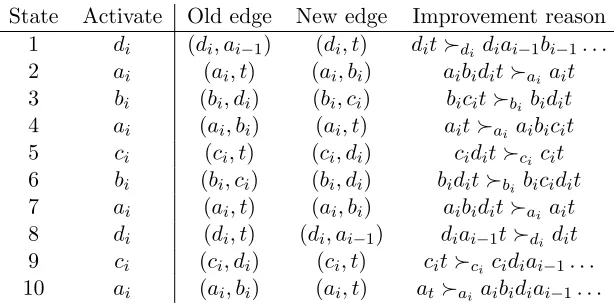
TABLE 1 : Sequence of improving moves for Lemma 4.5.1. . . 87
LIST OF ILLUSTRATIONS
FIGURE 1 : Unstable market with general trading graph and Mechanism (1) . 37
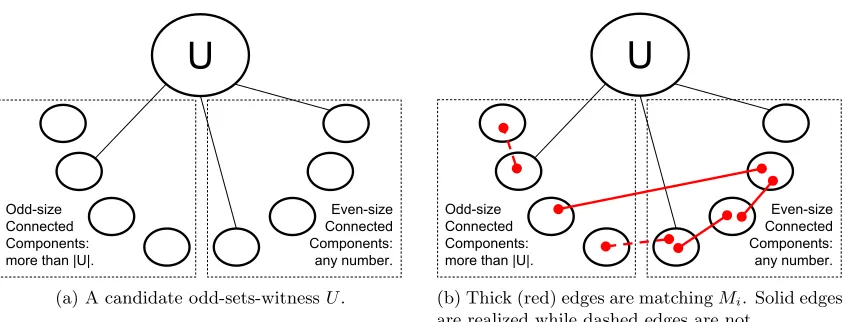
FIGURE 2 : An example of adding a large matchingMi to an odd-sets-witness
(the red/thick edges). The number of odd components does not
decrease but the total number of connected components indeed
decreases. . . 53
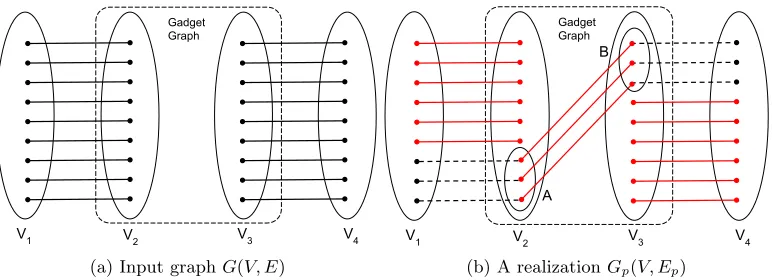
FIGURE 3 : An example of a barrier to (1−)-approximation non-adaptive
algorithms. The edges in the gadget graph are not presented in
this figure. In part (b), solid red edges (resp. dashed edges) are
the edges that are realized (resp. not realized). . . 68
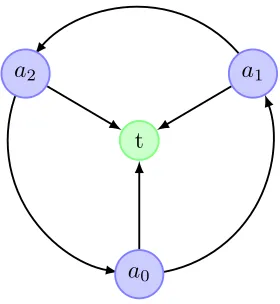
FIGURE 4 : Some network examples. . . 79
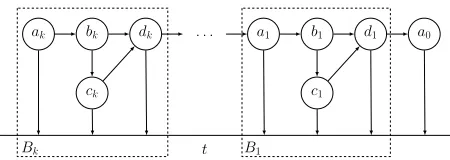
FIGURE 5 : A network with constant preference size and constant-length paths,
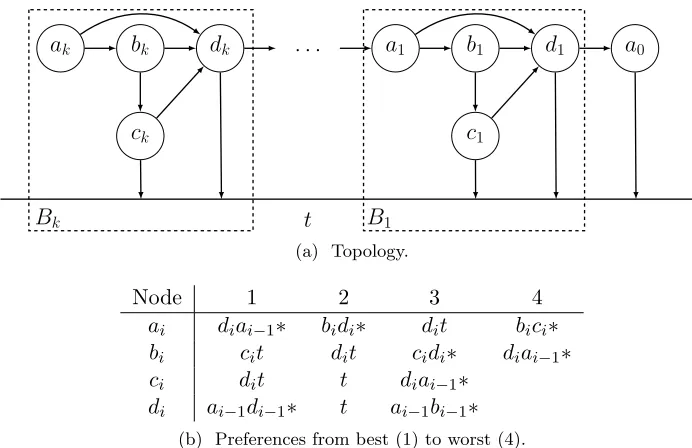
that takes an exponentially long time to converge. . . 84
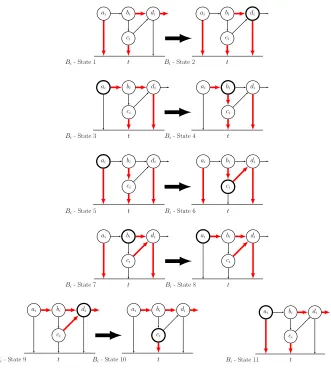
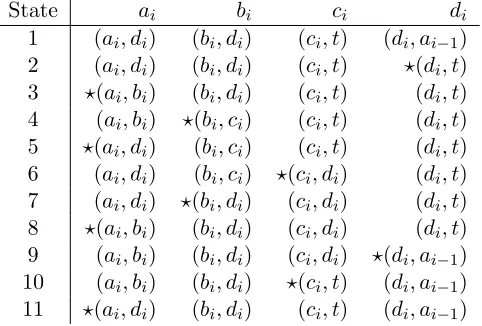
FIGURE 6 : States resulting from applying activation sequenceσi to blockBi. 86
FIGURE 7 : A network with 2-hop preferences and exponential convergence time. 90
CHAPTER 1 : Introduction
The term “Big Data” has quickly become one of the most popular keywords for the 21st
century. A study showed that, as for the year 2014, every minute, Facebook users share
nearly 2.5 million pieces of content, Twitter users tweet nearly 300,000 times, and Instagram
users post nearly 220,000 new photos [4]. According to more recent studies, everyday, over
2.5 exabytes (which is 2.5 billion gigabytes) of data is generated all over the world [5], and
Google alone needs to process over 20 terabytes (which is 20 million gigabytes) of these
data [3].
The presence of such massive data sets leads to many technical challenges. One of the key
challenges is how to efficiently store and access these data, as for data of this scale, storing
them on a single server is often infeasible. To overcome this challenge, a natural idea is
to distribute the data to multiple servers. This approach quickly becomes appealing and
one of the key reasons is that for many applications, data are in fact originally generated
in a distributed manner (e.g., think of data generated by Google users all over the world;
naturally these data would be stored at different servers in different locations).
Another key challenge for handling massive data sets is how to efficiently process them and
to extract useful information. In particular, with data stored in multiple locations in a
dis-tributed manner, efficiently processing these data (i.e., efficientlycomputing with distributed
information) becomes even more challenging since traditional computation paradigm
re-quires placing the entire dataset on a single server. One natural way of computing with
distributed information is to use distributed algorithms: these are algorithms where the
participating parties (i.e., the servers that hold portions of the entire data) collaboratively
compute a function over the entire data set by sending (preferably small-size) messages to
each other, where the computation performed at each participating party P only relies on
the data possessed by P and the messages sent to P. The following two key concepts are
Convergence. Using distributed algorithms, participating parties often follow the
follow-ing pattern: computfollow-ing based on their own data, sendfollow-ing/receivfollow-ing messages to/from other
parties, recomputing w.r.t. the received messages, sending/receiving new messages to/from
other parties, and etc. For this pattern to be meaningful, a key property that a distributed
algorithm must have is convergence (preferably rapid convergence: convergence in small
number of steps). In other words, one needs to guarantee that after a certain number of
steps, no party would have intention to send any new messages, and hence the algorithm
terminates. Typically, a distributed algorithm needs to guarantee convergence no matter
what the input data set is and how the data are distributed.
Data summarization. Another key concept of distributed algorithms (or of handling
massive data sets in general) isdata summarization: this is the approach of compressing or
summarizing the input data into much smaller size while retaining key information. When
designing distributed algorithms, a natural way of using the data summarization approach is
to ask each party to summarize (i.e., to compress) her input data and the received messages
into a small-size sketch and share the sketch with others.
The typical objective of the data summarization approach is to minimize the total size of
the messages sent between different participating parties, i.e., tominimize the total
commu-nication. This line of research comes from the more general field of sub-linear algorithms:
algorithms whose resource requirements are substantially smaller than the size of the input
data. Designing distributed algorithms with minimum communication is generally referred
to as thedistributed model of computation for sub-linear algorithms.
When considering data summarization for distributed algorithms, we mostly focus on the
goal of minimizing the total communication, with one exception where we using data
sum-marization to pre-processing the input data before executing distributed algorithms with
the goal of simplify the computation of the distributed algorithm.
dis-sertation is on design and analysis of distributed algorithms for diverse application domains
centering around convergence and data summarization. Along the way, we investigate some
of the important problems in these domains, and makes progress towards a better
under-standing of these problems.
1.1. Double Oral Auction
The concept of computing with distributed data was not formally introduced until late
1970s. However, the principle of performing computation in a distributed manner can be
traced years before that. In particular, in early 1960s, Smith [102] designed a double oral
auction (DOA) experiment for the following market trading problem.
There is a set of unit demand buyers (i.e., each buyer wants to buy an item) and a set of
unit supply sellers (i.e., each seller has an item to sell), and all items are identical. Each
buyer and each seller (i.e., each player) has his own valuation of an item, and the valuation
may differ from player to player. For a buyer, his valuation is the highest price that he is
willing to pay for an item, and for a seller, his valuation is the lowest price that he is willing
to sell his item. The valuation of each player is his private information and naturally,
players intend to keep their valuations private. Moreover, players behave selfishly: each
buyer wants a buy an item for as cheap as possible and each seller wants to sell his item for
as expensive as possible.
The goal of the market trading problem is to determine how the buyers and sellers should
trade with each other and what should be the price for each trade, which we will refer to as
an assignment of the market. In Smith’s experiment, players found an assignment using the
following simple double oral auction (DOA) mechanism. Buyers and sellers call out bids
and offers where all other players can hear and decide whether or not to accept a bid or an
offer. This continues until no more bids and offers are called out.
The DOA mechanism can be thought of as performing computation with distributed data
players and players communicate with each other through the bids and offers to compute a
preferable assignment.
Remarkably, as noted by Smith, employing DOA, players consistently arrive at the
Wal-rasian equilibrium, which, intuitively speaking, are assignments where every player is happy
with the outcome and the market achieves maximum efficiency. As noted by Friedman [50],
the outcome of Smith’s experiment, is something of a mystery. How is it that the agents in
the DOA overcome the impediments of both private information and strategic uncertainty
to arrive at the Walrasian equilibrium? In the same survey [50], Friedman summarized
various early theoretical attempts to explain this phenomenon, and concluded with a
two-part conjecture: “First, that competitive (Walrasian) equilibrium coincides with ordinary
(complete information) Nash Equilibrium (NE) in interesting environments for the DOA
institution. Second, that the DOA promotes some plausible sort of learning process which
eventually guides theboth clever and not-so-clever traders to a behavior which constitutes
an ‘as-if’ complete-information NE.”
Over the years, the first part of Friedman’s conjecture has been well studied and understood
(see, e.g., [40]), but the second part of the conjecture is still awaiting proper explanation.
Contributions. We focus on giving a theoretical explanation to the second part of
Fried-man’s conjecture. More specifically, we design a mechanism which simulates the DOA
mechanism, and prove that this mechanism always converges to a Walrasian equilibrium in
polynomially many steps. For our mechanism to convincingly simulates DOA, it captures
the following four key properties of the DOA where all earlier attempts lacks in one or a
few of them.
1. Two-sided market: Players on either side of the market can make actions.
2. Private information: When making actions, players have no other information besides
3. Strategic uncertainty: The players have the freedom to choose their actions modulo
mild rationality conditions.
4. Arbitrary recognition: The auctioneer (only) recognizes bids and offers in anarbitrary
order.
We further consider the more general scenario where not all players can hear and trade with
each other. In other words, there is a network structure among the players, and a player
can only communicate and trade with their neighbors on the network (the original setting
of Smith’s experiment can be viewed as the special case where the network is a complete
bipartite graph). We show that DOA may not converge in this more general case, and
a randomized variant of our mechanism (which can be viewed as a small modification of
DOA) can be used to overcome this issue and still ensure convergence.
Our study on the convergence of the double oral auction mechanism along with its
gen-eral bipartite graph variant was published in the 11th Conference on Web and Internet
Economics (WINE), 2015 [15] (best paper award).
1.2. Stochastic Matching
In many trading games, data are naturally distributed since players naturally have private
information. The market setting for double oral auction is a simple and classic example
where the private information of each player is just their valuation of an item. The following
is another interesting model for a simple and classic trading game.
Suppose there is a collection of players where each player wants to find another player to
trade. Each player P is given a list of other players that P can trade with, and P can
propose to trade with any player on his list. However, any player on the list may reject
P’s proposal with some probability. The goal is for each player to make only a few trade
proposal while ensuring that among the accepted proposals, a large number of player pairs
The above trading game can be formulated as a graph problem as follows. Create a node
for each player and the neighborhood (i.e., the incident edges) of a player P is the list of
other players that P can trade with. Each edge may be removed with some probability
(i.e., the proposal gets rejected), and we say an edge is realized if it is not removed (i.e.,
the proposal gets accepted). The goal is to identify a bounded degree subgraph where with
high probability, among the set of realized edges in the subgraph, there is a matching of
large size.
Note that for this problem, we are using the data summarization approach to reduce the
size of the trading graph (i.e., to pre-processing the input data). After preprocessing, the
number of neighbors that each player has would be bounded, and hence when the players use
(any) distributed algorithm to find a trading assignment (or a matching), the computation
of the distributed algorithm would be simplified.
This graph problem is formally known as the stochastic matching problem [25], which has
received great attention mainly due to the following application in kidney exchange. Often
patients who need a kidney transplant have a family member who is willing to donate
his/her kidney, but this kidney might not be a suitable match for the patient due to reasons
like incompatible blood-type etc. To solve this problem, a kidney exchange is performed in
which patientsswap their incompatible donors to each get a compatible donor.
In terms of the above trading game, each patient-donor pair is a player (or a node) and
the neighbor of a patient-donor pair is the set of all other pairs where a kidney exchange is
possible. The goal is to find a large set of exchange (i.e., a large matching). The reason that
a trade (or an exchange) proposal might be rejected is that when identifying the neighbors
of a patient-donor pair, typically one only has access to the medical record of the patients
and the donors, which can be used to rule out the patient-donor pairs where donation
is impossible (e.g., different blood types), but does not provide a conclusive answer for
whether or not a donation is indeed feasible. Therefore, after proposed one needs to run
be infeasible, which would make the exchange itself infeasible.
Contributions. We focus on solving the stochastic matching problem for two generally
considered settings: adaptive and non-adaptive. In the adaptive setting, one can identify
the target low-degree subgraph step by step while the computation is in each step can be
based on the outcome of previous steps (i.e., which of the previously used edges are realized).
In the non-adaptive setting, one needs to output a low-degree subgraph in one shot where
guaranteeing that a large matching would be realized from this subgraph.
We design both adaptive and non-adaptive algorithms for the stochastic matching problem
which achieves the same approximation ratio as the previous best bound [25]. However, the
degrees of the subgraph that our algorithms output are not only exponentially smaller than
the state of the art, but also essentially the best possible.
Our work on the stochastic matching problem was published in the 17th ACM Conference
on Economics and Computation (EC), 2016 [13].
1.3. Convergence Time of Interdomain Routing
In the decade following Smith’s double oral auction experiment, the field of computer
net-working started to flourish. This is the time when several amazing accomplishments were
made and the Internet started to come into our lives. Consequently, these accomplishments
also make 1970s a landmark, or the start, for computing with distributed data: the whole
idea of storing data (and process them) in a distributed manner relies on the ability of
trans-mitting data between any two computers, which was only made possible by the success of
the Internet.
The Internet is a network of networks, formed by many Autonomous Systems (ASes). Each
AS could be a telecommunication company, a university, etc. Some ASes are directly
connected to each other and some ASes need to go through a sequence of other ASes to
is necessary that any two ASes are connected. With the presence of many possible routes
between ASes, specific routes needs to be chosen and agreed by all ASes. The process where
ASes determine preferable routes to connect to each another is called interdomain routing,
and the current protocol for interdomain routing is BGP, Border Gateway Protocol [97].
The most important difference between interdomain routing and other route-finding
meth-ods is the way in which local policy controls the selection and propagation of routes: rather
than there being a single global definition of ‘best’ route (as in shortest-path protocols),
every AS has its own interpretation. This is because of the asymmetry in the economic
relationships among these network participants; accordingly, BGP is best perceived as a
protocol that tries to compute a Nash equilibrium in a game where all parties are trying to
obtain good routes (by their local definition) but are constrained by the choices of others
(one cannot pick a route through a neighbor without agreement) [93, 46].
Therefore, interdomain routing is naturally a computational problem with distributed
in-formation as follows. The preferences of all ASes along with the network topology (which
are the entire data set) are distributed among ASes and the goal is to determine routes
between any two ASes which is consistent with the preferences, which we will refer to as
stable routes.
It is well known that in general, network policies can conflict to the extent that BGP will be
unable to find stable routes: in this case, the protocol willoscillate indefinitely [81, 80, 88].
There has been a great deal of work on identifying sufficient criteria for BGP to converge to
a unique stable state [60, 62, 64, 107, 52, 104] using abstract models (in particular, stable
paths problems [63]). On the other hand, it was observed that even if BGPdoes converge,
it may take some time to do so [80, 47]. The slow convergence causes practical difficulties
for network operators, and degradation or loss of service for their customers.
Contributions. We focus on the theoretical aspect of the convergencetime of BGP. In
it requires for the network to actually converge (or to stabilize). We study convergence time
when different restrictions are applied on the structure of the preferences, and establish both
necessary and sufficient conditions (i.e., dichotomy theorems) for convergence inpolynomial
time. To the best of our knowledge, prior to our work, the only related studies concerning
polynomial time convergence are given by [52, 99], which only established polynomial time
convergence for the Gao-Rexford criteria.
The key challenge of our work lies in the fact that ASes might act (i.e., change their routes) in
any arbitrary order. In other words, we need to understand how bad the arbitrary activation
order can hurt convergence time and also, how to establish maximum convergence time with
the presence of arbitrary activation.
We further observe that given the preferences of the ASes, many different stable routes are
possible. However, other than being stable, some routes could be considered better for other
objectives. This leads to the question of designing efficient algorithms that add only a few
more preferences (which is consistent with the original preferences) such that the resulting
stable routes has desired properties, such as the length of the longest path in the resulting
stable routes is minimized. We provide both hardness results and approximation algorithms
for this problem.
Our study on understanding BGP convergence time and the problem of obtaining stable
routes with desired properties was published in IEEE International Conference on Computer
Communications (INFOCOM), 2016 [68].
1.4. Maximum Matching with Minimum Communication
During the past several decades and continuing on to recent years, there has been
tremen-dous research on distributed algorithms for graph problems [110, 45, 10, 71, 69]. The
maximum matching problem, one of the most well-studied problems in classical
optimiza-tion, has been extensively studied in the distributed model due to its central role in many
The distributed setting for the matching problem can be described as follows. The input
graph isadversarially partitioned acrossk parties and the goal is to design distributed
al-gorithms (or generally referred to asprotocols) such that thek parties can jointly compute
a maximum matching. Two natural ways of partitioning the input graph have been
consid-ered: in the edge partition model, each party holds a subset of edges of an input (possibly
multi-) graph while in the vertex partition model the input graph must be bipartite and
each player holds a distinct subset of vertices on the left together with all their adjacent
edges. The performance of the protocol is typically measured by the total communication,
which is simply the total size of all messages sent/received by every parties.
Many variations (especially regarding the communication model) of the aforementioned
distributed setting has been studied. For instance, Huanget al. [71] focused on thek-party
message-passing model with two-way player-to-player communication. This is the model
where any party can send messages to any other party in any order. This is probably the
most general communication model for distributed computation since there is essentially
no restrictions on who can communicate with whom or whether who should send messages
earlier than others. For this model, Huang et al. [71] showed that the communication of
Θ nk
α2
bits is both necessary and sufficient for computing an α-approximate matching for
both vertex partition and edge partition models; here n denotes the number of vertices in
the input graph.
The work of Dobzinski et al. [45, 10] considers another distributed computation model
where the input graph is bipartite and each party possesses a distinct vertex on the left
along with all edges incident on this vertex. This is a special setting for the vertex partition
model where the number of parties equals the number of vertices on the left. Dobzinski et
al. [45] focuses on simultaneous communication (or simultaneous protocols) where every
party simultaneously sends a message to a coordinator, and the coordinator computes a
large matching using the messages. Dobzinskiet al. [45] showed that for the simultaneous
coor-dinator can only output anO(√n)-approximate matching, which matches the lower bound
of [71].
Contributions. We mainly focus on simultaneous protocols for thek-party vertex
parti-tion model, where there arekparties and each party holds a distinct set of vertices on the left
along with all incident edges; each party simultaneously sends a message to the coordinator,
and the coordinator computes a large matching using all received messages. This model
generalizes the model studied by Dobzinskiet al. [45] (which is the case wherek=n). We
show that for achieving anα-approximation,Oe(nkα2) bits of communication is still sufficient
for this more restricted communication model (compared to Huang et al. [71]). In
partic-ular, our result implies that the lower bound of Ω(nk
α2) bits of communication (of Huanget
al. [71]) is not only tight for the more general two-way player-to-player communication
model, but also tight for the more restricted simultaneous communication model.
Moreover, we should also point out that the setting for the double oral auction (DOA)
experiment (Section 1.1) is also a distributed setting for the (weighted) maximum matching
problem: the weight of an edge between a buyer and a seller equals the valuation of the
buyer minus the valuation of the seller (i.e., the weights of the edges are vertex induced),
and DOA is in fact a distributed protocol that allows the players to compute a maximal
weighted matching in the input graph. Therefore, our work on understanding DOA also
contributes to understanding matching in distributed settings.
Our work on designing simultaneous protocols that compute maximum matching for the
vertex-partition model was published in the 27th Annual ACM-SIAM Symposium on
Dis-crete Algorithms (SODA), 2016 [16].
1.5. Data Provisioning
During the study of computation with distributed information, many interesting models are
introduced. For instance, for the aforementioned market trading and interdomain routing
ensuring rapid convergence and/or converging to desired states. For the aforementioned
maximum matching problem, the goal is to perform distributed computation with
mini-mum communication, while computing a pre-specified function. With more interest placed
on computation with distributed data, more applications emerge which leads to more
in-teresting models [76, 82, 77, 89]. Here is one of these models that we recently introduced
and studied.
Suppose the entire dataset is collected from k different sources, and the data of different
sources resides on different machines. When performing data analytics, often some sources
are considered less trustworthy than others. Moreover, whether or not a source can be
trusted may depend on many factors which may be subject to change (e.g., the credibility of
the company that collects the data, the business relationship between the companies, etc).
Therefore, an analyst might be interested in considering different subsets of the sources,
combining the data collected by these sources, and perform certain analysis.
A simple solution to handle this issue of combining different subsets of sources is to collect
all data from all sources to a single location. Then, whenever the analyst wants to consider
some subset of sources, he can directly combine the corresponding data and perform the
required computation. However, since the dataset collected by each source could be massive,
there are two issues of this approach: it might be infeasible to place all data to a single
machine, and performing (potentially costly) computation on such large dataset over and
over (i.e., whenever a source becomes/is no longer trusted) could be rather computationally
inefficient.
The overcome these issues, we introduce the following computation model for distributed
data referred to as provisioning. Each source only sends a sketch to the analyst such that for
any subset of the sources, the answer of the designated analytical question can be computed
using only the sketches. The goal is to compute and send sketches with small size (preferably
Notice that if we further constrain the model and require each source to directly send the
sketch to the analyst simultaneously, this model essentially degrades to the typical
dis-tributed computation model with simultaneous protocols: given any simultaneous protocol
Π of the distributed computation model, design an algorithm for provisioning as follows:
each source runs the protocol Π as if it is trusted and sends the message (which will be the
sketch for provisioning) to the analyst; whenever the analyst wants to analyze for a subset
of sources, he runs Π only over the sketches sent from trusted sources (and ignore the other
sketches). The correctness of this algorithm is guaranteed by the correctness of the protocol
Π. If Π is randomized, one only need to boost the probability of success accordingly, which
in all applications that we considered, only leads a blowup of factor k.
Contributions. We design provisioning algorithms for database Select-Project-Join (SPJ)
queries with standard aggregation functions including count, sum, average, and quantiles.
The sketch size of our algorithms are all poly(logn, k), where n is the size of the
en-tire dataset, and k is the number of sources. Moreover, the algorithms are also time
efficient in the sense that the running time for computing and sending the sketches is
O(n) + poly(logn, k), and the running time for computing the answer of any subset of
sources is poly(logn, k). Notice that using the provisioning model, the total running time
for computing the answer of all subsets of sources is 2k·poly(logn, k), while for the
afore-mentioned simple solution where each source sending all data, reading the data for each
subset of sources already takes time 2k·n.
Our study on designing algorithms for the provisioning model was published in 19th
CHAPTER 2 : Double Oral Auction
Starting from this chapter, we explain in more details the problems centering around
dis-tributed information that we studied, along with the methodologies that we developed. We
begin with two simple trading games that we mentioned in the previous section, namely
the double oral auction and the stochastic matching problem.
In particular, in this chapter, we will focus on the convergence property of double oral
auction (DOA)1. We will first formalize the buyer-seller trading market used in the DOA
experiment and design a mechanism for this market that simulates DOA. Then, we prove
that this mechanism always converges to a Walrasian equilibrium in polynomially many
steps, which proves the second part of Friedman’s conjecture. Finally, we further consider
the more general scenario where not all players can trade with each other, and show that
DOA may not converge in this more general case. To overcome this issue, we propose a
randomized variant of our mechanism (which can be viewed as a minor modification of
DOA) which still ensure convergence. We start with a short introduction on the history of
DOA.
2.1. Background
The study on double oral auction started from a market experiment conducted by
Cham-berlin in which prices failed to converge to a Walrasian equilibrium [28]. ChamCham-berlin’s
market was an instance of the assignment model with homogeneous goods. There is a set
of unit demand buyers and a set of unit supply sellers, and all items are identical. Each
agent’s value or opportunity cost for the good is their private information and preferences
are quasi-linear. Chamberlin concluded that his results showed competitive theory to be
inadequate. Vernon Smith, in an instance of insomnia, recounted in [103] demurred:
“The thought occurred to me that the idea of doing an experiment was right, but what
was wrong was that if you were going to show that competitive equilibrium was not
alizable . . . you should choose an institution of exchange that might be more favorable to
yielding competitive equilibrium. Then when such an equilibrium failed to be approached,
you would have a powerful result. This led to two ideas: (1) why not use the double oral
auction procedure, used on the stock and commodity exchanges? (2) why not conduct the
experiment in a sequence of trading days in which supply and demand were renewed to
yield functions that were daily flows?”
Instead of Chamberlin’s unstructured design, Smith used a different design, a double oral
auction (DOA) scheme, in which both buyers and sellers call out bids or offers which
an auctioneer recognizes [102]. Transactions resulting from accepted bids and offers are
recorded. This continues until there are no more acceptable bids or offers. At the conclusion
of trading, the trades are erased, and the market reopens with valuations and opportunity
costs unchanged. The only thing that has changed is that market participants have observed
the outcomes of the previous days trading and may adjust their expectations accordingly.
This procedure was iterated four or five times. Smith was astounded: “I am still recovering
from the shock of the experimental results. The outcome was unbelievably consistent with
competitive price theory.” [103](p. 156)
As noted by Daniel Friedman [50], the results in [102], replicated many times, are
some-thing of a mystery. How is it that the agents in the DOA overcome the impediments of
both private information and strategic uncertainty to arrive at the Walrasian equilibrium?
A brief survey of the various (early) theoretical attempts to do so can be found in Chapter
1 of [50]. Friedman concluded his survey of the theoretical literature with a two-part
con-jecture. “First, that competitive (Walrasian) equilibrium coincides with ordinary (complete
information) Nash Equilibrium (NE) in interesting environments for the DOA institution.
Second, that the DOA promotes some plausible sort of learning process which eventually
guides the both clever and not-so-clever traders to a behavior which constitutes an ‘as-if’
complete-information NE.”
see also Section 2.4) but the second part of the conjecture is still left without a
satisfy-ing resolution. The focus of this paper is on the second part of Friedman’s conjecture.
More specifically, we design a mechanism which simulates the DOA, and prove that this
mechanism always converges to a Walrasian equilibrium in polynomially many steps. Our
mechanism captures the following four key properties of the DOA.
1. Two-sided market: Agents on either side of the market can make actions.
2. Private information: When making actions, agents have no other information besides
their own valuations and the bids and offers submitted by others.
3. Strategic uncertainty: The agents have the freedom to choose their actions modulo
mild rationality conditions.
4. Arbitrary recognition: The auctioneer (only) recognizes bids and offers in anarbitrary
order.
Among these four properties, mechanisms that allow agents on either side to make actions
(two-sided market) and/or limit the information each agent has (private information) have
received more attention in the literature (see Section 2.2). However, very little is known for
mechanisms that both work for strategically uncertain agents and recognize agents in an
arbitrary order. Note that apart from resolving the second part of Friedman’s conjecture,
having a mechanism with these four properties itself is of great interest for multiple reasons.
First, in reality, the agents are typically unwilling to share their private information to other
agents or the auctioneer. Second, agents naturally prefer to act freely as oppose to being
given a procedure and merely following it. Third, in large scale distributed settings, it is
not always possible to find a real auctioneer who is trusted by every agent, and is capable
of performing massive computation on the data collected from all agents. In the DOA (or
in our mechanism) however, the auctioneer only recognizes actions in an arbitrary order,
which can be replaced by any standard distributed token passing protocol, where an agent
more like a platform (rather than a specific protocol) where rational agents always reach a
Walrasian equilibrium no matter their actual strategy. To the best of our knowledge, no
previous mechanism enables such a ‘platform-like’ feature.
2.2. Our Results and Related Work
We design a mechanism that simulates DOA by simultaneously capturing two-sided market,
private information, strategic uncertainty, and arbitrary recognition. More specifically,
following DOA, at each iteration of our mechanism, the auctioneer maintains a list of active
price submission and a tentative assignment of buyers to sellers that ‘clears’ the market
at the current prices (note that this can also be distributedly maintained by the agents
themselves). Among the agents who wish to make or revise an earlier submission, an
arbitrary one is recognized by the auctioneer and a new tentative assignment is formed. An
agent can submit any price that strictly improves his payoff given the current submissions
(rather than being forced to make a ‘best’ response, which is to submit the price that
maximizes payoff). We show that as long as agents make myopically better responses,
the market always converges to a Walrasian equilibrium in polynomial number of steps.
Furthermore,every Walrasian equilibrium is the limit of some sequence of better responses.
We should remark that the fact that an agent always improves his payoff does not imply
that the total payoff of all agents always increases. For instance, a buyer can increase his
payoff by submitting a higher price and ‘stealing’ the current match of some other buyer
(whose payoff would drop).
To the best of our knowledge, no existing mechanism captures all four properties for the
DOA that we proposed in this paper. For most of the early work on auction based algorithms
(e.g., [101, 79, 39, 40, 22]), unlike the DOA, only one side of the market can make offers.
By permitting only one side of the market to make offers, the auction methods essentially
pick the Walrasian equilibrium (equilibria are not unique) that maximizes the total surplus
For two-sided auction based algorithms [24, 23], along with the ‘learning’ based algorithms
studied more recently [91, 74], agents are required to follow a specific algorithm (or protocol)
that determines their actions (and hence violates strategic uncertainty). For example, [24]
requires that when an agent is activated, a buyer always matches to the ‘best’ seller and a
seller always matches to the ‘best’ buyer (i.e., agents only make myopicallybest responses,
which is not the case for the DOA). [74] has agents submit bids based on their current
best alternative offer and prices are updated according to a common formula relying on
knowledge of the agents opportunity costs and marginal values. [91], though not requiring
agents to always make myopically best responses, has agents follow a specific (randomized)
algorithm to submit conditional bids and choose matches. We should emphasize that agents
acting based on somerandom process is different from agents being strategically uncertain.
In particular, for the participants of the original DOA experiment (of [102]), there is no a
priori reason to believe that they were following some specific random procedure during the
experiment. On the contrary, as stated in Friedman’s conjecture, there areclever and
not-so-clever participants, and hence different agents could have completely different strategies
and their strategies might even change when, for instance, seeing more agents matching with
each other, or by observing the strategies of other agents. Therefore, analyzing a process
where agents are strategically uncertain can be distinctly more complex than analyzing the
case where agents behave in accordance with a well-defined stochastic process. In this paper,
we consider an extremely general model of the agents: the agents are acting arbitrarily while
only following some mild rationality conditions. Indeed, proving fast convergence (or even
just convergence) for a mechanism with agents that are strategically uncertain is one of the
main challenges of this work.
Arbitrary recognition is another critical challenge for designing our mechanism. For
exam-ple, the work of [95, 91] deploys randomization in the process of recognizing agents. This
is again in contrast to the original DOA experiment, since the auctioneer did not use a
randomized procedure when recognizing actions, and it is unlikely that the participants
be more ‘active’ than others, which could lead to the ‘quieter’ participants barely getting
any chance to make actions, as long as the ‘active’ agents are still making actions).
The classical work on thestable matching problem [51] serves as a very good illustration for
the importance of arbitrary recognition. Knuth [78] proposed the following algorithm for
finding a stable matching. Start with an arbitrary matching; if it is stable, stop; otherwise,
pick a blocking pair and match them; repeat this process until a stable matching is found.
Knuth showed that the algorithm could cycle if the blocking pair is pickedarbitrarily. Later,
[98] showed that picking the blocking pairs at random suffices to ensure that the algorithm
eventually converges to a stable matching, which suggests that it is the arbitrary selection
of blocking pairs that causes Knuth’s algorithm to not converge.
The setting of Knuth’s algorithm is very similar to the process of the DOA in the sense
that in any step of the DOA, a temporary matching is maintained and agents can make
actions to (possibly) change the current matching. But perhaps surprisingly, we show that
arbitrary recognition does not cause the DOA to suffer from the same cycling problem as
Knuth’s algorithm. The main reason, or the main difference between the two models is
that our assignment model involves both matching and prices, while Knuth’s algorithm
only involves matchings. As a consequence, in our mechanism, the preferences of the agents
change over time (since an agent always favors the better price submission, the preferences
could change when new prices are submitted). In the instance that leads Knuth’s algorithm
to cycle (see [78]), the fundamental cause is that the preferences ofall agents form a cycle.
However, in our mechanism, preferences (though changing) are always consistent for all
agents.
Based on this observation, we establish the limit of the DOA by introducing a small friction
into the market: restricting the set of agents on the other side that each agent can trade
with2. We show that in this case, there is an instance with a specific adversarial order of
2
recognizing agents such that following this order, the preferences of the agents (over the
entire order) form a cycle and the DOA may never converge. Finally, we complete the
story by showing that if we change the mechanism to recognize agents randomly, with high
probability, a Walrasian equilibrium will be reached in polynomial number of steps. This
further emphasizes the distinction between random recognition and arbitrary recognition
for DOA-like mechanisms.
Organization: The rest of this chapter is organized as follows. In Section 2.3, we formally
introduce the model of the market and develop some preliminaries. Section 2.4 establishes a
connection between the stable states of the market and social welfare. Our main results are
presented in Section 2.5. We describe our DOA style mechanism and show that in markets
with no trading restrictions, it converges in a number of steps that is polynomially bounded
in the number of agents. We then show that when each agent is restricted to trade only with
an arbitrary subset of agents, the mechanism need not converge. A randomized variant of
our mechanism is then presented to overcome this issue. Finally, we conclude with some
directions for future work in Section 2.6.
2.3. Preliminaries
We will use the terms ‘player’ and ‘agent’ interchangeably throughout the paper. We use
B to represent a buyer, S for a seller, and Z for either of them (i.e., a player). Also, b is
used as the bid submitted by a buyer and sas the offer from a seller.
Definition 2.1 (Market). A market is denoted by G(B,S, E, val), where B and S are the
sets of buyers and sellers, respectively. Each buyer B ∈B is endowed with a valuation of
the item, and each seller S∈Shas an opportunity cost for the item. We slightly abuse the
terminology and refer to both of these values as the valuation of the agent for the item. The
valuation of any agent Z is chosen from range [0,1], and denoted by val(Z). Finally, E is
the set of undirected edges between B and S, which determines the buyer-seller pairs that
Letm=|E|and n=|B|+|S|.
Definition 2.2 (Market State). The state of a market at time t is denoted St(Pt,Πt)
(S(P ,Π) for short, if time is clear or not relevant), where P is a price function revealing
the price submission of each player andΠ is a matchingbetweenB andS, indicating which
players are currently paired. In other words, the bid (offer) of a buyer B (sellerS) isP(B)
(P(S)), and B, S are paired in Π iff(B, S)∈Π. In addition, we denote a player Z ∈Π iff
Z is matched with some other player in Π, and denote his match by Π(Z).
Furthermore, the state where each buyer submits a bid of0, each seller submits an offer of
1, and no player is matched is called the zero-information state.
We use the term zero-information because no player reveals non-trivial information about
his valuation in this state.
Definition 2.3 (Valid State). A state is called valid iff (a1) the price submitted by each
buyer (seller) is lower (higher) than his valuation,(a2) two players are matched only when
there is an edge between them, and (a3) for any pair in the matching, the bid of the buyer
is no smaller than the offer of the seller.
In the following, we restrict attention to states that are valid.
Definition 2.4 (Utility). For a market G(B,S, E, val)at state S(P ,Π), the utility of a
buyer is defined as val(B)−P(B), ifB receives an item, and zero otherwise. Similarly, the
utility of a seller is defined asP(S)−val(S), if S trades his item, and zero otherwise.
Note that what we have called utility is also called surplus.
Definition 2.5(Stable State). Astable stateof a marketG(B,S, E, val) is a stateS(P ,Π)
s.t. (a1) for all (B, S,∈)E, P(B)≤ P(S) (a2) if Z /∈Π, then P(Z) = val(Z), and (a3) if
(B, S)∈Π, then P(B) =P(S).
SupposeS(P ,Π) is not stable. Then, one of the following must be true.
increase their utility by trading with each other using the average of their prices.
2. There exists Z 6∈ Π such that P(Z) 6= val(Z). This agent could raise his bid (if a
buyer) or lower his offer (if a seller), without reducing his utility and having a better
opportunity to trade.
3. There exists (B, S) ∈Π such that P(B) > P(S) (P(B)< P(S) results in an invalid
state). One of the agents could do better by either raising his offer or lowering his
bid.
Definition 2.6(-Stable State). For any≥0, a stateS(P ,Π)of a marketG(B,S, E, val)
is-stable iff(a1)for any(B, S,∈)E,P(B)−P(S)≤(a2)if playerZ /∈Π,P(Z) =val(Z),
and (a3) if (B, S)∈Π, P(B) =P(S).
Note that the only difference between a stable state and an -stable state lies in the first
property. At any -stable state, no matched player will have a move to increase his utility
by more than .
Definition 2.7 (Social Welfare). For a market G(B,S, E, val) with a matching Π, the
social welfare (SW) of this matching is defined as the sum of the valuation of the matched
buyers minus the total opportunity cost of the matched sellers. We denote by SWΠ the SW
of matching Π.
Definition 2.8 (-approximate SW). For any market, a matching Π is said to give an
-approximate SW ifSWΠ≥SWΠ∗−n for any Π∗ that maximizes SW. In other words, on
average, the social welfare collected from each player using Π is at most less than that
collected using Π∗.
2.4. Stable State and Social Welfare
In this section we mainly establish the connection between stables states and social welfare in
the market. We emphasize that most results in this section are well known in the literature
The problem of finding a matching that maximizes SW can be formulated as a linear
program (LP) (see [23] for example). For any edge (B, S,∈)E, let xB,S be the variable
indicating whether (B, S, )is selected in the matching or not, and define weight of the edge,
wB,S = val(B)−val(S). Therefore, the LP (primal) and its dual can be defined as follows.
max X
(B,S,∈)E
wB,S·xB,S min
X
B∈B yB+
X
S∈S yS
s.t. ∀B∗∈B, X
(B∗,S,∈)E
xB∗,S ≤1 s.t. ∀(B, S,∈)E, yB+yS ≥wB,S
∀S∗ ∈S, X
(B,S∗,∈)E
xB,S∗ ≤1 yB, yS ≥0
xB,S ≥0
In the following, we will refer to the above linear programs as ‘primal’ and ‘dual’,
respec-tively. The dual variables y can be interpreted as the utilities that agents enjoy assuming
every buyer gets an item and every seller sells the item. Since it only depends on the price
function, we call this price-wise utility. The constraint yB +yS ≥ wB,S essentially states
that the sum of the utilities obtained by (B, S) must be at least as large as their gains from
trade.
We usexΠto denote the characteristic function of matching Π, i.e.,xΠ
B,S = 1 iff (B, S)∈Π,
and useyP to denote the price-wise utility function of a price functionP, i.e.,yP
B= val(B)−
P(B) and yP
S = P(S)−val(S). It is well known that SW is maximized at a Walrasian
equilibrium (see [23]) and we state here a similar result for stable states.
Theorem 2.1. A state S(P ,Π) is stable iff xΠ is an optimal solution for the primal and
yP is an optimal solution for the dual.
Proof. To see the forward direction, assume S(P ,Π) is a stable state. We first verify that
xΠ and yP are indeed feasible solutions. xΠ is clearly feasible since it is characteristic
player could submit a price exceeding his valuation inP. Moreover, we can writeyP
B+yPS =
val(B)−P(B) +P(S)−val(S) =wB,S+P(S)−P(B). By property (a1) of stable states,
P(S)≥P(B), henceyP
B+ySP ≥wB,S, preserving the dual constraint and implying thatyP
is also feasible.
To prove optimality of xΠ andyP, using weak duality, we only need to verify that value of
primal is equal to value of dual.
X
B∈B yB+
X
S∈S yS=
X
(B,S)∈Π
(val(B)−P(B) +P(S)−val(S)) + X
Z /∈Π
yZP (2.1)
= X
(B,S)∈Π
(val(B)−val(S)) = X (B,S,∈)E
wB,S ×xΠB,S (2.2)
(1) to (2) uses properties (a1) and (a2) of stable states, P(B) =P(S) for (B, S)∈Π, and
P(Z) = val(Z) for Z /∈ Π. Thus xΠ and yP are optimal solutions of primal and dual,
respectively.
For the reverse direction, assume (xΠ, yP) is a pair of optimal primal and dual solutions .
SinceyP is a feasible solution, as we just stated,yP
B+ySP ≥wB,S will give usP(S)≥P(B),
thus property (a1) of stable states holds. For properties (a2) and (a3) of stable states, since
X
B∈B yB+
X
S∈S yS =
X
(B,S,∈)E
wB,S×xΠB,S
X
(B,S)∈Π
(val(B)−P(B) +P(S)−val(S)) + X
Z /∈Π
yZP = X (B,S)∈Π
val(B)−val(S)
X
(B,S)∈Π
(P(S)−P(B)) + X
Z /∈Π
yP Z = 0
Since P(S)≥P(B) and alsoyP is a non-negative vector, both terms in the last expression
must be zero, which implies that properties (a2) and (a3) of stable states also hold. Therefore
Theorem 2.1 states that any stable state maximizes SW. In other words, a stable state is
a Walrasian equilibrium of the market. Moreover, any pair of optimal primal and dual
solutions can form a stable state. We now show that for a sufficiently small , an -stable
state is almost as good as stable states in terms of achieving maximum SW.
Theorem 2.2. For any market G(B,S, E, val), for any > 0, any -stable state realizes
an-approximate SW. Moreover, for
δ= min{|val(Z1)−val(Z2)| |Z1, Z2 ∈B∪S, val(Z1)6=val(Z2)},
we have for 0≤ < δ/n, any -stable state maximizes SW.
To simplify the notation, we treat an agent who is unmatched as being matched with
themselves. To this end, for each buyer we introduce a dummy seller with an opportunity
cost equal to his valuation, similarly for each seller. An agent matched with their dummy
counterpart is interpreted as being unmatched. We denote the dummy seller of buyerB as
SB and the dummy buyer of seller S asBS.
Proof. We define the following -primal and-dual pair.
max X
(B,S,∈)E
(wB,S −)xB,S min
X
B∈B yB+
X
S∈S yS
s.t. ∀B∗ ∈B, X
(B∗,S,∈)E
xB∗,S ≤1 s.t. ∀(B, S,∈)E, yB+yS ≥(wB,S −)
∀S∗ ∈S, X
(B,S∗,∈)E
xB,S∗ ≤1 yB, yS≥0
xB,S ≥0
Given a-stable stateS(P ,Π), since property (a1) of-stable states is equivalent to val(B)−
hold sinceP is valid price function). By properties (a2) and (a3) of -stable states,
X
B∈B
yBP +X
S∈S
yPS = X (B,S)∈Π
(val(B)−P(B) +P(S)−val(S)) + X
Z /∈Π
yZP
= X
(B,S)∈Π
(val(B)−val(S)) =SWΠ
On the other hand, if we take a matching Π∗ that maximizes SW, and plug xΠ∗ into the
-primal, we have
X
(B,S,∈)E
(wB,S−)xB,S =
X
(B,S,∈)E
wB,SxB,S−
X
(B,S,∈)E
xB,S ≥SWΠ∗−n
The last inequality comes from the fact thatnis an upper bound on the number of possible
pairs (i.e., number of possible 1’s inxB,S) for any matching. By the weak duality, any value
of -primal is less than or equal to any value of-dual, thusSWΠ≥SWΠ∗−n.
We now proceed to prove the condition for an-stable state to maximize SW. Fix a matching
Π∗ that maximizes SW. Construct graph G0(V0, E0) with verticesV0=B∪Sand edges
E0 ={(B, S) |(B, S)∈Π∨(B, S)∈Π∗}
As any player can be matched with at most one other player in each matching, the degree
of each node in G0 is at most two. Consequently, the connected components of G0 could
only be cycles or paths. Note that such cycles and paths are formed by the different pairs
of the two matchings. We now prove that for any of those cycles or paths, the local SW of
the two matchings are the same.
For any cycleB0, S0, B1, S1, . . . , Bk, Sk, B0, pair (Bi, Si) belongs to one matching while pair
(Bi+1, Si) belongs to the other one. If we only consider these players, every buyer gets an
For any pathZ0, Z1, Z2, Z3, . . . , Zk, wlog, we can assume val(Z0)≥val(Zk). IfZ0 is a seller,
add his dummy buyer to the left of the path. IfZk is a buyer, add his dummy seller to the
right of the path. Therefore, the path starts with a buyer and ends with a seller. We can
denote the path asB0, S0, B1, S1, . . . , Bk, Sk.
For the same reason as cycle case, the players in the middle contributes same amount of SW
to both matchings, thus the difference of SW is val(B0)−val(Sk). Since Π∗ is a matching
that maximizes SW, it must be the case that (Bi, Si)∈Π∗ and (Bi+1, Si)∈Π.
If the difference of SW is 0, then we are done. Suppose not, then val(B0)−val(Sk)≥δ. By
properties (a1) and (a3) of-stable states,
P(Bi+1) =P(Si)≥P(Bi)−⇒P(B0)≤P(Bk) +k
We now have
val(B0)−val(Sk) =P(B0)−P(Sk) (2.3)
≤P(Bk) +k−P(Sk)≤(k+ 1)≤n < δ (2.4)
where (3) is because bothB0 and Sk are matched in Π∗ but not in Π, implying that their
submitted prices are equal to their valuation.
Thus on one side we haveval(B0)−val(Sk)≥δ, and from the other side by inequality (2.4)
above we haveval(B0)−val(Sk)< δ, a contradiction. It concludes that all such cycles and
paths generate the same SW for both matchings and thus Π also maximizes SW.
Note that [40] also shows that a -stable state realizes an -approximate SW. However,
the bound on given in Theorem 2.2 is new. In [23], using -complementary slackness,
Bertsekas shows that for integer valuations, any -stable state achieves maximum SW if
< 1/n. Therefore, for fractional valuations, by scaling valuations with a suitably large
achieving maximum SW. Note thatL is at least 1/δ but can possibly be much larger.
We should point out that the bound < δ/n is not an immediate consequence of the fact
that any matching in an-stable state is an-approximate SW, by arguing that the smallest
non-zero difference in SW of two matchings is at leastδ. Consider a market whose trading
graph is a complete bipartite graph, with four players, where val(B1) = 0.1, val(S1) = 0.05
val(B2) = 0.2001, val(S2) = 0.15. The difference of valuation price between any two players
is lower bounded by 0.05 (δ= 0.05) butB1, S1 yields a SW of 0.05 and B2, S2 yields a SW
of 0.0501 and the difference in SW could be made arbitrarily small.
Finally, it is worth mentioning that the fact that -stable state gives -approximate SW
does have a corollary as follows, which is a weaker result compared to Theorem 2.2: If for
any (B, S,∈)E, val(B)−val(S) is an integer multiple ofδ, then for any 0 ≤ < δ/n, an
-stable state always maximizes SW.
2.5. Convergence to a Stable State
We establish our main results in this section. We will start by describing a mechanism
in the spirit of DOA, and show that for anywell-behaved stable state, there is a sequence
of agent moves that leads to this state. When the trading graph is a complete bipartite
graph, i.e, the case of the DOA expriment, we show that convergence to a stable state
occurs in number of steps that is polynomially bounded in the number agents. However,
convergence to a stable state is not guaranteed when the trading graph is an incomplete
bipartite graph. We propose a natural randomized extension of our mechanism, and show
that with high probability, the market will converge to a stable state in number of steps
that is polynomially bounded in the number of agents.
2.5.1. The Main Mechanism
To describe our mechanism, we need the notion of an-interested player.