© 2018 IJSRST | Volume 4 | Issue 2 | Print ISSN: 2395-6011 | Online ISSN: 2395-602X Themed Section: Science and Technology
A Study on Strength Comparison of Self-curing Concrete with Replacement of
Fly Ash
R. Subrahmanya Pavan Kumar1, T. Naresh Kumar2, Dr. S. M. V. Narayana3
1Department of Civil Engineering, Annamacharya Institute of Technology and Sciences, Rajampeta, Kadapa, Andhra Pradesh, India
2Assistant Professor. Department of Civil Engineering, Annamacharya Institute of Technology and Sciences, Rajampeta, Kadapa, Andhra Pradesh, India
3Principal, Annamacharya Institute of Technology and Sciences, Rajampeta, Kadapa, Andhra Pradesh, India
ABSTRACT
Curing of concrete is defined as providing satisfactory moisture content in concrete during it’s early ages in order to develop the desired properties of Concrete. Self-curing Concrete is one type of modern concrete, which cure itself by retaining moisture content. And the concept of self-curing will reduce the evaporation of water from Concrete. Concrete is most widely used construction material due to it’s good compressive strength and durability. Depending upon the nature of work the cement, fine aggregate, coarse aggregate and water are mixed in specific proportions to produce plain concrete. Plain concrete needs congenial atmosphere by providing moisture for a minimum period of 28 days for good hydration and to attain desired strength. The strength and durability of concrete depends on curing. The cement hydration problem due to improper curing, which can be successfully overcome by using self-curing concrete. Hence no traditional way of Curing is required in self-curing concrete. Self-curing concrete can be used where curing is a constraint because of inadequacy of water, fluoride content in water which affects concrete charecterstics and where structures cannot be accessed for curing. In conventional curing this is achieved by external supply of water after mixing, placing and finishing of concrete. In practice, conventional type of Curing is difficult to perform as it shall need a large amount of water, meanwhile scarcity of potable water increases day by day. In order to overcome that problem as well as achieve curing. In the experiment replacement of fly ash in cement with 10%,15%,20%,and 25%. It is found that replacement of fly ash by 20% gives more strength and durability when compared to other percentages. The present study self-curing agents such as polyethylene Glycol (PEG) and super absorbent polymer (SAP) are used individually with fly ash in concrete. That self-curing is helps in better hydration and strength. Effect of these agents on strength properties of concrete such as Compressive strength, split tensile strength and flexural strengths are studied. And grade of concrete is M30 is used in this work. The main aim of this work is to study the mechanical properties of concrete with SAP&PEG. M30 grade of concrete is considered as reference mix and strength properties of reference mix are determined. The use of self-curing agents percentages of PEG (1%,1.5%,2%,2.5%) and SAP (0.2%,0.3%,0.4&0.5%) by weight of cement are added separately in the reference mix. Finally strength properties are studied and compared to normal concrete.
I.
INTRODUCTION
The desired properties in concrete can be obtained by proper curing if concrete is in the initial stages. Curing is the name given to the procedures used for promoting the hydration of the cement, and consists of a control of temperature and of moisture movement from and into the concrete. Curing allows continuous hydration of cement and consequently continuous gain in the strength, once curing stops strength gain of the concrete also stops. Proper curing of concrete structures is important to meet performance and durability requirements. In conventional curing this is achieved by external curing applied after mixing, placing and finishing. But, curing is not possible in all occasions because of some barriers and neglnce. Water is maximum utilised commodity and because of this the day-by-day level of water table is going down. If water has to be purchased for construction works, the cost of construction rises much higher. Also in case of concreting works done at heights, vertical members, sloped roofs and pavements, continuous curing is very difficult. Where the thickness of concreting is large, the percolation of water in the concrete is difficult, especially in the case of high strength concrete.Self-curing or internal curing is a technique that can be used to provide additional moisture in concrete for more effective hydration of cement and reduced self-desiccation.When concrete is exposed to the environment evaporation of water takes place and loss of moisture will reduce the initial water cement ratio which will result in the incomplete hydration of the cement and hence lowering the quality of the concrete. Various factors such as wind velocity, relative humidity, atmospheric temperature, water cement ratio of the mix and type of the cement used in the mix affects the hydration process. Evaporation in the initial stage leads to plastic shrinkage cracking and at the final stage of setting it leads to drying shrinkage cracking. Curing temperature is one of the major factors that affect the strength development
rate. At elevated temperature ordinary concrete losses its strength due to the formation of the cracks between two thermally incompatible ingredients, i.e., cement paste and aggregates. Self-curing agents mainly help in the retention of water in concrete by reducing evaporation during the hydration of concrete. When compared to conventional concrete self-cured concrete holds water fromevaporation. Water soluble alcohols such as Poly Ethylene Glycol (PEG) can be used as curing agents in self-curing concrete. Super Absorbent Polymer is also one of the self-curing agent. Most SAPs are cross linked polyelectrolyte. They absorb large quantity of water without dissolving because of their ionic nature and interconnected structure. Self-curing admixtures play a vital role in today’s condition where water is becoming an important asset which cannot be wasted for curing. For example 1m3 of concrete requires 3m3 of water.
particles may be prepared in different sizes and shapes including spherical particles.Today’s superabsorbent polymers are made from partially neutralised, lightly crosslinked acrylic acid and acrylamide and their modifications. The polymers are manufactured at low solids levels for both quality and economic reasons, and are dried and milled into granular white solids. Another self-curing agent is polyethylene Glycol.Poly Ethylene Glycol is a condensation polymer of Ethylene oxide and water with the general formula HO(C2H4O)nH, where n is the average number of repeating Oxy-Ethylene groups typically from 4 to about 180. The abbreviation (PEG) is termed in combination with a numeric suffix which indicates the average molecular weights. One common feature of PEG appears to be the water-soluble nature. Poly Ethylene Glycol is toxic, odourless, neutral, lubricating, non-volatile and non-irritating and is used in a variety of pharmaceuticals.
II.
LITERATUREREVIEW
DejianShen et al. [1] Studied the Effect of internal curing with super absorbent polymers on residual stress development and stress relaxation in restrained concrete ring specimens.
ChiwonSonget al. [2] Effect of internal curing by Super Absorbent Polymers – Internal Relative Humidity and Autogenous Shrinkage of alkali-activated slag mortars. The internal curing effect by SAPs was experimentally evaluated. As the dosage of SAP increased, the effect of internal curing increased; however, the SAP also created voids within the specimens, which reduced the compressive strength. In order to determine the appropriate dosage of SAPs, both effects, i.e., the increase and decrease of strength of the specimens due to incorporating SAPs, should be considered. The minimum dosage of SAPs required to completely compensate for the autogenous shrinkage
can be determined based on the modeling described in this study.
PatelManishkumarDahyabhai, et al. [3] studied the use of Poly Ethylene Glycol in conventional concrete as an admixture helps better hydration and hence the strength of concrete. In this research paper, the individual effect of admixture PEG600 & PEG1500 on strength properties of concrete by varying the percentage of PEG600 and PEG1500 by weight of cement 0.5%, 1.0%, 1.5% and 2% were studied. The study shows that PEG600 and PEG1500 could help in gaining the strength of conventional curing. It was also found that 1% of both PEG600 and PEG1500 by weight of cement was optimum for M25 grade concrete for achieving maximum strength without compromising workability. The test result indicates that use of water soluble polymers in concrete has improved performance of concrete.
They concluded that the compressive strength of curing concrete was increased by applying the self-curing admixtures such as PEG 600, PEG 1500 by 37% and 34% respectively.
Sri Rama Chand Madduruet al.[5] Effect of self-curing chemicals in self compacting mortars. In this study PEG 4000 and PEG 200 were used as a self-curing agents. These chemicals internally cure the mortars leading to improved hydration and C–S–H gel formation. Here two self compacting mortars 1:1 with w/c = 0.34 and 1:3 with w/c = 0.5 are investigated with two self-curing agents (Poly Ethylene Glycol 4000 and 200).
A.AielsteinRozario, et al. [6], studied that the sulphate attack measurement on self-curing concrete at ages 28 days, and 56 days. The main investigation in this study is variation of water soluble polymer dosage of 0.05% and 0.1%. The concrete produced by the addition of fly ash as a partial replacement of cement. The percentage of weight loss and of concrete was studied. The test result indicates that use of water soluble polymers in concrete has improved performance of concrete. They said that the permeability of concrete decreases with an increase in the replacement of fly ash with cement and in addition of P.E.G dosages. So the penetration of chemicals is decreased with the addition of PEG and the concrete is safe against sulphates. The percentage of weight loss of the concrete specimens are also decreased for every grades of concrete. From the results, we know that the self- curing concrete has the ability to resist the sulphates present in the soils and in the sea waters. It is very economical also, so it can be adoptable for the constructions.
K.Vedhasakthi, M. Saravanan, [7] studied the workability and strength characteristics of Normal Strength and High Strength Concrete, cast with the self-curing agents have been studied and compared with the corresponding conventionally cured concrete. For the Normal Strength Self-curing Concrete of grade M20, M30 and M40, IS method of mix design was adopted. Mix proportions of High Strength Self-curing concrete of grade M60, M70 and M80 were obtained based on the guidelines given in modified ACI 211 method suggested by P.C.AITCIN.
Super plasticizer dosage was varied with grade of concrete.
KamathamRadhakrishna, K. Rajasekhar [8] The present study which was carried out on standard concrete cubes of dimensions 150mmx150mmx150mm in which the variation of internal moisture content was measure by weighing the cubes at regular intervals. In this study, have been studied conventional concrete and self-cured concrete for compressive strength and tensile strength of similar mix design for 7 days and 28 days.
III.
MATERIALS
1.Cement53 grade ordinary Portland cement manufactured by zuari cement company with the specific gravity is3.15 and fineness of 4% is used in the present study.
2.Fly Ash
Fly ash conforming to the requirements of is 1727(1967) obtained from RTPP in muuddanur, kadapa district with specific gravity of 2.5 and fineness of 320m2/kg was used as supplementary cementitiousmaterialsin concrete mixtures.
3.Superabsorbent Polymer(Sap)
SAP was obtained from Sanguine genetics Ltd, chennai.SAP is solution polymerized and then crushed and sieved to particle sizes in the range of 125–250 nm. The size of the swollen SAP particles in the cement pastes and mortars is about three times larger due to pore fluid absorption.The sap is white granular colour,Density is 0.57-0.63 g/cm3, PH value is 6.3% and Moisture Content is 6%. The absorption rate of SAP is less than 30 seconds. The using percentages of SAP is 0.2%,0.3%,0.4% and 0.5%.
4.Polyethylene Glycol(Peg)
present work. It is a water soluble material.Poly Ethylene Glycol is a non-toxic, odourless, neutral, lubricating, non-volatile and non irritating material used in this experiment. It is in liquid state and specific gravity is 1.1. The using percentages of PEG is 1%, 1.5% 2%&2.5%.
5.Fine Aggregate
The sand used for the experimental programmewaslocally procured and conformed to grading zoneIVasper IS:383-1970. The sand was first sieved through 4.75 mm sieve to remove any particles greater than 4.75 mm and then was washed to
remove the dust.In this experiment natural river bed sand is used. The specific gravity of fine aggregate is 2.62 As per IS383 the sand falls under zone2
6. Coarse Aggregate
Locally available coarse aggregates having the maximum size of 10 mm were used in the present work. Testing on coarse aggregates was done as per IS:383-1970. They were then washed to remove dust and dirt and were dried to surface dry condition. The specific gravity of coarse aggregate is 2.74.
IV.
MATERIAL QUANTITIES
Table 1. Different mixes casted M30 Grade of concrete Cement
Kg/m3
Flyash Kg/m3
F.A Kg/m3
C.A Kg/m3
Water Lit
PEG Kg/m3
SAP Kg/m3
M0 0% 388.88 --- 638.447 1249.46 175 ---- ---
M1 1%PEG 311.10 77.77 629.447 1231.91 175 3.881 ---
M2 1.5%PEG 311.10 77.77 629.447 1231.91 175 5.788 ---
M3 2.0% PEG 311.10 77.77 629.447 1231.91 175 7.776 ---
M4 2.5%PEG 311.10 77.77 629.447 1231.91 175 9.656
M5 0.2% SAP 311.10 77.77 629.447 1231.91 175 --- 0.972
M6 0.3% SAP 311.10 77.77 629.447 1231.91 175 --- 1.36
M7 0.4% SAP 311.10 77.77 629.447 1231.91 175 --- 1.94 M8 0.5% SAP 311.10 77.77 629.447 1231.91 175 --- 2.295
V.
TESTS AND RESULTS
1.Compressive Strength
For casting of compressive strength specimen sizes are IS standard 150×150x150mm Cubes were cast from each mixture to evaluate compressive strength and split tensile strength and flextural strength. Concrete was prepared using a drum mixer with a capacity of
Compression test on the cubes is conducted on the digital compression testing machine. The cube was placed in the compression-testing machine and the load on the cube is applied at a rate up to the failure of the specimen and the ultimate load is noted. The cube compressive strength of the concrete mix is then
computed. This test has been carried out on cube specimens at 3 days, 7 days, 28, days and age. Here C is normal Concrete C1,C2,C3,C4 are samples of 1%,1.5%,2%&2.5% of PEG and C5,C6,C7,C8 are samples 0.2%,0.3%,0.4%&0.5% of SAP.
Table 2 Sample Compressive Strength(N/Mm2)
3 DAYS 7 DAYS 28 DAYS
C 24.2 27.03 32.56
PEG
C1 22 27.23 33.3
C2 23.7 27.7 36.0
C3 21.86 26.1 34.16
C4 21.05 25.22 33.50
SAP
C5 22 25.5 34.03
C6 22.8 27.0 34.86
C7 21.67 26.17 33.76
C8 21.0 25.90 33.0
The 1.5% of PEG will give the high strength compared to normal concrete. And 0.3% of SAP will give the high strength compared to normal concrete.
Graph 2. For Normal Concrete And Sap 2.Split Tensile Strength
The cylinders prepared for testing are 150 mm in diameter and 300 mm long. The test consists of applying a compressive line load along the opposite generators of a concrete cylinder placed with its axis horizontal between the compressive platens. Due to the compression loading a fairly uniform tensile stress is developed over nearly 2/3 of the loaded diameter as obtained from an elastic analysis. The magnitude of this tensile stress is given by the formula (IS: 5816-1970):
Where,P=compressive load on the cylinder L=lenth of the cylinder
D=diameter of the cylinder
Table 3
SAMPLE SPLIT STRENGTH(N/MM2)
3 DAYS 7 DAYS 28 DAYS
PEG
S1 2.2 2.8 3.1
S2 2.5 2.9 3.2
S3 2.1 2.6 2.9
S4 1.9 2.3 2.7
SAP
S5 2.0 2.5 3.1
S6 2.4 2.6 3.2
S7 2.1 2.4 3.1
Here S is normal Concrete S1,S2,S3,S4 are samples 1%,1.5%,2%,2.5% of PEG and S5,S6,S7,S8 are samples 0.2%,0.3%,0.4%&0.5% of SAP. The 1.5% of PEG will give the high strength compared to normal concrete. And 0.3% of SAP will give the high strength compared to normal concrete.
Graph 3. For Normal Concrete And Peg
Graph 4. For Normal Concrete And Sap 3.Flexural Strength
This test is performed on Beam specimens to determine Flexural strength of concrete by using Universal Testing Machine (UTM).The test for flexural strength of concrete beams under middle point loading utilizes a beam testing machine which permits the load to be applied normal to the loaded surface of the beam. The specimen is tested on its side with respect to its moulded position. The beam is centred on the bearing supports. The dial indicator of the proving ring is placed at the zero reading. The load is applied at a uniform rate and in a way to avoid shock. The load required to cause specimen failure is obtained from the dial indicator's final reading. The beam sizes are 150x150x700 mm.Flexural strength of the concrete is
2
bd
PL
f
b
whena13.33cm 00.5 1 1.5 2 2.5 3 3.5
3 DAYS 7 DAYS 28 DAYS
0%PEG
1% PEG
1.50% PEG
2%PEG
2.5%PEG
0 0.5 1 1.5 2 2.5 3 3.5
3 DAYS 7 DAYS 28 DAYS
0% SAP
0.2%SAP
0.3% SAP
0.4% SAP
When ‘a’ is greater than 20cm for 15cm specimen or greater than 13.33cm for a 10cm specimen, when
cm 11 a cm 33 .
13 , b
bd
2Pa
3
f
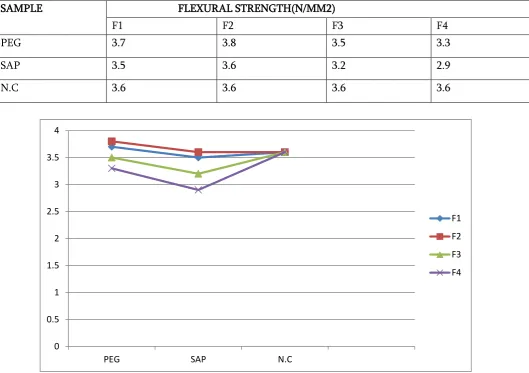
When ‘a’ is less than 20cm but greater than 17cm for 15cm specimen or less than 13.33cm but greater than 11cm for a 10cm specimen.F1,F2,F3,F4 are samples 1%,1.5%,2%,2.5% of PEG& 0.2%,0.3%,0.4%&0.5% SAP
Table 4
Graph 5. For Normal Concrete, Peg And Sap For 28 Days
The 1.5% of PEG will give the high strength compared to normal concrete. And 0.3% of SAP will give the high strength compared to normal concrete.
VI.
CONCLUSIONS
Based on above study, the following observation are made regarding the strength properties of self-curing concrete by using Two different self-curing agents such as Poly Ethylene Glycol 600 and Super Absorbent Polymer.
As percentage of self-curing agents is increased in concrete, its workability also increases.
The optimum dosage of PEG for maximium strengths(compressive,splittensile,flexural)was found to be 1.5% for M30 grade of concrete 0
0.5 1 1.5 2 2.5 3 3.5 4
PEG SAP N.C
F1
F2
F3
F4 SAMPLE FLEXURAL STRENGTH(N/MM2)
F1 F2 F3 F4
PEG 3.7 3.8 3.5 3.3
SAP 3.5 3.6 3.2 2.9
The optimum dosage of SAP for maximium strengths(compressive,splittensile,flexural)was found to be 0.3% for M30 grade of concrete
Self-curing concrete gives more strength than normal concrete. And PEG gives slightly more better strength than SAP.
Self-curing concrete is the answer to many problems faced due to lack of proper curing.
VII.
FUTURE SCOPE OF STUDY
It can become a new practice in construction field of replacing conventional concrete with internally cured concrete to skip curing process. It can be used for normal as well as high strength concrete. More of research can be done such as self internally cured concrete. Research on internally cured concrete in hot and cold weather condition can be done. Many other properties of concrete can also be studied such as chemical and physical properties.
VIII.
REFERENCES
[1]. DejianShen, Huafeng Shi, Xiaojian Tang, Yong Ji, Guoqing Jiang [2016] "Effect of internal curing with super absorbent polymers on residual stress development and stress relaxation in restrained concrete ring specimens"Construction and Building Materials 120 (2016) 309–320.
[2]. Chiwon Song, Young Cheol Choi, Seongcheol Choi [2016]"Effect of internal curing by Super Absorbent Polymers – Internal Relative Humidity and Autogenous Shrinkage of alkali-activated slag mortars" Construction and Building Materials 123 (2016) 198–206.
[3]. Patel ManishkumarDahyabhai, Prof.Jayeshkumar, R. Pitroda [2013] "Self-curing concrete: new technique for concrete curing - a literature review". Journal Of International Academic Research For Multidisciplinary
Impact Factor 1.393, Volume 1, Issue 9, October 2013.
[4]. M.V.Jagannadha Kumar, M. Srikanth, K. JagannadaRao [2012] "strength, Characteristics of selfcuring concrete" IJRET ,Vol: 1, Issue:1,pp 51-57, September 2012.
[5]. Sri Rama Chand Madduru, Swamy Naga RatnaGiriPallapothu, Rathish Kumar Pancharathi,Rajesh Kumar Garje, RaveenaChakilam [2016] "Effect of self-curing chemicals in self compacting mortars" Construction and Building Materials 107 (2016) 356–364.
[6]. A.AielsteinRozario, Dr.C.Freeda Christy, M.HannahAngelin [2013] "Experimental Studies on Effects of Sulphate Resistance on Self-Curing Concrete" International Journal of Engineering Research & Technology (IJERT) ISSN: 2278-0181 Vol. 2 Issue 4, April 2013.
[7]. K.Vedhasakthi1, M. Saravanan [2014] "Development of normal strength and high strength self-curing concrete using super absorbing polymers (sap) and comparison of strength characteristics". IJRET: International Journal of Research in Engineering and Technology, vol.3, issue.10 pISSN: 2321-7308. Oct-2014
[8]. KamathamRadhakrishna, K. Rajasekhar [2015] "An experimental investigation on selfcured concrete". International Journal of Advanced technology in engineering and science vol. No.3, issue.9, September 2015.
[9]. P.Muthukumar, K. Suganyadevi [2015] "Flexural behaviour of self compactingself-curing concrete beam". International Journal On Engineering Technology and Sciences – IJETS ISSN (P): 2349-3968, ISSN (O): 2349-3976 Volume 2 Issue 4, April -2015.
Emerging Trends in Engineering and Development, Issue 3, Vol.2 (March 2013), ISSN 2249-6149.
[11]. Nirav R Kholia, Prof.BinitaAVyas, Prof. T.G. Tank [2013] "Effect on concrete by different curing method and efficiency of curing compounds – a review". International Journal of Advanced Engineering Technology, vol.4, issue.2. E-ISSN 0976-3945. April-June 2013. [12]. Magda I. self-curing concrete (SCUC)". HBRC
Journal (2015) 11, 167–175.
[13]. J. Saran behaviour of m25 concrete mix". International journal of engineering research-online Vol .3 Issue.5, ISSN:2321-7758, Sep-Oct 2015.