FACTORS AFFECTING THE GROWTH OF E-COMMERCE IN JORDAN ZakariaIssa Saleh
IT Program. The American Intercontinental University (AIU) [email protected]
ABSTRACT
This study examines the barriers to E-commerce growth in Jordan. The adoption rate of e-commerce in Jordan is significantly lower when compared to other undeveloped countries, even though the overall e-commerce growth is slow, broadband communication is widely available, and Jordan has multiple internet service providers (ISPs) . After a review of existing literature on the adoption of information systems, the choice was made to use the two core constructs of TAM (Perceived Ease of Use, and Usefulness) and some of the previously used Constructs, and then extended upon them to incorporate cultural factors, assuming that it can play an important role and shapes consumers’ perceptions towards a technology, and therefore, it can affect the intention to use and adopt e-commerce. the research found that Security risks was perceived by non-adapters as the highest barrier, followed by uncertainty avoidance and lack of trust in virtual stores, and thus they are proved to be significant determinant of the intention to use e-commerce. The study suggested that ease of use couldn’t be the only predictive criterion for an individual’s adoption of a technological innovation. The findings of this study add support to the contention that predicting user adoption of a computer-based innovation or product is more complex than just measuring ease of use
1. INTRODUCTION
E-commerce has a potential to add value to businesses and consumers in developing countries as it did in the developed countries. Yet Jordan as most developing countries didnot gain the full benefits offered by modern information and communications technologies, which furnishes the “runway” for e-commerce take-off. It is true that some business sectors like the financial institutions as well as the government are providing some and limited electronic services, but statistics indicate that the number of all Jordanian industrial, service and/or trade companies that have a registered website is around 700. However, this does not cover much of the potential service that ecommerce can offer. This study will attempt to find the factors affecting the growth of commerce in Jordan as well as the future outlooks based on the current existing technology and telecommunication infrastructure.
2. PROBLEMS AND CHALLENGES
A Monthly Double-Blind Peer Reviewed Refereed Open Access International e-Journal - Included in the International Serial Directories
represents positive growth of a 10 percent annual increase, and suggests that a 10.3% of total retail sales in the U.S. will be online purchases. On the other hand, The Arab Advisors Group survey indicates that e-commerce users in Jordan have spent an estimated $192 million in e-commerce transactions (paying for services is around $75 million, pay bills online around $42 million, and buying products online around $75 million) and that the number of Jordan Internet users who use e-commerce are about 181,000 which is around 3.0% of the total population in Jordan (The Arab Advisors Group, 2010).In 2011, the number of e-commerce users in 2011 was estimated at around 514,000, or around 8.2 per cent of the total population of Jordan (Ghazal, 2012).If we assume that this will present a trend for an annual increase of e-commerce usersJordan, it looks like, with such high increase, it will take a very long time to have well established e-commerce services in the country. However, while e-commerce facilities have been developed by various service providers, e-commerce is still in the developmental stages of use for the business community (US Department of Commerce, 2013).
A second issue is that the business organizations in Jordan have also developed competitive strategies when using the technology to expand their customer,but the fact is, it is still a dream to go online and look for an apartment for rent, or buy/sell a used car in Jordan, when it is possible to buy groceries and order your lunch online in the developed countries. All you need is a computer and an Internet, which both are not harder to access in Jordan than they are to access in any developed country. Given the bad economic situation in Jordan for instance, the initiative to bridge the global digital divide may even sounds like a mission impossible.
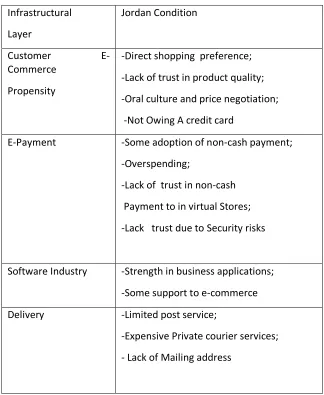
Table 1: Current Situation facing E-Commerce Growth in Jordan
Infrastructural
Layer
Jordan Condition
Customer
E-Commerce
Propensity
-Direct shopping preference;
-Lack of trust in product quality;
-Oral culture and price negotiation;
-Not Owing A credit card
E-Payment -Some adoption of non-cash payment;
-Overspending;
-Lack of trust in non-cash
Payment to in virtual Stores;
-Lack trust due to Security risks
Software Industry -Strength in business applications;
-Some support to e-commerce
Delivery -Limited post service;
-Expensive Private courier services;
- Lack of Mailing address
A Monthly Double-Blind Peer Reviewed Refereed Open Access International e-Journal - Included in the International Serial Directories
2.1 Technology Readiness as A Barrier to E-Commerce
E-commerce is being described as the utilization of various IT tools that support the advancement and development of business activities both internally and externally (Ghobakhloo et al. 2011). The Internet is a major driving force of change in the global marketplace. It is a global information highway linking countries likeJordan with the outside world, where Jordan is considered to be one of the more advanced countries in the region in this field. Even though the overall internet penetration rate is low, broadband is widely available, and Jordan has multiple internet service providers (ISPs) (US Department of Commerce, 2013). E-commerce provides exceptional opportunities for expanding commerce, disseminating investment, easing business transactions, providing a larger and diverse market, as well as supplying an great marketing tool. However, businesses in developing countries are faced with different challenges than businesses in developed countries (Ghobakhloo et al. 2011), where e-readiness can be classified as one barrier that houses all other barriers to e-commerce adoption in developing countries including Jordan. This represents the ability of a country, an organization or an establishment to create, adopt, diffuse and use various components of the networked economy (Uzoka et al. 2007). E-readiness in developing countries is low when compared with the developed countries which may be responsible for the slow rate of e-commerce adoption in those countries. In addition, Nath and Standing (2010) highlight the influence of company size upon the adoption of e-commerce and also claim that the adoption of e-commerce is directly related to the type of industry to which the organization belongs. Compared with developed nations, e-commerce has not been as successfully adopted in developing countries (Al-hudhaif and Alkubeyyer 2011), which suggests that the development of EC in developing countries is relatively low. Developing countries are still slow to keep up with emerging IT solutions to aid e-commerce (Kapurubandara and Lawson 2006).
3. RESEARCH OBJECTIVES
This research will look into the factors and barriers that affect e-commerce growth in Jordan. It will provide an overview of the different success criteria and then identify the key factors that can effect e-commerce growth and success. The primary research question in this study is trying to identify and determine the internal and external barriers that are preventing the growthof e-commerce in Jordan?
3.1 Research Questions
Focus: What are the barriers facing e-commerce in Jordan?
1. Q1: How would perceived ease of use, usefulness and convenience affect the intention of Jordanian consumers to use e-commerce?
2. Q2: How does quality evaluation affect the intention of Jordanian consumers to use e-commerce?
3. Q3: How does uncertainty avoidance affect the intention of Jordanian consumers to use e-commerce?
4. Q4: How does perceived security risks affect the intention of Jordanian consumers to use e-commerce.
6. Q6: How would the social challenges affect the intention of Jordanian consumers to use e-commerce?
3.2 Research Limitations
In this study, the dependent variable is the behavioral intention of Jordanian consumers to use e-commerce. The construct of attitude has been taken out in order to simplify the study, which is consistent with previous studies (Hong et al. 2001, Salisbury et al. 2001, and Wang et al. 2003). Furthermore, the construct actual usage was omitted because behavior intention to use is a more appropriate measure to use than actual usage in line with Agarwal and Prasad (1999) and Cheng et al. (2006).
4. Methodology and Research Hypotheses
The method of research chosen for this study will be a survey research. The survey questionnaire will collect data regarding consumer’s characteristics, consumers’ attitude scores, and consumers’ interest in e-commerce service. A questionnaire is an effective method used to collect information regarding sample’s characteristics, and opinions. The findings from survey questionnaires can then be generalized to the larger population the sample is representing.In addition, current trends in the technology deployment within the business sectors as well as the current state and applicability of e-commerce in Jordan will be evaluated through the published literature and available statistics. The research will be based on the assumption that Jordan has adequate and efficient e-commerce requirements in general; therefore, the stress of the study is to try and measure whether or not there exist suitable and or appropriate community culture. This research will also discuss a series of studies that provide an empirical evaluation of e-commerce factors and barriers in other developing countries , and uses the experimental results to begin building a body of knowledge about these type of barriers and try an propose a systematic approach to overcome these barriers. The research questions and the research hypotheses are mapped in table 2.
Table 2: Research Questions and Hypotheses Association
Question Number
Associated Research
Hypotheses
Q1 H1, H2, H3, H4
Q2 H5. H6
Q3 H5, H7
Q4 H8, H9
Q5 H6, H8
A Monthly Double-Blind Peer Reviewed Refereed Open Access International e-Journal - Included in the International Serial Directories
4.1 Perceived Ease of Use, Usefulness and Convenience
The technology acceptance model (Davis 1989) is one of the most widely used models of IT adoption. According to TAM, IT adoption is influenced by two perceptions: usefulness and ease of use. Many researchers had shown that perceived usefulness affects IT adoption, but others had mostly failed to do so regarding perceived ease of use (Verma,2001; Gefen& Straub 2000; Scannell,1997). In addition, convenience plays a prominent role in choices of today’s consumers. E-commerce aims to utilize the technology to allow shoppers to experience convenient, instant and suitable shopping at unrestricted time and place.
H1: Perceived ease of use has direct effect on perceived usefulness
H2: Perceived usefulness has direct effect on Intention to use.
H3: Delivery time has direct effect on Convenience
H4: Convenience has a direct influence on Intention to use
4.2 Uncertainty Avoidance
Uncertainty avoidance is one of the five cultural dimensions presented by Geert Hofstede in his 1980 book, Culture's Consequences as a society's tolerance for uncertainty and ambiguity and reflects the extent to which members of a society attempt to cope with anxiety by minimizing uncertainty (Hofstede 1980). Consistent with this, it is possible that uncertainty avoidance will affect the way individuals choose to purchase online. According to the authors face-to-face and telephone communication are information rich channels because of the richness of the cues that are transmitted to the listener Hsiao (2009); Wang et al. (2006); Steinfield et al.(2001); Steinfield et al.(2002). In addition, Consumer trust plays an important role in adoption of any technology.
H5: Quality evaluation has direct effect on Uncertainty avoidance
H6: Quality evaluation has direct effect on trusting virtual Stores
H7: Uncertainty avoidance has direct effect on the intention of Jordanian consumers to use to use e-commerce.
4.3 Perceived Web Security
H8: Perceived Security risks has direct effect on trusting virtual Stores
H9: Perceived web security positively affects the intention of Jordanian consumers to use e-commerce.
4.4Unified Mailing Address and Delivery times
Product delivery is critically important. In general, the mail is delivered to a well-known establishment, or a P O Box because of the lack of defined street addresses acceptable to the various delivery services like FedEx, DHL, etc. In many cases, these companies would call the recipient into their faculties to come and pick up the mail. Therefore, this research identifies the mailing system in the country as an obstacle to e-commerce adoption.
H10: lack of defined home address has a direct effect on the intention of Jordanian consumers to use to use e-commerce
H11: lack of defined home address has a direct effect on the Delivery times
4.5Credit Cards Availability
There are multiple benefits to having a credit card including being a convenient method of making payments for shopping, and more importantly when shopping online. In addition, when the shoppers want to buy something that is way out of their budget at the moment, they can chose to carry the transaction through using a credit card and then make the payments in instalments.
H12: Not having a Credit card has a direct effect on the intention of Jordanian consumers to use to use e-commerce.
4.6Instrument Testing
A Monthly Double-Blind Peer Reviewed Refereed Open Access International e-Journal - Included in the International Serial Directories
Table 3: Cronbach’s Alpha of the Research’s Measurement Instrument
Construct Pilot Test Alpha Field Alpha
Items n=40 Items n=315
Perceived Ease of Use 4 0.681 4 0.794
Quality Evaluation 3 0.814. 3 0.81
Perceived security 3 0.725 3 0.764
Perceived Trust 5 0.903 5 0.846
Delivery Times 3 0.934 2 0.881
Uncertainty avoidance 5 0.738 4 0.833
Perceived Usefulness 4 0.887 4 0.88
Credit card 2 0.854 2 0.882
Convenience 5 0.853 5 0.868
Mailing address 2 0.697 2 0.86
Table 4: Scale items of the Questionnaire
Variable Scale item Statements Source
Perceived Ease of Use My interact with e-commerce is easy for me to understand Davis, [1989]
E-commerce makes it easier to do conduct my transactions Davis, [1989]
I find it easy to recover from errors encountered when
buying online Davis, [1989]
Overall, I believe that online banking is easy to use Davis, [1989]
Quality Evaluation
I do not need to test and trial of products New Item
I will only buy a product that I am familiar with New Item
I can conveniently change or return a low-quality product New Item
Perceived security
I believe my information will not be lost during a session Yousafzai et al [2009]
I believe that the security system will confirm my identity
before disclosing account information Yousafzai et al [2009]
I believe that the security system provides a secure
Variable Scale item Statements Source
Perceived Trust in virtual stores
E-Commerce is reliable. New Item
Using E-Commerce , I can rely on business to keep the
promises that they make. New Item
I Will not trust online purchasing until I have clear evidence
that it can be trusted New Item
Virtual stores cannot be trusted; there are just too many
uncertainties. New Item
E-Commerce has the chance of fraud. New Item
Delivery Times
Products will be delivered to me within reasonable time New Item
I can expedite the deviltry time for argent products New Item
Uncertainty avoidance
Product information must be spelled out in detail New Item
I cant be sure of the legitimacy of business or the website New Item
I believe that my transaction information will only reach the
target bank account Chellappa [2003]
I believe that the security system stops any unauthorized
changes to a transaction Chellappa [2003]
Perceived Usefulness
E-Commerce transactions save more time. Davis, [1989]
E-Commerce makes it easier for me to do shopping. Davis, [1989]
E-Commerce provides me prompt and efficient services. Davis, [1989]
E-Commerce provides systems to give appropriate
feedback. Davis, [1989]
Credit card I have no problem Obtaining a credit card number * New Item
I can easily have a pre-charged credit card New Item
Convenience
I Could shop anytime I want to Jiang et, al [2013]
I Could order products wherever I am Jiang et, al [2013]
The websites are always accessible Jiang et, al [2013]
It is easy to understand and navigate websites Jiang et, al [2013]
I can search for desired products quickly Jiang et, al [2013]
Mailing address
It is difficult to get packages delivered to my door steps New Item
It is hard to provide details about my address New Item
A Monthly Double-Blind Peer Reviewed Refereed Open Access International e-Journal - Included in the International Serial Directories
5. DATA ANALYSIS
This study relied on primary data collection through use structured questionnaires. Two sets of questionnaires were designed. One for the Business and the second one was designed for the users.The computations were done using SPSS. Multiple regression models incorporating several independent variables were applied to analyze the relationships of the variables. The applicable formula used was:
y = a + b1 x 1 + b2 x 2 + …………. bn x n
b1 is the slope of the plane along the x1 axis and b2 is the slope of the plane along the x2 axis etc., and “a” is the intercept of the regression equation. Regression analysis was conducted to identify the factors that influence Jordanian shoppers’ attitude towards e-commerce adoption, and a second regression analysis was also conducted to explore the impact of those attitudes with the intention to purchase online. For the research hypothesis, multiple regression analysis was used to analyze the relationship between perceived usefulness, perceived ease of use, technological context and environmental context and attitude towards e-commerce adoption.
A total of 350 questionnaires were distributed where 8% of the participants reported that they did not know what e-commerce is, and did therefore not complete the rest of the questionnaire. Therefore, 315 valid questionnaires were collected and analyzed from participants between the age of 18-50 years. The targeted participants were shoppers of several major shopping malls in Jordan. Demographic data were collected regarding participants’ gender, age, education, Monthly income and familiarity with e-commerce (see table 5).
Table5: Participants’ Demographic Data
Variable Total Buyers Non
buyers Gender
Male 41 8,2 91,8
Female 59 6.1 93.9
Age
18 - 25 62.5 8.8 91.2
26 - 35 20.3 3.5 96.5
36 - 45 11.4 1.2 98.8
Over 45 5.7 1.5 98.5
Education
High School 27.6 3.9 96.1
Associate degree 29.8 5.7 94.3
University degree 36.8 1.8 98.2
Graduate degree 5.7 1.6 98.4
Monthly income
Less than $500 27.9 3.5 96.5
$500-$1000 47.6 8.1 91.9
Over $1000 25.5 2.8 97.2
E-commerce Familiarity
Of the participants, 129 (41%) were males, and 186 (59%) females. All age groups were represented. Of the analyzed questioners 46.7% were regular Internet users, 27.3 % use it occasionally, 14.0% had only tried. 7.9 % had not yet tried, but reported that they were interested to. Another 4.1% had not yet tried, and had no intention to do so. 11.4% reported that they had made purchases over the Internet. As many as 60.6% had not yet made any purchases, but were interested to, whereas 27.9% had no intention to shop online.
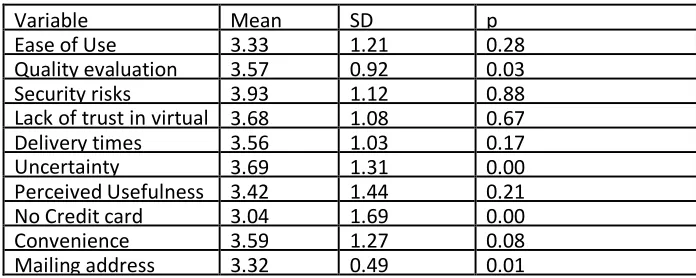
Results indicated that non-adapters showed higher means regarding eight of the ten tested Construct which includes; being not able to touch or inspect the product for quality evaluation (M = 3.57, sd. = 0.92), not owning a credit card (M = 3.04, sd. = 1.69 ), Perceived Usefulness (M = 3.60, sd. = 1.36), Perceived Security (M = 3.93, sd. = 1.12), product delivery times (M = 3.56, sd. = 1.03), Convenience (M = 3.59, sd. = 1.27), Lack of trust in virtual Stores, (M=3.68 sd. = 1.08 ) and not having a home mailing address (M = 3.32, sd. = 0.49), while adapters showed higher mean scores in only one barrier; uncertainty avoidance (M = 3.69, sd. = 1.31). Ease of use scored almost the same for adapters and non-adapters ( M = 3.33, sd. = 1.21). The study suggested that ease of use couldn’t be the only predictive criterion for an individual’s adoption of a technological innovation. The findings of this study add support to the contention that predicting user adoption of a computer-based innovation or product is more complex than just measuring ease of use (Verma,2001; Gefen& Straub 2000; Scannell,1997), where security risks was perceived by non-adapters as the highest barrier , followed by uncertainty avoidance and lack of trust in virtual stores, and not owning a credit card and not having a mailing address were perceived by non-adapters as the lowest barriers (see table 6).
Table 6: Top nine barriers perceived by Jordanian Shoppers
Variable Mean SD p
Ease of Use 3.33 1.21 0.28
Quality evaluation 3.57 0.92 0.03
Security risks 3.93 1.12 0.88
Lack of trust in virtual stores
3.68 1.08 0.67
Delivery times 3.56 1.03 0.17
Uncertainty avoidance
3.69 1.31 0.00
Perceived Usefulness 3.42 1.44 0.21
No Credit card 3.04 1.69 0.00
Convenience 3.59 1.27 0.08
Mailing address 3.32 0.49 0.01
6. CONCLUSIONS
A Monthly Double-Blind Peer Reviewed Refereed Open Access International e-Journal - Included in the International Serial Directories
constitute a small percentage of the total global users, reflecting the fact that the current distribution of Internet access needs to be restructured, especially when firms already using theInternet consider the lack of network security to be the primary problem. Among many potential users, a serious lack of confidence in e-commerce impedes usage. This research found that firms make balancing usage of video conferencing and otherCommunication methods such as telephone, e-mail, and face-to-face communications. However, scarcity of information technology administrative systems and a lack of experience makefirms hesitate to utilize e-commerce fully to digitize all of the administrative works related tobusiness transactions. High costs and fees to start e-commerce by utilizing e-marketplacesare a severe hindrance, especially for enterprises incapable of developing their own systems. Building trust or confidence is a precondition for doing e-commerce in a country like Jordan.
Without trust or confidence, the very effort of promoting e-commerce in developingcountries would be fruitless. E-commerce users, however, said fears of e-fraud and delays in delivery still discourage them from making online transactions.The promotion of trust and confidence depends on a number of factors. Goldstein andO’Connor (2000) pointed out that e-commerce requires legal norms and standards coveringfor example, consumer protection, liability assignment, privacyprotection, and process and technical standards. It is necessary to prepare users, and help them build confidence in the useof ecommerce solutions. This may be done not only by the use of adequate technologies toensure technical security but also by strategic initiatives aiming at a change in user perspectives on thereliability of ICT in commercial transactions. Legal and regulatory development acts as apossible pre-condition for the promotion of such confidence.
When selecting an e-commerce platform and hosting service, the merchant needs to ensure the platform employs strong encryption for payment processing and customer data retention. The data center that physically hosts the customer data should likewise employ onsite security. If the merchant is using an online third party credit card processor, the merchant also needs to ensure the payment processor is secure. The burier that customerscan't touch and feel a product can be deteriorated by providing detailed product disruption supporting product images. Images need to fairly and accurately reflect the product. An e-commerce platform should also support the ability to attach multiple pictures to a product catalog page, allowing the consumer to view the product from multiple angles.
REFERENCES
Abid, A., Rahim, M., Sheepers H. (2013).Experienced Benefits and Barriers of e-BusinessTechnology Adoption by SME suppliers.Journal of Advanced Management Science. Vol. 1 No.2, pp 258-264.
Al-Hudhaif S, AlkubeyyerA (2011) E-commerce adoption factors in Saudi Arabia. International Journal of Business Management Vol.6 No. 9, pp122–133.
Apulu I, Latham A (2011) Drivers for Information and communication technology adoption: acase study of Nigerian small and medium sized enterprises. International Journal of Business and Management,Vol. 6, No. 6, pp 51–60.
Chellappa, R. K. (2013). Consumers’ trust in electronic commerce transactions: the role of perceived privacy and perceived security, Huwei University of Science Thesis, Institute of Information Management
Duan, X. (2012). Evaluating the Critical Determinants for Adopting E-Market in Australian Small-and-Medium Sized Enterprises, Management Research Review, Vol.35, No. 3/4, pp.289-308
Geert Hofstede, Culture's Consequences: International Differences in Work-Related Values. Beverly Hills CA: Sage Publications, 1980
Gefen, D., Karahanna, E. and Straub, D.W. (2003) “Trust and TAM in Online Shopping: An Integrated Model”, MIS Quarterly, Vol. 7, No. 1, pp 51-90.
Gefen, D. and Straub, D. W. (2000) "The Relative Importance of Perceived Ease of Use in IS Adoption: A Study of E-Commerce Adoption," Journal of the Association for Information Systems: Vol. 1: Issue. 1, Article 8.
Ghazal, M (2012), E-commerce spending nearly doubled in 2011 — report, The Jordan Times, issue: Apr 27, 2012.
Ghobakhloo D, Arias-Aranda D, Benitez-Amado J (2011) Adoption of E-commerce applications in SMEs.Industrial Management & Data Systems.Vol. 111No. 8, pp 1238–1269.
Goldstein, Andrea and David O’Connor (2000), E-Commerce for Development: Prospects and Policy Issues, Technical Papers No. 164,Paris.
Harrison A, Van Hoek R (2011) Logistics management and strategy: competing through thesupply chain, 4th ed. Prentice Hall, England
Heyman, R., & Pierson, J. (2011). Social media and cookies: challenges for online privacy. The Journal of Policy, Regulation and Strategy for Telecommunications, Information and Media, Vol. 13, No. 6, pp 30– 42.
Imaita I. G. (2013).Training as a Factor Influencin Adoption of Innovations along Mango Value Chains in in Meru County, Kenya.International Journal of Marketing Studies, Vol. 5, No. 2, pp 74-90.
Jiang, L., Yang, Z., & Jun, M.(2013). Measuring consumer perceptions of online shopping convenience. Journal of Service Management, Vol 24, No. 2, pp 191-214.
Kapurubandara, M., & Lawson, R. (2006).Barriers to Adopting ICT and e-commerce with SMEs in Developing Countries; An Exploratory Study in Sri Lanka.Proceedings of the 9th international conference on Collaborative Electronic Commerce Technology and Research, Adelaide, Australia, ISBN: 0-864187831.
Krapf, E. (2007). A Perspective On Internet Security. Business Communications Review, Vol. 37, No. 6, pp 10–12.
Love, P.E.D., Irani, Z., Li, H., Cheng, E.W.L and Tse, R.Y.C (2001), ‘An empirical analysis of the barriers to implementing e-commerce in small-medium sized construction contractors in the state of Victoria, Australia’, Construction Innovation, vol.1 No1, pp. 31-41.
Ming-Hsiung Hsiao (2009), Shopping mode choice : physical store shopping versus e-shopping. Transportation research : an international journal , Vol. 45.No 1, pp. 86-95.
A Monthly Double-Blind Peer Reviewed Refereed Open Access International e-Journal - Included in the International Serial Directories
Pedersen, P. E. (2001) Adoption of mobile commerce: An exploratory analysis. SNF-Report No. 51/01. Bergen, Norway, Institute for Research in Economics and Business.SBN 82-491-0175-8
Popoola N. (2013), The Effect of Trust in Adoption of Internet Banking: A case study of Nigeria.
International Journal of Economic and Business Management. Vol.1 No 2, pp. 19-24.
Roggio, A, (2013), Ecommerce Challenges for 2014, Practical Ecommerce, issue of December 18, 2013.
Rolf H. Weber (2010), Internet of Things – New security and privacy challenges, computer law & security review Vol. 26, Issue 1, pp 23–30.
Steinfield, C, Bouwman, H and Adelaar T (2001).Combining Physical and Virtual Channels: Opportunities, Imperatives and Challenges. e-Everything: e-Commerce, e-Government, e-Household, e-Democracy. 14th Bled Electronic Commerce Conference Bled, Slovenia, June 25 - 26, 2001
Steinfield, C, Adelaar, T and Lai Y (2002). Integrating Brick and Mortar Locations with E-Commerce:Understanding Synergy Opportunities. Proceedings of the 35th Hawaii International Conference on System Sciences – 2002.
SucharitaMulpuru with Carrie Johnson, Douglas Roberge (2013), “U.S. Cross-Channel Retail Forecast, 2012 To 2017. Forrester Research Inc.
The Arab Advisors Group (2010), Jordan's e-commerce users spent around US$ 192 million in the past 12 months, September 19th, 2010.
Us Department of Commerce (2013,) Doing Business in Jordan: 2013 Country Commercial Guide for U.S.
Companies. Retrieved fromthe www on July 20,2014 at:
http://photos.state.gov/libraries/jordan/444376/pdf/2014CCGFinal.pdf
Uzoka F, Shemi A, Seleka G (2007) Behavioral influences on e-commerce adoption in adeveloping country context. The Electronic Journal of Information Systems in Developing Countries, Vol. 31, No. 4, pp 1–15.
WebRTC (2014). A Close Look at the Future of an Emerging Technology. A survey published by WebRTC World, available at http://www.tmcnet.com/tmc/whitepapers/white-paper.aspx?id=9882
Yousafzai, S., Palliser, J., and Foxall, G., (2009). Multi-dimensional role of trust in Internet banking adoption. The Service Industries Journal Vol. 29, No. 5, pp 591–605.