Developmental Relationship Programs: An
Empirical Study Of The Impact Of
Peer-Mentoring Programs
Siamack Shojai, Central Connecticut State University, USA William J. Davis, Central Connecticut State University, USAPatricia S. Root, Central Connecticut State University, USA
ABSTRACT
This paper provides an empirical analysis of the impact and effectiveness of developmental relationships provided through academic intervention programs at a medium-size master’s level public university in the Northeastern United States. The programs’ curriculum follows the Model of Strategic Learning’s four pillars of learning and is administered to students with diverse interventional needs.
This paper presents a brief review of the literature about effective developmental relationship programs (mentoring and coaching) in higher education. Then, Ordinary Least Squares regressions, as well as paired samples t-tests, are used to test the impact of programs offered through developmental relationships to students with varying academic deficiencies. The immediate, as well as longer-term, impact and sustainability of students’ enhanced performance is statistically examined. The paper concludes that students who fully take advantage of developmental relationships benefit the most and sustain their higher level of performance beyond the immediate post one-time intervention period. However, in the absence of additional intervention, the academic performance gains seem to subside and flatten out.
Keywords: Developmental Relations; Peer-Mentoring; Paired Sample t-tests; Strategic Learning
INTRODUCTION
his paper provides an empirical analysis of the impact and effectiveness of academic intervention programs provided through robust developmental relationships (peer-mentoring and academic coaching) to students with academic deficiencies in a medium sized university located in the Northeastern United States. A paired samples t-test, as well as an Ordinary Least Squares (OLS) regression analysis, is done to measure the immediate and longer term impact of academic intervention programs on students’ Grade Point Average (GPA). A brief review of relevant literature is provided next, followed by sections describing the structure of the academic intervention programs provided under different developmental relationships, the methodology, empirical results, a presentation of data, conclusions, and suggestions for further studies.
REVIEW OF THE LITERATURE
mentor and the mentee over a period of time when they engage in activities with growing complexity and eventually with a transfer of power from the mentor to the mentee. Any academic mentoring or other interventions must invest in a structure with a strong developmental relationships component.
Jacobi (1991) provides a critical review of the literature on mentoring from the mid-1970s to 1990. She identifies the absence of a commonly accepted definition of mentoring and the lack of a theoretical foundation since how mentoring helps students are two major concerns about the research done to 1991. She asserts that most research assumes that mentoring causes academic success without a clear demonstration of that. Many researchers (Campbell & Campbell, 2007; Flumerfeldt et al., 2007; Lennox-Terrion, 2010; McLean, 2004; Snowden & Hardy, 2012) have demonstrated that mentoring has a positive impact on the undergraduate academic experience. Snowden and Hardly (2012) use a case study method and demonstrate how peer mentoring reduces stress and anxiety as well as enhances students’ participation and adds value to students’ performance. The causality between mentorship and students’ academic performance has been examined by many researchers (Campbell & Campbell, 2000; Ferrari, 2004; Rhodes, 2008). For example, Rhodes (2008) uses a paired samples t-test and a Chi-square test to demonstrate that mentored undergraduate students had a higher GPA than non-mentored students. He also concludes that there is statistically significant evidence that mentored students have a higher graduation rate than non-mentored students. Other researchers (Jacobi, 1991; Paglis et al., 2006) have found no evidence of positive impact of mentorship on students’ academic performance.
This paper uses Ordinary Least Squares (OLS) and paired samples t-tests to examine the immediate and longer term impact of peer-mentoring on undergraduate students’ academic performance measured by cohort GPAs at a large Northeastern university in the United States of America.
STRUCTURE OF THE PROGRAM
In this university, all undergraduate students whose GPA falls below 2.00 (on a maximum 4.00 scale) and business students with a GPA below 2.5 are placed on probation and offered an academic coaching program (ACP, at the university level) or peer-mentoring program (Academic Ally program, “AAP”) in the School of Business. Coaches for the ACP are graduate students who are extensively trained to provide mentoring to undergraduate students. The Academic Ally program trains upper division undergraduate business students during a one-week “boot camp” to mentor under-performing business students. Mentors and mentees meet for at least 14 group sessions over the course of one semester and participate in a formal and well-structured curriculum. The curriculum design is based on the four pillars of learning in the Model of Strategic Learning (Weinstein & Mayer, 1986). These are the broad components which, through their interaction, describe how students become more strategic learners. These components are skill, will, self-regulation and the academic environment. The potency of this model lies in the interaction between these components. Although the effects of using the model cannot be traced to the direct effect of a single element, it is useful to describe each component in this interactive model.
The skill component refers to the types of knowledge, strategies, and tactical skills a student must possess to succeed. This component can be broken down to five elements. First, a student must have self-knowledge as a learner. Self-knowledge pertains to understanding strengths and weaknesses as a learner, personal motivation, attitudes and anxiety levels toward learning. Second, a student must have knowledge of what is required to successfully complete a given academic task so that the student knows what to think about and do in order to succeed. Third, a student must have a learning strategy in order to acquire, integrate and apply new learning. Fourth, a student must understand that new learning is often based on prior knowledge and therefore have an awareness of their personal knowledge base. Finally, a student must be able to place the new learning in a larger context, so the student will understand how new learning will potentially help them meet larger goals, whether personal, social, academic or occupational in nature.
Self-regulation is the third component of the model. This relates to the student’s ability to utilize time management and adapt a systematic approach to learning. Time management refers to a student’s ability to balance their time among many competing demands in a way that allows them to reach their learning goals. A systematic approach to learning occurs when the student is able to set a goal, develop a plan, chose a strategy to implement the plan, monitor the implementation, modify as needed, and evaluate the results. To do so, students need to monitor their stress level, motivation, concentration and comprehension.
The fourth component of the model is the academic environment, which is external to the student. This environment consists of factors such as available learning material and resources, teacher expectations, the nature of the learning activity and time constraints. The student should be able to adapt to the various types of academic environments in which they must perform in order to succeed.
The program starts with simple group activities and ends with more complex tasks. This would develop a determined and independent mindset among mentees to become academically successful. Mentors and mentees are encouraged to engage in dyad exchanges outside the group meetings.
The AAP has been offered for only two semesters. In the first pilot offering, mentees and mentors were matched on a voluntary basis after they had a chance to meet and become familiar with each other’s backgrounds. In the second semester, multiple sections of a mentoring course were offered and mentors, as well as mentees, registered for a convenient section without any prior knowledge about each other. In this setting, mentor-mentee matching was basically random and it seemed that interactions between mentees and mentors outside the class sessions were very limited compared to the first semester cohort. The peer-mentoring programs are intended to capitalize on a process (developmental relationships) that provides comfort and trust to learn from a peer. The major mentoring functions include advice and guidance, sponsorship and advocacy, and training and instructions. These are significant mentoring functions that most other researchers have identified in a typical mentorship (Jacobi, 1991).
METHODOLOGY
Jacobi (1991) asserts that many empirical studies on mentoring and academic performance assume that there is causality between the two based on measured correlations. In addition, indirect measures (such as surveys) of positive impact of mentorship on students’ academic performance based on case studies, as well as small sample size, limit external validity and internal consistency of empirical results. This paper attempts to overcome most of these flaws by using paired samples t-tests, as well as a stepwise Ordinary Least Squares, to establish causality in addition to measure correlations.
Participants
Two-hundred twenty-five undergraduate students with a GPA below 2.00 were required to participate in the ACP. Only 201 of them completed the program successfully and 24 failed to do so. These students belonged to four cohorts who were offered mentorship from Fall 2011 to Spring 2013. At the School of Business, two cohorts, composed of 32 students with a GPA between 2.00 and 2.50, participated in the School’s AAP. Twenty-seven of them completed the AAP successfully and five failed to complete the program. Additionally, a control group was created by random selection from all School of Business students who were invited to participate in AAP, but declined, and for whom GPA data was available for Spring 2012, Fall 2012 and Spring 2013 semesters (23 from the Spring 2012 warning list and 21 from Fall 2012 warning list).
RESULTS
Paired Samples T-test Estimation
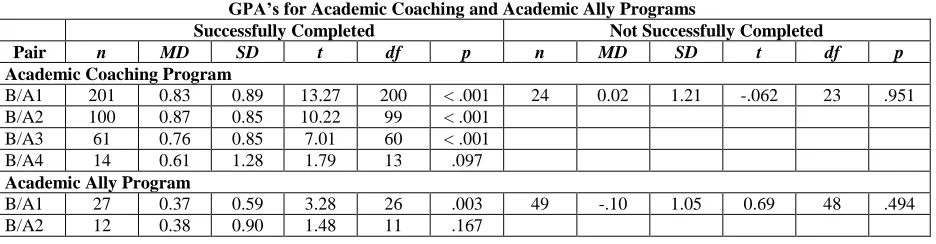
Table 1 presents the estimation results of paired samples t-tests for the Academic Coaching and Academic Ally Programs for students who successfully completed the peer-mentoring programs and those who did not. A series of paired samples t-tests were performed for students who successfully completed the ACP (n = 201). The cohort’s average GPA one semester after completion of the mentorship (GPA-A1) significantly increased (0.83 on a scale of 1 to 4) compared to before mentorship. Conversely, no significant difference was found between average GPA before and after mentorship for 24 students who did not successfully complete the program. The positive effect of participating in and successfully completing the ACP was maintained for two and three semesters after successful completion of the program (see B/A2, and B/A3 in Table 1), but due to the small sample size, no significant result was found at a one or five percent significance levels.
Also a series of paired samples t-tests similar to those done for the ACP were performed for students who successfully completed the AAP in the School of business (n = 27). Post-mentorship (B/A1, Table 1) average GPA for students who successfully completed the AA program improved by 0.37 on a scale of 1 to 4. However, and as expected, no significant difference was found between pre and post-mentorship GPA of the 49 students who either participated but did not complete the program or did not participate. The average GPA for the group who completed the AA program improved by 0.38 two semesters after completion of the program (See B/A2, Table 1); however, due to the small sample size (n = 12), the results are not statistically significant.
Table 1: Paired Samples t-Test Comparisons between Semester GPA’s for Academic Coaching and Academic Ally Programs
Successfully Completed Not Successfully Completed
Pair n MD SD t df p n MD SD t df p
Academic Coaching Program
B/A1 201 0.83 0.89 13.27 200 < .001 24 0.02 1.21 -.062 23 .951 B/A2 100 0.87 0.85 10.22 99 < .001
B/A3 61 0.76 0.85 7.01 60 < .001
B/A4 14 0.61 1.28 1.79 13 .097
Academic Ally Program
B/A1 27 0.37 0.59 3.28 26 .003 49 -.10 1.05 0.69 48 .494
B/A2 12 0.38 0.90 1.48 11 .167
Ordinary Least-Squares Estimation
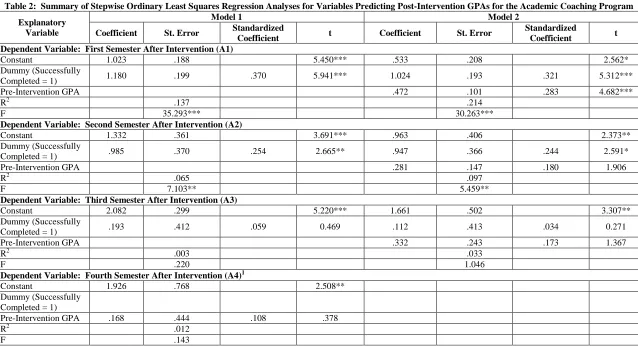
To further explore the causal effect of successfully completing the Academic Coaching and Academic Ally programs on post-intervention GPA, a stepwise OLS estimation was used to regress post-mentorship average GPA (A1 to A4) on a constant, the pre-mentorship GPA, and a dummy variable where D = 1 for successful completion of the programs and D = 0 for non-completion of the program. The estimation results are presented in Tables 2 and 3 for the ACP and AAP, respectively.
Table 2: Summary of Stepwise Ordinary Least Squares Regression Analyses for Variables Predicting Post-Intervention GPAs for the Academic Coaching Program
Explanatory Variable
Model 1 Model 2
Coefficient St. Error Standardized
Coefficient t Coefficient St. Error
Standardized
Coefficient t
Dependent Variable: First Semester After Intervention (A1)
Constant 1.023 .188 5.450*** .533 .208 2.562*
Dummy (Successfully
Completed = 1) 1.180 .199 .370 5.941*** 1.024 .193 .321 5.312***
Pre-Intervention GPA .472 .101 .283 4.682***
R2 .137 .214
F 35.293*** 30.263***
Dependent Variable: Second Semester After Intervention (A2)
Constant 1.332 .361 3.691*** .963 .406 2.373**
Dummy (Successfully
Completed = 1) .985 .370 .254 2.665** .947 .366 .244 2.591*
Pre-Intervention GPA .281 .147 .180 1.906
R2 .065 .097
F 7.103** 5.459**
Dependent Variable: Third Semester After Intervention (A3)
Constant 2.082 .299 5.220*** 1.661 .502 3.307**
Dummy (Successfully
Completed = 1) .193 .412 .059 0.469 .112 .413 .034 0.271
Pre-Intervention GPA .332 .243 .173 1.367
R2 .003 .033
F .220 1.046
Dependent Variable: Fourth Semester After Intervention (A4)1
Constant 1.926 .768 2.508**
Dummy (Successfully Completed = 1)
Pre-Intervention GPA .168 .444 .108 .378
R2 .012
F .143
* p < .05. ** p < .01. *** p < .001. 1All participants who completed a fourth semester after intervention (A4) also successfully completed the program. The variable “Successfully Completed” was not
Further, the OLS estimates indicate that successfully completing the Academic Ally program significantly contributes to improvement of one-semester post-mentoring GPA. Also, at most 8.2 percent of variations in the dependent variable are explained by successfully completing the AAP. Unlike the results of the ACP, the Pre-mentorship GPA does not explain improvement in post-mentoring GPA.
Table 3: Summary of Stepwise Ordinary Least Squares Regression Analyses for Variables Predicting Post-Intervention GPAs for the Academic Ally Program
Explanatory Variable
Model 1 Model 2
Coefficient St.
Error
Standardized
Coefficient t Coefficient
St. Error
Standardized
Coefficient t
Dependent Variable: First Semester After Intervention (A1)
Constant 2.326 .105 22.068*** 2.091 .329 6.352***
Dummy (Successfully Completed = 1)
.456 .177 .287 2.579* .436 .179 .275 2.433*
Pre-Intervention
GPA .106 .140 .085 0.752
R2 .082 .090
F 6.651* 3.589*
Dependent Variable: Second Semester After Intervention (A2)
Constant 2.348 .150 15.694*** 2.472 .500 4.948***
Dummy (Successfully Completed = 1)
.467 .259 .296 1.804 .483 .270 .306 1.792
Pre-Intervention
GPA -.057 .221 -.044 -.259
R2 .087 .089
F 3.254 1.616
* p < .05. ** p < .01. *** p <.001.
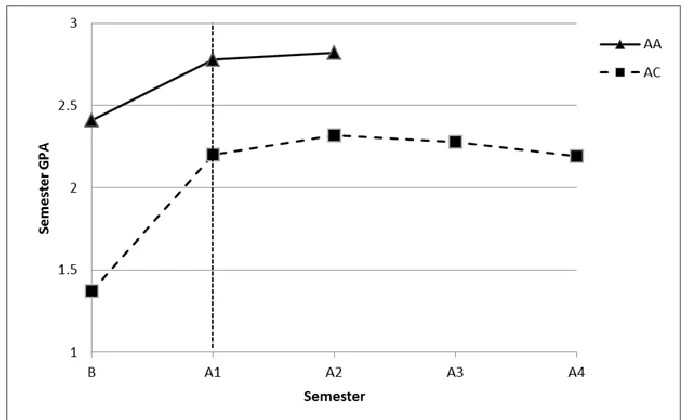
Figure 1 presents Mean GPA for participants in the ACP and AAP at the end of semesters before and after mentorship programs. The results indicate that the positive impact of the ACP is sustained at least three semesters after successful completion of the program. Because only one of the AAP cohorts had completed a post mentorship semester at the time of this writing, complete data for the AAP was not available to fully test sustainability of the impact of the mentorship program.
CONCLUSIONS
The paired samples t-tests indicate that mentoring programs at the university and school levels significantly contribute to an increase in the post-mentoring GPA of cohorts who successfully complete the programs. There is no significant difference between pre and post-mentoring GPA of cohorts that didn’t successfully complete the programs or did not participate. The OLS estimates clearly support a positive causal relationship between mentoring and academic performance improvement. Also, the significant increase in post-mentoring GPA of those in the ACP is sustained at least three semesters after the mentorship program is successfully completed without any additional interventions. To ensure external validity of the empirical results, it is suggested that at least several universities offer the same mentoring programs and create a much larger sample for estimation. In addition, survey data needs to be used to identify which components of the programs assisted the mentees to improve their academic performance. Also, the peer-mentor programs should be extended to include booster workshops beyond the first semester. This should assist to further evaluate the longer-term impact and sustainability of higher academic performance.
AUTHOR INFORMATION
Siamack Shojai has been Dean of the School of Business at Central Connecticut State University since 2007. Prior to joining Central Connecticut State University, he served as Dean of Business at State University of New York – Plattsburgh and later at Georgian Court University in New Jersey. Also, he had been professor of economics and finance at various colleges and universities including Fordham University, Manhattan College, and Marist College starting upon completion of his doctoral degree in 1984. He holds an MBA from Iona College and a Ph.D. in economics from Fordham University. His academic papers have appeared in scholarly journals such as the Journal of Energy and Development and the Journal of Economic Development. He is the editor of four volumes in the areas of global oil markets, globalization of the economy, and global budget deficits. E-mail: [email protected] (Corresponding author)
William J. Davis holds a Bachelor of Arts in Psychology and is a non-traditional graduate student at Central Connecticut State University completing his Master of Arts in General Psychology. An assistant to the Dean of the School of Business for research, accreditation, technology, and communication, Mr. Davis is also responsible for coordinating the School of Business’ tutoring center. He has served as the laboratory coordinator for the Interdisciplinary Biofeedback and Psychophysiology Center and the site coordinator for the federally funded, multi-university Brain & Alcohol Research in College Students (BARCS) study. E-mail: [email protected]
Patricia S. Root is an associate professor at Central Connecticut State University, where she teaches courses in the legal environment of business. She began her academic career in 1990, as an assistant professor at University of Hartford. Her research interests include international and intellectual property law, curriculum development and assessment, and business school administration. She held positions of interim dean and interim associate dean at Central Connecticut State University between 2000 and 2003. Professor Root was a practicing attorney prior to entering academia, with positions at several law firms in the Hartford area where she specialized in corporate and realty law. She received her J.D. from the University of Connecticut in 1982. E-mail: [email protected]
REFERENCES
1. Campbell, D. E., & Campbell, T. A. (2000). The mentoring relationship: Differing perceptions of benefits. College Student Journal, 34(4), 516.
2. Campbell, T. A., & Campbell, D. E. (2007). Outcomes of mentoring at-risk college students: Gender and ethnic matching effects. Mentoring and Tutoring, 15(2), 135-148.
3. Ferrari, J. R. (2004). Mentors in life and at school: Impact on undergraduate protégé perceptions of university mission and values. Mentoring and Tutoring, 12(3).
5. Jacobi, M. (1991). Mentoring and undergraduate academic success: A literature Review. Review of Educational Research, 61(4), 505-532.
6. Lennox-Terrion, J. (2010). Motivation of paid peer mentors and unpaid peer helpers in higher education. International Journal of Evidence Based Coaching and Mentoring, 8(1), 85-103.
7. Li, J., & Julian, M. M. (2012). Developmental relationships as the active ingredient: A unifying working hypothesis of “what works” across intervention settings. American Journal of Orthopsychiatry, 82(2), 157-166.
8. McLean, M. (2004). Does the curriculum matter in peer mentoring? From mentee to mentor in problem based learning: A unique case study. Mentoring and Tutoring, 12(2), 173-186.
9. Paglis, L. L. Green, S. G., & Bauer, T. N. (2006). Does Adviser Mentoring add value? A longitudinal study of mentoring and doctoral student outcomes. Research in Higher Education, 47(4), 451-476.
10. Rhodes, D. L. (2008). Does mentoring really work for college students? Proceedings of the Academy of Educational Leadership, 13(2), 62-66.
11. Snowden, M., & Hardy, T. (2012). Peer mentorship and positive effects on student mentor and mentee retention and academic success. Widening Participation and Lifelong Learning, 14, 76-92.