INTEGRATION OE SHADING AND
T E X T U R E gC D ^S
IN
T H E
PERCEPTION OF SOLID SHAPE
by W illiam Curran
ProQuest Number: 10106715
All rights reserved
INFORMATION TO ALL USERS
The quality of this reproduction is dependent upon the quality of the copy submitted.
In the unlikely event that the author did not send a complete manuscript and there are missing pages, these will be noted. Also, if material had to be removed,
a note will indicate the deletion.
uest.
ProQuest 10106715
Published by ProQuest LLC(2016). Copyright of the Dissertation is held by the Author.
All rights reserved.
This work is protected against unauthorized copying under Title 17, United States Code. Microform Edition © ProQuest LLC.
ProQuest LLC
789 East Eisenhower Parkway P.O. Box 1346
Acknowledgements
This work would be incomplete without recognising the advice, guidance and support o f the following people: Dr Peter Passmore, fo r meeting my programming needs in the first year o f research and introducing me to C language; Dr. Keith Langley, whom I could rely on to be frank in his criticisms; Tom Hartley, my office mate fo r the past three years; Mary Feeney, who was the primary influence in my decision to return to education, and who has since been an invaluable source o f encouragement and support; my colleagues from the vision lab, Colin Clifford, Dr Peter M Owan and Chris Benton; the sta ff and technicians at UCL Psychology department; and Mike Foulger and Claire Fazackerley, who endured endless hours o f psychophysical experiments and radio one. I am especially grateful to my supervisor, Dr Alan Johnston, who was everything that one could hope for, but rarely finds, in a supervisor.
Table of Contents
ABSTRACT
8
CHAPTER 1: INTRODUCTION
9
1.1: A Modular Approach to Vision 10
1.1.1: Neurophysiological Evidence o f Modularity 11
1.1.2: Neuropsychological Evidence o f Modularity 15
1.2: Shape from Shading 16
1.2.1: What Level o f Representation Mediates Shape from Shading? 23
1.3: Shape from Texture 27
1.4: Cue Integration 33
1.4.1: Classification o f Cue Integration 34
1.4.1.1: Veto 34
1.4.1.2: Disambiguation 35
1.4.1.3: Cooperation 36
1.4.1.4: Accumulation 37
1.4.2: The Modified Weak Fusion Model 41
1.5: Outline o f Thesis 45
CHAPTER TWO: METHODOLOGY
48
2.1: Introduction 48
2.2: Psychophysical Techniques 50
2.3: General Methods 52
2.3.1: Subjects 52
2.3.3: Stimuli Generation 56
2.3.4: Procedures 63
CHAPTER THREE: INTEGRATION OF SHADING AND TEXTURE
CUES - TESTING THE LINEAR MODEL
66
3.1: Introduction 66
3.2: Experiment One: Investigating Depth Range as a Cue to Curvature 67 3.3: Experiment Two: The Integration o f Shading and Texture: Testing the
Linear Model 73
3.3.1: Procedure 75
3.3.2: Results 76
3.4: Discussion 92
CHAPTER FOUR: FACTORS INFLUENCING
TEXTURE WEIGHT
96
4.1: Introduction 96
4.2: Invesigating Cue Availability and Reliability 102
4.2.1: Methodology 102
4.2.2: Experiment Three: Varying Aperture Size 103
4.2.2.1: Procedure 103
4.2.2.2: Results 105
4.2.3: Experiment Four: Varying Texture Contrast 109
4.2.3.1: Procedure 109
4.2.3.2: Results 110
4.2.4: Discussion 112
4.3: Which Texture Properties are Important for Curvature Perception? 114
4.3.1: Procedure 115
4.3.2.1: Results 116
4.3.3: Experiment Six: Varying Surface Contour Curvature 116
4,3.3.1: Textures used 118
4.3.3.2: Procedure 120
4.3.3.3: Results 120
4.3.4: Experiment Seven: Increasing Inconsistent Cues Difference 122
4.3.4.1: Results 123
4.3.5: Discussion 125
CHAPTER FIVE: VARYING LIGHT SOURCE POSITION: THE
EFFECT ON SHADING AND TEXTURE
WEIGHTS, AND
PERCEIVED CURVATURE
127
5.1: Introduction 127
5.2: The Effect o f Light Source Position on Shading and Texture Weights 131
5.2.1: Methodology 131
5.2.2: Experiment Eight: Varying Light Source Tilt 133
5.2.2.1: Results 133
5.2.2.2: Testing Stereo-Blind Subjects 139
5.2.3: Experiment Nine: Varying Light Source Slant 140
5.2.3.1: Results 141
5.3: Experiment Ten: The Effect o f Light Source Position on Perceived
Curvature 144
5.3.1: Results 147
5.4: Experiment Eleven: Adding Specular Highlights 149
5.4.1: Procedure 149
5.5: Experiment Twelve: The Relationship Between Texture Weight
and Perceived Curvature 154
5.5.1: Experiment 12a: Comparing Texture Weights 154
5.5.2: Experiment 12b: Light Source Position and Perceived
Curvature Revisited 156
5.6: Discussion 159
CHAPTER SIX: INVESTIGATING
3D CURVATURE CONTRAST
164
6.1: Introduction 164
6.2: Experiment Thirteen: Quantifying 3D Curvature Contrast 167
6.2.1: Results 168
6.3: Experiment Fourteen: Changing the Light Source Position 170
6.3.1: Results 170
6.4: Experiment Fifteen: 3D Curvature Contrast and Single Cues 173
6.4.1: Results 175
6.5: Experiment Sixteen: Reversing Local Contrast-Induced Interactions 175
6.5.1: Results 178
6.6: Experiment Seventeen: Perceived Contrast o f a Target Stimulus
in the Presence o f Peripheral Flanking Stimuli 182
6.6.1: Results 185
6.7: Experiment Eighteen: Perceived Curvature o f a Target Stimulus
in the Presence o f Flanking Stimuli 186
6.7.1: Results 186
CHAPTER SEVEN; INVESTIGATING THE EFFECT
OF 3D CURVATURE CONTRAST ON CUE WEIGHTS
192
7.1: Introduction 192
7.2: Experiment Nineteen: Curvature Contrast - Its Effects
on Shading and Texture Weights 196
7.2.1: Results 198
7.3: Experiment Twenty: Changes in Perceived Curvature as a Function
o f Surface Curvature and Background Curvature 204
7.3.1: Methodology 204
7.3.2: Results 206
7.4: Experiment Twenty-One: Removing Individual Cues from the Surround 207
7.4.1 : Results 208
7.5: Discussion 215
CHAPTER EIGHT: DISCUSSION
218
8.1: The Locus o f Integration for Shading and Texture 218
8.2: The Non-Linear Integration o f Shading and Texture Cues 219
8.3: What Factors Affect Cue Weights 222
8.4: Texture Properties Used in Curvature Perception 225
8.5: Shape from Shading and Texture: a Local or Global Process? 227 8.6: Light Source Position and it’s Influence On Curvature Perception 228
8.7: General Conclusions 230
ABSTRACT.
In constructing a three-dimensional perception o f our environment the visual system draws on a number o f different sources of information available in the image. It is often assumed that, at the early stages of this process, these cues to three-dimensional shape are processed independently, and are later integrated to form the three-dimensional percept. The experiments in this thesis address a number o f issues relating to the integration o f shading and texture cues. These include 1) At what level o f representation are shading and texture cues integrated? 2) Is the integration o f these cues a linear or non-linear process? 3) W hat factors influence the weights assigned to cues? 4) Is shape from shading and texture a local or global process? 5) W hat texture properties do subjects use to extract curvature information? and, finally, 6) What factors influence the perceived degree of curvature of a convex surface. Two main paradigms, perturbation analysis and 3D curvature contrast, were employed in an attempt to answer these questions.
CHAPTER ONE
INTRODUCTION
Humans have evolved several sensory systems which are employed in guiding our
behaviour in a potentially hazardous environment. These include the haptic, visual,
gustatory, auditory and olfactory systems. It could be argued that the visual system is one
o f the more complex of our sensory repertoire; up to one third o f the cerebral cortex in
humans is given over to visual perception. A core task of the human visual system is to
build up a three-dimensional representation or percept of the visual scene from a paired
sequence of two-dimensional retinal images of the scene in question. To create a
representation of depth the visual system makes use o f several cues, including occluding
contours (of which M arr (1982) identifies three classes), relative size, relative height,
famihar size, linear perspective, motion parallax, blur, shading, texture gradients, and
binocular disparity. All, except binocular disparity, are monocular depth cues. Two
additional depth cues, convergence and accommodation, provide information not from the
retinal image but from the muscles of the eye.
The past few decades have witnessed a growing interest in how the brain processes
individual cues to depth. Investigators typically test subjects’ perception of depth using
images in which a single depth cue can be manipulated in isolation. This approach to
stereopsis (Julesz, 1971), shape from shading (Ramachandran, 1988; Todd & Mingolla,
1983), shape from motion (Sperling, Landy, Dosher & Perkins, 1989; W allach &
O ’Connell, 1953), and shape from texture gradients (Cutting & Millard, 1984; Stevens,
1981; Todd & Akerstrom, 1987; Witkin, 1981) amongst others. Research of this type is
based on the assumption that the visual perception of objects is achieved by a visual
system made up of largely independent modules.
1.1 A MODULAR APPROACH TO VISION.
A system which is structurally modular contains distinct modules that are located at
different physical sites within the system. The modules in such a system may or may not
process information independently of each other. If its modules are autonomous in their
computations, then such a system would also be considered to be functionally modular.
Just as a structurally modular system can exist without being functionally modular, so too can a functionally modular system exist in the absence of modular structures.
Fodor (1983) proposes a view of modularity in which he defines a module as a subsystem
characterized by the following set of properties; 1) it is informationally encapsulated,
having access to only a very restricted amount o f information contained in the system as
a whole; 2) it is computationally autonomous, that is it does not share any general-purpose
processes (such as memory) with other modules; 3) it is domain specific, innately
specified, hard-wired, and is not assembled from more basic elements. Fodor argued that
only input systems are modular, and that central processing is carried out by a diffuse
it is carried out by equipotential central systems rather than modular input systems.
Fodor’s theory that central processing systems, those processes that occur beyond the
"observation-inference" interface, are not modular has been challenged in recent years by
neuropsychologists (see Shallice (1990) for possible examples o f central modular systems).
His proposal that input systems are modular, however, has been very influential and
widely accepted.
For M arr (1982), the primary advantage of a modular system in which a large
computation is split up and implemented as a collection o f small, autonomous sub-parts
is that a small change in one place will not seriously compromise the activities in other
places. However, if a process is not designed in this way, a small change in one place
will have consequences in many other places. Therefore, from an evolutionary
perspective, a non-modular system would be less adaptive than a modular one.
Thus there is a clear adaptive advantage in having inherited a visual system which has
evolved in a modular fashion. However, regardless of its advantages, is there any
evidence that the human visual system is functionally and/or structurally modular? There
is evidence to suggest that this is indeed the case. This evidence has been contributed,
in the main, from two fields of science - neurophysiology and neuropsychology.
1.1.1 Neurophysiological Evidence Of Modularity.
can be functionally and anatomically differentiated. This division of the visual system
into specialized pathways begins at the retina and continues through the lateral geniculate
nucleus (LGN) to the visual cortex. There are two identifiable specialized pathways
projecting from the retina to different destinations in the visual cortex, known as the M
and P pathways (Zeki & Shipp, 1988). P a retinal ganghon cells project, via the
magnocellular layers (M pathway) of the LGN, to layers 4Ca and 4B of striate cortex. The M pathway then seems to spht into two pathways, one concerned with orientation and the
other concerned with direction selectivity. From here, the M pathway projects to areas
V3 and V5 directly, and indirectly to V5 through the thick stripes of V2. The chief
functions of V3 are thought to be orientation selectivity, suggesting that it receives its
inputs from the orientation pathway which arises in layer 4B of V I, and processing
dynamic form; the primary function of V5 is motion processing (Zeki, 1993).
Pp retinal ganglion cells project, via the parvocellular layers (P pathway) of the LGN, to the blobs and interblobs of layers 2 and 3 of V I. The blobs contain cells that are
responsive to wavelength, and are thus suited to extracting information about colour;
interblobs cells, on the other hand, are mainly orientation selective and respond to
contours generated by differences in wavelength or luminance (Hubei & Livingstone,
1985; Zeki & Shipp, 1988). Thus the P pathway divides into two pathways in layers 2
and 3 o f V I; one pathway, which is concerned with colour, and a second pathway
concerned with detecting form. Both pathways project, via V2, to V4.
system appears to be more concerned with the form o f moving objects and with
generating structure from motion, whereas the P system is more concerned with colour
perception (Zeki & Shipp, 1988). However, the presence o f orientation selective cells in
both these systems suggests that both pathways are, to a greater or lesser extent, involved
in form perception. Just as neurons responsive to orientation and motion have been
isolated in several areas of the striate cortex in primates, so too have binocularly driven
neurons (Zeki, 1979) and neurons tuned to different disparities (Poggio, 1984). Such
neurons have also been isolated in the thick stripes of area V2; and in area V5 where they
have been found to be tuned to both binocular disparity and direction of motion
a partial correspondence between the subcortical and cortical pathways (Maunsel Nealey & Maunsell, 1994; Ferrera, Nealey & Maunsell, 1994).
There is now extensive evidence from primate studies demonstrating that the visual
system segregates information about the visual world. Recent research (Zeki, et al., 1991)
has demonstrated the existence of functionally specialised areas in the human visual cortex reflecting those observed in the macaque monkey. Given that we perceive the visual
world as a unified whole, with all the various properties o f objects being perceived in
exact spatio-temporal registration, one would expect to find anatomical and physiological
evidence of the integration of visual information. Zeki and Shipp (1988) describe two
types o f integration or convergence as an anatomical means of assembling information,
topical and confluent, both of which are found in all types o f cortical projections -
backward, forward and lateral. Zeki and Shipp define topical convergence as occurring
within a specialized pathway and involves integration o f an attribute across space;
confluent convergence, on the other hand, occurs between pathways and involves
seen in the colour pathway of the P pathway, where many blobs in V I project onto one
thin stripe in V2, which , in turn, is only one o f several thin stripes that project to a small
part o f V4. An example of confluent convergence between pathways is seen in the
connections between the separate zones in the temporal lobe, that receive inputs from V4
and V5, where neurons selective for faces are found in juxtaposition with neurons which
respond to body movements.
Zeki (1993) acknowledges that the integrative processes described above result in the loss
o f important information which must be recovered. For example, the enlargement of
receptive fields as a consequence of forward topical convergence results in an imprecise
topographic map and, consequently, in higher cortical areas these cells are not as able to
locate the exact position of a stimulus. Zeki proposes that the visual cortex has evolved "re-entrant pathways" that overcome this and other problems o f functional specialization,
such as compiling two or more signals from different stages of different parallel pathways.
By re-entrant pathways Zeki is referring to the diffuse return input from the various
specialized visual areas to VI and V2. Unlike the inputs reaching a specialized visual
area, re-entrant input from that area is not segregated, nor is it restricted to the area of V 1
or V2 that projects to the specialized region.
A good example of this is the re-entrant input to layer 4b of V I from V5, which
distributes to the territory of cells projecting to areas other than V5 as well as to the
territory o f cells projecting to area V5. Zeki proposes that the consequence of this
particular re-entrant pathway is the integration of the two different branches o f the M
respectively. A similar re-entrant pathway connecting area V4 with area V2 is described
by Zeki (1993); it is thought that this pathway unites signals belonging to form, motion
and colour. Unlike the projections from V I and V2 to the specialized visual areas, the
re-entrant pathways are not easily localizable and seem to lack modularity. Thus although
attributes of the visual scene, such as form or colour, are almost certainly processed by
distinct modules, the integration o f such information appears to be executed by a
non-modular system.
1.1.2 Neuropsychological Evidence Of Modularity.
Neuropsychological research provides evidence that concurs with neurophysiological
findings suggesting that the visual system is stmcturally and functionally modular. Much of this evidence has originated from clinical studies demonstrating dissociations between
disorders of visual perception. Since the turn of the century there have been reports of
patients suffering from specific deficits in the perception of shape (Efron, 1968;
W arrington, 1986), colour (Mollon, Newcombe, Polden & Ratcliff, 1980), movement
(Zihl, Von Cramon & Mai, 1983), and in the visual information necessary for the accurate
visual guidance of actions. These deficits have been found to exist independent of visual
acuity. By testing a group of patients with bilateral occipital lobe lesions, Warrington
(1986) obtained every possible pair-wise combination o f intact and impaired dimensions
for perception of location, colour, and of shape; thus demonstrating that these impairments
are distinct, and supporting the idea that the visual system has a modular architecture.
These and other clinical findings that very specific visual abilities can be selectively
visual functions are carried out in separate brain regions.
If, as the above evidence suggests, the human visual system comprises autonomous
modules involved in the independent analysis of visual information such as colour, shape,
and movement, it is possible that there exists within the visual system other subsystems
for the independent processing of visual features such as shading and texture. Such a
proposition is supported by the fact that we readily recognise images of objects defined
by either o f these two cues in isolation. The ability o f the visual system to discern images generated by just shading or texture has led to attempts at identifying the critical
characteristics o f these cues that the visual system exploits. The following two sections
give an overview of the progress to date in these two areas of research.
1.2 SHAPE FROM SHADING:
Although there has been a growing experimental interest in form perception over the past
few decades, work on shape from shading was largely neglected until the late seventies.
This was despite the fact that artists have made effective use o f shading in their execution
of paintings for several centuries. This late development was partly a consequence of the
unavailability of an appropriate technology for the systematic manipulation o f shaded images with mathematical precision. These methodological difficulties have, however,
been largely overcome by the increasing availability of computer graphic systems. The
increasing availability of such technology was accompanied by the rapid development and
years technological developments have provided valuable tools with which to investigate
and/or to simulate the visual processing o f images defined by shading (or, indeed, any
other visual cues).
A major problem encountered by those who wish to mathematically model or simulate
how the visual system processes shading information is often referred to as the
"many-to-one mapping" problem (Todd & Mingolla, 1983). This describes how the
specific intensity o f any given point on an observed surface can be generated by an
infinite number o f possible combinations o f several variables, including surface orientation
and position, surface reflectance, light-source intensity, and light source position. To
overcome this problem of image analysis, researchers in artificial intelligence adopt
simplifying assumptions that are designed to constrain the number of possible solutions
to just one. These include the assumptions that the observed surface is sufficiently far
from the observer and source of illumination such that its image approximates an
orthographic projection, each image point intensity is unaffected by cast shadows or
specularities, the "observer" has prior knowledge about the direction of illumination, and
that the observed surface is smooth (Horn, 1975; Horn, 1977; Horn, 1981; Ikeuchi &
Horn, 1981; Pentland, 1982).
Some o f the assumptions adopted by machine vision researchers clearly have no
psychological validity. For example, objects need not be far away for us to correctly
perceive their form; not all surfaces are perfectly smooth; surfaces often lie partially or
completely in cast shadows; and an observer may be unaware of a surface’s reflectance
apparent whether they have psychological vahdity or not. In such instances it is important
that these assumptions be tested empirically.
Psychophysical research (Mingolla & Todd, 1986; Todd & Mingolla, 1983) has
demonstrated that the process of representing shading-defined objects by the human visual
system is unlikely to be constrained by several o f the assumptions employed by machine
vision researchers. These include the assumptions that the environment is composed of
relatively homogenous Lambertian surfaces, that illuminant direction must be known
before shape detection can proceed, and that surface orientation is detected locally. Todd
and M ingolla (1983) report that, when given the task of judging the curvature o f shaded
cylinders that had their occluding contours masked, subjects performed more accurately
to stimuli that had specular highlights than to stimuli with dull surfaces. They also found
that subjects could accurately judge the position of the light source, and that their
performance on this task was independent of ability to judge surface curvature. These
results suggest that, when processing shaded images, the human visual system is not
constrained by the assumptions that all surfaces have Lambertian reflectance
characteristics or that explicit knowledge of the illuminant direction is a necessary
prerequisite to form detection. Similarly, Mingolla and Todd (1986) reported that
subjects’ performance on illuminant direction and surface orientation judgm ent tasks was
affected differently by the manipulation of three variables - cast shadows, highlights and object shape, thus suggesting a dissociation of the two processes. This dissociation is
contrary to what would be predicted by those models that assume knowledge of an
The suggestion that knowledge of illuminant direction is not essential for surface
orientation estimation is supported by the recent research o f Erens and colleagues (Brens,
Kappers & Koenderink, 1993a). These researchers demonstrated that, when estimating
the orientation o f a Gaussian perturbation (in the form o f either a bump or a dent) set
against a spherical background, observers did not seem to use the information about light
direction which was provided by the global shading of the background sphere. However,
knowledge o f light source position has been shown to be important in distinguishing
between concave and convex ellipsoids (Berbaum, Bever & Sup Chung, 1983; Erens,
Kappers & Koenderink, 1993b; Kleffner & Ramachandran, 1992; Ramachandran, 1988),
but not in distinguishing between elliptic and hyperbolic surfaces' (Erens, et al., 1993a;
Erens, et al., 1993b).
The assumption that the perception of solid shape from shading is a local process has been challenged by several investigators (Mingolla & Todd, 1986; Ramachandran, 1988).
Ramachandran (1988) reported that, when they are presented with two rows o f shaded
ellipses, with the intensity gradients of one row mirroring that of the other, observers
simultaneously perceive one row as convex ellipsoids and the other row as concave
ellipsoids. This, asserts Ramachandran, is evidence that deriving shape from shading
cannot be a strictly local operation. The idea that shape from shading is a global process
is indirectly supported by the experimental results reported by Mingolla and Todd (1986),
in which subjects were required to make slant and tilt judgem ents of local points on pairs
of computer-generated ellipsoids. Although the ellipsoids differed in their "eccentricity"
(the ratio of the lengths o f the longest and shortest axes), the local intensity patterns and
gradients for the two shapes had similar distributions. Yet, subjects’ performances
differed dramatically for the two ellipsoids; slant and tilt judgements were relatively
accurate for the low-eccentricity shapes, but very poor for the high-eccentricity shapes.
A local approach to shape-from-shading, argue Mingolla and Todd, would not predict such
performance differences. However, it is plausible that the visual system uses some other
metric, rather than local slant and tilt, for local shape detection; if so, then, one would
expect the above result. Similarly, Erens, et al (Erens, et al., 1993a; Erens, et al., 1993b)
report that subjects are unable to distinguish elliptic and hyperbolic surfaces on the basis
of local surface orientation even when illuminant direction is specified by the presence
of a cast shadow on the surfaces. Even when subjects were presented with stimuli
simulating a light source moving in a given direction about a shape of fixed orientation, they were unable to distinguish between the two classes of surface shapes.
Thus, although machine vision researchers have made laudable progress in developing
solutions to the shape-from-shading problem, psychophysical investigations have
challenged the psychological validity of several of the underlying assumptions and
demonstrated the psychological implausibility of other assumptions.
The machine-vision community plays a valuable role in terms of developing
computational theories o f vision that are accessible to testing for psychological validity.
This relationship between the machine vision and psychophysics communities is a
reciprocal one, in that psychophysical research is a valuable tool for identifying key
o f information for those machine-vision researchers who wish to simulate human vision.
Although it has been demonstrated through psychophysics that it is not necessary to have
explicit knowledge o f the illuminant direction in order to derive the form o f an object
defined by shading, it has been suggested that the human visual system processes shaded
images in accordance with an assumed illuminant position. The well known phenomenon
of the ambiguity o f protuberances and indentations defined only by shading and viewed
in the frontal plane was commented on as early as the 4th century B.C. (Plato, 375 B.C.),
and has led several researchers to conclude that, when the light position is not in view,
observers assume overhead hghting (Benson & Yonas, 1973; Brewster, 1826; Gibson,
1950; Kleffner & Ramachandran, 1992; Ramachandran, 1988). However, it has been
demonstrated that this assumption can be overridden or vetoed when the subject obtains explicit "knowledge" o f an apparent light source’s position prior to, but not during,
stimulus presentation (Berbaum, et al., 1983). It has also been reported that shadows
attached to unambiguous objects and cast shadows may compete with the light-from-above
assumption in interpreting the shape of ambiguous objects in the same scene (Berbaum,
Bever & Chung, 1984). Reichel and Todd (1990) have argued that, while there is
considerable evidence that an overhead illumination bias is employed by the visual
system, this explanation is applicable to a relatively narrow range of shaded images. They
reported that, even after neutralising the supposed perceptual bias for overhead
illumination by placing the light source at the point o f observation, inversion effects due
to changes in image orientation persisted. Furthermore, these inversion effects were also
perceived for surfaces depicted by texture or motion. Reichel and Todd argue that their
backwards in depth. Thus, while not denying the possible existence of a perceptual bias
for overhead illumination, Reichel and Todd suggest that it is "probably o f only marginal
significance in natural vision".
The effects on perception of systematically manipulating shaded images has led
Ramachandran (1988) to propose a number of rules for the early visual processing of
shaded images. He suggests that, as well as invoking the light-from-above assumption,
the visual system’s extraction of information about "above" and "below" is based on a
retinal, rather than a gravitational, frame of reference. He also argues that the visual
processing o f shading is a global process which occurs in the early stages of vision, and
suggests that when the single light source assumption cannot be satisfied it is replaced by
a "pointing" rule - a rule which states that shapes with similar orientations are in fact
parallel surfaces. Howard, Bergstrom and Ohmi (1990) point out that, although Ramachandran provides evidence that the assumption of a light source coming from above
is based on a retinocentric rather than a gravitational frame o f reference, the same
evidence can be used to support the view that the light-from-above assumption is based
on a headcentric frame of reference. Like Ramachandran (1988), these authors
demonstrated that a gravitational frame of reference was unlikely, but they did not attempt
to dissociate the effects of the two egocentric frames. Oberle (cited by Howard,
Bergstrom and Ohmi (1990)) approached the problem by having subjects view images of
convex and concave stimuli with upright head such that the part of the picture that was
"top" with respect to gravity and to the head was "bottom" with respect to the retina. The
results supported Ramachandran’s view that the visual system employs a retinocentric
There is also some support for the view that the extraction o f information from shading
occurs at the early stages of visual processing, thus lending support to the possible
existence of neural channels designed specifically for the processing of shape from
shading. This possibility is highlighted by Lehky and Sejnowski’s (Lehky & Sejnowski,
1988; Lehky & Sejnowski, 1990) work on a neural network model of shape from shading.
These researchers trained a neural network to accurately associate shaded images with
their three-dimensional axes of curvature. The network comprised an input and an output
layer of units, with a hidden layer between the two. The hidden units were trained, by
a back-propagation learning algorithm, to provide a transform between the retinotopic
space o f the input units and the 2D curvature magnitude and orientation parameter space
o f the output units. It was reported that the hidden units had developed receptive fields
similar to those in the cat’s visual system that had been previously identified as "edge"
or "bar" detectors (Hubei & Wiesel, 1962; Hubei & Wiesel, 1965); this was despite the
fact that Lehky and Sejnowski had purposely omitted any edge information from the
stimuh used. This, of course, is not unequivocal evidence for the existence of
shape-from-shading neurons in the human visual system. Lehky and Sejnowski
acknowledge this, suggesting that we should be cautious when attempting to deduce
neuronal function solely from determination of their receptive fields.
1.2.1 What Level of Representation Mediates Shape From Shading?
A common assumption adopted by vision researchers is the idea that three-dimensional
structures of smoothly curved surfaces are perceptually represented by point-by-point
M arr & Nishihara, 1978; Pentland, 1984; Stevens, 1984; Stevens, 1981; Witkin, 1981).
It has been argued that, if this view of shape representation is correct, it should be
possible to estimate the effectiveness o f a given cue to shape by giving subjects tasks that
involve local surface orientation and depth judgments (Mingolla & Todd, 1986; Todd,
Reichel & Mingolla, 1986). If this is the case, then, one would expect shading, which
does not provide information about absolute depth, to be a poor cue to depth and orientation.
T here is evidence to suggest that shading is a poor cue to depth in comparison with
binocular disparity (Bulthoff & Mallot, 1988). Yet, artists find chiaroscuro to be a very
effective means o f depicting surface shape. This raises the question of whether tasks involving local orientation and depth judgments require subjects to make decisions about
surface attributes that are not explicitly encoded by visual mechanisms (Todd & Reichel,
1989; Johnston & Passmore, 1994a), and casts doubt on the view that the primary form
o f representation for the visual perception of surfaces is local mappings of depth or
orientation.
Recent research suggests that surface curvature is encoded explicitly in the early stages o f visual processing, and that this "primary representation" is not mediated by a local
orientation map. Rogers (1986) has demonstrated that observers are able to match
accurately the curvature of two parabolic surfaces viewed stereoscopically from different
distances. Furthermore, observer ability to perform this task is influenced by the
orientation o f surface markings (Rogers & Cagenello, 1989), with thresholds being higher
when surface lines on a vertically oriented cylinder were oriented at 0° or 90° than when
observers were using curvature disparity in the curvature discrimination task. Stevens,
Lee and Brookes (1991) suggest that surface curvature features are detected separately by
stereo and mono processes. They further suggest that it is these surface curvature
features, rather than local, pointwise values such as depth or surface orientation, which
constitute a "common language" or representation. Recent work by Johnston and
Passmore (1994a; 1994b) provides evidence that curvature information may be represented
by the visual system in the form of an explicit description, rather than being represented
implicitly as changes in the topography of surface normals from which orientation may
be derived. Using a surface alignment task for a range o f surface curvatures defined only
by shading, Johnston and Passmore measured curvature discrimination thresholds.
Considerable precision was reported for this task, and was evidenced by reported W eber
fractions of around 0.1. Johnston and Passmore point out that, as a measure of
discrimination performance, their results compare well with a W eber fraction of around
0.1 found by E. Johnston (1991) for curvature discrimination using cylinders defined by
binocular disparity. This is strong evidence that shading is as effective a cue to surface
curvature as binocular disparity. Johnston and Passmore also reported that, whereas
rotating the light source towards the viewer resulted in increased discrimination thresholds,
slant discrimination thresholds declined. Similar results were reported when the above
experiments were run using stimuli presented stereoscopically (Johnston & Passmore,
1994b). These results are similar to the results reported by Rogers and Cagenello (1989),
who tested subjects curvature discrimination thresholds for parabolic stimuli presented
stereoscopically. It was found that the disparity range of their displays at curvature
discrimination threshold levels was one third of that required to detect a change in surface
discrimination thresholds is compelling evidence that surface curvature is not represented
by a surface orientation map; rather, it supports the notion that surface curvature encoding
is primary and does not depend upon the prior encoding of surface orientation. Similarly,
when subjects were given a shape index^ (Koenderink, 1990) discrimination task. De
Vries, Kappers and Koenderink (1994) found that varying the slant angle of a range of
object shapes had no effect on discrimination thresholds.
A further series o f experiments by Johnston and Passmore (1994c) also undermine the
notion that the visual system constructs a dense orientation map, from which higher order
geometric properties such as curvature are derived. Subjects’ precision at making
three-dimensional spatial judgments was assessed through their performance on two spatial
judgm ent tasks, arc length bisection along geodesics and geodesic alignment, with
reference to a sphere. It was argued that, if arc length is computed on the basis of a surface orientation map, subjects performance should improve as a function of increasing
the sources of information about surface orientation. However, when compared with a
control condition in which only minimal information about the surface orientation was
available, it was reported that the presence o f shading and texture in the displays had no
effect on subjects’ performance in the above tasks.
Thus, until recently, shading was regarded as a poor cue to shape perception; this is
^ Koenderink’s shape index (S) is a quantity describing objects in K^j„ space; where K^^ and are the
maximum and minimum principal curvatures at any given point on a surface. The shape index is defined by Koenderink as
5= - —ar c t an
^ ^ a x ^ i n
supported by the relatively poor performance o f subjects when making local orientation
and depth judgements of surfaces defined by shading. The implications of such findings
are surprising in light of the fact that we readily interpret objects in which shading is
virtually the sole cue to shape; for example pictures of sculptures. Consequently, the
notion that we derive higher order geometric features from an orientation map has come
under scrutiny. Recent developments suggest that the visual system does not construct
an orientation map for the purpose of extracting higher order geometric properties, such
as curvature. There is also a growing body o f evidence that the recovery of surface
curvature from shading is primary, rather than being mediated by the construction o f a
dense surface orientation map.
1.3 SHAPE FROM TEXTURE.
When compared with the shape from shading problem, the problem of deriving a
representation o f shape from surface texture has attracted relatively more attention from
vision researchers. A large proportion o f the research in this area has concentrated on the
problem of perceiving slanted surfaces from texture. This tendency o f the study of slant
perception to be closely tied to the study of shape perception is, in part, a consequence
o f the shape-slant invariance hypothesis (Koffka, 1935; cited in Braunstein (1976)), which
states that a given retinal projection is perceived as a particular 2D shape at a particular
slant; if, through the manipulation of experimental variables while keeping the retinal
M uch of the research into the perception of shape from texture evolved from the initial
w ork o f Gibson (1950), who proposed that a texture density gradient was a sufficient
stimulus for the perception of surface slant. A texture gradient is a systematic variation
in projected surface texture (Stevens, 1981); more specifically, texture density gradients
describe how the density o f projected texture elements vary as a function o f surface slant
and texture element distance from the observer. Gibson demonstrated a positive
correlation between slant judgements and displayed slant in an experiment in which
subjects viewed photographs o f slanted surfaces, which were projected onto a translucent
screen through an aperture arrangement restricting the field of view to a small circular
area within the photograph. Gibson found that subjects consistently underestimated a
surface’s slant by as much as 50%, with subjects’ accuracy being greater for surfaces with
regular texture than for those with irregular texture.
G ibson’s finding that subjects were better able to judge the slant of regularly textured
surfaces prompted other investigators to identify what types of texture regularities are
important in the perception of slant. For example, it has been suggested that size and
shape regularity are more important than the regular distribution of texture elements
(Flock & Moscatelli, 1964; Phillips, 1970). Gruber and Clark (1956) report that texture
density is an influential variable in slant judgments; they found an inverted U-shaped
function relating judged slant to mean separation of texture elements.
Gibson suggested that the important texture measure is density, and that its gradient
specifies slant. However, demonstrating that slant is equated with a surface’s texture
gradients. Although he successfully isolated the texture density gradient from other slant
cues, such as stereo, motion, and accommodation, Gibson did not isolate it from other
possible texture measures. These include decreasing texture size (scaling) and increasing
foreshortening, both of which occur with distance (Stevens, 1981). Stevens (1984; 1981)
has shown it is possible that the visual system uses the geometrical transformations
scaling and foreshortening in deriving surface distance and orientation, respectively; and
that surface shape may then be derived from these measurements. He identified a texture
measure for computing surface distance, which he called the characteristic dimension or
CD of surface texture. The CD varies only with scaling, and thus is considered to be an
appropriate cue to distance or depth. Thus Stevens argues that local surface depth values
can be estimated directly from such texture measures, rather than through the mediation
of texture gradients as proposed by Gibson.
The approaches o f Gibson and Stevens have in common the underlying assumptions that
a surface texture comprises texture elements o f uniform density and of uniform size.
However, the former assumption is not strictly true of natural textures (Gumming,
Johnston & Parker, 1993; Witkin, 1981), and it has been reported that random variations
in the sizes of individual surface elements does not affect observers’ surface curvature
judgments (Gumming, et al., 1993; Todd & Akerstrom, 1987). Stevens adopts the further
assumption that surface texture elements have an approximately circular symmetry.
However, Todd and Akerstrom (1987) report that observers’ performance on a
shape-judgment task was unaffected when a surface texture composed of
irregularly-shaped elements was substituted for one composed of regularly-shaped texture
diminished the correlations between optic element length and depth, and between optic
element compression and orientation. This, argue Todd and Akerstrom, also undermines
the notion that observers draw on point-by-point depth maps or orientation maps derived
from optical texture when constructing a representation of surface shape. Instead, they
argue that the perception of shape from texture by human observers is probably based on
a more global level of analysis. This is supported by the recent work of Gumming,
Johnston and Parker (1993), who reported that randomly varying the aspect ratios of
surface texture elements, thus controlling for the possibility that subjects could calculate
local surface orientation from the elongation o f the texture element in the image, did not
affect subjects’ performance on the "apparent circular cylinder" (ACC) task \
W itkin (1981) argues that, although some assumptions about texture geometry are necessary to successfully recover surface shape and orientation from texture, the
unpredictability of natural textures precludes the use of highly restrictive assumptions.
He proposes that emphasis should be placed on the regular nature o f projective distortion
rather than on the assumption of perfectly regular textures; he also advocates the
assumption that natural textures do not usually mimic or cancel projective effects. This
approach to perceiving shape from texture ensures that as much as possible of the
observed variation in an image is attributed to projection. Witkin proposes that the visual
system resolves the problem of projective distortion by separating the projective
component o f the image from a component intrinsic to the unprojected texture. Using this
strategy, a machine vision system demonstrated considerable success at reconstructing
images o f planar and curved surfaces. However, W itkin’s strategy fails for natural
textures that violate the assumption that texture geometry does not mimic projection, such
as wood grain. This problem is overcome, argues Witkin, by drawing on additional
sources o f information in the image, such as shading.
W itkin, like many machine-vision researchers, employs the simplifying assumption that
the image is formed through orthographic projection. However, in the real world, most
objects under our scrutiny are relatively near to us, with variation in nearness being
captured by perspective projection. Orthographic projection, on the other hand, simulates
infinite viewing distance, and is "unnatural" in terms of human vision. Orthographic
projection also nullifies the usefulness o f particular texture gradients, such as perspective
and density; cues that have been shown to be effective in the perception of slant. Cutting and Millard, for example, have demonstrated that perspective and density are probably the
primary cues to perceiving flat surfaces. This underlines the importance of choosing the
appropriate form of image projection for the study of human vision. W itkin’s approach
further assumes that surface texture is isotropic, and that the projection of such a surface
texture generates an anisotropic image texture (if the surface is not fronto-parallel).
Support for this assumption is provided by recent psychophysical research (Gumming, et
al., 1993), in which it was found that surface texture isotropy is an important contributing
factor in perceiving curvature from texture.
M uch of the research addressing the question o f what projective properties o f surface
paradigm, in which one texture cue is varied while the others are held constant. It is
possible that the mechanism employed by the visual system to resolve the cue-conflict
condition in a psychophysical experiment differs from the mechanism used to interpret
naturally occurring images, which, typically, are not composed of conflicting cues.
However, Blake, Bulthoff and Sheinberg (1993) report that the results o f such experiments
are similar to those predicted by an ideal observer model for estimating shape from
texture. Their model predicted that, as well as density being a texture cue to shape,
optical texture compression is an important texture cue to shape; and that compression
dominates density for the family of parabolic cylinders. The model’s predictions agreed
with the results of psychophysical experiments reported by Blake et al, as well as those
o f other investigations of texture as a cue to surface curvature (Gumming, et al., 1993;
Cutting & Millard, 1984; Todd & Akerstrom, 1987). Thus the practise of employing the
cue-conflict paradigm to assess the relative importance of visual cues in shape perception
appears to be justified.
The results of Blake et al’s ideal observer model and psychophysical experiments showed that the relative dominance of compression over density increased as a function of
increasing elongation of portrayed cylinders. This is in general agreement with the earlier
work o f Cutting and Millard (1984). These researchers tested subjects’ ability to assess
the three-dimensional character of projections of flat and curved surfaces receding in the
distance. They reported that, for flat surfaces, the compression gradient, accounted for
only 6% of the total variance. However, for curved surfaces, the compression gradient
accounted for a mean of 96% o f the variance. Similarly Gumming, Johnston and Parker
com pression was the strongest cue to perceived surface curvature, and that changes in
texture size and density had relatively little effect. Furthermore, they reported that the
effectiveness of the compression gradient as a cue to surface curvature was mediated by
the level o f surface texture isotropy; as surface texture becomes more anisotropic, the
effectiveness of the compression gradient is markedly reduced.
1.4 CUE INTEGRATION.
The previous sections on shape-from-shading and shape-from-texture attest to the fact that,
until relatively recently, a great deal o f research has focused on how the visual system
extracts three-dimensional information from single cues; an approach which reflects the current view that the visual system is essentially modular in nature. However, over the
past decade, a number of researchers have turned their attention to the question of how
the visual system integrates the three-dimensional information from each module to form
a unified three-dimensional depth percept. Although there had been earlier empirical
attempts at addressing this question (eg: Gillam (1968)), any possibility o f rapid progress
was hampered by the lack of appropriate technology. It was only with the advent and
accessibility of computer graphics systems that progress in this area of research became
a reality.
1.4.1 Classification of Cue Integration.
1.4.1.1 Veto: This occurs when unequivocal information from one or more "strong" cues
completely overrides the information from another "weaker" cue. Several instances of
vetoing have been reported. As early as 1925 Schriever found that there was no perceived
depth inversion when the pairings between the viewing eye and stereo photographs of
complex scenes were switched. This demonstrates that when several consistent pictorial
cues are present in the images, stereo can be vetoed if the depth information it conveys
is incongruent with that o f the pictorial cues. Similarly, other researchers (Bulthoff &
M allot, 1990; Bulthoff & Mallot, 1988; Gregory, 1970; Stevens & Brookes, 1988;
Youngs, 1976) have found that stereo is vetoed when it is placed in direct opposition to
monocular information, such as linear perspective and edge information. For instance,
Bulthoff and Mallott (1990; 1988) report that when edge information is present in images
of ellipsoids it vetoes both shape-from-shading and disparate shading. Stevens, Lees and
Brookes (1991) found that when a wireframe surface was generated by two conflicting
cues, stereo disparity and monocular surface contours, the local dominance o f either cue
over the other was dependent on the form o f the local surface area depicted by each cue.
Thus disparity information dominated the monocular information when the former
indicated curvature and the latter indicated planarity, and the monocular interpretation was
dominant where the disparity information suggested planarity.
Veto has also been reported for other cue combinations. Braunstein et al (1982) reported
that when conflicting motion parallax and dynamic occlusion cues were used to simulate
conflicting results have been shown to be related to the magnitude o f the depth separation
o f the dynamic occlusion and motion parallax cues (Ono, Rogers, Ohmi & Ono, 1988),
with motion parallax determining the perceived depth order for small depth separations
and dynamic occlusion dominating for large depth separations.
1.4.1.2 Disambiguation: Quite often the information from a single cue, say shading or
texture, is ambiguous in that there is no one unique interpretation. The inclusion of a
second cue can disambiguate the percept by indicating which one o f two opposing
interpretations is correct. A good example o f this is the use of occluding contours by the
visual system to disambiguate shading information (Ramachandran, 1988). Ramachandran
found that when two identical shading patterns were enclosed by different outlines, one
pattern was perceived as three cylinders lit from above and the other suggested a
corrugated metal sheet lit from the side (although it should be noted that the perceived
shape of the latter stimulus and the perceived position o f the light source were bi-stable).
Several other authors report instances in which the inclusion of a specific cue serves to
disambiguate a percept. For example, when viewing a transparent 3D object under
orthographic projection conditions, dynamic occlusion has been used to disambiguate the
depth order of the object’s surfaces (Andersen & Braunstein, 1983; Braunstein, Andersen & Reifer, 1982). Proffitt, Bertenthal and Roberts (1984) found that appropriate occlusion
information served to reduce the multistability of point-light "walker" displays, and
increased the likelihood of recognising such a display as a walking person. Rogers and
It has been suggested that the 3-D appearance of a surface specular reflection may be
used by the visual system to disambiguate an ambiguous concave-convex figure (Blake
& Bulthoff, 1990). Similarly, several authors have reported that, following adaptation to
an unambiguous structure-from-motion stimulus, a motion aftereffect was reported by
observers when presented with a previously ambiguous kinetic depth (KD) display
(Nawrot & Blake, 1991; Petersik, Shepard & Malsch, 1984; Rogers & Graham, 1984).
Thus the unambiguous information in the former display biased observers’ perception of
the ambiguous motion in the KD display.
1.4.1.3 Coopération: A cooperative interaction between visual processes or modules
occurs when information from one process/module facilitates the functioning o f another
process/module. Tittle and Braunstein (1990) found what they believed to be cooperative
interaction between stereo and shape-from-motion (SFM). These authors presented
subjects with computer-generated, transparent cylinders defined by conflicting depth
values o f the above two cues (stereo-defined-depth was three times that of
motion-defined-depth). When stimuli motion was halted, leaving stereo as the only cue
to depth, subjects reported that the display looked flat. However, when both cues were
presented simultaneously, subjects’ perceived depth was greater than that depicted by the
SFM cue alone. The observed five-fold increase in judged depth from the separate to the
combined conditions, argue Tittle and Braunstein, is evidence that the SFM cue facilitated
the use of stereo information. Similarly, for a shape-matching task in which the standard
was defined by stereo-disparity, Bulthoff (1991) found that subjects underestimated the
(1991) interpreted this as evidence o f cue cooperation, which they term "strong coupling".
A further example o f one cue facilitating another is reported by Buckley, Frisby and
Mayhew (1989), who demonstrated the influence that texture boundaries have over the
perception of discontinuities between neighbouring 3-D surfaces defined by stereo cues.
They found that, in the absence o f a monocularly visible texture boundary in the area
between two stereo-defined surfaces, perceived depths of the monocular texture elements
are in part determined by the adjacent stereo-defined surfaces. This may be interpreted
as an example of texture information facilitating the construction o f a 3-D surface section
which effectively bridges the gap between the stereo-defined regions. Furthermore, it was
shown that this effect could be removed by adding a distinct monocular texture boundary; in such cases the stereo-defined regions were perceived as being separated by sharp
surface discontinuities.
1.4.1.4 Accumulation: Information from different cues could be accumulated in a number
of ways, one of the simplest methods being a weighted linear combination rule. Evidence has accrued in recent years to suggest that the visual system may employ such a strategy
in the integration of information from a number of different cue combinations (Bruno &
Cutting, 1988; Dosher, Sperling & Wurst, 1986; Johnston, Gumming & Landy, 1994;
Johnston, Gumming & Parker, 1993; Landy, Maloney & Young, 1990; Maloney & Landy,
1989; Rogers & Collett, 1989; Tittle & Braunstein, 1990; Young, Landy & Maloney,
1993).
proxim ity luminance covariance (PLC), PLC being a technique first adopted by Schwartz
and Sperling (1983) in which line intensity co-varies with depth. They reported that a
simple linear model accounted for the results of their experiment. It was found that more
weighting was given to the stereo cue than to the proximity luminance covariance (PLC)
cue when subjects were presented with a still preview of a Necker-cube stimulus.
However, in the absence of a still preview, more weighting was given to the PLC cue,
thus emphasising the role of context in the assignment of weights to depth cues.
Bruno and Cutting (1988) obtained statistical support for a linear combination rule
encompassing four depth cues - relative size, height in the projection plane, occlusion and
motion parallax. A magnitude estimation procedure, in which subjects judged the relative
distance between three square panels, was employed to assess subjects’ perceived exocentric distances. Each depth cue was either present or absent in a given stimulus (an
"absent" cue provided no relative depth information), resulting in sixteen different
combinations. They found effects o f relative size, height in plane and motion parallax.
M ore importantly, the absence of significant interactions between the depth cues provided
support for the argument that a linear combination strategy was adopted by the visual
system in the processing of these depth cues. Their analysis, however, was dependent on
the assumption that each cue was either present or absent. Massaro (1988) argues that,
with the technique adopted by Bruno and Cutting it was not possible to eliminate these
depth cues, if eliminating them means to make them uninformative, and emphasises the
importance of distinguishing between a cue’s presence or absence and whether the cue
As noted earlier, Tittle and Braunstein (1990) reported a cooperative interaction between
stereo and shape-from-motion cues when these cues depicted transparent cylinders.
However, when the cues depicted opaque cylindrical surfaces the experimental results
were consistent with an additive combination of the two sources o f information. This is
supported by the observation that judged depth increased monotonically as a function of
both sources o f information, and that there was no significant interaction between the two
cues. The results of their experiments led Tittle and Braunstein to speculate that
stereopsis and SFM integration might be a two-step process, in which SFM facilitates the
resolution o f the stereo correspondence problem prior to the depth estimates derived from
the two cues being integrated in a simple additive manner. This explanation is similar to
the concept o f cue promotion (Landy, Maloney, Johnston & Young, submitted) discussed
below.
Johnston et al (1993) report that, when a texture depth cue is added to stereograms
portraying a range of surfaces (ellipsoids, cylinders and ’roofs’), subjects’ perception of
depth is increased (although not necessarily made more veridical). When both cues
portrayed incongruent depth information, the data were well accounted for by a weighted
linear rule, with stereo being more heavily weighted than texture. As in the experiments
of Dosher et al (1986) Johnston et al reported that the weight assigned to the depth cues
employed appeared to be somewhat dependent on context; as viewing distance was
increased beyond one metre, the weight assigned to texture increased and the weight
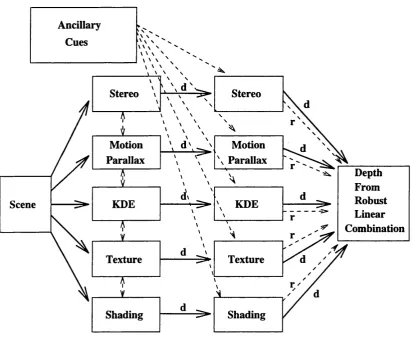
assigned to stereo decreased. Similarly, Rogers and Collett (1989) report contextual effects on the weight assigned to motion parallax when combined with binocular disparity,