68 |
P a g e
COMPARATIVE STUDY ON IRIS RECOGNITION
FOR BIOMETRIC AUTHENTICATION
D. Meenakshi
1, Dr.M.Sivajothi
2, Dr.M.Mohamed Sathik
31
Department of Computer Science, Sri ParaSakthi College for Women, (India)
2
Department of Computer Science, Sri ParaSakthi College for Women, (India)
3
Department of Computer Science, Sadakathullah Appa College, (India)
ABSTRACT
The main objective of this paper is to compare the performance of two method which are used to recognize half
iris image and Full iris image for human identification. Iris recognition is a method of identifying people based
on unique patterns within the ring-shaped region surrounding the pupil of the eye. In this paper two methods
are implemented and their performance are compared to find the best method to recognize the iris image with
high accuracy. The first method recognize the half of the iris image using Triplet Half-Band Filter Bank (THFB)
approach. The second method uses lifting wavelet approach to recognize the iris image. To analyse the
performance of these methods several performance metrics are used. This paper uses detection accuracy,
precision rate, recall rate, Error Rate and F-Measure to analyses the performance. From the experimental
results it is shown that the Lifting Wavelet method performs better than the other method.
Keywords
:Canny Edge Detection, Circular Hough transform, Gabor filters, Homogeneous Rubber
Sheet Model, THFB
.I.
INTRODUCTION
69 |
P a g e
voice recognition and handprint. Iris recognition security systems are the most appropriate security system. It is truly an easy way to identify a person.In the past few years, as a novel personal authentication technology, iris recognition has attracted a lot of attention. A great number of results have been reported to improve the performance of iris recognition systems [13]–[16]. The most well-known iris recognition algorithms are proposed by Daugman [13] and Wildes [14], which have achieved satisfactory results. Inspired by their groundbreaking achievements, many researchers have introduced new methods [12], [17]–[19] to improve the performance of iris recognition systems. In recent years, experts have diverted their attention to noisy and non-co-operative iris recognition [15], [20], which demands more robust, accurate and rapid iris segmentation and matching algorithms. Kang et al. [21] proposed an adaptive eyelash detection method based on measured focus score. In [15], a novel prediction model was established to determine a proper threshold for eyelash detection. On the other hand, feature extraction and matching are also hot research areas for iris recognition. In 2004, Ma et al. [12] introduced a set of 1-D intensity signals to effectively characterize the most crucial information of the 2-D image in the feature extraction process. Then, the 1-D method has become fashionable [18], because it embodies much stronger robustness. Recently, the communities have paid more attention to iris indexing methods with the purpose of enhancing the code searching speed in a huge iris database. In front of the tough nut, some path breaking ideas have been raised by Mukherjee et al. [22] and Mehrotra et al. [23].
This paper is to compare the performance of two method which are used to recognize the iris image for human identification. Iris has complex patterns that used as a biological characteristics, it is consider a form of biometric verification. Iris recognition is proving to be one of the most reliable biometric features for personal identification. In this paper two methods are implemented and their performance are compared to find the best method to recognize the iris image with high accuracy. The first method recognize the iris image using Triplet Half-Band Filter Bank (THFB) approach. The second method uses wavelet lifting approach to recognize the iris image. To analyse the performance of these method several performance metrics are used. This paper uses detection accuracy, precision rate, recall rate, Error Rate and F-Measure to analyses the performance. From the experimental results it is shown that the Wavelet Lifting method performs better than the other method. The remainder of the paper is organized as follows: In Section II, the overview of first method is presented. In Section III, the second method is specifically depicted, including its design idea and practical implementation approach. In Section IV, the performance of the two methods are compared. Finally, conclusions are made in Section V.
II
IRIS
RECOGNITON
USING
TRIPLET HALF BAND FILTER BANK APPROACH70 |
P a g e
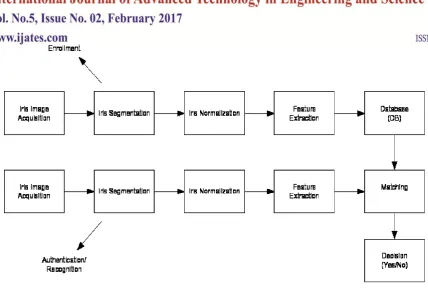
Fig. 1. Overall Block Diagram of Method1
2.1 Iris Image Manipulation
The first phase of the iris recognition method is to collect a large database consisting of several iris images from various individuals. CASIA-IrisV3 database is used for this purpose.
2.2 Preprocessing
Iris features are mostly oriented in vertical, horizontal and diagonal directions are computed by using wavelet basis. The inner half iris region is divided into six subimages and selected only four regions for further processing.
2.3 Iris Localization and Normalization
In the module this approach using some image processing algorithms to demarcate the region of interest from the input image containing an eye. The IIP Module contains two major tasks. (i) Iris Localization (ii) Iris Normalization
2.3.1 Iris Localization
Iris in the image is localized using Daugman‟s Integro-differential operator (IDO). It is used to detect the center and diameter of the iris.
2.3.2 Iris Normalization
Image is normalized using Daugman‟s Rubber Sheet Model. Using this convert iris image from Cartesian co-ordinate system to polar system.
71 |
P a g e
Upper half iris is preferred because, Region closer to the pupil provides more information and Limbic boundary sometimes may not be segmented properly.Half iris is divided into six sub regions and select only four sub regions so it reduces the effect of occlusions. THFB is applied on each four regions to extract Multi resolution based iris texture. An energy is an important characteristics in identifying texture.
(1) Wi(m,n) is the ith subband coefficients
M x N is the total number of coefficients in that subband
Feature Vector is derived by concatenating the features at different scales and orientations as E=[E1,1,E1,2,….. E1,s,Eα]
S – Total number of scales
Eα - Energy of an approximate sub band
Total number of sub bands for THFB is (3S)+1 Derived feature vector is stored in the trained database.
The test iris pattern is classified on the basis of minimum Canbera Distance (CD) between test iris FV and Trained Database.
(2) B – Dimension of FV
Xi – ith component of test FV
Yi – ith component of enrolled FV
2.4 Iris Recognition: K-out-of-n postclassifier CD‟s are obtained between two iris images as
CD = {CD1,CD2,…..CDn}
The set of corresponding Threshold values for respective n-regions. Th = {Th1,Th2,……Thn} to compute the class Threshold.
2.5 Computation of FRR(False Rejection Rate)
A person is rejected when the combination of k out on n-tests fail to recognize correctly. If the combination of k-out-of-n CS‟s > Threshold is called as Intraclass comparisons.
FRR , K=1 (3) N means Total number of intraclass comparisons.
Computation of FAR (False Acceptance Rate)
The false acceptance (FA) occurs only if any k out of n-regions passes the test(K CD‟s <= Thresholds). (4)
72 |
P a g e
For each value of K, FAR and FRR are calculated. These technique is applied on CASIA database.III
IRIS
RECOGNITON
USING
LIFTING
WAVELET
TRANSFORM
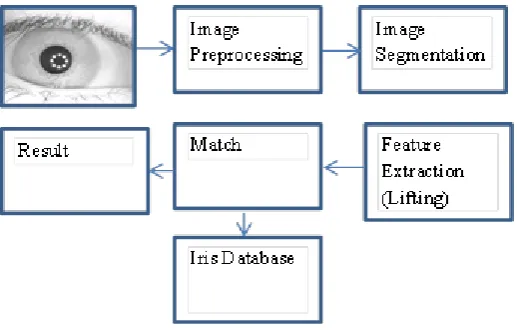
In this section, the proposed methodology for iris image recognition is presented. Figure 2 shows the processing steps that will be used. The process involves five modules and a database.
In this method, a novel, efficient approach for iris recognition is presented. The goal is to develop a lifting (integer) wavelet based algorithm that enhances iris images, reduces noise to the maximum extent possible, and extracts the important features from the image. The similarity between test and training iris images is estimated using some standard distance measures and comparison of threshold.
Fig. 2. Overall Block Diagram of Method2
3.1 Image Preprocessing
Images for CASIA database are collected and preprocessed to reduce the noise and secular reflections to improve the quality of the image. Eyelids and Eyelashes are eliminated to the maximum possible extent and then the process of normalize is carried out.
3.2 Iris Segmentation
73 |
P a g e
3.3 Feature Extraction using Lifting Wavelet Transform
Feature extraction is a key process where the two dimensional image is converted to a set of mathematical parameters. The iris contains important unique features, such as stripes, freckles, coronas, etc. These features are collectively referred to as the texture of the iris. These features are extracted using various algorithms. In this paper a lifting wavelet scheme is proposed for feature extraction.
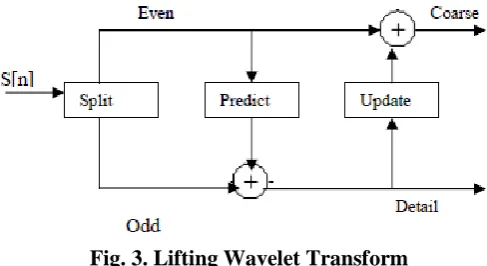
The lifting scheme is a technique for both designing wavelets and performing the discrete wavelet transform (DWT). In an implementation, it is often worthwhile to merge these steps and design the wavelet filters while performing the wavelet transform. This is then called the second generation wavelet transform.
Fig. 3. Lifting Wavelet Transform
Thus, lifting scheme contains three steps to decompose signal, that is, Split, Predict and Update, as shown in Figure 3. The original signal is s[n]. It is transformed into approximated signal c[n] in high frequency and detail signal d[n] in low frequency, i.e.:
(1) Split:
Se[n] =S[2n]
So[n] =S[2n+1]
(2) Predict:
d[n]=So[n]-P(Se)[n]
(3) Update:
c[n]=Se[n]+U(d)[n]
The decomposition of wavelet can be written as
= M(z) (5) Where M(z) is polyphase matrix and in the proposed algorithm:
(6)
Where h (z) and g(z) are the FIR filters for Haar wavelet . i.e he (z)=1/2 , ho (z)= ½ and ge (z) = -1,go (z) = 1. Thus in
74 |
P a g e
coefficients (those of c[n]) are of interest. If there are 2ndata elements, the first step of the forward transform willproduce 2n-1approximation coefficients. In case of an image of size NxM, at the Kth level coarse approximation
component will get reduced to (N/2)k(M/2)k In the proposed approach the original masked image is resized to [256, 256] and then 6th level coefficients were obtained by increasing the frequency. After sixth level image size becomes
too small to be useful.
3.4 Iris Matching
In order to make the decision of acceptance or refusal, a distance is calculated to measure the closeness of match. The extracted features of the iris are compared with the iris images in the database. Following three distance measures have been considered and maximum of the distance between iris images of the same person in the database is considered as the threshold.
Euclidean Measure 1:
Find the closeness of match between two iris feature templates. It is calculated by measuring the norm between two vectors X and Y respectively of two images under consideration.
EM1 = (7)
Euclidean Measure 2:
The difference between the maximum value of input image (Max_1) and database image (Max_2)
EM2= (8)
Distance Threshold (DT) is calculated by square of the difference between the threshold maximum value of input image and database image of the 6th level decomposition.
DT={Max(max_1-max_2)}2 (9)
IV PERFORMANCE ANALYSIS
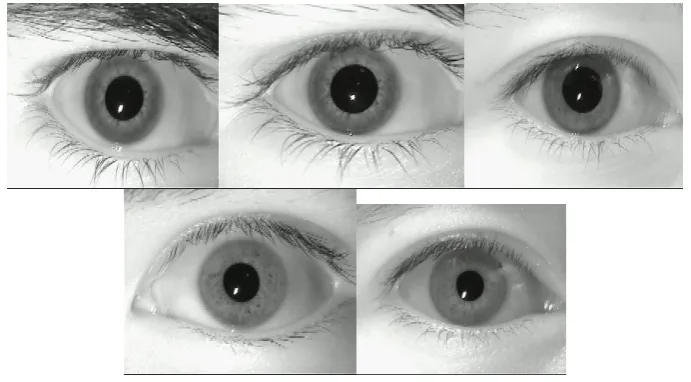
4.1. Expiremental Images
75 |
P a g e
Fig. 4. Expiremental Images
4.2 Performance Analysis
To evaluate the performance of the iris recognition techniques several performance metrics are available. This project uses the detection accuracy, precision rate, recall rate, Error Rate and F-Measure to analyses the performance.
4.3 Precision Rate
The precision is the fraction of retrieved instances that are relevant to the find.
(10)
where TP = True Positive (Equivalent with Hits) FP = False Positive (Equivalent with False Alarm)
4.4 Recall Rate
The recall is the fraction of relevant instances that are retrieved according to the query.
(11) Where TP = True Positive (Equivalent with Hits)
FP = False Negative (Equivalent with Miss)
4.5 F-Measure
F-measure is the ratio of product of precision and recall to the sum of precision and recall. The F-measure can be calculated as,
76 |
P a g e
4.6 Detection Accuracy
Detection Accuracy is the measurement system, which measure the degree of closeness of measurement between the original detected face and the detected face by the proposed method.
(13)
where, TP – True Positive (equivalent with hit) FN – False Negative (equivalent with miss)
TN – True Negative (equivalent with correct rejection) FP – False Positive (equivalent with false alarm)
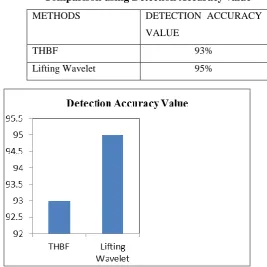
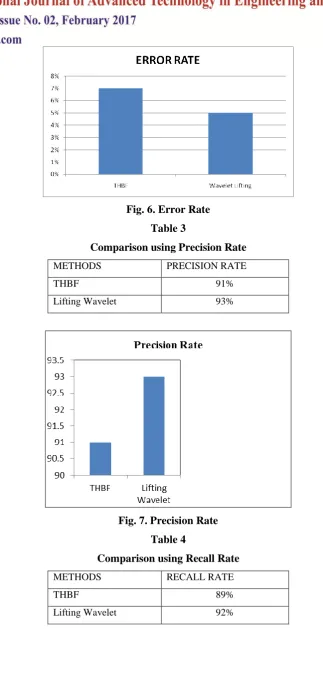
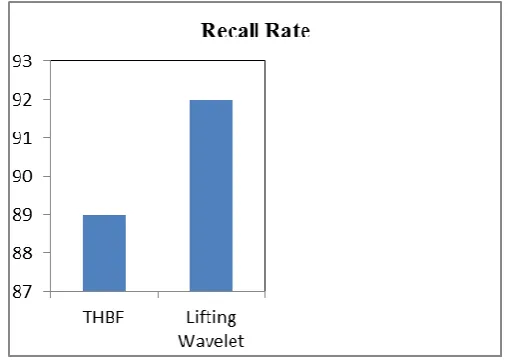
To analysis the performance of the proposed system, it is compared with various techniques by using the performance metrics which are mentioned above. This is shown in the below tables and graphs.
Table 1
Comparison using Detection Accuracy value
METHODS DETECTION ACCURACY
VALUE
THBF 93%
Lifting Wavelet 95%
Fig. 5. Decision Accuracy value
Table 2
Comparison using Error Rate method
METHODS ERROR RATE
THBF 7%
77 |
P a g e
Fig. 6. Error Rate
Table 3
Comparison using Precision Rate
METHODS PRECISION RATE
THBF 91%
Lifting Wavelet 93%
Fig. 7. Precision Rate
Table 4
Comparison using Recall Rate
METHODS RECALL RATE
THBF 89%
78 |
P a g e
Fig. 8. Recall Rate
V
CONCLUSION
This paper is to compare the performance of two method which are used to recognize the iris image for human identification. The half iris recognition method provides low computational complexity which makes it feasible for online applications. This improve the performance of the nonideal environmental conditions. For example in the presence of eyelids/eyelashes occlusion, inaccurate segmentation of inner and outer iris boundaries, specular reflection, etc. The second method “Lifting Wavelet Transform” reduces computation time, memory space and improves the accuracy. This can be embedded in security systems that require an identity check.
From the experimental results it is shown that the Lifting Wavelet Transform performs better than the other method.
REFERENCES
[1] A. Picon, O. Ghita, P. Whelan, and P. Iriondo, “Fuzzy spectral and spatial feature integration for classification of nonferrous materials in hyperspectraldata,” IEEE Trans. Ind. Inform., vol. 5, no. 4, pp. 483–494, Nov. 2009.
[2] A. Kumar, “Computer-vision-based fabric defect detection: A survey,” IEEE Trans. Ind. Electron., vol. 55, no. 1, pp. 348–363, 2008.
[3] D. Tsai and J. Luo, “Mean shift-based defect detection in multicrystalline solar wafer surfaces,” IEEE Trans. Ind. Inform., vol. 7, no. 1,pp. 125–135, Feb. 2011.
[4] M. Sotelo, F. Rodriguez, and L. Magdalena, “VIRTUOUS: Visionbased road transportation for unmanned operation on urban-like scenarios,” IEEE Trans. Intell. Transp. Syst., vol. 5, no. 2, pp. 69–83, 2004. [5] A. De La Escalera, L. Moreno, M. Salichs, and J. Armingol, “Road traffic sign detection and classification,”
IEEE Trans. Ind. Electron.,vol. 44, no. 6, pp. 848–859, 1997.
[6] L. Snidaro, C. Micheloni, and C. Chiavedale, “Video security for ambient intelligence,” IEEE Trans. Systems, Man, Cybern., Part A: Syst. Humans, vol. 35, no. 1, pp. 133–144, 2005.
79 |
P a g e
[8] Q. Zhao, D. Zhang, L. Zhang, and N. Luo, “Adaptive fingerprint pore modeling and extraction,” PatternRecognit., vol. 43, no. 8, pp.2833–2844, 2010.
[9] D. Zhang, G. Lu, W. Li, L. Zhang, and N. Luo, “Palmprint recognition using 3-D information,” IEEE Trans. Syst., Man, and Cybern., Part C: Appl. Rev., vol. 39, no. 5, pp. 505–519, 2009.
[10] L. Zhang, L. Zhang, D. Zhang, and H. Zhu, “Online finger-knuckleprint verification for personal authentication,” Pattern Recognit., vol. 43, no. 7, pp. 2560–2571, 2010.
[11] X. Li, S. Maybank, S. Yan, D. Tao, and D. Xu, “Gait components and their application to gender recognition,” IEEE Trans. Syst., Man, Cybern., Part C: Appl. Rev., vol. 38, no. 2, pp. 145–155, 2008. [12] L. Ma, T. Tan, Y. Wang, and D. Zhang, “Efficient iris recognition by characterizing key local variations,”
IEEE Trans. Image Process., vol. 13, no. 6, pp. 739–750, 2004.
[13] J. Daugman, “High confidence visual recognition of persons by a test of statistical independence,” IEEE Trans. Pattern Anal. Mach. Intell., vol. 15, no. 11, pp. 1148–1161, 1993.
[14] R.Wildes, “Iris recognition: An emerging biometric technology,” Proc. IEEE, vol. 85, no. 9, pp. 1348– 1363, 1997.
[15] Z. He, T. Tan, Z. Sun, and X. Qiu, “Toward accurate and fast iris segmentation for iris biometrics,” IEEE Trans. Pattern Anal. Mach. Intell., pp. 1670–1684, 2008.
[16] A. Abhyankar and S. Schuckers, “Iris quality assessment and bi-orthogonal wavelet based encoding for recognition,” Pattern Recognit.,vol. 42, no. 9, pp. 1878–1894, 2009.
[17] J. Daugman, “New methods in iris recognition,” IEEE Trans. Syst., Man, Cybern., Part B: Cybern., vol. 37, no. 5, pp. 1167–1175, 2007.
[18] D. Monro, S. Rakshit, and D. Zhang, “DCT-based iris recognition,” IEEE Trans. Pattern Anal. Mach. Intell., vol. 29, no. 4, pp. 586–595,2007.
[19] A. Kumar and A. Passi, “Comparison and combination of iris matchers for reliable personal authentication,” Pattern Recognit., vol. 43, no. 3, pp. 1016–1026, 2010.
[20] H. Proença, “Iris recognition: Analysis of the error rates regarding the accuracy of the segmentation stage,” Image and Vision Comput., vol. 28, no. 1, pp. 202–206, 2010.
[21] B. Kang and K. Park, “A robust eyelash detection based on iris focus assessment,” Pattern Recognit. Lett., vol. 28, no. 13, pp. 1630–1639, 2007.
[22] R. Mukherjee and A. Ross, “Indexing iris images,” in Proc. 19th Int. Conf. Pattern Recognit., 2008, pp. 1– 4.