Themed Section: Science and Technology
Integrated Mine Safety Alerting System Using IOT with GSM
Ramesh. V1, Gokulakrishnan V .J2, Saravanan R2, Manimaran R2
1M. E. Assistant Pofessor, Department of Electronics and Communication Engineering, JEPPIAAR SRR Engineering College, Old Mamallapuram road, I.T. Highway, Padur, Chennai, Tamil Nadu, India 2Department of Electronics and Communication Engineering, JEPPIAAR SRR Engineering College, Old
Mamallapuram road, I.T. Highway, Padur, Chennai, Tamil Nadu, India
ABSTRACT
With continuous enlarging of exploiting areas and extension of depth in coal mine, many laneways become monitoring blind areas, where are lots of hidden dangers. Moreover, it is inconvenient to lay cables which are expensive and consume time. Miners working at high altitude must handle extreme climatic and physiological hazards without specialized medical supervision. An embedded system is a special-purpose system in which the computer is completely encapsulated by the device it controls. A data logger is an embedded system device. In addition to commonly described embedded systems based on small computers, new classes of miniature wireless devices called motes are quickly gaining popularity as the field of wireless sensor networking rises. An Embedded System is a combination of Hardware and Software that may have some mechanical components to perform specific tasks. This project presents the design and implementation of a continuous monitoring device to measure the physiological variables of miners at high altitudes with wireless communication, safety monitoring.
Keywords: Coal mine safety system, GSM, IOT, Wireless Sensor Network (WSN)
I.
INTRODUCTION
The safe production level of coal mine is still low, especially in recent years, disasters of coal mine occur frequently, which lead to great loss of possession and life, the safety problems of coal mine has gradually become to the focus that the nation and society concern on.
The disasters of coal mine happening are due to the complexity of mine environment and the variety of work condition of coal mine, so it is very necessary to monitor mine working environment. The various environmental parameters of mine safety monitoring and controlling system, such as methane, carbon monoxide, temperature, oxygen and so on, are currently using the traditional cable transmission. As the mine has its own special applications require a
simple sensor network protocols, network easy, self-organization, self-healing ability.
level is increased above the normal level buzzer alert is provided for the coal mine workers for their safety and also a GSM module is integrated to the system in which the emergency numbers will be fed already, it sends a text message or a call to those numbers in order to alert the paramedic teams. As we need to calculate the heart beat rate of the worker it should be mounted with in the worker hence we decided to integrate the system in a safety coat which the workers have to wear compulsorily. Hence it can not only monitor the atmospheric conditions of the mine but also can monitor the health condition of the workers by detecting the heart beat rate of the worker.
II.
LITERATURE REVIEW
Pournima S. Sawai1, C. Satyanarayana Development of a WSN Framework for Mining & Civil Safety Monitoring Purposes (August 2017). This paper is based on the development of an IEEE 802.15.4 compatible wireless sensor network (WSN) node for mining & civil safety protocols. The sensor node will acquire and internally store data of sensors periodically. Starting times as well as the time intervals for the measurements can be freely programmed over the network system. As soon as an obstacles is detected in its proximity the node will automatically transfer data. Optionally sensor data can be delivered on demand. When in its idle state the node remains in power-down mode in order to minimize power consumption. Secondly attempt can also be make in this work that to generate the alerts as per settable range of unhealthy conditions. In normal Industrial data transfer environments standard current loops of 4mA-20mA or standard voltage loops of isolated 12V, 24V & 36v are used. But all these methodologies are associated with the long distance & short distance wired topologies. As wired communications are costly & needs the frequent maintenance cost appointments their forms the need of development of suitable profile with suitable data rates. The profile here developed form the unique
wireless link using Wireless for such inter analog & digital data transmissions.
III.
SENSORS
Sensors are the devices whose purpose is to detect events or changes in its environment and send the information to the other electronics, frequently a computer processor. Sensor converts non electrical, physical or chemical quantity into an electrical signal. Sensor measures something which is called as measurand. American National Standards Institute states that a device which provides a usable output in response to a specified measurand is a sensor. A sensor acquires a physical quantity and converts it into a signal suitable for processing (e.g. optical, electrical, mechanical). Nowadays common sensors convert measurement of physical phenomena into an electrical signal. Active element of a sensor is called a transducer.
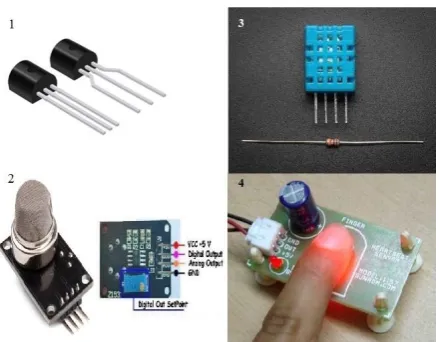
In this project we’ve used totally 4 sensors Temperature sensor, Gas sensor, Humidity sensor, Heart beat sensor. All these sensors are used to monitor the environment and the worker’s health condition.
Figure 1. Sensors 1.Temperature sensor 2.Gas sensor 3.Humidity sensor 4.Heartbeat sensor
This sensor detects the values and transfers the data to the microcontroller to be processed.
IV.
DATA PROCESSING
The data from the sensors are processed to perform the specified task. The data is sent to the microcontroller to be processed. In this project we use an Arduino UNO microcontroller. The Arduino microcontroller processes the data from the sensor, if any one of the values which is measured is abnormal the buzzer is set ON and the paramedic team of the mine is alerted through the GSM. At the same time all the data is transferred to a monitoring system through IOT. Here a mobile application is used to monitor the data through IOT.
Arduino Uno
The Arduino Uno is a microcontroller board based on the ATmega328. It has 14 digital input/output pins (of which 6 can be used as PWM outputs), 6 analog inputs, a 16 MHz crystal oscillator, a USB connection, a power jack, an ICSP header, and a reset button. It contains everything needed to support the microcontroller; simply connect it to a computer with a USB cable or power it with an AC-to-DC adapter or battery to get started. The Uno differs from all preceding boards in that it does not use the FTDI USB-to-serial driver chip. Instead, it features the
Atmega8U2 programmed as a USB-to-serial converter. "Uno" means one in Italian and is named to mark the upcoming release of Arduino 1.0. The Uno and version 1.0 will be the reference versions of Arduino, moving forward.
The Uno is the latest in a series of USB Arduino boards, and the reference model for the Arduino platform; for a comparison with previous versions. Arduino’s processor basically uses the Harvard architecture where the program code and program data have separate memory. It consists of two memories- Program memory and the data memory. The code is stored in the flash program memory, whereas the data is stored in the data memory. The Atmega328 has 32 KB of flash memory for storing code (of which 0.5 KB is used for the boot loader), 2 KB of SRAM and 1 KB of EEPROM and operates with a clock speed of 16MHz. The most important advantage with Arduino is the programs can be directly loaded to the device without requiring any hardware programmer to burn the program. This is done because of the presence of the 0.5KB of Boot loader which allows the program to be burned into the circuit. All we have to do is to download the Arduino software and writing the code.
Arduino Uno consists of 14 digital input/output pins (of which 6 can be used as PWM outputs), 6 analog inputs, a 16 MHz crystal oscillator, a USB connection, a power jack, an ICSP header, and a reset button POWER JACK Arduino can be power either from the pc through a USB or through external source like adaptor or a battery. It can operate on an external supply of 7 to 12V. Power can be applied externally through the pin VIN or by giving voltage reference through the IO Ref pin.
The Arduino Uno can be powered via the USB connection or with an external power supply. The power source is selected automatically. External (non-USB) power can come either from an AC-to-DC adapter (wall-wart) or battery. The adapter can be connected by plugging.
The board can operate on an external supply of 6 to 20 volts. If supplied with less than 7V, however, the 5V pin may supply less than five volts and the board may be unstable. If using more than 12V, the voltage regulator may overheat and damage the board. The recommended range is 7 to 12 volts.
DIGITAL INPUTS It consists of 14 digital inputs/output pins, each of which provide or take up 40mA current. Some of them have special functions like pins 0 and 1, which act as Rx and Tx respectively , for serial communication, pins 2 and 3-which are external interrupts, pins 3,5,6,9,11 which provides PWM output and pin 13 where LED is connected.
ANALOG INPUTS It has 6 analog input/output pins, each providing a resolution of 10 bits.
AREF It provides reference to the analog inputs RESET It resets the microcontroller when low.
GSM
GSM is a mobile communication modem; it is stands for global system for mobile communication (GSM). The idea of GSM was developed at Bell Laboratories in
1970. It is widely used mobile communication system in the world. GSM is an open and digital cellular technology used for transmitting mobile voice and data services operates at the 850MHz, 900MHz, 1800MHz and 1900MHz frequency bands.
GSM system was developed as a digital system using time division multiple access (TDMA) technique for communication purpose. A GSM digitizes and reduces the data, then sends it down through a channel with two different streams of client data, each in its own particular time slot. The digital system has an ability to carry 64 kbps to 120 Mbps of data rates. There are various cell sizes in a GSM system such as macro, micro, pico and umbrella cells. Each cell varies as per the implementation domain. There are five different cell sizes in a GSM network macro, micro, pico and umbrella cells. The coverage area of each cell varies according to the implementation environment.
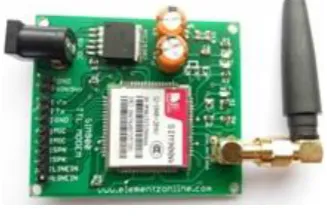
Figure 3. GSM module
A GSM network consists of the following components:
A Mobile Station: It is the mobile phone which consists of the transceiver, the display and the processor and is controlled by a SIM card operating over the network.
Network Subsystem: It provides the basic network connection to the mobile stations. The basic part of the Network Subsystem is the Mobile Service Switching Centre which provides access to different networks like ISDN, PSTN etc. It also consists of the Home Location Register and the Visitor Location Register which provides the call routing and roaming capabilities of GSM. It also contains the Equipment Identity Register which maintains an account of all the mobile equipments wherein each mobile is identified by its own IMEI number. IMEI stands for International Mobile Equipment Identity.
Figure 4. GSM architecture
IOT (Ethernet Shield)
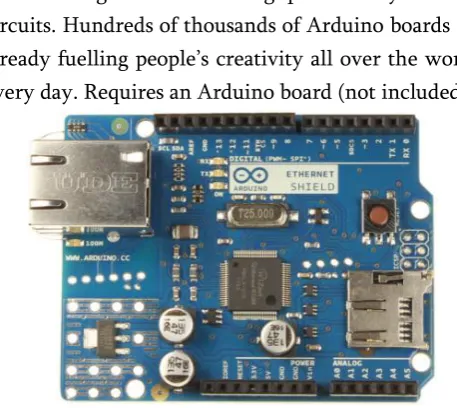
The Arduino Ethernet Shield R3 (assembled) allows an Arduino board to connect to the internet. It is based on the Wiz net W5100 Ethernet chip (datasheet). The Wiz net W5100 provides a network (IP) stack capable of both TCP and UDP. It supports up to four simultaneous socket connections. Use the Ethernet library to write sketches which connect to the internet using the shield. Ad fruit started shipping the R3 version on Feb. 3, 2012 at 3:30pm ET.
The Arduino Ethernet Shield connects your Arduino to the internet in mere minutes. Just plug this module onto your Arduino board, connect it to your network
with an RJ45 cable (not included) and follow a few simple instructions to start controlling your world through the internet. As always with Arduino, every element of the platform – hardware, software and documentation – is freely available and open-source.
This means you can learn exactly how it's made and use its design as the starting point for your own circuits. Hundreds of thousands of Arduino boards are already fuelling people’s creativity all over the world, every day. Requires an Arduino board (not included)
Figure 5. Ethernet Shield Blynk
Blynk is a Platform with iOS and Android apps to control Arduino, Raspberry Pi and the likes over the Internet. It’s a digital dashboard where you can build a graphic interface for your project by simply dragging and dropping widgets. It’s really simple to set everything up and you’ll start tinkering in with in mins. Blynk is not tied to some specific board or shield. Instead, it’s supporting hardware of your choice. Whether your Arduino or Raspberry Pi is linked to the Internet over Wi-Fi, Ethernet or this new ESP8266 chip, Blynk will get you online and ready for the Internet of Your Things.
then click the “+” at the top-right of the display to create a new project.
Figure 6. Blynk App
You can name your project, select the target hardware (Arduino Uno) – then click “E-mail” to send that auth token to yourself – you will need it in a moment. Then click “Create” to enter the main app design screen. Next, press “+” again to get the “Widget Box” menu as shown below, then press “Button”. This will place a simple button on your screen. After that you need to select your pin which you want to get value or display. After connected with your internet it will display value of your sensor on your android phone.
V.
RESULT & DISCUSSION
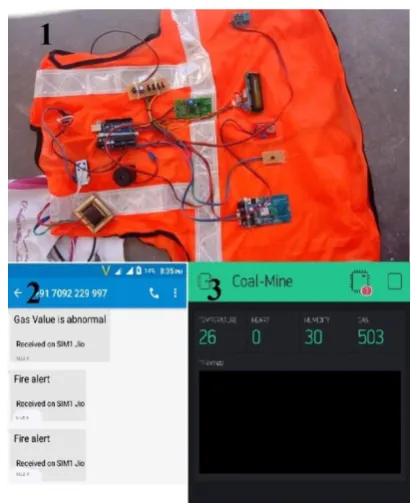
According to our project the safety of the mine workers are ensured by monitoring the psychological variable at high altitude. By using sensor we are able to monitor the physical condition continuously in the mine, and alert the workers during disasters before a life is been spared. We can save the life of coal mine worker through wireless network using IOT. It will provide each person’s information to the monitoring unit. The project also helps to contact to the emergency numbers in order to alert the paramedics to help the workers at disaster times
.
Figure 7. Output 1.Final Hardware Kit 2.GSM Output 3.Blynk Output
VI.
CONCLUSION
This integrated design will replace old-fangled way of mine safety system. The system works on any kind of mine environments, to ensure the safety of the mine workers. The system can be enhanced in future by adding more sensors like mems sensor, flux sensor, etc. in order to ensure the further safety of the workers
A Flux sensor can also integrated to detect the landslides inside the mine, it bends when a weight or pressure is put on it and responds to the bend by performing the specified task. So these sensors can be separately placed near the walls of the mine, when the landslides some mud or soil will fall on it and it detects the occurrence of landslide.
VII.
REFERENCES
[1]. Aarti Rao Jaladi, Karishma Khithani, Pankaja Pawar, Kiran Malvi, Gauri Sahoo-"Environmental Monitoring Using Wireless Sensor Networks (WSN) based on IOT" Volume: 04 Issue: 01 Jan -2017
[2]. Pournima S. Sawai, C. Satyanarayana Professors, Dept. of Electronics and Telecommunication Engineering-"Development of a WSN Framework for Mining & Civil Safety Monitoring Purposes" 2016
[3]. Wu Li Song, Jing Qiao -"Research of Mine-shaft Wireless Sensor Network Based on Agent" on International Conference on Education, Management, Commerce and Society, 2015. [4]. Moridi Mohammad Ali, Kawamura Youhei,
Sharifzadeh Mostafa, Chanda Emmanuel Knox, Wagner Markus, Jang Hyongdoo, Okawa Hirokazu -"Development of underground mine monitoring and communication system integrated ZigBee and GIS" on International Journal of Mining Science and Technology 2015. [5]. Shilpa Lande, Prof.Matte P.N -"Coal Mine Monitoring System for Rescue and Protection using ZigBee" on International Journal of Advanced Research in Computer Engineering & Technology (IJARCET) Volume 4 Issue 9, September 2015.
[6]. Pranoti Anandrao Salankar, Sheeja S. Suresh -"Zigbee Based Underground Mines Parameter Monitoring System for Rescue and Protection" on IOSR Journal of VLSI and Signal Processing
(IOSR-JVSP) Volume 4, Issue 4, Ver. I Jul-Aug. 2014.
[7]. Sharul Agrawal, Mr. Ravi Prakash, Prof. Zunnun Narmawala-"Implementation of WSN which can simultaneously monitor Temperature conditions and control robot for positional accuracy" 2014.
[8]. Yu Zhang, Wei Yang, Dongsheng Han and Young-I Kim -"An Integrated Environment Monitoring System for Underground Coal Mines-Wireless Sensor Network Subsystem with Multi-Parameter Monitoring" on Sensors 2014