IJSRST1845578 | Received : 01 April 2018| Accepted : 25 April 2018| March-April-2018 [(4)7 : 640-647]
© 2018 IJSRST | Volume 4 | Issue 7 | Print ISSN: 2395-6011 | Online ISSN: 2395-602X
640
Environmental Impact of Stone mining areas on Adjoining Rural
Settlements of Rohtas District in Bihar
Dr. Jai Shankar Prasad Singh Associate Professor & Head, Department of Geography SherShah College Sasaram, Rohtas
Mrs. Mamta Kumari (UGC-NET) Research Scholar, Department of Geography
V.K.S.University Ara. Bihar
ABSTRACT - The stone mining industry of Rohtas district is a boon of socio economic development of the study area. Because it provides important raw materials for the house and building construction in and around the region and employment for more than 10,000 of skilled and unskilled labors and entrepreneurs. But this industry provide a vital problem for the general environment due to the unbalanced echo system around the areas. It causes a number of physical social and biological problems from which the rural people are facing. Thus this industry requires a proper management for the well being of the entrepreneur as well as general people of the areas.
Keywords : Environmental, Adjoining, establishments, Rural, Bihar.
Introduction -
Industrialization is a boon for the economic growth of the nation and Society but turns to be curse when the industrial space is not properly managed which adversely affected and degrades the environment. Almost in all the developing countries of the world the unbalanced industrialization particularly in terms of spatial interactions poses more serious threats not only for the health and hygiene of the people living within the boundary of the city or settlement but also towards adjoining rural areas. The problem can briefly be understood in two ways,
i) The productive land is grabbed by the fast growing Industrial establishments which push back the rural frontiers.
ii) By omitting dust and soot through the machine of the small and giant establishments and by discharging the refuse through ground flow which pollute the micro environmental surroundings leading to natural and cultural hazards.
Objective –
International Journal of Scientific Research in Science and Technology (www.ijsrst.com)
641
Hence, the main objectives of the present paper are
i) to evaluate the rate of stone mining expansion of Rohtas district and resultant recession of rural landscape in terms of repatriate relationship of distance, direction and dimensions.
International Journal of Scientific Research in Science and Technology (www.ijsrst.com)
642
ii) to examine the spatial alignment of industrial sectors of Rohtas district in term of wind direction and to evaluate whether the wind direction has been taken into account while planning industrial space or not and
iii) to bring forth a suggestive spatial plan to overcome the spatio-micro-environmental problems resulting from newly created situation even within the unplanned industrialization in Rohtas district stone mining areas.
Study Area -
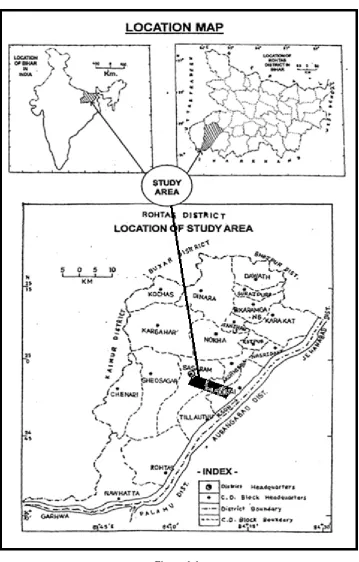
Rohtas is one of the thirty-eight districts of Bihar located in the south-western part of the State and occupies an area of 3851 Sq Km. Rohtas district extends between N. latitude 24029' and 25022'40" and E longitudes 83019'.
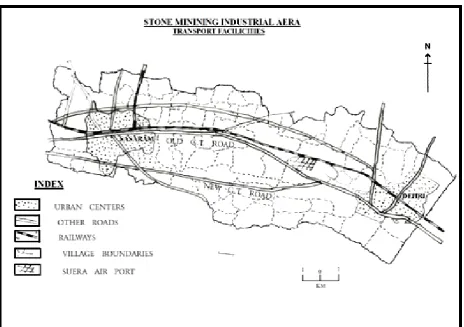
Stone mining areas are situated along the G.T. Road and Grand Chord Railway extending about 15k.m long and about 3 km wide as an industrial packet between Sasaram and Dehri On Sone towns of the Rohtas district in Bihar.
Fig no -1.2 Methodology -
International Journal of Scientific Research in Science and Technology (www.ijsrst.com)
643
i) a critical analysis of the evolution of the functional zone of the region to examine the spatial relationships in terms of distance and direction within these zones
ii) a Study of the relationship between rural settlement and stone mining industrial pollution on residential areas and
iii) an appraisal of the behavioral response of the resident of stone mining areas in Rohtas district and the people living in adjoining villages about the adverse effect of industrial pollution on health hygiene
Hypothesis -
The need of healthy environment is well recognized for human health and happiness. Environmental pollution is a health hazard and is ultimately detrimental to human progress, because pollutants reach us through the air we breathe, the water we drink, the food we eat and the Noise we hear. Besides these direct effects on mankind activities on the earth's echo systems upon which human existence depends.
There is no denying fact that the environmental pollution is the result of mismanagement. It calls for scientific environment management which should aim at protection, preservation, conservation regulation and echo development in consonance with human needs. It should be fully backed by environmental impact analysis, environmental education system, environmental monitoring and research activities.
Description of the problem –
There are many of problems in the industrial area caused by pollution. Level of pollution in the area in a critical condition due to no control measures used for their abatement. Basically these all problems are only in existence due to carelessness and ignorance regarding environment. The plant emits many of pollutants and has to identify them but after all the seen the entrepreneurs have no any authority to control over these problems.
There are two types of problems which boost the degradation.
1. Populace caused problem – There are the problems which adversely affect the environment due to human interference and human carelessness. These problems are
a) No awareness and interest about environment issues. b) No proper medium to connect with the issue
c) No proper authority to control and abatement d) Deforestation is still continue
2. Pollutant caused problem –
a) Critical condition of air due to air pollutants b) Degradation and reduction of water resources. c) Degradation of soil quality and crops
d) Level of noise in the environment
International Journal of Scientific Research in Science and Technology (www.ijsrst.com)
644
Stone Industrial Areas –
Fig no 1.3
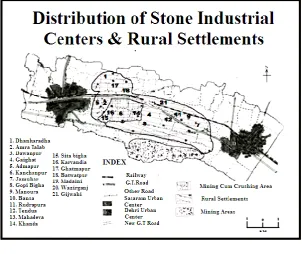
The stone mining and industrial area of Rohtas district is an important industrial unit of the state in which more than 10,000 people are directly or indirectly getting their employment. This is a multi series process of employment in which from stone blasting through breaking of stones in to various size sending at industrial units and marketing of stone chips are done. This industry produces stone pattia, stone poles, chips of different sizes eg. 3/4, 5/8, rabises, seal chakki, stone bricks, stone statue etc. are the important goods. But overall stone chips of various size are more commercial which are marketed to Ara, Patna, Buxar and adjoining districts of eastern U.P.
After 2002 the development of stone mining industry in this area was increased greatly and started its impact on the environment of the surrounding areas. During 2002 the forest department and environment security dept have challenge the illegal development of the industry. In this process a war is going between the forest dept. and entrepreneur of the stone mining in which a very honest IFS officer Late sri Sanjay singh was murdered and since then the victory of the stone industrial honor have taken place. At present there are about 505 crusher plants and about 17500 tons per day production of stone chips.
The Impact on Rural Settlements:-
International Journal of Scientific Research in Science and Technology (www.ijsrst.com)
645
labour of different natures like daily, weekly and monthly are employed. They work as a tractor driver, machine operator and other unskilled worker are engaged in which lower casts like Noniya, Tanto, Kanu, Koiry, Kurmi, yadav and schedule cast are important.
Table – 1.1. Village wise number of Cruser Plants
Area
Number of Plants
Per Day Production ( in Ton)
Dilia 56 1960
Karvandiya 232 8120
Amra Talab 46 1380
Madaini 32 1120
Dhaudarh 12 360
Kanchanpur 22 760
Gopi Bigha 20 700
Dawan pur 35 1225
Gay Ghat 25 875
Wazirganj 25 875
Source – District Industrial department Rohtas 2015-16
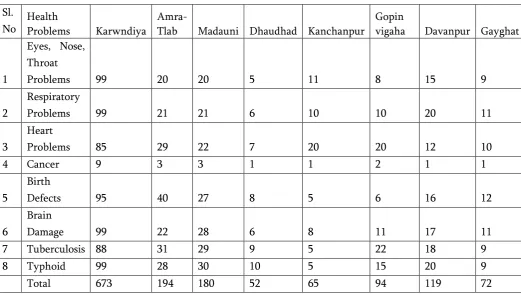
Table 1.2. Health Problems of Stone Industrial Areas in Rohtas District Sl.
No
Health
Problems Karwndiya
Amra-Tlab Madauni Dhaudhad Kanchanpur
Gopin
vigaha Davanpur Gayghat
1
Eyes, Nose, Throat
Problems 99 20 20 5 11 8 15 9
2
Respiratory
Problems 99 21 21 6 10 10 20 11
3
Heart
Problems 85 29 22 7 20 20 12 10
4 Cancer 9 3 3 1 1 2 1 1
5
Birth
Defects 95 40 27 8 5 6 16 12
6
Brain
Damage 99 22 28 6 8 11 17 11
7 Tuberculosis 88 31 29 9 5 22 18 9
8 Typhoid 99 28 30 10 5 15 20 9
Total 673 194 180 52 65 94 119 72
International Journal of Scientific Research in Science and Technology (www.ijsrst.com)
646
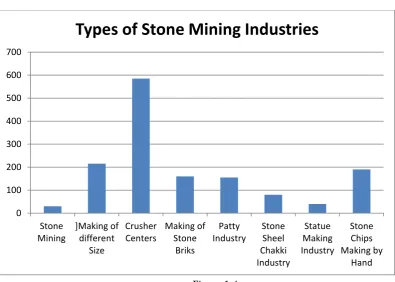
Table – 1.3. Types of Stone Industries in Rohtas district
Work No of Units
Stone Mining 30
]Making of different Size 215
Crusher Centers 585
Making of Stone Briks 160
Patty Industry 155
Stone Sheel Chakki
Industry 80
Statue Making Industry 40 Stone Chips Making by
Hand 190
Source – District Industrial department Rohtas 2015-16
Fig no 1.4
The other 11 settlements are not directly involved in this process but these villages are located near the crusher's plant and also badly affected by the stone mining industries.
The table no 1.2 reveals that the most effected village is Karvandia where total number of patient of various dieses are 673 during the period of 2015-16 because Karvandiya village has maximum number of crusher plants and the people of this village have more engaged in this profession. Similarly Amra Talab stand for 2nd position
where the number of patient are 194. Other villages like Madaini – 180, Davanpur – 119, Gopi Bigha – 94,
0 100 200 300 400 500 600 700 Stone Mining ]Making of different Size Crusher Centers Making of Stone Briks Patty Industry Stone Sheel Chakki Industry Statue Making Industry Stone Chips Making by Hand
International Journal of Scientific Research in Science and Technology (www.ijsrst.com)
647
Gaighat – 72, Kanchanpur – 65 and Dhaudardh – 52 patiant. The number of patients is depending on the number of crusher plant and the processing activities.
Findings & Conclusions – The stone mining industry of Rohtas district is a boon of socio economic development of the study area. Because it provides important raw materials for the house and building construction in and around the region and employment for more than 10,000 of skilled and unskilled labors and entrepreneurs. But this industry provide a vital problem for the general environment due to the unbalanced echo system around the areas. It causes a number of physical social and biological problems from which the rural people are facing. Thus this industry requires a proper management for the well being of the entrepreneur as well as general people of the areas.
References
1. Gupta, A.K. & Rakesh Kumar (2003) Urbanization & Environment with reference to Gaya City "Vatavaran aur Hum" vol – 4 & 5
2. Kumra, V.K. (1982) Kanpur city. A study in Environmental pollution, Tara Book Agency, Varansi 3. Singh, J. (1994) Geography & Environment, Perspective & Prospect in Geography & Teaching of
Environment, Dept. of Geog, Puna University.
4. Singh, S. (1983) Environmental Geography Conceptual Framwork, National Geographer vol – 24. 5. Singh, R.L. , Singh, S., Tiwari, & Srivastava R.P. (1983) Environmental Management (ed) Allahabad
geographical society, seog. Drpt. Allahabad, University.