On The Role Of Management Commitment
In Export Performance: A Meta-Analysis
Hind El Makrini, ESDES - Université Catholique de Lyon, France Anissa Chaibi, IPAG Business School, France
ABSTRACT
Research on exporting frequently points the role of management commitment in the export performance of the firm. This article reviews the conceptual, methodological, and empirical insights gained from a systematic analysis of 65 studies conducted on this subject. Undoubtedly, this stream of research has enhanced understanding of the importance of management commitment in affecting exporting activities. However, conceptually, there is still a lack of integral theoretical framework. Methodologically, limitations are identified concerning sampling designs, fieldwork procedures, and analytical methods. Empirically, hypothesized associations between export commitment and export performance lead to conflicting findings. After a presentation of meta-analysis techniques used and articles compiled, our paper provides an original investigation of this issue by implementing three meta-analyses to examine the relationship between commitment to export and export performance. The meta-analysis, more relevant than simple literature surveys, generally leads to the conclusion that there is a significant positive relationship between export commitment and export performance. Moreover, our findings suggest directions for future research in the field.
Keywords: Meta-Analysis; Commitment To Export; Export Performance
1. INTRODUCTION
o stay competitive in today’s global market place it is crucial for firms in developing countries to improve their export success. This is the only way they can be assured of continued growth and survival in the international market (Kumcu, Harcar, & Kumcu, 1995).There have been numerous studies published in the past 30 years on the effect of export commitment on export performance (Aaby & Slater, 1989; Sousa, 2004; Sousa, Martínez-López, & Coelho, 2008). This large volume of publications is a strong testimony of not only the importance of the issue but also the legitimacy of inquiry into export marketing. As an area of inquiry, export marketing has been gaining increased recognition among academic disciplines as a legitimate field of research. This recognition is well reflected not only by the fact that exporting research has been published in the leading academic journals, but also by the sheer number of publications related to exporting.
Its importance and legitimacy notwithstanding, the field of exporting inquiry is known for autonomous and uncoordinated efforts (Cavusgil & Zou, 1994). In particular, the knowledge of the impact of export commitment on export performance is still characterized by a fragmented collection of confusing findings (Zou & Stan, 1998). A major reason for the lack of clear conclusions is the lack of synthesis and assimilation of the fragmented knowledge (Zou & Stan, 1998).
The literature is still characterized by the lack of consensus of the impact of export commitment on export performance and the findings are sometimes conflicting (Zou & Stan, 1998). These divergences may be attributed to (1) differences in methodology, in terms of design, sampling, sample size, data collection, and response rates; (2) the country of the study, the information source, and moment in time when the data were collected; (3) differences in statistical analysis, in terms of method, reliability and validity issues, discussion and interpretation of the data.
In order to avoid confusion, a more focused review on the impact of export commitment on export performance needs to be conducted. Indeed, it is worthwhile to offer an updated review of what has been accomplished in the last decade and where future research efforts should be directed. An interesting method to see the overall picture is the meta-analysis.
The aim of the present study is to provide an update review and synthesis of the empirical literature between 1990 and 2012 of the link between management export commitment and export performance and to discuss directions for future research aimed at developing better theories and advancing knowledge of export marketing. We believe that the comparison of meta-analysis techniques applied to all of the available literature can help to answer the following question: Is the impact of the commitment to export on export performance significantly positive?
Our paper combines different methods of analysis. The combination of several techniques of meta-analysis allows us to combine the advantages and overcome the major drawbacks of each method. We first implement a non-quantitative meta-analysis. Second, we proceed to a quantitative meta-analysis that considers the quality of the studies. Finally, we propose to include only high quality studies.
Moreover, the use of the three meta-analyses provides a comprehensive picture of the relationship between management export commitment and export performance, proving that the positive and significant association does not change regardless of the meta-analysis used. All studies were analyzed for their conceptual, methodological, and empirical content. In conceptual terms, the review aimed to identify the link between management export commitment and export performance. On the methodological side, the research designs were evaluated in terms of fieldwork procedures, sampling processes, independent variable, dependent parameters, and analytical methods. From an empirical standpoint, hypothesized association between managerial export commitment and export performance was extracted from the pertinent literature, and the findings resulting from the empirical validation of this association were recorded.
To reach the purpose of the study and to explain its contributions, the remainder of this article is as follows. We first present a literature review on the relationship between management export commitment and export performance and the characteristics of the publications included in the present research. Second, we present respectively the characteristics and the results of non-quantitative meta-analysis and quantitative meta-analysis. We finally propose the results and conclude with a discussion of the implications of our fings for both practitioners and researchers.
2. LITERATURE REVIEW:
THE LINK BETWEEN EXPORT COMMITMENT AND EXPORT PERFORMANCE
Commitment to export was considered in the 1960s as a key concept in the social sciences. Since, it has been studied extensively in various other contexts and disciplines (Papadopoulos & Martin, 2010). It is one of the components of attitudinal characteristics mentioned in the previous literature (Sousa et al., 2008). Commitment to export is considered as one of the most important determinants of export performance (Navarro, Losada, Ruzo, & Díez, 2010; Nazar & Saleem, 2009) and explains the differences in export sales between companies.
Management export commitment can be defined as the general willingness to aggressively go after the export market opportunities, avoid international threats and undertake effective marketing strategies which improve the export success (Julian & Nhat, 2007).
to export and implement in an orderly and systematic manner (O'Cass & Julian, 2003; Stoian, Rialp, & Rialp, 2011), which allows him to gain the opportunities to export markets, to guard against threats and develop a marketing strategy to achieve the objectives set out in international business (Zou & Stan, 1998). The leader will be better oriented in his decisions and will be able to reap the benefits in the long term (Haghighi & Ataei, 2010). Indeed, the more resources are involved, the higher the leader is able to improve his planning and strategy. Without proper resource allocation, a firm may find itself in the initial stages of exporting for long periods of time and may not make significant progress in tapping international markets. In our research, commitment to export is an independent variable expected to play a role in the success or failure of the export as it has been shown by several researchers (Wilkinson & Brouthers, 2006).
We are aware that other authors such as Evangelista (1994) established that there is no significant relationship between commitment to export and export performance. This confirms the lack of consensus among researchers. Another study that investigated systematic and nonsystematic exporters found no statistically significant differences in terms of managerial commitment to exporting (Bourantas & Halikias, 1991). Top management commitment has also been seen as critical to successful business performance in foreign markets, particularly during the early stages of internationalization (Madsen, 1994). This is confirmed in two empirical studies examining the effect of managerial commitment on export performance (Cavusgil & Zou, 1994; Madsen, 1989).
3. CHARACTERISTICS OF THE REVIEWED STUDIES
The review covered the period from 1990 to 2012, when the thrust of research into exporting was conducted. We first selected articles from literature (Dhanaraj & Beamish, 2003; Evangelista, 1994) on the relationship between management commitment and export performance. We have covered the studies through available databases which are EBSCO, Science Direct, JSTOR, Emerald, Proquest and Google Scholar with the keywords search “export performance” and “management export commitment”. The studies included in this paper were identified using a combination of electronic and manual bibliographic search methods. The manual search, on the other hand, was directed at sorting through the articles published in major marketing and international business journals, tracking down those articles listed in the references of major export performance studies, and searching the books on exporting.
Sixty-five publications in English were finally included in our study. We excluded studies lacked sufficient information regarding statistics and results and those that not address direct effect of management export commitment to export performance. The majority of the 65 studies were published in Journal of Business Research, International Marketing Review and Journal of International Business Studies. The differences on the export commitment and export performance, the heterogeneity of the methodology can explain the conflicting findings obtained in the different studies on the subject.
3.1 Scope Of The Review
The goal of this research is to trace the new developments in the last decade and identify trends in export performance research. Publications before 1989 are not included, as Madsen, 1987 has offered valuable reviews of those pieces. There are three major criteria used in selecting the articles for review. First, the articles have to be empirical in nature, reporting data analysis and statistical tests. Second, the articles have to use some kind of export performance measures as dependent variables. Third, the articles must be cross selectional in nature. Case studies are not included nor are studies that have appeared in English publication outlets. It was difficult to access non-English publications due to the non-availability of the printed form of these studies outside the countries of publication and the non-inclusion of most of these journals in electronic databanks.
3.2 Overall Rating Of The Studies Reviewed
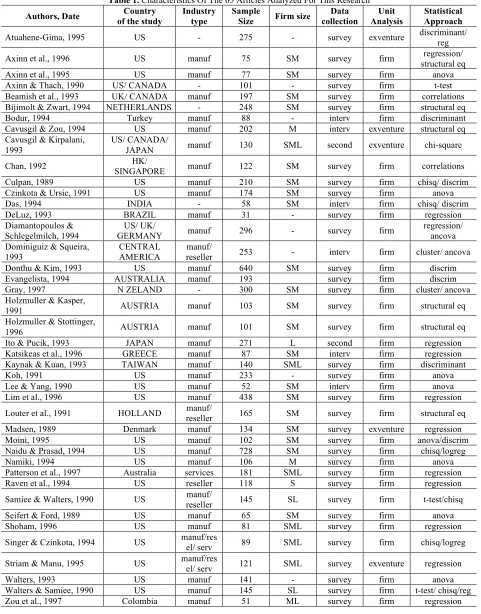
dimensions: country of investigation, firm size, industrial sector, theoretical basis adopted, sample size, data collection, unit of analysis and statistical analysis.
3.3 Country Of Investigation
The U.S. is the most studied country in export performance between the periods 1990 to 2012. A large number of studies have been conducted in several other countries. Of the 65 papers included in our meta-analysis, 29 studies were conducted in the USA. An important contribution has been made by European researchers from non-English-speaking countries who conducted studies in the contexts of their home countries and published in English-language journals, and in Asia and Latin America have also been studied researchers (Cadogan, Cui, & YeungLi., 2003; Das, 1994; DeLuz, 1993). This is a clear indication that export performance research has gained recognition around the world. It can be expected that this trend will help enrich the knowledge of the link between export commitment and export performance.
3.4 Firm Size
The overwhelming majority of studies investigated the subject from the perspective of small to medium-sized enterprises (SMEs), and larger units were the focus of attention of just 18 studies (Balabanis, Theodosiou, & Katsikea, 2004). This can be explained by several factors. First, smaller firms account for the largest part of the manufacturing base in most countries, thus increasing the likelihood of export engagement. Second, the well-known limitations of smaller companies in terms of personnel, production, financial and other resources create serious handicaps for export development, which need to be removed through proper assistance. Finally, despite resource constraints, smaller units can be formidable competitive forces in international business and can contribute to job creation, technological innovation, and economic development.
The criteria to measure the firm size differed among studies (e.g. number of employees, annual sales) making comparisons difficult. Second, because of the geographic focus of these studies, the meaning of the terms ‘small’, ‘medium’, and ‘large’ varies greatly in an international context.
3.5 Industrial Sector
Only 5 studies (Dominguez & Sequeira, 1993; Louter, Ouwerker, & Bakker, 1991; Samiee & Walters, 1990; Singer & Czinkota, 1994; Sriram & Manu, 1995) included in their samples reselling and service firms in addition to manufacturers. While this may reflect the importance of manufacturing exports in the world economy (Leonidou & Katsikeas, 1996), the generalizability of the findings to other industry contexts should not be automatically assumed. Researchers should focus more on service firms in order to elucidate the specific problems posed by the unique characteristics of services, such as intangibility.
3.6 Theoretical Basis Adopted
Only a few studies have built upon an explicit theoretical basis. Nevertheless, quite a few studies have made a conscious effort to derive their research hypotheses with clear reference to some theoretical and conceptual frameworks, such as the strategy-structure-performance paradigm.
3.7 Sample Size
Studies conducted in the 1990s tended to use small sample sizes with fewer than 150 firms (Leonidou et al., 2002). The size of sample used in the reviewed studies sizes ranged from a minimum of 50 to a maximum of 783 firms, with a median sample size of 181 and a mean around 232. This constitutes relatively high sample sizes and indicates a tendency to use larger samples which allows for more sophisticated statistical analysis. For studies which reported small sample sizes, external validity and generality can be questioned. The sample itself may not be representative of the population and it also limits the use of adequate statistical analysis to test the relationships. Therefore, specific conclusions are attenuated and should be regarded as suggestive rather than conclusive.
3.8 Data Collection
Only empirical research was considered because of the need to validate the asserted relationships between export commitment and various export dimensions. The data collection approach most commonly employed was the mail survey, which was adopted in approximately three quarters of the studies. Interestingly, mail surveys were more often employed in the United States for relatively large samples, while the personal method was associated with small sample sizes. Telephone interviewing was not used at all, while three other studies did not disclose the data gathering method utilized.
In most studies data were collected from the individual responsible for international marketing activities, namely the export manager. Nevertheless, the CEO, president, vice president, managing director, or marketing director also provided the information requested. However, the tendency to view firms as having only one decision maker is misleading, since decisions are made often made by more than one person, especially in larger firms (Leonidou & Katsikeas, 1996).
3.9 Unit Analysis
Approximately more than half of the studies reviewed here used the firm as the unit of analysis. In the case of using the firm as the unit of analysis, the export performance construct is assessed in the context of the firm’s overall activities in international markets. This can be attributed to the greater willingness of key informants to disclose information at this broad level (Matthyssens & Pauwels, 1996).
The majority of studies, however, one included both exporters and non-exporters, in order to compare and contract their export commitment. One problem of any attempt to divide these two broad categories into subgroups of firms, such as marginal and committed exporters, or uninterested non exporters and exporter intenders, resulting in a somewhat crude analysis.
3.10 Analytical Approach
The majority of the studies used multivariate statistical methods, primarily multiple discriminant analysis, principal components analysis, and multiple regression analysis. Both frequency distributions and mean scores were used extensively as auxiliary statistical tools to establish the relative importance of management export commitment. In the vast majority of studies, causality problems appear to exist between the independent variable and the dependent variables. For instance, does management commitment lead to high export performance, or is a good export performance the cause of management commitment?
Table 1. Characteristics Of The 65 Articles Analyzed For This Research
Authors, Date of the study Country Industry type Sample Size Firm size collection Data Analysis Unit Approach Statistical
Atuahene-Gima, 1995 US - 275 - survey exventure discriminant/ reg
Axinn et al., 1996 US manuf 75 SM survey firm structural eq regression/
Axinn et al., 1995 US manuf 77 SM survey firm anova
Axinn & Thach, 1990 US/ CANADA - 101 - survey firm t-test
Beamish et al., 1993 UK/ CANADA manuf 197 SM survey firm correlations
Bijimolt & Zwart, 1994 NETHERLANDS - 248 SM survey firm structural eq
Bodur, 1994 Turkey manuf 88 - interv firm discriminant
Cavusgil & Zou, 1994 US manuf 202 M interv exventure structural eq
Cavusgil & Kirpalani, 1993
US/ CANADA/
JAPAN manuf 130 SML second exventure chi-square
Chan, 1992 SINGAPORE HK/ manuf 122 SM survey firm correlations
Culpan, 1989 US manuf 210 SM survey firm chisq/ discrim
Czinkota & Ursic, 1991 US manuf 174 SM survey firm anova
Das, 1994 INDIA - 58 SM interv firm chisq/ discrim
DeLuz, 1993 BRAZIL manuf 31 - survey firm regression
Diamantopoulos & Schlegelmilch, 1994
US/ UK/
GERMANY manuf 296 - survey firm
regression/ ancova Dominiguiz & Squeira,
1993 CENTRAL AMERICA reseller manuf/ 253 - interv firm cluster/ ancova
Donthu & Kim, 1993 US manuf 640 SM survey firm discrim
Evangelista, 1994 AUSTRALIA manuf 193 survey firm discrim
Gray, 1997 N ZELAND - 300 SM survey firm cluster/ ancova
Holzmuller & Kasper,
1991 AUSTRIA manuf 103 SM survey firm structural eq
Holzmuller & Stottinger,
1996 AUSTRIA manuf 101 SM survey firm structural eq
Ito & Pucik, 1993 JAPAN manuf 271 L second firm regression
Katsikeas et al., 1996 GREECE manuf 87 SM interv firm regression
Kaynak & Kuan, 1993 TAIWAN manuf 140 SML survey firm discriminant
Koh, 1991 US manuf 233 - survey firm anova
Lee & Yang, 1990 US manuf 52 SM interv firm anova
Lim et al., 1996 US manuf 438 SM survey firm regression
Louter et al., 1991 HOLLAND reseller manuf/ 165 SM survey firm structural eq
Madsen, 1989 Denmark manuf 134 SM survey exventure regression
Moini, 1995 US manuf 102 SM survey firm anova/discrim
Naidu & Prasad, 1994 US manuf 728 SM survey firm chisq/logreg
Namiki, 1994 US manuf 106 M survey firm anova
Patterson et al., 1997 Australia services 181 SML survey firm regression
Raven et al., 1994 US reseller 118 S survey firm regression
Samiee & Walters, 1990 US reseller manuf/ 145 SL survey firm t-test/chisq
Seifert & Ford, 1989 US manuf 65 SM survey firm anova
Shoham, 1996 US manuf 81 SML survey firm regression
Singer & Czinkota, 1994 US manuf/resel/ serv 89 SML survey firm chisq/logreg
Striam & Manu, 1995 US manuf/resel/ serv 121 SML survey exventure regression
Walters, 1993 US manuf 141 - survey firm anova
Walters & Samiee, 1990 US manuf 145 SL survey firm t-test/ chisq/reg
(Table 1 continued)
Cadogan et al., 2002 Finland industries multiple 783 - survey firm structural eq
Cicic et al., 2002 Australia industries multiple 181 - survey firm structural eq
Balabanis and Katsikea
(2003) UK
multiple
industries 82 SML survey firm structural eq
O'Cass and Julian (2003) Australia industries multiple 293 SML survey exventure structural eq
Cadogan et al., 2003 HONG KONG industries multiple 137 ML survey firm structural eq
Dharanaj & Beamish, 2003 USA/ CANADA industries multiple 87/70 SM survey firm structural eq
Morgan et al., 2004 USA industries multiple 287 SM survey firm structural eq
Lages & Lages, 2004 Portugal/ UK industries multiple 519/111 SM survey exventure structural eq Lages & Montgomery,
2004 Portugal/ UK industries multiple 413 SM survey exventure structural eq
Yeoh, 2000 USA industries multiple 180 MI survey firm correlation, regression
Stewart & McAuley, 2000 CANADA/ UK industries multiple 207/160 S survey firm anova
Albaum & Tse, 2001 HONG KONG industries multiple 183 SML survey firm REGRESSION
Richey & Myers, 2001 USA industries multiple 404 ML survey exventure structural eq
Gençturk & Kotabe, 2001 USA industries multiple 162 SM survey firm anova, regression Stottinger & Holzmuller,
2001 USA industries multiple SM survey exventure regression
Ling-Yee & Ogunmokun,
2001 CHINA
multiple
industries 111 SM survey exventure regression
Shoham et al., 2002 AUSTRALIA industries multiple 193 SM survey firm regression
Brouthers & Xu, 2002 CHINA industries multiple 88 SML survey firm correlation, regression
Cadogan et al., 2002 CHINA industries multiple 206 - survey firm structural eq
Rose & Shoham, 2002 ISRAEL industries multiple 124 SML survey exventure correlation, regression
Myers, 1999 USA industries multiple 404 ML survey exventure regression, manova
white et al., 1998 USA industries multiple 124 SML survey firm regression
3.11 Measures
3.1.1 Measures Of Export Performance
As with any measure, export performance measures consist of conceptual and operational definitions. The conceptual definition attempts to define export performance. The operational definitions establish how export performance can be measured. A conceptual definition of export performance should address each of the two parts: export and performance. Export is defined conceptually as the composite outcome of a firm’s international sales (Shoham, 1996). This is a conceptual definition and is, therefore, inclusive of several international engagements.
It is essential to recognize the central importance of performance in any discussion about strategy, including international strategy. This importance is due to success being a pivotal outcome construct in the study of international strategy.
The export performance is defined as the ability of the firm to combine its resources and its competencies (Barney, 1991; Newbert, 2007). Both the conceptual and operational definitions of export performance should depend on the more general and inclusive definitions of firm and marketing performance. In addition, firms hold different concepts of performance including employees, top management or other groups that may affect the exporter’s operations. Any definition of international performance is context-specific. The conceptual definition of performance depends on the research context of a given study.
The number of studies published over the past decades on the subject of export performance is testimony to the importance of the issue in the literature. However, researchers do not agree on its conceptual nor operational definition, which frequently leads to incoherent and contradictory results (Katsikeas, Leonidas, & Morgan, 2000). Comparing studies using different indicators is difficult, as is generalizing their conclusions (Styles, 1998).
Measurement of export performance has varied widely in the export literature and no single measure or construct definition dominates the field (Sousa et al., 2008).
Most researchers accept the unidimensionality of the export performance (Sousa et al., 2008; Zou, Taylor, & Osland, 1998). For example, Zou et al. (1998), building on (Cavusgil & Zou, 1994) model, propose a scale that incorporates objective, strategic and subjective measures of export performance. Different terms have been used in explaining export performance.
Among them are international performance (Ural, 2009), international market place performance (O’Cass & Weerawardena, 2009), economic international performance, export performance (Bijmolt & Zwart, 1994). It can also be seen that there are many measures of export performance used over the years.
Export performance has been broadly measured using financial or objective measures (sales, profit), non-financial or subjective measures (satisfaction, goal achievement) and also composite measures. Export sales have been used by a majority of researchers to measure export performance. They include (Köksal, 2008; Shamsuddoha & M, 2006; Ural, 2009)). Export sales growth has also been used as form of export performance measure. Other forms of measures are export profit (Blesa & ́s, 2008; Shamsuddoha, 2004) and profitability (Lages & Montgomery, 2005; O’Sullivan & Butler, 2009; Ural, 2009). Satisfaction have been measured in terms of customer (O’Cass & Weerawardena, 2009), market performance (O’Sullivan & Butler, 2009), level of export performance (Lee & Griffith, 2004) and export operation (Akyol & Akehurst, 2003).
(Racela & Chaikittisilpa, 2007) measure satisfaction on a variety of criteria such as export sales, export profitability, export market share and rate of new market entry. Market share achievement has also been used to measure export performance level by (Köksal, 2008; O’Cass & Weerawardena, 2009; Ural, 2009). Measuring export performance through export intensity is applied by (Akyol & Akehurst, 2003; Francis & Collins-Dodd, 2004; Suarez & Vera, 2005). (Akyol & Akehurst, 2003; Lages & Montgomery, 2004) used overall market performance as a form of measure.
export venture. The measurement of export development or export expansion has not been researched widely in internationalization related studies. Among the existing studies, (Francis & Collins-Dodd, 2004) referred export development as export expansion. Among the measurements used are in terms of new markets and/or new products, new geographic or new product markets (next year and the next three years) and increase export intensity “next year” and “next three years”. Entering new markets is also used by (O’Cass & Weerawardena, 2009); however, it is used to measure export performance, while rate of new market entry is applied by (Racela & Chaikittisilpa, 2007) for measuring performance satisfaction. (White, Griffith, & Ryans, 1998) on the other hand use development of firms’ market to measure the effect of internationalization in the future. (Lim, Sharkey, & Heinrichs, 2006) use measures such as ‘expand their export sales through additional product introduction’ and ‘expand their export sales through international market expansion’ among others to measure export market involvement.
We can conclude that there is no consensus and no agreement for definition and measures of export performance (Navarro et al., 2010), and export sales, profits, and composite sales are probably the most frequently used measures of export performance (Zou & Stan, 1998), despite recent recommendations for using perceptual measures of overall export performance in achieving organizational goals (Sousa et al., 2008).
The unidimensionality of the export performance may explain Bonoma & Clark (1988) comment that perhaps no other concept in marketing’s short history has proven as stubbornly resistant to conceptualization, definition, or application.
3.1.2 Measures Of Export Commitment
To operationalize “export commitment” construct, several items were adopted from relevant literature (Brodrechtova, 2008). Respondents in majority of the studies were asked to indicate their level of agreement with each statement on a seven-point scale ranging from 1 (strongly disagree) to 7 (strongly agree).
4. CONDUCTING META-ANALYSIS
A systematic synthesis of the existing studies and frameworks is needed to understand better the effect of management export commitment on export performance. To this aim, in the light of the studies included in our research, we first implement a non-quantitative meta-analysis.
Meta -analysis was first used by Pearson in 1904. It has gained momentum especially since 1970.
4.1 Non Quantitative Meta-Analysis
We first use the vote counting method. The available studies are sorted into three categories: those that report significant results in the predicted direction, those that yield significant results in the opposite direction and those that yield non-significant results.
Second, we implement a combined significance tests that tests the null hypothesis (there is no relationship between management export commitment and export performance).
Third, we present their contributions and limitations.
4.1.1 The Vote Counting Method
The vote counting method is limited to answer to the simple question “is there any evidence of an effect?”
In its simplest form, we first classified the results of the included publications into three categories: positive significant relationship (+), negative relationship (-) and no significant relationship (n.s).
evaluate the significance of evidence for the existence of an effect in either direction. In fact, if we found no relationship the studies will be distributed evenly around the null hypothesis of no difference.
The positive relationship means that the probability of obtaining a positive result is significantly higher than 0.5. In fact, H0 π = 0.5 is conventionally used to denote the null hypothesis and H1 π1> 0.5 the alternative. 0.5 is the traditional value used (Conover, 1980).
The table 2 proposes the results of the vote counting method.
Table 2. Results Of The Vote Counting Method
All the studies pv ≤ .1 pv ≤ .05 pv ≤ .01
Positive results 49 40 35 27
Total results 65 52 47 38
Sign test .75 .77 .74 .71
Probability value (p-value) under H0 p <.0001*** p <.0001*** p <.0001*** p <.0001*** H0: No positive and significant results.
The hypothesis of no positive and significant results between management export commitment and export performance is rejected. In fact, the results showed in table 2 concluded of a positive and significant relationship between the two variables in the two cases (all studies and only taking into account low pv). This result demonstrates the appropriateness of studies included according to their corresponding p values.
4.1.2 Testing The Null Hypothesis: Combined Significance Tests
The combined significance approach tests the null hypothesis that the effect of an independent variable on a dependent variable is zero in all studies. This approach emphasizes the characterization of the magnitude of the combined effect.
Becker (1994), Hedges & Olkin (1985), and Rosenthal (1978) described two types of methods:
• The method of the minimum value and the average values, that assume uniformity of distribution of p-values.(Originally developed by Tippet (1931)).
• The sum-of-logarithm-distribution, based on the transformation of p-values to obtain a combined significance level.(Developed by Fisher (1932)).
The findings presented in the literature review on the relationship between management export commitment, show that there is more non-significant results (n.s) than significant results (+) and (-).
Using the sum-of-logarithm process and the method of the minimum p-value are inappropriate.
Using the average p-value for conducting this research is more powerful than the sum of logs summary and other techniques (Kozil & Perlman, 1978).
The average p-value method is used to test the null hypothesis from a sum of values.
The table 3 proposes the results of the combined significance tests.
Table 3. Results Of The Combined Significance Tests
All the studies pv ≤ .1 pv ≤ .05 pv ≤ .01
Average p-value 14.76 11.21 11.06 10.56
Cumulative significance level p <.0001*** p <.0001*** p <.0001*** p <.0001***
In fact, there is at least one significant result.
The non-quantitative meta-analysis may lead to wrong conclusion about the overall outcome across studies. In fact, the statistical significance of the research findings has power for effects of relatively small magnitude. Not all studies included provide adequate data for inclusion and analysis.
On the basis of the issue raised, can we conclude on the significant effect of management export commitment on export performance?
These methods give more weigh to studies using different measurement scales for a specific construct with a heterogeneity of study populations (Slavin, 1995).
They do not allow quantifying the effect of one variable on another. Slavin (1995) considers that this technique provides only a response for the effect of the independent variable on the dependent variable, without any estimate of this effect.
Conducting a quantitative meta-analysis is a crucial step to assess the relationship between management export commitment on export performance. In fact, we can estimate this effect only with quantitative meta-analyses.
4.2. Quantitative Meta-Analysis
The goal of quantitative meta-analysis is to address the gap in quantifying the effect of one variable on another. The aim of quantitative meta-analysis is to estimate the effect of an independent variable on an outcome variable based on the estimated effects of the studies included.
Quantitative meta-analyses can be mobilized only to synthesize results from studies using regression to estimate the relationship between two variables (Bonache et al., 2012).
The use of quantitative meta-analysis is very interesting since it allows to quantify the effect studied, thus exceeding the limits of the non-quantitative meta-analysis.
It is advisable to perform analyses both with and without quality scores and exclude studies that do not provide appropriate statisctical results.
4.2.1 Inclusion Of Study Quality Score
Results from better quality studies are more valid than results from other studies.
It is important to consider the internal and external validity of the items and the relevance of the scales used to weigh their quality. We propose the implementation of this method, a discussion of the results and their limitations.
The studies on the relationship between management export commitment and export performance use different methods and constructs for each variable and the results are very frequently different. The meta-analysis is a research method designed to pool different small series from various studies in order to reach a conclusion in this subject where there is no general agreement between different authors. By pooling various little series, the number of studies is more important; hence the power of the study is stronger. It is therefore important that the following conditions be met: Studies must report clear informations in terms of design, sampling, sample, size, data collection and response rate. Obviously, the various studies must be on the same nature and use the same scales, unit of analyses and definitions of constructs.
precisions of the analytical approaches (t-test, chi-square test, ANOVA, …). The lower score is given to articles do not precise these conditions.
The score range from 0.5 to 1.1. on our sample of articles. Using the scale of Cavusgil and Zou (1994) to measure commitment to export, and that of Cavusgil & Zou (1994) and Zou, Taylor & Osland (1998) to measure the export performance were used according to the literature. If they measure commitment with a scale based on that of Cavusgil and Zou (1994), the score is .10. No score is assigned in other cases. We did the same with the scale of Cavusgil and Zou (1994) and Zou et al. (1998) for export performance. The quality score is determined according the above criteria.
The sample finally consisted of 52 studies. The statistical presentation of these publications allows a quantitative meta-analysis.
Once the quality score is identified, the effect sizes should be calculated.
4.2.2 Exclusion Of Study Quality Score
We have calculated the effect sizes without quality scores to evaluate the results’ sensitivity of the quantitative meta-analysis on the relationship between commitment to export and export performance.
Hence, the comparison between statistical tests with and without quality scores can control the impact of subjectivity linked to quality scores that could biase the results. In making a report of a meta-analysis, it is thus desirable to find this comparison so that the results of the meta-analyses be discussed carefully (Bonache et al., 2012).
The table 4 presents the results of the quantitative meta-analysis with and without taking into account quality score of items.
Table 4. Results of the quantitative meta-analysis with and without quality score (QS)
With QS Without QS
Estimate of common effect .009*** .141***
Variance of the estimator .001 .001
Test statistic 6,018 28.401
*** p<.001
The results of the quantitative meta-analysis of all studies used are positive: Without quality score, the relationship between commitment to export and export performance is positive and significant. Considering the quality score, this link is also positive and significant.
We can conclude that with or without quality scores, the relationship between management export commitment and export performance is positive significant.
Although quality would be captured in one dimension, the use of quality scores in summarization weights would biase estimated of effect. In this way, quality weighting should be evaluated against formal bias-variance trade-off methods such as hierarchical meta-regression (Greenland & Rourke, 2001).
Slavin (1995) recommended using a quantitative meta-analysis called the “best synthesis analysis” with the selection of the studies with the strongest design.
4.3. An Intelligent Alternative To Meta-Analysis
The principal of best synthesis analysis is to retain the homogeneous works in terms of the method. retained the studies randomly drawn from the sample, improving the robustness of the results we retained (Yin, 2009). The best studies were performed on 27 studies. We highlight that the results can be affected by the quality scores attributed to the pooled series as this can produce biased estimates of effect. Hence, the researcher has to exert his own judgments to avoid such a bias.
We also conduct analyzes without quality score to limit potential bias. In this way, if the researchers are interested by replication of this study, they can build their own quality scores and it would be interesting to compare their results to ours. In fact, replication studies could contribute to the development of the theory concerning our subject of study.
The table 5 proposes the results of best synthesis analysis with and without quality scores.
Table 5. Results Of Quantitative Meta-Analysis “Best Studies”
With QS Without QS
Estimate of common effect 0,119*** 0,227***
Variance of the estimator 0,002 0,002
Test statistic 0,627 24,322
*** p<.001
We found the same results when retaining the first study based on a random sample in the both cases, and by retaining then only articles published in journals classified by CNRS, AERES and FNEGE.
5. CONCLUSION: DISCUSSION OF MAIN FINDINGS AND AVENUES FOR FUTURE RESEARCHES
The literature on the relationship between management commitment and export performance is important and its results being ambiguous, this article makes a comprehensive and quantified synthesis. Significant progress has been made in the last decade in developing better theory and knowledge of the impact of management export commitment on export performance. A key point to make here is that, compared to earlier studies reviewed by (Aaby & Slater, 1989; Chetty & Hamilton, 1993), more studies in the last decade have incorporated some theoretical reasoning in developing their research questions and hypotheses. Indeed, several studies (Cavusgil & Zou, 1994; Holzmüller & Stöttinger, 1996) have used explicit conceptual models to guide their hypothesis development.
Although compared to earlier studies (Sousa, 2004; Zou & Stan, 1998) , some progress has been made in developing theory and knowledge of the measures of export performance, there is still a long way to go before it is possible to clearly delineate the domain of this construct and identify its dimensions. Indeed, the export marketing literature has been criticized for providing only fragmented results and for not being able to develop a widely accepted model of export performance, thus limiting theoretical advancement in this field (Morgan, Kaleka, & Katsikeas, 2004; Sousa et al., 2008). However, these developments in the last decade have significantly strengthened the theoretical foundation of export performance research, legitimizing the academic inquiry in the field of exporting.
Our review synthetizes 65 articles published on the subject has revealed that studies use either the firm level or the export venture as the unit of analysis. The vast majority of the reviewed studies assessed export performance at the firm level (28 out of 43), which can be explained by the greater willingness of respondents to disclose information at this broad level (Matthyssens & Pauwels, 1996). The selection of the unit of analysis is important for the correct operationalization of export performance, since a study at the firm level seeks success determinants describing the overall export activity of a firm; whereas a study at the venture level focuses on performance determinants of a particular product/market combination.
meta-analysis is more powerful. We found a positive and significant effect of management export commitment on export performance when using a quality score and Best Synthesis Analysis (Slavin, 1995).
This article provides an updated review and synthesis of the empirical literature of the effect of management export commitment on export performance. The results presented in this work should be interpreted with caution because the majority of studies included in our meta-analysis and in general who are interested in this topic have been established in developed countries.
The present study also assessed collective usefulness of the empirical literature related to the strong positive influence of management commitment on export performance in a specialized, detailed, and integrated fashion. Conceptually, this stream of research is still in its exploratory phase of development, lacking a well-defined theoretical framework that would link managerial export commitment to firms’ export performance. This can be attributed to the fact that most studies on the subject vary in terms of time frames, geographical focus, and industrial coverage; and the tendency to establish relationships between export commitment and export performance without connecting the results to a specific research program. As a result, this body of knowledge, consistent with the trend in the overall stream of exporting research, could be described as not being well grounded in theory.
Methodologically, there is a great diversity in the methods employed, particularly with respect to sampling designs, fieldwork procedures, and analytical techniques. One possible explanation for this lies in that research on the subject was conducted by independent researchers around the world at different points in time. The majorities of studies are one-off in nature and have a strong ethnocentric orientation, largely attributable to resource constraints to conduct longitudinal research on a cross-cultural basis. Most of this research also suffers from certain methodological handicaps, such as insufficient construct operationalization, which, however, have to be explained by the fact that an individual study, as opposed to a collaborative effort, can only make incremental contributions.
With few exceptions, the research designs employed appear not to have built upon the strengths nor to have avoided the weaknesses of previous studies, although there has been a slow increase in the methodological sophistication of research in this field over time. Finally, the focus of studies reviewed was relatively diffused, probably due to the absence of a central agency that would coordinate the whole research effort on the subject. Empirically, the most widely investigated dependent variable (export performance) was of an objective measure. The export dimension that received most empirical attention was export intensity, which also exhibited the strongest association with management export commitment.
Notwithstanding, the above conceptual, methodological, and empirical limitations, this type of research has made a number of substantial contributions to researchers, managers, and governments. From a research point of view, it has alerted exporting researchers to the potential role of management export commitment play in initiating, developing and sustaining export business. Indeed, this review has indicated that this variable is highly associated with particular facets of exporting. From a managerial standpoint, this stream of research has helped practitioners create a profile in their organizations that would be conductive to a formidable and successful engagement in exporting.
ACKNOWLEDGEMENTS
Hind El Makrini would like to thank Adrien Bonache, lecturer and researcher at the IAE of Dijon. When he was a lecturer and researcher at Clermont University where Hind El Makirini was a phd student, Adrien Bonache helped her understand the principles of meta-analyses and recommended her to refer to his coauthored article “Bonache, A., Moris, K., Maurice, J. (2012), Participation budgétaire et performance managériale: lien non significatif et contingences, Comptabilité – Contrôle – Audit, 18 (2), pp. 125-184)”.
AUTHOR INFORMATION
Anissa Chaibi is an assistant researcher at IPAG Business School, France. Her research focuses on statistics and econometrics applied to economics and finance. She has published her recent articles in referred journals such as Economic Modelling, Energy Policy and Energy Economics. E-mail: [email protected]
Hind El Makrini is an assistant Professor ESDES - Université Catholique de Lyon, France. Her research focuses on strategic management and international marketing. She participated at several conferences and published academic articles in refereed journals (Business Process Management Journal, Journal of Strategic Marketing). E-mail: [email protected]
REFERENCES
Aaby, & Slater. (1989). Management Influences on Export Performance: A Review of the Empirical Literature 1978-88. [Article]. International Marketing Review, 6(4), 7.
Akyol, & Akehurst. (2003). An Investigation of Export Performance Variations Related to Corporate Export Market Orientation. European Business Review, 15(1), 5-19.
Balabanis, Theodosiou, & Katsikea. (2004). Export Marketing: Developments and a Research Agenda. International Marketing Review, 21 ((4/5)), 353- 377
Barney, J. B. (1991), Firm resources and sustainable competitive advantage, Journal of Management, 17, pp. 99-120.
Barret, & Wilkinson. (1986). Internationlaisation Behaviour :Management Characteristics of Australian
Manufacturing Firms by Level of International Development. in Research in International Marketing, P.W. Turnbull and S.J Paliwodi, Eds. Beckenham, Kent: Croom Helm.
Becker. (1994). Combining signifi cance levels: In The handbook of research syntheis (Eds, Cooper, H., Hedges, L.V.). New York : Russel Sage Foundation.
Bijmolt, & Zwart. (1994). The Impact of Internal Factors on the Export Success of Dutch Small and Medium sized firms,. Journal of Small Business Management, 69-82.
Blesa, & ́s, R. (2008). The Influence of Marketing Capabilities on Economic International Performance. International Marketing Review, 25(6), 651-673. .
Bonache, Maurice, & Moris. (2012). Participation budgétaire et performance managériale : lien non significatif et contingences, Comptabilité Contrôle Audit, 18 (2), pp. 125-184.
Bonoma, & Clark, (1988), Marketing Performance Assessment, Boston, Massachusetts: Harvard Business School Press
Bourantas, & Halikias. (1991). Discriminating variables between systematic and non-systematic exporting manufacturing firms in Greece. Journal of Global Marketing, 4(2), 21-38.
Brodrechtova. (2008). Determinants of export marketing strategies of forest products companies in the context of transition — The case of Slovakia. Forest Policy and Economics, 10(7), 450-459.
Cadogan, Cui, & Yeung Li. (2003). Export Market oriented Behavior and Export Performance: The Moderating Roles of Competitive Intensity and Technological Turbulence. International Marketing Review, 20(5), 493-513.
Cavusgil, & Zou. (1994). Marketing Strategy-Performance Relationship: An Investigation of the Empirical Link in Export Market Ventures. [Article]. Journal of Marketing, 58(1), 1-21.
Chetty, & Hamilton. (1993). Firm-level determinants of export performance: A meta-analysis. International Marketing Review, 10(3), 26-34.
Cucherat, Boissel, & Leizorovicz. (1997). Méta-analyse des essais thérapeutiques: Paris : Masson.
DaRocha, Christensen, & DaCunha. (1990). Aggressive and passive exporters: a study in the brazilian furniture industry. Int Mark Rev, 7(5), 6-15.
Das. (1994). Successful and Unsuccessful Exporters from Developing Countries. European Journal of Marketing Intelligence & Planning, 28(12), 19-33.
DeLuz. (1993). Relationship Between Export Strategy Variables and Export Performance for Brazil Based Manufacturers. Journal of Global Marketing, 7(1), 87.
Dhanaraj, & Beamish. (2003). A resource-based approach to the study of export performance. Journal of Small Business Management, 41(3), 242-261.
Dominguez, & Sequeira. (1993). Determinants of LCD Exporter’s Performance: A Cross National Study. Journal of International Business Studies, 1, 19-40.
Evangelista. (1994). Export Performance and its Determinants: Some Empirical Evidence from Aus-tralian Manufacturing Firms. Advances in International Marketing, 207-229.
Fisher (1932). Statistical Methods for Research Workers, 4th ed. Oliver and Boyd, Edinburgh.
Francis, & Collins-Dodd. (2004). Impact of Export Promotion Programs on Firm Competencies, Strategies and Performance, The case of Canadian high-technology SMEs. International Marketing Review, 21(4/5), 474-495.
Greenland, S., & O’Rourke, K. (2001). On the bias produced by quality scores in meta-analysis, and a hierarchical view of proposed solutions. Biostatistics, 2(4), 463-471.
Haghighi, & Ataei. (2010). Evaluation of access food exporting companies to information of export market and its effect on export decision process. Iranian Journal of Modiriat Bazargani, 2(4), 19-26.
Hedges, & Olkin. (1985). Statistical methods for meta-analysis: Orlando : Academic Press.
Holzmuller, & Kasper. (1991). On the theory of export performance: personal and organizational determinants of export trade activities observed in small and medium-sized firms. Manage Int Rev, 31, 45-70.
Holzmüller, & Stöttinger. (1996). “Structural Modeling of Success Factors in Exporting: Cross-Validation and Further Development of and Export Performance Model”. Journal of International Marketing, 4(2), 29-55. Julian, & Nhat (2007). The internet and export marketing performance: the empirical link in export market ventures.
Asia Pac. J. Mark. Logis., 19(2), 27-144.
Katsikeas, Leonidou, & Morgan. (2000), Firm level Export Performance Assessment:
Review, Evaluation, and Development, Journal of the Academy of Marketing Science, 28(4), 493-511.
Köksal. (2008). How Export Marketing Research Affects Company Export Performance:Evidence from Turkish companies. Marketing Intelligence & Planning, 6(4), 416-430.
Koziol & Perlman (1978). Combining independent non-central chi-square tests, Journal of the American Statistical Association, 73, 753-763.
Kumcu, Harcar, & Kumcu (1995). Managerial perceptions of the adequacy of export incentive programs. Implications for export-led economic development policy. Journal of Business Research Policy, 32(3), 163-174.
Lages, & Montgomery. (2004). Export Performance as an Antecedent of Export Commitment and Marketing Strategy Adaptation. Evidence from Small and Medium-sized Exporters. European Journal of Marketing, 38(9-10), 1186-1214.
Lages, & Montgomery. (2005). The Relationship between Export Assistance and Performance Improvement in Portuguese Export Ventures: An Empirical Test Of the Mediating Role of Pricing Strategy Adaptation. European Journal of Marketing, 39(7/8), 755-784.
Lee, & Griffith. (2004). The marketing strategy-performance relationship in an export-driven developing economy. International Marketing Review, 21(3), 321-334.
Leonidou, & Katsikeas. (1996). The export development process: an integrative review of empirical models. [Article]. Journal of International Business Studies, 27(3), 517-551.
Leonidou, Katsikeas, & Samiee. (2002). Marketing Strategy determinates of export performance: a meta-analysis. Journal of Business research, 55(1), 517-567.
Lim, Sharkey, & Heinrichs. (2006). Strategic Impact of New Product Development on Export Involvement. European Journal of Marketing, 40(1/2), 44-60.
Madsen. (1989). Successful Export Marketing Management: Some Empirical Evidence. [Article]. International Marketing Review, 6(4), 41.
Madsen. (1994). A contingency approach to export performance research In Cavusgil, S.T. and Axinn, C.N. (Eds). Advances in International Marketing, 6, 25-42.
Matthyssens, & Pauwels. (1996). Assessing Export Performance Measurement. New York: JAI Press. Morgan, Kaleka, & Katsikeas. (2004). Antecedents of export venture performance: A theoretical model and
empirical assessment. Journal of Marketing, 68(1), 90-108.
Navarro, Losada, Ruzo, & Díez. (2010). Implications of perceived competitive advantages, adaptation of marketing tactics and export commitment on export performance. [Article]. Journal of World Business, 45(1), 49-58. doi: 10.1016/j.jwb.2009.04.004
Nazar, & Saleem. (2009). Firm level determinates of export performance. J. Int. Bus. Econom. Res, 8(2), 105-112. Newbert. (2007), Empirical research on the resource-based view of the firm: an assessment
and suggestions for future research, Strategic Management Journal, 28, 121-146
O'Cass, A., & Julian, C. (2003). Examining firm and environmental influences on export marketing mix strategy and export performance of Australian exporters. [Article]. European Journal of Marketing, 37(3/4), 366-384. O’Cass, & Weerawardena. (2009). Examining the role ofInternational Entrepreneurship, Innovation and
International Market Performance in SME Internationalization. European Journal of Marketing, 43(11/12), 1325-1348.
O’Sullivan, & Butler. (2009). Market Orientation and Enterprise Policy. European Journal of Marketing, 43(11/12), 1349-1364.
Papadopoulos, & Martin, M. (2010). Toward a model of the relationship between internationalization and export performance. Int. Bus. Rev, 19, 388-406.
Pearson (1904). Report on certain enteric fever inoculation statistics. British Medical Journal, 3, 1243-1246. Racela, & Chaikittisilpa. (2007). Market Orientation, International Business Relationships and Perceived Export
Performance. International Marketing Review, 24(2), 144-163.
Rosenthal (1978). Combining results of independent studies. Psychological Bulletin, 85, 185-193.
Samiee, & Walters. (1990). Influence of firm size on export planning and performance. Journal of Business Research, 20, 235-248.
Shamsuddoha. (2004). Antecedents of firm export performance: The role of export promotion programs. PhD Dissertation, Queensland University, Australia.
Shamsuddoha, & (2006). Mediated Effects of Export Promotion Programmes on Firm Export Performance. Asia Pacific Journal of Marketing and Logistics, 18(2), 93-110.
Singer, & Czinkota. (1994). Factors associated with effective use of export assistance. Journal of International Marketing, 2, 53-71.
Slavin. (1995). Best evidence synthesis : An intelligent alternative to meta-analysis. Journal of Clinical Epidemiology 48(1), 9-18.
Sousa. (2004). Export performance measurement: An evaluation of the empirical research in the literature. Academy of Marketing Science Review, 9, 1-22.
Sousa, Martínez-López, & Coelho. (2008). The determinants of export performance: A review of the research in the literature between 1998 and 2005. [Article]. International Journal of Management Reviews, 10(4), 343-374. doi: 10.1111/j.1468-2370.2008.00232.x
Sriram, & Manu. (1995). Country-of-destination and export marketing strategy: a study of US exporters. Journal of Global Marketing, 8(3-4), 171-190.
Stoian, Rialp, & Rialp. (2011). Export performance under the microscope: A glance through Spanish lenses. International Business Review, 20, 117-135.
Styles. (1998). Export Performance Measures in Australia and the United Kingdom. Journal of International Marketing, 6 (3), 12-36.
Suarez, & Vera. (2005). SMES internationalization: firms and managerial factors. Int. J. Entrep. Behav. Res., 11(4), 258- 279.
Tippett (1931). The Methods of Statistics. Williams & Norgate Ltd., London.
Ural. (2009). The Effects of Relationship Quality on Export Performance A Classification of Small and Medium-Sized Turkish Exporting Firms Operating in Single Export-Market Ventures. European Journal of Marketing, 43(1/2), 139-168.
Review, 188-204.
Wilkinson, & Brouthers. (2006). Trade promotion and SME export performance. International Business Review, 15, 233-252.
Yin. (2009). Case study research: Design and methods (Vol. 4): Sage Publications, Thousand Oak, California. Zou, & Stan. (1998). The determinants of export performance: a review of the empirical literature between 1987 and
1997. J. Int. Mark. Rev., 15(5), 333-350.