SYBIL SECURITY: AN EFFICIENT SYBIL ATTACK
DETECTION TECHNIQUE IN ONLINE SOCIAL
NETWORK
Yamala Sreenivasa Rao
1, V. Nagi Reddy
21
M.Tech (IT) Scholar,
2Associate Professor
Nalanda Institute of Engg and Tech. (NIET), Siddharth Nagar, Guntur, A.P, (India)
ABSTRACT
Into recent, it is completed here some very significant working research of the interest into the leveraging
outcome social based network for the defending next to the Sybil assault. It is possible here that so many of
given work can be appeared as the similar at the very first look, the existing society based network related to the
Sybil resistance type of module can get part in the two types: the Sybil discovery and the Sybil acceptance.
Above given category of the system both the leverage of global features of fundamental type of social chart, it
sure that they will dependent upon the dissimilar kind assumption and also provide some dissimilar concern
guaranty: The Sybil discovery is not depend on the application but depends on the only chart arrangement for
recognizing the Sybil identity, so if the Sybil easiness will depends upon the application related facts and then it
will leverage chart arrangement and the operation record also for combining leverage the attacker of the data
will find from utilizing the many of the identity. So here going to take the very similar overview at propose goal,
the defined model, pre assumption, the allowing guaranty, and the understood limitation of both of the category
of the social type of the network related to the Sybil resistance mechanism.
I. EXISTING SYSTEM
The numerous type characteristics, or the Sybil, based assaults related poses the fundamentals problems in the
website based and the distributed techniques. Into the Sybil attacks, the users who are harmful generates the
numerous (Sybil) type identity and then work on the benefit of united privilege that will be similar with all the
given identity for making the system attacks. Such as, in the online auctions based system such eBay and the
falsified users can also keep on to using systems with the help of generating the fresh users accounts at whatever
time her already available account have gained the not good status. Likewise, in the social networking website
like the Digg or the YouTube, where the content will be rated on the basis of the user‟s feedbacks, the assailant
can generate the many identities for casting the bogus vote and then manipulate the contents popularities. In the
recent, in this fields came with the considerable research based interests in the leveraging of the societal network
for protecting next to the Sybil attack. The given idea will concentrate on design of these all communal type
networks that will work on the Sybil protection mechanism. Here we have two groups of the communal
networks works on the Sybil protection scheme. First category, name is the Sybil recognition; it will operate
with sensing the identity which is probable to get the Sybils. So it can say, second categories, namely the Sybil
tolerance techniques, will never try for the label type identity as the Sybil or the non Sybil. However, they will
attempt for the bounding of leverage the assailant will achieve with utilizing the numerous of the Sybil identity.
way of achieving a higher stage objectives of the Sybil defenses, that are for the protecting the assailant with the
help of achieving the improvement by generating and by utilizing the various identity.
II. DISADVANTAGES
1) Communal networks related the Sybil recognition methodology depends onto assumption.
2) The already available communal networks related Sybil recognitions completely do their work with help of
analysing structure of social networks.
III. PROPOSED SYSTEM
The given approach will investigate how the Sybil discovery and the acceptances is differs into assumption they
can create, guaranty offered, and the limitations and all challenge here poses in the world of the reality
consumption of the situations. Whereas the investigation of propose space type of the Sybil defense will never
complete and the many clear type question may still wait, here the job highlight all necessitate for understanding
essentials dissimilarity in between the existing type Sybil protection design and tradeoffs being offered.
Maximum of current job is surveying or is analyzing the social based network depending upon the Sybil
protections methods, counting our given approches, tend in the direction of the overly common type
characterization of all the communal networks depending on the Sybil protection methods related onto study of
the few. Into remainder of the given techniques will be discussed two of the Sybil recognition and the Sybil
acceptance for making improved understand to design of the goal, the model, the assumption, the guaranty, and
the limitation of the all. We will be closed with the discussion of an issue and a tradeoff on the time of the
deploying scheme into the practices.
The Sybil discovery approaches have been already designed for the identity based communal mechanisms. Each
of the users is planned to have the particular type of an identity,and only the user can set up the friendship link
to identity of the othersuser they should recognize in systems, thus building the communalnetworks. The Sybil
discovery must use these communal networks like a basis of therecognizing user by help of various identities.
Here a user is called by thevarious identities the Sybil users and each and every identities she will use the all
Sybil identity. Main objective of this Sybil discovery will be to make the identitiesin organization as moreover
Sybil („untrustworthy‟) or the non Sybil („trustworthy‟) and with the very high type accuracy. Systems or the
individual‟suser in systems will then acquire a proper action fortaking care the identity which is label as the
Sybils. For the example, it can also block all the discovered type Sybil identity from the interacting by the
additional identity in a system.
Fig. 1 Sybil Detection Relies On the Small Edge Cut between the Fast Mixing Non-Sybil Region and the
Communal networks type Sybil discovery techniques will depends onto assumption that even though an
assailant can generate the uninformed number of the Sybil identity in a communal networks, so not possible to
set up the arbitrarily type numbers of the communal association to the non Sybil identity in networks.
Instinctively, these kind of the supposition is then rooted into inspection which establishing the new communal
link with the honest kind user identities will take a little effort, reason is the truthful user are unlikely can admit
the friend requests from the identity the given approach will not identify. Efficiently, the already available
communal networks that are related to the Sybil discovery scheme works with the help examining arrangement
of communal type networks. For reorganization of the Sybils, all the techniques can create three basic ordinary
assumptions:
Non Sybil section of networks will densely linked (or fast types of the mixing), that means the random walk
in non Sybil type region rapidly arrive at fixed concern distribution.
Even though the assailants will generate the random type of the numbers of the Sybil identity in the
communal networks, user can neverset up the arbitrary numbers of the socials connection to the non Sybil
base identity, such as, assailants can never simply infiltrates densely that is linked non Sybil networks.
Systems is given identities of the at least single trusted non type Sybil.
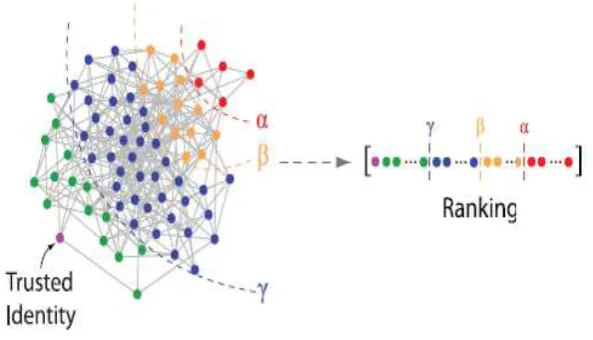
The above given three assumption, will together, the structure basis of the Sybil discoveries. While a non Sybil
regions of networks are tightly interconnected (in the assumption 1), so and Sybil section of networks are
attached by the very restricted numbers of the link (in the assumption 2), the already available discoveries
techniques stare for the resulting of the topological feature for the partitioning networks into the Sybil and the
non Sybil region (for that see the Figure 1). Finally it will be considered for divider which consists all
recognized the non Sybil identities (in the assumption 3) for finalizing that which is a non Sybil section.
Fig. 2. Diagram of Converting Partitionings into a Ranking of Identities
IV. ADVANTAGES
1) Here in given scheme it is taken care to differ the Sybil discovery and the acceptance in presumptions they
both creates.
2) This method can stop all the recovered Sybil identity in the context of interacting to the other identity into
V. RELATED WORK
Here the credit type network will generated from a communal related network are the Sybil tolerant by the
character. Now consider the assault topologies, imbalance in the transaction between all spammer and the
legitimate user (such as, spam in the given messaging systems) will always surrounded with help of collective
credit (all sum of credit balance onto connections) accessible onto border cut deviding spammer from the
legitimate type user. So it is completely accurate regardless of amount of the Sybil identity spammer uses or
credit balance onto connection between spammer identities. So that, credit networks can naturally jumps
numbers of the spam‟s transaction, in spite of numbers of the identity an assailant poss. System stylish should
too make sure that selected working mechanism could never block legitimate type of transaction in a very
common container. And finally, it can concentrate onto container when every node in the offered messaging
scheme will be legitimated. Suppose the edge cutting that will divide legitimate user in the two type of group.
The offered credits adjustments modules would bind all credits imbalances in between two type of the group for
credit the reach of group generate given to others. If identity in single groups is paying attention into the sending
the disproportionately the very huge numbers of the message to identity in others type of groups, credit of all
along edge cutting can also exhaust, putting off the additional transaction. And it is very fundamentally that the
liquidity problems, where the subsets of legitimate node will have inadequate liquidities with the other type of
sub sets. Therefore, in long terms, several sub sets of the legitimate node should be received the message from
rest of a legitimated node as always as they will send the message to the discussed node.2 Mechanism must be
selected so we can say statistic of the legitimated works loads sharing would be ensured the estimated long
terms trades type of balances. And if it won‟t work, Use of the technique supposes the credits replenishment
(wherever the credit will every so often will be readjusted by systems) and can be then utilized. So numbers of
the credit type networks techniques have been already is in existence and will be evaluated for the particular
application. Scheming the proper type of the techniques for the various more application in the moral ways will
remain the open problems. Lastly, systems designers should make sure that given credits networks technique
will never bring into the fresh vulnerability. Take an example; can the little number of assailant node exhausts
credits with along with the edge cutting untying type legitimate identity, thus the stopping legitimate kind
identity from the interacting with the each others? We can say by considering the small cutting A from side to
side the networks where here is both assailant and the legitimate identity on the either sides. If a attacker will
have, in the aggregates, more than the credits within legitimates identity than the exits down cutting A, so it‟s
possible that all assailant can tire out credits along with the A (such that, with help of the transferring the
message to the each others, disturbing credits value on the A). Luckily, topologies of the communal network (on
which the offered credits network are all always built) will make these type of situations completely unlikely. At
first, communal network are the sufficiently fine linked that a min cutting in between any of the pairs of the
node will tend to be the contiguous to the either of node. It follows the single completely misbehaving type of
the nodes will then run out of the credits before credits on any of the other cutting into networks will pooped.
Next, the assumption 2 indicates that the groups of the Sybil will be controlled by the assailant will then tend to
be have the very small cutting to rest of given networks (because assailants will not be able for generating the
arbitrary numbers of the connections to the other type of the real user). So that, the groups of the Sybil will too
probable for the run out of the credits before groups will tired out all credits on some larger type cutting in
can also be engrossed by the settings appropriates and the original credits allocation. Of the credits network and
relationships with operations workload stays the future works.
VI. CONCLUSION
In concerned techniques conclusions, given paper consider the communal networks that will be based on the
Sybil type of the defenses and then make separate the existing proposal into the two types of the category that is
namely, the Sybil discovery and the Sybil acceptance. The Sybil discovery will be conceptually a
straightforward approach, and then it will be independent from the applications, and also it is very easy for
applying. Though, it will be dependent onto the all very strong type of the assumption about communal chart of
arrangements. Furthermore, the misclassification is potentially very expensive, reason is that it can ban the
legitimate users from systems, or can allow the assailant identities free of the reign. The complete and detailed
description of usefulness of the Sybil discoveries on the real communal network will remain the as an open
problems. The Sybil patience, on contrary, will permit or can also deny the personage transaction between the
entire user, which will enable the presentation to the degraded gracefully into a presence of the all false positive
or the negative. The tolerance techniques can be potentially achieving the all superior type of the correctness all
because of it will consider given pattern and the history of the user‟s transaction, apart from this communal chart
of the arrangement, basis for the giving permission communications. Though, the Sybil acceptance techniques
need an application related methodology which will distinguishes the attacks activities from the legitimate
activities, with not creating systems vulnerable for denial of the services assaults. For that these technology have
been always designed well and also evaluated well for the particular application. The common understanding of
all classes of the application that will lend them self to the Sybil acceptance, the systematic based design style
for the appropriate schemes, well-organized representations of the credits network on the communal network at
the scale, and the studies of communal dynamic which will outline all combined communal chart or the credits
networks in the Sybil understanding systems all the remain opens problem.
REFERENCES
[1] J. Douceur, “The Sybil Attack,” in IPTPS, 2002.
[2] N. Tran, B. Min, J. Li, and L. Subramanian, “Sybil Resilient Online Content Voting,” in NSDI, 2009.
[3] H. Yu, M. Kaminsky, P. B. Gibbons, and A. Flaxman, “SybilGuard: Defending Against Sybil Attacks via
Social Networks,” in SIGCOMM, 2006.
[4] H. Yu, P. B. Gibbons, M. Kaminsky, and F. Xiao, “SybilLimit: A Near- Optimal Social Network Defense
against Sybil Attacks,” in IEEE S&P, 2008.
[5] G. Danezis and P. Mittal, “SybilInfer: Detecting Sybil Nodes using Social Networks,” in NDSS, 2009.
[6] N. Tran, J. Li, L. Subramanian, and S. S. Chow, “Optimal sybil-resilient node admission control,” in
INFOCOM, 2011.
[7] D. Quercia and S. Hailes, “Sybil attacks against mobile users: Friends and foes to the rescue,” in
INFOCOM, 2010.
[8] C. Lesniewski-Laas and M. F. Kaashoek, “Wh¯anau: A Sybil-proof Distributed Hash Table,” in NSDI,
2010.
[9] A. Post, V. Shah, and A. Mislove, “Bazaar: Strengthening user reputations in online marketplaces,” in
NSDI, 2011.
[10] A. Mislove, A. Post, K. P. Gummadi, and P. Druschel, “Ostra: Leveraging Trust to Thwart Unwanted
AUTHOR PROFILE
Yamala Sreenivasa Rao is currently pursuing M.Tech in the Department of Information
Technology, from Nalanda Institute of Engineering & Technology (NIET), siddharth
Nagar, Kantepudi(V), Sattenapalli (M), Guntur (D), Andhra Pradesh , Affiliated to
JNTU-KAKINADA.
V. Nagi Reddy working as Assistant Professor at Nalanda Institute of Engineering &
Technology (NIET), siddharth Nagar, Kantepudi(V), Sattenapalli (M), Guntur (D),