VM migration using minimum migration time
selection policy on virtual machines
Pooja Tandel,Prof.Abhijitsinh Parmar,Prof.Jaimeel shah student,professor,professor
Computer Science & Engineering ,Parul university ,vadodara, India.
Abstract: The distributed computing focus incorporates virtualization of prerequisites resource, precedent amassing arrangement of standards virtual machine (VM) memory. The cloud data run gives momentous figuring condition; anyway essentially the ordinary utilization of cloud servers is low. The standard goal is to design the advantages in appropriated processing when stacks in the virtual machines are generous. The live movement (migration) of these VMs is familiar with gaining various favorable circumstances which generally consolidate vitality proficiency, high accessibility, equipment upkeep, Proactive adaptation to non-critical failure and outstanding task at hand adjusting. This paper cements diverse successful procedures of choice strategy for relocating VM, alongside I had played out the arrangement which demonstrates for better moving time in examination of others.
Keyword: cloud computing, VM migration, virtual machine (VM), VM selection policy
I. Introduction
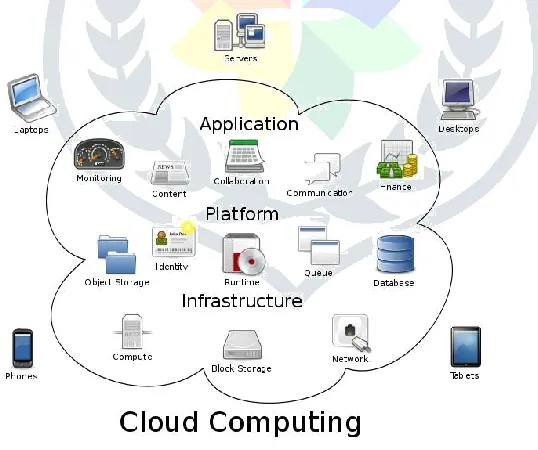
In the most prompt terms, streamed taking care of deduces tying down and getting to data and undertakings over the Internet as opposed to your PC's hard drive. The cloud is just a relationship for the Internet. This is showed up in figure 1.Cloud preparing utilizes the probability of virtualization. Virtualization portrays a movement in which an application, guest working system or data securing is drenched a long way from the veritable significant contraption or programming. A key use of virtualization headway is server virtualization, which uses a meager layer called a hypervisor to duplicate the fundamental rigging. Advancement is the bit of virtualization. Cloud advancement is the course toward moving information, applications or various business parts to an appropriated enlisting condition.
Fig: 2 Cloud Migrations [12]
There are two types of migration:
1) Process Migration: Process Migration is an approach in which a working technique is moved start with one machine then onto the accompanying of possibly exceptional structure. A technique any be moved either before it begin executing on its source focus point or over the scope of its execution.
2) VM Migration: Development advantage, with respect to virtual machines, is the path toward moving a virtual machine from one host server or capacity area to another. There are differing frameworks of VM migration, hot/live development and cool/standard development of a VM. In this strategy, each and every key machine parts, for instance, CPU, amassing plates, frameworks organization, and memory, are absolutely virtualized, thusly promising the entire state of a VMs to be gotten by a course of action of easily moved data reports.
II. Need of Migration
Its aim is to optimize following parameters such as:-
1. Load Balancing: It's required when the store is fundamentally uneven and moving toward downtime routinely requires simultaneous VM development. It is used for continuing with organizations after lemon over of parts which are watched constantly then burden on host scattered to various hosts and never again sends development to that have.
2. Server Consolidation: So as to less server spread in server farms, server combination calculations are required. These calculations are VM pressing heuristics which endeavor to pack however many VMs as would be prudent on a PM with the goal that asset utilization is improved and unused or under-used machines can be killed. Combination will result in decreased power utilization and in this manner lessening generally speaking operational expenses for server farm chairmen [5].
3. Energy Efficiency: The power consumption of Data centres is mainly based upon the utilization of the servers and their cooling systems. The servers typically need up to 70% of their maximum power consumption even at their low utilization level. Therefore there is a need for migration techniques that conserves the energy of servers by optimum the resource utilization [5].
4. Proactive fault tolerance: Fault is another challenge to guarantee the critical service availability and reliability. Failures should be anticipated and proactively handled, to minimize failure impacts on the application execution and system performance.
5. Power management: switch the inactive mode server to either rest mode or off mode dependent on asset requests, that prompts incredible vitality sparing on the grounds that inert mode server devours 70% of their pinnacle control and combine the running VM's to less dynamic hosts prompts extraordinary vitality sparing. So unique designation of VM's too couple of dynamic servers' however much as could be expected, VM live relocation is a decent strategy for cloud control productivity [5].
6. Resource sharing: The sharing of restricted equipment assets like memory, store, and CPU cycles prompts the application execution corruption. This issue can be unraveled by migrating VM's from over-stacked server to under-stacked server .Although, the sharing of assets prompts chop down operational expense due to turn off the superfluous or inert servers [5].
III . Types of VM Migration
A. Cold virtual machine migration:
Cold movement is the relocation of a controlled off virtual machine. With cold movement, you have the choice of moving the related plates starting with one information store then onto the next.
Fig: 3 Cold Virtual Machine Migrations
Cold relocation, in the meantime, suspends OS and applications on virtual machines before exchanging them to physical machines. Sorts of movement accessible rely upon the hypervisor chose.
The virtual machines are not required to be on shared capacity. The virtual machine you need to move must be fueled off before starting the cool relocation process.
B. Live Virtual Machine Migration:
Live relocation (which is additionally called hot or ongoing relocation) can be characterized as the development of a virtual machine starting with one physical host then onto the next while being controlled on. When it is appropriately completed, this procedure happens with no detectable impact from the end client's perspective (a matter of milliseconds).
IV. How Is Live Migration Achieved
The logical steps that we execute when migrating the VM are summarized in figure 5.
Fig: 4 Steps of Live VM migration [7]
Stage 0: Pre-Migration - we start with a functioning VM on physical host A. To speed any future relocation, an objective host might be preselected where the assets required to get movement will be ensured [7].
Stage 1: Reservation- An request for is issued to move an OS from host A to have B. We at first affirm that the essential assets are accessible on B and hold a VM compartment of that measure. Inability to verify assets here implies that the VM basically keeps on running on an unaffected [7].
Stage 2: Iterative Pre-Copy- During the main cycle, all pages are exchanged from A to B. Resulting emphases duplicate just those pages dirtied amid the past exchange stage [7].
Stage 3: Stop-and-Copy- We suspend the running OS occasion at diverts its system traffic to B. As depicted before, CPU state and any staying conflicting memory pages are then exchanged. Toward the finish of this phase there is a steady suspended duplicate of the VM at both An and B. The duplicate at an is as yet viewed as essential and is continued if there should arise an occurrence of disappointment [7].
Stage 4: Commitment Host B demonstrates to A that it has effectively gotten a predictable OS picture. Host Acknowledges this message as responsibility of the relocation exchange: have a may now dispose of the first VM, and host B turns into the essential host [7].
Stage 5: Activation The relocated VM on B is presently initiated. Post-relocation code races to reattach gadget drivers to the new machine and publicize moved IP addresses [7].
This way to deal with disappointment the executives guarantees that something like one host has a reliable VM picture consistently amid relocation. It relies upon the suspicion that the first host stays stable until the movement submits, and that the VM might be suspended and continued on that have with no danger of disappointment. In light of these suppositions, a relocation ask for basically endeavors to move the VM to another host and on any kind of disappointment execution is continued locally, prematurely ending the movement [7].
V. Literature Review
In this paper the creator actualize the VM-DFM Algorithm is utilized to limit the no of physical machines, balance the outstanding burden, decreases the measure of VM relocation. Also, a dynamic estimating planning calculation is utilized to decide the goal where VM moved from time arrangement [3].
In this paper we Live VM movement procedures like pre duplicate and post duplicate methods to talk about different execution measurements like application administration downtime, all out relocation time and measure of information exchanged [4].
In this paper they have structured three calculations, by doing amalgamation of heuristic strategy and relocation control. Virtual Machine (VM) choice is the prompt advance after the host over-burden is identified. Presently choice should be settled on to decision the VM(s) to relocate. VM choice is an imperative errand and the vitality utilization relies upon the choice. Three VM determination systems have been proposed in writing and been joined in CloudSim, a recreation structure to reenact Cloud engineering, asset provisioning and so forth. In this proposed model, CPU use has been considered to recognize a VM to be enduring or not. The VM determination components are adjusted and conditions are likewise changed to embrace relocation control in the approach and calculations additionally created. They have utilized Cloudsim toolbox to reenact our examination and to assess the execution of the proposed calculation; they have utilized genuine remaining burden hints of Planet lab VMs. From the correlation with existing vitality mindful VM combination techniques, it is discovered that execution of the calculation is superior to anything other proposed heuristic methodologies [9].
In this Paper our calculation chips away at Modification Minimum Migration Time Virtual Machine (VM) Selection Policy to help limit generally speaking execution time for each host machine. Whole outcome demonstrates less execution time mean. These marvels help to improve SLA Violation. That is likewise limiting number of Virtual Machine Migration (VMM) and Energy Consumption. The choice Policy dependent on cloudsim test system 3.0 and gives best existing arrangement component Like MadMmt [10].
VI . Existing Methodology for VM Selection Policy
a) Minimum Migration Time:
This approach is use in VM Selection in cloud server farm. The Minimum Migration Time (MMT) strategy moves a VM v that needs the base time to entire relocation similarly to alternate VMs charged to the host. The movement time is assessed as the measure of RAM misused by the VM isolated by the system data transmission accessible for the host j. Let Vj be a lot of VMs as of now dispensed to the host j. The MMT arrangement finds a VM v that fulfills conditions formalized. Where RAMu(a) is the amount of RAM currently utilized by the VM a; and NETj is the spare network bandwidth available for the host j.
b) Random Selection with Migration Control
Arbitrary choice strategy chooses an irregular VM to be relocated for the over-burden have. In the RS with relocation (rsmc) control, movement control criteria are incorporated to force control for relentless VM not to be moved. The rsmc chooses a VM to be relocated from the over-burden have as indicated by a consistently circulated discrete arbitrary variable whose esteem list is a lot of VMs Vh dispensed to have h. So the conditions are [9].
Whose values index set of VMs Vh allocated to the host h.
c) Maximum Correlation with Migration Control
A vector of predicted value is denoted by y.
Having found the predicted value the correlation coefficient is:
VII .
EXPERIMENTAL RESULTS
Fig: 5 minimum migration time selection policy
VIII . Conclusion & Future Work
Movement procedure is utilized for adjusting load in server farms without hindering other running virtual machines. This paper represents the assortments of movement procedures alongside different VM choice strategy methods which contributed in limiting the relocation time, downtime and expanding the execution. It is hard to pass judgment on the diverse techniques as every one of them is actualized in different engineering and stages. It is likewise difficult to institutionalize the accomplishment of the movement. Additionally my examination result portrays that its assistance us to accomplish the base relocation time. In addition the future work actualizing the recently one which will be fulfiller the every one of the parameters like least execution time, least down time, CPU usage.
Reference
[1]. International Journal of Pure and Applied Mathematics, 2017, “Live Migration of Multiple Virtual Machines (Vms) Using Migration Dirty Page Rate (Mdpr) Model”, V.Jayanthi, S.Nagadevi.
[2]. IEEE, 2017, “Live Migration of Virtual Machine with Pre-Record and Use Pdopmp To Analyses Memory Access Trend”, Zhongyuan Shan, JianzhongQiao, Shukuan Lin.
[4]. Journal Of Cloud Computing: Advances, Systems And Applications,2017, “A Critical Survey Of Live Virtual Machine Migration Techniques”, Anita Choudhary, Mahesh Chandra Govil, Girdhari Singh, Lalit K. Awasthi, Emmanuel S. Pilli And DivyaKapil
[5]. International Journal Of Grid Distribution Computing 2015, “ Migration Jobs In Cloud Computing”, Anita Rani And PankajdeepKaur
[6]. Indian Journal of Science and Technology, Vol 8(S9), 326–332, May 2015,” Live Migration of Virtual Machines in Cloud Environment: A Survey”,LalithabhinayaMallu,Ezhilarasie R
[7]. 2nd Symposium on Networked Systems Design & Implementation“Live Migration of Virtual Machines”, Christopher Clark, Keir Fraser, Steven Hand, Jacob GormHanseny,Eric July, Christian Limpach, Ian Pratt, Andrew War_eld
[8]. International Journal of Scientific and Research Publications, Volume 2, Issue 6, June 2012,”live virtual machine migration in cloud ”,Ashima Agarwal, Shangruff Raina
[9]. International Journal of Information Web Applications Volume 6 Number 4 December 2014,”Incorporating Migration Control in VM Selection Strategies to Enhance Performance”
Mohammad Alaul Haque Monil, Romasa Qasim, Rashedur M Rahman
[10]. International Journal of Application or Innovation in Engineering & Management (IJAIEM) Volume 4, Issue 4, April 2015 ISSN 2319 – 4847”Improved Minimum Migration Time VM Selection Policy for Cloud Data Center “,Sonal Namdev, Prof. Neelam Sain , Prof. Anjul K S Rai
Website
[11]. https://en.wikipedia.org/wiki/Cloud_computing