e-ISSN: 2278-7461, p-ISSN: 2319-6491
Volume 6, Issue 10 [October. 2017] PP: 42-46
Solution of the Problem of Excess of Setup in the
Production Process of Plastic Packaging
Matheus Augusto Souza Sarraipo
1*; Hellon Santos Silva
1; Lucas Contiéri Mota
Nunes da Silva
1; Domingos Sávio Silva1; André Ricardo Soares Amarante
1;
Herlandí de Souza Andrade
1,21Faculdade de Tecnologia de Guaratinguetá, Brazil. 2
Faculdade Anhanguera de Pindamonhangaba, Brazil.
Abstract:Production management is relevant, not just to organizations, but to the nation as a whole. The object
of study of this article is the production of plastic packaging and its objective is to reduce the excess of the time of setup of the mold exchange of the productive process of one of the products of its portfolio and with that to bring benefits to the company, as for example: reduce set-up time, reduce machine operator idleness and increase production. The methods applied were inductive reasoning, bibliographic research, documentary research, brainstorming, GUT matrix, SMED, Ishikawa diagram, Pareto chart, control chart and project management tools. With the study and application of the tools, it was possible to reduce the time of setup of the mold exchange.Keywords: Productive Process, Problem Solution, Setup, SMED
--- --- Date of Submission: 02-10-2017 Date of acceptance: 18-10-2017 ---
---I.
INTRODUCTION
Production management is of extreme relevance not only to organizations, but to the nation as a whole. Developed countries have achieved [2] their success by having efficient production management. It is understood that an efficient production management is one of the economic foundations of a nation, directly influencing its growth. Over the years, production management has been undergoing reforms, always aiming to improve its processes and consumer satisfaction.
The object of study of this article is the production of plastic packaging. The segment of plastic packaging presents good results in view of the current scenario of Brazil. According to studies carried out by ABRE (Brazilian Association of Packaging) [1] the gross value of packaging production in general reached R $ 55.1 billion in 2014. This sector corresponds to 39.07% of the gross value of production. Considering all companies operating in this sector, the value of exports reached R $ 523.2 million in 2014. In 2015, the physical volume of the packaging segment [1] fell 4.41% and in 2016 fell 4.20%. For the year 2017, the projection is for improvement, but starting in the second half, estimating a small increase of 0.6% in the physical volume of production. Within this current scenario, the company studied in this article produces plastic packages blown in monolayers and co-extruded, providing for the agrochemical and food sectors.
The objective of this study is to reduce the excess of setup time of the mold exchange of the productive process of one of the products of its portfolio and thus bring benefits to the company, such as reducing setup time, reducing idle time machine operator and increase production.
The methodology used for this research was a case study carried out in the studied company, with the direct interaction with the employees of the productive area and the administration. During this case study we identified the main problems in the productive area and prioritized this problem with the help of the GUT (Severity x Urgency xTendency) tool. After prioritization, it was studied the causes of this problem with the help of Brainstorming and Fish Spine tools. With the identified causes, it was possible to propose a solution to the problem, with the help of the Project Management tools. To support the case study, a review of the literature was also performed.
II.
THE
COMPANY
AND
THE
PROCESS
STUDIED
sustainable. And, the values are defined as: quality, customer focus, innovation, commitment, teamwork and sustainability.
The company is located in Lorena / SP and currently has 115 employees, including: machine operators (75 employees), section manager (05 employees), process control (05 employees), dispatch and logistics (4 employees), maintenance ( 10 employees), administrative (16 employees).
The company's products are: 1L Bottle Monolayer; 5L Monolayer Bottle; 20L Monolayer Bottle; 1L Coex bottle; 5L Coex bottle; Bottle 250ml Monolayer; Coex 250ml bottle.
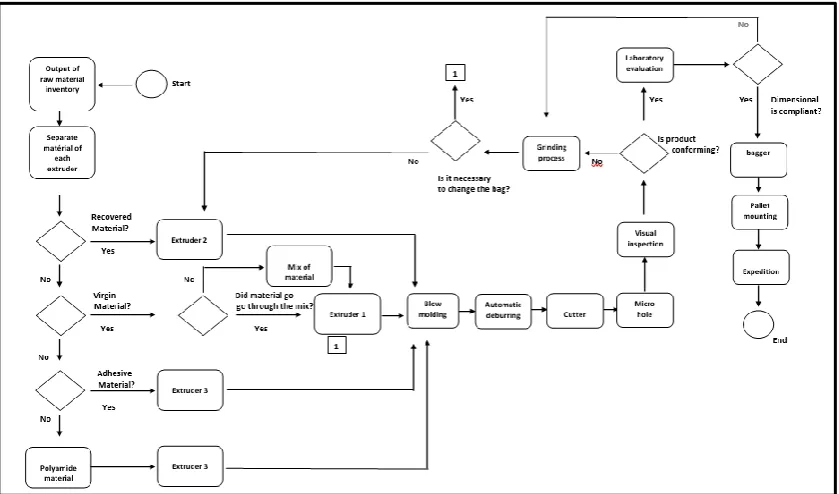
Production consists of 5 steps. The first step starts with the material leaving the stock to the mixer. The second step is where the basic raw material (HDPE) is mixed manually into the pigment. The third step concerns the storage of the mixture in a bag, to await loading for production. In the fourth stage the raw material is processed to generate the 1L Coex flask. After the material has been processed, we have the fifth step, where the product is sent for quality inspection. This flow is illustrated in Figure 1. Also, Figure 2 shows the mapping of the value chain of the production process, allowing to analyze the time that the 1L Coex Bottle takes to be produced.
III.
IMPROVEMENTS
IN
THE
PRODUCTION
PROCESS
Initially, brainstorming was conducted with the production team to identify the problems that are common in the production of the product. Based on the results of this brainstorming, the problems, which are presented in Table 1, were prioritized.
Table 1:SUT Matrix for Improvement Opportunities.
Problem
Severity
Urgency
Tendency
GxUxT
Sequence
Excessive setup time
5
5
4
100
1º
Lack of corrective maintenance
5
4
4
80
2º
Raw material irregular
4
4
4
64
3º
Disqualified labor
4
3
4
48
4º
Dimensional nonconforming
3
3
3
27
5º
The problem prioritized was Excess in the "Setup Time". The setup for the companies represents a waste, since the production line is not in operation, that is, there is no productivity. Today, companies are looking to reduce setup time by analyzing the best way to accomplish this, so that the production process returns, as quickly as possible, increasing the quantity of products produced and maximizing profits. "The setup time starts on the production of the last part of a batch or on the last action within the defined specifications and goes until the time when the first part of the new batch or new action is produced or performed within the defined specifications "[3].
In order to better understand the prioritized problem, the SMED (Single minute Exchange Die) tool, also known as "Fast Tool Exchange (TRF)" was applied. It is an instrument used in industries with the focus on reducing the hours of the Setup process.
In the process, there is internal setup and external setup. The internal setup [3] is the preparation time for the machine or tool to be used (TPI), the external setup is the setting with the operating machinery (TPE). In the process of the studied machine, this means that the internal setup would be all the replacement of the tools and peripherals of the blower and the external setup would be adjustments in the blower already operating, until leaving the first bottle inside the conform and approved by the quality control.
The total hours of internal setup were a little more than 153 hours in the analyzed period. The item referring to the mold exchange had a cycle lasting a little more than 109 hours, with a greater attention in the last two months in which there were two exchanges, one in March and another in April that lasted more than 20 hours for the replacement of the mold.
The product release is an external setup item, which refers to the settings made on the machine, with the machine running. The adjustment is done until the product is within the standard, approved by the quality department of the organization.
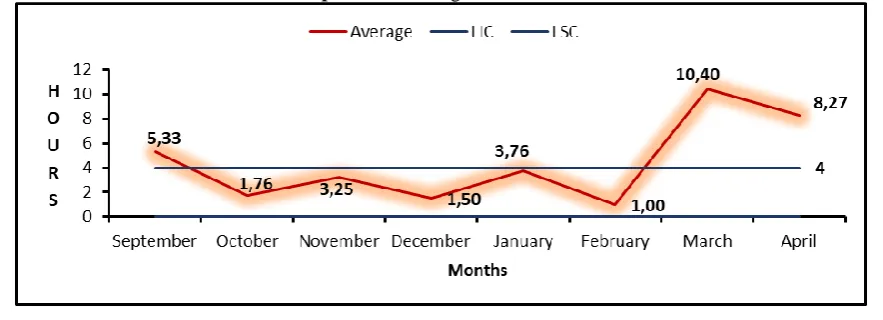
Also, a control chart was applied to evaluate the mold exchange. The control chart is a chart that allows you to view the follow-up of a given process. In this case, it is a KPI (Key Performance Indicator) applied to monitor the performance, in hours, of the mold exchange, analyzing the months of September 2016 until April 2017, as can be observed in Graph1.
The limit in hours for each mold exchange is 4 hours. Over the months, mold turnover numbers ranged from 1 to 4 exchanges in the month. The red line is the average in hours of the mold exchange of each month and how it can be analyzed, in the months of September, March and April, the average in hours was above the limit of 4h. In the months of March and April there were two exchanges, one in each month that lasted another 20 hours.
With the analyzes carried out and applying a new brainstorming with the production and administration team, it was possible to draw up a cause and effect diagram to identify the causes of the problem studied. Such a diagram is shown in Figure 3.
Figure 3: Ishikawa Diagram of Mold Exchange.
IV.
CONCLUSION
With this study, it can be concluded that it is possible to reduce 53: 43h in its manufacturing process. This would result in an increase in the production of the 1L coex flask of approximately 24,306 units, and thus decrease the idleness of the machine operator. The billing of these bottles that could be produced would be approximately R $ 21,875.40. This would result in a significant increase in company revenue.
With the application of the described quality tools, the use of SMED, as well as the use of the other concepts of production and operations management, and the application of project management tools, it was possible to identify the causes of the problem and propose its solution. This solution was presented to the company and is expected to be implemented.
To conclude, the study showed that it is possible to reduce the excess in the hours of setup of the mold exchange, thus bringing benefits to the organization, such as reducing the hours of setup and the idleness of the operator and the possibility of increased manufacturing and billing.
REFERENCES
[1] ASSOCIAÇÃO BRASILEIRA DE EMBALAGEM (ABRE). Estudo Macroeconômico da Embalagem. Disponível em http://www.abre.org.br/setor/dados-de-mercado/. Acesso em: 22/03/2017.
[2] PARANHOS FILHO, M. Gestão da Produção Industrial. Curitiba: Editora Ibpex, 2007.
[3] RODRIGUES, M. V. Entendendo, aprendendo e desenvolvendo sistema de produção Lean Manufacturing. 2ª ed. Rio de Janeiro: Elsevier, 2016.
[4] VELAPLAST. Disponível em http://www.velaplast.com.br/pt/paginas/. Acesso em: 03/03/2017.