Volume 7, Issue 4 [April 2018] PP: 01-09
Production and Characterization of Activated Carbon from
Nigerian Bamboo Using the Two Methods of Activation
Udeh, N.U
Department of Civil and Environmental Engineering University of Port Harcourt, Rivers State, Nigeria
Abstract: The study investigated the production activation carbon with bamboo sticks at different carbonization temperatures (400oC and 500oC), impregnation ratios (1:2; 1:3 and 1:4) and different activation methods (chemical and physic-chemical activation methods). The effects of carbonization temperature, impregnation ratios and activation methods on the properties of bamboo activated carbon were studied by characterizing them in terms of surface area, porosity, bulk density, carbon yield and ash content. The results showed that the unwashed chemically activated carbon (UCABC) had higher surface areas (4839m2/g and 5415 m2/g) at 400oC and 500oC at ratio 1:2 respectively while the washed chemically activated carbon (CABCW) had higher surface areas of 1287m2/g and 1255m2/g (at ratios 1:2 and 1:3 respectively) at 500oC. However, the physic-chemical activated carbon (PABC) had higher surface area of 359m2/g with ratio 1:3 at 500oC. Furthermore, high porosity values ranging from 0.77 to 0.95% was observed for all the bamboo activated carbon indicating highly porous materials and their bulk density were in the range of 0.425g/cm3 to 0.687 g/cm3. Also, the ash content ranged from 8.7 to 15.4 % while the carbon yield at 400oC had the same values of 31.9% for UCABC and CABCW at ratio 1:2. Thus, UCABC at 500oC (ratio 1:2) has the highest surface areas and the activating chemical need not to be washed away to avoid generating more wastewater during production
Keywords: Activation, Bamboo, Characterization, Carbonization, surface area
--- --- Date of Submission: 18-04-2018 Date of acceptance: 03-05-2018 --- ---
I INTRODUCTION
Activated carbon is an adsorbent produced from a wide range of organic based materials such as coal, coconut shell, wood chips, palm-kernel shell, corn cobs, saw dust and many others [1]. The raw material is carbonized to obtain the char or carbonaceous material, which is then activated to yield the highly porous product which has high degree of porosity and an extended internal surface area. Thus, two main parameters are relevant to the performance of the activated carbon namely the surface area and the pore volume or structure. The pore volume limits the size of the molecules that can be adsorbed whilst the surface area limits the amount of material which can be adsorbed. Activated carbon particle has two types of pores existing in it by which adsorption take place. They are the macro pores (>10-1 um) and the micro pores (10-3 - 10-1 um). The macro pores provide a passageway to the particle's interior and to the micro pores while the micro pores are responsible for the large surface area of activated carbon particles and adsorption largely takes place in the micro pores. The macro pores and the micro pores are created during the activation process.
Basically, there are two different processes for preparation of activated carbon namely, chemical activation and physical activation[2], [3]. Physical activation involves carbonization of a carbonaceous materials followed by activation of the resulting char in the presence of activating agents such as CO2, steam or other
mixtures [4] while in Chemical activation, the precursor is impregnated with a chemical agent and then pyrolyzed [5], [6]. Chemical activation enjoys the benefit of development of better porous structure in a single process route at low carbonization temperatures as compared to physical activation. The excellent features of activated carbon has made it to be widely used in many fields including, water and wastewater treatment, gas filters, deodorization, decolorization, purification and separation processes [2]. They can be also used as catalysts and catalyst supports in the catalytic processes. However, due to the high cost and non-renewable source of commercially Activated Carbon, researchers have studied production of activated carbons from cheap and renewable precursors. Bamboo appears to be economically attractive because of its abundance, low cost, high carbon content, rapid growth and multiplication speed.
its inherent mechanical strength [8]. It is a strong, tough, cheap, versatile, and highly renewable material, one that people and communities have known and utilized for thousands of years.
The focus of this research is to produce high surface area activated carbon from bamboo sticks by comparing the two activation methods: chemical activation and physical activation. Conversion of bamboo to activated carbon with high surface area would help to solve part of wastewater treatment in Nigeria.
II MATERIALS AND METHODS
2.1 Collection and Preparation of materials
The Bamboo sticks used for this study could be referred to as Indian bamboo which is the dominant bamboo in Nigeria found in the rain forest belt. Fully matured Bamboo sticks were cut into smaller sizes (2- 4cm), washed, air dried and then taken to the laboratory for further processing. Preliminary analyses were carried out on the dried Bamboo materials to determine the Fixed Carbon and Volatile matter content. Zinc Chloride (ZnCl2) of
about 80% purity was used as the activating agent.
2.2 Production of Bamboo Activated Carbon
The Bamboo Activated carbons were produced by two methods: Physico-chemical activation method (which involved two- step pyrolysis) and Chemical activation method (which involved the single step pyrolysis).
2.2.1 Chemical Activation Method (Single Step Pyrolysis)
The bamboo samples were chemically activated using Zinc Chloride (ZnCl2) as the activating agent. 500g of
dried bamboo was mixed with ZnCl2 solution at different impregnation ratios (1:2, 1:3 and 1:4) ZnCl2/Bamboo.
The mixture was then heated on a hot plate to almost dryness. The activated bamboo samples were air- dried and then carbonized at two different temperatures 400oC to 500oC for 3 hours using a muffle furnace and then grinded into powder. The carbonization temperature and time ranges were in accordance with previous studies on Nigeria Bamboo [9], [10], [11]. Part of the grinded activated bamboo carbon were washed with distilled water to a pH of 6 (to remove the activating chemical) while the other part was left unwashed. The washed samples were dried in an oven at a temperature of 110oC for a period of 6 hours. The washed bamboo samples were named Chemical Activated Bamboo Carbon washed (CABCW) while the unwashed samples were named Unwashed Chemical Activated Bamboo Carbon (UCABC). This nomenclature was used to identify the two variations of bamboo activated carbons produced by chemical activation.
2.2.2 Physico -Chemical Method of Activation
500g of dried Bamboo samples were carbonized in a muffle furnace at two different temperatures (400 and 500oC) for 3 hours. The carbonized materials were grinded into smaller sizes and impregnated with Zinc Chloride (ZnCl2) at different weight ratios of 1:2, 1:3 and 1:4 (ZnCl2/bamboo). The resultant mixtures were
heated on a hot plate until a paste was formed. The carbon samples were allowed to cool and then washed with distilled water to a pH of 6 and then dried in an oven between temperature ranges of 100oC to 110oC for 6 hours. The samples were named Physical Activated Bamboo Carbon (PABC).
2.3 Characterization of Produced Bamboo Activated Carbon
The bamboo activated carbon samples produced (PABC, UCABC and CABCW) were characterized and the following parameters were determined: surface area, porosity, bulk density, carbon yield and ash content. Surface area and porosity in particular were adopted as criteria because it has been reported that carbons with high surface area and porosity are the most suitable for adsorption of adsorbates in aqueous solution [12], [13], [14], [15].
The Surface area was calculated using Sear’s method as reported by [16]. Carbon yield was measured using the method of [17] in which the dried weight of each bamboo sample was determined before and after carbonization and the carbon yield, Ych calculated from Equation 1:
𝑌𝑐ℎ = Wo
Wch × 100% (1) Where: Wo = mass of bamboo carbon retrieved from the furnace. Wch = mass of air-dried bamboo samples
before carbonization.
The Porosity which is the ratio of the volume of voids to the total volume of the activated carbon particles and was calculated from Equation 2:
n = 1 − ρ
ρw G s 1+w (2)
Where: n = Porosity, ρ = Bulk density of activated carbon particles, ρw = Density of water, Gs =Specific
gravity of activated carbon particles and w = Moisture content.
calculated as the ratio of the change in weight to the original weight expressed as a percentage. It was calculated from Equation 3;
w =Wo−Wd
Wo × 100% (3) Where: Wo = original weight (g), Wd = weight after drying (g), w= moisture content (%)
A pycnometer was used in the determination of the specific gravity of the activated carbon particles. The Specific gravity Gs was calculated from Equation 4:
2 4
1 3
1 2
M
M
M
M
M
M
G
s
(4)Where M1 = mass of the empty pycnometer, M2 = mass of oven dried activated carbon inside the pycnometer,
M3 = mass of oven dried activated carbon inside the pycnometer filled with water, M4 = mass of pycnometer
filled with water.
The pH was determined by suspending one gram of carbon in 100ml distilled water of pH 7.0 and heating at 90oC for 20 minutes. The solution was then cooled and pH measured using a digital pH meter [12].
III RESULTS AND DISCUSSION
3.1 Preliminary Analysis of Raw Bamboo
The results of the preliminary analysis of raw bamboo indicated a relatively high volatile matter content (86.4%) and fixed carbon content of 12.12% and may be considered as a good material for activated carbon. This confirms with the study of [19] reported that bamboo is rich in volatiles (70%) and has a fixed carbon of 11.32%. Also, [20] reported a high carbon content of 43.8% for raw bamboo sticks. Note that fixed carbon content of bamboo changes when exposed to high temperature during carbonization and activation. The fixed carbon content would increase steadily while volatile matter would decline with temperature [19].
3.2 Results of Characterization of Bamboo Activated Carbon
The effect of the optimum conditions (carbonization temperature and impregnation ratios) in the production of Bamboo activated carbon using Physico-Chemical and Chemical method of activation were analyzed in terms of surface area, porosity, ash content and carbon yield.
3.2.1 Effects of Carbonization Temperature on properties of Bamboo carbon
The results of characterization of the different samples of Bamboo activated carbon produced using the two activation methods at two different carbonization temperatures (400oC and 500oC) were shown in Table 1.
Table 1: Characterization of Bamboo Activated Carbon at 400oCand 500oC
Parameters 400oC 500oC 400oC 500oC
Bamboo Charcoal PABC UCABC CABCW PABC UCABC CABCW
Impregnation ratio No impregnation 1:2 1:2 1:2 1:2 1:2 1:2
Surface area (m2/g) Bulk density (g/cm3) Specific gravity Moisture content (%) Porosity
Ash content (%) Carbon yield (%) pH 151 0.476 1.11 2.7 0.88 11.3 24.5 10.10 156 0.454 0.91 1.95 0.83 8.7 27.69 10.10 167 0.473 1.27 1.60 0.86 8.6 24.5 6.0 4839 0.524 2.23 0.98 0.88 11.1 31.9 6.4 1159 0.543 1.78 1.20 0.86 14.1 31.9 6.2 247 0.53 1.98 1.48 0.89 10.4 27.69 6.4 5415 0.687 2.066 1.30 0.86 9.4 25.6 6.5 1287 0.653 1.403 8.2 0.95 9.9 25.6 6.3
Figure 1: Surface Area as a function of Carbonization Temperature (ZnCl2/Bamboo ratio 1:2)
The effect of carbonization temperature on the porosity of bamboo activated carbon was shown in Figure 2. The porosity of all the bamboo activated carbon was between the ranges of 0.83% to 0.95% at the two temperatures tested. CABCW and PABC had porosity of 0.95% and 0.89% at 500oC indicating higher porosity at higher temperature. However, UCABC had porosity of 0.86 at 500oC indicating that the unwashed chemical might have blocked some of the pores. Note that porosity enhances adsorption capacity of the adsorbent and activated carbon with high surface area will be highly porous.
Figure 2: Porosity as a function of carbonization Temperature (ZnCl2/Bamboo ratio 1:2)
The effects of different carbonization temperature on ash content of bamboo carbons were shown in Figure 3. The ash content of bamboo carbons were in the range of 8.7% to 14.1%. Higher ash content values were observed at 400oC carbonization temperature with CABCW having the highest ash content of 14.1%. Note that the inorganic materials contained in activated carbon are measured as the ash content and it reflects the purity of the carbon and the organic residue left after the carbon source has been heated. The ash content values for the bamboo carbon at 500oC were within the range of 2 - 10% which were the range recommended by [ 24]. Low ash content value indicates that the inherent carbon, in the starting material is high [15].
0 1000 2000 3000 4000 5000 6000
Bamboo charcoal
PABC UCABC CABCW
Su
rface
ar
e
a (
m
2/g)
400°C
500°C
0.75 0.8 0.85 0.9 0.95 1
bamboo charcoal
PABC UCABC CABCW
Por
o
si
ty
400°C
Figure 3: Ash content as a function of carbonization Temperature (ZnCl2/Bamboo ratio 1:2)
The effects of carbonization temperature on carbon yield shown in Fig. 4 revealed higher carbon yield at lower temperature for UCABC and CABCW while the PABC had higher carbon yield at higher temperature. CABCW and UCABC had carbon yield of 31.9% at 400oC while PABC and bamboo charcoal had carbon yield of 27.69% at 500oC. Carbon yield is the amount of original precursor remaining after carbonization and activation treatment. The carbon yield for all the bamboo carbons were within the range of 20% recommended by[25].
Figure 4: Carbon Yield as a function of carbonization Temperature (ZnCl2/Bamboo ratio 1:2)
It then follows that the carbonization temperature has significant influence on the properties of activated carbon. This could be seen in very high surface area values observed at 500oC for all the bamboo carbon tested (see Table 1). Note that the higher the porosity and surface area of a carbon, the higher the adsorptive capacity of the carbon [12], [13], [15].
3.2.2 Effects of Impregnation Ratio on Properties Bamboo Carbon
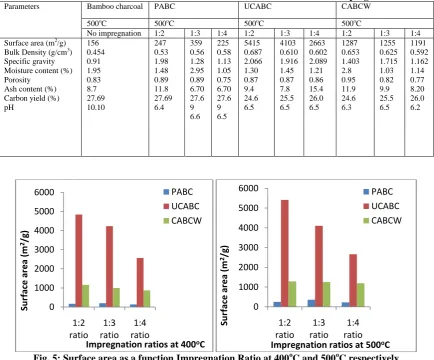
Results on the effect of different impregnation ratios on the properties of the bamboo activated carbons produced at two different carbonization temperatures (400oC and 500oC) were presented in Tables 2 and 3. The results revealed that surface area decreased as the ratios increased for the chemically activated carbon. UCABC had higher surface area of 5415m2/g and 4839 m2/g at ratio 1:2 at 500oC and 400oC respectively while the CABCW had surface area of 1287m2/g and 1159 m2/g at ratio of 1:2 at 500oC and 400oC respectively. However, PABC had lower surface areas (167m2/g, 199m2/g and 135m2/g at 400oC) and (247m2/g, 359m2/g and 225m2/g at 500oC) at ratios of 1:2, 1:3 and 1:4 respectively. These were presented in Figure 5.
0 2 4 6 8 10 12 14 16 18
bamboo charcoal
PABC UCABC CABCW
A
sh
Co
n
te
n
t
(%
)
400°C
500°C
0 5 10 15 20 25 30 35
bamboo charcoal
PABC UCABC CABCW
Car
b
o
n
Yi
e
ld
(%
)
400°C
Table 2: Characterization of Bamboo Activated Carbon at 400oC at different impregnation ratios
Parameters Bamboo
charcoal
PABC UCABC CABCW
400oC 400oC 400oC 400oC
No impregnation 1:2 1:3 1:4 1:2 1:3 1:4 1:2 1:3 1:4
Surface area (m2/g) Bulk density (g/cm3) Specific gravity Moisture content (%) Porosity
Ash content (%) Carbon yield (%) pH 151 0.476 1.11 2.7 0.88 11.3 24.5 10.10 167 0.473 1.27 1.60 0.86 9.4 24.5 6.0 199 0.42 5 0.98 1.73 0.82 8.9 24.5 6.3 135 0.48 9 1.14 1.04 0.79 8.6 24.5 6.5 4839 0.524 2.23 0.98 0.88 12.1 31.9 6.4 4231 0.592 2.00 0.75 0.83 11.7 30.8 6.5 2567 0.589 1.79 1.5 0.87 11.0 29.6 6.7 1159 0.543 1.78 1.20 0.88 14.1 31.9 6.2 999 0.527 1.60 0.56 0.79 11.4 30.8 6.4 871 0.50 1.59 1.65 0.86 9.8 29.6 6.2
Table 3: Characterization of Bamboo Activated Carbon at 500oC at different impregnation ratios
Parameters Bamboo charcoal PABC UCABC CABCW
500oC 500oC 500oC 500oC
No impregnation 1:2 1:3 1:4 1:2 1:3 1:4 1:2 1:3 1:4
Surface area (m2/g) Bulk Density (g/cm3) Specific gravity Moisture content (%) Porosity
Ash content (%) Carbon yield (%) pH 156 0.454 0.91 1.95 0.83 8.7 27.69 10.10 247 0.53 1.98 1.48 0.89 11.8 27.69 6.4 359 0.56 1.28 2.95 0.89 6.70 27.6 9 6.6 225 0.58 1.13 1.05 0.75 6.70 27.6 9 6.5 5415 0.687 2.066 1.30 0.87 9.4 24.6 6.5 4103 0.610 1.916 1.45 0.87 7.8 25.5 6.5 2663 0.602 2.089 1.21 0.86 15.4 26.0 6.5 1287 0.653 1.403 2.8 0.95 11.9 24.6 6.3 1255 0.625 1.715 1.03 0.82 9.9 25.5 6.5 1191 0.592 1.162 1.14 0.77 8.20 26.0 6.2
Fig. 5: Surface area as a function Impregnation Ratio at 400oC and 500oC respectively
The effects of different impregnation ratios on the porosity of bamboo activated carbon at 400oC and 500oC carbonization temperatures were shown in Figure 4.7 and 4.8. At 400oC, the porosity values ranged between 0.79% and 0.88% at all the ratios tested. It was observed that the porosity decreased as the ratios increased. High porosity values were observed at ratio 1:2 for PABC (0.86%), UCABC (0.88%) and CABCW (0.88%) at 400oC.
Furthermore, the effects of impregnation ratios on the ash content of bamboo activated carbon revealed that the ash content decreased as the ratios increased. At 400oC, UCABC and CABCW had ash content of (12.1%, 11.7% and 11.0%) and (14.1%, 11.4% and 9.8% ) at ratios of 1:2, 1:3 and 1:4 respectively while PABC had lower ash contents of 9.4%, 8.9% and 8.6% at ratios 1:2, 1:3 and 1:4 respectively. However, at 500oC, a high ash content of 15.4% was observed for UCABC at ratio 1:4 while the ash content at ratio 1:2 and 1:3 were 9.4% and 7.8% respectively. Also, the ash content of PABC was in the range of 6.7% to 11.8% and 8.6% to 9.4% for 500oC and 400oC respectively (see Tables 2 and 3).
0 1000 2000 3000 4000 5000 6000 1:2 ratio 1:3 ratio 1:4 ratio Su rface ar e a ( m 2/g )
Impregnation ratios at 400oC
PABC UCABC CABCW 0 1000 2000 3000 4000 5000 6000 1:2 ratio 1:3 ratio 1:4 ratio Su rface ar e a ( m 2/g )
Impregnation ratios at 500oC
The effects of different impregnation ratios on carbon yield revealed that at 400oC, the carbon yield decreased as the ratios increased. CABCW and UCABC had higher carbon yield of 31.9%, 30.8% and 29.6% at ratios 1:2, 1:3 and 1:4 respectively while PABC had the same value of carbon yield (24.5%) at the different ratios. However, at 500oC, the carbon yields of CABCW and UCABC increased as the ratios increased (24.6%, 25.5% and 26% at ratios 1:2, 1:3 and 1:4 respectively) while PABC had the value of carbon yield (27.69%) at the different ratios. These were presented in figure 6. Furthermore, the bulk densities of all the bamboo carbon were within the range of 0.425g/cm3 to 0.687g/cm3. Generally, any adsorbent with high bulk density need not to be regenerated frequently because, it can hold more adsorbate per unit weight [26] and a carbon with a bulk density of about 0.5g/cm3 is adequate for adsorption [27].
Figure 6: Carbon yield as a function of Impregnation ratios at 400oC and 500oC respectively
3.3 Morphology Structure of Bamboo Carbons
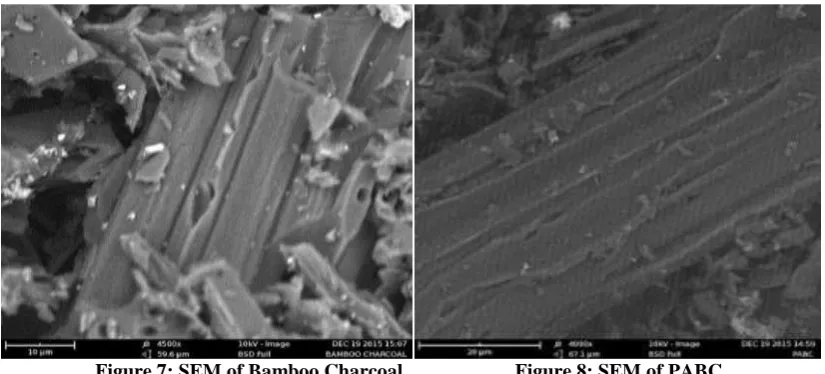
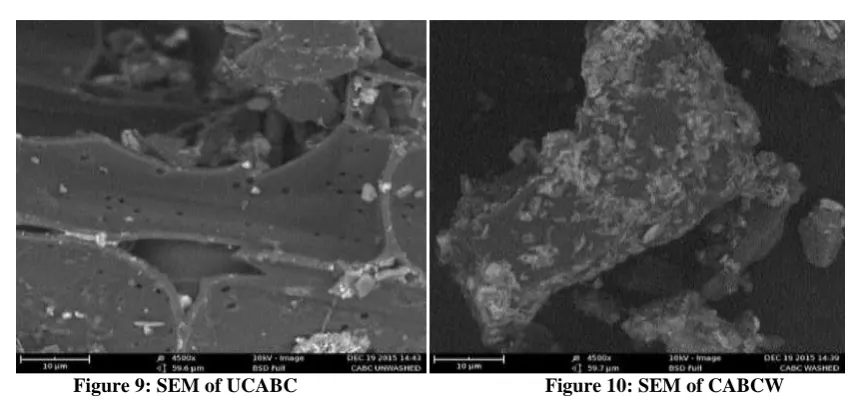
The morphology structure of Bamboo carbons was observed using the scanning electron microscope (SEM). The SEM was taken for bamboo charcoal, PABC, UCABC and CABCW as shown in Figures 7 to 10. The SEM micrographs of the activated carbon particles showed cavities, pores and rough surfaces on the carbon samples. SEM photography of UCABC shows that the surface is more pitted and fragmented due to carbonization and activation with ZnCL2, thus having a well developed porous structure (see Fig. 9). The
external surface shows a rough area having different pore diameters distributed over the surface of activated carbon. Similar observations were reported [28]. However, the pores of bamboo charcoal, PABC and CABCW were not as developed as the UCABC.
Figure 7: SEM of Bamboo Charcoal Figure 8: SEM of PABC
0 5 10 15 20 25 30 35
1:2 ratio
1:3 ratio
1:4 ratio
Car
b
o
n
y
ie
ld
(%
)
Impregnation ratios at 400OC
PABC UCABC CABCW
22 23 24 25 26 27 28
1:2 ratio
1:3 ratio
1:4 ratio
Car
b
o
n
y
ie
ld
(%
)
Impregnation ratios at 500oC
Figure 9: SEM of UCABC Figure 10: SEM of CABCW
IV CONCLUSION
This study revealed that carbonization temperature and impregnation ratio has significant influence on the properties of activated carbon. This could be seen in very high surface area values observed at 500oC and other impregnation ratios tested. Similar trend was also reported by [11]Evbuomwan et al, (2013). Also, production of Bamboo activated carbon using chemical method of activation with Zinc Chloride (ZnCl2) gave
activated carbon with higher surface areas than the physic-chemical activated method. Thus, the unwashed chemical activated carbon (UCABC) gave the highest surface area for all the carbon samples tested. This was confirmed by the SEM morphology structure of UCABC which showed more cavities and porous structure. This indicates that the activating chemical need not to be washed away to avoid generating more wastewater during production. Therefore, the optimum conditions for production of activated carbon from Nigerian Bamboo were presented in Table 4.
Table 4: Optimum conditions for the production of Bamboo Activated Carbon
Type of Activated carbon Carbonization Temperature (oC) Impregnation ratios PABC
CABCW UCABC
500 500 500
1:3 1:2 1:2
REFERENCES
[1]. Guo, J., and Lua, A.C.,(1998): Characterization of chars Pyrolyzed from Oil Palm Stone for the Preparation of Activated Carbons. J. of Analytical and Applied Pyrolysis, Vol. 46, pp. 113-125.
[2]. Bansal, R.C., Donnet, J.B., Stoeckli, H.F. Active carbon. Marcel Dekker, 1988, New York
[3]. Encinar, J. M., Beltran, F. J., Ramiro, A., and Gonzalez, J. F . 1998. Pyrolysis/gasification of agricultural residues by carbon dioxide in the presence of different additives: Influence of variables.Fuel Proc. Technol. 55:219–233.
[4]. Ramakrishna G. (2012): Preparation and Characterization of Microporous Activated Carbon from Biomass and its application in the removal of Chromuim IV from Aqueous phase, Ph.D Thesis, Department of Chemical Engineering; National Institute of Technology Rourkela.
[5]. Zhang K., Cheung W, . Valix M. (2005): Roles of Physical and Chemical Properties of Activated Carbon in the Adsorption of Lead ions, Chemosphere., vol. 60, pp. 1129-1140, 2005.
[6]. Soleimani, M., and Kaghazchi, T. (2007). Agricultural Waste Conversion to Activated Carbon by Chemical Activation with Phosphoric Acid. Chem. Eng. Technol. 30: 649- 654.
[7]. Global Forest Resource Assessment Update (2005): Nigeria Country Report on Bamboo Resources, Forestry Department, Food and Agriculture Organization,‘UN’, pp 4.
[8]. Hameed,B.H.,Ahma,A L.,and Lat,K.N.A. (2007).“Adsorption of basic dye (methylene blue) onto activated carbon prepared from rat of carbon prepared from rattan sawdust. Dyes pigments 75, 143-149
[9]. Ademiluyi, F.T, Amadi S.A, Amakama, Nimisingha J, (2009): Adsorption and Treatment of Organic Contaminants using Activated Carbon from Waste Nigeria Bamboo, J. of Appl. Sci. Envir. Management Vol. 13 (3) 39-47.
[10]. Nwabanne J.T and Mordi M.I (2009): Equilibrium uptake and Sorption Dynamics for the removal of basic Dye using Bamboo, Afri. J. of Biotechnology Vol 8 (8). Pp 1555-1559.
[11]. Evbuomwan, B.O; Abutu, A.S and Ezeh C.P (2013): The Effects of Carbonization Temperature on Some Physicochemical Properties of Bamboo Based Activated Carbon By Potassium Hydroxide (KOH) Activation, J. Physical Sciences Vol 3 (5), pp 187-191.
[12]. Bansode, R.R. (2002): Treatment of Organic and Inorganic Pollutants in Municipal Wastewater by Agricultural By-Product Based Granular Activated Carbon (GAC). M.sc Thesis, Louisiana State University and Agricultural and Mechanical College, Louisiana.
[13]. Aloko, D.F. and Adebayo, G.A. (2007): Production and Characterization of Activated Carbon from Agricultural Wastes (rice-husk and corn-cob). J. Eng. Applied Sci.Vol.2, No.2, pp 440-444.
[15]. Karthikeyan, S., Sivakumar, P., and Palanisamy, P. N. (2008): Novel Activated Carbons from Agricultural Wastes and their Characterization. E- J. Chem., 5: 409-426.
[16]. Al-Qodah, Z. and Shawabkah, R. (2009): Production and Characterization of Granular Activated Carbons from Activated Sludge. Brazilian J. of Chemical Engineering. Vol. 26, No. 1 pp127-136.
[17]. Fapetu,O.P.(2000): Production of Charcoal from Tropical Biomass for Industrial and Metallurgical Processes. NJEM, Vol.1,No.2, pp34-37.
[18]. Ahmedna. M.; Johns, M.M.; Clarke, S.J.; Marshall, W.E. and Rao, R.M. (1997): Potential of Agricultural By-Product Based Activated Carbons for use in Raw Sugar Decolourization. J. of Sci. Food and Agric., Vol.75, pp 117-124.
[19]. Mahanim, S.M.A.; Wan Asma, I.; Rafidah, J.; Puad E. and Shaharuddin, H., (2011): Production of Activated Carbon from Industrial Bamboo Waste. J. of Tropi. Forest Sci. Vol. 23 (4): 417-424.
[20]. Keith, K.H; Choy, J.P and Gordon McKay (2005): Production of Activated Carbon from Bamboo Scaffolding Waste – Process Design, Evaluation and Sensitivity analysis, Chem. Engr. J. 109 pp 147 -165.
[21]. Akpen, G.D; Nwaogazie, I.L and Leton, T.G. (2011): Optimum conditions for the removal of colour from waste water by mango seed shell based activated carbon. Indian J. of Science and Technology, Vol 4 (8) 890 – 894.
[22]. Wang, X. F; Zhang, H.P and Chen, H.Q (2006): Preparation and Characterization of High specific Surface Area Activated Carbon From Bamboo By chemical Activation With KOH; The school of Chemical and Energy Engineering, South China University of Technology, Guangzhou 510641, China
[23]. Roy, G.M. (1995): Activated Carbon Applications in the Food and Pharmaceutical Industries. Technomic Publishing Co., Pennsylvania, USA. 193 pp.
[24]. Yang, T. and Lua, A. C. (2003): Characteristics of Activated Carbons Prepared from Pistachio-NutShells by Physical Activation. J. Coll. Interf. Sci., 267: 408-417.
[25]. Bacaoui, A., Yaacoubi, A., Dahbi, A., Bennouna, C., Phantanluu, R., Maldonado- Hodar, F.J., Rivera, J. and Moreno- Castilla, C., (2001): Optimization of conditions for the preparation of activated carbons from olive-waste. Carbon.39, 425- 432.
[26]. Viswanathan, B, Indra neel, P and Varadarajan, T.K (2009): Methods of Activation and Specific Applications of Carbon Materials. National centre for Catalysis Research Department of Chemistry Indian Institute of Technology Madras Chennai 600 036.
[27]. Okieimen F.E., Okiemen C.O. and Wuana R.A.,(2007): Preparation and characterization of Activated carbon from Rice husks, J. Chem.Soc., 32, 126-136
[28]. Raffiea Baseri, J., Palanisamy, P.N. and Sivakumar, P. (2012): Preparation and characterization of activated carbon from Thevetia peruviana for the removal of dyes from textile waste water. Advances in Applied Sci. Research, 3, 377-383.