- 7 - Abstract—In this paper a Sugeno-Type FLC for temperature control in a batch polymerization reactor is developed and tested through a simulation study. A novel ANFIS-based method is implemented to design a practicable advanced controller. Temperature of a pilot-scale jacketed batch reactor is controlled by manipulating the reactor cooling water temperature. Manifest feature of the proposed method is smoothing of undesired control signal of conventional PI controller. The simulation study shows that the proposed controller has good set point tracking and disturbance rejection properties. Also it is robust against changes in the system parameters. It is also superior to the conventional PI controller and even previously proposed advanced controllers.
Index Terms—ANFIS, Batch Polymerization Reactor, Fuzzy Logic Controller (FLC), Practicability Constraints.
I. INTRODUCTION
It is well-known fact that batch process is gaining wider ground in chemical industries, owing to its availability and operational flexibility. Compared with continuous processes the control of batch processes is more difficult and thermal runaway would cause a runaway reaction [1], because physical and chemical properties of the contents, such as heat capacity, heat transfer coefficient and reaction rate vary from run to run and within runs [2].
The main control objective of the industrial batch polymerization reactor operation is to maintain or to track desired trajectories for reactor temperature. The importance of temperature control during polymerization reaction is due to its effects on polymer properties such as average molecular weight (MW) and molecular weight distribution (MWD). These properties are straightly related to the physical and mechanical polymer qualities and its commercial applications.
The suspension polymerization of styrene in batch reactor kinetics is assumed to follow the free-radical mechanism and this batch reaction is considered a challenge for process control design, presenting nonlinear and transient behavior.
Manuscript received January 25, 2009.
Mohammad Alipoor is with the Engineering Department, Tarbiat Moallem University of Sabzevar, Sabzevar, Iran. (Corresponding author to provide phone: +985714198; fax: +984112861679;)
Mahdi Zeinali is with Electrical Engineering Department, Sahand University of Technology, Tabriz, Iran.
Hadi Sadoghi Yazdi was with the Engineering Department, Tarbiat Moallem University of Sabzevar, Sabzevar, Iran. He is now with the Electrical Engineering Department, Ferdowsi University of Mashhad, Mashhad, Iran.
A major source of non-linearity is due to the autocatalytic nature of the polymerization reaction (known as gel effect). It may lead to uncontrollable situations, resulting in excessive temperature rise, rapid increase in polymerization rate and equipment plugging.
Viscosity raise also affects negatively the heat removal, because it leads to a decrease in the effective heat transfer coefficient between the reactor wall and the cooling water in the jacket [3]. Temperature control of batch polymerization reactor has attracted attention in recent years [3-11]. In some cases both of temperature behavior and control action are remarkably oscillatory at the end of the batch period [12-16]. Despite considerable research efforts in developing new methods for modeling and control of nonlinear systems over the last decade, many of these advanced techniques have not found applicability in real industrial problems. According to available survey of advanced control for batch polymerization reactors [15], there is a huge gap between industry and research practices. This is primarily due to high implementation costs and the lack of theoretical knowledge required to understand these sophisticated methods and computational burden of these methods. Secondly most of the time the practical constraints didn't take into account. Therefore, there is an increasing awareness of the need for practical approaches to aid engineers to better understand and perform complex modeling and control tasks [17]. Incorporating actuation constraints is a brilliant idea that can be observed in few works like [18]. In the present work, we tried to develop a practicable controller by taking some practical constraints into account. Firstly, a conventional PI controller is designed, which is widely used in industry [19]. Since the obtained control signal had abrupt changes, which can't be produced practically. Then a Sugeno-type FLC (Fuzzy Logic Controller) is developed. The input/output data set of the existing PI controller used to train an ANFIS. The adaptive-neuro fuzzy inference system (ANFIS) will help us to produce a smooth and practicable control signal. Removal of the heat of polymerization reactor is accomplished by circulating coolant through a jacket [20]. The paper focuses on the temperature control of a polystyrene batch reactor with rule based Takagi-Sugeno fuzzy controller with ANFIS Method. So its sections arranged as plant description including kinetics model and model formulation, control strategy, result and discussion and at last conclusion.
II. PLANT DESCRIPTION
A. Kinetics Model
The kinetic mechanism of styrene is a free radical
Fuzzy Temperature Control in a Batch
Polymerization Reactor Using ANFIS Method
- 8 - mechanism (Table 1) which consists of four main elementary steps, i.e. initiation, propagation, chain transfer, and termination. The decomposition of the initiator, an azo or peroxide compound, follows first order kinetics. The initiator radical can react very rapidly with a monomer molecule to form a monomer radical and sometimes it disappears by side-reactions: the initiator efficiency factor f is the fraction of initiator radicals reacting in the desired reaction. Kinetics data were taken from the literature [1]:
(7) 0.1704x 6.362x 0.1104x ) ln(g (6) ] s Kmol [mol 1141.42/T) exp( 10 1.7 K (5) g K K (4) ] s Kmol [mol 3548/T) exp( 10 1.09 K (3) ] s Kmol [mol 3548/T) exp( 10 1.09 K (2) ] s Kmol [m 13810/T) exp( 10 2.19 K (1) ] [s 15103/T) exp( 10 1.7 K 3 2 t 1 -1 -3 9 0 tc t 0 tc tc 1 -1 -3 4 tM 1 -1 -3 7 p 1 -2 -6 5 i _ -1 14 i − − − = − × = = − × = − × = − × = − × =
See appendix A for nomenclature. Assuming that the auto-initiation rate of styrene polymerization is second-order initiation, component balances are defined as follows [1]:
{
}
(10) 0. [P] 0, at t [R] K 2 1 [M][R] K dt d[P] (9) [M] [M] 0, at t )[M][R] K (k [M] K 2 [I] 2fK dt d[M] (8) [I] K dt d[I] 2 tc tM 0 tM p 2 i i i = = + = = = + + + − = − =For a batch reactor of suspension polymerization, heat balance is defined as follows [1]:
) 11 ( , 0 ) ( ] ][ [ ) ( ) ( 0 T T t at T T UA R M K V H dt dT V
CP S p MP p c
= = − − ∆ − = ρ
Only styrene, polystyrene, and water are assumed to have significant volumes. The volumes of other compounds (initiator, suspending agents, etc.) are assumed to be negligible. The volume of the reactants (VMP) is calculated as a function of the reactor temperature and the monomer conversion (x). It is defined as follows:
)
12
(
)
(
)
(
)
1
(
0T
x
T
x
m
V
p M M MPρ
ρ
+
−
=
)
13
(
]
[
]
[
]
[
0 0M
M
M
x
=
−
The accumulated heat ((ρCpV)s) is defined as follows:
) 14 ( ] ) 1 [( )
(ρCpV s = −x CpM +xCpP m0M +mWCpW
At the initial time of reaction, as heat of generation is negligible, heat balance is defined as follows:
) 15 ( ) ( ] [ )
( p s U0AT Tc dt
T d V
C = −
ρ
An initial overall heat transfer coefficient (U0) can be calculated by integrating Equation (16). But the overall heat transfer coefficient is varied while the reaction progresses because heat of generation is no more negligible and physical and chemical conditions of reactants, i.e. viscosity etc., are varied. Therefore, the viscosity of the reacting mixture (hydrophobic phase) increases significantly and the heat transfer coefficient decreases sharply with conversion. In this paper, the overall heat transfer coefficient has been modeled through the use of empirical correlation proposed by Takamatsu et al. (1988). The overall heat transfer coefficient is defined as follows:
)
16
(
)
1
1
exp(
1
0
−
−
=
x
U
U
α
TABLE 1:REACTION MECHANISM OF FREE RADICAL POLYMERIZATION
________ __________ __________ __________ __________ : : min : Pr 2 : : : : ________ __________ __________ __________ __________ 0 1 1 2 1 * * R P S R R P M R agent and monomer to transfer Chain P P R R P R R ionation disproport and n combinatio by ation Ter R M R opagation R M M initiation Auto R M I radical initiator by starts Chain I I initiator the of ion Decomposit Initiation i K i i K i j i K j i j i K j i i K i K K tS tM td tc P i i + → + + → + + → + → + → + → + − → + → + +
B. Reactor Model
To simulate thermal behavior of suspension
polymerization of styrene in a batch reactor, we assumed that heat of generation was negligible at the initial time of reaction, the volume of additive agents (initiator, suspending agents, etc.) were negligible and physical and chemical conditions of additive agents were negligible, too. Having the mentioned 4 non-linear differential equations (i.e. Equations 8 to 11) One can make a Simulink® model that takes coolant temperature (Tc) as its single input and gives back reactor temperature (T) as its single output (Fig. 1), but first some constants and initial values must be assigned.
Fig. 1: Batch
- 9 - So this model takes initial data, i.e. monomer weight (mM), initiator weight (mi), water weight (mW), reaction temperature (T0), cooling temperature (Tc), initial overall heat coefficient, initial heat transfer area (A0), and initiator efficiency (f), etc. Then it calculates resulting data including concentrations of monomers ([M]), initiator ([I]), and radicals ([R]), overall heat coefficient, heat transfer area (A), conversion (x), kinetics, etc. The used literature data of physical and chemical conditions of materials as follows [1]:
kmol
kJ
H
tionheat
Polymeriza
T
T
kgK
kJ
C
T
T
m
kg
Water
T
kgK
kJ
C
T
m
kg
e
Polystyren
T
kgK
kJ
C
T
m
kg
Styrene
p pW
W pP p pM M
/
73200
)
(
:
10
307
.
1
10
186
.
8
442
.
5
]
/
[
)
10
77
.
3
10
9625
.
1
257
.
1
/(
23
.
1001
]
/
[
:
)
15
.
273
(
10
04
.
4
225
.
1
]
/
[
)
15
.
273
(
605
.
0
1084
]
/
[
:
)
15
.
273
(
10
308
.
4
547
.
1
]
/
[
)
15
.
273
(
981
.
0
924
]
/
[
:
2 5
3 2
6
3 3
3 3
3 3
=
∆
−
×
+
×
−
=
×
+
×
−
=
−
×
+
=
−
−
=
−
×
+
=
−
−
=
−
− −
− −
−
ρ
ρ
ρ
The estimated temperature profiles were in good agreement with experimentally measured values [1]. Therefore the control design can base on this model of batch polymerization. For [I]0=0.0716 step response of the system is as shown in Fig. 2.
Fig. 2: Step response of the batch reactor for [I]0=0.0716
III. CONTROL STRATEGY
It is well known that the temperature control of the reactor depends mainly on the heating and cooling system of the reactor. A jacketed reactor temperature control is ensured by acting on both variables of the flow rate of cooling water and temperature of the coolant. Most often, one of these two input rates is fixed and the other is changed as manipulated variable [4]. In this work, the fluid flow rate was set to a mean value and removal of the heat of polymerization is accomplished by
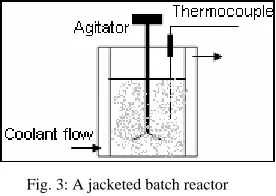
circulating coolant through a jacket (Fig. 3), while only temperature of coolant is adjusted.
Adaptive neural network based fuzzy inference system (ANFIS) is an intelligent neuro-fuzzy technique used for modeling and control of ill-defined and uncertain systems. ANFIS is based on the input–output data pairs of the system under consideration [21].
Fig. 3: A jacketed batch reactor
The algorithm of the ANFIS method has been defined by Jang et al. [22]. It has attained its popularity due to a broad range of useful applications in such diverse areas in recent years. The adaptive network based fuzzy inference system (ANFIS) represents a useful neural network approach for the solution of function approximation problems. Data driven procedures for the synthesis of ANFIS networks are typically based on a training set of numerical samples of the unknown function to be approximated. Since introduction, ANFIS networks have been successfully applied to classification tasks, rule-based process controls, pattern recognition problems and the like [21]. Here, just like what happens in industry, a conventional PI controller is used to track the predetermined set point. From the literature [19], PI parameters can be set as P+ Is = 16+0.425I to achieve best performance. Despite of good set point tracking (Fig. 4) such a controller will produce an undesirable control signal with abrupt changes (Fig. 5). It is practically impossible to manipulate a coolant liquid's temperature with a rate greater than 10 'C/min, on the other hand manipulated variable signal doesn't have the permission to overrun beyond some extents. Because it may vaporize the coolant water, and then previously achieved equations aren't valid any longer. Solving the former problem imposes high cost and sophisticated devices, while the later enforces us to use some expensive and rarely available oils instead of water. So we aimed to propose a controller witch produces a smooth and practicable control signal and also can perform with cheap and available coolants like water.
- 10 - The main idea is to use the input/output of PI controller as a training data set for an ANFIS. The ANFIS will mimic PI controller all over the process, except in cases the control signal has abrupt variations. Therefore newly obtained system can perform acceptable, while attenuates the amplitude of the former signal and doesn't include abrupt variations in manipulator signal.
Fig. 5: Undesirable control signal required for PI controller
Using ANFIS editor GUI it is found out the best possible configuration is as follows: The controller developed in this way, uses just three simple rules based on 3 linguistic variables defined over the input universe of discourse. (Fig. 6)
Fig. 6: Input membership functions
1. If (input1 is ok) then (output is M) 2. If (input1 is low) then (output is H) 3. If (input1 is high) then (output is L)
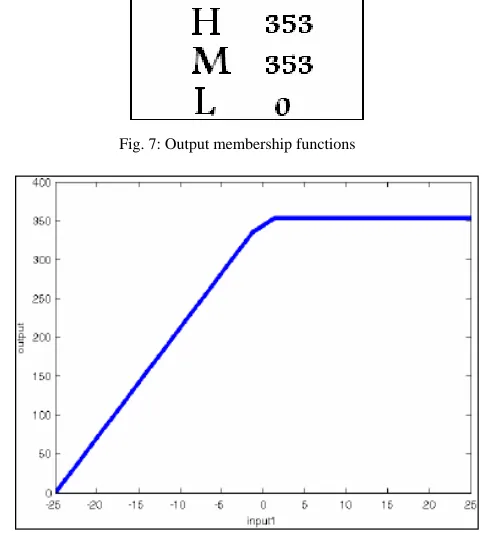
Output membership functions are set constants corresponding to the L (low), M (medium), and H (high). (Fig. 7)
we aim to manipulate a temperature as our control lever, it is clear that the temperature should vary between 0 and set point (353 'K), but in the case of medium level, two points are considerable: firstly, initial temperature of the reactants is about 333 'k and secondly, maximum reactor temperature in an open loop system (Fig. 2) is about 383 'K. So it seems sensible to set the mean value equal to 353 'K. One could find a simple semantic relation between rules and desired control action. For example if error signal has a large positive value (i.e. input one is low), it indicates the reactor temperature is low, so control action should increase to pull up the temperature and so forth. Furthermore, nonlinear relation between input and output of proposed ANFIS is visualized in Fig. 8.
Fig. 7: Output membership functions
Fig. 8: Non-linear relation between input and output of proposed ANFIS
IV. RESULTS AND DISCUSSION
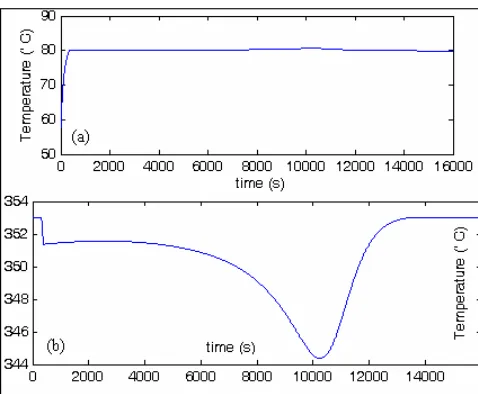
Presented controller is used in a conventional configuration (Fig. 9) to be tested. As can be seen in Fig. 10 the controller leads to an acceptable set point tracking and elegant control signal. The claim is supported by maximum variations of 9 ' C and maximum slope of 1.7 'C/min in the obtained control signal. So it is practicable and implementable by low cost device and material. Also the quality of product is guaranteed by the maintenance of reactor temperature at desired point all over the batch. The controller also shows robustness against system parameter variation.
Fig. 9: Proposed FLC configuration
- 11 - guaranties applicability of proposed controller. It seems such properties would suffuse the huge gap existing between industry and research practices [15].
Fig. 10: Proposed FLC performance, a) set point tracking b) smooth control signal
V. CONCLUSION
Temperature control in a batch reactor is of high importance, because it effectively affects the product properties and quality. Commonly used PID controllers, can't perform on systems which include varying parameters, on the other hand advanced controllers which have been proposed in literature, due to complexity and computational burden, necessitating high cost and ignoring some practical constraints haven't been applied yet. In this study a simple Sugeno-type FLC was developed and tested on a batch polymerization reactor. Design approach had two stages, designing PI controller and smoothing its control signal using ANFIS. Using input/output set of the PI controller as a training data set, an ANFIS is trained to function instead of former controller. The controller presents good set point tracking properties and robustness against system parameters variation. It also requires a smooth and practicable control signal. For future works, tracking some multilevel temperature profiles (as is common for some batch processes) and solving the actuation delay time problem, can be investigated.
APPENDIX A: NOMENCLATURE
- 12 -
initial
0
t
Superscrip
water
W
suspension
S
polymer
P
initial
0
monomer
M
initiator
I
Subscript
=
=
=
=
=
=
=
ACKNOWLEDGMENT
The authors would like to express their sincere thanks to Mr. Nasiri from polymer lab of Sahand University of Technology (SUT).
REFERENCES
[1] Seo-Il JANG, So-Mi KIM, Jong-Pyo WU and Tae-Ok KIM, " Simulation of Thermal Behavior of Suspension Polymerization of Styrene in a Batch Reactor, " Journal of Chemical Engineering of Japan, Vol. 39, No. 3, pp. 305–313, 2006.
[2] L. Nagy, "Simulation and control of batch reactors", Ph.D. Dissertation, Dept. Process Eng., Univ. of Veszprém, Hungary, 2005.
[3] A.J.B. Antunes, J.A.F.R. Pereira and A.M.F. Fileti, "Fuzzy control of a PMMA batch reactor", Journal of Computers and Chemical Engineering, Vol. 30, pp. 268–276, 2005.
[4] Z. K. Nagy, B. Mahn, R. diger Franke and F. Allgo¨ wer, " Evaluation study of an efficient output feedback nonlinear model predictive control for temperature tracking in an industrial batch reactor, " Journal of Control Engineering Practice, Vol. 15, pp. 839–850, 2007. [5] G. Karer, G. Music, I. Skrjanc and B. Zupancic, "Hybrid fuzzy
model-based predictive control of temperature in a batch reactor", Journal of Computers and Chemical Engineering, Vol. 31, pp. 1552–1564, 2007.
[6] A. Altınten, K. Fazil, E. Sebahat, H. Hale and M. Alpbaz, "Self-tuning PID control of jacketed batch polystyrene reactor using genetic algorithm", Chemical Engineering Journal, Vol. 138, pp. 490-497, 2008.
[7] K. K. Noh, D. Shin, E. Sup Yoon and H. Ku Rhee, " Optimal Temperature Tracking Control of a Polymerization Batch Reactor by Adaptive Input-Output Linearization, " ICASE, The Institute of Control, Automation and Systems Engineers, KOREA Vol. 4, No. 1, 2002.
[8] A. Rıza Karagoz, H. Hapoglu, M. Alpbaz, "Generalized minimum variance control of optimal temperature profiles in a polystyrene polymerization reactor, " Journal of Chemical Engineering and Processing, Vol. 39, pp. 253-262, 2000.
[9] J. Causaa, G. Karerb, A. Núneza, D. Sáeza, I. Skrjancb and B. Zupan, " Hybrid fuzzy predictive control based on genetic algorithms for the temperature control of batch reactor", Journal of Computers and Chemical Engineering, Vol. 32, pp. 3254-3263, 2008.
[10] W. Choa, T. F. Edgar, J. Lee, "Iterative learning dual-mode control of exothermic batch reactors", Journal of Control Engineering Practice, Vol. 16, pp. 1244-1249, 2008.
[11] G. Karer, I. Skrjanc and B. Zupancic, "Self-adaptive predictive functional control of the temperature in an exothermic batch reactor" Chemical Engineering and Processing, Vol. 47, pp. 2379-2385, 2008. [12] G. Ozkan, H. Hapoglu, M. Alpbaz, "Generalized predictive control of
optimal temperature profiles in a polystyrene polymerization reactor, " Journal of Chemical Engineering and Processing, Vol. 37, pp. 125-139, 1998.
[13] A.M.F. Fileti, A.J.B. Antunes, F.V. Silva, V. Silveira Jr and J.A.F.R. Pereira, " Experimental investigations on fuzzy logic for process control, " Journal of Control Engineering Practice, Vol. 15, pp. 1149-1160, 2007.
[14] R.A.F. Machado, A. Bolzan, "Control of batch suspension polymerization reactor" Chemical Engineering Journal, Vol. 70, pp. l-8, 1998.
[15] P. Li, Z. Wang, "A survey of advanced control for batch polymerization reactors, " Fifth world congress on intelligent control and automation, conference proceedings, Vol. 4, pp. 3575-3579, 2004.
[16]S. Cetinkaya, Z. Zeybek, H. Hapoglu and M. Alpbaz, "Optimal temperature control in a batch polymerization reactor using fuzzy-relational models-dynamics matrix control" Journal of Computers and Chemical Engineering, Vol. 30, pp. 1315-1323, 2006. [17] L. Ozkan, M. V. Kotharea and C. Georgakis, "Control of a solution
copolymerization reactor using multi-model predictive control" Chemical Engineering Science, Vol. 58, pp. 1207-1221, 2003. [18] P. Valigi, M.L. Fravolini and A. Ficola, "Improved temperature control
of a batch reactor with actuation constraints" Journal of Control Engineering Practice, Vol. 14, pp. 783-797, 2006.
[19] J. E. Edwards, "Dynamic modeling of batch reactors and batch distillation, " Batch Reactor Systems Technology Symposium, Teesside, 2002, [Online]. Available: www.pidesign.co.uk
[20] J. R. Richards, J. P. Congalidis, "Measurement and control of polymerization reactors, " Journal of Computers and Chemical Engineering, Vol. 30, pp. 1447-1463, 2006.
[21] M. Buragohain, C. Mahanta, " A novel approach for ANFIS modelling based on full factorial design " Journal of Applied Soft Computing, Vol. 8, pp. 609-625, 2008.
[22] J.-S.R. Jang, "ANFIS: adaptive-network-based fuzzy inference system", IEEE Trans. on System Man and Cybernetic, Vol. 23, No. 3, pp. 665–685, 1993.
Mohammad Alipoor was born in Tabriz, Iran, in 1983. He received the B.Sc degree in biomedical engineering from Sahand University of Technology, Tabriz, Iran, in 2007. He is now a M.Sc student in electronic engineering in Tarbiat Moallem University of Sabzevar, Iran. His research interests include image processing, artificial intelligence and intelligent control/computing.
E-mail: [email protected]
Mahdi Zeinali was born in Iran, in 1978. He obtained his B.Sc. and M.Sc degrees in Electrical Engineering (control) from Sahand University of Technology and Sharif University of Technology, Iran, respectively. He is now a lecturer in Electrical Engineering at Sahand University of Technology, Tabriz, Iran. His main interests are model predictive control and fuzzy control.
E-mail: [email protected]