Abstract—The North China Oil and Gas Branch has carried out a large number of researches on the mechanism of hydrogen sulfide in the Ordovician weathering crust of the Da Niu underground Paleozoic. However, the distribution and formation mechanism of hydrogen sulfide in the area is very complicated, and it is necessary to further clarify its related mechanism. Otherwise, Affect the safety development of sulfur gas wells and formulate supporting hydrogen sulfide protection measures. Therefore, the distribution law of hydrogen sulfide in the study area, analysis of the formation mechanism of hydrogen sulfide, summarizing the influencing factors of its content, and supporting the corresponding sulfur removal agent system, can provide a basis for the next oil and gas exploration and development. It is also clear that the formation mechanism of hydrogen sulfide in the Ordovician weathering crust gas reservoir, the influencing factors of hydrogen sulfide formation, and the sulfur removal agent system are preferred. To provide a theoretical basis for the development of supporting hydrogen sulfide protection measures and efficient and safe development of the Ordovician sulfur-containing gas wells in Daniudi.
Index Terms—𝐇𝟐𝐒, sulfur removal, ordovician, daniud.
I. INTRODUCTION
The Da Niudi Ordovician weathering crust gas reservoir is rich in reservoir resources. From the horizontal well development evaluation, it is found that its drilling test has a good effect and can support the long-term stable production of the Daniudi gas field. According to the data, the proportion of sulfur in gas wells in the Ordovician weathering crust gas reservoir is 28%. In recent years, hydrogen sulfide has appeared in the development of many blocks in the study area, especially the horse of PG19 well. A higher concentration of hydrogen sulfide appeared in the fifth five. Hydrogen sulfide is a highly toxic corrosive gas, which seriously corrodes the pipe wall, and the high content of CO2 in the gas well in this area exacerbates the corrosion of hydrogen sulfide. The serious water production increases the difficulty of selecting hydrogen sulfide treatment agent, threatening Safe production of oil and gas.
Manuscript received August 30, 2019; revised October 12, 2019. This work was partially supported by the US Department of Commerce under Grant BS123456. Hydrogen Sulfide Production Mechanism and Sulfur Removal Agent Testing and Processing.
Zhou Ruili is with Petroleum Engineering Research Institute of Sinopec Huabei Oil and Gas Branch, China (e-mail: [email protected]).
Liu Changlong is currently engaged in research work related to the stimulation of production in offshore oil fields, Tianjin, China.
Nie Gongzhe is with Southwest Petroleum University, China.
II. EXPERIMENTAL TEST ON THE FORMATION MECHANISM OF
H2SGAS
Mechanism research ideas: Hydrogen sulfide reacts with lead acetate to form lead sulfide and acetic acid. Lead sulfide is a black substance that is hardly soluble in water and hardly soluble in acid, so it can be observed that the lead acetate test paper turns black [1]. The product obtained by reacting the rock sample with concentrated hydrochloric acid is tested with a wet lead acetate test paper, and the color change of the test paper is observed to determine whether the secondary gas generation mechanism is the cause of hydrogen sulfide in the block in the project. The reaction equation is:
Pb(𝐴𝑐)2+𝐻2𝑆=PbS+2HAc (1)
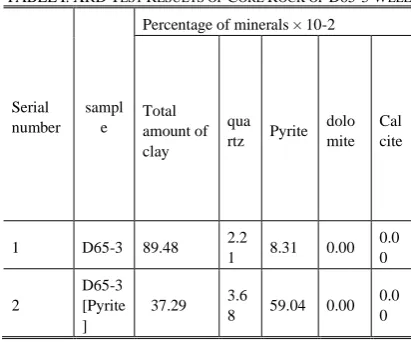
A. Rock Sample XRD Full Rock Detection Analysis The rock sample used in this experiment is the core of D65-3 well, and the core is knocked open, and the dark gold minerals can be found, and the pyrite is judged by color. The rock samples were analyzed by X-ray diffractometry with full XRD analysis to see how much pyrite contains pyrite. As shown in Table I.
Fig. 1. D65-3 core.
TABLEI:XRDTEST RESULTS OF CORE ROCK OF D65-3WELL
Serial number
sampl e
Percentage of minerals × 10-2
Total amount of clay
qua rtz Pyrite
dolo mite
Cal cite
1 D65-3 89.48 2.2
1 8.31 0.00 0.0 0 2
D65-3 [Pyrite ]
37.29 3.6
8 59.04 0.00 0.0 0
The whole rock XRD results show that by observing the
Zhou Ruili, Liu Changlong, and Nie Gongzhe
Hydrogen Sulfide Production Mechanism and Sulfur
Removal Agent Testing and Processing
rock samples of D65-3 well, it can be found that there are many pyrites in the core, which are dark gold. The presence of pyrite was also detected in the full-rock XRD test.
B. Secondary Gas Mechanism - Pyrite Detection
Fig. 2. Experimental diagram of H2S secondary gas detection by lead acetate test paper.
1) Pour 30 g of core particles with pyrite crushed in a 500 mL Erlenmeyer flask, and place a 300 mL bottle of 2 mol/L sodium hydroxide aqueous solution on the side of the jar. Insert a rubber stopper with a hose, and install a rubber stopper on the other end of the hose;
2) Wetting the lead acetate test paper prepared in advance, and quickly binding it into the conical flask with tape;
3) Add 100 mL of concentrated hydrochloric acid to the Erlenmeyer flask, quickly insert the rubber stopper with the hose, and the reaction starts.
4) After 1 h, the wet lead acetate test paper was found
to be black. In the experiment, it was observed that there was a bubble in the sodium hydroxide solution, indicating that the pyrite in the core reacted with hydrochloric acid to form hydrogen sulfide to make the test paper color reaction.
III. SULFUR REMOVAL SYSTEM COMPATIBILITY TEST
Research ideas: The reserves of the Ordovician weathering crust are rich in reserves. In order to ensure the smooth development of the gas reservoir, it is necessary to formulate supporting measures for hydrogen sulfide, evaluate the sulfur removal agent system, and conduct a preferred test for it. Provide a basis for oil and gas exploration and development. Before conducting the sulfur removal experiment and evaluating the effect of the sulfur removal agent system, it is necessary to conduct compatibility tests on the sulfur removal agent system (desulfurizer, corrosion inhibitor, scale inhibitor, bubble discharge agent, fungicide) to prevent interaction between agents. And the impact [2].
Experimental steps
1) 10 mL of desulfurizer, corrosion inhibitor, scale inhibitor, bubble discharge agent and fungicide are added to the colorimetric tube;
2) then adding distilled water to a volume of 100 mL;
3) Shake well and place in a constant temperature water bath (60 ° C) for standing;
4) Observe the solution phenomenon in the
colorimetric tube after 6 hours. Experimental result. As shown in Table II.
TABLEII:SELECTION OF SULFUR REMOVAL AGENT SYSTEM
type model Quantity Sampling date Sulfur
removal agent
MJ-06 1 2017.9.14 DFS-1 1 2017.9.14 RX-8 1 2017.9.14
Inhibitor
MJ-03 2[Repeatedly
once] 2017.9.14 Pudong
Pusan 1 2017.9.14 Bubbling
agent
KY-08 1 2017.9.14 XHY-4 1 2017.9.14 MJ-01 1 2017.9.14
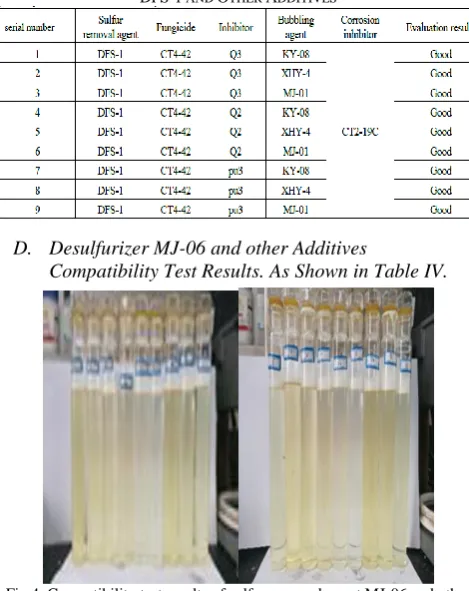
C. Compatibility Test Results of Sulfur Removal Agent DFS-1 and other Additives As Shown in Table III
Fig. 3. Compatibility test results of sulfur removal agent DFS-1 and other additives.
TABLEIII:COMPATIBILITY TEST RESULTS OF SULFUR REMOVAL AGENT
DFS-1 AND OTHER ADDITIVES
D. Desulfurizer MJ-06 and other Additives
Compatibility Test Results. As Shown in Table IV.
TABLEIV:COMPATIBILITY TEST RESULTS OF SULFUR REMOVAL AGENT
MJ-06 AND OTHER ADDITIVES
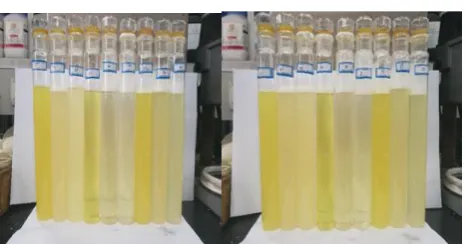
E. Compatibility Test Results of Sulfur Removal Agent RX-8 and Other Additives
Fig. 5. Compatibility test results of sulfur removal agent RX-8 and other additives.
The test results show that the compatibility of sulfur remover rx-8 with scale inhibitor Q3 and scale inhibitor pu 3 is not good.The sulfur remover dfs-1 and mj-06 are transparent and compatible with other additives [3].
IV.EXPERIMENTAL STUDY ON FORMATION MECHANISM OF
H2S IN ORDOVICIAN WEATHERING CRUST GAS RESERVOIR
H2S is a colorless, odorous toxic gas. It is a binary weak acid and is slightly soluble in water to form hydrosulfuric acid (a weak acid). With the advancement of oil and gas field development technology, the domestic issue of hydrogen sulfide has been highly valued and related. the study. At present, it is generally believed that the formation mechanism of H2S in oil and gas field development process is divided into two categories, namely the original gas generation mechanism and the secondary gas generation mechanism. The original gasification mechanism mainly comes from these three aspects: biological genesis, thermochemical genesis, and volcanic eruptions [4]. The secondary gas is generated by the reaction of the fracturing fluid injected from the gas reservoir and the pyrite in the rock formation. According to the data, H2S is more common in the original gas generation mechanism, and the sulfate thermochemical reduction reaction is the main way to produce H2S in high-sulfur oil and gas fields at home and abroad.
The biological pathway for hydrogen sulfide is one of the main sources of hydrogen sulfide in oil and gas fields. The biological mechanism of hydrogen sulfide is usually achieved by the sulfate-reducing bacteria's dissimilatory reduction metabolism of sulfate, and hydrogen sulfide can be directly formed under the action of dissimilation. In the depth of the reservoir, there are usually a large number of sulfate-reducing bacteria. On the one hand, the temperature
of the formation (about 40 °C) provides breeding conditions. On the other hand, the formation contains a large amount of ammonium ions and nitrate ions. The growth of sulfur bacteria provides nutrients.
Sulfur is generally present in living organisms. After the death of living organisms, sulfur and sulfur-containing organic compounds in the organism are buried in the ground together with sediments, and undergo various complicated chemical and biochemical actions such as
oxidation, hydrolysis, and bacterial degradation.
Accompanied by the generation of H2S.
Combined with the specific analysis of the horizon involved in this project, the microbial sulfate bacterial reduction reaction (BSR) mainly occurs when the temperature is less than 80 °C. The dissimilation reduction of sulfate-reducing bacteria mainly occurs in the shallow layer, which is inconsistent with the burial depth of more than 3000 m of the gas wells of hydrogen sulfide produced in this project. The hydrogen sulfide content of the sulfate-reducing bacteria reducing sulfate generally does not exceed 3%.
According to the data, the formation temperature of the strata in the Ordovician weathering crust gas reservoir is greater than 140 °C, and the activity of sulfate-reducing bacteria is significantly reduced when the formation temperature is higher than 85 °C. Therefore, the reaction occurs in the shallower strata. Inconsistent with the research situation of this project [5].
In the core and mantle, the sulfur element content is much higher than that of the crust. When the local shell is unstable, the magma activity causes the deep rock in the crust to be heated to produce a large amount of volatile components containing hydrogen sulfide, which enters the sedimentary rock along the fault zone.
The main characteristics of hydrogen sulfide produced by volcanic eruptions are: the content of hydrogen sulfide is extremely unstable; migration and preservation are difficult. The structure of the Ordos Basin is stable, the environment of the craton is stable, and the magmatism is not active, which basically eliminates the possibility of volcanic eruptions.
When drilling, as the depth of the well increases, the temperature will continue to rise. The main cause of hydrogen sulfide gas is not the bacteria but the temperature. Sulfate minerals react with organic matter or hydrocarbons at a certain temperature (usually above 120-150 ° C) and then produce hydrogen sulfide. Second, the presence of hydrogen in the process of production or formation of
sulphate also produces hydrogen sulphide. The
thermochemical causes suggest that hydrogen sulfide in oil and gas reservoirs originates from the chemical action of sulfur-bearing minerals in the formation and oil and gas under geological conditions. Due to the high temperature and high pressure conditions in the deep layer, sulfur-bearing minerals such as CaSO4 and MgSO4 may chemically react with hydrocarbons to form hydrogen sulfide. At higher temperatures, sulfur-containing organic
compounds may also undergo thermal chemical
decomposition to produce hydrogen sulfide [6].
greater than 100 ° C, and the optimum reaction temperature is higher than 140 ° C. Combined with the specific geological conditions of the project, the strata temperature of the Ordovician Majiagou Formation limestone in the Ordos Basin of Daniudi Formation has reached 180 °C at the end of the Late Triassic, and exceeded 220 °C at the end of the Early Cretaceous. Temperature conditions required for the thermochemical reduction of sulfate.
The thermochemical causes satisfy the actual geological environment conditions, and it is presumed that this is the cause of the formation of H2S in the Ordovician weathering crust gas reservoir. In this project, high temperature and high pressure thermochemical reaction experiments were used to explore the formation of H2S by thermochemistry. The research ideas of thermochemical reaction mechanism are as follows:
Take the 3 layers of rock samples and water samples of the Ordovician weathering crust gas reservoirs of the Ordovician weathering crust in the Da Niudi gas field, and prepare a gas sample containing no hydrogen sulfide. Three kinds of samples were placed in a high temperature and high pressure reactor for thermochemical reaction experiments to simulate the bottomhole environment. The gas samples and water samples were separately detected by a period of high temperature and high pressure, and H2S was detected, including (H2S analysis, Sulfur content detection, H2S reduction bacteria detection), the formation mechanism of hydrogen sulfide in the Ordovician
weathering crust gas reservoir was preliminarily
determined by lithologic geochemical parameters such as whole rock analysis and organic matter analysis. Then, the microstructure of the rock sample surface was observed by scanning electron microscopy. Combined with metal ion analysis and detection, the mechanism of hydrogen sulfide formation is judged.
V. SUMMARY
Through the experimental test of the sulphur removal agent system of the Ordovician weathering crust gas reservoir, it is found that:
1) Experimental results of sulfur removal agent
evaluation showed that Rx-8 had the best sulfur removal capacity. With the increase of temperature (30~90 °C), the sulfur removal effect of sulfur removal agent shows a decreasing law. When the temperature is 30 °C, the hydrogen sulfide content of 50mL 1000ppm sulfur removal agent absorption solution is 1694ppm, and when the temperature is At 90 ° C, the hydrogen sulfide content is only 417 ppm; as the temperature increases, the saturated hydrogen sulfide absorption in the sulfur removal agent solution is lower; at 30 ° C, the saturated hydrogen sulfide content is 1800 ppm.
2) The effects of salinity, condensate and methanol content on sulfur removal performance were obtained. The results are as follows: 1 With the increase of the mineralization degree of the sulfur removal agent absorption solution, the sulfur removal effect of the sulfur removal agent gradually Increase, when the degree of mineralization exceeds 30,000ppm, the absorption capacity of the sulfur
removal agent solution to hydrogen sulfide tends to be gentle; 2 with the increase of the condensate content in the solution of the sulfur removal agent absorption solution, the sulfur removal effect of the sulfur removal agent is gradually increased. When the condensate content exceeds 10%, the sulfur removal agent solution tends to absorb hydrogen sulfide. 3 As the content of methanol in the sulfur removal agent absorption solution increases, the sulfur removal effect of the sulfur removal agent gradually increases. When the methanol content exceeds 10%, the ability of the sulfur removal agent solution to absorb hydrogen sulfide tends to be gentle.
3) With the higher content of hydrogen sulfide in the gas, the higher the content of hydrogen sulfide in the sulfur removal agent absorption solution, the gas with a hydrogen sulfide content of 4000 ppm is introduced at 30 ° C, and the hydrogen sulfide in the solution is absorbed by the 1000 ppm sulfur removal agent after 6 hours. The content is about 600ppm; meanwhile, when the content of hydrogen sulfide is constant in the gas, the lower the hydrogen sulfide content in the sulfur removal agent absorption solution as the temperature increases.
4) Through a series of sulfur removal agents and
adding single agent evaluation experiments, a single agent with good performance was screened out, and finally a set of sulfur removal system formula was formed: sulfur removal agent Rx-8+ corrosion inhibitor CT2-19C+ resistance Scale agent Mj-3 Q2+ fungicide CT4-42+ bubble discharge agent Mj-01
REFERENCES
[1] Y. Q. Ma, J. M. Mao, X. Cong, L. Yan, and Z. Lihua. “Immobilization of functionalized ionic liquid on sol-gel derived silica for efficient removal of H_2S,” China Petroleum Processing &
Petrochemical Technology, 2019, vol. 21, no. 1, pp. 62-70.
[2] D. Kangle, M. Ping, and L. Yue. “Pyrite-hydrocarbon interaction under hydrothermal conditions: An alternative origin of H_2S and organic sulfur compounds in sedimentary environments,” Acta
Geologica Sinica, 2016, vol. 90, no. 6, pp. 2133-2148.
[3] S. Nina, S. Wei, L. W. Qiu, S. Y. Chen, and Z. Na, “Diagenetic evolution of tight sandstone reservoirs in the Lower Shihezi Formation of Daniudi gas field,” Journal of Central South
University:Science and Technology, 2016, vol. 47, no. 10, pp. 3555-
3561.
[4] Z. D. Li, W. N. Zhang, Z. Wen, K. Y. Hui, L. Liang, A. S. L. Fan, and J. S. Yuan, “The upper paleozoic pressure storage tank and reservoir pore evolution in daniudi gas field,” Journal of Mineralogy, 2007.
[5] C. Z. Wang, “Research and practice of engineering technology in Daniudi gas field in North Hubei,” Natural Gas Industry, 2001. [6] B. G. Liu, “Depth-domain stochastic simulation inversion technique
for horizontal well trajectory design,” Geophysical Prospecting for
Petroleum, 2014.
Reservoir evaluation and development: development and application of new detergents in low pressure and low fluid gas wells
Liu Changlong was graduated from Southwest Petroleum University with a major in oil and gas field development engineering. He is currently engaged in research work on increasing production measures in offshore oil fields.