112804-7676 IJBAS-IJENS © August 2011 IJENS I J E N S
Detection Ovarian Cycle of Bekantan (
Nasalis
larvatus
) Based on the Profile of Fecal Estradiol and
Progesterone
Kamal I. Aly, Ahmed S. Hammam, Shaban M. Radwan, and Mona A. Abdel-Rahman*.
Polymer Lab 122, Chemistry Department, Faculty of Science, Assiut University, Assiut, 71516, Egypt. Fax 002 088 2342708. E-mail: [email protected].
Abstract
--
A new interesting series of linear, unsaturated copolyesters containing cyclopentanone moiety in the main chain were synthesized by interfacial polycondensation of a mixture containing one mole of both monomeric units 2,5-bis (4-hydroxybenzylidene) cyclopentanone (Ia) and 2,5-bis (4-hydroxy-3-methoxybenzylidene) cyclopentanone (Ib) together with two moles of different acid chlorides. The yield and the values of reduced viscosity of the copolyesters were found to be affected by the kind of organic phase, contribution of benzyltriethylammonium chloride as a catalyst, the quantitative ratio of organic to aqueous phase, concentration of hydrogen chloride acceptor and time of addition of the acid chloride. The resulting copolyesters were characterized by elemental and spectral analyses. Moreover, the various characteristics of the various types of prepared copolymers including: solubility, viscosity, X-ray diffraction analysis, DSC and TGA were determined and discussed. The electrical properties of the copolyesters were tested and the morphology of selected examples of the copolyesters was examined by scanning electron microscopy.Index Term
--
Dibarylidenecyclopentanone; characterization; copolyesters and synthesis.I. INTRODUCTION
Polyesters showed interesting applications in various fields including wide commercial use as fibers (Dacron, Terylene), preparation of films (Mylar) [1-3], manufacture of laminates, in conjunction with glass fiber reinforcing, chemically, thermal resistants and self extinguishing materials [4,5]. Unsaturated polyesters are coming into wider and wider use as matrices for composite materials for naval construction for economic reasons and because of their ease of processing [6].
This has encouraged the synthesis of some new unsaturated copolyesters with the hope that they may find some interesting applications in one or more of these fields. Unsaturated copolyesters, also called polyester resins, are based on macromolecules with a polyester backbone in which both a saturated acid and unsaturated acid are condensed with a dihydric alcohol [7].
In recent years much emphasis has been given to the synthesis of polymers containing chromophoric groups. For example,
the aromatic azo group which can form a part of the main chain [8]. The aromatic azo group is of special interest because of the existence of cis–trans isomerism and its effect on the photochromic properties of the polymers. Therefore, polymers that contain the azo group have potentional use in a variety of applications [ 9-11].
As a continuation of our study on the synthesis and properties of different new polymers based on diarylidenecycloalkanones possessing an interesting properties, attractive morphology [12-20], liquid crystalline behavior, conducting properties and many other properties, which have been published in our previous work. A major purpose of this work is to synthesize and characterize a new series of unsaturated copolyesters
based on dibenzylidenecyclopentanone and
dibenzylidenecyclo-pentanone containing meta- and para- azo groups in the main chain. Moreover, the crystallinity, thermal stability, morphology and electrical properties of the synthesized copolyesters have also been examined and discussed.
II. EXPERIMENTAL
A. Measurements
112804-7676 IJBAS-IJENS © August 2011 IJENS I J E N S copolyesters IIa-g were characterized by DSC and conducted at
a heating rate of 10°C min-1.
B. Reagents and Solvents
p-Hydroxybenzaldehyde (Aldrich) was used without crystallization. 4- Hydroxy-3-methoxybenzaldehyde (vanillin) (EL-Nassr Chemical Company Egypt), dihaloalkanes and hydrazine hydrate (Aldrich) were used without further purification. All solvents and other reagents were of high purity and were further purified by standard methods [21].
C. Monomers Syntheses Ia & Ib
All the monomers were prepared as described in our previous papers [22-24].
D. Copolymerization Procedure
General Method
In a three-necked round-bottomed flask (500 cm3 in
volume), equipped with a mechanical stirrer, (2000 rev min-1), dry nitrogen inlet and outlet and dropper, a mixture (0.002 mole) of each 2,5-bis (4-hydroxybenzylidene) cyclopentanone (Ia) and 2,5-bis (4-hydroxy-3-methoxybenzylidene) cyclopentanone (Ib), 30 ml of dry methylene chloride and NaOH (0.008 mole dissolved in 30 ml distilled water) and 1 g of benzyltriethylammonium chloride (BTC) were introduced . After mixing, (0.004 mole) of appropriate acid chloride dissolved in dry methylene chloride was added in dropwise manner at room temperature and vigorously stirred. The stirring was continued for a further 3 hrs, after this time the formed copolymer was isolated by special method , then washed with excess water, hot methanol and finally with hot acetone; then dried under reduced pressure (1mm/Hg) at 80ºC for 24 hours.
Separation of Copolyesters and Casting Films
All the films were cast from methylene chloride.
Copolyesters IIa
Copolyesters IIa obtained by the copolymerization of 2,5-bis(4-hydroxy- benzylidene)cyclopentanone (Ia) (0.5844 g, 0.002 mole) and 2,5-bis ( 4- hydroxy -3- methoxybenzylidene ) cyclopentanone (Ib) (0.7045 g, 0.002 mole) with adipoyl chloride (0.5835 ml, 0.004 mole) for 3 hrs as yellow plates in 71 % yield.
Copolyesters IIb
Copolyesters IIb obtained by the copolymerization of 2,5-bis(4-hydroxy-benzylidene)cyclopentanone (Ia) (0.5844 g, 0.002 mole) and 2,5-bis ( 4- hydroxy -3- methoxybenzylidene ) cyclopentanone (Ib) (0.7045 g, 0.002 mole) with sebacoyl chloride (0.854 ml, 0.004 mole) for 3 hrs as dark yellow, flexible film in 98% yield.
Copolyesters IIc. Copolyesters IIc obtained by the
copolymerization of
2,5-bis(4-hydroxy-benzylidene)cyclopentanone (Ia) (0.5844 g, 0.002 mole) and 2,5-bis ( 4- hydroxy -3- methoxybenzylidene ) cyclopentanone (Ib) (0.7045 g, 0.002 mole) with terephthaloyl chloride (0.8124 g, 0.004 mole) for 3 hrs as yellow flexible film in 93% yield .
Copolyesters IId
Copolyesters IId obtained by the copolymerization of 2,5-bis(4-hydroxy-benzylidene)cyclopentanone (Ia) (0.5844 g, 0.002 mole) and 2,5-bis ( 4- hydroxy -3- methoxybenzylidene ) cyclopentanone (Ib) (0.7045 g, 0.002 mole) with isophthaloyl chloride (0.8124 g, 0.004 mole) for 3 hrs as yellow plates in 88% yield.
Copolyesters IIe
Copolyesters IIe obtained by the copolymerization of 2,5-bis(4-hydroxy-benzylidene)cyclopentanone (Ia) (0.5844 g, 0.002 mole) and 2,5-bis ( 4- hydroxy -3- methoxybenzylidene ) cyclopentanone (Ib) (0.7045 g, 0.002 mole) with 4,4`-biphenyldicarbonyl chloride (1.1162 g, 0.004 mole) for 3 hrs as light yellow powder in 83% yield.
Copolyesters IIf
Copolyesters IIf obtained by the copolymerization of 2,5-bis(4-hydroxy-benzylidene)cyclopentanone (Ia) (0.5844 g, 0.002 mole) and 2,5-bis ( 4- hydroxy -3- methoxybenzylidene ) cyclopentanone (Ib) (0.7045 g, 0.002 mole) with 4,4`-azodibenzoyl chloride (1.2188 g, 0.004 mole) for 3 hrs as orange yellow plates in 69% yield.
Copolyesters IIg
Copolyesters IIg obtained by the copolymerization of 2,5-bis(4-hydroxy-benzylidene)cyclopentanone (Ia) (0.5844 g, 0.002 mole) and 2,5-bis ( 4- hydroxy -3- methoxybenzylidene ) cyclopentanone (Ib) (0.7045 g, 0.002 mole) with 3,3`-azodibenzoyl chloride (1.2188 g, 0.004 mole) for 3 hrs as orange yellow plates in 82% yield.
III. RESULTS AND DISCUSSION
The new copolyesters containing diarylidenecyclopentanone moiety in the main chain were synthesized by interaction of a mixture containing one mole of 2,5-bis (4-hydroxybenzylidene) cyclopentanone (Ia), one mole of 2,5-bis (4-hydroxy-3-methoxybenzylidene) cyclopentanone (Ib) together with two moles of different acid chlorides using interfacial polycondensation technique; as the latter technique proved to be useful for the synthesis of polyesters and their analogues [25-27] .
This method was therefore chosen and applied for
preparation of some new copolyesters of
112804-7676 IJBAS-IJENS © August 2011 IJENS I J E N S
Fig. 1. Synthesis of Copolyesters IIa-f.
To characterize these copolyesters, model compounds were prepared from monomers Ia & Ib with benzoyl chloride in sodium hydroxide solution as reported in our previous papers [22-24].
The previous work [12] was focused on studying the optimum conditions for the preparation polyesters of diarylidenecyclo-pentanone. To determine the optimum conditions in interfacial polycondensation of 2,5-bis(4-hydroxybenzylidene) cyclo-pentanone (Ia) and 2,5-bis (4-hydroxy-3-methoxybenzylidene) cyclopentanone (Ib) with adipoyl, sebacoyl, terephthaloyl , isophthaloyl, 4,4`-biphenyldicarbonyl, 4,4`-azodibenzoyl and 3,3`-azodibenzoyl dichlorides, copolyester IIb was chosen as a model system. In the choice of optimum conditions, yield of the process and value of reduced viscosity were considered.
The effects of the following parameters were studied:
a) The kind of organic phase. b) The quantitative ratio of organic to aqueous phase. c) The concentration of hydrogen chloride acceptor. d) The time of addition of the acid chloride. e) The contribution of benzyltriethylammonium chloride as a catalyst.
The organic phases which are used, in the copolymerization are tetrachloromethane, chloroform and methylene chloride. It can be clarified from Table I that copolyester IIb a of the highest yield and reduced viscosity was produced by using methylene chloride as organic phase (cf.Table I).
TABLE I
THE ORGANIC PHASE EFFECT ON THE YIELD AND REDUCED VISCOSITY OF COPOLYESTER IIba
Organic phase Yield (%) ηred* (dL/g)
Tetrachloromethane 29.27 0.33
Chloroform 87.1 0.72
Methylene chloride 98.68 0.98
a Conditions of the reaction: phases ratio
1:1, time of addition of acid chloride 10 min, temperature 25°C.
* : Reduced viscosity was measured in H2SO4 at 25°C.
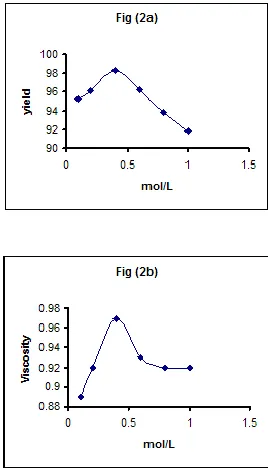
Different ratios of aqueous: organic phase in the range 1:1, 1:0 were used and it been found that the best ratio giving highest value of reduced viscosity and better yield was 1:1 [12]. Using this optimum ratio and changing the concentration of the monomeric compounds from 0.1-1.0 mol./L altered also the reduced viscosity and percentage yield of the polymers in a way that the best results were obtained with 0.4M solution (cf. fig.2 a,b).
Fig. 2. The effect of 2,5-bis(4-hydroxybenzylidene) cyclo-pentanone (Ia) and 2,5-bis (4-hydroxy-3-methoxybenzylidene) cyclopentanone (Ib) concentrations on yield (a) and reduced viscosity (b) of copolyester IIb : organic phase, methylene chloride, 100% NaOH, time of addition of acid
chloride , 10 min. at room temperature.
The amount of NaOH as a hydrogen chloride acceptor exerts considerable influence on the results of copolymerization. Figure 3a,b showed that the highest value of viscosity and better yield was obtained from 100% excess of NaOH.
O CH
HC O
O CO R' CO O HC O CH O CO R' CO
H3CO OCH3
n
O CH
HC OH
HO HO HC O CH OH
H3CO OCH3
N=N
,
N=N
,
+ + 2
.
Cl C R' O
C CI O
R' = (CH2)4 , (CH2)8 , ,
Interf acial Polycondensation
NaOH / CH2Cl2
Coplyesters IIa-g
(Ia) (Ib)
a b
c d
112804-7676 IJBAS-IJENS © August 2011 IJENS I J E N S
Fig. 3. The effect of the excess of hydrogen chloride acceptor (NaOH) on yield (a) and reduced viscosity (b) of copolyester IIb : organic phase, methylene chloride, time of addition of acid chloride, 10 min. at room
temperature.
Performing the condensation without addition of BTC with 100% excess NaOH gave 86.51% yield, however using 10% BTC with relation to the weight of the diarylidenecyclopentanone ( Ia ,Ib) improved the yield 98.68% (cf.Table II).
TABLE II
THE EFFECT OF BTC ON THE YIELD AND REDUCED VISCOSITY OF COPOLYESTER IIba
a Conditions of the reaction: phases ratio 1:1, time of addition
of acid chloride 10 min, temperature 25°C.
* : Reduced viscosity was measured in H2SO4 at 25°C.
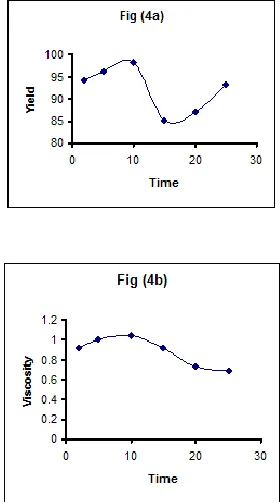
The time of addition of the acid chloride exerts considerable influence on the results of polymerization. Figure 4a,b showed that the optimum time of acid chloride addition is 10 min.; during longer time, the yield did not show substantial increases whereas the value of reduced viscosity decreased (cf. fig . 4a,b).
Fig. 4. The influence of the time of acid chloride addition on yield (a) and reduced viscosity (b) of copolyester IIb : organic phase, methylene chloride,
100% NaOH, at room temperature.
Polymers Characterization
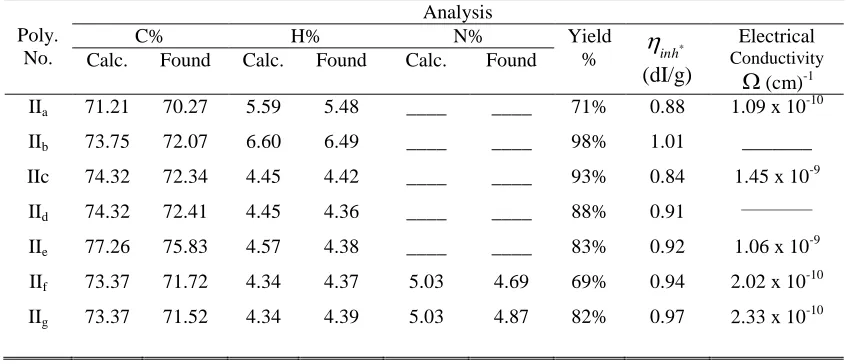
The resulting copolyesters were characterized by elemental analysis, IR spectra, solubility, viscometry, X-ray diffraction analysis, TGA, DSC analysis, morphology and electrical properties. The elemental analysis of all the copolyesters coincident with the characteristic repeating units of each copolymer. It should be noted that results of the analysis of the copolymers (c.f. Table III) deviated up to 1.98 % from theoretical values. Especially polymers of high molecular weight and those polymers containing polar groups capable of hydrogen bonding with solvent molecules easily trap solvent molecules within the polymer matrix [21].
Spectral data support the structural assignment of the copolyesters. IR spectra recorded from pellets of KBr mixed with respective polymer showed characteristic absorption bands due to C=O of esters at 1745-1735 cm-1; C=O of cyclopentanone at 1690-1700 cm-1; C=C stretching at 1590-1600 cm-1; phenylene rings at 1590-1510cm-1 and C-O-C bonds (ether linkage) at 1250-1260 cm-1 .
Catalyst Yield (%) ηred* (dL/g)
_ 86.51 0.91
112804-7676 IJBAS-IJENS © August 2011 IJENS I J E N S
TABLE III
RESULTS OF ELEMENTAL ANALYSES, AND SOME PHYSICAL PROPERTIES OF COPOLYESTER IIa-g
Poly. No.
Analysis
C% H% N% Yield
%
inh*(dI/g)
Electrical
Conductivity
(cm)-1Calc. Found Calc. Found Calc. Found
IIa IIb IIc IId IIe IIf IIg 71.21 73.75 74.32 74.32 77.26 73.37 73.37 70.27 72.07 72.34 72.41 75.83 71.72 71.52 5.59 6.60 4.45 4.45 4.57 4.34 4.34 5.48 6.49 4.42 4.36 4.38 4.37 4.39 ____ ____ ____ ____ ____ 5.03 5.03 ____ ____ ____ ____ ____ 4.69 4.87 71% 98% 93% 88% 83% 69% 82% 0.88 1.01 0.84 0.91 0.92 0.94 0.97
1.09 x 10⁻¹⁰
_______
1.45 x 10⁻⁹
___________
1.06 x 10⁻⁹
2.02 x 10⁻¹⁰
2.33 x 10⁻¹⁰
A. Solubility
The solubility characteristics of the copolyesters IIa-g were tested using various solvents including (DMF) dimethylformamide , (DMSO) dimethylsulfoxide, (NMP) N-methylpyrrolidone, (DMA) dimethylacetamide ,chloroform – acetone (1:1), formic acid and conc. H2SO4. A 5% (w/v) solution was taken as a criterion for solubility. The results are shown in table 4 All the copolyesters are freely soluble in H2SO4. In polar aprotic solvents, such as DMF, DMSO or NMP all polymers dissolved partially, except IIb did not dissolve in DMSO and IIc did not dissolve in DMF or DMSO. In DMA all polymers dissolved partially. In HCOOH all polymers dissolved partially except polymers IIc, IId and IIe which were completely insoluble. In CHCl3-acetone mixture all the polymers showed poor solubility except polymers IIa and IIe dissolved partially. When comparing the solubility of copolyesters with polyesters in our previous papers [22-24], we found that the former have better solubility than the latter (cf.Table IV).
B. Inherent Viscosity
The inherent viscosities (η inh) of all copolyesters IIa-g were determined in concentrated sulphuric acid (9 M) at 25°C with a Ubbelohde Suspended Level Viscometer. The inherent viscosity value is defined as Equation (1):
η inh =[2.3 log η/ηo] / C
The solution concentration C is 0.5g/100 ml, η/ηo = relative viscosity (or viscosity ratio). The data are listed in table 3. It can be clarified from table 3 that polymers IIb,f and IIg have high viscosity values (1.01, 0.97 and 0.94 dL/g) and this may be attributed to high molecular weight of these polymers. On the other hand, polymer IIc has low viscosities (0.84 dL/g) respectively, and this may be attributed to low molecular weight of this polymer (c.f. Table III).
TABLE IV
SOLUBILITY CHARACTERISTICS OF COPOLYESTER IIa-g
Polymer Number
DMF DMSO NMP DMA CHCl3
+acetone ( 1: 1 )
HCOOH Conc H2SO4
II
aII
bII
cII
dII
eII
fII
g+
+
-
+
+
+
+
+
-
-
+
+
+
+
+
+
+
+
+
+
+
+
+
+
+
+
+
+
+
-
-
-
+
-
-
+
+
-
-
-
+
+
++
++
++
++
++
++
++
+ + : Soluble at room temperature (RT).
+ : Partialy soluble at (RT).
112804-7676 IJBAS-IJENS © August 2011 IJENS I J E N S C.X-ray Measurements
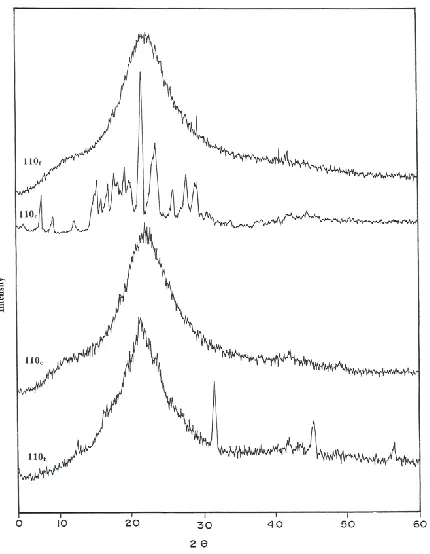
X- ray diffractograms of selected examples of copolyesters (IIb,c,e,f) are shown in Fig.5. shows few sharp peaks with an amorphous background, indicating that there is a large class of structures that are intermediate in the ordered state. More particularly, figure 5, shows that polymer IIb which contains eight methylene units in the back bone – (CH2)8- the reflection peaks increased and became (semicrystalline). It is noted that the presence of eight methylene groups in the polymer chain increased the polymer chain flexibility [24]. In polymer IIe which contains biphenyl group the reflection peaks increased and became (crystalline), this may be attributed to the extended conjugation system in the biphenyl rings, which lead to increasing in the ordering between chains. In copolyesters IIc & IIf which containing the aromatic and azo groups respectively in figure 5 showed an amorphous halopatterns in the region 2θ = 5-60°and this indicates a low degree of crystallinlty. This observation is consisting with that observed in previous work [18] for polyesters of diarylidene cycloalkanones based on aromatic para azo linkage. It should be noted that copolyesters IIa-g which based on diarylidenecyclopentanone has low degree of crystallinity, this may be attributed to the rigidity of cyclopentanoe moiety as reported in previous publications [15].
Fig. 5. X-ray Diffraction patterns of copolyesters IIb,c,e,f .
Morphological Features
The morphology of selected examples of copolyesters II
b,d,f were examined by scanning electron microscopy (SEM). The SEM samples were prepared by putting a smooth part of
polymer on a copper holder and subsequently coating it with gold palladium alloy. SEM images were taken on a penta Z Z-50 P Camera with Ilford film at an accelerating voltage of 15 kV using a low-dose technique [28].
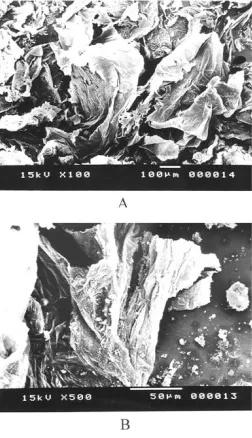
Figure 6a (X = 200) shows that polymer IIb consists of many spherical and globular micropores structure. The higher magnifications (X = 1000) in figure 6b shows that the globular micropores structure appeared more regular than in the lower magnifications. Figure 7a (X = 350) shows that polymer IId has aggregates of layer structure. The higher magnification (X = 3500) in figure 7b shows aggregate like columnar shape. Figure 8a (X = 100) shows that polymer IIf has aggregates layer structure. The higher magnifications (X = 500) in figure 8b shows aggregate like columnar shape.
Fig. 6. SEM images of copolyester IIb surface at different magnifications (A: X=200) (B: X= 1000)
112804-7676 IJBAS-IJENS © August 2011 IJENS I J E N S
Fig. 8. SEM images of copolyester IIf surface at different magnifications (A: X=100) (B: X= 500)
D. Thermal Properties of Copolyesters IIa-g
The thermal properties of the copolyesters IIa-g and polyesters were characterized by Differential Scanning Calorimetery (DSC) and Differential Thermal Analyses (TGA). In DSC studies, most of the copolyesters revealed multiple or more endotherms on DSC thermograms, probably due to polymorphism [29, 30].
DSC Analyses
In DSC studies, the peaks were broadened, which may be attributed to overlapping with thermal decomposition temperature. Copolyesters IIa-f were characterized by DSC measurements and conducted at heating rate of 10º/min. The DSC shows profiles of melting process of sample IIa which revealed multiple endotherm peaks at 245ºC (Tg), 330ºC (Tm) and exotherm peak at 375ºC , also probably with decomposition. The DSC of sample IIb revealed endotherm peak at 358ºC (Tm) and exotherm peak at 411ºC, also probably with decomposition, the glass transition Tg was weak and not observed. The DSC of sample IIc revealed endotherm peak 331ºC (Tm) and exotherm peak at 412ºC , also probably with decomposition, a glass transition Tg was weak in this case . The DSC profiles of sample IId revealed endotherm peaks at 200ºC (Tg), 300ºC (Tm) and exotherm peak at 405ºC, also probably with decomposition. The DSC shows profiles of melting process of sample IIe which revealed multiple endotherm peaks at 265ºC (Tg), 360ºC (Tm) and exotherm peak at 411ºC , also probably with decomposition. The DSC profiles of sample IIf revealed endotherm peaks at 245ºC (Tg), 375ºC (Tm) and exotherm
peak at 406ºC , also probably with decomposition. The DSC profiles of sample IIg revealed multiple endotherm peaks at 260ºC (Tg), 350ºC (Tm) and exotherm peak at 400ºC , also probably with decomposition.
TGA Measurements
The thermal behavior of copolyesters IIa-g were evaluated by TGA and DTG in nitrogen at a heating rate of 10ºC min –1. TGA curves show a small weight loss in the range 2-4 % starting at 100°C until 265°C which may be attributed to loss of moisture and entrapped solvents. All the copolyesters showed similar decomposition patterns. The initial decomposition of these polymers (10% loss) is considered to be the polymer decomposition temperature (PDT) [24], it occurred in the range 315ºC to 380ºC for all the samples.
112804-7676 IJBAS-IJENS © August 2011 IJENS I J E N S
TABLE V
THERMAL PROPERTIES OF COPOLYESTER IIa-g
Polymer
number
Temperature (°C) for various decomposition
levels *
5 %
Wt. loss10 %
Wt. loss20 %
Wt. loss30 %
Wt. loss40 %
Wt. loss50 %
Wt. lossII
a285
330
348
365
410
440
II
b280
315
365
390
430
475
II
c290
375
420
450
500
552
II
d265
315
370
405
430
460
II
e365
380
405
420
445
480
II
f330
360
410
445
460
475
II
g325
385
460
540
620
715
*Heating rate : 10 °C min-1.
Electrical Conductivity
The electrical conductivity was measured as follows:The sample was inserted in a laboratory made holder between two copper disks (insulated with Teflon) after which the sample resistivity was measured directly at 25ºC with polymer disks (6.5 mm diameter, 0.55- 2.8 mm thickness) which had been prepared by compressing the finely powdered polymers at 6 N/m2 under vacuum. The conductivity σ of the selected polymers was calculated using the Arhenius equation. Values in the range of 10-9-10-10 ohm.cm-1 being obtained, this indicates that the polymers are in the range of insulator materials (cf. Table III).
IV. CONCLUSIONS
High to moderate molecular weight of novel copolyesters of diarylidenecyclopentanone based on aliphatic and aromatic substituents in the main chain have been synthesized by interfacial polycondensation technique. All the copolyesters were soluble in H2SO4. X- ray diffractograms of selected examples of these copolyesters showed few sharp peaks with an amorphous background in the region 2θ = 5-60º, indicating that there is a large class of structures that are intermediate in the ordered state. Thermogravimetric analysis (TGA) showed moderate thermal stability with the onset of 10 % weight loss in nitrogen and ranged between 315ºC to 380ºC. An SME study indicated that the surface of copolyester IIb possesses many spherical and globular micropores structure, while copolyester IId has aggregates of layer structure. Electrical conductivity measurements indicated that most of the prepared copolyester are in the range of insulator materials.
REFERENCES
[1] Bjorksten Research Laboratories, “ Polyesters and their applications ” Reinhold, New York (1956).
[2] Korshak,V.V. and Vinogradova,S.V., “ Polyesters”, Pergamon Press, New York, 1965.
[3] Goodman, I. and Phys, J.A. “ Polyesters ” vol. 1 “ Saturated Polymers,” Hiffe Books, London, 1965.
[4] A. Wende, H. Priede and K. Deutsch, “Proceeding of 2nd International Symposium of Glass Reinforced Plastics,” Berlin , 1967.
[5] B. Parkyn, F. Lamb and B.V. Clitton, “Polyesters” vol. 2 “Unsaturated Polyesters and Polyesters Plasticizers” American Elsevier, New York, 1967.
[6] F. Belan, V. Bellenger, B. Mortaigne, J. Verdub and Y. S. Yang, “Hydrolytic stability of unsaturated polyester prepolymers,”
Composites Science and Technology vol. 56, pp. 133-137, 1996. [7] H. V. Boenig, “Unsaturated polyesters,” Elsevier, Amsterdam,
1964.
[8] H. C. Bach, H. F. Mark, N. G. Gaylord and M. M. Bikalo, “cyclopedia of polymer science and technology,” Interscience, New York, 1969.
[9] M. A. Abd-Alla, K. I. Aly and A. S. Hammam, “Arylidene Polymers VII. Synthesis and characterization of new polyesters and of diarylidenecycloalkanones containing an azo group in the main chain,” High Performance Polymer, vol. 4, pp. 323-334, 1989.
[10] M.A. Abd-Alla, K.I. Aly and A.A. Geies, “Arylidene Polymers XVI. Synthesis, characterization and morphology of new polyesters of diarylidenecyclopentanones containing azo and azomethine groups in the main chain,” J. Macromolecular Science Chemistry, vol. A28,pp. 269-282, 1991.
[11] N. S. Al-Muaikel, “Synthesis and characterization of new unsaturated polyesters and copolyesters containing azo groups in the main chain,” European Polymer Journal, vol. 39, pp. 1025– 1033, 2003.
[12] M. A. Abd-Alla, M. M. Kandeel, K. I. Aly and A. S. Hammam, “Arylidene Polymers II. Synthesis, characterization of some new polymers of diarylidenecyclopentanone,”. J. Macromolecular Science Chemistry, vol. A 27, pp. 523-538, 1990.
[13] M. A. Abd-Alla, K. I. Aly and A. S. Hammam, “Arylidene Polymers IV. Synthesis, characterization and morphology of new polyesters of diarylidenecyclohexanone,” High Performance Polymer, vol.3, pp.223-234, 1989.
[14] M. A. Abd-Alla and K. I. Aly, “Arylidene Polymers -X. Preparation and properties of new polyesters of diarylidenecyclopentanones containing symmetrical bis-azomethine groups in the polymer backbone,” High Performance Polymers, vol. 2,pp. 181-188, 1990.
[15] M. A. Abd-Alla and K. I. Aly, “Arylidene Polymers XIV- a new synthetic route to copoly(ester-thioester)s by direct polycondensation of thio-acids with diarylidenecyclohexanone,”
High Performance Polymers, vol.2,pp. 235-243, 1990.
[16] K. I. Aly and A. A. Geies, “New polymer syntheses I. Synthesis of linear unsaturated polyesters,” High Performance Polymers, vol. 4, pp. 187-195, 1992.
112804-7676 IJBAS-IJENS © August 2011 IJENS I J E N S
[18] M. A. Abd-Alla, M. F. El-Zohhry, K. I. Aly and M. M. A. Mohamed, “Arylidene Polymers XVIII. Synthesis and thermal behavior of organometalic Arylidene polymers containing ferrocene derivatives in the main chain,” J. of Applied Polymer Science,vol. 47, pp. 323-329, 1993.
[19] K. I. Aly and R. A. Ahmed, “Liquid Crystalline Polymers V. Thermotropic Liquid Crystalline Poly(azomethine-ether)s Containing Cycloalkanone Moiety in the Polymer Backbone,”
Liquid Crystals, vol. 27, pp. 451-458 , 2000.
[20] K. I. Aly, A. A. Khalaf and I. A. Alkaskas, “Liquid Crystalline Polymers VII. Thermotropic Liquid Crystalline Poly(azomethine-ether)s Containing Dibenzylidene Derivatives in the Main Chain,”
Eropean Polymer Journal, vol. 39, pp. 1035–1044 , 2003. [21] S. M. Andrew and R. G. Bass “Polypyrazolinones from aromatic
di(propynoic ester)s and aromatic dihydrazines,”. Journal of Polymer Science Part A: Polymer Chemistry, vol. 27, pp. 1225– 1239, 1989.
[22] K. I. Aly and M. A. Abd-Alla,“Arylidene Polymers XX. Synthesis and characterization of some new photochromic heterocyclic arylidene polymers containing 1,3,4-oxadiazole and 1,2,4- triazole moieties in the main chain,” Polymer Journal, vol. 24,pp. 165-171, 1992.
[23] K. I. Aly, M. F. El-Zohhry, and M. A. Abd-Alla, “Arylidene Polymers XIX. Synthesis and properties of aromatic polyphosphate from diarylidenecycloalkanones,” Polymer International, vol. 30, pp. 313-316, 1993.
[24] K. I. Aly, “New polymer syntheses VIII. Synthesis, characterization and morphology of new unsaturated copolyesters based on dibenzylidenecycloalkanones,” Polymer International, vol. 47, pp. 483–490, 1998.
[25] E. L. Wittbecker and P. W. Morgan, “Interfacial Polycondensation I,” Journal of Polymer Science, Vol. 40, pp. 289-296, 1959. [26] Y. Imai, M. Ueda and M. Li, “Synthesis of aromatic
polysulfonates by phase-transfer-catalysed polycondensation with crown ethers,” Die Makromolekulare Chemie,vol. 179,pp. 2085-2087, 2003.
[27] Y. Imai, N. Sato and M. Ueda, “Synthesis of aromatic polyphosphonate by phase-transfer catalyzed polycondensation with quaternary onium salts and crown ethers,” Die Macromolekulare Chemie, Rapid Communications, vol. 1, pp. 419-422, 1980.
[28] A. Tager, Physical Chemistry of Polymers. Mir, Moscow, 1972. [29] S. Antoun, R. W. Lenz and J. I. Jin, “ Liquid crystal polymers. IV.
Thermotropic polyesters with flexible spacers in the main chain,”
Journal of Polymer Science: Polymer Chemistry Edition ,vol. 19, pp. 1901-1920 ,1981.