Volume 11, Issue 11 (November 2015), PP.08-16
A Novel Technique for Simultaneous Encryption of Multiple
Images Using 3D Chaotic Permutation
Prabhudev Jagadeesh
1, P. Nagabhushan
21Department of Computer Science and Engineering, JSS Academy of Technical Education,
Bengaluru, Affiliated to VTU, Belagavi
2Department of Studies in Computer Science, University of Mysore, Mysore
Abstract:- With the swift increase of digital data exchange and increased usage of digital images, it is important to protect the confidential image data from illegitimate access. Digital image scrambling or encryption is the solution which transforms a meaningful image into a meaningless or disordered image in order to enhance the ability to tackle attack and in turn improve the security. However inherent features of image data such as bulky nature, high redundancy and high correlation among pixels demand the need to treat an image in a different way from text data regarding confidentiality. In this paper a novel scheme is proposed to simultaneously encrypt multiple images in an image database or image folder. Images are stacked and are viewed as a 3D block of images. Permutation of image pixels/blocks across the images is done using 3D chaotic permutation and pixel substitution using three-way grid based noise induction. 2D grid structure projected on each dimension of the 3D block of images defines the scrambling nature of pixels resulting in varied distortion of information. The proposed novel model of perceiving multiple images as 3D block of images and simultaneous scrambling provides an additional level of complexity for unauthorized access. The proposed scheme is more apt for secured storage of images. The experimental results demonstrate that the proposed algorithm can effectively and simultaneously scramble the images, and the security analysis of the algorithm also reveals that the proposed scheme can survive various attacks.
Keywords:- Image Encryption, Scrambling, Image Entropy, Image correlation, Image histogram, chaotic map.
I.
INTRODUCTION
The security of multimedia data in digital distribution networks is generally provided by encryption. Classical and modern ciphers have all been developed for the simplest form of data i.e., text and thus are not apt for encrypting image data which has certain intrinsic properties like bulky nature, intractable high redundancy and higher correlation among pixels. There have been several image scrambling schemes for protecting confidentiality of sensitive images essentially through cryptographic and steganographic techniques [1-3]. Despite these efforts, analysis indicates that security level is still not strong for images and multimedia data in general [4-6]. Also these techniques hardly consider the important inherent properties of images. This indicates the need for content-based schemes which are simpler yet stronger for protecting confidentiality of digital images [2]. In the proposed work a novel scheme which is unique in its approach is proposed to simultaneously scramble multiple images in an image database or image folder.
The rest of this paper is organized as follows. Section 2 presents the related work found in literature with regard to image encryption. In Section 3, the proposed scheme for multiple image encryption based on 3D chaotic permutation is discussed. Section 4 contains the experiments carried out and the results obtained. Section 5 presents the detailed security analysis of the new proposed technique. Finally, Section 6 concludes the paper highlighting the research accomplishments and also proposing future directions.
II.
RELATED WORK
multi-round combination of secret permutations and pixel value substitutions [13]. Several chaos-based algorithms are also proposed for image encryption [15-16].
III.
PROPOSED TECHNIQUE
A novel scheme is proposed to simultaneously scramble multiple images in an image database or image folder. Images are stacked and are viewed as a 3D block of images. Permutation of image pixels/blocks across the images is done using 3D chaotic permutation and pixel substitution using three-way grid based noise induction. 2D grid structure projected on each dimension of the 3D block of images defines the scrambling nature of pixels resulting in varied distortion of information. The proposed scheme is more suitable for secured storage of images.
The following sections provide the necessary background, 2D grid formation on images and the basics of 3D chaotic map.
3.1 2D grid structure
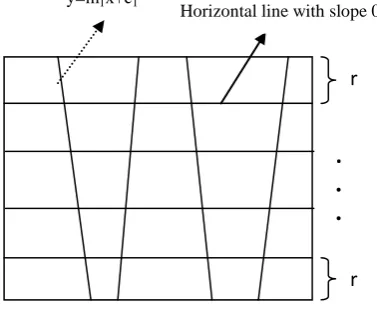
An image is first partitioned into several arbitrary grids of geometrical objects (in the present case into trapezoidal grids). For this the plain image is partitioned into several arbitrary trapezoidal grids by drawing: i) horizontal lines at regular intervals on the image and ii) lines with different slopes across the image such that they do not intersect within the image area. The lines are drawn with the above property to limit the grids formed to trapezoidal grids. This method of partitioning has a higher probability of image being partitioned into distinctive trapezoidal grids. To eliminate any chances of an attacker tracing out the grid formed on the image, pixels are considered in terms of p x q pixel blocks and are mapped to their respective trapezoidal grid. A p x q pixel block is mapped on to a grid where its center lies. Fig. 1 illustrates the formation of grids on an image. The keys for pixel substitutions are derived from the geometrical properties of the grids like the area or the perimeter of the grid. Using these keys the substitution process is carried out by adding noise to every pixel through simple substitution cipher. The slopes, intercept and interval of horizontal lines act as keys for pixel substitution. The same set of keys is used for decrypting the image.
Fig. 1 Grid Formation on an Image
3.2 3D Chaotic Map
The simplicity of discrete chaotic maps and well established chaos theory make it possible to evolve prudently good solutions to image encryption. The classic Arnold cat map is a two-dimensional cat map. The extension of 2D map as 3D map for image encryption as proposed in [16] is described for the sake of clarity and completeness.
The classical Arnold cat map is a two-dimensional invertible chaotic map described in Eq.1 as: 𝑥𝑛+1
𝑦𝑛+1 = 1 1
1 2
𝑥𝑛
𝑦𝑛 mod1 (1)
In Eq.1 (xn, yn) are the original coordinates and (xn+1, yn+1) are the transformed coordinates. The generalized 2D
cat map with two control parameters, a and b, is given in Eq.2 as follows:
𝑥 𝑥
.
.
.
r
r
y=m1x+c1
𝑥𝑛+1 𝑦𝑛 +1 𝑧𝑛+1
=
1 𝑎𝑧 0
𝑏𝑧 𝑎𝑧𝑏𝑧+ 1 0
0 0 1
𝑥𝑛 𝑦𝑛 𝑧𝑛
mod 1 (3)
i.e., by fixing zn unchanged the 2D cat map is performed on the x–y plane.
In Eq.3 (xn,yn,zn) are the original coordinates and (xn+1,yn+1,zn+1) are the transformed coordinates.
The second one is similarly performed, but on the y–z plane while keeping xnunchanged:
𝑥𝑛+1 𝑦𝑛 +1 𝑧𝑛+1
=
1 0 0
0 1 𝑎𝑥
0 𝑏𝑥 𝑎𝑥𝑏𝑥+ 1
𝑥𝑛 𝑦𝑛 𝑧𝑛
mod 1 (4)
The last one is performed on the x–z plane: 𝑥𝑛+1
𝑦𝑛 +1 𝑧𝑛+1
=
1 0 𝑎𝑦
0 1 0
𝑏𝑦 0 𝑎𝑦𝑏𝑦+ 1
𝑥𝑛 𝑦𝑛 𝑧𝑛
mod 1 (5)
Then, by combining these three maps together, a three-dimensional cat map is obtained as follows: 𝑥𝑛+1
𝑦𝑛 +1 𝑧𝑛+1
= 𝐀 𝑥𝑛 𝑦𝑛 𝑧𝑛
mod 1 (6)
Where
𝐴 =
1 + 𝑎𝑥𝑎𝑧𝑏𝑦 𝑎𝑧 𝑎𝑦+ 𝑎𝑥𝑎𝑧+ 𝑎𝑥𝑎𝑦𝑎𝑧𝑏𝑦
𝑏𝑧+ 𝑎𝑥𝑏𝑦+ 𝑎𝑥𝑎𝑧𝑏𝑦𝑏𝑧 𝑎𝑧𝑏𝑧+ 1 𝑎𝑦𝑎𝑧+ 𝑎𝑥𝑎𝑦𝑎𝑧𝑏𝑦𝑏𝑧+ 𝑎𝑥𝑎𝑧𝑏𝑧+ 𝑎𝑥𝑎𝑦𝑏𝑦+ 𝑎𝑥
𝑎𝑥𝑏𝑥𝑏𝑦+ 𝑏𝑦 𝑏𝑥 𝑎𝑥𝑎𝑦𝑏𝑥𝑏𝑦+ 𝑎𝑥𝑏𝑥+ 𝑎𝑦𝑏𝑦+ 1
3.3 Discretization of the 3D cat map
Since encryption is a kind of transformation operated on a finite set, in order to incorporate a chaotic map into image encryption, it is discretized, while preserving some of its useful features such as the mixing property and the sensitivity to initial conditions and parameters.
The map in Eq.6 is discretized and extended to N x N x N 3D image blocks according to the following formula:
𝑥𝑛+1 𝑦𝑛 +1 𝑧𝑛+1
= 𝐀 𝑥𝑛 𝑦𝑛 𝑧𝑛
mod 𝑁 (7)
Where
𝐴 =
1 + 𝑎𝑥𝑎𝑧𝑏𝑦 𝑎𝑧 𝑎𝑦+ 𝑎𝑥𝑎𝑧+ 𝑎𝑥𝑎𝑦𝑎𝑧𝑏𝑦
𝑏𝑧+ 𝑎𝑥𝑏𝑦+ 𝑎𝑥𝑎𝑧𝑏𝑦𝑏𝑧 𝑎𝑧𝑏𝑧+ 1 𝑎𝑦𝑎𝑧+ 𝑎𝑥𝑎𝑦𝑎𝑧𝑏𝑦𝑏𝑧+ 𝑎𝑥𝑎𝑧𝑏𝑧+ 𝑎𝑥𝑎𝑦𝑏𝑦+ 𝑎𝑥
𝑎𝑥𝑏𝑥𝑏𝑦+ 𝑏𝑦 𝑏𝑥 𝑎𝑥𝑎𝑦𝑏𝑥𝑏𝑦+ 𝑎𝑥𝑏𝑥+ 𝑎𝑦𝑏𝑦+ 1
(xn,yn,zn) are the original coordinates and (xn+1,yn+1,zn+1) are the transformed coordinates.
ax, bx, ay , by , az, bz are all positive integers.
The determinant of A is 1, which means that the discrete version of the 3D cat map is one to one, and that its mixing property and the sensitivity to initial conditions and parameters are kept unchanged.
3.4 Proposed Algorithm
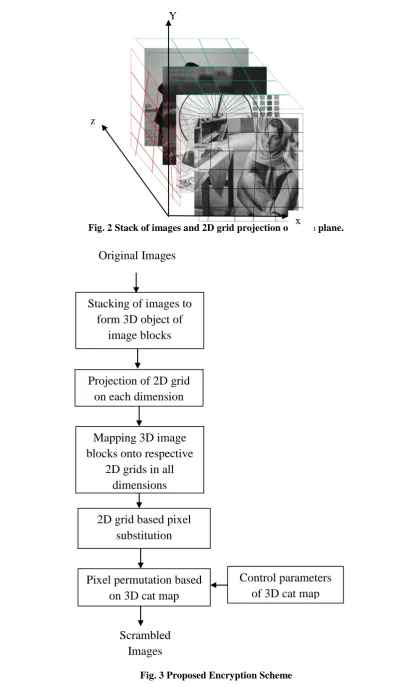
Fig. 2 Stack of images and 2D grid projection on each plane.
x
z
Y
Scrambled
Original Images
Stacking of images to
form 3D object of
image blocks
Projection of 2D grid
on each dimension
Mapping 3D image
blocks onto respective
2D grids in all
dimensions
Pixel permutation based
on 3D cat map
2D grid based pixel
substitution
Algorithm
Step 1: Stack two-dimensional images as three-dimensional stack of images or cube.
Step 2: Project three randomly generated 2D trapezoidal grids one each on x-y, y-z and z-x plane of 3D image stack as shown in Fig. 2. Here x indicates the row position of pixel, y the column position and z indicates the image number in the image stack.
Step 3: Map 3D image blocks of size p x p x p onto the projected 2D trapezoidal grids separately for all the three projections.
The mapping is done such that a 3D image block is assigned to a grid if its center lies on that grid.
Step 4: Perform pixel substitution three times (for all three directions) using respective Area values of the trapezoidal grid to which the cube containing the pixel is mapped
c = (p + Area) mod 256
p is the original pixel and c is the transformed pixel and Area is the area of grid.
Step 5: Perform permutation of pixels/3D blocks using Arnold 3D cat map defined in Eq.7
Where (xn,yn,zn) is the original position of pixel/3D blocks and (xn+1,yn+1,zn+1) is the transformed position of the
corresponding pixel/3D blocks. N x N is the size of each image in the set containing N images.
ax, bx, ay , by , az, bz are positive integers which can be viewed as keys for chaotic permutation.
Step 6: Repeat step 5 for required number of iterations.
For decryption and reconstruction of the original image, the above encryption process is reversed by using the same keys employed during encryption, by reversing first permutation and then the substitution in similar way done during encryption.
IV.
EXPERIMENTAL RESULTS
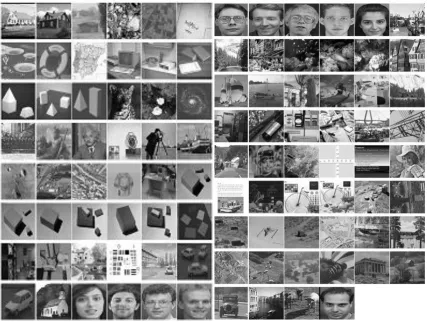
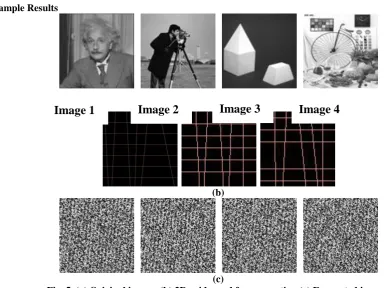
The proposed algorithm was tested on the dataset of 100 images shown in Fig. 4 of size 100 x 100. Results of four images randomly selected are shown in Fig. 5. For results shown in Fig. 5, size of 3D image blocks for substitution process is 2 x 2 x 2. Permutation of these cubes is carried out across the planes using 3D map.
Sample Results
(a)
(b)
(c)
Fig. 5 (a) Original images (b) 2D grids used for encryption (c) Encrypted images
V.
SECURITY ANALYSIS OF THE PROPOSED SYSTEM
An efficient image encryption algorithm should be robust against all kinds of statistical, cryptanalytic and brute-force attacks. To analyze the security of the proposed system, Entropy analysis, Histogram analysis and Correlation Coefficient analysis are carried out.
5.1 Entropy Analysis
The proposed technique is based on the principle of information entropy which intends to maximize the entropy thereby increasing the security. For a digital image, Image Entropy indicates the amount of information contained in an image. It can be chosen as a measure of the detail provided by an image. Higher the value of entropy less is the information revealed. The entropy En of a grayscale image is calculated as below:
𝐸𝑛 = (𝑝 𝑖 ∗ 𝑙𝑜𝑔2(
1 𝑝 𝑖 ) 255
𝑖=0 (8)
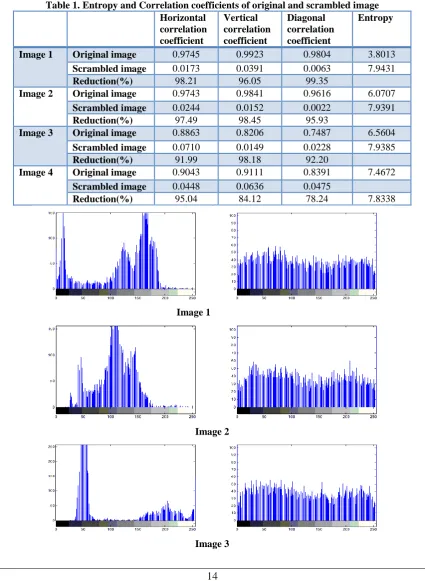
p(i) is the probability of occurrence of a pixel with grayscale value i. If each symbol has an equal probability then entropy of 8 would correspond to complete randomness, which is the ideal value expected in a scrambled image. The entropy of plain image and scrambled image are listed in Table. 1. The entropy values obtained for various scrambled image indicate that the proposed method results in a scrambled image that is more assorted thereby reducing the information revealed.
5.2 Histogram Analysis
Another Security analysis carried out is histogram analysis. An image histogram illustrates how pixels in an image are distributed by plotting the number of pixels at each intensity level. It is apparent from the results shown in Fig.6 that the histogram of the final encrypted image is comparatively uniform and is significantly different from that of the original image thus not revealing any hint for statistical attack.
5.3 Correlation Coefficient
To study the correlation property of horizontally adjacent pixels, vertically adjacent pixels and also diagonally adjacent pixels for the original image and scrambled image, 1000 pairs of adjacent pixels were selected randomly and the correlation coefficient of each pair is computed using Eq.9:
𝑐𝑜𝑣(𝑥, 𝑦)
𝑐𝑜𝑣 𝑥, 𝑦 =1
𝑁 𝑥𝑖− 𝐸 𝑥 𝑦𝑖− 𝐸 𝑦
𝑁
𝑖=1
(10)
𝐸(𝑥) =1
𝑁 𝑥𝑖 𝑁
𝑖=1 (11)
𝐷 𝑥 =1
𝑁 (𝑥𝑖− 𝐸 𝑥 )
2 𝑁
𝑖=1 (12)
Here x and y are grayscale values of two adjacent pixels in the image.
In Table 1, higher value of correlation coefficient of original image indicates pixels in original image are highly correlated, whereas the smaller value of correlation coefficient of encrypted image indicate lesser correlation between image pixels which is the property desired from any image encryption technique.
Table 1. Entropy and Correlation coefficients of original and scrambled image Horizontal
correlation coefficient
Vertical correlation coefficient
Diagonal correlation coefficient
Entropy
Image 1 Original image 0.9745 0.9923 0.9804 3.8013
Scrambled image 0.0173 0.0391 0.0063 7.9431
Reduction(%) 98.21 96.05 99.35
Image 2 Original image 0.9743 0.9841 0.9616 6.0707
Scrambled image 0.0244 0.0152 0.0022 7.9391
Reduction(%) 97.49 98.45 95.93
Image 3 Original image 0.8863 0.8206 0.7487 6.5604
Scrambled image 0.0710 0.0149 0.0228 7.9385
Reduction(%) 91.99 98.18 92.20
Image 4 Original image 0.9043 0.9111 0.8391 7.4672
Scrambled image 0.0448 0.0636 0.0475
Reduction(%) 95.04 84.12 78.24 7.8338
Image 1
Image 2
Image 4
(a) (b)
Fig. 6 (a) Histograms of original images (b) Histogram of Encrypted images
VI.
CONCLUSION
A method proposed for simultaneously encrypting stack of images has produced promising results. A substitution process is proposed through which pixel intensity is altered using the property (area) of the 2D grid to which the pixel/pixel cube is mapped. A permutation method to shuffle pixels/pixel cube using 3D cat map was explored. Promising results are obtained for all the experimentations carried out. Encrypting multiple images simultaneously by considering them as 3D block of images, provides efficient results w.r.t statistical features, and also adds another dimension of complexity for various attacks. The model qualifies as an encryption technique more apt for storage security which has not been seriously addressed in separation with transmission security. The novel attempt to use 3D chaotic map for permuting pixels or block of pixels across multiple images is a noteworthy contribution. As future enhancement, the proposed work which employs simple substitution cipher and trapezoidal grids for exploratory purpose of 2D grid framework can also be explored with various other advanced substitution ciphers and chaotic maps.
REFERENCES
[1]. Yuan-Hui Yu, Chin-Chen Chang and Iuon-Chang Lin, A new steganographic method for color and grayscale image hiding, Computer Vision and Image Understanding, Volume 107, Issue 3, September 2007.
[2]. Furht B., D Kirovsk, Multimedia Security Handbook, 2005.
[3]. Shiguo Lian, Multimedia Content Encryption: Techniques and Applications, CRC Press, 2009.
[4]. I. Ozturk, I. Sogukpinar, "Analysis and comparison of image encryption algorithm," Journal of transactions on engineering, computing and technology December, vol. 3, 2004, pp. 38.
[5]. Qiudong Sun; Wenying Yan; Jiangwei Huang; Wenxin Ma, “Image encryption based on bit-plane decomposition and random scrambling”, 2nd International Conference on Consumer Electronics, Communications and Networks, 2012, pp. 2630 – 2633.
[6]. A. Akhavan 1, A. Samsudin 1 and A. Akhshani, “On the Speed of Image Encryption with Chaotically Coupled Chaotic Maps", IJCSI International Journal of Computer Science Issues, Vol. 9, Issue 3, No 3, May 2012
[7]. Prabhudev Jagadeesh, Nagabhushan, Pradeep Kumar, ”A Novel Image Scrambling Technique Based On Information Entropy And Quad Tree Decomposition”, International Journal of Computer Science Issues ,Vol.10,Issue 2,No. 1, March 2013.
[8]. Alireza Jolfaei and Abdolrasoul Mirghadri, “ Survey: Image Encryption Using Salsa20,” IJCSI, Vol. 7, Issue 5, September 2010 pp 213-220.
[9]. Prabhudev Jagadeesh, P.Nagabhushan, R.Pradeep Kumar, “A Novel Color Image Scrambling Technique Based on Transposition of Image-Blocks between RGB Color Components”, International Journal of Research in Engineering & Advanced Technology(IJREAT), Vol 1, Issue 2(2013).
[10]. Prabhudev Jagadeesh, P.Nagabhushan, R.Pradeep Kumar, “A Novel Perceptual Image Encryption Scheme Using Geometric Objects Based Kernel”, International Journal of Computer Science and Information Technology (IJCSIT), Vol 5, No. 4(2013).
[13]. Mohammad Ali Bani Younes and Aman Jantan, “An Image Encryption Approach Using a Combination of Permutation Technique Followed by Encryption” IJCSNS, April 2008.
[14]. A. Mitra, Y V. Subba Rao, and S. R. M. Prasnna, "A new image encryption approach using combinational permutation techniques," Journal of computer Science, vol.1, no. 1, 2006, pp.127 [15]. Avasare M.G. Kelkar, V.V, “Image encryption using chaos theory”, International Conference on
Communication, Information & Computing Technology (ICCICT), 2015 pp. 1 – 6.