
INTRODUCTION
Near the nuclear facilities the radiation pol-lution of a territory is due to by emission of the isotopes Cs-137 and Sr -90 as the products of nuclear decay. In urban areas, the deactivation of contaminated territory takes the degree of the radiation pollution of the soil and the migration mobility of isotopes Cs-137 and Sr -90 into ac-count with the aim for further building in these territories. At the same time, the ground used shall comply with the sanitary and hygienic
re-quirements in respect of building matters which may be used in the base of buildings.
Generally, the lowest level of specific radio -activity is 1.2×10⁻⁶ Ci/kg, established for the solid radioactive waste. The building is forbidden with contamination levels of beta-rays from 1.2×10⁻⁶ to 2×10⁻⁶ Ci/kg, but it is possible final deposition in the reverse-well disposals. The large volumes of ground are generated in urban areas with the large-scale radiation pollution. Such volumes are difficult to disposal. Therefore, cleaning from ra -dionuclides of urban areas is an urgent issue.
PROBLEMS OF PROTECTION OF URBAN AREAS FROM RADIONUCLIDES
STRONTIUM-90 AND CAESIUM-137 AFTER TECHNOLOGICAL DISASTERS
Olga Cheremisina1, Vasiliy Sergeev1, Alexander Fedorov1, Alexandra Iliyna1
1 Saint Petersburg Mining University, Department of General and Physical Chemistry, 21st Line 2, 199106 Saint Petersburg, Russia, e-mail: [email protected], [email protected], [email protected], [email protected]
Volume 18, Issue 3, May 2017, pages 97–103
DOI: 10.12911/22998993/70201 Research Article
ABSTRACT
The methods of decontamination of radionuclides from soils are considered. The
literature focuses on fixing radionuclides in soils and creating geochemical barriers
that it is prevent the spread of pollution. The main disadvantage of these methods is
excluding the possibility of building a territory. It is needed to clean up the area to the sanitary and hygienic requirements for further use and then it is desirable to fix the residual activity. The conducted analysis of forms of radionuclides fixation in soils and mechanics of this fixation, therewith revealed that Cs-137 fixed more strongly
on mineral components of soil, than Sr-90, which is mainly in the acid-soluble and
exchangeable form, and, as a consequence, passes into the liquid phase during soil
deactivation more easily. Contaminated soil deactivation in the urbanized territory is possible by washing it by ferric chloride solution at a concentration 0.02–0.05 M
and with an equimolar addition of an ammonium chloride. Therewith, most efficient
methods, which use in-situ conditions, are heap and convection leaching technologies
with treatment degree, which is not less than 80%. At the same time, the most effi
-cient methods which use in-situ conditions are heap and the convection leaching. The hardware-technological scheme of a convection leaching is presented. It is worth to
note that ammonium salts additions slightly rise coefficient of treatment from Sr-90. Because ammonium salts are inexpensive, their additions allow to obtain significant
economic benefits due to decreasing ferric chloride consumption, which is more valu
-able, and waste water volume reduction.
Keywords: Strontium-90, Caesium-137, decontamination of radionuclides, elution of radionuclides, convection leaching, heap leaching
METHODS OF DECONTAMINATION SOILS
FROM RADIONUCLIDES
The literature focuses on fixing radionuclides in soils and creating barriers that it is prevent the spread of pollution. There are different types of geochemical barriers to the migration of cations of heavy metals, including radionuclides:
1. The coagulation-based thin suspensions [Mao et al, 2015];
2. The physicochemical barriers – precipitation under the action of a sharp violation of acid-base or oxidation-reduction regimes [Choppin et al, 2002];
3. The biogeochemical barriers [Newsome et al, 2014];
4. The Sorption barriers [ Mao et al, 2015]; 5. The thermodynamic barriers – deposition
un-der the influence of temperature and pressure changes [Grivé et al, 2015]
The simplest way of fixing Sr-90 is liming the ground. There are other ways of fixation: the cat -ion-exchange membranes [Ambashta and Sillan -pää, 2012] and the ecological concreting [Shi and Fernández-Jiménez, 2006.] On the other hand, the disadvantage of these methods is excluding the possibility of building a territory. It is necessary to clean up the area to the sanitary and hygienic requirements for further use and then it is desir-able to fix the residual activity. Consequently, de -activation of very contaminated soil and dilution of less contaminated one with clean materials up to current standards are more realistic.
Elution soil leaching would be the simplest and cheapest way of soil deactivation. Possibil-ity of radionuclide removal from soil has been researched for many years [Sawhney, 1972.]. Ce-sium-137 is hardly removed from soil by 1 M
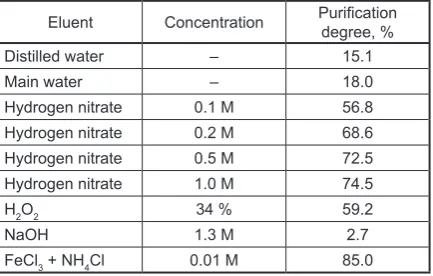
am-Table 1. Results of leaching of silts from river Techa of strontium-90
Eluent Concentration Purification degree, %
Distilled water – 15.1
Main water – 18.0
Hydrogen nitrate 0.1 M 56.8
Hydrogen nitrate 0.2 M 68.6
Hydrogen nitrate 0.5 M 72.5
Hydrogen nitrate 1.0 M 74.5
H2O2 34 % 59.2
NaOH 1.3 M 2.7
FeCl + NHCl 0.01 M 85.0
monium acetate and hydrochloric acid solutions, 0.01 M sodium ethylenediaminetetraacetate (Trilon B) solution and bird-cherry extract, birch and aspen, potassium and cesium salts’ solutions. Cesium-137 desorption during soil leaching with salts and acids was researched in papers [Tit-lyanova, 1963; Rogozin et al, 1994]. As a result of soil leaching with salts’ and acids’ solutions, cesium-137 is desorbed for no more than 30%, likely, only from surface of the mineral. Humates are a non-exchangeable form of cesium in soil. Organic complexes do not extract cesium from soil at all. Boiling treatment with 6 M hydrogen nitrate, where organic and some mineral compo-nents of soil are degraded, is the only known way of cesium-137 desorption.
Possibility of strontium-90 leaching from soil was researched in the paper [Chuveleva, 1996]. Objects of the research were silts from river Te-cha in Chelyabinsk region (Table 1). It was found out that strontium in silts is bonded significant -ly less competent than cesium. Around 15% of strontium-90 was in researched objects of silts in water-soluble form and could be leached just with water. Around 70% of radionuclides were in ion-exchangeable form and went over to dilute solu -tions of acids and salts. Only around 15% of stron-tium-90 were fixed in non-ion-exchangeable form.
In spite of high concentration of organic frac-tion, silts leaching from radionuclides reaching purification degree above 70% is possible with hydrogen nitrate solutions. Thus, to solve the task of effective soil leaching, it is necessary to research forms of radionuclides’ fixation in soil and mechanism of its belaying.
FORMS OF FIXATION OF
RADIONUCLIDES
137CS AND
90SR IN SOIL
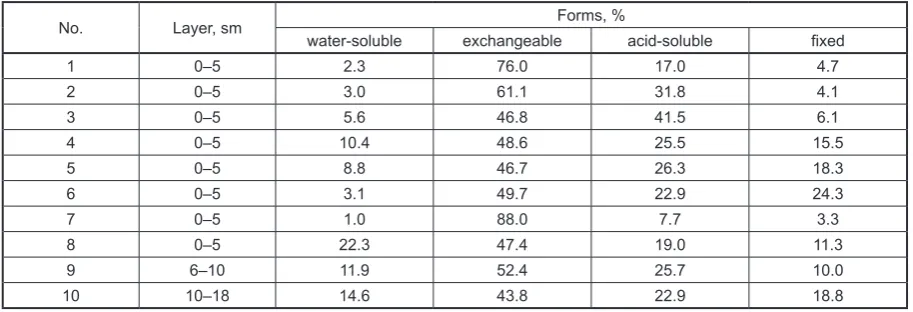
Authors of the paper [Lisin et al, 1993] re-searched physicochemical forms of 90Sr and 137Cs in soil of western area of Bryansk region, which was influenced by Chernobyl nuclear disaster. Research results of radionucludes’ sorption in sod-podzolic sabulous soil of western area in Bryansk region are shown in tables 2 and 3.
than mobile forms of 137Cs on single-order and it is responsible for high radiation danger.
So, main part of 137Cs is fixed as a result of irreversible ion sorption with soil particles via in-sertion into minerals’ lattice, also clayey. More-over, it is pointed out in a lot of papers [Virch-enko et al 1993; Varshal et al 1996; Zakharov et al 2001; Kuznetsov and Payne et al 2000; Mar-tjushov et al 1995] that during sorption process of 137Cs amorphous films are of significant impor -tance. They form ferric and aluminum hydroxides and organic elements (humic and fulvic acids) on the surface of the soil particles.
Authors of the paper [Martjushov et al 1995] researched forms of state and deport-ment of radionuclides in soil of Eastern-Ural radioactive trail, 36 years after the accident. Using ion-exchangeable resins, the authors de -termined anionic, cationic and neutral forms of radionuclides in water extract.
It is obvious from the table that 90Sr is bond-ed less competent, because the concentration of its fixed forms in soil does not go above 34%, while 137Cs concentration is about three times higher (95–99% of total ratio).
The conducted researches allow to conclude, that Cs-137 fixed on mineral component of soil more strongly than Sr-90, consequently Sr-90 is more mobile and will be easier to go into liquid phase in the process of the ground deactivation. Additionally, the feature of Sr-90 is the preferen-tial fixation in complexes with fulvic acids, and Cs – with humic acids.
Common patterns in dynamic of radionuclide fixation in soil are as follows: transition of radionu -clides in nonexchangeable state the more intense, the higher concentration of humus, silt fraction and exchangeable cations. In course of time in soil redistribution of mobile form of radionuclides is taking place from areas with low bond energy to areas with more strong, specific sorption.
ELUTION WASH OF SOILS FROM
RADIONUCLIDE CONTAMINATION
Removal of radionuclides from soils is pos-sible by applying ion exchange of their cations for cations with stronger throwing power. Last-named (throwing power) proportional to cation Table 2. Physicochemical forms of 137Cs in soil
No. Layer, sm Forms, %
water-soluble exchangeable acid-soluble fixed
1 0–5 0.2 0.4 5.9 93.5
2 0–5 0.08 1.1 3.8 95.0
3 0–5 0.1 0.9 3.8 95.2
4 0–5 0.06 0.2 0.9 98.9
5 0–5 0.05 0.4 1.7 97.9
6 0–5 0.6 1.0 5.9 92.6
7 0–5 0.04 1.2 9.2 89.6
8 0–5 0.3 7.9 11.3 80.5
9 6–10 0.4 3.8 8.3 87.4
Table 3. Physicochemical forms of 90Sr in soil
No. Layer, sm Forms, %
water-soluble exchangeable acid-soluble fixed
1 0–5 2.3 76.0 17.0 4.7
2 0–5 3.0 61.1 31.8 4.1
3 0–5 5.6 46.8 41.5 6.1
4 0–5 10.4 48.6 25.5 15.5
5 0–5 8.8 46.7 26.3 18.3
6 0–5 3.1 49.7 22.9 24.3
7 0–5 1.0 88.0 7.7 3.3
8 0–5 22.3 47.4 19.0 11.3
9 6–10 11.9 52.4 25.7 10.0
charge and inversely proportional to its radius in hydrated state. On these parameters Fe3+ was se-lected as an ion-displacer.
Selection of salt’s anion had the following rea-sons. Salts of weak acids are unsuitable because of irreversible hydrolysis. Sulfate ions exerts mask -ing effect on iron cations because of complex for -mation. Ferric nitrates (3+) unstable and unsuit-able for agrochemical standards. For this reason, authors [Chirkst et al. 2001] for the function of eluent selected ferric chloride (3+) solution with ammonium chloride addition for pH stabilization and for non-isotopic carrier for Ce-137.
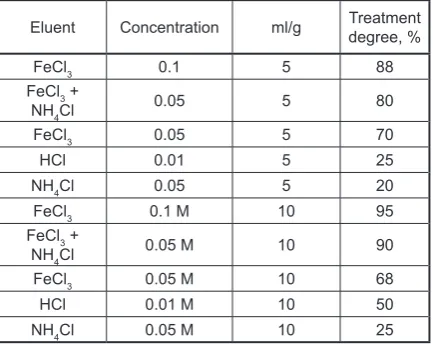
During in-situ testing in Bryansk region it was found that soil treatment from Ce-137 ra-dionuclides is carried out satisfactory under elu-ent concelu-entration 0.02M. In laboratory degree of treatment amounted to over 90% on model so-lution and 70% on real samples of contaminat-ed soil. Further, during in-situ testing degree of treatment of the land plot with an area of 10 m2 was achieved at 50%. The results of model soil samples, in other words artificially contaminated, treatment from Sr-90 is presented in Table 5.
Therethrough, soil treatment from radio-nuclides of Ce and Sr is possible by washing it by ferric chloride solution at a concentration 0.02–0.05 M and with an equimolar addition of a ammonium chloride. Authors [Chirkst et al. 2002] have revealed that soil treatment degree by applying ferric chloride solution significantly more than solutions of ammonium chloride or hydrochloric acid. Furthermore, treatment degree is rising with increasing eluent concentration and with addition of ammonium chloride. Composi-tion of eluents which used for sample washing and treatment coefficients is presented in Table 6.
It is worth to note that ammonium salts addi-tions (chloride or nitrate) slightly rise coefficient of treatment from Sr-90. Because ammonium salts are inexpensive, their additions allow to ob -tain significant economic benefits due to decreas -ing of ferric chloride consumption, which is more valuable, and waste water volume reduction. In such case ammonium cation acts as non-isotopic carrier for Cs in solution and prevents re-fixation of an isotope in soil.
As a result following eluents are recommended: 1. Nitric acid solution at 0.5 M concentration. 2. Equimolar solution of ferric chloride and
am-monium soil (chloride or nitrate) at 0.5 M concentration.
APPROBATION OF PROCESS MODELS
IN-SITU
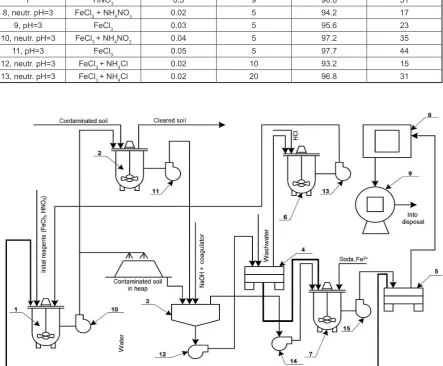
Most efficient methods which used in-situ conditions are heap and convection leaching (Figure 1) [Chirkst et al. 2001]. Ore heap leach-ing technology is well developed, particularly, in St. Petersburg Mining Institute, and successfully applied for non-ferrous metals recovery from lean ore and tailings, when other technologies are not economically irrational.
Table 4. Forms of radionuclides in soil, % of total ratio
Soil 137Cs 90 Sr
А В С D А В С D
Sod-podzolic 0.2 0.4 0.4 99.0 2.5 45.8 44.2 7.5
Sod-podzolic + grey forest 0.03 2.87 0.5 96.6 2.0 23.4 73.6 1.0
Grey + dark-grey forest 0.02 1.18 2.7 95.1 2.4 58.0 30.0 9.6
Chernozem + meadow
chernozem 0.1 1.1 2.1 96.6 1.8 55.9 30.9 11.4
Alluvial-lacustrine 0.03 1.47 1.7 96.8 1.2 38.8 26.0 34.0
Peaty-bog 0.2 1.4 2.9 95.5 2.9 43.3 32.0 21.8
Notice: А- water soluble; В- exchange; С- acid soluble ; D-fixed.
Table 5. Results of model soil samples treatment Eluent Concentration ml/g Treatment degree, %
FeCl3 0.1 5 88
FeCl3 +
NH4Cl 0.05 5 80
FeCl3 0.05 5 70
HCl 0.01 5 25
NH4Cl 0.05 5 20
FeCl3 0.1 М 10 95
FeCl3 +
NH4Cl 0.05 М 10 90
FeCl3 0.05 М 10 68
HCl 0.01 М 10 50
Heap leaching includes following operations [Chirkst et al 2001]:
1. Initial material is piled up on a moisture-proof concrete platform equipped with drainage channels. The dimensions of a heap are calcu-lated in accordance with soil rheological prop-erties research.
2. Heap periodically irrigates with eluent, which protects it from drying out by a polyethylene
film. Eluting solution is slowly filtered through the heap, leaching contaminants under dynam-ic equilibration conditions.
3. Wash water is collected to a water receiver then headed to neutralization and treatment. Mate-rial in the heap is periodically refreshed.
Heap leaching has following drawbacks: 1. Low intensity, i.e. process reaction rate. Table 6. Coefficients of soil treatment from Sr-90
Sample number Eluent Concentration, M V/m, Treatment degree, % Treatment coefficient
1 Trilon B 0.05 6 43 1.76
2 Trilon B 0.025 15 41 1.69
3 рН=12trilon, 0.025 10 37 1.58
4 FeCl3 0.15 14 94.7 19
5 HNO3 0.1 5 97.8 46
6 HNO3 0.5 6 96.6 29
7 HNO3 0.5 9 96.8 31
8, neutr. рН=3 FeCl3 + NH4NO3 0.02 5 94.2 17
9, рН=3 FeCl3 0.03 5 95.6 23
10, neutr. рН=3 FeCl3 + NH4NO3 0.04 5 97.2 35
11, рН=3 FeCl3 0.05 5 97.7 44
12, neutr. рН=3 FeCl3 + NH4Cl 0.02 10 93.2 15
13, neutr. рН=3 FeCl3 + NH4Cl 0.02 20 96.8 31
2. Presence of sticking, lumping of soil which leads to unequal washing. It is also possible to form areas, which are not inaccessible for eluent. For this reason soil treatment degree is worse.
Another technological method of soil treat-ment provides higher treattreat-ment degree – washing in batch action installations with active phase mix -ing – convectional leach-ing [Dibrov 2000]. Oper-ating principle – separation and disposal of finely divided radionuclides enriched soil fraction.
CONCLUSION
The conducted analysis of forms of radio-nuclides fixation in soils and mechanics of this fixation, therewith revealed that Cs-137 fixed more strongly on mineral component of soil, than Sr-90, which is mainly in the acid-soluble and exchangeable form, and, as a consequence, passes into the liquid phase during soil deactiva-tion more easily. Contaminated soil deactivadeactiva-tion in the urbanized territory is possible by washing it by ferric chloride solution at a concentration 0.02–0.05 M and with an equimolar addition of a ammonium chloride. Therewith most efficient methods, which used in-situ conditions, are heap and convection leaching technologies with treat-ment degree, which are not less than 80%.
REFERENCES
1. Ambashta R., Sillanpää M. Membrane purification
in radioactive waste management: a short review. Journal of Environmental Radioactivity,105,76–84. 2. Bondar Yu.I., Zabrodsky V.N. 2001. Sorbtsiya ion-nykh form 90Sr i 137Cs razlichnymi tipami pochv (Sorption of the ionic forms of 90Sr and 137Cs
by different types of soils). Radiokhimiya, 43 (6),
566–568.
3. Chirkst D.E., Litvinova T.E., Cheremisina O.V., Streleckaja M.I. 2001. Opytnaja tehnologija deza-ktivacii gruntov, zagrjaznennyh radionuklidom
Sr-90 / D (Experienced technology of decontamina
-tion of soils contaminated by radionuclide Sr-90). Radiohimija, 43(5), 475–478.
4. Chirkst D.E., Litvinova T.E., Cheremisina O.V. 2002. Povedenie 137Cs v processe dezaktivacii grunta 5-go kvartala Vasil’evskogo ostrova (The behavior of 137Cs in the process of decontamina-tion of the soil of the 5th quarter of Vasilievsky
is-land). Radiohimija, 44( 4), 378–381.
5. Choppin G., Liljenzin J-O., Rydberg J. 2002. Be-havior of Radionuclides in the Environment. Ra-diochemistry and Nuclear Chemistry (Third Edi-tion), 22, 642–673.
6. Chuveleva E.A., Firsova L.A. Et al. Radiokhimiya, 1996, 38 (6), 554–557.
7. Dibrov I.A. 2000. Opytnaja tehnologi-ja ochistki gruntov ot zagrtehnologi-jaznenitehnologi-ja
radionuklidami((Experienced technology of clean
-ing soil from pollution by radionuclides). Jekologi-ja i razvitie stran Baltijskogo regiona. 121 – 126.
8. Grivé M., Duro L., Colàs E., Giffaut E. 2015. Ther
-modynamic data selection applied to radionuclides
and chemotoxic elements: An overview of the Ther
-moChimie-TDB. Applied Geochemistry, 55, 85–94. 9. Konoplev A.V., Comans R.N.J., Hilton J. 1996.
The Radiolodical Consequences of the Chernobyl Accident, 121–135.
10. Kuznecov V.A., Generalova V.A. 2000. Issledo-vanie sorbcionnyh svojstv gidroksidov zheleza, marganca, titana, aljuminija i kremnija po otnosh-eniju k Sr-90 i Cs-137 (Study of sorption
proper-ties of the hydroxides of iron, manganese, titanium,
aluminum and silicon in relation to Sr-90 and Cs-137). Radiohimija, 42( 2), 154–157.
11. Lisin S.K., Simirskaya G.P., Simirsky Yu.N.,
Ro-dionov Yu.F., Shubko V.М. 1993. Formy nakhozh
-deniya Cs-137 i Sr-90 v pochvakh Bryanskoj oblasti (Forms of the presence of Cs-137 and Sr-90 in the soils of the Bryansk region). Radiatsiya i risk, 3, 129–132.
12. Mao X, Jiang R., Yu J. 2015. Use of surfactants for the remediation of contaminated soils: A review. Journal of Hazardous Materials, 285, 419–435. 13. Martjushov V.V., Spirin D.A., Bazilev V.V.,
Fe-dorova T.A. 1995. Sostojanie radionuklidov v po-chvah Vostochno-Ural’skogo radioaktivnogo sleda (The state of radionuclides in soils of the Eastern-Urals radioactive trace). Jekologija, 2, 110–113. 14. Newsome L., Morris K., Lloyd J.R. 2014. The
bio-geochemistry and bioremediation of uranium and other priority radionuclides. Chemical Geology, 363, 164–184.
15. Pavlotskaya F.I. 1974. Migratsiya radioaktivnykh produktov global’nykh vypadenij v pochvakh (Mi-gration of radioactive products of global fallout in soils). Moscow: Atomizdat
16. Rogozin Yu.M. Et al. Radiokhimiya, 1993, 35(2), 149–153.
17. Sawhney B.L. 1972. Selective sorpsion and fixa
-tion of ca-tions by clay minerals: a review. Clays and Clay Minerals, 20, 93–100.
solidification of hazardous and radioactive wastes
with alkali-activated cements. ournal of Hazardous Materials, 137(3), 1656–1663.
19. Sawhney B.L.1972. Selective sorpsion and fixation
of cations by clay minerals: a review. Clays and Clay Minerals, 20, 93–100.
20. Titlyanova A.A.1964. Pochvovedenie, 12, 88–94. 21. Varshal G.M., Koshheeva N.Ja., Veljuhanova
T.K., Chhetija D.N., Tjutjunnik O.A., Grinevs-kaja Zh.M. 1996. Sorbcija tjazhelyh metallov i izotopnyh nositelej dolgozhivushhih radionukli-dov na G.K.: Soobshhenie 1. Sorbcija cezija (I), stroncija(II), cerija (III), rutenija (IV) na gumino-voj kislote (Sorption of heavy metals and isotopic
carriers of long-lived radionuclides.) Geohimija, 11, 1107–1112.
22. Virchenko E.P., Agapkina G.I. 1993. Radionuklid-organicheskie soedinenija v pochvah zony vlijanija ChAJeS (Radionuclide-organic compounds in the
soils of the zone of influence of Chernobyl). Poch
-vovedenie, 1, 13–17.
23. Zaharova E.V., Kajmin E.P., Darskaja E.N.,
Men-jajlo K.A., Zubkov A.A. 2001. Rol’ fiziko-himi
![[2 Oxido 1 naphthaldehyde (2 hydroxybenzoyl)hydrazonato]pyridinenickel(II)](data:image/gif;base64,R0lGODlhAQABAIAAAP///wAAACH5BAEAAAAALAAAAAABAAEAAAICRAEAOw==)