(DOI: 10.24874/jsscm.2017.11.01.03)
Thermodynamic Optimization and Phase Modeling in the Ni-Sn-Bi Ternary
System
V. Gandova1,*, K. Lilova2
1 Inorganic and Physical Chemistry Department, University of Food Technologies, Plovdiv,
Bulgaria
e-mail: [email protected]
2 Peter A. Rock Thermochemistry Laboratory, University of California at Davis, Davis, USA
e-mail: [email protected]
*corresponding author
Abstract
The thermodynamic optimization of the Ni-Sn-Bi ternary system was performed using the Calphad method and experimental data obtained by Differential Scanning Calorimetry and Scanning Electron Microscopy. The ternary phase was described using a three-sublattice model. The previously reported new ternary compound and the solubility of the third element in two binary systems (Bi in Ni-Sn and Sn in Bi-Ni) were included in the optimization. Four isothermal sections were calculated using Thermi-Calc software and compared with the experimentally obtained ones. A miscibility gap in the ternary system was found at 1610 K.
Keywords: Phase modeling, computational thermodynamics, thermodynamic optimization, Calphad method
1. Introduction
compound T1 with the approximate formula Ni7Sn2Bi and compositions xNi = 0.66, xSn = 0.21
and xBi = 0.13 (Vassilev et al. 2009a). The thermochemical properties of the ternary system and particularly the liquid phase are not well-known yet. The possible existence of a miscibility gap in the binary Bi-Ni system (Vassilev et al. 2009b) was presented. The purpose of the current optimization is modeling some phases and calculating the phase equilibria in the ternary Ni-Sn-Bi system using experimental data from the authors (Vassilev et al. 2008, Vassilev et al. 2009a, Milcheva et al. 2011).
2. Literature data
2.1 Binary systems
The Bi-Sn system is a simple eutectic system with no mutual solubility of the two elements. A thermodynamic assessment of the Bi-Sn system was published before (Vizdal et al. 2007; Dinsdale et al. 2008). The thermodynamic description is used in this study (Vizdal et al. 2007).
One liquid phase (L) and four solid phases (two of them intermetallic compounds NiBi and NiBi3) are part of the phase equilibria in the Bi-Ni system. The liquid and FCC_A1 phases are
treated as substitutional solutions. The phase (Bi) is stoichiometric, while the FCC_A1 Ni contains very small amounts of dissolved bismuth. The NiBi3 compound is stoichiometric, and it
is described using the two-sublattice model (Ni)0.25(Bi)0.75 (Seo et al. 2007, Vassilev et al. 2008)
while the phase NiBi is described using two or three-sublattice models. The three-sublattice model (Ni)0.333(Bi)0.333(Bi,Va)0.333 (Vassilev et al. 2008) is preferred in the current optimization.
Several thermodynamic optimizations of the binary Ni-Sn phase diagram have been performed (Liu et al. 2004, Zemanova et al. 2012). One of them, done by (Liu et al. 2004), is used for optimization in this work. The Ni-Sn phase diagram consists of one liquid (L), two solid solution phases (FCC_A1 and BCT_A5), and five intermetallic compounds Ni3Sn_LT,
Ni3Sn_HT, Ni3Sn2_LT, Ni3Sn2_HT and Ni3Sn4.
The following models are introduced to modify the descriptions of the binary Ni-Sn phase: Ni3Sn2_LT - (Ni,Zn)0.4 (Ni,Sn,Zn)0.4 (Sn,Zn)0.2; Ni3Sn2_HT - (Ni,Zn)0.33333 (Ni,Sn,Zn)0.33334
(Sn,Zn)0.33333; Ni3Sn4 - (Ni,Zn)0.25 (Ni,Sn,Zn)0.25 (Sn,Zn)0.5; Ni3Sn_LT - (Ni,Zn)0.75 (Sn,Zn)0.25;
Ni3Sn_HT - (NI,Sn,Zn)0.25 (NI,Sn)0.25 (Ni)0.5.
The newest thermodynamic optimization of the Ni-Sn system was performed (Zemanova et al. 2012). The authors treated the low and the high temperature modifications of the Ni3Sn2
compound (Ni3Sn2_LT and Ni3Sn2_HT) as a single phase and therefore their optimization is not
used in the current thermodynamic calculations.
2.2 Ternary system
One ternary compound T1 with the formula Ni7Sn2Bi and a homogeneity range is known
(Vassilev et al. 2009a) in the Ni-Sn-Bi system. The preferred model is: (Ni)0.7(Sn,Va)0.2(Bi,Ni)0.1.
In the literature, this ternary compound is not described by any thermodynamic model. For this reason, a three-sublattice model is used, since the ternary compound includes three elements in the formula. Va (the symbol ‘‘Va’’denotes vacancies) is added in the sublattice of Sn, but Ni is added in the sublattice of Bi, because this is necessary to describe a homogeneity range.
3. Thermodynamic modeling and phase equilibria in the ternary system
The phase diagram of the Ni-Sn-Bi ternary system was calculated by the calculation of phase diagrams (CALPHAD) method (Lukas et al. 2007). The basic mathematical method used for the calculation of phase equilibria is a constrained minimization of Gibbs energy for the given temperature, pressure and overall composition. This approach is common for all currently available software packages for the modeling of thermodynamic properties and phase diagrams of multicomponent systems (Andersson et al. 2002). The Ni-Sn-Bi system exhibit a number of phases: liquid, RHOMBO_A7 (Bi), FCC_A1 (Ni), NiBi, NiBi3, Ni3Sn2 low and high
modification, Ni3Sn low and high modification, Ni3Sn4 and ternary compound T1. The phases of
binary systems with their crystallographic data are listed in Table 1.
Table 1. Crystal structures of pure components and binary phases in systems Ni-Sn, Bi-Ni and Bi-Sn and temperatures of precipitations of the presented phases (Liu et al. 2004, Okamoto 2012)
The Gibbs energy of the liquid phase is described by the random substitutional solution model with Redlich-Kister polynomials. Taking an A-B-C system as an example, the Gibbs energy of the solution phase in the A-B-C system is expressed as follows:
)
,
(
)
ln ln ln ( 0 0 0 B E C C B B A A C C B B A Am x G x G x G RT x x x x x x G
T
x
Gφ
=
φ φ+
φ φ+
φ φ+
φ φ+
φ φ+
φ φ+
(1) L x x x L x x L x x L x x
G B A B AB A C AC B C BC A B C ABC
E
T
x
φ φ φ φ φ φ φ φ φ φ φ φ φ, , , , ,
)
,
(
=
+
+
+
(2) Phase Compositionat% Pearson Symbol Space group Structur-bericht designation Proto - type Single and eutectic temperature s, K FCC_A1 0 ~ 10.7
аt% Sn cF4 Fm
3
m A1 Cu 1728.25α-Sn ~100 at% Sn cF8 Fd3m A4 α-Sn 290
β-Sn ~100 at% Sn tI4 I41/amd A5 β-Sn 505
Ni3Sn_HT 24.1 ~ 26.3
аt% Sn cF16 Fm
3
m D03 BiF3 1397Ni3Sn_LT 24.8 ~ 25.5
аt% Sn hP8 P63/mmc D019 MgCd 3
1190
Ni3Sn2_HT 36.7 ~ 44
аt% Sn hP6 P63/mmc B81 Ni2In 1540
Ni3Sn2_LT 39.3 ~ 41.1
аt% Sn oP20 P63/mmc - Nin32S
848
Ni3Sn4 53 ~ 57
at% Sn
mC14 C2/m B20 Ni3S
n4
1069
FCC_A1 0 ~ 0.05
аt% Bi cF4 Fm
3
m A1 Cu 1728NiBi 45 ~ 49
аt% Bi hP4 P6/mmc B81 NiAs 927
NiBi3 75 аt% Bi oP16 Pnma D162h CaLi
Si2
744
m j i n
m ij j
i L x x
L
(
)
0 , ,
=
∑−
= φ φ (3) L x L x L xLφA,B,C
=
Aφ0 φA,B,C+
Bφ1 φA,B,C+
Cφ2 φA,B,C (4)Where Li,j (i,j = A,B,C) and LABCare binary and ternary temperature-dependent interaction
parameters optimized on the basis of the available thermodynamic and phase diagram data. For other phases, sublattice models are used.
4. Results and discussion
In Table 2, the optimized thermodynamic binary parameters and the ternary parameters obtained in this optimization are given only. The other optimized parameters were taken from the literature (Vassilev et al. 2009b, Liu et al. 2004, Vizdal et al. 2007, Dinsdale et al. 2008).
Liquid (1 sublattice, sites: 1, constituents: Bi,Ni,Sn) LL
Bi,Ni,Sn = (+38091.14-80×T)xBi+(-4000+0.4×T)xNi+(+5000)xSn O a
Ni3Sn2_HT (3 sublattices, sites: 0.33333:0.33334 :0.33333, constituents:
Ni,Bi:Ni,Sn:Sn,Bi) °GNi
3Sn2_HTBi:Ni:Sn -0.33333°GRHOMBO_A7-0.33334°GFCC_A1-0.33333°GBCT_A5=
-27243.12+14.34×T °GNi
3Sn2_HTBi:Sn:Sn-0.66666°GBCT_A5-0.33334°GRHOMBO_A7= +15584.87-7.11×T
°GNi
3Sn2_HTNi:Sn:Bi-0.33333°GFCC_A1-0.33334°GBCT_A5-0.33333°GRHOMBO_A7=
-28941.89+19.783×T
O a
O a
O a
Ni3Sn2_LT (3 sublattices, sites: 0.4:0.4:0.2, constituents: Ni,Bi:Ni,Sn:Sn)
°GNi
3Sn2_LTBi:Ni:Sn -0.4°GRHOMBO_A7-0.4°GFCC_A1-0.2°GBCT_A5= -17444.97+0.203×T
°GNi
3Sn2_LTBi:Sn:Sn-0.6°GBCT_A5-0.4°GRHOMBO_A7= -2287.56+12.532×T
O a
O a
Ni3Sn4 (3 sublattices, sites: 0.25:0.25:0.5, constituents: Ni,Bi:Ni,Sn:Sn)
°GNi
3Sn4Bi:Ni:Sn -0.25°GRHOMBO_A7-0.25°GFCC_A1-0.5°GBCT_A5= -12188.15-3.312×T
°GNi
3Sn4Bi:Sn:Sn-0.75°GBCT_A5-0.25°GRHOMBO_A7= -2582.41+12.92×T
O a
O a
NI3Sn_HT(3 sublattices, sites: 0.25:0.25:0.5, constituents:
Ni,Sn,Bi:Ni,Sn:Ni) °GNi
3Sn_HTBi:Ni:Ni-0.75°GFCC_A1-0.25°GRHOMBO_A7=-1045.61+5.98×T
°GNi
3Sn_HTBi:Sn:Ni-0.5°GFCC_A1-0.25°GBCT_A5-0.25°GRHOMBO_A7=-14534.88+2.32×T
O a
O a
Ni3Sn_LT (2 sublattices, sites: 0.75:0.25, constituents: Ni,Bi:Sn,Bi)
°GNi
3Sn_LTNi:Bi-0.75°GFCC_A1-0.25°GRHOMBO_A7=-2267.55+9.442×T O a
Bi3Ni(2 sublattices, sites: 0.75:0.25, constituents: Bi,Sn:Ni,Sn)
°GBi
3NiSn:Ni-0.25°GFCC_A1-0.75°GBCT_A5=+1110.47+2.2×T
°LBi
3NiBi,Sn:Ni=-49700+13×T
O a
O a
BiNi (3 sublattices, sites: 0.333:0.333:0.334, constituents: Bi,Sn:Ni,Sn :Bi,Sn,Va,Ni) °GBiNi
Bi:Ni:Sn-0.333°GRHOMBO_A7-0.333°GFCC_A1-0.334°GBCT_A5=-16700
°LBiNi
Bi,Ni:Va,Sn=-9312.6+0.9×T
O a
O a
T1(3 sublattices, sites: 0.1:0.7:0.2, constituents: Bi,Sn,Ni,Va:Ni,Sn:Sn,Va,Bi) °GNiSnBi
T1Bi:Ni:Sn-0.1°GRHOMBO_A7-0.7°GFCC_A1-0.2°GBCT_A5=-28242.82+11.3×T
°GNiSnBi
T1Bi:Ni:Va-0.1°GRHOMBO_A7-0.7°GFCC_A1=-277.243+1.56×T
°GNiSnBi
T1Ni:Ni:Sn-0.8°GFCC_A1-0.2°GBCT_A5=-19800+3.8×T
°GNiSnBi
T1Ni:Ni:Va-0.8°GFCC_A1=+1900+1.1×T
O a
O a
O a
O a – optimized in this work value
Table 2. Thermodynamic modelling of Ni-Sn-Bi ternary system of phases optimized in this work
Four isothermal sections at 723 K, 903 K, 973 K and 1273 K calculated using the parameters optimized in this work, are presented in Figs. 1-4. According to the thermodynamic description, some discrepancies in the solubility of Sn in the NiBi3 phase and Bi in the Ni3Sn_LT appeared
according to the calculations. The solubility of Sn in NiBi3 phase is observed at a low
temperature up to 573 K. The main idea to calculating these isothermal sections was that the calculated results confirm experimental results from Vassilev et al. (2008, 2009a).
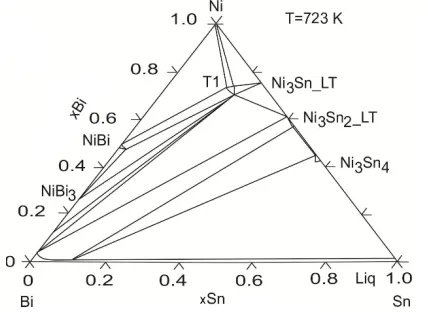
Figure. 1 presents the isothermal section at 723 K including the ternary compound T1 and is in a very good agreement with the experimental data (Vassilev et al. 2009a). In the calculated isothermal section at this temperature the solubility of Sn in NiBi3 and Bi in Ni3Sn_LT phases
did not appear. In the other binary phases, Ni3Sn2_LT, Ni3Sn4 and NiBi the solubility of the third
element was noticed (Vassilev et al. 2009a). Good agreement between the calculated and experimental results connected with the phase equilibria was observed.
Fig. 1. Isothermal section of the system calculated at 723 K
The ternary compound is observed at 903 K and 973 K (Fig. 2 and Fig. 3) but not at 1073 K, hence it can be described as a low temperature phase, which does not exist above 1000 K. The highest temperature, at which the ternary compound exists, is 973 K (Fig. 3), which is supported by both the calculations and the experimental data (Vassilev et al. 2008, 2009a). Figure 2 shows the binary phase fields between Ni3Sn2_HT, Ni3Sn4 and the liquid phase (Vassilev et al. 2009).
Ternary phase equilibria between T1-FCC_A-NiBi and T1-FCC_A1-Ni3Sn_LT appears. Figure 3
Fig. 2. Isothermal section of the system calculated at 903 K
Fig. 3. Isothermal section of the system calculated at 973 K
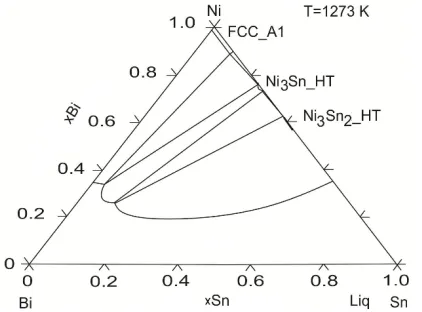
Fig. 4. Isothermal section of the system calculated at 723 K
phases Ni3Sn_HT-Liq-Ni3Sn2_HT and FCC_A1-Liq-Ni3Sn_HT exist. The liquid phase exhibits a
strange shape probably connected with the predicted miscibility gap in the Ni-Sn-Bi ternary system (Milcheva et al. 2011b).
Fig. 5. Liquid phase integral enthalpies of formation at 873 K along cross-sections with xNi equal to: 0.05, 0.07 and 0.1 mole fractions
Figure 5 shows the calculated enthalpies of the liquid phase at 873 K compared with the experimental results (Vassilev et al. 2008). The three points represent the experimental enthalpies of formation (Vassilev et al. 2008) of the three binary nickel intermetallics, the solid, dotted and dashed curves are the calculated enthalpies of formation with different Sn:Bi mole fractions. The solid line corresponds to Sn:Bi=0.51:0.42, the dashed line to Sn:Bi=0.27:0.63 and dotted one to Sn:Bi=0.70:0.27. The calculated enthalpies are slightly more negative than the experimental ones, but a reasonable agreement is observed when the Ni mole fraction is below 0.2 (Vassilev et al. 2008). The experimental and the calculated enthalpies of formation are shown in Table 3.
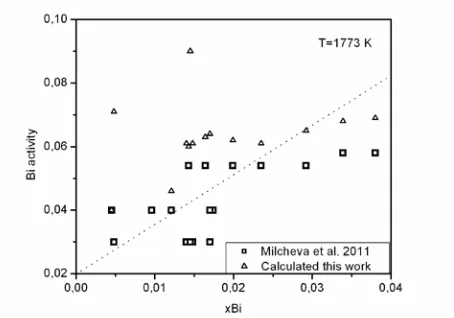
The Bi-activities at 1773 K calculated in this optimization compared with the experimental data (Milcheva et al. 2011b) are presented in Fig. 6. A positive deviation from the ideal behavior is observed.
Table 3. Comparative review of experimental enthalpies (Vassilev et al. 2008) and enthalpies calculated with parameters obtained in this optimization
A liquid phase miscibility gap in the Ni-Sn-Bi ternary system was predicted (Milcheva et al. 2011b), using the binary parameters to calculate the phase diagram only. A miscibility gap at 1610 K on the BiNi side of the phase diagram was confirmed by the current optimization. The ternary parameters for the liquid phase were used during the calculations. A two phase field equilibria between the liquid and an FCC_A1 phase appears at the same temperature.
4. Conclusions
The thermodynamic description of the ternary Ni-Sn-Bi system was performed using the Calphad method. In addition to the binary phases, a ternary compound T1 was included. It is considered non-stoichiometric and was described using the three-sublattice model. The models of some phases (Ni3Sn_LT, Ni3Sn_HT, Ni3Sn2_LT, Ni3Sn2_HT, Ni3Sn4, NiBi and NiBi3) have been
changed in order to comply with the present assessment.
Four ternary isothermal sections were calculated. The obtained results were compared with the experimental results and a reasonable correlation was found. In addition, the enthalpies of formation and Bi-activities were used for calculations. The solubility of the respective third element in two binary systems (Bi in Ni-Sn and Sn in Bi-Ni) were included in the presented optimization.
References
Andersson J, Helander T, Höglund L, Shi P, Sundman B (2002). Thermo-Calc & DIictra, Computational Tools For Materials Science, Calphad, 26, 273-312.
Dinsdale A (1991). SGTE Data for pure elements,Calphad, 15, 317-425.
Dinsdale A, Watson A, Kroupa A, Vrestal J, Zemanova A, Vizdal J (2008). Atlas of Phase Diagrams for the Lead-Free Soldering, COST 531 (Lead-free Solders).
Kang S, Sarkhel A (1994). Lead (Pb)-free solders for electronic packaging, J. Electron. Mater.,
23, 701-707.
Kang S, Rai R, Purushothaman S (1996). Interfacial reactions during soldering with lead–tin eutectic and lead (Pb)-free, tin rich solders, J. Electron. Mater., 25, 1113-1120.
Lee J, Chen S, Chang H, Chen C (2003). Reactive wetting between molten Sn-Bi and Ni substrate, J. Electron. Mater., 32, 117-122.
Liu H, Wang J, Jin Z (2004). Thermodynamic Optimization of the Ni-Sn Binary System,
Calphad, 28, 363-370.
Lukas H, Fries S, Sundman B (2007). Computational Thermodynamics: The Calphad method,
Cambridge University Press, Cambridge, UK.
N xNi xSn xBi T K HMR, exp [Jmol-1]
HMR, calc this work [Jmol-1]
1 0.05 0.70 0.25 873 -1390 -2219 2 0.07 0.51 0.42 873 -1320 -1693
Massalski T (1996). CD ROM: Binary Alloy Phase Diagrams, ASM International, OH, USA.
Milcheva N, Broz P, Burˇsik J, Vassilev G (2011a). Thermochemical and phase diagram studies of the Bi–Ni–Sn system, Thermochimica Acta, 534, 41-50.
Milcheva N, Romanowska J, Vassilev G (2011b). Sn-Ni-Bi liquid phase thermodynamic properties, Cent. Eur. J. Chem., 9, 149-156.
Okamoto H (2012). Bi-Ni. Journal of Phase Equilibria and Diffusion, 33 (6), 492-492.
Seo S, Cho M, Lee H (2007). Thermodynamic Assessment of the Ni-Bi Binary System and Phase Equilibria of the Sn-Bi-Ni Ternary System, Journal of Electronic Materials, 36, 1536-1544.
Schmetterer C, Flandorfe H, Richter K, Saeed U, Kauffman M, Roussel P, Ipser H (2007). A new investigation of the system Ni-Sn, Intermetallics, 15, 869-884.
Vassilev G, Lilova K, Gachon J-C (2007). Supplementary X-ray studies of the Ni-Sn-Bi system,
J. Min. Metall. B, 43, 141-150.
Vassilev G, Lilova K, Gachon J-C (2008). Calorimetric and phase equilibria studies of the Ni-Sn-Bi system, Cryst. Res. Technol., 43, 980-985.
Vassilev G, Lilova K, Gachon J-C (2009a). Phase diagram investigation of the Ni-Sn-Bi system,
J. Alloys Compd., 469, 264-269.
Vassilev G, Milcheva N, Record M, Mancheva R (2012). Diffusion couple studies of the Ni-Bi-Sn system, J. Min. Metall. B, 48, 347-357.
Vassilev G, Gandova V, Docheva P (2009b). Comments and reconciliation of the Ni-Bisystem thermodynamic reassessments, Cryst. Res. Technol., 44, 25-30.
Vizdal J, Braga M, Kroupa A, Richter K, Soares D, Malheiros L, Ferreira J (2007). Thermodynamic assessment of the Bi-Sn-Zn system, Calphad, 31, 438-448.
Zemanova A, Kroupa A, Dinsdale A (2012). Theoretical assessment of the Ni-Sn system,