Identifying Components of Strategic Thinking and
their Role in Improving the Decision-Making
Process for Managers
(Case Study: Organization for the Protection of
Consumers and Producers)
Ali Dehgahi
1, Ebrahim Salari Nahand
2, Heidar Moghni
31. Assistant Professor of Economics, Shahrood University of Technology,[email protected] 2. PhD Candidate, Azad University of Shahrood, [email protected]
3. PhD Candidate, Azad University of Shahrood, [email protected]
ABSTRACT: This paper aims to identify components of strategic thinking that affect the decision-making process and investigate their role in improving the process for managers. A descriptive survey with applied objectives is presented. Following a review of literature pertaining to models of strategic thinking and the decision-making process, six main components of strategic thinking as well as four stages of decision-making are identified, which form the basis for the conceptual model of the study. A questionnaire is used for data collection purposes, whose validity is confirmed by experts. Furthermore, in order to demonstrate instrument reliability, a pretest with 10 participants was conducted. This was followed by the calculation of Cronbach’s alpha, yielding 0.942, which is an acceptable value. The population of the study includes employees of the Organization for the Protection of Consumers and Producers (affiliated to the Iranian Ministry of Industries and Business), of which 73 participants are selected. According to the results, participants believe that components of strategic thinking positively impact the decision-making process. Also, according to Friedman’s test, opportunism and creativity have the largest and smallest rolesin the decision-making process, respectively.
Keywords: strategy, decision-making, strategic thinking
INTRODUCTION
In the twenty-first century, nearly all aspects of the human life are affected by constant change, which forces individuals to continuously adapt to new situations. The business environment is not an exception, where the future is almost impossible to predict due to complex and sudden transformations. In order to survive these circumstances, organizations require competitive advantage, which can only be achieved through strategic thinking. Many leaders and managers believe that appropriate strategies guarantee both survival and success in the market (Iranzadeh et al., 2008: 9).
When faced with problems, processes, events, or situations which are considered to be whole entities, strategists are able to decompose them and determine the significance of each component. Moreover, they possess the ability to rearrange the constituents to obtain maximal benefits (Ohmae, 2002).
This paper attempts to extract features and components of strategic thinking from extant literature in order to present a native model.
Research Problem
The 21st century is characterized by rapid, complex, and sudden changes. The transformations near the end of the 20th century shatteredmany dreams and hopes. These changes occur at a rate that causes dizziness, revolutionizing our lives and careers (Heinz, 2008: 3).
151 while learning this competency. Similar to any skill, strategic thinking requires a deep understanding and tremendous practice before it can be mastered. However, by making an effort to identify the boundaries of strategic thinking a schematic view can be obtained (Stacy, 2010: 11).
Many managers spend a large portion of their time on solving problems and making decisions. Nearly all their activities, including the basic functions of management i.e. setting organizational goals, planning, organizing, leading, and controlling involve decision-making. Furthermore, other activities such as selecting technologies, staffing, and motivating employees require a number of decisions to be made. Managers, regardless of their level, need to make decisions to resolve issues that arise in the organization. Each decision can shape the activities of others in the organization. Thus, decision-making is a sensitive and important activity (Alagheband, 2006: 43).
As evident, strategic thinking is a vital element whose components need to be identified. Moreover, the role of each component has to be determined. This purpose of this study is twofold: (1) identifying the components of strategic thinking and (2) investigating the impact of each component on the decision-making process. In the following section, the objectives of the study are presented.
Objectives
Decision-making is at the core of any management activity. The act of decision-making is so significant that many scholars such as Herbert Simon consider it equal to management. Drucker argues that management is nothing but decision-making. It is also integral in setting organizational policies and goals as well as designing the structure and assessing the activities of the organization. Thus, organizational success is directly impacted by the quality of the decisions made by managers (Alvani, 2010: 199). The ever-changing modern world forces managers to adopt particular attitudes and thoughts, which are emphasized in the literature. Garratt defines strategic thinking as a process through which managers are able to view crises and daily activities from above to have a different perspective of the organization and its environment. According to Stacey, strategic thinking is “using analogies and qualitative similarities to develop creative new ideas” (Iranzadeh et al., 2008: 25).
Based on the preceding arguments regarding the effect of decisions and the speed of change in the modern world, it is paramount that components of strategic thinking be identified so that their impact on decisions can be explored. Therefore, based on prior literature, we aim to analyze the impact of strategic thinking and its components on the decision-making process of managers.
Literature Review Theoretical Background
A. Strategy and Strategic Thinking
The term strategy originates from the Greek work stratēgia, meaning “the art of troop leader”. While commanders are in charge of war strategies, senior managers in companies are tasked with formulating strategies (Ghafarian & Kiani, 2011: 15). According to Britanica, in warfare, strategy is defined as the art of planning and directing operations. Three characteristics differentiate strategies from tactics: (1) larger operational domains, (2) longer durations, and (3) utilization of vast resources (Ghafarian & Emadzadeh, 2006: 40).
In management and organization literature, strategy refers to a model of goals, policies, and operations in the organization that are connected to each other as a whole. If devised properly, strategies can be effective tools for allocation and direction of resources based on the capabilities and potential shortcomings of the organization (Queen et al., 2003: 5).
According to Mintzberg, when the concept of strategy was introduced into management literature in the 1960s, leaders and managers embraced planning and strategic thinking as tools for gaining competitive advantage. Nevertheless, other factors such the post-industrial society, production-based marketing philosophies, intense competition, and uncertain environments influenced this adoption. However, following the failures of large organizations with strategic plans, the foundations of the theory were called into question (Nazemi & Jafariani, 2010: 11-13).
152 which contributed to their acceptance by practitioners. However, due to lack of consensus, they were not successful in academic contexts (Ghafarian & Emadzadeh, 2006: 88-89).
Subsequent to the arrival of the new theories, strategic thinking was introduced as a modern approach to planning and strategic management. This is because the classic approach was unable to meet the needs of modern businesses (Nazemi & Jafariani, 2010: 14).
Strategic thinking is part of the descriptive school of thought which, instead of prescribing procedures and methodologies, attempts to describe the approach to be taken. A number of models have been proposed for strategic thinking, each of which tend to certain dimensions of the concept and process of strategic thinking (Ghafarian & Kiani, 2010: 73).
Handford (1995) conducted one of the first and most influential studies on strategic thinking. He identified eight characteristics to differentiate strategic and operational thinking, as shown in Table 1.
Table 1- Distinct characteristics of strategic and operational thinking
Strategic Thinking Operational Thinking
Long-term Immediate and short-term
Conceptual Objective
Learning/ reflective Action-oriented/ practical
Identification of opportunities and strategic
issues Resolving current issues
Moving towards new contexts Current contexts
Effectiveness Efficiency
Mental View Manual View
Helicopter View Context (Partial View)
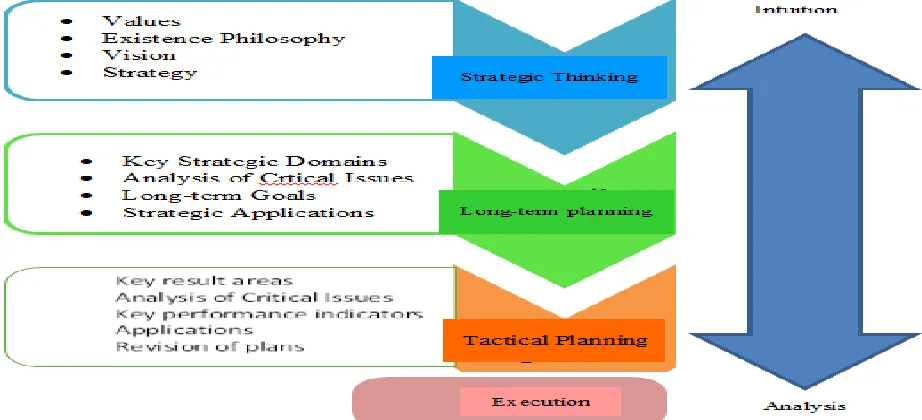
Morrissey (1995) divides the planning process into three complementary stages, as shown in Fig.1, to create strategic thinking. In his work, it is argued that if one does not know where one is going, no path will lead to the destination. This kind of thinking, which helps managers in different situations, originates from the Holy Quran (Iranzadeh et al., 2008: 35).
153 In 1998, Mintzberg’s theory on strategic thinking was developed into a conceptual model by Liedtka (Ghafarian & Kiani, 2001: 74). The proposed model combined Mintzberg and Handford’s models to illustrate the concept of strategic thinking (Nazemi & Jafariani, 2010: 41).
In the model, five central elements that distinguish strategic thinking are explored:
Systems perspective: A strategic thinker needs to have a model of the value generating system and understand how the components are connected. Despite having separate and various components, strategy is a holistic and integrated approach.
Intent focused: Organizational resources (staff, technologies, energy, etc.) must be directed toward achieving strategic organizational goals. This prevents misdirection and moves the organization toward its goals.
Intelligent opportunism: Novel ideas are always welcome in strategic thinking. This creates a number of strategic options and facilitates the realization of strategies. Identifying and exploiting opportunities is a necessity in strategic thinking.
Thinking in time: Strategic thinkers are able to review and understand the connection between the past, present, and future. According to Liedtka, the past guides what the organization achieves in the present. Thus, the future is formed based on the past. Success of the organization depends on its past activities.
Hypothesis-driven: In the modern world, which is filled with unlimited information, the ability to develop and test hypotheses is an important ability which helps organization achieve their goals. This reveals a distinction between strategic thinking versus strategic planning. Using a sequence of “what-if” and “if-then” statements, an effective link between creative synthesis (developing hypotheses) and analytical tools (testing hypotheses) is established.
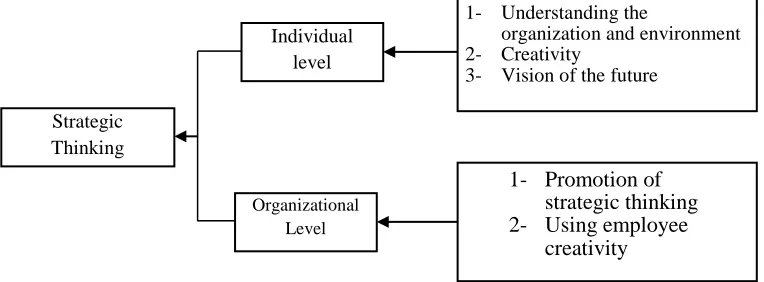
Bonn investigates strategic thinking at individual and organizational levels, which are interconnected. He argues that establishing strategic thinking in these two levels creates a core competency for organizations, which is a source of competitive advantage (Iranzadeh et al., 2008: 37). Fig.2 presents Bonn’s model.
Fig. 2 – Bonn’s model of strategic thinking
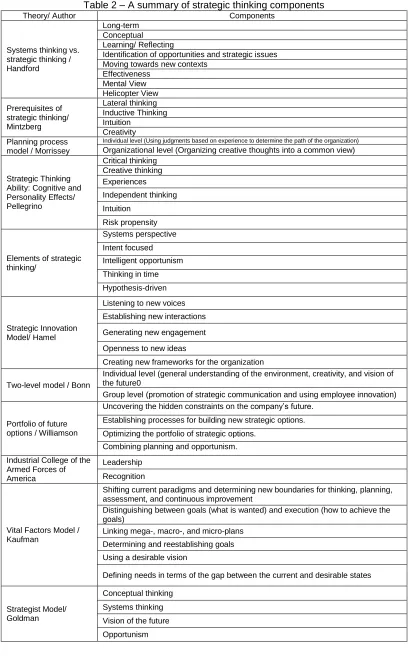
The most recent study on the matter dates back to 2005, in which becoming a strategic thinker was studied by Goldman. The author discusses how strategic thinking can be developed in executive managers in health organizations. A taxonomy of Mintzberg, Liedtka, and Handford’s theories are presented which identifies four factors for strategic thinking: conceptual thinking, system thinking, vision of the future, and opportunism. The most important aspect of the study is the integration of previous models into a comprehensive model. Although a vision of the future appears as a new concept, it is in fact referred as long-term thinking by Liedtka and Handford (Nazemi & Jafariani, 2010: 42-43). Table 2 summarizes components of strategic thinking identified by various scholars.
Strategic Thinking
Individual level
Organizational Level
1- Understanding the
organization and environment 2- Creativity
3- Vision of the future
1- Promotion of
strategic thinking
2- Using employee
154 Table 2 – A summary of strategic thinking components
Theory/ Author Components
Systems thinking vs. strategic thinking / Handford
Long-term Conceptual Learning/ Reflecting
Identification of opportunities and strategic issues Moving towards new contexts
Effectiveness Mental View Helicopter View
Prerequisites of strategic thinking/ Mintzberg
Lateral thinking Inductive Thinking Intuition
Creativity Planning process
model / Morrissey
Individual level (Using judgments based on experience to determine the path of the organization) Organizational level (Organizing creative thoughts into a common view)
Strategic Thinking Ability: Cognitive and Personality Effects/ Pellegrino
Critical thinking Creative thinking Experiences
Independent thinking
Intuition
Risk propensity
Elements of strategic thinking/
Systems perspective
Intent focused
Intelligent opportunism
Thinking in time
Hypothesis-driven
Strategic Innovation Model/ Hamel
Listening to new voices
Establishing new interactions
Generating new engagement
Openness to new ideas
Creating new frameworks for the organization
Two-level model / Bonn
Individual level (general understanding of the environment, creativity, and vision of the future0
Group level (promotion of strategic communication and using employee innovation)
Portfolio of future options / Williamson
Uncovering the hidden constraints on the company’s future.
Establishing processes for building new strategic options.
Optimizing the portfolio of strategic options.
Combining planning and opportunism.
Industrial College of the Armed Forces of America
Leadership
Recognition
Vital Factors Model / Kaufman
Shifting current paradigms and determining new boundaries for thinking, planning, assessment, and continuous improvement
Distinguishing between goals (what is wanted) and execution (how to achieve the goals)
Linking mega-, macro-, and micro-plans
Determining and reestablishing goals
Using a desirable vision
Defining needs in terms of the gap between the current and desirable states
Strategist Model/ Goldman
Conceptual thinking
Systems thinking
Vision of the future
155
B. Decision-making
Growth, development, and success in organizations are rooted in the decisions made by the managers. Executives are in charge of making decisions that are paramount to achievement of organizational goals (Sarafrazi et al., 2010: 2).
Decision-making is a complex process which involves a network of previous decisions. The nature of this process makes it very hard to predict the outcome of a decision (Abbaspour, 2006: 2). Strategic thinking aids managers with retaining competitive advantage for their organization. Successful firms are those who are able to identify their major opportunities through strategic thinking. Without a doubt, any successful organization has some degree of strategic thinking (Ghafarian, & Doustmohammadian, 2010: 2).
The decision-making process involves selecting from a number of alternatives. A decision is a self-aware choice which allows a person to evaluate a set of alternatives based on one’s thinking and the situation to choose the most desirable option. Once an alternative is chosen, the decision is made. Decision-making cannot be avoided since this is a decision in and of itself (Abbaszadegan, 2002: 41).
Barnard maintains that decision-making is the principal function in management, which is revealed in the quality of services and efficiency of tasks in the organization. Newman believes that quality of management is a function of the quality of decisions by the manager because quality of programs, efficiency and effectiveness of strategies, and quality of outcomes are all dependent on the quality of decisions made by the manager (Gholipour, 2010: 2).
Put simply, decision-making refers to achieving the solution to a problem. This is a selection which is followed by the outcome of a situation. A decision presents a behavior or action regarding “what must and must not be done”. Decision-making is a process, the outcome of which is referred to as a decision (Alagheband, 2006: 43-44).
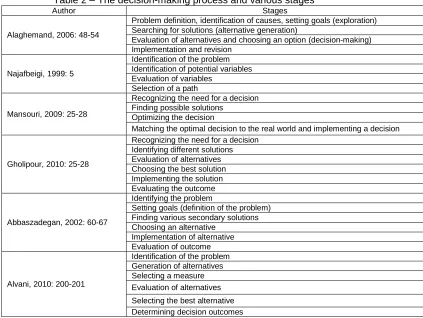
A large body of literature has been devoted to describing the stages of decision-making. The presented models and theories share common elements and logic. Table 2 summarizes the main theories on the process and stages of decision-making.
Table 2 – The decision-making process and various stages Stages Author
Problem definition, identification of causes, setting goals (exploration)
Alaghemand, 2006: 48-54 Searching for solutions (alternative generation)
Evaluation of alternatives and choosing an option (decision-making) Implementation and revision
Identification of the problem
Najafbeigi, 1999: 5 Identification of potential variables Evaluation of variables
Selection of a path
Recognizing the need for a decision
Mansouri, 2009: 25-28 Finding possible solutions Optimizing the decision
Matching the optimal decision to the real world and implementing a decision Recognizing the need for a decision
Gholipour, 2010: 25-28
Identifying different solutions Evaluation of alternatives Choosing the best solution Implementing the solution Evaluating the outcome Identifying the problem
Abbaszadegan, 2002: 60-67
Setting goals (definition of the problem) Finding various secondary solutions Choosing an alternative
Implementation of alternative Evaluation of outcome Identification of the problem
Alvani, 2010: 200-201
Generation of alternatives Selecting a measure Evaluation of alternatives
156
Empirical Background
In our review of literature on strategic thinking in Iran, a model, two sets of guidelines, and a number of dissertations were identified. In the following a summary of the efforts is presented:
In their book, Nazemi and Jafariani (2010) reviewed previous models on strategic thinking to present a model with six components: vision of the future, opportunism, recognition, transformational leadership, conceptual thinking, and systems perspective.
Ghafarian and Kiani present five guidelines for strategic thinking known as the “five strategic thinking commands”.
Lashkar Bolouki (2011) created another set of guidelines known as the “ten strategic thinking commands”.
A thesis by Tajri in University of Tehran considered the components of strategic thinking in Cultural Heritage, Handcrafts and Tourism Organization in the Province of Qom.
“Strategic Thinking Abilities of Tehran Municipality Managers” was studied by Shahmatnezhad in her thesis on the topic.
Moshabaki and Khazaei proposed a model on the elements of strategic thinking in Iranian organizations, which was published in the Journal of Business Administration.
Conceptual Model
Subsequent to the review of literature, six components of strategic thinking were chosen: “application of novel ideas”, “opportunism”, “creativity”, “systems thinking”, “thinking in time”, and “effectiveness”. Furthermore, four stages were considered four the decision-making process: “identification of problems”, “finding possible solutions”, “choosing the best alternative”, and “evaluation of the solution”. Accordingly, the conceptual model of the study is presented in Fig.3.
METHODOLOGY
A. Typology
This study is a descriptive (non-experimental) field survey in terms of methods. Moreover, the study has practical goals because it aims to improve strategic thinking abilities in the statistical population. A study can be considered practical once it aims to resolve an issue in an organization. Practical studies normally focus on the most effective practices while ignoring root causes. This is largely because practical studies are directed towards application of knowledge (Khaki, 2007: 106).
Decision-making Process
Identification of problems
Finding possible solutions
Choosing the best alternative
Evaluation of the solution
Strategic Thinking
Application of
novel ideas Opportunism Creativity
Systems thinking
Thinking
in time Effectiveness
157
B. Statistical Population
Since the authors were not able to contact senior executives of the organization under study, the population includes mid-level and operational managers at the Organization for the Protection of Consumers and Producers. A total of 90 individuals were considered. According to Cochran’s formula, a sample of 73 participant was deemed sufficient. The participants completed the questionnaire of the study.
Three distinct characteristics were considered for choosing the population: (1) organizational position; (2) having at least an Associate’s degree; and (3) being tasked with making decisions.
C. Time and Place
The study was conducted in the Organization for the Protection of Consumers and Producers, which is affiliated to the Iranian Ministry of Industries and Business. The required data were collected in analyzed in January and February of 2011.
D. Validity and Reliability
A valid instrument exactly measures the variables that are intended to be studied (Hafeznia, 2010: 182). In order to confirm validity of the study, 20 dimensions were initially considered and a questionnaire was distributed among 17 experts in the field, who were asked to judge the relevance of the dimensions. Upon analysis of the opinions, the number of dimensions was reduced to 14 and several other modifications were made. The modified questionnaire was then given to 10 other experts who confirmed its content validity.
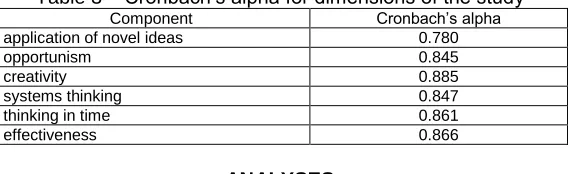
Reliability is defined as “homogeneity of recurrent measurements” (Bieker, 2009: 92). In order to test the reliability of the study, Cronbach’s alpha was calculated yielding 0.942, which an acceptable value. The obtained values for each of dimension of the study are presented in Table 3.
Table 3 – Cronbach’s alpha for dimensions of the study
Component Cronbach’s alpha
application of novel ideas 0.780
opportunism 0.845
creativity 0.885
systems thinking 0.847
thinking in time 0.861
effectiveness 0.866
ANALYSES
The collected data were analyzed using both descriptive and inferential statistics methods. The operations were carried out using SPSS 19.0 and Microsoft Excel 2010 software packages.
A. Descriptive Statistics
First, we introduce the sample with regard to demographic characteristics such as age and gender. Table 4 shows a summary of the demographics of the population.
Table 4 – Demographic characteristics of the population
Variable Categories Frequency Frequency Distribution
Gender Female 14 19.2
Male 59 80.8
Degree
Associate’s 10 13.7
Bachelor’s 47 64.4
Master’s 16 21.9
Age
Under 30 13 17.8
30-40 44 60.3
40-50 11 15.1
Over 50 5 6.8
Tenure
Under 5 years 11 15.1
5-10 years 21 28.8
10-15 years 22 30.1
Over 15 years 19 26.0
Position
Department head 60 82.2
Chief 6 8.2
158
B. Inferential Statistics and Hypothesis Test
The hypotheses of this study are in the following format:
Variable X (strategic thinking component) improves stage Y of the decision-making process.
Based on the five-point Likert scale of the study, averages greater than 3 indicate that the considered variable impacts improvement in the considered stage of the decision-making process. Table 5, presents the findings.
Table 5 – Hypothesis test results
D e s c ript ion Hypothesis A v e ra g e S t. D e v iat ion T D e g re e o f Fr e e d o m S ig. V a lue S ta tu s
H1 Application of new ideas directly impacts
Identification of problems 3.79 0.61 11.00 72 0.000 Supported
H2 Application of new ideas directly impacts finding possible solutions 3.77 0.69 9.53 72 0.000 Supported
H3 Application of new ideas directly impacts
Choosing the best alternative 3.83 0.63 11.23 72 0.000 Supported
H4 Application of new ideas directly impacts evaluation of the solution 3.73 0.71 8.85 72 0.000 Supported
H5 Opportunism directly impacts Identification of problems 3.94 0.61 13.10 72 0.000 Supported
H6 Opportunism directly impacts finding possible
solutions 3.90 0.66 11.59 72 0.000 Supported
H7 Opportunism directly impacts Choosing the
best alternative 3.90 0.68 11.33 72 0.000 Supported
H8 Opportunism directly impacts evaluation of
the solution 3.77 0.65 10.24 72 0.000 Supported
H9 Creativity directly impacts Identification of
problems 3.64 0.63 6.26 72 0.000 Supported
H10 Creativity directly impacts finding possible
solutions 3.64 0.61 6.35 72 0.000 Supported
H11 Creativity directly impacts Choosing the best alternative 3.42 0.66 5.41 72 0.000 Supported
H12 Creativity directly impacts evaluation of the
solution 3.38 0.71 4.61 72 0.000 Supported
H13 Systems thinkingdirectly impacts
Identification of problems 3.49 0.85 4.89 72 0.000 Supported
H14 Systems thinkingdirectly impacts finding
possible solutions 3.54 0.70 6.64 72 0.000 Supported
H15 Systems thinkingdirectly impacts Choosing
the best alternative 3.47 0.72 5.50 72 0.000 Supported
H16 Systems thinkingdirectly impacts evaluation
of the solution 3.47 0.80 5.05 72 0.000 Supported
H17 Thinking in time directly impacts Identification
of problems 3.84 0.69 10.31 72 0.000 Supported
H18 Thinking in time directly impacts finding
possible solutions 3.82 0.75 9.40 72 0.000 Supported
H19 Thinking in time directly impacts Choosing
the best alternative 3.80 0.78 8.77 72 0.000 Supported
H20 Thinking in time directly impacts evaluation of the solution 3.75 0.80 8.05 72 0.000 Supported
H21 Effectiveness directly impacts Identification of
problems 3.79 0.75 9.06 72 0.000 Supported
H22 Effectiveness directly impacts finding
possible solutions 3.88 0.70 10.68 72 0.000 Supported
H23 Effectiveness directly impacts Choosing the
best alternative 3.82 0.80 8.82 72 0.000 Supported
H24 Effectiveness directly impacts evaluation of
the solution 3.78 0.79 8.49 72 0.000 Supported
Main Strategic thinking positively impacts the
159
FINDINGS
According to Table 5, the significance value for all the hypotheses is smaller than 0.01; thus, with 99 percent confidence, H0 is rejected. Since all average values are greater than 3, it is confirmed that all components of strategic thinking impact the stages of the decision-making process.
Next, we address the issue of finding the component with the highest impact. In other words, we seek to rate the impact of each factor. Since the answers were dependent, Friedman’s non-parametric test was used for comparison purposes. The results are shown in Table 6.
Table 6 – Results of Friedman’s test
Component
D
e
g
re
e
o
f
Fr
e
e
d
o
m
2
χ Sig.
A
v
e
ra
g
e
R
a
n
k
R
e
lev
a
n
c
e
Opportunism
5 37.7 0.000
4.18 Most
Effectiveness 3.85
Thinking in time 3.71
Application of new ideas 3.67
Systems thinking 2.97
Creativity 2.62 Least
According to Table 6, the significance value for all the components is smaller than 0.01; thus, with 99 percent confidence, components of strategic thinking have different impacts on the decision-making process, with opportunism and creativity being the most and the least relevant components.
Conclusion and Recommendations for Future Works
In this study, a survey of literature was conducted to identify components of strategic thinking as well as the stages of the decision-making process. Based on the findings, the conceptual model of the study was presented and tested based in a population of 90 executive managers. The components were finally ranked in terms of their impact on the decision-making process. In order to improve strategic thinking and the decision-making process, the following are hypothesized:
Development of performance appraisal systems to allow managers to determine the impacts of the decisions on the success or failure of the organizations.
Due to the significance of strategic thinking, training managers in this area can play a major role in improving the decision-making process. Training programs can be helpful in this regard; however, in addition to technical knowledge, they need to enhance managers’ abilities to have a vision of the future.
Decision-making is an important aspect of organizations. Furthermore, our findings indicate that components of strategic thinking positively impact the decision-making process. Thus, enhancing strategic thinking abilities in organizations may lead to improved performance.
The findings revealed that strategic thinking is a process which penetrates the operational levels of the organization. This is in contrast to the popular belief that “strategic thinking is only appropriate for high-level managers”. Therefore, improving the quality of thinking in any level of the organization will lead to creativity and audacity.
160
REFERENCES
1. Abbaspour A., (2003), Decision-making in Management: In Search of Understanding Decision-making Models and Paradigms, Journal of Management Excellence, 2(1), pp.55-29.
2. Abbaszadegan S.M., (2002), Decision-making in Executive Management, Tehran: Sahami Publications, 2nd Print.
3. Alaghemand A., (2006), Public Administration, Tehran: Ravan Publicatios, 14th Print. 4. Alvani, M., (2010), Public Aministration, Tehran: Nay Publications, 39th Print. 5. Andrews, K, R. (1971). The Concept of Core Strategy, Homewood, IL: Irwin
6. Bonn, I. (2001). “Developing Strategic Thinking As A core Competency”, Management decision, Vol.39/1
7. Chandler, A.D., Strategy and Structure: Chapters in the History of the Industrial Enterprise, Mass.: M.I.T. Press, 1962 8. David G, Band and Gerald Scanlan. (1995). Strategic control through Core Competencies, Long Range Planning, Vol 28,
No 2, Britain
9. Debono, E. (1979). “Lateral Thinking “, Schumacher UK Bristol Lecture, Available At: www. Schumacher.org.uk
10. Ghafarian V., Doustmohammadi S., (2010), Identiying the Components of Strategic Thinking in an Iranian Company, Management Selection Magazine, 11(104), pp.70-81.
11. Ghafarian V., Emadzadeh M., (2006), Emerging Concepts in Strategy, Tehran: Industrial Management Organization, 2nd Print.
12. Ghafarian, V., Kiani G.R. (2010), Five Commands of Strategic Thinking, Tehran: Fara Cultural Organization, 4th Print. 13. Gholipour, R. (2010), Organizational Decision-making and Public Policy, Tehran: Organization of Social Sciences
Textbooks (Samt Publications), 2nd Print.
14. Heinz S.J., (2008) Systems Thinking Approach to Strategic Planning and Management, Translated by Aslan R., Tehran: Nay Publications. 1st Print.
15. Heraclius, L. (1998). Strategic thinking or strategic planning? Long Range Planning, 31(3): pp481-487. 16. Iranzadeh S., Sabahi E., Amari H., (2008), Strategic Thinking. Tabriz: Forouzesh Publications. 1st Print.
17. Kaufman, R. & Etal. (2003). Strategic Planning For Success (Aligning People, Performance And Pay Offs)”, Hard Cover. 18. Khaki G.R., (2007), Research Methods: A Dissertations Approach, Tehran, Baztab Publications.
19. Lindgren, Mats and Bandhold, Hans. (2003). “Scenario Planning; the Link between Future and Strategy, McMillan, UK 20. Mansouri M.M., (1999), The Decision-making Algorithm, Tehran: Public Administration Training Center.
21. Morrisey, G. (1996). “A Guide To Strategic Thinking (Building Your Planning Foundation) “, Hard Cover.
22. Najafbeigi, R., (1999), Decision-making: The Hardest Part of Management, Tehran: Public Administration Training Center. 23. Nazemi S., Jafarian H., (2010), Strategic Thinking, Tehran: Industrial Management Organization, 1st Print.
24. Ohmae. K., (1992), The Mind of the Strategist, Translated by Mesgarian, H., Tehran: Industrial Management Organization, 1st Print.
25. Queen B., Mintzberg H., Robert J.M., (2003), Strategic Thinking, Translated by Saebi M., Institute of Management Education and Research, 3rd Print.
26. Robbins, Stephen P. Management, 3rd edition, Prentice-Hall, 1991
27. Sanford Labovits, "Some Observation on Measurment and Statistics", Social Forces, 46 (Dec. 1967): pp 51-160.
28. Sanford Labovits, "The Assignment of Numbers to Rank Order Categories, “American Sociological Reviwe", 35 (June 1970): pp 515-524.
29. Sarafrazi M., Sepehrnia R., Kavousi E., (2010), The Impact of Creativity on Managers’ Decisions: A Case Study, Innovation in Social Sciences Quarterly, 1(1), pp.85-97.
30. Sekaran, U., (2007), Research Methods in Management, Translated by Saebi M., Shirazi M., Tehran: Institute of Higher Education in Management and Planning
31. Simon, H A. (1993). “Decision making: rational, norrational, and irrational”, Educational Administration Quarterly, Vol 29: pp 392-411.
32. Stacey R., (2010), Strategic Thinking and Change Management, Translated by Kazemi M., Tehran: Rasa Publications, 3rd Print.
33. Tarter, J C and Hoy, W K. (1996). Toward a Contingency. Theory of decision making, Journal of Educational Administration, Vol 36, No 3, pp 212-228.