The Brachiopods of Bahram Formation in Southwest
of Damghan (Shorab Section)
Mohammad Reza Kebriaizadeh, Saeedeh Najaflou*
Department of Geology, Payam Noor University, Iran
Corresponding author: [email protected]
ABSTRACT :The Shorab Section is 45 km away from southwest of Damghan. The Bahram Formation in this section is uninterruptedly situated on the Padeha Formation with mid-Devonian age. The Jamal Formation with Permian age covers the Bahram Formation in a fragmented manner. The Bahram Formation is 96 m thick in Shorab Section. From lithological perspective, it is mostly composed of limestone and maronite limestone which includes numerous fossils of brachiopods. The study of brachiopods of Bahram Formation in this section led to identification of the some taksa brachiopods such as Devonoproductussp, Productellasubaculeata, Cyphoterorhynchuskoraghensisinterposittus, Cyphoterorhynchuskoraghensis, Ripidiorhynchuselburzensis, Ripidiorhynchuskermanensis, Paropamisrhynchuskotalensis, Athyrischitralensis, Athyris sp., Spinatrypina cf. bodoni, Tenticospirifer cf. tenticulum, Cyrtospiriferverneuili, Cyrtospiriferschelonicus, Cyrtospirifer sp., Uchtospirifermultiplicatus, Uchtospirifermultiplicatus minor, and Rigauxiahutkensis. Due to the biostratigraphic significance of brachiopods, the age of Bahram Formation in FrasnianShorab Section should be defined.
Keywords:Bahram Formation, Shorab Section, brachiopods,Frasnian, biostratigraphy
INTRODUCTION
The Brachiopods of Bahram Formation in Southwest of Damghan (Shorab Section)
The pattern section of Bahram Formation in Sare-Takhte Bahram Mountain of Ozbak-Kuh region was introduced by Ruttner et al. in 1986. The control section of this formation is located in Shotori Mountains (south and southeast of Tabas) which includes few hundred meters of well-layered grey limestone with some mid-layers of shale, sandstone and dolomite. The top and bottom boundaries of this section are continuously aligned with Shishto and Sibzar formations (Alavi-Naini, 1993). The limestone of this formation has numerous fossils of brachiopods, clams, sponges, corals, preziosa, ostracode, conodonts, and the remains of fish and palynomorphs among which the brachiopods and the algae are dominant. Apart from the section pattern, the types of limestone found in Bahram Formation with similar stone facies of the section pattern were also reported in some other regions such as Khor, Anarak, Torod, Jam, Semnan, Damghan, Binalood, Gonabad, Taibad, Khaf, Ferdos and Aghlid (Alavi-Naini, 1993). The equivalents of Bahram Formation in Alborz zone is all or parts of Mola, Jirood and Khosh-Yailagh formations. In Zagros zone, the Zakin Formation is the equivalent of Bahram Formation (Agha-Nabati, 2005).
Literature Review
43
General Geology and Lithostratigraphy
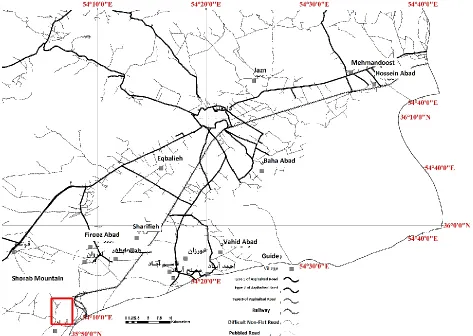
The Shorab Section is 45 km away from southwest of Damghan and in the altitude of 1638 meters above the sea level. The geographical coordinates of this section show that its longitude and latitude are respectively 54 ˚07´27, 7´´ east and 35˚51´28, 2´´ north. In addition, the Shorab Section is located in the geological map 1: 100,000 of Manad (Eghlimi, 2001; Fig 1). The best way to access this section is the asphalted road of Damghan-Semnan which after travelling for 22 km towards Amirieh City, we should change direction to pass from Abdollah-Abad and Amrovan villages in parallel to the railway line. The intended section is 12 km along this pathway (Fig 2).
From structural viewpoint, the Shorab Section is an anticline with northern-southern orientation the nucleus of which constitutes Bahram Formation. The sequences equivalent with Padeha Formation are located at the base of Shorab Section with the thickness of 110 meters. From lithological viewpoint, this formation is made of an alternation of sandstone, dolomite, shale and horizons of gypsum. In addition, the volcanic unites of andesite and basalt with pyroxene are the other constituents of Padeha Formation in Shorab Section.
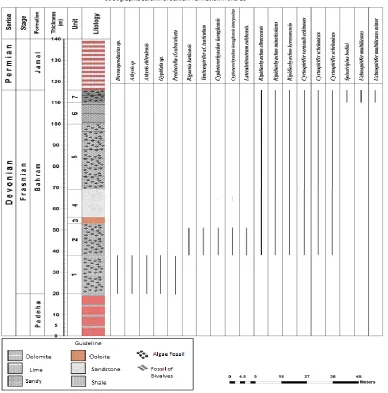
On the Padeha Formation, the equivalent deposits of Bahram Formation have similar slope and construction (Fig 3) so that the sandstones at the head of Padeha Formation change into calcareous sandstone, sandy limestone, and fossiliferous limestone at the base of Bahram Formation. The thickness of Bahram Formation in Shorab Section amounts to 96m and its lithology from the base to the head includes the following 7 lithostratigraphic units (Fig 4):
Unit 1-18 meters of limestone with low to medium thickness of fossiliferous layer Unit 2-15 meters of clay limestone and sandy limestone in a fossiliferous layer Unit 3-3 meters of dolorite flood
Unit 4-13 meters of mid-layer quartz-included sandstone Unit 5-31 meters of fossiliferous mid-layer sandy limestone Unit 6-10 meters of grey dolomite
Unit 7-16 meters of fossiliferous thin layer
Biostratigraphy
As mentioned in the lithostratigraphic description, the lithological units 1, 2, 5, and 7 include fossils of brachiopods. To study themsystematically, 200 samples were collected in a systematic and orderly manner. The study of these brachiopods led to identification of 17 genus and 17 species as the detailed in the following.
The brachiopods of unit 1 include Devonoproductus sp., Productella cf. subaculeata (Murchison, 1840), Athyrischitralensis, Athyris sp. The brachiopods of unit 2 include Paropamisorhynchuskotalensis (Brice, 1970), Cyphoterorhynchuskoraghensis (Reed, 1922), Cyphoterorhynchuskoraghensiinterpositus(Sartenar, 1966), Ripidiorhynchuselburzensis (Gaetani, 1965) Rigauxiahutkensis(Brice 1999), Tenticospirifer cf. tenticulum. In regard to unit 5, the brachiopods include Paropamisorhynchuskotalensis (Brice 1970), Cyphoterorhynchuskoraghensiinterpositus(Sartenar 1966), Cyphoterorhynchuskoraghensis (Reed 1922), Cyrtospiriferverneuili, Cyrtospirifer sp. The brachiopods of the unit 7 include Spinatrypina cf. Bodoni, Uchtospirifermultiplicatus, Uchtospirifermultiplicatus minor, Cyrtospiriferschelonicus(Nalivkin, 1941), Cyrtospiriferverneuili, ,Cyrtospirifer sp.
Due to their biostratigraphical significance, these brachiopods constitute a Frasnian age range for the Bahram Formation in Shorab Section. The Bahram Formation is covered by a boundary of erosive and fragmented type of Jamal Formation (Fig3).
CONCLUSION
44 Figure 1.Geological map of mabad and location of Shorab section
45 Figure 3.A view of boundaries of Bahram formation, Padehaformation and Jamal formation
46
Agha-Nabati A. 2005.Geology of Iran.Iranian Organization of Geological and Mineral Exploration, 586. Alavi-Naini M. 1993.Paleozoic stratigraphy.Iranian Organization of Geological and Mineral Exploration. Brice D. 1977.Biostratigraphie du Devonian d Afghanistan, Mem. H. Ser. Soc. Geol. France, 8,267 - 279.
Brice D.1970. Etude paleontologiqueetstratigraphique du Devonian de L Afghanistan, Contribution A La connaissance des brachiopods et des polypiersrugueux, 364.
Eghlimi B. 2001. Geological Map of Mabad (1: 100,000).Iranian Organization of Geological and Mineral Exploration.