Volume-7 Issue-1
International Journal of Intellectual Advancements
and Research in Engineering Computations
A comparative study of refined oils with oils extracted by traditional
methods with reference to erode district consumers
Prof. N. Devaraj, V. Preethi
Associate Professor and Head /MBA, Nandha Engineering College (Autonomous)
2
ndMBA Nandha Engineering College
ABSTRACT
Physicochemical properties like density, viscosity, boiling point, saponification value (SV), iodine value (IV),and peroxide value (PV) of Corn and Mustard oils were studied to evaluate the compositional quality of oils and also to investigate the effect on the use of same oil for r epeated frying as it ultimately changes the physicochemical, nutritional and sensory properties of the oil. FT -IR spectroscopy was used to evaluate the degree of oxidation after heating and frying processes. Results revealed that due to the temperature cha nge in the oil there is a notable difference in the spectral band which showed that the proportions of the fatty acids were changed.
INTRODUCTION
Lipids and triacylglycerol naturally occur in oils and fats. Their chemical composition contains saturated and unsaturated fatty acids and glycerines. Edible oils are vital constituents of our daily diet, which provide energy, essential fatty acids and serve as a carrier of fat soluble vitamins. Corn oil which is obtained from seeds of Zea mays is an important component usually used as food and also as a vehicle in certain pharmaceutical formulations such as in suspensions and emulsions. Mustard oil from Brassica nigra has 30 per cent protein, calcium, phytins, phenolics and natural anti-oxidants. Mustard oil contains a high amount of mono-unsaturated fatty acids and a good ratio of polyunsaturated fatty acids, which is good for the heart. Mustard oil contains the least amount of saturated fatty acids, making it safe for heart patients. Different physical and chemical parameters of edible oil were used to monitor the compositional quality of oils. The aim of the present study is the quantitative analysis ofthe properties of Mustard and Corn oils and the effect of temperatureon the properties of oils after
heating and frying with carbohydrate using potato pieces and also the use of same oil for frying three times to check the changes in oil quality. Changes in the physicochemical properties of oils are also analysed by FT-IR analysis to evaluate the degree of oxidation after heating and frying.
STATEMENT OF THE PROBLEM
Wooden oil is now being adopted by people and is used in the preparation of all kind of foods. The question is why we are changing in the pure nature of nature. All activities are possible only if our body is good at the present time of the arrival of the body, which is the basis of the fact that this is the fact that there are all the necessary nutrients in the body [1].
OBJECTIVES OF THE STUDY
1. To identify the Demographic profile of the respondents.
2. To identify the health hazards on using inorganic oils.
SCOPE OF THE STUDY
This study helps to forecast the benefits of the organic oils.
This study shows the health hazards in refined oils.
This study helps us to know about the factors influencing of using organic oils [2].
LIMITATIONS OF THE STUDY
The main purpose of the study to examine the comparative study of refined oils with oils extractive traditional method.
LITERATURE REVIEW
Deep frying is one of the most common methods used for the preparation of food. Repeated frying causes several oxidative and thermal reactions which results in change in the physicochemical, nutritional and sensory properties of the oil.
Consumption of repeatedly heated cooking oil (RHCO) has been a regular practice without knowing the harmful effects of use. The present study is based on the hypothesis that, heating of edible oils to their boiling points results in the formation of free radicals that cause oxidative stress and induce damage eat the cellular and molecular levels.
Exposing the oil samples to various heating times and microwave oven power levels caused some hydrolysis to free fatty acids and accelerated the formation of hydro peroxides and secondary oxidation products.
RESEARCH METHODOLOGY
Research design
A Master plan that specifies the method and procedures for collecting and analysing needed information.
Descriptive research
Descriptive research design is used for the study, it is a fact finding investigation with adequate interpretation.
Sample design
Sampling is the process of selecting a sufficient number of elements from the population. A Sample Design is a definite plan for obtaining a sample from the sampling frame. It refers to the technique or the procedure the researcher would adopt in selecting some sampling units from which inferences about the population is drawn.
Non probability sampling
Non-Probability Sampling is a sampling technique where the samples are gathered in a process that does not give all the individuals in the population equal chances of being selected.
Cluster sampling
A cluster sampling refers to a type of sampling method. With cluster sampling, the researcher divides the population into separate groups, called cluster [3].
Size of the sample
The sample size is 100.
DATA COLLECTION METHOD
Primary data
These are data which are collected for the first time directly by the Researcher for the Specific study undertaken by researcher. In this research primary data are collected directly from the Respondent by using Questionnaire.
Secondary data
These are data which are already collected and used by someone preciously. In this research review of Literature, Details of the industry are collected from the Internet.
STATISTICAL TOOLS USED
To analyse and interpret collected data the following simple percentage and ranking were used.
Simple percentage analysis
Formula
Percentage analysis = (No. of respondents/ Total no. of respondents) x100
Hentry garratt ranking
Garrett’s ranking technique to find out the most significant factor which influences the respondents; Garrett’s ranking technique was used. As per this method, respondents have been asked to assign the rank for all factors and the outcomes
of such ranking have been converted into score value with the help of the following formula: Percent Position = 100 (Rij – 0.5) Nj
Where Rij = Rank given for the ith variable by jth respondents
Nj= Number of variable ranked by j th
respondents.
DATA ANALYSIS
The Respondents participated in the research are from diversified background with gender, age group, marital status and educational qualification, height, weight.
Table no 1: Demographic profile of the respondents
Details of the respondents No. of the respondents Percentage
Gender
Male 24 24
Female 76 76
Total 100 100
Age
20-25 yrs 03 03
25-30 yrs 21 21
30-35 yrs 36 36
Above 35 yrs 40 40
Total 100 100
Educational qualification
School 20 20
UG 30 30
PG 29 29
Un educate 21 21
Total 100 100
Occupation
Private 27 27
Gvt 13 13
Business 30 30
Others 30 30
Total 100 100
Time a day do you cook
Once 0 0
Twice 65 65
Thrice 35 35
Total 100 100
Oil usage per month 2 Lt 17 17
3 Lt 44 44
Above 3 Lt 34 34
Total 100 100
Location
City 05 05
Town 35 35
Village 60 60
Total 100 100
SOURCE: Primary data
Interpretation
From this table it evident that respondents are mostly 24% of the respondents are male, 76% are female. Age of the respondents are 03% 20- 25 years, 21% of the respondents are 25-30 years, 36% 0f the respondents are 30-35 years, 40% of the respondents are above 35 years. Educational Qualification is 20% of the respondents are School, 30% of the respondents are UG, 29% of the respondents are PG, and 21% of respondents
are Uneducated. No of cooking per day are 65% of the respondents are twice, 35% of the respondents are Thrice. Oil usages per month are 5% of the respondents are 1Liter, 17% of the respondents are 2Liter, 44% of the respondents are 3Liter, 34% of the respondents are above 3Liters. Localities are 5% of the respondents are City, 35% of the respondents are Town, and 50% of the respondents are Village.
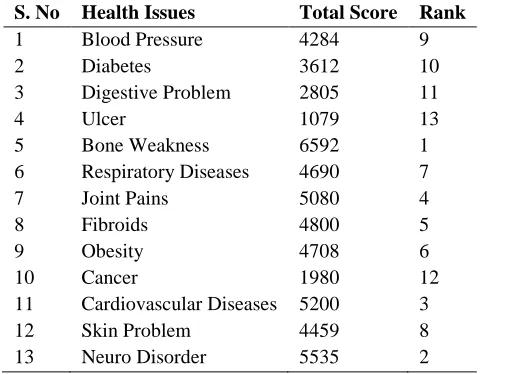
TABLE No 2: Rank of the problem faced by the respondents due to inorganic oils S. No Health Issues Total Score Rank
1 Blood Pressure 4284 9
2 Diabetes 3612 10
3 Digestive Problem 2805 11
4 Ulcer 1079 13
5 Bone Weakness 6592 1
6 Respiratory Diseases 4690 7
7 Joint Pains 5080 4
8 Fibroids 4800 5
9 Obesity 4708 6
10 Cancer 1980 12
11 Cardiovascular Diseases 5200 3
12 Skin Problem 4459 8
13 Neuro Disorder 5535 2
Interpretation
From the above table it is evident that “Bone Weakness” ranked as no 1 with total score of 6,592points, “Neuro Disorder” ranked as no 2 with total score of 5,535 points, “Cardiovascular diseases” ranked as no 3 with total score of 5,200points, “Joint Pains” ranked as no 4 with total score of 5,080points, “Fibroids” ranked as no 5
score of 2,805, and “Ulcer” ranked as no 13 with total score of 1,079.
FINDINGS
“Bone Weakness” ranked as no 1 with total score of 6,592points.
“Neuro Disorder” ranked as no 2 with total score of 5,535 points.
“Cardiovascular diseases” ranked as no 3 with total score of 5,200points.
SUGGESTIONS
Stop using rice brand refined oils to avoid bone weakness.
Herbal and Ayurvedic system of medicine has traditionally been used in several neurological conditions.
Olive oils and traditional method oils were suggested to use for avoiding the cardiovascular diseases.
CONCLUSION
Deep frying and the use of same oil for frying many times is a general practice mostly in commercial and sometimes in domestic cooking processes. This practice generates lipid peroxidation products that may be harmful to human health. Most of these compounds are non-volatile, so they remain in the frying medium and affect its physical properties at elevated temperatures in the presence of air and moisture causing the oxidative degradation of their amino acids and the partial conversion of these lipids to volatile chain-scission products, non-volatile oxidized derivatives and dimeric, polymeric or cycli substances leading to the formation of toxic and/or carcinogenic compounds. The results of this particular study suggested that repeated heating gradually diminished the health-protective effects.
REFERENCE
[1].Rekhadevi Perumalla Venkata, Rajagopal Subramanyam “Evaluation of the deleterious health effects of consumption of repeatedly heated vegetable oil” Received 29, 2016 Received in revised form 4, 2016 Accepted 2016 Available online 16, 2016.
[2].R. S. FARAG*1, F. M. HEWEDP, S. H. ABU-RAIIA2, and G. S. EL-BAROTY1 'Biochemistry Department and 2Food Science and Technology Department, Faculty of Agriculture, Cairo University, Cairo, Egypt Received for publication 23, 1991