EFFECT OF FLY ASHES AND SEWAGE SLUDGE ON Fe, Mn, Al, Si AND Co
UPTAKE BY GRASS MIXTURE
Jacek Antonkiewicz1
1 Department of Agricultural and Environmental Chemistry, University of Agriculture in Krakow, 21 Mickiewicza Ave., 31-120 Krakow, Poland, e-mail: [email protected]
INTRODUCTION
In view of their heavy metal concentrations, a considerable amount of generated municipal sewage sludge qualifies for environmental man
-agement [Rozporządzenie... 2010]. In case of en
-vironmental management of fly ashes in landfill sites, the problem of creating environmental bar
-rier relies on securing appropriate conditions for the development of vegetation introduced to the landfill [Antonkiewicz 2009, 2011]. The optimal technological solution seems to be covering the top layer of fly ashes landfill with municipal sew
-age sludge or its mixing with the top ash layer [Samaras et al. 2008, Klimont 2011]. Sewage sludge used in ashes landfill joins volatile parts of the ash preventing its dusting and supplies nutri
-ents, including microelem-ents, to plants used for the reclamation. Fly ashes subjected to biologi
-cal reclamation also provide a valuable source of nutrients enabling growth and development Volume 15, No. 3, July 2014, pp. 6–13
DOI: 10.12911/22998993.1109115 Research Article
ABSTRACT
Application of sewage sludge for environmental management of fly ashes landfill site affects chemical composition of plants. The aim of the present investigations was learning the effect of growing doses of municipal sewage sludge on the yield and uptake of Fe, Mn, Al, Si and Co by grass mixture used for environmental management of fly ashes landfill. The experimental design comprised of 5 objects differing by a dose of municipal sewage sludge supplied per 1 hectare: I. control, II. 25 t d.m., III. 50 t d.m., IV. 75 t d.m. and V. 100 t d.m. Application of sewage sludge resulted in the increase in yield. The content of analyzed elements in the grass mixture depended sig
-nificantly on sewage sludge dose. Increasing doses of sewage sludge caused marked increase in Mn and Co contents, while they decreased Fe, Al and Si contents in the grass mixture. It was found that growing doses of sewage sludge caused an improve
-ment of Fe to Mn ratio value in the grass mixture. Assessing the ele-ment content in the grass mixture in the view of forage value, it was found that Fe and Mn content did not meet the optimal value. Si content in plants was below the optimal value.
Keywords: fly ashes, municipal sewage sludge, grass mixture, yield, Fe, Mn, Al, Si, Co, uptake, quantitative ratios.
Received: 2014.03.03 Accepted: 2014.06.06 Published: 2014.07.01
of plants, particularly at their early development stages [Gilewska, Przybyła 2001, Bielińska et al. 2009, Rosik-Dulewska et al. 2011].
Presented research aimed to identify the im
-pact of increasing doses of municipal sewage sludge on the yield and Fe, Mn, Al, Si and Co uptake by a grass mixture used for environmental management of fly ashes landfill site.
The present paper on the yielding and uptake of Fe, Mn, Al, Si and Co is a continuation of re
-search on the effect of municipal sewage sludge on the yield, content and uptake of heavy metals by grass mixture [Antonkiewicz 2009].
MATERIALS AND METHODS
The research on the effect of increasing dos
on fly ashes landfill site owned by Dwory S.A. Chemical Enterprise in Oświęcim. A one factor field experiment was conducted in a randomized block design. The plot area was 10 m2. The land -fill possesses also a closed ash quarter -filled with fly ashes, i.e. an ash-slag mixture from wet depo
-sition of fly ashes with catalogue number 10.01 80 [Rozporządzenie... 2001]. The deposited ash, i.e. ash and slag mixture was supplied by hydro-transport and deposited in the ash quarter. The ex
-perimental design comprised 5 objects differing by a dose of supplied municipal sewage sludge per 1 hectare: I. control, II. 25 t d.m., III. 50 t d.m., IV. 75 t d.m. and V. 100 t d.m. The maxi
-mum dose of municipal sewage sludge – 100 t d.m.·ha-1 could be applied to the ground reclama -tion for agronomic and non-agronomic purposes, including for example reclamation of fly ashes landfill sites, in compliance with the Regulation of the Minister of Environment on municipal sewage sludge dated 1 August 2002, in force at that time [Rozporządzenie... 2002].
Municipal sewage sludge was applied to the surface two weeks prior to the grass mixture sow
-ing. Previous research has shown that legumes
(Fabaceae) were covering fly ashes less than
ash-sludge mixtures [Antonkiewicz, Radkowski 2006], so in the field experiment set up on fly ashes land
-fill a mixture composed exclusively from grass plants was used. The grass mixture sown there was composed of Festuca rubra L., ‘Brudzyńska’ cv. (20%), Festuca arundinacea (Schreb.), ‘Skar
-pa’ cv. (25%), Festuca pratensis (L.), ‘Skiba’ cv. (25%), Poa pratensis (L), ‘Skiz’ cv. (5%) and
Lo-lium perenne (L.), ‘Solen’ cv. (25 %).
The grass mixture was sown by hand in the first decade of August 2005 in the amount of 53 kg·ha-1. The norm of grass sowing was increased by 50% because at the beginning grasses germinate poorly in alkaline soil pH [Rogalski, Kardyńska 1999]. At the beginning, the sown grass mixture was sprinkled with water to the depth of 2 cm as the substratum was drying up. 3 weeks after sowing, plant emergencies were watched. No mineral NPK fertilization was applied in the field experiment. In the first year of vegetation the plants were cut once, in the first decade of October (1 regrowth), where
-as in subsequent years it w-as cut once, in the first decade of September. A single harvest of the mix
-ture was due to the conditions on the experiment site, among others intensive dusting of the landfill, which reduced the plant yielding, especially in the first and second year of the experiment.
After harvest the grass mixture was dried at 70 ºC in a drier with forced air flow and the yield of dry mass was determined. Samples of the plant ma
-terial were dry-mineralized in a muffle furnace at 450 ºC and the obtained ash was dissolved in 20% nitric acid. The paper presents average yields of the grass mixture from respective years 2005–2007 and mean weighted contents of the elements for the investigated period. Approximate to total ele
-ment contents were assessed in the ash and sewage sludge after organic matter incineration and diges
-tion in the mixture of HClO4 and HNO3 (3:2, v/v) acids [Ostrowska et al. 1991]. Concentrations of Fe, Mn, Al, Si and Co in the ash and sludge, as well as in the plant material mineralisates were assessed by means of atomic emission spectrometer with in
-ductively coupled argon plasma (ICP-AES).
RESULTS AND DISCUSSION
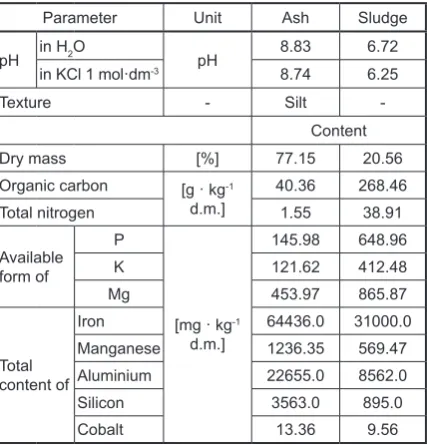
Basic physicochemical properties of wastes were presented in Table 1. Analysis of granula
-tion revealed that considering the granulometric composition, the deposited fly ash matched ordi
-nary dust [Systematyka... 1989]. The content of organic carbon and total nitrogen assessed in fly ash reveal the presence of unburned coal residue [Gilewska, Przybyła 2001, Su, Wong 2003].
The contents of Fe, Mn, Al, Si and Co in fly ash were higher by 108%, 40%, 117%, 165% and 298%, respectively, in comparison with these elements’ concentrations in the municipal sewage sludge (Table 1).
Table 1. Properties of waste used in field experiment
Parameter Unit Ash Sludge
pH in H2O pH 8.83 6.72
in KCl 1 mol·dm-3 8.74 6.25
Texture - Silt
-Content Dry mass [%] 77.15 20.56 Organic carbon [g · kg-1
d.m.]
40.36 268.46 Total nitrogen 1.55 38.91
Available form of
P
[mg · kg-1
d.m.]
145.98 648.96
K 121.62 412.48
Mg 453.97 865.87
Total content of
Municipal sewage sludge applied on fly ash landfill site revealed a slightly acid pH, where
-as total organic carbon and nitrogen content was 6.6 and 25-fold higher in comparison with fly ash (Table 1). Municipal sewage sludge was a rich source of available macroelements, be
-cause of very high contents of available P, K and Mg forms. Assessment of municipal sew
-age sludge revealed that in view of heavy metal concentrations it met the requirements for ap
-plication in agriculture and land reclamation for agronomic and non-agronomic purposes [Rozporządzenie... 2002, Antonkiewicz 2009, Rozporządzenie... 2010].
Yield of grass mixture
The effect of increasing doses of municipal sewage sludge on the yield of grass mixture culti
-vated on fly ash landfill site was presented in the previous paper [Antonkiewicz 2009]. The yield of grass mixture obtained in the field experiment was presented for individual years and as an av
-erage value for the period of investigations, i.e. 2005–2007 (Table 2).
Average yield of grass mixture dry mass ob
-tained in the years 2005–2007 on fly ashes landfill fluctuated from 0.69 to 4.03 t d.m.·ha-1 depend -ing on the object (Table 2). The lowest yield of the mixture was obtained on the control where no sewage sludge was used. Obtained yield of the grass mixture cultivated solely on fly ash may be explained by disadvantageous physicochemical properties of the substratum and nutrient deficien
-cy in comparison with municipal sewage sludge treatments (Table 1).
Application of municipal sewage sludge on fly ashes landfill resulted in a significant increase in grass mixture yield. The smallest dose of sew
-age sludge, i.e. 25 t d.m.·ha-1 caused an increase
Table 2. Yield of grass mixture [t d.m.·ha-1]
Object Sludge dose Year of vegetation Average [t d.m.·ha-1] 2005 2006 2007
I Control 0.09 0.88 1.10 0.69 II 25 0.27 1.62 2.10 1.33 III 50 0.44 2.64 3.76 2.28 IV 75 0.78 3.36 4.71 2.95 V 100 1.13 4.58 6.39 4.03
RSD [%] 76.62 55.51 57.99 58.44
LSD(α=0.05) 0.10 0.27 0.41 0.220 Explanation: RSD – relative standard deviation.
in the grass mixture yield by 94% in comparison with the values obtained in the control. Doubling the sewage sludge dose (50 t d.m.·ha-1) led to an increase in yield by 230% as compared with the control. Successive doses of sewage sludge also positively affected the amount of yield. The largest yield of grass mixture was obtained on the object where 100 t d.m.·ha-1 of sewage sludge was applied. The yield of grass mixture from this object was over 480% higher in com
-parison with the values obtained in the control. The research conducted on fly ashes landfill site demonstrated the best fertilizer value of the ob
-ject where 100 t d.m.·ha-1 of sewage sludge was applied.
The yield of the grass mixture obtained in respective years of experiment 2005–2007 was greatly diversified (Table 2). The lowest yields were produced in the first year of investigations, which should be explained by a long period of grass mixture emergencies and incomplete pe
-riod of its vegetation. Much larger grass mix
-ture yield was obtained in the second year and the largest in the third year of the research. De
-pending on the object, the yields obtained in the third year of research were between 5.7 and 12.2 times higher in comparison with those in the first year of vegetation. The highest yield increment, in comparison with the first year of vegetation, was registered in the control object and the low
-est with the high-est dose of sewage sludge. The highest yield increment was noted for grass mix
-ture cultivated exclusively on fly ash, after the plant spreading.
Element content in the grass mixture
Fly ash and municipal sewage sludge were a potential source of Fe, Mn, Al, Si and Co for the grass mixture cultivated on the landfill (Table 1). The element content in grass mixture, depend
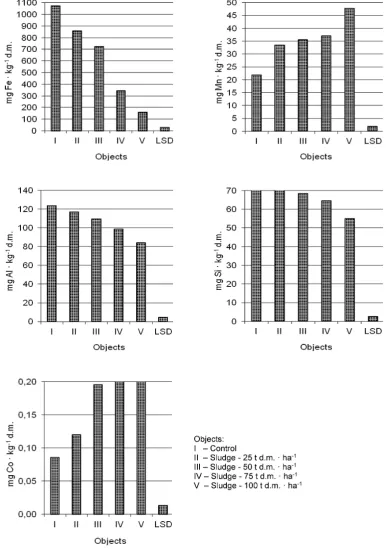
-ing on sewage sludge dose, ranged as follows: 159.65–1072.91 mg Fe, 21.93–47.68 mg Mn, 84.21–123.69 mg Al, 55.11–80.51 mg Si and 0.09–0.29 mg Co·kg-1 d.m. (Figure 1). Research has shown that the content of these elements in the grass mixture was diversified. The high
-est diversification was observed for Fe (RSD = 59%) and Mn (RSD = 46%), while the lowest for silicon and iron (RSD = 14%). The experiment demonstrated that municipal sewage sludge ap
-plied on the fly ashes landfill site led to a sig
grass mixture (Figure 1). The highest increment of Mn and Co content in the grass mixture was registered at the dose of 100 t d.m.·ha-1. Increase in Co content at the application of the highest dose of sewage sludge exceeded 243%, whereas for Mn the increase was over 117% in relation to the control.
An opposite relationship was noted for Fe, Al and Si. The highest Fe, Al and Si content was
Figure 1. Content of elements in grass mixture
noted in the grass mixture cultivated solely on fly ash, on the control not fertilized with sew
-age sludge. Increasing doses of sew-age sludge caused a marked decrease in Fe, Al and Si con
Element uptake
The paper presents a summary uptake of ele
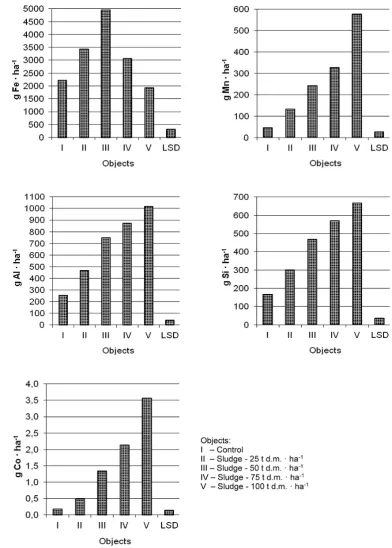
-ments for the three-year research period (2005– 2007). The element quantity absorbed from the respective objects (from the landfill) depended on the crop yield and individual element concentra
-tion in the yield (Figure 2). Considering the ana
-lyzed elements, Fe was absorbed in the greatest
amounts, irrespective of the object, then Al, Si and Mn, whereas Co uptake was the lowest. The highest iron uptake by grass mixture was regis
-tered on the object where 50 t d.m.·ha-1 of sewage sludge was applied, whereas the subsequent in
-creasing doses of sewage sludge caused a dimin
-ished uptake of this microelement. A dose of 100 t d.m.·ha-1 of municipal sewage sludge applied on the landfill significantly and to the greatest extent
increased Mn, Al, Si and Co uptake by grass mix
-ture. Increased absorption of Mn, Al, Si and Co following this dose application was 11.74, 2.98, 3.01 and 19.04-fold, respectively, in comparison with the control, i.e. fly ash not receiving sew
-age sludge. The research has shown that the lower dose of sewage sludge, the lower uptake of these elements by grass mixture. Reduced element up
-take by the grass mixture was connected mainly with diminishing yield (Table 2). The lowest re
-moval of these elements was noted in the control. The lowest uptake of microelements is explained by the fact that the grass mixture cultivated on the ash in the control produced lower yield and in case of Mn and Co low contents of these metals were noted in plant yield.
Weight relationships between elements in the grass mixture
For the cognitive reasons of the paper, the re
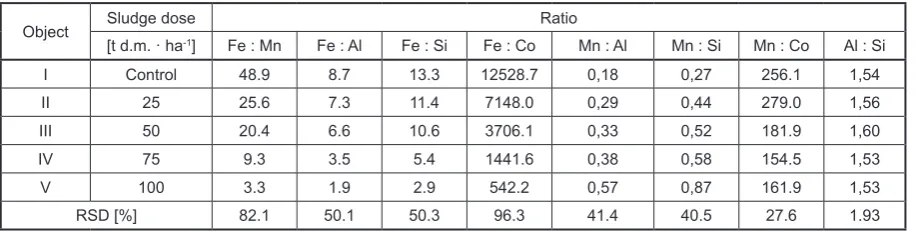
-lationships between the analyzed elements in the grass mixture were presented. Increased doses of sewage sludge applied on fly ashes landfill clearly modified relationships between the studied ele
-ments (Table 3).
A considerable variation range of mutual rela
-tionships between the elements in the grass mix
-ture was observed in the experiment, which in
-dicates that grasses cultivated on wastes reveal a notable tolerance to quantitative relationships be
-tween these elements. The highest variation was assessed for Fe:Mn and Fe:Co ratios, whereas the lowest one for Al:Si ratio.
Application of increasing doses of munici
-pal sewage sludge on fly ashes landfill caused a decline in values of Fe:Mn, Fe:Al, Fe:Si, Fe:Co and Mn:Co weight ratios in the grass mixture in comparison with the control. An opposite rela
-tionship, i.e. increasing values of weight ratios in comparison with noted in the control was regis
-tered for Mn:Al and Mn:Si ratios. In case of Al:Si ratio it was found that sewage sludge addition to fly ashes did not have any marked influence on this ratio value in the grass mixture (Table 3).
A proper growth of forage crops requires main
-taining relatively stable and determined Fe:Mn ra
-tio. It was assumed that the optimum Fe:Mn ratio is 1.5–2.5:1. According to Falkowski et al. [2000] below this ratio value 1.5, symptoms of manganese toxicity and iron deficiency are apparent, whereas when the Fe:Mn ratio exceeds 2.5, a manganese deficiency and iron excess appear in a plant.
Analyzing the value of Fe:Mn ratio in the grass mixture, it was determined that increasing doses of municipal sewage sludge caused an im
-provement of the ratio value between these ele
-ments. After the application of the highest dose of sewage sludge (100 t d.m.·ha-1) the value of this ratio was most approximate to the optimal, however it remained below the optimal value. The value of Fe:Mn ratio in the grass mixture cul
-tivated on fly ashes landfill evidenced Fe excess, but a deficiency of Mn. Assessing element con
-tent in the grass mixture from the point of forage value, it was found that it did not meet the optimal value for Fe and Mn.
Fly ashes landfills require a necessary recla
-mation through initiation of pedogenic processes and forming a vegetation cover using a method of a proper plant species selection [Antonkiewicz, Radkowski 2006, Klimont 2007]. In environmen
-tal management of fly ash landfills grasses are re
-garded as pioneer plants [Góral, Rola 2001]. Au
-thor’s own research has shown that introduction of municipal sewage sludge causes a significant increase in grass mixture yield, and therefore en
-vironmental management of fly ash landfill site. According to Gilewska and Przybyła [2001], application of municipal sewage sludge on ash rock improves its physical and chemical prop
-erties through increasing the content of among
Table 3. Relation between elements in grass mixture
Object Sludge dose Ratio
[t d.m. · ha-1] Fe : Mn Fe : Al Fe : Si Fe : Co Mn : Al Mn : Si Mn : Co Al : Si
I Control 48.9 8.7 13.3 12528.7 0,18 0,27 256.1 1,54 II 25 25.6 7.3 11.4 7148.0 0,29 0,44 279.0 1,56 III 50 20.4 6.6 10.6 3706.1 0,33 0,52 181.9 1,60
IV 75 9.3 3.5 5.4 1441.6 0,38 0,58 154.5 1,53
V 100 3.3 1.9 2.9 542.2 0,57 0,87 161.9 1,53
RSD [%] 82.1 50.1 50.3 96.3 41.4 40.5 27.6 1.93
others, microelements. Studies on efficiency of sewage sludge in reclamation of ash landfill sites were also conducted by Baran et al. [2008], who demonstrated an advantageous effect of munici
-pal sewage sludge on the yield and chemical com
-position of plants.
The present paper focuses on such elements as iron, manganese, aluminum, silica and cobalt, which occur in plants in diversified quantities, but are crucial for their growth and development [Falkowski et al. 2000]. Therefore, for cognitive reasons the element content in the grass mixture was assessed in view of their fodder value. The following optimal values were assumed, below which their deficiency in forage plants occurs: 40–80 mg Fe, 40–70 mg Mn and 0.08–0.16 mg Co·kg-1 d.m. Animals fed with fodder abundant in silicon may deposit this element as urinary stones, therefore attempts were made to estab
-lish a limit of its safe content in animal feed, re
-garding 9.0 g Si·kg-1 d.m. as permissible content [Falkowski et al. 2000, Wiśniowska-Kielian, Lipiński 2007].
If one assumes the upper limit of Fe content in forage crops as 80 mg·kg-1 d.m., the grass mix -ture cultivated solely on fly ash contained over 13-fold more of this element in comparison with the optimal value. Increasing doses of municipal sewage sludge significantly diminished this mi
-croelement content in the grass mixture. The grass mixture cultivated on the highest dose of sewage sludge (100 t d.m.·ha-1) contained over twice more of Fe than the upper limit of the optimal content of this microelement. Mn content in the grass mixture cultivated only on the ash ranged below the optimal, whereas increasing doses of sewage sludge resulted in a growing content of this element, and grass biomass obtained on the highest dose of sewage sludge (100 t d.m.·ha-1) revealed the optimal content of this element. Co content in the grass mixture was above, while Si below the optimal value.
Assessment of chemical composition of the obtained grass mixture meant for reclamation of fly ash landfill site was not positive. The mixture should not be destined for animal feed due to the risk of heavy metals present in it in quantities ex
-ceeding the norm, which excludes it’s forage use. The obtained yield of the grass mixture should be destined for biomass, used as energy source or for compost production. Moreover, industrial utiliza
-tion of the plant biomass guarantees excluding heavy metals from the food chain.
Scientific literature [Kalembkiewicz, Sočo 2004, Wojcieszczuk et al. 2009] shows that fly ashes constitute not only a source of heavy metals, but are a valuable source of microelements, al
-though the element solubility and bioavailability is generally low regarding their total content [Su, Wong 2003]. The factor limiting their availability is alkaline pH of ashes. For increasing microel
-ement solubility, and therefore their availability, application of municipal sewage sludge is recom
-mended, which is also a valuable source of mi
-croelements for plants [Kalembasa, Wysokiński 2008, Papadimitriou et al. 2008].
It results from the Author’s own research that relationships between the elements in the grass mixture were clearly modified by municipal sew
-age sludge. A change of weight relationships be
-tween the elements in the grass mixture was prob
-ably caused by the effect of sludge on concentra
-tions of individual elements in the soil solution, and therefore limiting or increasing their availability for grasses [Kalembkiewicz, Sočo 2004], due to acidi
-fication and increasing contents of these microele
-ments in the substratum [Antonkiewicz 2009].
CONCLUSIONS
1. Growing doses of sewage sludge significantly increased yields of the grass mixture cultivat
-ed on fly ash landfill site.
2. Increasing does of sewage sludge resulted in a marked growth of Mn and Co content in the grass mixture cultivated on fly ash landfill site, whereas they declined its concentrations of Fe, Al and Si.
3. It was determined that sewage sludge supple
-ment on fly ashes landfill led to a greater Fe, Mn, Al, Si and Co uptake by the grass mixture. 4. It was assessed that Fe and Co contents in the
grass mixture were above the optimal value, whereas Mn and Si contents were below the optimal value.
5. Applied municipal sewage sludge obviously modified values of weight ratios between the analyzed elements in the grass mixture.
REFERENCES
1. Antonkiewicz J. 2009. An assessment of the envi
2. Antonkiewicz J. 2011. Assessment of bioavail
-ability of heavy metals in wastes used for biologi
-cal reclamation of hazardous waste landfill. Zesz. Nauk. UR w Krakowie, 484, Seria rozprawy 358, p. 119 [In Polish].
3. Antonkiewicz J., Radkowski A. 2006. Usability of selected grass and legume species for biological reclamation of ash dumps. Annales UMCS, sec. E, 61, 413-421 [In Polish].
4. Baran S., Wójcikowska-Kapusta A., Żukowska G., Milczarek T. 2008. Influence of the addition of kompost from sewage sludge and sludge-ashes on sorption properties of the soil-less ground forma
-tion. Zesz. Probl. Post. Nauk Roln., 533, 49-58. [In Polish].
5. Bielińska E.J., Baran S., Stankowski S. 2009.
As-sesment concerning usability of fluidal ashes from hard coal for agricultural purposes. Inżynieria Rol
-nicza, 6(115), 7-15 [In Polish].
6. Falkowski M., Kukułka I., Kozłowski S. 2000. Właściwości chemiczne roślin łąkowych. Wyd. AR Poznań, p. 132 [In Polish].
7. Gilewska M., Przybyła Cz. 2001. Utilization of sewage sludge in recultivation of ash disposal sites. Zesz. Probl. Post. Nauk Roln., 477, 217-222 [In Polish].
8. Góral S., Rola S. 2001. Trawy na popiołach elektrociepłowni nawożonych osadami ścieko-wymi. Inż. Ekol., 3, 146-150 [In Polish].
9. Kalembasa S., Wysokiński A. 2008. The influence of the addition of different quantities of calcium
oxide and ash from brown coal to the waste acti
-vated sludges on the content of boron and molyb
-denum in the tested plants. Zesz. Probl. Post. Nauk Roln., 533, 189-196 [In Polish].
10. Kalembkiewicz J., Sočo E. 2004. Sequential ex
-traction of Cr, Fe, Co, and Ni from industrial ash. Ecol. Chem. Eng., 11(4-5), 347-352.
11. Klimont K. 2007. Ocena przydatności wybranych gatunków roślin użytkowych do rekultywacji terenów zdewastowanych przez przemysł i
gospodarkę komunalną. Problemy Inżynierii Rol
-niczej, 2, 27-36 [In Polish].
12. Klimont K. 2011. Reclamation efficiency of the sewage sludge on soil-less substrate of post-flotation lime and incineration ashes. Problemy Inżynierii Rolniczej, 2, 165-176 [In Polish].
13. Ostrowska A., Gawliński S., Szczubiałka Z. 1991. Methods of analysis and assessment of soil and plant properties. A Catalogue. Wyd. IOŚ, Warsaw, p. 334 [In Polish].
14. Papadimitriou C.A., Haritou I., Samaras P., Zouboulis A.I. 2008. Evaluation of leaching and ecotoxicological properties of sewage sludge-fly ash mixtures. Environ. Res., 106, 340-348.
15. Rogalski M., Kardyńska S. 1999. Initial growth and development of Festulolium and lolium pe-renne on ashes from the Dolna Odra power plant. Fol. Univ. Agric. Stetin. 197, Agricultura 75, 263-266 [In Polish].
16. Rosik-Dulewska Cz., Karwaczyńska U., Ciesielc
-zuk T. 2011. Possibilities of utilization of organic
and mineral waste according to rules of environ
-mental protection. Rocznik Ochrona Środowiska, 13, 361-376 [In Polish].
17. Rozporządzenie Ministra Środowiska z dnia 1 si
-erpnia 2002 r. w sprawie komunalnych osadów ściekowych. Dz. U. RP 2002, Nr 134, poz. 1140. (Nie obowiązuje) [In Polish].
18. Rozporządzenie Ministra Środowiska z dnia 13 lipca 2010 r. w sprawie komunalnych osadów ściekowych. Dz. U. RP, Nr 137, poz. 924 [In Polish].
19. Rozporządzenie Ministra Środowiska z dnia 27 września 2001 r. w sprawie katalogu odpadów. Dz. U. RP 2001, Nr 112, poz. 1206 [In Polish].
20. Samaras P., Papadimitriou C.A., Haritou I., Zouboulis A.I. 2008. Investigation of sewage Sludge stabilization potential by the addition of fly ash and lime. J. Hazard. Mater., 154, 1052-1059. 21. Su D.C., Wong J.W.C. 2003. Chemical speciation
and phytoavailability of Zn, Cu, Ni and Cd in soil amended with fly ash-stabilized sewage sludge. Environ. Int., 29, 895-900.
22. Systematyka gleb Polski. PTG. 1989. Roczn. Gle
-bozn., 40(3/4), 1-150 [In Polish].
23. Wiśniowska-Kielian B., Lipiński W. (Red.). 2007. Ocena składu chemicznego roślin. Wyd. Polskie Towarzystwo Inżynierii Ekologicznej, Krajowa
Stacja Chemiczno-Rolnicza. Kraków-Warszawa
--Wrocław, 2007, p. 57 [In Polish].
24. Wojcieszczuk T., Meller E., Sammel A., Stankowski S. 2009. The content and dissolubility of some chemi
![Table 2. Yield of grass mixture [t d.m.·ha-1]](https://thumb-us.123doks.com/thumbv2/123dok_us/8359938.1670745/3.595.71.287.624.756/table-yield-of-grass-mixture-t-d-ha.webp)