Vol. 2 Issue 8, August - 2016
Determination of the maximum explosion
pressure and maximum rate of pressure rise
during explosion of polycarbonate
Richard Kuracina, Zuzana Szabova, Karol Balog, Matej Mencik
Slovak University of Technology in Bratislava, Faculty of Materials Science and Technology in Trnava Trnava, Slovakia
[email protected], [email protected], [email protected], [email protected]
Abstract — The article deals with the measurement of
maximum explosion pressure and maximum rate of pressure rise of polycarbonate dust cloud. The measurements were carried out according to STN EN 14034-1+A1:2011 Determination of explosion characteristics of dust clouds. Part 1: Determination of the maximum explosion pressure pmax of dust clouds and STN EN 14034-2+A1:2011 Determination of explosion characteristics of dust clouds. Part 2: Determination of the maximum rate of explosion pressure rise (dp/dt)max of dust clouds. The testing of explosions of polycarbonate dust clouds showed that the maximum value of the pressure was reached at concentration of 400 g/m3 and its value is 9.8 bar. The maximum rate of pressure rise was reached at the same concentration and its value is 316.6 bar/s.
Key Words — explosion characteristics, maximum explosion pressure, maximum rate of pressure rise, dust clouds, polycarbonate
I.
INTRODUCTIONThe majority of powders that are used in the processing industries are combustible (also referred to as flammable, explosible). An explosion will occur if the concentration of the combustible dust that is suspended in air is sufficient to propagate flame when ignited by a sufficiently energetic ignition source [13].
Dust explosions cannot occur unless an effective ignition source of sufficient energy to initiate flame propagation is present. Avoidance or elimination of potential sources of ignition therefore is a crucial step in preventing dust explosions. A careful analysis of all aspects of plant design, plant operation and product reactivity is required if all potential ignition sources are to be identified and the hazard they represent reduced or eliminated [12].
The phenomenon named dust explosions is in fact quite simple and easy to envisage in terms of daily life experience. Any solid material that can burn in air will do so with a violence and speed that increases with increasing degree of subdivision of the material. If the subdivision is continued right down to the level of small particles of sizes on the order of 0.1 mm or less and the particles are suspended in a sufficiently large volume of air to give each particle enough space for its unrestricted
burning, the combustion rate is very fast and the energy required for ignition very small. Such a burning dust cloud is a dust explosion. In general, the dust cloud is easier to ignite and burn more violently the smaller the dust particles are, down to some limiting particle size that depends on the type of dust material. [10]
Dust consists of particles of a solid matter smaller than 0.5 mm that can be whirled. In many cases the bigger particles can have characteristic properties of dust e.g. feather, foam, polystyrene, etc. It depends on weight, their forms and other circumstances, such as temperature, humidity, and speed of airflow, that influence whether they will be turbid in the air [10].
Particle size/specific surface area of the dust is a central factor. However, there are other important factors too, and the comprehensive list may look as follows:
1. Chemical composition of the dust, including its moisture content.
2. Chemical composition and initial pressure and temperature of the gas phase.
3. Distributions of particle sizes and shapes in the dust, determining the specific surface area of the dust in the fully dispersed state.
4. Degree of dispersion, or agglomeration, of dust particles, determining the effective specific surface area available to the combustion process in the dust cloud in an actual industrial situation.
5. Distribution of dust concentration in an actual cloud.
6. Distribution of initial turbulence in an actual cloud.
7. Possibility of generation of explosion-induced turbulence in the still unburned part of the cloud. (Location of ignition source important parameter.)
8. Possibility of flame front distortion by mechanisms other than turbulence.
Vol. 2 Issue 8, August - 2016
Dust explosions generally arise from rapid release of heat due to the chemical reaction:
Fuel + oxygen = oxides + heat
The materials that can cause dust explosions include:
Natural organic materials (grain, linen, sugar, etc.).
Synthetic organic materials (plastics, organic pigments, pesticides, etc.).
Coal and peat.
Metals (aluminum, magnesium, zinc, iron, etc.) [10].
Dust dispersion has a significant influence on its combustiblity and explosibility. A dispersed dust has a considerably large surface, chemical activity, lower temperature of the thermic self-ignition and a dust mixture has a broad interval of explosibility [10].
There are several definitions of dust. For example, the British standards define materials with particles smaller than 1000 micrometers as powders, and particles with a diameter of less than 76 micrometers as dust (BS 2955: 1993). According to The National Fire Protection Association (NFPA), in the USA the term dust means any finely divided solid particles with a diameter of 420 micrometers or less (NFPA 68: 2002). Other literary sources classify also the particles with a diameter of more than 1000 micrometers as dust which is dangerous in terms of explosion. [2]
A systematic approach to identifying dust cloud explosion safety against their consequences generally involves:
Identification of locations where combustible dust cloud atmospheres could be present.
Understanding of the explosion
characteristics of the dust(s).
Identification of potential ignition sources that could be present under normal and abnormal conditions.
Proper process and facility design to eliminate and/or minimize the occurrence of dust explosions and protect people and facilities against their consequences.
Adequate maintenance of facilities to prevent ignition sources and minimize dust release [13].
II.
DETERMINATION OF EXPLOSION CHARACTERISTICS OF DUST CLOUDSBurning is associate with the term of fire triangle,
cloud. A dust explosion is initiated by the rapid combustion of flammable airborne particles. Any solid material which is able to burn in the air under these conditions burns at a high speed. The burning rate increases with the increasing fineness of dust. The extent and the rate of flame propagation in a cloud of dust depends on the factors such as character of dust, size of particles and properties of by-products formed during burning. Dust explosion is a complex phenomenon involving simultaneous momentum, energy and mass transfer in reactive zone of a multiphase system [4].
A smaller particle size causes increase of the rate of reaction and explosive combustion. However, if the particles are too fine they tend to aggregate in larger units. If a dust cloud ignites in enclosed space, there is a rapid burning in the form termed Flash Fire. If ignition of the dust cloud occurs in a limited space, combustion heat can result the rapid pressure rise with the flame spreading through the dust cloud. These processes lead to an explosion which is accompanied by the development of large amounts of heat and reaction products. The character of explosion depends on the particle size and the rate of energy release which is due to the combustion. It also depends on the range of heat generation and heat loss. In exceptional circumstances destructive explosion of dust cloud may occur in limited space [6].
Properties of dust clouds and settled dust are characterized by Lower Explosive Limit (LEL), maximum explosion characteristics (maximum explosion pressure pmax, maximum rate of explosion
pressure rise (dp/dt)max), minimum ignition energy
Emin, minimum ignition temperature of dust clouds troz,
induction period for ignition τi and Limiting oxygen
concentration (LOC) [6].
A modified KV 150-M2 chamber was used to measure the monitored characteristics. Scheme of the chamber is shown in Figure 1. Dust clouds in this unit are carried out mechanically. From the tank of compressed air is compressed air transmitted by fast opening valve to inner space of chamber. The chamber has a volume of 291 liters. The sample is located on a plate and spread by compressed air. This compressed air is directed to the sample through the metal profiled sheeting. The sample is initiated by a chamber nitrocellulose initiator after the spreading of this sample. The initiator works on a resistive principle. Immediate initiation of nitrocellulose is achieved by the voltage value which is supplied to the resistance wire and results into an immediate burning and interruption of wire. Ignition energy of nitrocellulose used in initiator is 5 kJ.
Vol. 2 Issue 8, August - 2016
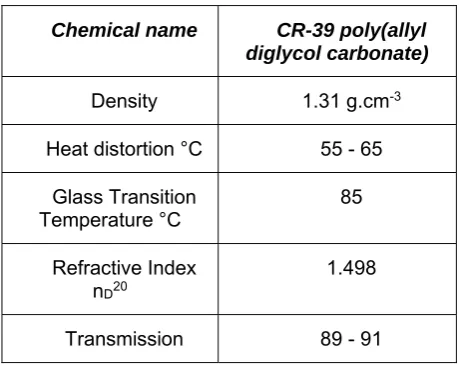
output and the maximum measurable overpressure value of 16 bar. The pressure transducer is powered by a stabilized DC source. Response time of the sensor is 1 ms and the current value is recorded through the datalogger. The measured sample was polycarbonate dust with a particle size of 0.500 mm. The characteristic of measured material is shown in Table 1.
TABLE 1CHARACTERISTICS OF TESTED SAMPLES
Chemical name CR-39 poly(allyl
diglycol carbonate)
Density 1.31 g.cm-3
Heat distortion °C 55 - 65
Glass Transition
Temperature °C 85
Refractive Index nD20
1.498
Transmission 89 - 91
Measurement of parameters was carried out on the apparatus described above. The initiator was nitrocellulose with a weight from 1.19 to 1.22 g. As mentioned above, the weight of the nitrocellulose corresponded to the energy of initiator with the value of 5 kJ.
The nitrocellulose was placed into initiator and the resistance wire passes through nitrocellulose. The pressure value in the tank of compressed air before the swirling was 9.5 bar for each measurement. The time interval between opening of the fast opening valve and the connecting power of clamps of the initiator was 310 ms. The starting of the whole mechanism (swirling of the dust and the initiation) was carried with a relay. The pressure transducer was powered by a stabilized DC voltage source with the value of 24.3 V and a current limiter set to 1 A. The current in the circuit was measured by a data logger. The values were recorded at the rate of 500 values per second. The pressure changes during the explosion of dust clouds were measured at the following concentrations: 60 g/m3, 100 g/m3, 200 g/m3, 300 g/m3, 400 g/m3 and 500 g/m3.
Fig. 1 Figure 1: Scheme of a modified KV 150-M2 chamber (1- lid, 2- nozzle for spreading the sample, 3- desk, 4- base, 5- pyrotechnical igniter, 6- vessel, 7- manometer, 8- compressed air inlet valve, 9- fast opening valve, 10- window [9]
III.
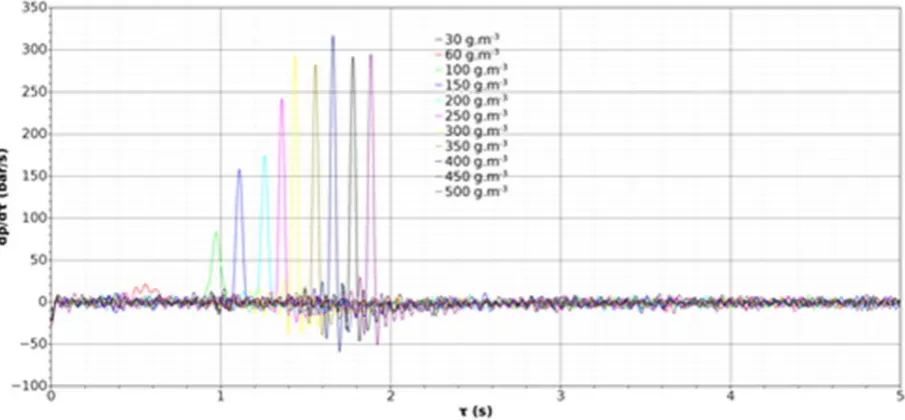
RESULTS AND DISCUSSIONThe values obtained by the measurement of pressure depending on the time and concentration are shown in Figure 2.The values obtained by the measurement of maximum rate of pressure rise depending on the time and concentration are shown in Figure 3.
The individual concentrations are color and shape coded on the graphs. However, since the value of the current on a pressure transducer oscillates around the medium value, the curves were smoothed with a FFT smoothing filter. Curve smoothing is achieved by removal of the Fourier component with a frequency higher than the limit frequency determined by the formula:
F=.ΔTଵ (1)
Vol. 2 Issue 8, August - 2016
Fig. 2 The maximum pressure obtained during the explosion of polycarbonate dust clouds depending on the concentration of dust
Vol. 2 Issue 8, August - 2016 TABLE 2MAXIMUM PRESSURE OF CARBONATE DUST EXPLOSION
Concentration of dust cloud [g.m-3]
Overpressure [bar]
30 0.680
60 3.198
100 5.555
150 7.291
200 8.153
250 8.924
300 9.320
350 9.445
400 9.813
450 9.362
500 9.364
TABLE 3MAXIMUM RATE OF PRESSURE RISE OF CARBONATE DUST EXPLOSION
Concentration of dust cloud [g.m-3]
Pressure rise [bar/s]
30 10.8
60 21.4
100 83.3
150 158.1
200 174.7
250 241.9
300 293.0
350 282.1
400 316.6
450 291.5
500 294.8
The individual concentrations are color coded on the graphs. However, since the value of the current on a pressure transducer oscillates around the medium value, the curves were smoothed with a FFT smoothing filter. Curve smoothing is achieved by removal of the Fourier
component with a frequency higher than the limit frequency determined by the formula (1). For the purpose of this measurement, chosen was the value of n = 25. Finally, smoothed curves were differentiated.
The results allow us to conclude that the increasing concentration of the dust leads to the increase of the pressure value in the chamber and the maximum rate of pressure rise (Table 2, Table 3).
IV.
CONCLUSIONThe testing of explosions of polycarbonate dust clouds by the device of the above-described parameters proved that the maximum value of the pressure was reached at the concentration of 400 g/m3 and its value is 9.813 bar. Maximum of explosion pressure rise of polycarbonate was also reached at the concentration of 400 g/m3 and its value is 316.6 bar/s. Further research will focus on optimizing the system configuration with the aim of achieving the ideal conditions for the dust clouds and explosions, and also for the achievement of the maximum parameters of explosions.
ACKNOWLEDGMENT
This research was supported by the Slovak Research and Development Agency under the contract No. APVV- 0057- 12.
REFERENCES
[1] J. Kalousek, Principles of physical chemistry of combustion, explosion and fire fighting, SPBI, Ostrava, 1999, 203 p., ISBN 80-86111-34-2
[2] K. N. Palmer, Dust Explosions and Fires, Chapman and Hall, London, 1993, 350 p., ISBN 978-0412354205
[3] STN EN 14034-3+A1:2012 Determination of explosion characteristics of dust clouds. Part 3: Determination of the lower explosion limit LEL of dust clouds
[4] S. A. Abbasi, Dust explosions - Cases, causes, consequences, and control. Journal of Hazardous Materials, vol. 140, p. 7 - 44, 2007
[5] F. P. Lees, Loss Prevention in the Process Industries, vol. 2. Oxford, Elsevier/Butterworth-Heinemann, 2005, ISBN 978-0408106979
[6] K. L. Cashdollar, Overview of dust explosibility characteristics. Loss Prevent. Process Ind., vol. 13, p. 183 - 199, 2000
[7] J. Damec, Risk of industrial dust explosions (Part 4). 150 Fire, vol. 6, 1993, ISSN 0682-8467
[8] R. Siwek, Determination of technical safety in dices and factors influencing hazard evaluation of dusts. Loss Prevent. Process Ind., vol. 9, pp. 21- 31, 1996, ISSN: 0950-4230
Vol. 2 Issue 8, August - 2016
[10] I. Slabá, I. Tureková, Smouldering and Flaming Combustion of Dust Layer on Hot Surface. Scientific Monographs, Dresden, 88 p., 2012, ISBN 978-3-9808314-5-1
[11] R. Eckhoff, Dust Explosions in the Process Industries, 3rd ed., Elsevier Science, 2003, 754 p. ISBN 978-0080488745
[12] Barton, J., Dust explosion prevention and protection a practical guide, Institution of Chemical Engineers, Rugby, U. K & Gulf Professional Publishing, Butterworth-Heinemann, USA, 300 p., 2002, ISBN 978-0750675192