THE NOVEL METHOD FOR RECOGNITION OF AMERICAN SIGN
LANGUAGE WITH RING PROJECTION AND DISCRETE WAVELET
TRANSFORM
Murat Taşkıran*, Sibel Çimen and Zehra Gülru Çam Taşkıran
Electronics and Communication Engineering, Yildiz Technical University, 34220, Esenler,
İstanbul, Turkey.
Article Received on 03/11/2017 Article Revised on 24/11/2017 Article Accepted on 15/12/2017
ABSTRACT
Sign Language is a language that allows individuals with hearing or
speech impairment to communicate with themselves and their
surroundings and has the feature of not being a universal language.
This language, which is not universal, is suitable for image processing
as it is expressed by hand signals in general terms. In this study, firstly,
we performed the skin color detection process to determine the
position of the hand gesture, and then extract the edge regions of the
hand gestures using the sobel filter and discrete two-dimensional wavelet transform. The
obtained hand gesture image was used with the ring projection technique and the
two-dimensional image was reduced to one-two-dimensional. The feature vectors were obtained by
applying discrete wavelet transform to obtained the one-dimensional matrise. Classification
of hand gestures was made with the Generalized Regression Neural Network (GRNN) using
the obtained feature vectors. As a result of this study, 90.44% test accuracy was obtained.
KEYWORDS: American sign language; determination of skin color; ring projection; discrete wavelet transform; generalized regression neural networks.
INTRODUCTION
The sign language, a visual language, is a language that allows individuals with hearing or
speech impairments to communicate with each other or with their environment. This
World Journal of Engineering Research and Technology
WJERT
www.wjert.org
SJIF Impact Factor: 4.326*Corresponding Author Murat Taşkıran
language consists of hand movements, mimics and body language. One of the most important
features is that this language is not universal. Sign language varies from country to country.
American Sign Language (ASL) is a sign language developed by hearing-impaired children
in the western United States. In this study, the processing of feature vectors using image
processing techniques of American Sign Language was performed and classified by neural
networks. When the studies in the literature were examined, in 2011, Mahmoud Zaki and
Samir Shaheen's work[1] on the feature vector and the Hidden-Markov Model (HMM) were
used as the classifier in Basic Component Analysis. In Zafrulla's work in 2011 with the
team,[2] the feature vector was extracted with the Kinect camera and HMM was used to make
the movement meaningful. Zhou Ren and his team[3] extracted feature vectors with depth
comparison with Kinect Sensor in 2013 and classified them using conventional shape
matching algorithms. In the study of Ching-Hua et al.[4] in 2014, the American Sign
Language movement sensor was tried to be recognized and classified with k-NN and SVM.
In Upendran and Thamizharasi's work in 2014, Basic Component Analysis was used to
extract the feature vectors and k-NN was used as the classifier.[5] In 2015, Cao and his team[6]
obtained feature vectors with depth comparison using Microsoft Kinect and implemented the
algorithm by using random forest and restricted connection angle algorithm as a classifier.
Finally, in 2016, a real-time American Sign Language sensor was proposed by Jayshree
Pansare and Maya Ingle[7] in India, using the Haar technique. Funde and Thepade[8] proposed
a new feature extraction algorithm consisting of a hybrid of cosine and wavelet transforms. In
this study, the skin color detection process was performed to determine the position of the
hand gesture, and then the edge regions of the hand gestures were extracted using the sobel
filter and discrete two-dimensional wavelet transform. The obtained hand gesture image was
subjected to a ring projection technique and the two-dimensional image was reduced to
one-dimensional. The feature vectors are obtained by applying the one-dimensional matrice
discrete wavelet transform obtained. Classification of hand gestures was made with the
Figure 1: American Sign Language.
MATERIALS AND METHODS
In this study, data set[9] of Massey University, Institute of Information and Mathematical
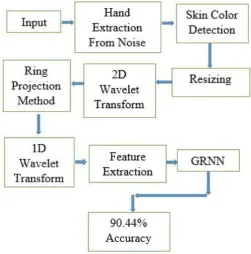
Sciences, collected in 2012, was used. The flow chart of the our proposed method is as shown
in Figure 2.
Figure 2: Flow Chart of the Proposed Method.
The data were converted to YCbCr space for skin color determination. YCbCr is a color
Cr. The YCbCr color space emerged during the worldwide effort to create a digital video
standard. Y is defined in the range 16-235 of 8 bits. Cb and Cr are defined as 16-240. The
YCbCr color model includes detachable shiny features that make it easy to separate vibrancy
and brightness. For this reason, it is a suitable color space for image processing. The relation
of this space to the RGB color space can be shown as in (1).[10]
(1)
The threshold values used in the skin color determination studies in the literature have been
investigated[11] and consequently the limitations of (2) and (3) have been used in this study in
determining the skin color.
(2)
(3)
In order to determine the hand in a clear way, it is necessary to subtract the real part from the
areas where noise can be counted. For this, 1/1200 view is taken from the whole image. This
can be regarded as a filter used to avoid a problem in understanding the hand gesture
determined by shadows or noises that may be due to the condition of the hand gesture. It is
aimed to clean the image of 256x256 in large scale by extracting the true value of 1/1200
which is the value found by trial and error method. Skin color was determined and both hand
gestures were obtained and background was removed.
The images were resized to 256x256 and the edge extraction was done with the sobel filter so
that the image processing and image dimensions do not differ.
Figure 4: Edge Detection.
The original images that have been resized are subjected to one-stage discrete 2D wavelet
transform. 2D wavelet transform is derived from one-dimensional wavelet transform. The
concept of discrete one-dimensional wavelet transform can be shown as in Figure 5.
Figure 5: Concept of Discrete Wavelet Transform.[12]
x[n] is the input signal, h[n] is high pass filter, g[n] is low pass filter, x1, L[n] is the output
of the low pass filter, x1,H[n] is the output of the high pass filter, ↓ 2 is the 2 factor sample
reduction.
2D wavelet transform is one dimensional wavelet transform over n and m. This is also shown
Figure 6: Concept of 2-D Discrete Wavelet Transform.[12]
When the 2D wavelet transform is applied to an image, 4 images are obtained at 1/4 of the
original size.[12] The Daubechies-1 filter is used for this wavelet transformation.
Figure 7: 2-D Discrete Wavelet Transform.
The horizontal coefficient vector is used since the edge information can be obtained more
clearly from the data obtained from 2D wavelet transform. The edge information obtained as
a result of the sobel filter applied to the image of the hand gesture is added to the image
obtained as a result of the 2D wavelet transformation. This was done to clearly reveal the
positions of the fingers in the hand gesture. The obtained image is shown in Figure 8.
Figure 8: An image, Edge Information Added on 2-D Discrete Wavelet Transform.
The ring projection technique is used to reduce the 2D image, which is the output of the
The ring projection technique is feature extraction, independent of the rotation process.
During this process, the center point of the view is determined, and rings are drawn inside the
radius from this center. The state of the sum of the gray level pixels of the rings passes
through the function f gives the attributes. This process is expressed in (4).[13]
(4)
For each r-value, the feature vector is obtained by summing the gray level brightness values
of the pixels falling within the T-angle range using the f-function.
(5)
The total number of features obtained in the Radial Projection method is always 360.[13]
When the images reduced to this single dimension are subjected to one-dimensional discrete
1-dimensional wavelet transform, the detailed coefficient vectors obtained as the feature
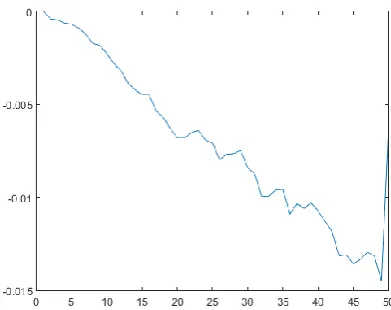
vector are used. Figure 9 shows the vector of coefficients in detail.
Figure 9: Detailed Coefficient Vector of 1-D Discrete Wavelet Transform.
This feature vector consists of 50 elements. In the used sign language data set, a data set
consisting of a total of 900 samples was used, taking 25 samples each for each hand gesture,
with 10 digits and 26 letters. 50% of this data set is used for training and 50% is used for test
data. The use of the Generalized Regression Neural Networks (GRNN) has been found
suitable for classification in consideration of the given multidimensional space distribution.
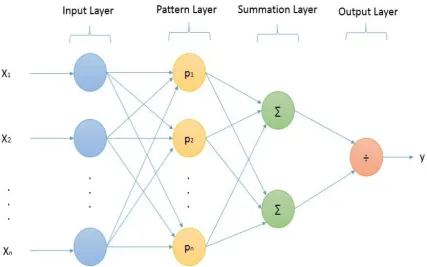
The GRNN is a radial based network which is a customized structure used for function
approach to continuous functions by giving a good performance result. It does not need
continuous training as it is in Multi-Layer Perceptrons. It may converge to a function
depending on the relationship between input and output data and training data. For this
reason, the error in approach to function converges to zero as the training data grows. It uses
the kernel approach for convergence. According to the kernel approach, the regression of a
dependent y variable relative to an independent x variable approximates the value with the
most likelihood for y given the x inputs and training set. The approach is determined to
approximate the mean square error to the lowest value. The only parameter that can be set in
GRNN networks is the smoothing (spread = σ) factor for the kernel function.[14]
Figure 10
shows the symbolic architecture of GRNN.
Figure 10: Symbolic GRNN Architecture.
RESULTS AND CONCLUSION
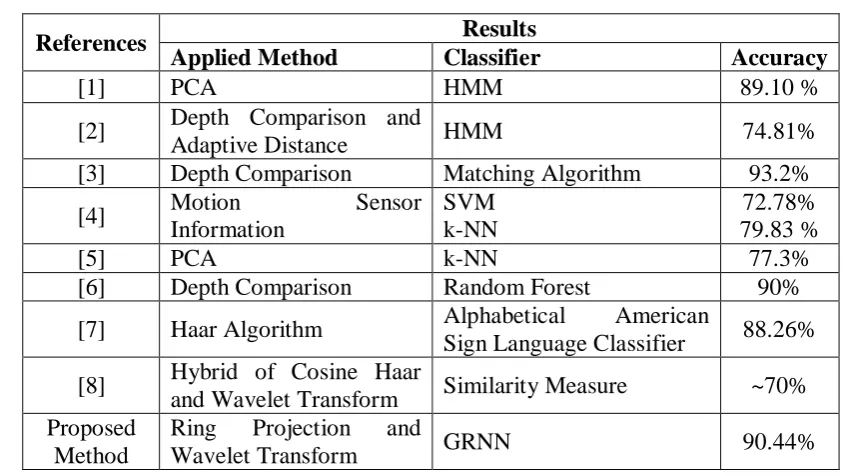
The results of the studies carried out in the literature and the method we propose are given in
Table 1: Results.
References Results
Applied Method Classifier Accuracy
[1] PCA HMM 89.10 %
[2] Depth Comparison and
Adaptive Distance HMM 74.81%
[3] Depth Comparison Matching Algorithm 93.2%
[4] Motion Sensor
Information
SVM k-NN
72.78% 79.83 %
[5] PCA k-NN 77.3%
[6] Depth Comparison Random Forest 90%
[7] Haar Algorithm Alphabetical American
Sign Language Classifier 88.26%
[8] Hybrid of Cosine Haar
and Wavelet Transform Similarity Measure ~70%
Proposed Method
Ring Projection and
Wavelet Transform GRNN 90.44%
It seems that the proposed method is more successful in understanding hand gestures when
compared to literature studies. Although the work done by Ren and his team[3] has a more
successful face than the our proposed method in this study, Ren and his team used Kinect
camera is a high-cost disadvantage and only 10 of 36 hand gestures have been worked on.
However, we have used all characters and also 10 numbers, 36 hand gestures in total.
Future work is aimed at real-time operation of this work and creation of a hardware that can
be easily used by the end user.
REFERENCES
1. Zaki M M and Shaheen S I, “Sign language recognition using a combination of new
vision based features”. Pattern Recognition Letters,2011; 32: 572-577.
2. Zafrulla Z, Brashear H, Starner T, Hamilton H, Presti P, “American sign language
recognition with the kinect”. Proceedings of the 13th international conference on
multimodal interfaces, ACM, New York, NY, USA, 2011; 279–286.
3. Ren Z, Yuan J, Meng J, and Zhang Z, “Robust Part-Based Hand Gesture Recognition
Using Kinect Sensor”. IEEE Transaction on Multimedia, 2014; 15(5): 1110-1120.
4. Chuan C H, Regina E, and Guardino C, “American Sign Language Recognition Using
Leap Motion Sensor”. 13th International Conference on Machine Learning and
5. Upendran S and Thamizharasi A, “American Sign Language Interpreter System for Deaf
and Dumb Individuals”. International Conference on Control, Instrumentation,
Communication and Computational Technologies, 2014; 1477-1481.
6. Dong C, Leu M C, and Yin Zhaozheng, “American Sign Language Alphabet Recognition
Using Microsoft Kinect”. IEEE Conference on Computer Vision and Pattern Recognition
Workshps,2015; 44-52.
7. Pansare J R and Ingle M, “Vision-based approach for American Sign Language
Recognition using Edge Orientation Histogram”. International Conference on Image,
Vision and Computing,2016; 86-90.
8. Funde A G and Thepade S D, “Recognising Sign using fractional energy of cosine haar
hybrid wavelet transform of American Sign images”, Conference on Advances in Signal
Processing, 2016; 290-294.
9. www.massey.ac.nz/~albarcza/gesture_dataset2012.html.
10.Chen Y K and Chen K J, “Pavement detection in YCbCr color space and its application.”
IEEE International Conference on Information and Automation, 2015; 663-667.
11.Phung S L, Bouzerdoum A and Chai D, “A novelskin color model in ycbcr color space
and its application to humanface detection”. In IEEE International Conference on Image
Processing (ICIP’2002), 2002; 1: 289–292.
12.Pan G C, “A Tutorial of Wavelet for Pattern Recognition”. Graduate Institute of
Communication Engineering, National Taiwan University, Taipei, Taiwan, ROC.
13.Ataş M, Kaya Y, and Uyar M, “An Efficient Rotation Invariant Feature Extraction
Method Based on Ring Projection Technique”. 21st Signal and Communications
Applications Conference, 2013.
14.Sezer E, “Epilepsi Teşhisi için EEG Sinyal Analizi”. Selçuk University, Graduare School

![Figure 5: Concept of Discrete Wavelet Transform.[12]](https://thumb-us.123doks.com/thumbv2/123dok_us/8359861.1670705/5.595.254.340.125.321/figure-concept-of-discrete-wavelet-transform.webp)
![Figure 6: Concept of 2-D Discrete Wavelet Transform.[12]](https://thumb-us.123doks.com/thumbv2/123dok_us/8359861.1670705/6.595.81.520.80.240/figure-concept-of-d-discrete-wavelet-transform.webp)