Volume 40: March 2019
ISSN 2414-6633
https://doi.org/10.22151/politikon.40
Editorial Board
Editor-in-Chief:
Max Steuer (Slovakia)
Deputy Editor-in-Chief:
Rafael Plancarte (Mexico)
Ana Magdalena Figueroa (Brazil)
Justinas Lingevičus (Lithuania)
Stephanie Mojica (USA)
Dana Rice (Australia)
Gergana Tzvetkova (Bulgaria)
Editorial Assistants
Cláudia
Susana Rodrigues de Araújo (Portugal)
Andressa Liegi Vieira Costa (Brazil)
Ngoc Anh Khoa Doan (Vietnam)
Karla
Drpić (Croatia)
Damla Keşkekci (Turkey)
Jesslene Lee (Singapore)
Emmanuelle Rousseau (France)
Kamila Suchomel (Czech Republic)
Table of Contents
Editorial Note ... 4
Special Section: IAPSS Academic Think Tank & Academic Committee
2017/2018
Articles
Attending to the wrong issue in the political spectrum: Right-wing populism for
left-wing concerns in the EU /
Lora Hadzhidimova and Aaron Stacey
... 7
More integration or more disintegration in the European Union? A sociological
perspective /
Lora Hadzhidimova
... 28
Research Note
Understanding the enlargement of the Eurasian Economic Union: The case of
Armenia and Kyrgyzstan /
Rigina Syssoyeva
... 48
Article
Domestic Politics as an Explanation for Voluntary Union: The Missing Case of the
United Arab Republic /
Joshua A. Schwartz
... 61
Editorial Note
https://doi.org/10.22151/politikon.40.0
While each issue of IAPSS Politikon presents unique original texts, this issue is special in two additional respects. Firstly, Vol. 40 contains a special section bringing together the contributions of the members of the IAPSS Academic Think Tank and Academic Committee (ATT & ACOM). Thereby it continues the tradition of the journal to encourage submissions from individuals and research groups that are active in the Association. These submissions undergo an equally rigorous peer review process and at the same time point to some areas of current research interests of junior scholars. On this occasion, we are grateful to Dr. Jamila Glover, the 2017/2018 ATT & ACOM Coordinator, who facilitated this initiative and who introduces us to the special section below:
The 2017-2018 ATT/ACOM research efforts focused on issues, debates and controversies related to the (un)intended consequences of globalization. Such topics included inequality, regional integration and the rise of nationalism.
Lora Hadzhidimova and Aaron Stacey analyse the relationship between populism and the national concerns expressed by citizens in the European Union’s (EU) Eastern and Western member-states. The authors find that the predominant type of populism in the EU does not overlap with the type of concerns on a national level. The article concludes with outlining the implications of their findings.
In a single-authored piece, Lora Hadzhidimova presents a comprehensive overview of the emergence, evolution and current state of scholarly debate on the contentious issue of integration in the European Union. She argues that the debate has shifted from a paradigm perspective to a problem driven approach. The article further contends that this new approach is optimal because it is pragmatic in solving complex problems that occur within the EU.
Rigina Syssoyeva’s research note addresses the growth of the Eurasian Economic Union (EAEU). She conducts s a rigorous qualitative research study that demonstrates that Schimmelfennig’s theoretical concepts can explain the process of enlargement of the EAEU.
The second speciality is the introduction of the IAPSS Politikon Best Article Award. This Award will be given out to the article published in each annual edition of IAPSS Politikon (comprising four issues of the journal each) that represents an outstanding contribution from the perspective of (1) the quality of the article’s work with concepts and theories and/or empirical data, (2) the originality of the article’s argument, and (3) the potential of the article to enhance academic discussion in Political Science and/or practice. The Award consists of a certificate of recognition, promotion of the winning article through the IAPSS channels, and a registration fee waiver for one of the upcoming IAPSS conferences within 12 months after the reception of the award. Honorable mentions may be given out in addition to the award accompanied with a certificate. Depending on available means, other prizes may be included into the award on a case-by-case basis. All research papers published in the journal are automatically eligible (there is no separate nomination process).
The inaugural edition of the Award will be based on the issues published in 2018; however, the articles of Vol. 40 will be subject to evaluation in 2020, and those who consider the submission to the journal still have a chance, depending on the outcome of the evaluation process and the date of publication, to be considered for the 2020 edition of the Award. The Editorial Board hopes that the Award will encourage even more high-quality contributions as well as stimulate the readership and reflections on the published articles.
As with other aspects of the journal’s functioning, the Politikon Best Article Award is a collaborative enterprise between junior scholars with the help of senior scholars.1 As such, the Award Committee consists of two senior scholars and one junior scholar, who may be joined by an Honorary Chairperson. The Honorary Chairperson is a senior scholar in the honour of whom the Award is given out for the respective year. Each of these scholars needs to demonstrate significant contributions to Political Science research and/or teaching but also to place special emphasis on support for students and junior scholars worldwide and/or in a particular region of the world where institutional support of this kind is lacking. We are pleased to announce that the inaugural Award Committee will be chaired by Professor İlter Turan, Past-President of the International Political Science Association (IPSA) and Emeritus Professor of Political Science at Istanbul Bilgi University, who is thereby recognized for his contributions to the fields of comparative and Turkish politics and foreign policy, but also for the significant support provided to students and junior scholars through
various positions in university administration and in IPSA. The names of the other members of the Award Committee will be announced together with the results of its work.
Last but not least, the publication of this issue in advance of the publication date in order to increase the dissemination of new findings and discussions has been made possible by the continuous dedication of the Editorial Board as well as the Editorial Assistants. Also, welcome to the newest member of the Editorial Board, Dana Rice.
We look forward to continuing the dialogue with many of you and to the introduction of further good news about the development of the journal in the near future.
Attending to the wrong issue in the political spectrum: Right-wing
populism for left-wing concerns in the EU
Lora Hadzhidimova and Aaron Stacey2
https://doi.org/10.22151/politikon.40.1
Lora Hadzhidimova is a PhD candidate in International Studies with a focus on Security Studies at Old Dominion University, Norfolk, VA. She earned her MA degree in Humanities at ODU and holds an LL.M. degree from Sofia University, Bulgaria. Previously, she completed internships with the Operational Analysis branch in NATO-ACT and the Joint Forces Staff College in Norfolk, VA. E-mail: [email protected].
Aaron Stacey has a BA in Politics, Philosophy, and Economics from the University of Stirling in the UK, and an MA in Political Economy of Russia and Eastern Europe from University College London. He is currently a Doctoral Candidate in the Graduate Program in International Studies at Old Dominion University, Norfolk, VA, where he concentrated in Transnational, Interdependence and Power, and International Political Economy. In addition to European academic interests, he has also worked at the Institute for Asian Studies, and the Confucius Institute. E-mail: [email protected].
Abstract
This study aims to explore the relationship between populism and the national concerns expressed by citizens in the European Union (EU). In particular, we seek to determine if a certain type of populism in the countries (right or left) responds to the leading national concerns (cleavages). In order to do so, we examine the national concerns and the type of populism in the EU’s Eastern and Western member-states, separately, and then compare them. Results show, first, that right-wing populism in the EU is much more common than left-wing populism, and, second, that the East and the West share to a large extent similar national concerns that are left-wing in nature. We conclude that the predominant type of populism in the EU does not overlap with the type of concerns on a national level. Implications for this tendency are provided.
Keywords
European Union; Left-Wing; National Concerns; Populism; Right-Wing
Introduction
In the past few years, there has been a rise in the support for parties that have come to be termed ‘populist’ or ‘anti-establishment’. The parties come from both left and right, can present different degrees of authoritarianism, of nationalism, and geographically span through the European continent. Based on these parties’ diversity, has arisen the question of the type of populist party that countries have. In some countries, the populist party has a left-wing hue while in other it leans to the right. Some theories suggest that the leftness or rightness of a populist party depends on what social cleavages and concerns are most salient in that society. When an economic cleavage is most salient, such as the gap between rich and poor, income inequality, job prospects and so forth, populists tend to lean to the left. In the case of a salient cultural cleavage, in terms of immigration, language, religion, and others, populist parties will tack to the right. In some places both cleavages may coexist, populists consequently having elements of both (Rodrik, 2017). In this case, the variety of populist parties across Europe as a whole may be explained by the concerns that are most pressing to the people of each country. Using responses from Eurobarometer surveys from the past 10 years, that ask people in each EU-member state what the most pressing concern facing their country is, this paper seeks to test the hypothesis that economic cleavages lead to left-wing populism and cultural cleavages to right-wing populism. If it is true, then we might expect to see that countries, where people have economic concerns would tend to have a populist party that leaned to the left while in countries where people reported cultural concerns the local populist party leaned to the right. We will also pay attention to variations over and across different regions of Europe such as in the East and the West.
Literature Review
One of the striking features in the literature on populism is the difficulty that authors have had to define the concept as it has been used to describe a variety of movements, parties, and policies, across a variety of geographical locations and time periods, beginning with the Narodniks of Russia in the 1870s and the Farmers’ movement in the United States of the same period. One of the earliest attempts to analyze and define the concept of populism was the 1969 book Populism (Ionescu and Gellner, 1969) which derived from a conference held in London. It discussed the phenomena from a variety of angles and across a number of geographical areas but did not reach an all-encompassing definition beyond the underlying criteria that populism lionized “the people” (Ionescu and Gellner, 1969).
whereas the elite are corrupt, or even that the people are superior to the elite (Mudde, 2004). Beyond that, populism does not present a set of ideas and policies of its own, offering a narrative about how society should be run. On its own, the people versus the elite dynamic can be meshed with either left-wing or right-wing ideologies (Taggart, 2000; Mudde and Kaltwasser, 2013). A study of the voting patterns of left-wing and right-wing populist parties in the Dutch Parliament showed that they had little in common in terms of their voting positions, except their opposition to supranational institutions (Otjes and Louwerse, 2013).
From this perspective, there are no “pure” forms of populism and its study takes the form of case studies, mixing the concept in with specific contexts of time and place (Taggart, 2000). Culture and context are important in understanding populist movements as they reach across geographical location, historic period, and political ideology (Kaltwasser, 2014).
In Western Europe, resurgent populism has sought to exclude others, especially immigrants, through welfare chauvinism, while in Latin America the populist movements have sought to include previously marginalized groups in the political life (Madrid, 2008; Mudde and Katwasser, 2013; Koster et al., 2013). However, it should not be said that all European populist movements are based on exclusion, a counter case being the Greek leftist party Syriza (Stavrakakis and Katsembakis, 2014). These differences in the inclusiveness or exclusiveness of populism are also part of the debate about whether populism is good or bad for democracy (Mudde and Kaltwasser, 2012; Gidron and Bonikowski, 2013). Those who look at populism in its European context, such as Mudde, Kaltwasser (2012), and Bartolini (2011), view it as a negative development for democracy. This negativity stems from its main European manifestation in the form of rather xenophobic radical right-wing parties; some of the language surrounding the discussion about this strain of populism brings up imagery of disease and pathology (Bartolini, 2011; Gidron and Bonikowski, 2013).
short-termist and careless of budget constraints. Other studies also noted this short-term characteristic (Guiso et al., 2017).
Simultaneously, existing economic difficulties are blamed on foreigners and international institutions that engage in or support unfair competition, harming the domestic population but benefiting the elite. Immigrants are presented as stealing jobs, enabling employers to hold down wages, and “bleeding” the welfare system dry. An elevated sensitivity to immigration as a political issue is also found to be a factor in generating support for populism by Bale (2013), alongside the party leader’s style, and whether or not a party is in opposition or in power. Hostility to immigration can fit into the broader category of “Heritage Populism” as described by Reynié (2016) in his study of the French Front National. Heritage populism centers itself around the protection of heritage in both tangible and intangible forms. Tangible heritage refers to living standards and intangible heritage to ‘way of life’. Both of these can be claimed by populists to be threatened by immigrants as well as by global economic changes (Reynié, 2016).
The populist economic policies’ short-termism is put into practice through expansionary economic policies, running deficits yielding quickly visible short-term benefits but can build up debts and other longer-term problems in the financial system. Economic openness can also be reduced, including the freedom of trade and increased regulation, as well as erosion of some laws (Rode and Revuelta, 2015). Immigration can be made harder and welfare chauvinist social policies make access to welfare payments more difficult for foreigners. Longer-term problems can be large enough to end up canceling out the short-term gains, sometimes to the extent that the overall economic interests of the intended beneficiaries are harmed (Acemoglu et al. 2013).
Fuest (2017) also echoes a point made elsewhere by Taggart (2000) that populists usually offer simplistic interpretations and solutions to complex problems. According to Madrid (2008), populist proponents of these types of policies in Latin America have used them as a way to signal to the electorate that they have not been captured by powerful elite economic interests. Rodrik (2017) distinguishes between populist orientations responding to cultural cleavages and those responding to economic cleavages. This is similar to Inglehart and Norris’ (2016) observation that the traditional left-right cleavage also has a cross-cutting cultural cleavage along the populist-cosmopolitan liberalist lines.
been Muslims, the EU, and other minorities such as Gypsies or Jews. In this case, populism takes a right-wing form and is epitomized in the U.S. by Trump, and in Europe by radical right parties such as the French Front National.
In the case of an economic cleavage, the emphasis tends to be on the gap between the haves and have-nots. Populists calling attention to this cleavage tend to be leftist, and include Bernie Sanders in the U.S., and parties such as Syriza in Europe. These two cleavages can overlap, and both are subject to the “supply and demand” rule with certain problems generating a demand and populist parties stepping in to supply a narrative. Mukand and Rodrik (2017) divide society into three groups: elite, majority, and minority. Depending on the cleavage, a different group will be cast as the problem. In the case of a cultural cleavage, the minority is portrayed as the ‘other’ on the base of identity. With an economic cleavage, the elite is singled out based on their wealth. Populists mobilize supporters based on these divisions, with the former being right-wing and the latter left-wing (Mukand and Rodrik, 2017).
Guiso et al. (2017) expand this idea of demand and supply, i.e. where there is an interaction between a ‘demand’ stemming from economic and distributional problems, creating an inchoate sense of dissatisfaction, and anxiety. Populists ‘supply’ a narrative that helps make sense of these problems and explains who is to blame (also in Rodrik, 2017) by saying that demand/supply for short-term protection is at the conjunction of the two. When faced with an economic cleavage this can take for instance the form of import restrictions; when responding to cultural cleavages short-term protection may take the form of immigration bans or border walls. Since the cultural and economic cleavages can overlap, some populist parties may combine the two, such as Ataka (Attack) in Bulgaria, which has a nationalist and anti-Muslim message combined with policies to improve welfare spending. Other populist parties that combine a xenophobic message with criticisms of the global capitalism’s dynamics include Jobbik in Hungary and Golden Dawn in Greece (Inglehart and Norris, 2016).
Either way, the response generally involves some radical institutional change or the removal of some institutional restraints that have unclear long-term effects. Populists try to obscure these effects or only talk about them vaguely. Detailed scrutiny of long-term effects coming from experts or various prominent institutions can be rebuffed as coming from the elites who caused the problem in the first place (Guiso et al. 2017).
dynamic is an “empty signifier” that is filled in according to a given context (Laclau, 2005). As a political strategy and organization, populism is described as being centralized around a charismatic leader who is able to interpret and channel the will of the people. (Gidron and Bonikowski, 2013).
Additional factors discussed as causes of support for populism include demographic and psychological characteristics of certain voters, who are considered to typically be of lower socioeconomic status, lower formal education, male, and of the majority ethnicity, while on psychological measures such supporters score low on Agreeableness and have a tendency towards conspiracy theorizing (Bakker et al., 2015; Taggart, 2000). However, in a more recent article, Roodujin suggests that there is no ‘typical’ supporter of populist parties across Western Europe, with characteristics varying from country to country (Rooduijn, 2017).
Support for populists may also signal the health or lack thereof in a democracy whereas an increase in populism suggests that the regular democratic functioning is not as good as it could be (Taggart, 2000) and acts similarly to a “drunken dinner guest” that brings up important issues that “polite society” would rather ignore (Arditi, 2007). Support for populism arises from the gap between the ideal of democracy representing the will of the people and the practical reality of institutions that are run by professional and political elites (Meny and Surel, 2000), as well as the sometimes opaque functioning of these institutions (Canovan, 2002). Populists prioritize the implementation of the will of the people to the detriment of checks and balances (Urbinati, 1998).
Methods
The research question that we aim to explore in the present study is the relationship between populism and the national concerns expressed by EU-voters. More precisely, we seek to uncover if a certain type of populism (right or left) actually responds to a particular national concern (cleavage) that belongs to the realm of the left- or the right-wing populist agenda. We explore national concerns in two time-frames: in a ten-year time frame (2008-2017); and in the most recent time frame for which information was available (2013-2017) so that we can observe how concerns evolve in time and if the countries’ type of populism reflects these concerns as they change. Two reasons presided to our choice to dividing the time-periods this way. First, we want to delineate the most predominant concerns in the EU for the entire period for which data was available whilst capturing the immigration crisis. Second, we aim to examine if, in the shorter 5-year period characterized by high tension engendered by immigration issues, these tensions will assign immigration a leading place among other concerns.
concerns on a national level are the same in the East and in the West. The countries included in the category for Eastern Europe are: Bulgaria, Czech Republic, Croatia, Cyprus, Estonia, Greece, Hungary, Latvia, Lithuania, Malta, Poland, Romania, Slovakia, and Slovenia. The ones in the group of Western Europe are: Austria, Belgium, Denmark, Finland, France, Germany, Ireland, Italy, Luxembourg, Portugal, Spain, Sweden, the Netherlands, and the United Kingdom. We expect to observe, as Hawkins et al. (2012) note, that the far-right populism will be predominant in the more affluent Western countries, and left-wing in Eastern Europe, due to the economic cleavage existing inside these populations.
The present study uses data from the Standard Barometer conducted by the European Commission in the years from 2008 to 2017 in order to determine what the biggest concerns for the population of a certain EU-member state on a national level are. Since the Standard Barometer is a survey conducted twice a year, the results reveal slight differences. For the purposes of our research, from the two annual Barometers, we chose the national concern that is the most shared among the respondents. The answers of the surveyed sample fall into the following categories: security, economy, rising prices/inflation, taxation, unemployment, terrorism, defense/foreign affairs, housing, immigration, healthcare system, education system, pensions, environmental concerns, energy-related concerns, government debt, climate change. These groups correspond to different types of populism that will be discussed further in the context of the findings. The units of analysis are the 28 member-states of the EU (including the U.K). Despite the fact that Croatia has become a member only in 2013, it is part of the dataset as its development was not only monitored closely for reasons related to its potential membership but was also part of the official data gathering for the Eurobarometer.
Results and Findings
The first set of findings includes an overview of the populist types in the entire European Union, then in the Eastern part, and in the Western, respectively. By doing so, we aim to make the first step toward a comparison between the type of populism in the EU and the concerns that the citizens express, by country, and to respond to the question if they match or there are some deviations from what we expect to observe. In addition, the results and the findings in this study do not aim to provide support for the fact that only one single factor causes one or another type of populism but only to show some tendencies in how different types of populism reflect on popular concerns. As shown in Table 1, right-wing populism is not only prevalent in Western Europe, as the literature on the question suggests but is also predominant in Eastern Europe, contrary to our expectations. In a small number of cases, there are some amalgamations between left- and right-wing populism. Nonetheless, even if they are added to the percent of left-wing populism, the right-wing type still overwhelmingly outweighs the percentage of the left-wing populism. Interestingly, the right-wing populism’s level in Eastern Europe is just as high as in Western Europe. In this regard, it could be concluded that the EU is very homogenous in terms of the predominant type of populism regardless of outlined cultural, economic, historical, and societal differences.
Table 1.Percentage of populism in the European Union by type (2008-2017).
Type of populism In the European Union
In Eastern Europe
In Western Europe
Right-wing populism
75% 71.43% 78.57%
Left-wing populism 14.29% 14.29% 14.29%
Both types 10.72% 14.29% 7.14%
Source: Authors.
Figure 1.Percentage of national concerns in the European Union (2008-2017).
Source: Authors.
The second part of this stage of our study focuses on the results from the more recent and shorter 5-year period. While the findings in Figure 2 overlap with those from Figure 1 in terms of the leading concern, there are some very important differences and changes that have taken place in the EU. First, the view of unemployment as a major concern has decreased among the EU-citizens. With much less support than the unemployment but still with a sensible increase is the immigration as a concern from the right-wing domain. In the 2013-2017 period, concerns like housing, healthcare and social security and economy also appear, all of them belonging to the left-wing populist agenda. These dynamics captured in these two snapshots underline two factors. One of them has to do with the confirmation of left-wing concerns even when we focus on a shorter period of time, thus, it should logically lead to a more heightened presence of left-wing populist parties. The second finding relates to the increased importance of immigration as a concern on a multinational level and its potential to be used in narratives that could affect discussions about other non-right-wing issues (such as housing, the economy, and the healthcare and social security system).
Figure 2.Percentage of national concerns in the European Union (2013-2017).
Source: Authors.
0% 10% 20% 30% 40% 50% 60% 70% 80% 90%
Economy Immigration Inflation Unemployment
Percentage of national concerns in the European Union (2008-2017)
0% 10% 20% 30% 40% 50% 60%
Economy Healthcare and Social Security Housing Immigration Inflation Unemployment
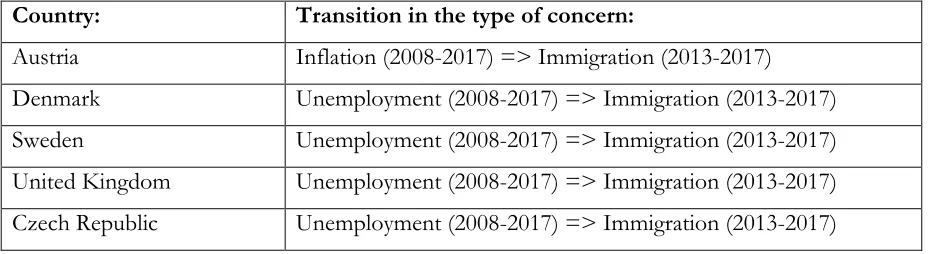
Table 2 shows what particular countries shifted from left-wing concerns to right-wing concerns, by comparing the 10-year period to the 5-year one. Four Western states – Austria, Denmark, Sweden and the U.K. - transitioned from predominantly left-wing concerns (inflation and unemployment) to immigration as the most shared concern. As opposed to this, only one Eastern European country, the Czech Republic, shifted toward the immigration (right-wing) concern. In the case of three of the four western European states, Austria, Denmark, and Sweden, the shift of main concern to immigration may have been caused by the country’s respective experience of the 2015 migration crisis. Austria and Denmark found themselves part of the overland transit route into neighboring countries that had initially adopted an open stance towards refugees and migrants. As a result, they experienced a sudden increase of transiting refugees and asylum seekers. Sweden took something over 134,000 refugees and migrants during the crisis equivalent to 1.6% of Sweden’s population, and a total that exceeded the number of births in the country that year (The Swedish Institute, 2018a). The few years before the crisis had also seen historically high rates of immigration to Sweden too (The Swedish Institute, 2018b). In all three of these countries in the preceding 5-year period, there was a significant increase in the number of people from abroad. In the U.K., comparatively, few people were taken in during the migration crisis, although the crisis added further rhetorical fuel to the already burning debate over immigration that had its origins in issues such as freedom of movement (BBC, 2016). Also from around 2012-2013 period, the unemployment in the U.K. had begun to decline (Office for National Statistics 2018). In Sweden too, unemployment began to ease a little after 2010 (Statistics Sweden, 2005), while in Denmark it began to fall around 2012-2013 (Statistics Denmark, 2018). The Czech Republic took few refugees in during the crisis, and overall its immigrant population accounted for 6% of its population, the 24th highest rate in the Organization for Economic Co-operation and Development (OECD, 2018). However, efforts by the EU to redistribute the refugee population among member states has stoked resistance in the Czech Republic to being forced to take in refugees that it does not want (Frum, 2017).
Table 2.Difference between the most frequent concern in a ten-year period (2008-2017) and the last five years of this period (2013-2017) in terms of the transition from left-wing to right-wing populism.
Country: Transition in the type of concern:
Austria Inflation (2008-2017) => Immigration (2013-2017)
Denmark Unemployment (2008-2017) => Immigration (2013-2017)
Sweden Unemployment (2008-2017) => Immigration (2013-2017)
The second research question that we attempt to address is related to the differences between the national concerns in Eastern and Western Europe. In order to compare them properly, we divided them into two periods as we did with the results from the entire EU. Findings from our study in Western Europe do not provide support for what the literature suggests we would observe – right-wing concerns that will provide a suitable political climate for right-wing populism. While this type of populism is indeed the predominant type, empirical results do not show that the biggest concerns on a national level are the right-wing concerns. Unemployment, as belonging into the left-wing domain is overrepresented (more than 75%) in Western Europe, followed by inflation, immigration, and concerns about the economy, all with less than 10%, as shown in Figure 3.
Figure 3. Percentage of national concerns in the Western member-states of the European Union (2008-2017).
Source: Authors.
As opposed to the 10-year period, the 2013-2017 one shows notable discrepancies regarding immigration. Unemployment remains still the most prevalent concern, represented by 50%, but immigration had advanced to 36% which is a significant increase from the 10-year time-frame. One other change is also observable in Figure 4 – the housing, and the healthcare and social security concerns, customary for the left-wing domain.
Interestingly, the picture of the 10-year period for the Eastern European concerns, captured in Figure 5, does not look much different from the one for Western Europe considering the same time-frame. Unemployment leads as the most shared concern with 79%, followed by inflation, immigration and economy concerns with 7%. These results point to the conclusion that there are literally no differences between the perceptions of the biggest concerns in both Eastern and Western Europe when a 10-year period is considered.
0% 10% 20% 30% 40% 50% 60% 70% 80% 90%
Economy Immigration Inflation Unemployment
Percentage of national concerns
Figure 4. Percentage of national concerns in the Western member-states of the European Union (2013-2017).
Source: Authors.
Figure 5.Percent of national concerns in the Eastern member-states of the European Union (2008-2017).
Source: Authors.
Figure 6 shows, similarly to the concerns of Western Europeans in the longer time-frame, the ones of Eastern Europeans for the shorter, 5-year time-frame, that almost fully replicate the ones discussed above. Unemployment is still the leading concern, followed by inflation and immigration that all have 14%, and concerns about the economy with 7%. Compared to the 10-year period, the shorter one (2013-2017) reveals the same characteristics as the former but with somewhat increased support for immigration and inflation, that are, still far behind the 64% support for unemployment as a major concern. The Eastern European citizens supporting immigration as the most pressing concern (14%) are significantly less than the ones in Western Europe (36%). A possible explaining factor lays in the series of terrorist attacks perpetrated by ISIS in Western and not Eastern Europe – a fact that was exploited by right-wing populist parties supporting narratives that inspire fear of issues typical for the right-wing populist agenda.
0% 10% 20% 30% 40% 50% 60%
Healthcare and Social Security Housing Immigration Unemployment
Percentage of national concerns
in the Western member-states of the European Union (2013-2017)
0% 10% 20% 30% 40% 50% 60% 70% 80% 90%
Economy Immigration Inflation Unemployment
Figure 6. Percentage of national concerns in the Eastern member-states of the European Union (2013-2017).
Source: Authors.
Discussion
The results presented in the section above suggest two major findings. First, the biggest issues that Europeans see on a national level are left-wing concerns but the predominant type of populism in the states is right-wing one. Second, Eastern and Western European states are not that different in terms of the predominant concerns, despite their historical, cultural and economic differences. These findings, in contrast to what the literature suggests, create some room for a further discussion. The lack of similar studies exploring the relationship between populism and national concerns is not allowing us to compare the results from this research with other inquiries. However, in this section, some context of the problem is provided and mainly to the question if there are economic rather than cultural and social concerns that are predominant in the EU, then to what we could attribute the lack of success of the left-wing populist and the growing popularity of right-wing parties.
Our findings point to an interesting paradox: the predominant concerns are left-wing in nature and yet the voters choose right-wing populist parties over left-wing populist parties. Politicians from the right-wing populist spectrum do not change their programs based on the concerns of the citizens but instead, they skillfully endeavor to adapt the conditions that different events create in order to bolster their right-wing agenda despite the overwhelming amount of left-wing concerns of the Europeans. Thus, they attempt to incorporate right-left-wing solutions to left-left-wing concerns, for instance to resolve an unemployment problem through blocking immigration. Moreover, the motive of vilifying a particular group of the population by attributing major concerns that they supposedly create has much more power due to its applicability to a very wide range of topics. In addition, it is much easier to control a narrative about an enemy than to face economic problems that deserve proper attention, concrete reforms and are generally much harder to be
0% 10% 20% 30% 40% 50% 60% 70%
Economy Immigration Inflation Unemployment
managed. Campbell (1998) links this enemy creation to the state’s identity that protects the citizens from threats, as a way to reaffirm its role as an authority distributing public goods, including security. Another reason why right-wing populism has been so widely successful is that it provides much more clarity of its political program to the voter than the traditional parties (Canovan 2002). Moreover, a left-wing populist party would also be hardly understood by the average voter mainly because of the specifics that the economist terminology poses. As opposed to this tendency, the right-wing populists have easily comprehensible manifestos that rely on emotions and symbols, rather than on stable socio-economic programs – a fact that makes them appealing to the masses that find themselves in a transition to a “postindustrial capitalism” (Betz 1993: 665). Yilmaz (2012: 377) explains the success of right-wing populism by a change from the economic division in society to a division between the different cultures, as the latter has become increasingly important for the ontological security of the Europeans. He continues by outlining why the left-wing parties suffered from the discourse that the right-wing populists created and maintain:
The populist right managed to frame media debates, via ongoing moral panics around immigrants’ ‘cultural’ behaviors, in such a way that political parties of all persuasions are forced to respond continually to ever fresh scandals and intentional provocations. They thus tacitly accept the premises for these so-called debates (Yılmaz, 2011). Whatever the differences between political platforms, the basic antagonism produces its own culturally defined social divisions, making it impossible to articulate alternative visions under given conditions. This is what paralyzes social democrats.
– “economic changes, political elitism and corruption, and immigration” and in particular determined which one is responsible for the success of right-wing populist parties in Western Europe. She found that the appeal to immigration issues is the factor without which the right-wing populist parties did not perform well on elections. That said, it could be derived that left-wing populist parties relying heavily on political manifestos that accentuate economic and class issues in society were not as successful as their right-wing counterparts.
Conclusion
In the era of a new wave of populism in Europe, it is important to distinguish between the types of populism, the goals that they pursue, and to what extent these political parties are a response to actual concerns shared by voters. In this study, we explored the link between the two variations of populism – the right-wing and the left-wing and perceptions of problems in EU member-states. In addition, we compared the concerns in Eastern and Western Europe. Our results refuted the idea that, because of their economic, historical, cultural and societal characteristics, their needs and concerns were fundamentally different. We also found a lack of overlap between the concerns shared by EU-citizens, belonging to the left-wing domain – unemployment, inflation and economic concerns, and the right-wing populist parties that notably surpass the number of left-wing populist parties. Having established that the predominant type of populism in the EU, the far-right, does not seek to address public concerns in regard to the economic sector, we identified a few factors that could have engendered this tendency. Among them is the appeal of the narrative about the “enemy” that is in the core of the immigration debate. It shifted the attention of both the voters and the traditional parties from conversations about concrete political measures and reforms to improving the socio-economic indicators. At the same time, left-wing parties are at a significant disadvantage in comparison to the right-wing ones because of the dilemma that they inevitably face – how to improve the nation’s economy in a globalized, interconnected world, by economic self-sufficiency and by cutting ties with major organizations and institutions of international significance. In theory, in various EU-states with increased presence of left-wing populist parties (i.e. Greece, Ireland, Spain), the economic challenges were becoming so unmanageable to deal with domestic measures that the only choice left was to continue the dialogue with the EU and the other transnational partners despite the inherent antipathy of populist parties towards multilateral organizations and institutions.
easily created, applied, and supported through the presence of a common cultural enemy that could be also blamed for economic shortcomings.
References
Acemoglu, Daron, Egorov, Georgy and Konstantin Sonin (2013): ‘A political theory of populism’.
The Quarterly Journal of Economics, 128(2), pp. 771-805. DOI:
https://doi.org/10.1093/qje/qjs077.
Arditi, Benjamin (2007): Politics on the Edges of Liberalism. Difference, Populism, Revolution, Agitation. Edinburgh: Edinburgh University Press.
Bakker, Bert N., Rooduijn, Matthijs, and Schumacher, Gijs (2015): ‘The psychological roots of populist voting: Evidence from the United States, the Netherlands and Germany’. European Journal of Political Research, Volume 55, Issue 2, pp. 302-320. DOI:
https://doi.org/10.1111/1475-6765.12121.
Bale, Tim (2013): ‘More and More Restrictive—But Not Always Populist: Explaining Variation in the British Conservative Party's Stance on Immigration and Asylum’. Journal of Contemporary European Studies, 21(1), pp. 25–37. DOI: https://doi.org/10.1080/14782804.2013.766474.
Bartolini, Stefano (2011): ‘Political parties, ideology and populism in the post-crisis Europe’, Poros Conference, 7-10 July 2011. Accessible at:
http://europeanseminars.eliamep.gr/wp-content/uploads/2011/07/Stefano-Bartolini-Paper.pdf.
BBC (2016, March 04): ‘Migrant crisis:Migration to Europe explained in seven charts’. Accessible
at: https://www.bbc.com/news/world-europe-34131911 (July 11, 2018).
Betz, Hans-Georg (1993): ‘The Two Faces of Radical Right-Wing Populism in Western Europe’. The Review of Politics, 55(4), pp. 663-686, https://doi.org/10.1017/S0034670500018040.
British Office for National Statistics (July, 2018): ‘Time series: Unemployment rate (aged 16 and
over, seasonally adjusted)’. Accessible at:
https://www.ons.gov.uk/employmentandlabourmarket/peoplenotinwork/unemployment/timeser
ies/mgsx (July 18, 2018).
Campbell, David (1998): Writing security: United States foreign policy and the politics of identity. University of Minnesota Press.
Frum, David (2017): ‘The Toxic Politics of Migration in the Czech Republic’. The Atlantic. Accesible
at: https://www.theatlantic.com/international/archive/2017/10/czech-elections/543669/ (July 16,
2018)
Fuest, Clemens (2017): ‘Populist economic policy and how to respond to it’. Euraktiv, Accesible at:
https://www.euractiv.com/section/elections/opinion/populist-economic-policy-and-how-to-respond-to-it/ (July 2, 2018).
Gidron, Noam and Bonikowski, Bart (2013): ‘Varieties of Populism’. Harvard Working Paper Series,
No. 13-0004, Accessible at
https://scholar.harvard.edu/files/gidron_bonikowski_populismlitreview_2013.pdf (November 13,
2018).
Guiso, Luigi, Herrera, Helios, Morelli, Massimo and Sonno, Tommaso (2017): ‘Populism: Demand and Supply’. Center for Economic Policy Research Discussion Paper 11871. Accessible at:
http://www.heliosherrera.com/populism.pdf (November 13, 2018).
Hawkins, Kirk Andrew, Riding, Scott, and Mudde, Cas (2012): ‘Measuring populist attitudes’. Political Concepts Committee on Concepts and Methods Working Paper Series, 55, pp. 1-35.
Inglehart, Ronald, and Norris, Pippa (2016): ‘Trump, Brexit, and the Rise of Populism: Economic Have-Nots and Cultural Backlash’. Harvard Kennedy School, Faculty Research Working Paper
Series, RWP16-026. Accessible at:
https://research.hks.harvard.edu/publications/getFile.aspx?Id=1401 (November 13, 2018).
Ionescu, Ghita, and Gellner, Ernest (1969): Populism: Its Meanings and National Characteristics. London: Palgrave Macmillan.
Ivarsflaten, Elisabeth (2008). ‘What unites right-wing populists in Western Europe? Re-examining grievance mobilization models in seven successful cases’. Comparative Political Studies, 41(1), pp. 3-23. DOI: https://doi.org/10.1177/0010414006294168.
Kaltwasser, Cristóbal Rovira (2014): ‘The responses of populism to Dahl's democratic dilemmas’. Political Studies, 62(3), pp. 470-487. DOI: https://doi.org/10.1111/1467-9248.12038.
Koster (de), Willem, Achterberg, Peter, and van der Waal, Jeroen (2013): ‘The new right and the welfare state: The electoral relevance of welfare chauvinism and welfare populism in the Netherlands’. International Political Science Review, 34(1), pp. 3–20. DOI:
https://doi.org/10.1177/0192512112455443.
Laclau, Ernesto (2005): On Populist Reason. London: Verso.
Madrid, Raul L. (2008): ‘The Rise of Ethnopopulism in Latin America’. World Politics, 60(3), pp. 475-508. DOI: https://doi.org/10.1017/S0043887100009060.
Mavrozacharakis, Emmanouil, Kotroyannos, Dimitrios and Tzagkarakis, Stylianos Ioannis (2017): ‘Mediterranean Left-Wing Populism: The Case of SYRIZA’. European Quarterly of Political
Attitudes and Mentalities, 6(2), pp. 40-54. Accessible at:
https://www.etracker.com/lnkcnt.php?et=qPKGYV&url=https://www.ssoar.info/ssoar/bitstrea m/handle/document/51522/ssoar-eqpam-2017-2-mavrozacharakis_et_al-Mediterranean_Left-
Wing_Populism_The_Case.pdf?sequence=1&isAllowed=y&lnkname=ssoar-eqpam-2017-2-mavrozacharakis_et_al-Mediterranean_Left-Wing_Populism_The_Case.pdf (November 13, 2018).
Meny Yves, and Surel Yves (2000): Democracies and the Populist Challenge. London: Palgrave Macmillan.
Mudde, Cas (2004): ‘The Populist Zeitgeist’. Government and opposition, 39(4), pp. 541-563. DOI:
https://doi.org/10.1111/j.1477-7053.2004.00135.x.
Mudde, Cas and Kaltwasser, Cristóbal Rovira (eds.) (2012): Populism in Europe and the Americas: Threat or Corrective for Democracy? Cambridge University Press.
Mudde, Cas and Kaltwasser, Cristóbal Rovira (2013): ‘Exclusionary vs. inclusionary populism: Comparing contemporary Europe and Latin America’. Government and Opposition, 48(2), pp. 147-174. DOI: https://doi.org/10.1017/gov.2012.11.
Mukand, Sharun and Rodrik, Dani (2017): ‘The Political Economy of Liberal Democracy’ (April 24, 2017). CESifo Working Paper Series No. 6433. Available at: https://ssrn.com/abstract=2973082 (November 12, 2018).
Organization for Economic Co-Operation and Development (2012): ‘Indicators of integration 2012,
Czech Republic’. Accessible at:
https://www.oecd.org/migration/integration-indicators-2012/keyindicatorsbycountry/name,218310,en.htm (July 16, 2018).
Otjes, Simon and Louwerse, Tom (2015): ‘Populists in Parliament: Comparing Left-Wing and Right-Wing Populism in the Netherlands’. Political Studies, 63(1), pp. 60-79. DOI:
https://doi.org/10.1111/1467-9248.12089.
Reynié, Dominique (2016): ‘‘Heritage Populism’ and France’s National Front’. Journal of Democracy 27(4), pp. 47-57. DOI: https://doi:10.1353/jod.2016.0061.
Rode, Martin and Revuelta, Julio (2015): ‘The Wild Bunch! An empirical note on populism and economic institutions’. Economics of Governance, 16(1), pp. 73-96. DOI:
https://doi.org/10.1007/s10101-014-0154-5.
Rooduijn, Mathhijs (2017): ‘What unites the voter bases of populist parties? Comparing the electorates of 15 populist parties’. European Political Science Review, 10:3, pp. 351-368. DOI: https://doi.org/10.1017/S1755773917000145.
Statistics Denmark (2018): ‘Unemployment’. Accessible at:
https://www.dst.dk/en/Statistik/emner/arbejde-indkomst-og-formue/arbejdsloeshed (July 17, 2018).
Statistics Sweden (2005): ‘Unemployed persons aged 15-74 (LFS) by duration of unemployment, sex
and age. Month 2005M04 - 2018M05’. Accessible at:
http://www.statistikdatabasen.scb.se/pxweb/en/ssd/START__AM__AM0401__AM0401L/NA
KUArblosaTM/table/tableViewLayout1/?rxid=73adb9f3-d251-4c73-847c-98fa2ffad0a5 (July 18,
2018).
Stavrakakis, Yannis and Katsambekis, Giorgos (2014): ‘Left-wing populism in the European periphery: the case of SYRIZA’. Journal of political ideologies, 19(2), pp. 119-142. DOI:
https://doi.org/10.1080/13569317.2014.909266.
Taggart, Paul (2000): Populism. Concepts in the social sciences. Philadelphia: Open.
The Swedish Institute (2018a): ‘Sweden and migration: The refugee challenge’. Accessible at:
https://sweden.se/migration/#2015 (July 11, 2018).
The Swedish Institute (2018b): ‘Sweden and migration: The integration issue’. Accessible at:
https://sweden.se/migration/#2013 (July 11, 2018).
Urbinati, Nadia (1998): ‘Democracy and Populism’. Constellations. 5(1), pp. 110-124.
Yılmaz, Ferruh(2011): ‘The Politics of the Danish Cartoon Affair: Hegemonic Intervention by the
Extreme Right’. Communication studies, 62(1), pp. 5-22. DOI:
https://doi.org/10.1080/10510974.2011.533340.
Yılmaz, Ferruh (2012): ‘Right-wing hegemony and immigration: How the populist far-right achieved hegemony through the immigration debate in Europe’. Current Sociology, 60(3), pp. 368-381. DOI:
Appendix: List of populist parties in the European Union
Country Party name Type of populism
Austria FPO Right
Belgium Vlaams Belang Right
Bulgaria3 United Patriots Right
Croatia Human Blockade Both
Cyprus Citizens Alliance Right
Czech Republic ANO 2011 Right
Denmark People's Party Right
Estonia Centre Party Both
Finland The Finns Right
France Front National Right
Germany Alternative For Germany Right
Greece Syriza Left
Hungary Fidesz Right
Ireland4 Sinn Fein Left
Italy Five Star Movement Both
Latvia National Alliance Right
Lithuania Order and Justice Right
Luxembourg5 Alternative Democratic Reform Right
Malta Maltese Patriots Movement Right
Netherlands Party for Freedom Right
Poland Law and Justice Right
Portugal National Renovator Party Right
Romania Greater Romania Party Right
Slovakia Smer-SD Left
Slovenia Slovenian National Party Right
Spain Podemos Left
Sweden Sweden Democrats Right
United Kingdom UK Independence Party Right
3 The Bulgarian nationalist parties united for the last Parliamentary elections in 2017. However, they were still separate parties for the European Elections and did not get more than 3% each.
4 Sinn Fein is not a populist party per se but is considered to have attracted most of the vote of people discontented with the status quo.
More integration or more disintegration in the European Union?
A sociological perspective
Lora Hadzhidimova
6https://doi.org/10.22151/politikon.40.2
Lora Hadzhidimova is a PhD candidate in International Studies with a focus on Security Studies at Old Dominion University, Norfolk, VA. She earned her MA degree in Humanities at ODU and holds an LL.M. degree from Sofia University, Bulgaria. Previously, she completed internships with the Operational Analysis branch in NATO-ACT and the Joint Forces Staff College in Norfolk, VA. E-mail: [email protected].
Abstract
This paper analyzes the scholarly debate about integration in the European Union; its emergence, evolution and current state. It examines works employing theoretical and problem-driven approaches, dedicated to analyzing integration as their main object. The findings suggest that the debate has progressed significantly - a fact evident by the change of the initial question with which scholars engaged – whether international organizations and institutions have a future as independent entities. The way the EU integration was explored has also gradually shifted from paradigmatic debates, mostly between realists and liberalists, to diverse problem-driven contributions. This new, pragmatic approach is preferred as an effort to better explain the complex question of the EU integration in times of crises. An assessment of this debate is required to improve the quality of the future research agendas, methodological approaches, and policy recommendations of the field.
Keywords
Debate; Disintegration; EU; Integration; Sociology
Introduction
Generations of scholars have looked to evaluate the European Union. In the uncertain times after the world wars it was claimed as an impossible illusion to construct an international community. The initial branch of scholarly discussions were focused on the role of such an international community. As the states needed to abandon the old balance-of-power doctrine, they realized that anarchy is hard to temper, state interests are a persistent tendency even when a compromise must be reached for the sake of the common peace and wellbeing. Despite these tendencies, in 2016, the EU has been described as “a unique partnership in which member states have pooled sovereignty in certain policy areas and harmonized laws on a wide range of economic, social, and political issues” (Archick, 2016).
Scholars no longer argue if the idea of an international society could be implemented at all. Instead they started wondering if it will disintegrate, and eventually disappear, or further integrate to become a cohesive multinational community. While they differ in the ways in which they look to address the problem, they all contribute to the question of the future of the European Union and integration. Some examine what particular theory would be most useful in assessing current events and thus will be most appropriate for making predictions. Others use a problem-driven approach7 to reflect on how particular crises could influence the development of the Union – leading to more or to less integration. As one of the most influential figures in bringing European states together, Jean Monnet, recognized early on that “Europe will be forged in crises and will be the sum of the solutions adopted for these crises” (Barber, 2010). Indeed, scholars see crises as the ultimate test for the foundations of the EU – the sense of common identity, shared interests and goals. The crises challenge these notions and pose the question if the Union will walk toward more or less integration in the future.
In this paper, I aim to explore how the scholarly debate about the integration of the European Union has evolved since the foundation of the Union, the current trends in how the topic is discussed, and the potential causes of these trends. Similar to other studies, such as the one by Höing and Kunstein (2018), this study is a scholarly effort to examine different conceptualizations of crises and questioning whether one framing is prevalent over others. Previous studies using scholarly articles to assess trends in popular debates, and to suggest areas for future research accentuate more on a quantitative approach (Kolk and Rivera-Santos, 2016). Therefore, this study will be a qualitative analysis. It is important to contribute to this question since the evolution of the debate on the future of the European Union still continues as global developments - from rising nationalism and the refugee crisis to economic inequality and deterring expansionistic Russia - keep
challenging scholars. Researchers attempt to address these problems by providing a parsimonious approach that will both facilitate contextualizing political phenomena, and enhance decision-making. Moreover, in times of crises, these conditions of the international system require scholars to be even more careful in their predictions (Goudzwaard, Vander Vennen and Heemst, 2017). Building on these crises, the main task of this article is to assess whether theoretical or problem-driven approaches are preferred in the recent scholarship on the EU integration. To complement this task, I also present a brief overview of the history of the debate and the central questions in the field.
Methodology
In order to analyze the development of the debate over the years, I first conduct a sociological analysis on the existing research and how it approaches the issue of integration. The analysis follows a sociological logic as it “operates according to a methodological principle of linguistic consistency; that is, if a ‘sufficient proportion’ of participants’ accounts appear consistently to tell the same sort of story about a particular aspect of social action, then these accounts are treated as being literally descriptive” (Gilbert and Mulkay, 1984: 7). Furthermore, to begin the examination of the topic and to provide a framework that situates this article within a broader literature, I build on Douglas Webber’s work titled “How likely is it that the European Union will disintegrate? A critical analysis of competing theoretical perspectives”, that laid the foundations of the integration/disintegration metadebate. However, while Webber (2014) focuses on theoretical perspectives on the topic, I further expand the analyzed materials to also include the more recent problem-driven approaches. Moreover, I add the element of the five EU-crises, following the framework Archick (2014) suggests (the sovereign debt crisis, the refugee flow, the Brexit, resurgent Russia, and the threat of terrorism), as they trigger controversial reactions in the scholarship in regard to the EU’s future as an expression of more or less integration. Nevertheless, I consider Webber’s research and his continued efforts as a focal point in measuring the effectiveness of scholarly contributions and their applicability in the complex environment of EU politics.
the debate and are more engaged with it. Additionally, a proper analysis of the literature on the future of EU integration should include a few words about the inevitable definitional issues, since only a small number of scholars define “integration” or “disintegration” before utilizing the terms. Webber’s definition brings some clarity to the dimensions of the debate. He sees three aspects of the term integration: (1) “the range of common or joint policies adopted and implemented in the EU”, (2) “the number of EU member states”, and (3) “the formal (i.e. treaty-based) and actual capacity of the EU organs to make and implement decisions if necessary against the will of individual members” (Webber, 2010: 342), whereas “disintegration” implies a decreasing number/authority of these elements.
In the following parts of the article, first, I present the framework that accounts for the foundational theoretical approaches in literature and some more recent ones. Second, I incorporate the problem-driven scholarship on the subject, divided into four different crises that point to scholarly views on more integration or less integration in the Union. While a distinction between a theoretical lens and a problem-driven approach is subjective and a clear line for differentiation is difficult to achieve, I employ the following criteria. By a theoretical perspective, I identify a predominant, if not full, focus on a theory that is applied to a phenomenon. As opposed to this, a problem-driven approach is a tool that utilizes a specific case and empirically examining it in an effort to make a broader argument. Thus the theoretical approach relies more on deductive reasoning (applying a principle to a case) while the problem-driven one is rooted in inductive reasoning (using a case to build a conclusion). Third, I discuss the implications of this debate, its characteristics and directions of research. Fourth, I summarize the main findings and propose avenues for subsequent inquiries.
Theoretical approaches
Another theoretical perspective is the one of classical intergovernmentalists that Webber (2010) classifies as “moderate”, as opposed to the utter “pessimists” in the case of the realist school. Here, Stanley Hoffman sees the vital role of the nation-states as “a factor of international non -integration” (1966: 863). In a similar perspective to Hoffman but a bit more nuance, Moravcsik puts the emphasis of EU integration on the degree of overlap between major actors’ interests in the context of intergovernmental negotiations and the dynamics of domestic politics (1991: 25-27).
Third perspective that Weber mentions is the institutionalist one. Within this category, Keohane and Nye for instance, accept the role of supranational actors not as completely independent entities but rather as tools through which a higher degree of collaboration between states could be achieved (1977: 20-28). Moreover, they argue that such institutions make the “collective” element in the EU realistic and expanding.
In general, neofunctionalists, transactionalists, and liberal intergovernmentalists share a more optimistic perspective. For instance, Karl Deutsch, one of the most notable scholars among the transactionalists, maintains that the increased transactions between the states in the European community will result in increased cooperation (1961). Here, Webber points out it is unlikely that “even profound economic crisis…could undermine European integration” (2010: 348), while underlining the arguments of contemporary neofunctionalist scholars like Sandholtz and Sweet (1999: 152-153). To this group of scholars could be attributed the work of Adler and Barnett (1998) who build on Deutsch’s concept. However, instead of measuring integration from the standpoint of transactions, they utilize a constructivist approach that implements the idea of socialization of the states sharing common goals and interests. While they do not deny that a very cohesive (“amalgamated”) security community could be achieved, they acknowledge that this concept could have different expressions –some “nascent”, others more “mature” (Adler and Barnett, 1998: 48).
Finally, evaluated from the perspective of the federalists, Kelemen, believes that a common sense of identity may empower integration in the Union (2007: 53-61). Furthermore, it is capable of overcoming the uncertain future of federations that domestic partisan politics in the EU could evoke.
social constructivism could best explain some crises, such as the sovereign debt crisis. However, where some of these crises result in more integration, and others result in more disintegration (the Schengen crisis, that later was incorporated into the narrative of the refugee crisis, and Brexit). These crises, among others, will be analyzed in the paragraphs below through the lens of some problem-driven, rather than theoretical, approaches.
Problem-driven approaches
As opposed to these theoretical perspectives on the process of European integration, other scholars prefer to focus on the subject by utilizing a problem-driven approach. For instance, in the cases of the sovereign debt crisis, the refugee flow, the Brexit, resurgent Russia, and the threat of terrorism, Archick (2016: 17-18) envisions four possible scenarios for the future of the EU that imply either higher level of integration or disintegration. According to her, an initial outcome from these crises can be a steady situation in which the current status-quo persists – EU continues to adopt and apply common policies where possible. A second scenario would be a “Europe on two speeds”, that refers to a close tight cooperation and policy harmonization between some states and more independence in legislation for other member states. This scenario incorporates both integration and disintegration features. According to her, a third possible development would be more intergovernmental cooperation, instead of further integration strategies. In this scenario, she claims, there would be some amount of disintegration caused by far-right parties that traditionally express Euro-skepticism. The fourth scenario may involve closer integration between a lower number of member states than before the crisis occurred. Differently, authors such as Karolewski and Cross (2017: 151) accentuate on the “restraining or enabling” effects the crises have on EU integration. They claim that in some cases, the EU could produce a common policy and a united reaction against the external crisis. In other cases, the crisis could merely show that the limits of integration have been reached, and that the member states are, to a large extent, comfortable with maintaining their sovereignty intact and thus rejecting further integration (Karolewski and Cross, 2017: 141-142).
conceptualization of the events and suffers from its limitations because it aims to apply a set of principles (a theory), perceived as valid, to a case. In problem-driven contributions, the problem stays in the core of the analysis, and the chosen method of reasoning and framework revolve around the problem, and not on the contours of the employed theory. Authors who advocate for such approach find it capable to avoid the “often bitter, repetitive, and inherently inconclusive paradigmatic debates” (Katzenstein and Okawara, 2002: 183).
The EU’s financial crisis
Becker and Jäger (2012: 183) argue that the Eurozone created room for uneven economic development of the member states as it stimulated growth based on substantial debt, thus provoking instability in the entire Union. This conclusion that more integration could ironically lead to more disintegration in the future was also supported by Polyakova and Fligstein (2016). Seeing that the financial crisis of 2007-2009 that pushed forward integration on the economic level, in terms of coordinating fiscal policy and bank supervision, at the same time made citizens anxious about their economic security. This eventually led to an increased support for right-wing parties that advocated for (more) domestic sovereignty, which can lead to a certain degree of disintegration in the Union (Polyakova and Fligstein, 2016: 68).
To further problematize the issue, Kuhn and Stoeckel (2014: 638) assert that strict economic policies adopted on a supranational level are perceived by developing member states as a difficult but much needed measure, while stronger economies in the Union tend to see it merely as an additional financial burden. In addition, Kuhn and Stoeckel (2014: 638) propose that European integration is conditional upon whether member states perceive it as a threat to the national identity. On the other hand, a much more hopeful view on the future of European integration, in the spirit of post-functionalism, is the one of by Frank Schimmelfennig (2014). Since he argues that in challenging times of a financial crisis in Europe, integration policies defeated disintegration, thanks to three essential factors:
isolating policy-making at the European level from the constraining dissensus through Euro-compatible government formation, avoiding or taming referendums, and supranational delegation (Schimmelfennig, 2014: 335).
The crises engendered by EU’s security concerns
8The refugee crisis brought a tension escalation about the immigration policies in the European Union. One of the puzzles that scholars look to resolve, in this regard, relates to the
asylum law on a supranational level and its implementation or lack of implementation in the member states. Trauner (2016: 321) argues that imposing rules to deal with the refugee crisis would be an immense burden for the Southern states, while ignoring the problem and the legislations to solve the issue would burden the Northern states. Explained through a more theoretical point of view, this work seems to imply that nation-states have diverging interests and pose the inevitable dilemma of the Rubik’s cube – a solution that is good for Northern Europe causes disruption in the Southern Europe, and so on. Thus, the refugee crisis and border control concerns could reintroduce the problem of disintegration that stems from the incompatible interests of different member states.
Contrary to this perception about the refugee crisis, Timothy Hatton (2015: 605) sees it as a case for deeper integration, which is “desirable and politically possible”. The focus of his analysis is on the success of harmonization policies and shared responsibilities in the process of developing a Common European Asylum System. Introducing the idea of a search for “social optimum”, Hatton (2015: 632) encourages further integration efforts in times of crises related to European security. To this end, Alexander Caviedes (2015: 563) subscribes as well. He emphasizes the great amount of work by EU institutions and agencies dedicated to issue of migration in the Union, thus demonstrating the increased level of integration between the member states and the empowerment that supranational bodies received as a consequence through the implementation of Directives in regard to asylum, for instance (Caviedes, 2015: 561-562).
Brexit
Brexit not only posed difficult questions for the future of the EU integration process, but also gave scholars a variety of new topics to consider – What would be the future of the U.K. outside of the EU? How would the EU continue survive without one of the strongest actors in the Union? Could Brexit be seen as an opportunity for further integration, remaining as is, or would it have a spillover effect over other member states that are already skeptical about their membership? In terms of these general trends about Brexit, Giandomenico Majone (2017: 26) argues that concerns for sovereignty would make member states indecisive in terms of crises when it comes to further integration, thus “contemporary Europe can become, at best, a confederation”. He adds that the idea for a confederation, as an expression of the functionalist approach, might be a possibility in the negotiations between the EU member states, especially after Brexit and other events that entail disintegration.