~ 175 ~ WWJMRD 2017; 3(11): 175-179
www.wwjmrd.com International Journal Peer Reviewed Journal Refereed Journal Indexed Journal UGC Approved Journal Impact Factor MJIF: 4.25 e-ISSN: 2454-6615
Tapan Kumar Das School of Information Technology and Engineering, VIT University, Vellore, India
Asis Kumar Tripathy School of Information Technology and Engineering, VIT University, Vellore, India
Correspondence: Tapan Kumar Das School of Information Technology and Engineering, VIT University, Vellore, India
Fuzzy Logic as a Tool for Rainfall Prediction: A Case
Study
Tapan Kumar Das, Asis Kumar Tripathy
Abstract
This case study presents the application of fuzzy inference model for predicting rainfall. Annual rainfall is the major factor for economic wellbeing of a nation. It plays the most important role for prosperity of developing country like India where seventy percent of the people depends on agriculture, and mostly the agriculture sector depends on monsoon rainfall. Hence, forecasting of the future rainfall is crucial for us. In this work, fuzzy logic is applied in proposing a model to predict rainfall given the temperature of that particular geographical location. This will enable efficient planning based on the anticipated chances of rainfall.
Keywords: Planning, Forecast, Rainfall, Fuzzy logic
Introduction
Application of fuzzy set theory has rapidly increased with establishing its utility in numerous areas of the scientific world. Any system consisting of ambiguous input variables may contribute to an ultimate effect. In fuzzy logic approach, it is possible to express crisp intervals in terms of linguistic subsets by fuzzy expressions like low, medium, high, good, moderate, poor etc. Each of these expressions represents the sub-range of the entire variability of the variables concerned. Weather prediction has been done using conventional probability theory. Here, fuzzy set theory, as an alternate method has recently been applied to develop a model for predicting rainfall as it is concerned with ambiguities and vagueness. The fuzzy logic possibility and its degree of effect due to the ambiguous input variables are considered by some as being generated in the human mind and is often referred to as expert knowledge.
Rainfall forecasting is one of the most important task which carried out by meteorological services worldwide. It is a complicated procedure as it includes numerous specialized technological fields. The task is complicated in the field of meteorology because all decisions are made within a visage of uncertainty associated with the weather system. Chaotic features associated with atmospheric phenomenal has also attracted the attention of modern scientist. Fuzzy inference model yield a lower percentage of error when compared to the linear multiple regression model. Compared the results of fuzzy rule-based rainfall prediction with an established method, fuzzy rule based methods provide better results than the established method.
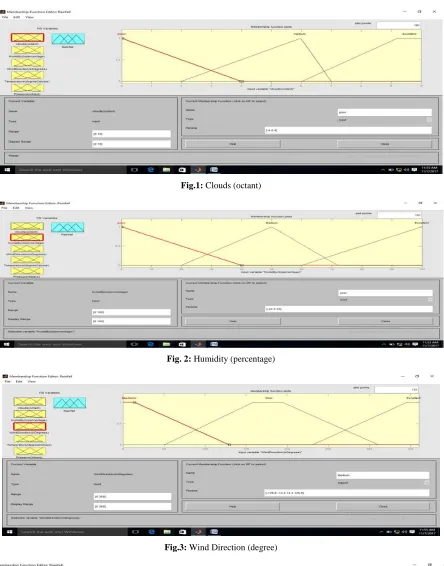
Rainfall predication data - Clouds (octant)
- Humidity (in percentage) - Wind direction (in degree) - Temperature (in degree Celsius) - Pressure (in bars)
Fig.1: Clouds (octant)
Fig. 2: Humidity (percentage)
Fig.3: Wind Direction (degree)
~ 177 ~
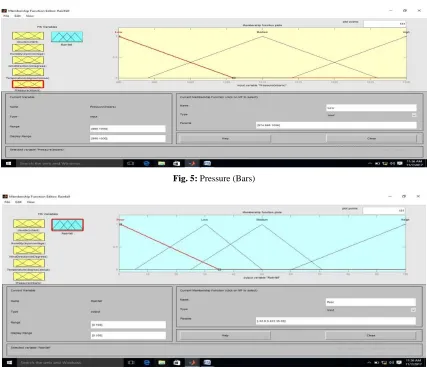
Fig. 5: Pressure (Bars)
Fig. 6: Rainfall prediction output variables
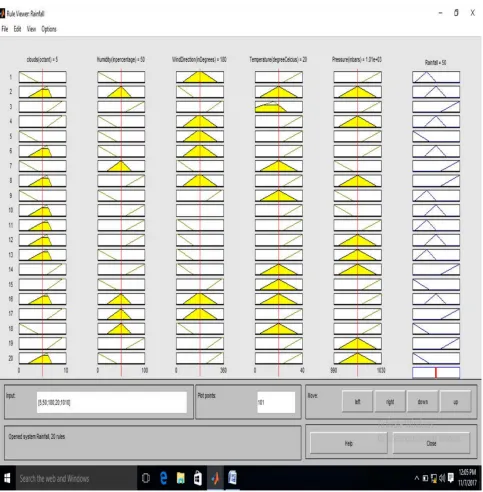
Generated Rules
• If (clouds(octant) is poor) and (Humidity(in percentage) is poor) and (Wind Direction (in Degrees) is Poor) and (Temperature (degree Celsius) is Poor) and (Pressure (in bars) is High) then (Rainfall is Low)
• If (clouds (octant) is medium) and (Humidity(in percentage) is Medium) and (Wind Direction(in Degrees) is Medium) and (Temperature (degree Celsius) is Medium) and (Pressure(in bars) is Medium) then (Rainfall is Medium)
• If (clouds(octant) is excellent) and (Humidity(in percentage) is Excellent) and (Wind Direction(in Degrees) is Excellent) and (Temperature(degree Celsius) is Excellent) and (Pressure(in bars) is High) then (Rainfall is High)
• If (clouds(octant) is excellent) and (Humidity(in percentage) is poor) and (Wind Direction (in Degrees) is Poor) and (Temperature(degree Celsius) is Poor) and (Pressure (in bars) is Medium) then (Rainfall is Medium)
• If (clouds(octant) is poor) and (Humidity(in percentage) is poor) and (Wind Direction (in Degrees) is Poor) and (Temperature (degree Celsius) is Poor) and (Pressure (in bars) is High) then (Rainfall is Poor)
• If (clouds(octant) is medium) and (Humidity(in percentage) is poor) and (Wind Direction (in Degrees) is Poor) and (Temperature (degree Celsius) is Poor) and (Pressure (in bars) is High) then (Rainfall is Medium)
• If (clouds(octant) is poor) and (Humidity(in percentage) is Medium) and (Wind Direction(in Degrees) is Medium) and (Temperature (degree Celsius) is Medium) and (Pressure(in bars) is Low) then (Rainfall is High)
• If (clouds(octant) is medium) and (Humidity(in percentage) is Excellent) and (Wind Direction (in Degrees) is Poor) and (Temperature(degree Celsius) is Poor) and (Pressure(in bars) is Medium) then (Rainfall is High)
• If (clouds(octant) is poor) and (Humidity(in percentage) is poor) and (Wind Direction (in Degrees) is Excellent) and (Temperature(degree Celsius) is Medium) and (Pressure(in bars) is Low) then (Rainfall is Low)
• If (clouds(octant) is medium) and (Humidity(in percentage) is Excellent) and (Temperature (degree Celsius) is Poor) and (Pressure(in bars) is Low) then (Rainfall is Medium)
• If (clouds(octant) is medium) and (Humidity(in percentage) is Excellent) and (Wind Direction(in Degrees) is Medium) and (Temperature(degree Celsius) is Poor) and (Pressure(in bars) is High) then (Rainfall is Low)
• If (clouds(octant) is medium) and (Humidity(in percentage) is Excellent) and (Wind Direction(in Degrees) is Medium) and (Temperature(degree Celsius) is Poor) and (Pressure(in bars) is Medium) then (Rainfall is Medium)
Degrees) is Medium) and (Temperature(degree Celsius) is Poor) and (Pressure (in bars) is Medium) then (Rainfall is Low)
• If (clouds(octant) is excellent) and (Humidity(in percentage) is Excellent) and (Wind Direction(in Degrees) is Medium) and (Temperature(degree Celsius) is Medium) and (Pressure(in bars) is Medium) then (Rainfall is High)
• If (clouds(octant) is excellent) and (Humidity(in percentage) is poor) and (Wind Direction(in Degrees) is Excellent) and (Temperature(degree Celsius) is Medium) and (Pressure(in bars) is High) then (Rainfall is Poor)
• If (clouds(octant) is medium) and (Humidity(in percentage) is Medium) and (Wind Direction(in Degrees) is Poor) and (Temperature(degree Celsius) is Medium) and (Pressure(in bars) is High) then (Rainfall is Medium)
• If (clouds(octant) is excellent) and (Humidity(in percentage) is Medium) and (Wind Direction(in
Degrees) is Poor) and (Temperature(degree Celsius) is Poor) and (Pressure(in bars) is High) then (Rainfall is High)
• If (clouds(octant) is poor) and (Humidity(in percentage) is Medium) and (Wind Direction(in Degrees) is Medium) and (Temperature(degree Celsius) is Medium) and (Pressure(in bars) is High) then (Rainfall is Poor)
• If (clouds(octant) is excellent) and (Humidity(in percentage) is Excellent) and (Wind Direction(in Degrees) is Excellent) and (Temperature(degree Celsius) is Poor) and (Pressure(in bars) is Medium) then (Rainfall is High)
• If (clouds(octant) is medium) and (Humidity(in percentage) is poor) and (Wind Direction(in Degrees) is Excellent) and (Temperature(degree Celsius) is Poor) and (Pressure(in bars) is Medium) then (Rainfall is Poor)
~ 179 ~
Result
Total cloud content in sky (values in 1 to 8 octant) 4 How much is the Humidity percentage? 44
At which angle the wind is flowing (In Degrees)? 30 What is the temperature (in Celsius (0-40 degrees))? 25 What is the current pressure (From 990 to 1040 Bars)? 1000
Total Percentage rainfall: 48.2947
Conclusion
In this study, it is imperative that knowledge of parameters like cloud, humidity, pressure, temperature and wind speed helps to predict likelihood of rainfall and even the volume of it. This will help to better plan for a better resource utilization and prevention of associated disaster. It is how ever studied that fuzzy logic is necessary and an effective technique for correctly predicting rainfall.
References
1. Hasan M,Tsegaye T, Shi X, Schaefer G,Taylor G. Model for predicting rainfall by fuzzy set theory using USDA scan data, 2015
2. Jim, M., Application of fuzzy logic in operational meteorology, Carlifornia: Addison Wesley,
Longman Inc., 2015
3. Lyons, G., Defuzzification, Materials received on the internet, 2000
4. Cirstea, M. N., Dinu, A., Khor, J. G. and McCormink, M., Neural and Fuzzy Logic Control of Daves and Power, 2002
5. Jang, J.S.R., Sun, C.T. and Mizutani, E., Neuro-fuzzy and Soft Computing (A Computational
Approach to Learning and Machine Intelligence), Prentice Hall, Inc., pp 1- 90, 1997
6. Kevin, M. P. and Stephen Y., Fuzzy Control, Carlifornia: Addison Wesley Longman Inc., 1998 7. Padhy, N.P., Artificial Intelligence and Intelligent
systems, Oxford University Press, 2006
8. Das TK, Mohapatro A, Abburu S. A Decision Making Mechanism During Disaster Event Monitoring and Control, Middle-East Journal of Scientific Research, 2015, 23(9): 2251-2255.