EXPLORING OF MULTI MATHEMATICAL
REPRESENTATION CAPABILITY IN
PROBLEM SOLVING ON SENIOR HIGH
SCHOOL STUDENTS
Nizaruddin, Muhtarom, Yanuar Hery Murtianto
University PGRI Semarang, Indonesia E-mail: [email protected], [email protected], [email protected]
Abstract
The students’ multi-mathematical representation capability in problem solving is very important and
interesting to discuss, specifically for problems in the two-variable linear equation system. Data was collected from 48 students using written tests and in-depth interviews with selected participants. The research findings showed that few students are using three representations namely symbolic - verbal - table representation, and symbolic representation, however most of the students are using three representations namely symbolic - verbal - images representation, and two representations namely symbolic – verbal representations, and the rest used symbolic representation. In the use of verbal representation, some students had difficulty composing words and all students encountered difficulties in the translational process from symbolic representation and verbal representation to other types of representation. The ability to understand concepts and relationships between mathematical concepts was found to be a necessary condition for the achievement of multi-mathematical representation capability. It is therefore recommended that teachers use a variety of different types of representation, such as verbal, tables and images, to enhance students' understanding of the material.
Keywords: multiple representations, problem solving, two-variable linear equation system.
Introduction
Mathematical representation ability is important in understanding mathematics, both when students are solving mathematical problems and when they need to communicate their solutions to others, and it is also a form of attitude in mathematics. Problem-solving abilities are related to metacognition (Muhtarom, Juniati & Siswono, 2017), as well as mathematical representation abilities. Moreover, representation can be presented in the form of images, symbols, and signs (notation), which are all forms of mathematical concepts (Vergnaud, 1997). Representation is a kind of configuration process to present something in a different situation which involves identification, selection and the delivery of ideas (Goldin & Kaput, 1996; Romberg & Kaput, 1999; Seeger et al, 1998). Everything that students do to externalize and show their work is called representation (Kalathil & Sherin, 2013). Hwang, Chen, Dung, & Yang (2007) conclude that good representational skills are the key to gaining the right solutions to solve problems.
Vol. 75, No. 6, 2017
592 Keller & Hirsch (1998) stress that the use of multiple representations is an advantage, since it avoids limitation to a single type of representation and builds something new, which is clearer and more useful for the problem-solving process. Thus, there are several functions of multiple representation: 1) the different representations complement each other; 2) the interpretation of other representations is limited; 3) the process of constructive understanding is enhanced (Ainsworth, 2006). This means that the use of multiple representations is recommended by many mathematical educators. Similarly, the mathematics community supports the idea that students can interpret mathematical concepts through the experience of multiple representations (Janvier, 1987; Sierpinska, 1992).
The use of different representations can make concepts more accessible and enjoyable for the student. Romberg & Kaput (1999) and Hiebert & Carpenter (1992) state that the use of multiple representations helps students to learn by using their own thinking and learning habits. Nizaruddin et al, (2017) offers the view that game-based learning can improve students’ problem-solving skills, and furthermore it has the potential to develop the representation skills needed for solving mathematics problems. It is generally recognized that learning facilitates students in accommodating their thoughts to develop their own knowledge schemes (Muhtarom, Yanuar & Sutrisno, 2017). Therefore, a learning process that uses two representations is better than a process using only a single representation (Bransford & Schwartz, 1999; Ainsworth, 2006). Thus, an understanding of multiple representations can support students’ comprehension of mathematical concepts, as well as anticipating the fallacy of concepts in mathematics. This means that the ability to understand concepts and relationships between mathematical concepts is a necessary condition for the achievement of multi-mathematical representation capability.
In Indonesia, to date there has been little research on multiple-representation capability; existing studies tend to discuss only the types of representation used by students (Santia, 2015; Tyas, 2016; Muhamad, 2017) and do not offer views on the multiple-representation capability of students or the translation process from one representation to another. Therefore, it is interesting to research students' multi-mathematical representation in problem solving, especially among students in Indonesia. The purpose of this current research is to determine the multi-mathematical representation capability of students in solving mathematical problems, specifically two-variable linear equation problems.
Research on multiple representations is an important topic to address because the identification of multiple representation capability can be used for developing teaching material. In addition, the importance of multiple representations in this research can be used to improve students’ creative thinking. This research will explore multiple representation capability, specifically in mathematical problem solving in two-variable linear equation problems, observing the following thought processes: procedure-oriented, process-oriented, math object-oriented and concept-object-oriented.
Research Methodology
General Background
This research is qualitative and explores multi-mathematical representation capability in problem solving, specifically in two-variable linear equation problems. The results of the research can be used as the basis for developing teaching material for the two-variable linear equation system based on multiple representations so as to improve students' creative thinking ability, especially in Indonesia.
Sample
Vol. 75, No. 6, 2017 593
the academic year 2017/2018. The selection of participants was based on the following considerations: 1) the students had already been given sufficient material that they were expected to be able to complete a two-variable linear equation mathematics problem, 2) the participants selected were considered to possess good communication skills enabling them to express the process used for solving the problem, 3) in problem solving, the participants used a number of different kinds of representation. A trial of the research instrument was conducted on May 30, 2017. From the results of the trial, it was seen that the problem could be solved using various types of representation. The test results were then analyzed based on validity and reliability to determine the feasibility of the problem as a research instrument. This research involved participants who were class XI students. In the initial stage, the students were given a written test. In this research, the written test was taken by 48 prospective participants consisting of 5 male students and 43 female students. The selection of research subjects was also based on a review of the students' mathematics grades.
Instrument and Procedures
The instrument used in this research was a written test on problem solving and a guided interview based on the problem solving task to explore the multiple-representation capability of students. Prior to use, the instrument was first validated by three validators who are experts in mathematics education, and was declared eligible to be used for obtaining research data. The written test instrument was as follows: "A two-variable linear equation system has a finite set {3.3}. If the first variable coefficient is an even number and the second variable coefficient is an odd number, make a two-variable linear equation example! Also show the steps used to solve the problem using your own choice of representations”. The data was collected in two stages. The first stage was the written test, as described above, which was held on July 14, 2017 at 7 a.m. in the classroom of XI IPA and at 8.40 a.m. in the classroom of XI IPS. The second phase was to conduct interviews with selected subjects. The interviews were conducted based on an agreement between the researcher and the research scientist. The details of the interviews are presented in Table 1 below:
Table 1. List of interviews.
No Date Participant’s Code Time Location
1 28 July 2017 DP 1 p.m. School
2 28 July 2017 FA 2 p.m. School
3 31 July 2017 MN 10 a.m. School
4 31 July 2017 RI 11 a.m. School
Data Analysis
Vol. 75, No. 6, 2017
594 results of the triangulation was valid participant data for providing a description of the students’ multi-mathematical representation capabilities.
Results of Research
Table 2 presents a clear description of the results of the data analysis of the 48 students. From this, the types of representation used by students for solving the problem can be identified, namely: symbolic - verbal - image representations, symbolic - verbal - table representations, symbolic - verbal representations, and symbolic representation. The percentage of students using three representations, namely symbolic - verbal - table representation was 8.33%, the use of symbolic - verbal - image representation was 37.5%, those using two representations namely symbolic – verbal representation was 45.83% and those using only one representation was 8.33%.
Table 2. Representation used by participants.
Representation Type of representa-tion Participant’s Code % Selected partici-pants with code*
Three representations
Symbolic - verbal - images
DN, RD, NA, ES, SY, RI*, DR, PR, UN, AK, DI, MF, RM, ET,
CN, NL, MN, MA 37.5 RI Symbolic - verbal -
table FA*, MK, NN, BR 8.33 FA
Two representations Symbolic - verbal
SW, ZN, NS, K, IA, RW, NDS, DP*, NM, CL, RM, ZY, AP, PN, HN, ZN, PL, MD, EF, NS, IK, VN
45.83 DP
One representation Symbolic ME, MN*, ND, AS 8.33 MN
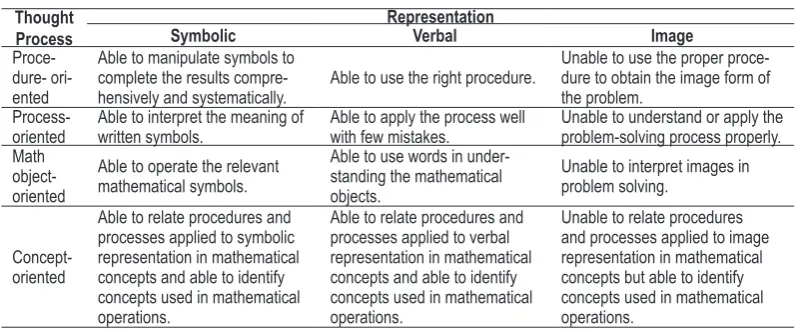
Participant RI solved the two-variable linear equation problem using 3 representations, namely symbolic - verbal - image representations. When answering using symbolic and verbal representations, participant RI was able to answer correctly but when answering using image representation there were mistakes in the answer. The representation and thought process of RI’s problem solving is shown clearly in Table 3.
Table 3. Analysis of the results of the participant with code RI.
Thought
Process Symbolic Representation Verbal Image
Proce-dure- ori-ented
Able to manipulate symbols to complete the results
compre-hensively and systematically. Able to use the right procedure.
Unable to use the proper proce-dure to obtain the image form of the problem.
Process-oriented Able to interpret the meaning of written symbols. Able to apply the process well with few mistakes. Unable to understand or apply the problem-solving process properly. Math
object-oriented
Able to operate the relevant mathematical symbols.
Able to use words in under-standing the mathematical objects.
Unable to interpret images in problem solving.
Concept-oriented
Able to relate procedures and processes applied to symbolic representation in mathematical concepts and able to identify concepts used in mathematical operations.
Able to relate procedures and processes applied to verbal representation in mathematical concepts and able to identify concepts used in mathematical operations.
Vol. 75, No. 6, 2017 595
The participant with the code FA solved the two-variable linear equation problem using 3 representations, namely symbolic - verbal - image representations. When answering with the use of symbolic representation, the participant FA was able to answer correctly but when answering using verbal and table representations, there were a number of mistakes in the answer. For a clearer picture, the representation and thought process of the participant FA’s problem solving are presented in Table 4.
Table 4. Analysis of the results of the participant with code FA.
Thought
Process Symbolic Representation Verbal Table
Procedure-oriented
Able to manipulate symbols to complete the results comprehensively and system-atically.
Unable to use the procedure
appropriately. Unable to use the proper proce-dure to complete the results.
Process-oriented Able to interpret the meaning of written symbols.
Unable to implement the problem-solving process properly.
Unable to understand and implement the problem solving process.
Math
object-oriented Able to operate the relevant mathematical symbols.
Able to use words in under-standing the mathematical objects.
Unable to interpret the problem in the form of mathematical tables.
Concept-oriented
Able to relate procedures and processes applied to symbolic representation in mathematical concepts and able to identify concepts used in mathematical operations.
Unable to relate procedures and processes applied to verbal representation in mathematical concepts but able to identify concepts used in mathematical operations.
Unable to relate procedures and processes applied to precise ta-ble representation and unata-ble to identify and operate mathemati-cal concepts.
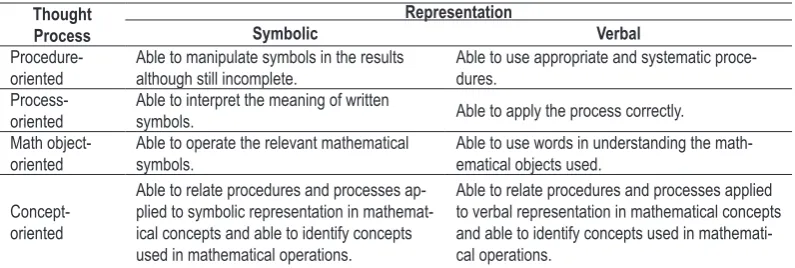
The participant with code DP solved the two-variable linear equation problem using two representations, namely symbolic - verbal representations. When answering with the use of symbolic representation, it appeared that the participant was able to use the relevant symbols, namely variables x and y, and able to complete the process well even though the procedure used was not yet complete. The participant was able to interpret the symbols used, able to relate the procedures and processes applied to symbolic representation in the mathematical concepts, and able to identify the concepts used in the mathematical operations. Participant DP was able to answer correctly and was aware of the mistakes made in the completion process using verbal representation because of his understanding of the characteristics of the two-variable linear equation system. The representation and thought process of participant DP’s problem-solving are presented in Table 5.
Table 5. Analysis of the results of the participant with code DP.
Thought
Process Symbolic Representation Verbal
Procedure-oriented Able to manipulate symbols in the results although still incomplete. Able to use appropriate and systematic proce-dures.
Process-oriented Able to interpret the meaning of written symbols. Able to apply the process correctly. Math
object-oriented Able to operate the relevant mathematical symbols. Able to use words in understanding the math-ematical objects used.
Concept-oriented
Able to relate procedures and processes ap-plied to symbolic representation in mathemat-ical concepts and able to identify concepts used in mathematical operations.
Vol. 75, No. 6, 2017
596 Table 6. Analysis of results of participant with code MN.
Thought Process Representasi Simbolik Symbolic Representation
Procedure-oriented Unable to manipulate symbols to complete the results comprehensively and systemati-cally. Process-oriented Able to interpret the meaning of written symbols.
Math object-oriented Able to operate the relevant mathematical symbols.
Concept-oriented Unable to relate processes and procedures applied to symbolic representation in math-ematical concepts but able to identify concepts used in mathematical operations.
The participant with the code MN solved the problem of a two-variable linear equation system using symbolic representation. This is evident from the use of variables x and y. Participant MN was unable to use the proper procedures and processes because there was still a large amount of verbal representation. The participant was essentially able to interpret the symbols used but was unable to relate the procedures and processes applied to the symbolic representation in mathematical concepts though able to identify the concepts used in mathematical operations. The representation and the problem-solving thought process of the participant with code DP are presented in Table 6.
Discussion
The results of this research show that students essentially have the ability to solve problems using various types of representation. It was found that only 8.33% of students solved the problem presented using only a single type of symbolic representation. Students who had a high level of independence were seen to use a number of different types of representations, unlike other students who used only a single type of representation to solve the problem. In addition, the students' understanding of mathematical concepts was reflected in the greater number of representations used to solve the problem (Brenner et al., 1997). However, it should be noted that some of the students still encountered difficulties in the process of transferring the use of different types of representation, for example, in the beginning they used symbolic representation, then verbal or image representation (other types of representation). This is in line with the research of Gagatsis & Elia (2004) which concludes that students encounter numerous difficulties in changing from symbolic representation (algebra) into verbal representation. An investigation by Janvier (1987) shows how a successful transfer between one type of representation and another varies depending on the nature of the relationship between the chosen representations. Thus, in order to use different representations, students require knowledge of the subject matter as well as knowledge about representation because not all material can be presented using all types of representation.
Vol. 75, No. 6, 2017 597
concepts is a necessary condition for the achievement of multi-mathematical representation capability, and multiple-representation ability itself is able to support students in understanding each different mathematical concept and anticipating mistakes in understanding mathematical concepts.
Conclusions
Students tend towards the use of symbolic representation rather than other types of representation in solving two-variable linear equation problems. When students use verbal representation, they are inclined to have difficulty in composing words while in image or table representation they are unable to solve the problem correctly. Based on these facts, we can conclude that the choice of representation used to solve a problem greatly affects the students' answers because the use of a particular type of representation requires knowledge of the mathematical concept as well as an understanding of the representation itself. Suggestions for further research include an exploration of the students' thought process in transitioning between different types of representation, such as verbal representation to symbolic representation or vice versa.
References
Ainsworth, S. (2006). DeFT: A conceptual framework for considering learning with multiple representations. Learning and Instruction, 16 (3), 183–198.
Bransford, J. D., & Schwartz, D. L. (1999). Chapter 3: Rethinking transfer: A simple proposal with multiple implications. Review of Research in Education, 24 (1), 61–100.
Brenner, M. E., Mayer, R. E., Moseley, B., Brar, T., Durán, R., Reed, B. S., & Webb, D. (1997). Learning by understanding: The role of multiple representations in learning algebra. American Educational
Research Journal, 34 (4), 663–689.
Gagatsis, A., & Elia, I. (2004). The Effects of Different Modes of Representation on Mathematical Problem Solving. International Group for the Psychology of Mathematics Education. Retrieved from http://emis.ams.org/proceedings/PME28/RR/RR171_Gagatsis.pdf.
Goldin, G. A., & Kaput, J. J. (1996). A joint perspective on the idea of representation in learning and doing mathematics. In: L. P. Steffe, P. Nesher, P. Cobb, G. A. Goldin, & B. Greer (Eds.), Theories
of mathematical learning (pp. 397–430). Hillsdale, NJ: Lawrence Erlbaum.
Hiebert, J., & Carpenter, T. P. (1992). Learning and teaching with understanding. In D. A. Grouws (Ed.), Handbook of research on mathematics teaching and learning: A project of the National Council of Teachers of Mathematics (pp. 65-97). New York: Macmillan.
Hwang, W.-Y., Chen, N.-S., Dung, J.-J., & Yang, Y.-L. (2007). Multiple Representation Skills and Creativity Effects on Mathematical Problem Solving using a Multimedia Whiteboard System.
Journal of Educational Technology & Society, 10 (2). Retrieved from http://www.jstor.org/stable/ jeductechsoci.10.2.191.
Janvier, C. (1987). Representation and understanding: The notion of function as an example. In C. Janvier (Ed.), Problems of representation in the teaching and learning of mathematics (pp. 67–71). Hillsdale, NJ: Erlbaum.
Kalathil, R. R., & Sherin, M. G. (2013). Role of students’ representations in the mathematics classroom. In International Conference of the Learning Sciences: Facing the Challenges of Complex Real-world Settings (p. 27). East Sussex: Psychology Press.
Keller, B. A., & Hirsch, C. R. (1998). Student preferences for representations of functions. International Journal of Mathematical Education in Science and Technology, 29 (1), 1–17.
Muhamad, N. (2017). Pengaruh Metode Discovery Learning untuk Meningkatkan Representasi Matematis dan Percaya Diri Siswa. (The Influence of the Discovery Learning Method on Improving Students' Mathematical Representation and Confidence). Jurnal Pendidikan UNIGA, 10 (1), 9–22.
Vol. 75, No. 6, 2017
598 Muhtarom., Juniati, Dwi., & Siswono, T.Y.E. (2017). Exploring Beliefs in a Problem-Solving Process of Prospective Teachers’ With High Mathematical Ability. Global Journal of Engineering Education, 19 (2), 130-136.
Nizaruddin, Muhtarom, & Sugiyanti. (2017). Improving Students’ Problem-Solving Ability in Mathematics through Game-Based Learning Activities. World Transactions on Engineering and Technology Education, 15 (2), 102-107.
Romberg, T. A., & Kaput, J. J. (1999). Mathematics worth teaching, mathematics worth understanding. In E. Fennema, & T. A. Romberg (Eds.) Mathematics classrooms that promote understanding (pp. 3–18). Mahwah, NJ: Lawrence Erlbaum Associates.
Santia, I. (2015). Representasi Siswa SMA dalam Memecahkan Masalah Matematika Berdasarkan Gaya Kognitif. (High School Students' Representation in Solving Mathematics Problems Based on Cognitive Style). JIPM (Jurnal Ilmiah Pendidikan Matematika), 3 (2). Retrieved from http://e-journal.ikippgrimadiun.ac.id/index.php/jipm/article/view/505.
Seeger, F. (1998). Representations in the mathematics classroom: Reflections and constructions. In F. Seegers, J. Voigt, & U. Waschescio (Eds.), The culture of the mathematics classroom (pp. 308-343). New York: Cambridge University Press.
Sierpinska, A. (1992). On understanding the notion of function. The concept of function: Aspects of
epistemology and pedagogy, 25, 23–58.
Tyas, W. H., Sujadi, Imam., Riyadi. (2016). Representasi Matematis Siswa dalam Menyelesaikan Masalah Matematika pada Materi Aritmatika Sosial dan Perbandingan ditinjau dari Gaya Kognitif Siswa Kelas VII SMP Negeri 15 Surakarta Tahun Ajaran 2014/2015. (Students' Mathematical Representation in Solving Social Arithmetic Mathematics Problems and a Comparison with the Cognitive Style of Class VII Students from the No. 15 Surakarta State Middle School Academic Year 2014/2015). Jurnal Elektronik Pembelajaran Matematika, 4 (8), 781-792.
Vergnaud, G. (1997). The nature of mathematical concepts. In P. Bryant (Ed.), Learning andTeaching
Mathematics. East Sussex: Psychology Press.
Received: October 12, 2017 Accepted: December 18, 2017
Nizaruddin M.Si., Lecturer, Department of Mathematics Education, Faculty of Mathematics
Education and Natural Science, University PGRI Semarang, Indonesia. Email: [email protected]
Web: http://orcid.org/0000-0002-1166-6006
Muhtarom M.Pd., Lecturer, Department of Mathematics Education, Faculty of Mathematics
Education and Natural Science, University PGRI Semarang, Indonesia. Email: [email protected]
Web: https://www.researchgate.net/profile/Muhtarom_Muhtarom
Yanuar Hery Murtianto M.Pd., Lecturer, Department of Mathematics Education, Faculty of Mathematics
Education and Natural Science, University PGRI Semarang, Indonesia. Email: [email protected]