Volume-6 Issue-1
International Journal of Intellectual Advancements
and Research in Engineering Computations
Analysis of Cold Metal Defect in Casting by Using Six-sigma
Method
Omprakas. M.A
1, Sahil abinesh.V
2, Senthil kumar.R
2, Siva prakash.G
2, Siva sankar.N
21
Assistant Professor,
2UG Students
Department of Mechanical Engineering, Nandha Engineering College, Erode-52,
Tamil Nadu, India.
1
[email protected] ,
2[email protected]
Abstract— A defect in castings does not just happen. Casting defects are unusually not by accidents, they occurbecause some step in manufacturing cycle does not get properly controlled and somewhere something goes wrong. They are caused by wrong practice in one or more of the basic operations involved in the casting process as in the equipment used, or by the design of the part. A defect may be the result of a single clearly defined cause or a combination of factors, in which case necessary preventive measures are more obscure. If not controlled the amount of rejection it may be increased randomly. In this paper our work is to identify the major occurrence defects from a leading foundry industry in Tamilnadu, which we have visited for 36 days and monitor the production of castings and identify some defects for different 12 products, the total production quantity of that 12 products are 17,365 and total amount of rejection is 1407, with the help of Six-Sigma (DMAIC) method we have identified that Cold Metal defect which is the major defect from that 12 productswhich affects the quality, more when compared to other defects, so we have taken the cold metal defect and identified the root causes and suggested some remedies to control the occurrences of the cold metal defect, so that the defective products where reduced when compared to the previous rejection percentage.
Index Terms— six sigma , Grey cast iron, Cold metal,
Casting defect.
I. INTRODUCTION
Foundry, it means where metal is melted and poured in the factory to produce a number of components and products according to the requirement what we specified. The major process is that metals which are cut into shape by the process of melting them into a liquid, once the melting had
finished it get poured into the shaped mold, then the process of solidification occurs that which solidifies the liquid metal. Then by removing the mold materials, the required metal shape has been obtained. The overall process of foundry is to make the quality products and components. But these process sometimes get collapsed due to some error that which can be named as casting defects. These defects may
be of various kinds. It occurs in each and every process of foundry when something went wrong. It may be of human error, machine effect or any other defect from sand mixture etc. These also many approaches and industry tools are used to rectify the problem and to solve the problem. From that various techniques, we are using the approach of six sigma [DMAIC] to give the solution. In this paper, we are going to identify and solve the casting defects by using the approach of six sigma and machine tools by the following five process[Define, Measure, Analysis, Improve and Control].
II.METHODOLOGY
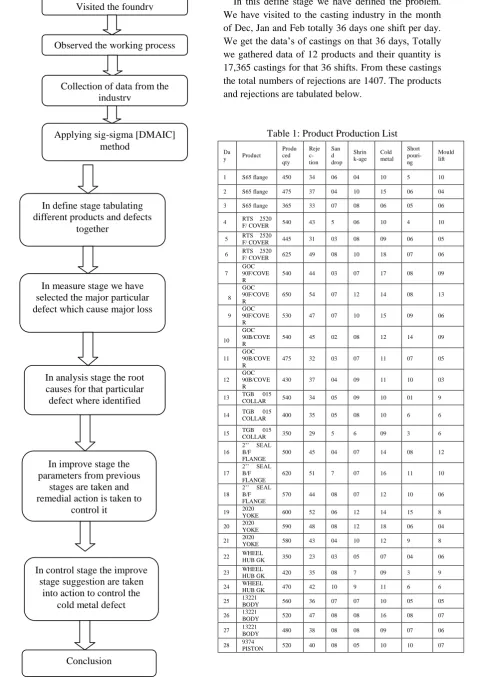
results. The flow chart of six sigma process is
mentioned below. 2.1 Define Stage:
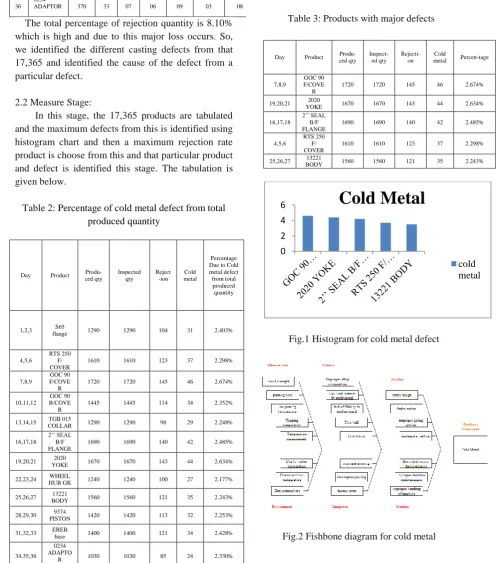
In this define stage we have defined the problem. We have visited to the casting industry in the month of Dec, Jan and Feb totally 36 days one shift per day. We get the data‟s of castings on that 36 days, Totally we gathered data of 12 products and their quantity is 17,365 castings for that 36 shifts. From these castings the total numbers of rejections are 1407. The products and rejections are tabulated below.
Table 1: Product Production List
Da y Product
Produ ced qty
Reje c-tion
San d drop
Shrin k-age
Cold metal
Short pouri-ng
Mould lift
1 S65 flange 450 34 06 04 10 5 10
2 S65 flange 475 37 04 10 15 06 04
3 S65 flange 365 33 07 08 06 05 06
4 RTS 2520
F/ COVER 540 43 5 06 10 4 10
5 RTS 2520
F/ COVER 445 31 03 08 09 06 05
6 RTS 2520
F/ COVER 625 49 08 10 18 07 06
7 GOC 90F/COVE R
540 44 03 07 17 08 09
8 GOC 90F/COVE R
650 54 07 12 14 08 13
9 GOC 90F/COVE R
530 47 07 10 15 09 06
10
GOC 90B/COVE R
540 45 02 08 12 14 09
11 GOC 90B/COVE R
475 32 03 07 11 07 05
12 GOC 90B/COVE R
430 37 04 09 11 10 03
13 TGB 015
COLLAR 540 34 05 09 10 01 9
14 TGB 015
COLLAR 400 35 05 08 10 6 6
15 TGB 015
COLLAR 350 29 5 6 09 3 6
16
2‟‟ SEAL B/F FLANGE
500 45 04 07 14 08 12
17
2‟‟ SEAL B/F FLANGE
620 51 7 07 16 11 10
18
2‟‟ SEAL B/F FLANGE
570 44 08 07 12 10 06
19 2020
YOKE 600 52 06 12 14 15 8 20 2020
YOKE 590 48 08 12 18 06 04 21 2020
YOKE 580 43 04 10 12 9 8
22 WHEEL
HUB GK 350 23 03 05 07 04 06
23 WHEEL
HUB GK 420 35 08 7 09 3 9 24 WHEEL
HUB GK 470 42 10 9 11 6 6 25 13221
BODY 560 36 07 07 10 05 05 26 13221
BODY 520 47 08 08 16 08 07 27 13221
BODY 480 38 08 08 09 07 06
28 9374
PISTON 520 40 08 05 10 10 07 Visited the foundry
Observed the working process
Collection of data from the industry
Applying sig-sigma [DMAIC] method
In define stage tabulating different products and defects
together
In measure stage we have selected the major particular defect which cause major loss
In analysis stage the root causes for that particular defect where identified
In improve stage the parameters from previous
stages are taken and remedial action is taken to
control it
In control stage the improve stage suggestion are taken
into action to control the cold metal defect
29 9374
PISTON 490 43 08 07 13 08 07
30 9374
PISTON 410 30 05 06 09 07 03 31 EREB base 460 38 05 08 10 07 08
32 EREB base 510 44 08 09 12 07 08
33 EREB base 430 39 05 06 12 11 05
34 0234
ADAPTOR 320 25 04 05 06 05 05
35 0234
ADAPTOR 340 27 03 06 09 04 05
36 0234
ADAPTOR 370 33 07 06 09 03 08
The total percentage of rejection quantity is 8.10% which is high and due to this major loss occurs. So, we identified the different casting defects from that 17,365 and identified the cause of the defect from a particular defect.
2.2 Measure Stage:
In this stage, the 17,365 products are tabulated and the maximum defects from this is identified using histogram chart and then a maximum rejection rate product is choose from this and that particular product and defect is identified this stage. The tabulation is given below.
Table 2: Percentage of cold metal defect from total produced quantity
2.3 Analysis Stage:
This step that which mostly concentrate on where the provide cause. The attention to this step helps in making the accurate solution. The above mentioned five defects are analyzed in the industry like where it may happen whether human error, machine error, working time, sand hardness and some other new problems. The below fish-bone diagram represents the whole analysis.
Table 3: Products with major defects
Fig.1 Histogram for cold metal defect
Fig.2 Fishbone diagram for cold metal
0 2 4
6
Cold Metal
cold metal Day Product
Produ-ced qty
Inspected qty
Reject -ion
Cold metal
Percentage Due to Cold metal defect from total produced quantity
1,2,3 S65
flange 1290 1290 104 31 2.403%
4,5,6
RTS 250 F/ COVER
1610 1610 123 37 2.298%
7,8,9
GOC 90 F/COVE R
1720 1720 145 46 2.674%
10,11,12 GOC 90 B/COVE R
1445 1445 114 34 2.352%
13,14,15 TGB 015
COLLAR 1290 1290 98 29 2.248%
16,17,18
2‟‟ SEAL B/F FLANGE
1690 1690 140 42 2.485%
19,20,21 2020
YOKE 1670 1670 143 44 2.634%
22,23,24 WHEEL
HUB GK 1240 1240 100 27 2.177%
25,26,27 13221
BODY 1560 1560 121 35 2.243%
28,29,30 9374
PISTON 1420 1420 113 32 2.253%
31,32,33 EREB
base 1400 1400 121 34 2.428%
34,35,36 0234 ADAPTO
R 1030 1030 85 24 2.330%
Day Product Produ-ced qty
Inspect-ed qty
Rejecti-on
Cold
metal Percen-tage
7,8,9
GOC 90 F/COVE R
1720 1720 145 46 2.674%
19,20,21 2020
YOKE 1670 1670 143 44 2.634%
16,17,18
2‟‟ SEAL B/F FLANGE
1690 1690 140 42 2.485%
4,5,6
RTS 250 F/ COVER
1610 1610 123 37 2.298%
25,26,27 13221
From the above tabulation we have taken the highest percentage of rejection product and its defect and we have made a cause and effect flow chart diagram from that we have considered the following parameters which affects the quality and occurance of the Cold Metal defect,
Lack of fluidity in molten metal
Pouring Time
Tapping Temperature
Human Error
2.4 Improve Stage:
In this stage the parameters which where considered in the analysis stage are taken and the problem due to that where identified and remedial action for that was concluded for each parameters.
Lack of fluidity in molten metal:
Insufficient amount of liquid metal in the laddle that which leads to incomplete filing of mold cavity. refilling of liquid metal in the remaining space in the same mold cavity that which makes the different temperature combination of liquid metal leads to the defect, every one of seven product gets defected if the same process continues.
Remedies:
Sand should be properly rammed
Molding sand/core sand should not be too coarse to promote metal penetration.
Control proper metal temperature.
Pouring time:
Pouring is a process by which molten metal is transferred to the cast for cooling and solidification and thus be converted into final product. Pouring temperature is the temperature to which the molten metal has to be raised to before being poured into casts for cooling and setting. This pouring temperature must also take into account the heat loss and caused due to the transfer of metal through ladles, as a distance between furnace and cast has to be covered and also due to the heat absorbed by ladles.
Remedies:
Fluidity of metal should be high
Pouring rate and time should be controlled.
Thin section should be suitable designed.
Tapping temperature:
Delay of tapping time from heating furnace to ladle leads to the major defect of tapping temperature. The temperature that varies from heating furnace to pouring ladle.
Remedies:
Delay of time should be controlled.
Tapping of liquid metal from furnace to ladle should be at require temperature.
Human error :
That action performed by a human that results is something different than expected.” This one refers directly to the individual itself. Human error is responsible for more than 80 percent of failures and defects.
Remedies:
Human laziness should be controlled Ladle position while pouring should be
properly maintained.
2.5 Control Stage:
In this stage the solution acquired from the Improve stage is applied in the production of the same product to see wether the cold metal defect is controlled are not. We have implemented the four parameter solutions and got the results.
Table 4 : Product of very high defect
Hence we have reduced the percentage of cold metal when compared to the previous amount of rejections rate, so the amount of rejection of cold metal defect is reduce by Six-sigma method.
III. CONCLUSION
We have reduced the amount of rejection of cold metal defect in GOC 90 F/COVER, the previous rejection percentage is 2.674% but now the amount of rejection is reduce by 1.315% which is reduced half the value from its previous percentage by Six-sigma method. Hence we concluded with the help of six-sigma technique we can reduce the percentage of defects. We only focused on the Cold metal defect alone but not on the other defect so there is possibility of occurrences of some other defects also not in a high value.
IV. REFERENCES
[1] Abhijeet B.Vante, G.R.Naik, “Quality Improvement for dimensionalvariations in sand casting using quality control tools,” Vol.5, issue 2,February 2016.
Day Product Produ-ced qty
Inspect -ed qty
Rejec tion
Cold metal
Percen-tage 1 GOC 90
[2] B.R. Jadhav, Santosh J Jadhav “Investigation and analysis of cold shut casting defect and reduction by using 7 quality control tools,”
[3] Lakshmanan Singaram “Improving quality of sand casting using taguchi method and ANN analysis,” Vol.4, No.1, January 2010.
[4] Uday A. Dabade and Rahul C. Bhedasgaonkar “Casting defect analysis using design of experiments (DOE) and computer aided casting simulation technique,”2013.
[5] Young Hoon Kwak, Frank T. Anbari, “Benefits, obstacles, and future if six sigma approach,‟‟ issue 2006.
[6] Y.Chang, H .Hocheng,„„The Flowability of bentonite bonded green molding sand”. 113 (2001) 238-244.
[7] Bhushan Shankar kamble ,„„ Analysis of Different sand casting defects in a medium scale foundary industry”, vol.5, Issue 2, February 2016.
[8] Young Hoon Kwak , Frank T.Anbari ,
„„ Benefits,Obstacles,and future of six sigma approach” 2004
[9] D Dimitrov, w van Wijck , N de Beer and J Dietrich
„„Development , evaluation , and selection of rapid Tooling process chains for sand casting of functional prototypes”. 16 may 2007