Open Access
Review
The generation and function of soluble apoE receptors in the CNS
G William Rebeck
1, Mary Jo LaDu
2, Steven Estus
3,4, Guojun Bu
5,6,7and
Edwin J Weeber*
8,9,10Address: 1Department of Neuroscience, Georgetown University, Washington DC, USA, 2Department of Anatomy and Cell Biology, University of Illinois at Chicago, Chicago, USA, 3Department of Physiology, University of Kentucky, Lexington, USA, 4Sanders-Brown Center on Aging, University of Kentucky, Lexington, USA, 5Department of Pediatrics, Washington University, St. Louis, USA, 6Department of Cell Biology and Physiology, Washington University, St. Louis, USA, 7Hope Center for Neurological Disorders, Washington University, St. Louis, USA, 8Department of Molecular Physiology and Biophysics, Vanderbilt University, Nashville, USA, 9Department of Pharmacology, Vanderbilt University, Nashville, USA and 10Vanderbilt Kennedy Center for Research on Human Development, Vanderbilt University, Nashville, USA
Email: G William Rebeck - [email protected]; Mary Jo LaDu - [email protected]; Steven Estus - [email protected]; Guojun Bu - [email protected]; Edwin J Weeber* - [email protected]
* Corresponding author
Abstract
More than a decade has passed since apolipoprotein E4 (APOE-ε4) was identified as a primary risk factor for Alzheimer 's disease (AD), yet researchers are even now struggling to understand how the apolipoprotein system integrates into the puzzle of AD etiology. The specific pathological actions of apoE4, methods of modulating apolipoprotein E4-associated risk, and possible roles of apoE in normal synaptic function are still being debated. These critical questions will never be fully answered without a complete understanding of the life cycle of the apolipoprotein receptors that mediate the uptake, signaling, and degradation of apoE. The present review will focus on apoE receptors as modulators of apoE actions and, in particular, explore the functions of soluble apoE receptors, a field almost entirely overlooked until now.
Background
ApoE and apoE receptors
Apolipoprotein E (apoE) is a small (34-kDa) secreted glycoprotein that associates with lipoproteins and medi-ates uptake of these particles into target cells via receptor-mediated endocytosis by the low density lipoprotein (LDL) receptor family. Three commonly occurring iso-forms have been identified in the human population due to single nucleotide polymorphisms on the APOE gene on chromosome 19. The apoE3 isoform (Cys112, Arg158) occurs at the highest frequency, followed by apoE4 (Arg112, Arg158) and apoE2 (Cys112, Cys158). ApoE is a ligand for the seven identified mammalian members of the evolutionarily conserved low density lipoprotein (LDL) receptor family: the low density lipoprotein
recep-tor (LDLR), apoE receprecep-tor 2 (ApoER2), the very low den-sity lipoprotein receptor (VLDLR), multiple epidermal growth factor (EGF) repeat-containing protein (MEGF7), megalin, LDL-related protein-1 (LRP1) and LDL-related protein-1b (LRP1b). APOE was initially recognized for its importance in lipoprotein metabolism and cardiovascular disease, however, more recently it has been studied for its role in several biological processes not directly related to lipoprotein transport. The following review will focus on the role of apoE and apoE receptors in the CNS with a focus on the processing and production of soluble apoE receptors.
Published: 24 October 2006
Molecular Neurodegeneration 2006, 1:15 doi:10.1186/1750-1326-1-15
Received: 02 October 2006 Accepted: 24 October 2006
This article is available from: http://www.molecularneurodegeneration.com/content/1/1/15
© 2006 Rebeck et al; licensee BioMed Central Ltd.
Genetics of apoE and Alzheimer's disease
Alzheimer's disease (AD) is a complex neurodegenerative condition characterized neuropathologically by the pres-ence of extracellular amyloid plaques, intraneuronal neu-rofibrillary tangles, and neuronal loss. While most AD is sporadic in nature, two classes of genetic risk factors for AD have been identified. The first class consists of muta-tions responsible for the rare, familial AD (FAD). Genes implicated in FAD include the β-amyloid protein precur-sor (APP), presenilin-1, and presenilin-2; mutations in these genes produce AD risk marked by autosomal domi-nance, early disease onset, high penetrance, and relative rarity, on the order of hundreds of families worldwide (reviewed in [1]). Each of the mutated forms of these genes enhances the production of amyloid-β (Aβ) peptide [2], particularly the 42 amino acid form (Aβ42). Because Aβ42 aggregates to form amyloid, the discovery of these genes strongly supports the "amyloid hypothesis" [2]. A second class of AD risk factor is genetic variation that modulates the sporadic late onset AD; at present, the sole member of this class is the APOE gene. APOE encodes a secreted protein of 299 amino acids important for the transport of cholesterol. Single nucleotide polymor-phisms (SNP) define three common alleles (ε2, ε3, and
ε4), which encode proteins that differ at two amino acids.
APOE-ε2 is associated with reduced odds and delayed onset of AD while APOE-ε4 is associated with increased odds and earlier onset of AD [3]. APOE-ε4 appears to account for up to 40–50% of the genetic risk of AD [4,5]. Furthermore, APOE-ε4 is associated with increased brain Aβ in affected individuals [6]. The effects of APOE on Aβ burden are seen in mice as well, with studies in mice defi-cient for apoE or transgenic for human apoE supporting a role for apoE in Aβ fibrillogenesis and neuritic plaque for-mation [7,8]. Importantly, the risk associated with
APOE-ε4 is modulated by other unknown genetic and environ-mental factors.
AD has a complex etiology that encompasses environ-mental factors as well as the genetic risk factors. The exist-ence of environmental risk factors is demonstrated by multiple lines of evidence, including studies of twins. Interestingly, it was found that only about half of identical twins have concordance for AD [9,10]. Among the envi-ronmental factors identified, cholesterol lowering treat-ments (reviewed in [11,12]) and anti-inflammatory drugs (reviewed in [13]) may decrease risk of AD. Alternatively, analysis of post-mortem AD brains showed an increased level of traumatic brain injury compared to normal non-AD brains, suggesting that brain trauma may significantly increase the risk of AD [14]. ApoE is potentially involved in each of these environmental factors.
ApoE and apoE receptors in the CNS ApoE and cholesterol transport in the CNS
In the periphery, there are numerous lipoprotein classes and apolipoproteins. However, in the CNS, lipoproteins are predominantly high density and do not include the large classes of lower density lipoproteins found in the plasma [15]. The two major apolipoproteins present in the cerebral spinal fluid (CSF) are apoE and apoAI; classes of high density lipoproteins in the CSF contain either or both of these apolipoproteins [16]. These lipoproteins can act either to deliver cholesterol to cells, or to remove excess cholesterol from cells [17]. The additional role of these proteins as signaling molecules will be discussed later in this review.
ApoE and Aβ
The strongest associations of APOE genotype with disease are with conditions containing amyloid deposition including AD, Down's syndrome, cerebral amyloid angio-pathy and head trauma [6,18-23]. In vivo, early evidence for an involvement of apoE in AD came from immunohis-tochemical localization of apoE to senile plaques [24]. ApoE4 increases levels of amyloid deposition in humans [6,18] and accelerates amyloid deposition in transgenic mice [8,25,26]. Recent research has focused on soluble oligomeric assemblies of Aβ as the proximate cause of neuronal injury, synaptic loss and the eventual dementia associated with AD [27-31]. ApoE binds soluble Aβ oli-gomers found in the brain, plasma and CSF [32,33]. In vitro, apoE forms stable complexes with Aβ [34-37], alters the aggregation of various Aβ peptides [38-40], modulates Aβ-induced neuroinflammation [41-44], and promotes Aβ clearance [45]. In addition, Aβ42 and apoE4 act syner-gistically to reduce neuronal viability in vitro and ex vivo as measured by neurotoxicity in primary cultures and impaired long term potentiation (LTP) in hippocampal slice cultures [46-51]. Each of these important functions is partially mediated by apoE receptors.
ApoE receptors
protein (RAP) [69]. RAP is an endoplasmic reticulum (ER)-resident protein that functions in receptor folding and trafficking along the early secretory pathway and uni-versally antagonizes ligand-binding to all members of the family [69].
Many of the apoE receptors have been found in the CNS. Neurons express LDLR, LRP, ApoER2, and the VLDLR; astrocytes express LDLR and LRP; microglia express VLDLR and LRP [6,57,70-73]. It is unclear which receptors are expressed on oligodendrocytes. Soluble forms of each of these receptors have been detected (see below).
ApoE receptors and endocytosis
A major function of at least some of the apoE receptors is clathrin-mediated endocytosis. The rapid endocytosis rate of LRP is unique among LDLR family members. The dom-inant endocytosis signal for LRP is the YXXL motif [74]. The two copies of the NPXY motif, which mediates LDLR endocytosis [75], do not play significant roles in LRP endocytosis but likely bridge interactions with adaptor proteins for signaling and intracellular trafficking. The ini-tial endocytosis rates of individual LDLR family members are significantly different with half time for internaliza-tion ranging from <0.5 min (LRP) to > 8 min (ApoER2/ VLDLR) ([76], see Table 1). These results suggest endo-cytic functions among LDLR family members are distinct.
In addition to endocytosis, LDLR family members also exhibit efficient recycling. In particular, sorting nexin 17, a member of the PX-domain containing, sorting nexin family, interacts with the proximal NPXY motif of the LRP tail and promotes its recycling in the early endosome [77]. Other adaptor proteins, specifically Dab-1 and FE65, affect levels of surface apoE receptors [78]. Although sig-nificant cholesterol from the periphery does not get trans-ported into the CNS and sufficient cholesterol is synthesized in the CNS [79], cholesterol redistribution is important for transport of cholesterol from glia to neu-rons [80] and for clearance of membrane debris after CNS damages [81].
ApoE receptors and intracellular signaling
Recently, several studies have demonstrated a role for some apoE receptors (specifically LRP, ApoER2, and VLDLR) as signaling molecules (see [53,82] for review). VLDLR and ApoER2 transduce signals from the extracellu-lar matrix molecule Reelin, affecting neuronal cell migra-tion during development [83]. LRP activamigra-tion by ligand binding affects NMDA receptor function [84-89]. These effects are transduced through the cytoplasmic domains of receptors binding various cytoplasmic adaptor and scaffold proteins containing PID or PDZ domains, includ-ing mammalian Disabled-1 (mDab1), mDab2, FE65, JNK-interacting protein JIP-1 and JIP-2, and PSD-95 [90-95]. ApoE receptor ligands also promote other intraneuro-nal sigintraneuro-nals via apoE receptors, including PI3 activation, ERK activation, and JNK inhibition [86,96,97] but exactly which receptors promote which signals is unknown. ApoE receptors on glia also affect signaling pathways, affecting the state of glial activation [41,42,98].
ApoE receptors and synaptic plasticity
These receptor-mediated processes defined in vitro are important for brain physiological functions. The apoE receptor antagonist RAP prevents induction of long-term potentiation (LTP) in hippocampal slices [69]. ApoER2 and VLDLR knock-out (KO) mice have normal baseline synaptic transmission, as measured in acute hippocampal slices, but have subtle impairment of hippocampal LTP [83,99]. Moreover, Reelin application enhanced LTP induction, which was dependent on the presence of both ApoER2 and VLDLR [97]. A potential molecular mecha-nism for this function of ApoER2 is a 59 amino acid cyto-plasmic domain that is alternatively spliced. This ApoER2 splice variant interacts with PSD-95, which is itself associ-ated with NMDA receptor conductance [87,95]. Knock-in mice exclusively expressing ApoER2 receptors that lack the 59 amino acid insert exhibit decreased LTP induction, and no enhancement of LTP in the presence of exogenous Ree-lin [87]. Thus, the role of ApoER2 in LTP appears to be in the capacity of NMDA receptor modulation by increasing
LDL receptor family members Figure 1
NMDAR conductance and thus indirectly altering intracel-lular calcium levels.
ApoE isoforms and synaptic plasticity
Increasing evidence indicates that apoE4 itself impairs neuronal viability. Not all cell types are susceptible to apoE4-induced toxicity; glia are relatively resistant [100] and only cells with a neuronal phenotype appear vulner-able [101]. ApoE4 actually inhibits neurite outgrowth, overrides the neurite-stimulatory effect of apoE3 and is neurotoxic in vitro (reviewed by Teter [102]). Transgenic expression of human apoE4 has dominant negative behavioral effects [103-106], including deficits in mem-ory tasks [103,105]. In addition, apoE4 mice a exhibit greater memory impairment than apoE-knockout (apoE-KO) mice, suggesting that apoE4 confers a gain of negative function [106,107].
Several studies utilizing genetically altered mice have begun to shed light on the roles of apoE in synaptic plas-ticity and memory formation. ApoE targeted replacement mice (apoE-TR mice) express one of the three human iso-forms under the control of endogenous murine APOE
promoter sequences in a conformation and at physiolog-ical levels in a temporal and spatial pattern comparable to endogenous mouse apoE [108]. ApoE-TR mice expressing the apoE3 isoform are identical to wild type mice in both LTP induction and spatial learning. In contrast, mice expressing the apoE4 isoform demonstrate compromised LTP induction and spatial learning. Importantly, the impaired spatial learning exhibited by apoE-deficient mice can be rescued by infusion of human apoE3 or apoE4 [109,110]. Thus, apoE and its receptors influence NMDA receptor activity, LTP, and spatial memory.
ApoE, Aβ, and synaptic plasticity
In addressing the effect of apoE on Aβ-induced changes in neuronal viability, it is unclear precisely what form of the Aβ peptide was used in early studies because it has been difficult to isolate and determine the conformational spe-cies of Aβ responsible for its neural activity [50,51]. In vitro, several recent studies have demonstrated that apoE2 and E3, but not E4, protect neurons against cell death induced by non-fibrillar Aβ, but have no effect on fibril-lar-induced toxicity [111,112]. In addition, oligomeric Aβ42-induced neurotoxicity is significantly greater in
both Neuro-2A cells treated with apoE4 [112-114] and primary co-cultures of wild-type (WT) neurons and glia from apoE-TR mice expressing apoE4 [47,112]. Using apoE-TR mice, oligomeric Aβ42-induced inhibition of LTP was greatest in hippocampal slice cultures from apoE4-TR mice, while apoE2 actually protected against LTP impairment [46]. In vivo, crossing apoE2 transgenic mice with APP transgenic mice prevented soluble Aβ -induced dendritic spine loss [115].
Summary
Of the two major apolipoproteins found in the CSF, apoE can associate to a number of extracellular molecules and bind to four major CNS apoE receptors; VLDLR, ApoER2, LDLR and LRP. The apoE4 isoform has garnered attention due to the genetic association of apoE4 inheritance and AD risk. ApoE receptors undergo rapid clathrin-mediated endocytosis following ligand binding and have the ability to link ligand binding to several signal transduction path-ways. ApoE isoforms exhibit a differential affect on synap-tic function and VLDLR and ApoER2 are shown to play a role in synaptic plasticity and memory formation.
ApoE receptors and AD
ApoE receptors are an integral part of normal apoE metab-olism, potentially mediating and/or modulating the effects of apoE isoforms on AD pathological processes. They are also important for the cellular homeostasis of cholesterol, which may also affect Aβ production from APP [12]. Several lines of research have implicated apoE receptors directly in AD pathophysiology through several mechanisms (Figure 2).
ApoE receptors endocytose Aβ
Almost from the initial observations that apoE bound Aβ [24,34], apoE receptors have been suggested to act as clearance mechanisms for Aβ. Since then, apoE receptors have been found to help transport Aβ across the endothe-lial cells forming the blood brain barrier [116] or clear Aβ into astrocytes as a degradative process [45]. ApoE is found on most, but not all Aβ deposits in the AD brain [117,118]. LRP is expressed on activated astrocytes [6] and closely associated with Aβ deposits [119]. The importance of Aβ clearance via apoE receptors is also supported by the significant increase in amyloid deposition observed in transgenic APP mice deficient in the RAP gene [120],
Table 1: ApoE receptor endocytosis rates.
Receptor t1/2
LRP 0.5 min
LDLR 4.8 min
ApoER2 8.1 min
which has increased levels of several LDLR family mem-bers [121,122]. Thus, the interactions of apoE complexes with the apoE receptors in the CNS vitally affect not only the metabolism of apoE, but of Aβ as well.
LRP alters APP trafficking and processing
ApoE receptors also have been implicated in the produc-tion of Aβ. LRP interacts with APP through the intracellu-lar adaptor protein FE65 or via direct binding to the KPI domain [90,123-126]. Functionally, LRP's rapid endocy-tosis facilitates APP endocytic trafficking and Aβ produc-tion [127-129]. Overexpression of a funcproduc-tional LRP minireceptor in vivo resulted in an increase of soluble Aβ in the brain [130].
Other members of the LDLR family alter APP trafficking and processing
The apoE receptor LRP1B, which undergoes a slow endo-cytosis, interacts with APP. However, unlike LRP, expres-sion of LRP1B decreases APP endocytic trafficking and processing to Aβ [131]. ApoER2 also interacts with APP, through an extracellular matrix molecule F-spondin [132] and the intracellular adaptor protein FE65 [78]. These studies suggest that conditions that stabilize APP on the cell surface can increase α-cleavage of APP and decrease Aβ production. Finally, several recent studies have shown that SorLA/LR11 alters APP trafficking to discrete com-partments such that APP processing by β/γ-secretases is decreased [133-136]. Together these studies indicate that
ApoE receptors and AD pathophysiology Figure 2
binding to APP is a common event for the LDLR family members and expression and proteolytic processing of these receptors can impact APP trafficking and processing.
Summary
ApoE receptors are believed to act as a clearance mecha-nisms for extracellular Aβ and apoE is often associated with Aβ deposits in post mortem AD brains. The apoE receptors ApoER2, LRP and LRP1B can directly interact with and stabilize amyloid precursor causing increased α -cleavage and reduced Aβ producing cleavage. Thus, apoE and apoE receptors can influence both levels and produc-tion of Aβ.
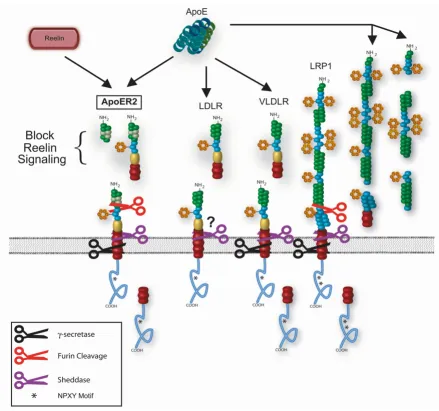
Soluble apoE receptors
In addition to the transmembrane forms of apoE recep-tors, soluble forms of these receptors have been observed
in vitro and in vivo (Figure 3). Soluble receptors can be gen-erated by cleavage of transmembrane forms of the recep-tors (also called "ectodomain shedding"). Extracellular proteinases responsible for the release of soluble receptors are commonly metalloproteinases, either membrane bound (A Disintegrin and Metalloproteinase, ADAMs) or secreted (Matrix Metalloproteinase, MMPs) [137]. Alter-nately, soluble receptors can be expressed from alternately spliced mRNAs that lack a transmembrane domain [138]. Both of these processes are important for regulation of soluble apoE receptors and functions of membrane bound apoE receptors.
Soluble LRP
LRP is synthesized as a single polypeptide chain of ~600 kDa and then cleaved in the trans-Golgi network by furin into a 515-kDa ligand-binding subunit and an 85-kDa transmembrane subunit that remain non-covalently asso-ciated with one another as they traffic to the cell surface [139]. The LRP extracellular region undergoes shedding from a region close to the membrane by metalloprotein-ases, releasing a soluble LRP (sLRP) capable of binding ligands [140,141]. sLRP is detected in human plasma at nanomolar concentrations [140,141] and in human CSF [142]. Recent studies have also shown that the cell associ-ated fragment of LRP can be cleaved at a third, intramem-branous site by the γ-secretase, releasing its intracellular domain (ICD) [143,144]. These sequential cleavage events by furin, metalloproteinases, and γ-secretase closely resemble those of Notch family proteins [145-147].
Soluble ApoER2 and VLDLR
Like LRP, ApoER2 and VLDLR undergo extracellular cleav-ages by metalloproteinases to release soluble receptors as well as C-terminal, cell-associated fragments, and these events are induced by Phorbol esters [148]. Furthermore, the C-terminal fragments are cleaved by γ-secretase [149].
ApoER2 and VLDLR proteolytic events are also increased by extracellular ligand binding [148]. Interestingly, the different apoE alleles induced different degrees of release; both ApoER2 and VLDLR show greatest cleavage follow-ing apoE2 activation, less with apoE3 and relatively little with apoE4 [148]. The release of soluble forms of ApoER2 and VLDLR is affected by the presence of splice variants. ApoER2 and VLDLR both have prominent splice variants that lack the exon encoding an O-linked glycosylation site. This region is important in the regulated cleavage of transmembrane proteins [150]. In addition, some ApoER2 splice variants contain an exon that encodes a furin cleavage site in the extracellular domain [59,151]. Furin-dependent cleavage results in extrusion of a soluble fragment of the receptor [152]. Thus, cleavages of ApoER2 and VLDLR are regulated in part by alternate splicing events.
Soluble LDLR
Like the other family members, LDLR exists as a soluble form [153,154]. LDLR shedding from the cell surface is enhanced by several stimuli, including interferon and phorbol ester. As for the other apoE receptors, this effect is dependent upon a cell surface metalloproteinase [154]. Inefficient LDLR exon splicing may also contribute to sol-uble LDLR isoforms because LDLR ESTs have been reported which lack (i) exon 12, which causes a frameshift in the extracellular domain, resulting in a premature ter-mination codon in exon 13, or (ii) exon 15, which encodes the LDLR O-linked glycosylation domain (BG945931 and BQ685399, respectively).
Release of soluble receptors
Numerous transmembrane proteins in addition to the apoE receptors have soluble forms, including growth fac-tors and their recepfac-tors, cytokine precursors and recep-tors, cell adhesion molecules, enzymes, and differentiation factors [155]. To gain insight into the pos-sible mechanisms of soluble apoE receptors, we will briefly consider the functions of released extracellular domains of various other transmembrane proteins.
1. Protein function at a distance from the cell
secreted and acts at a distance [157]. Another example of membrane bound protein cleavage is APP. Isoforms of APP containing the Kunitz proteinase inhibitor (KPI) domain can act as serine proteinase inhibitors at the cell surface but, once released from the cell surface, act as sol-uble proteinase inhibitors [158].
2. An initial step in cell signaling
Ligand binding to a cell surface receptor can transduce a signal inside the cell through several general mechanisms. One of these involves sequential cleavage of the surface receptor after ligand binding, releasing extracellular
(solu-ble) and intracellular (membrane-bound) domains. A subsequent intramembranous (i.e. γ-secretase) cleavage of the membrane-associated protein then releases the cyto-plasmic domain for intracellular effects [159]. Thus, release of the soluble receptor is a required step in the sig-nal transduction pathway. The large number of proteins identified as γ-secretase substrates undergo this series of proteolytic events [160]. One well-studied example of this mechanism is the Notch receptor [161]. Notch is a recep-tor for cell surface proteins on adjacent cells (Delta, Jag-ged, etc.). After ligand binding, Notch undergoes sequential cleavages to release of its intracellular domain
Soluble apoE receptors Figure 3
(NICD), which acts as a transcription factor of genes important to development. No function has been assigned the soluble fragment of Notch generated by the initial cleavage. Another example is the proteolysis of SREBP (sterol responsive element binding protein) at luminal and intramembranous sites [162]. These cleav-ages result in the release of the cytoplasmic fragments of SREBPs that act as transcriptional activators of specific genes important in cholesterol homeostasis.
3. Inhibition of cell signaling
The soluble form of receptors can bind to soluble ligands and prevent them from interacting with membrane-bound receptors, thus preventing their effects on cells. High affinity receptors for several interleukins (IL-1, IL-4, IL-15) have shed forms that bind the specific interleukins and block their actions on cells [163-165]. A soluble ver-sion of the receptor for advanced glycation end products (RAGE) can block the interactions of ligands with the membrane bound forms of RAGE, preventing their endo-cytosis [166], and a soluble version of the leptin receptor blocks leptin signaling [167]. Receptor cleavage can also inhibit signaling that is already occurring on the cell sur-face. For example, cell surface ephrins interact with Eph receptors on adjacent cells, promoting both forward and reverse cell signaling cascades important in development [168]. The formation of the ligand receptor complex pro-motes cleavage of the ephrin from the cell surface by ADAMs, thus ceasing both forward and reverse signaling events [169].
4. Release of cell adhesion
Transmembrane proteins are vital for establishing stable connections of a cell with adjacent cells or with the extra-cellular matrix. When proteolysis of these membrane pro-teins occurs, the cellular binding to the extracellular matrix is broken, allowing a cell to migrate, or allowing portions of a cell to form new interactions. A component of the cleavage of the ephrin-Eph receptor complex is that this cleavage allows for the induced axonal repulsion [170]. Other examples include the cleavage of cell adhe-sion molecules L1 that disrupts cell-cell adheadhe-sion [171], and cleavage of the discoidan domain receptor 1, that dis-rupts cell-collagen adhesion [172].
5. Protein turnover
Secreted proteins are often degraded by soluble protein-ases, or internalized by cells and degraded in endosomes and lysosomes. Cytoplasmic proteins can be ubiquiti-nated and degraded by the proteosome [173]. However, transmembrane proteins cannot be sufficiently degraded by either of these mechanisms as long as they are mem-brane bound. Therefore, turnover of transmemmem-brane pro-teins requires a combination of proteolytic events. Cleavage at the cell surface would release soluble proteins
for extracellular degradation or clearance. Subsequent cleavages within the membrane would generate small protein fragments that could be removed from the mem-brane, as well as cytoplasmic fragments that could be degraded by intracellular pathways. The urokinase recep-tor uPAR undergoes a series of cleavages that may be responsible for this type of protein turnover[174]. CD44 is another example of a protein that undergoes these sequential cleavages for degradation [175].
Functions of soluble apoE receptors
These potential functions of soluble receptors each apply to apoE receptors. One of the most profound implications of the production of soluble apoE receptors is the possible dominant negative effect on apoE receptor function. This action is observed with the production of soluble ApoER2. The expression of the ApoER2 variant containing the furin consensus site results in the production of solu-ble receptor consisting of the ligand binding domain [152]. Soluble ApoER2 can effectively block Reelin bind-ing to both ApoER2 and VLDLR and subsequent Reelin-dependent signaling in primary neuronal cells. Thus, inhi-bition of normal Reelin signaling through ApoER2 and VLDLR can acutely modulate other signaling mechanisms through changes in NMDA receptor activity and intracel-lular signaling pathways [84-89]. The effect on apoE-dependent signaling has yet to be determined, but these studies suggest that selected apoE receptor shedding would affect both specific ligand binding, as in the case of soluble ApoER2 and Reelin signaling, as well as overall apoE binding and signaling.
Summary
Numerous transmembrane receptors undergo proteolytic processing. Soluble apoE receptors have also been identi-fied for VLDLR, ApoER2, LDLR and LRP. The specific physiologic function for apoE receptor processing has yet to be elucidated. However, a dominant negative effect has been attributed to the processing of ApoER2 and subse-quent production of soluble receptor. Thus, specific apoE receptor shedding may represent a novel mechanism for modulating individual apoE receptor-ligand interactions and overall apoE receptor function.
Conclusion
Soluble apoE receptors are generated by two mechanisms, i.e., proteolysis of transmembrane receptors and by expression of alternately spliced isoforms of the proteins. Moreover, splicing also modulates cell surface proteolysis because exons encoding the O-linked glycosylation domains of VLDLR, ApoER2 and LDLR are alternatively spliced, and this glycosylation domain modulates suscep-tibility to cell surface proteolysis. These soluble receptors bind their ligands, including apoE, and affect their func-tion and metabolism. The mechanisms and regulafunc-tion of the processes generating soluble apoE receptors, mediat-ing the actions of these receptors, and controllmediat-ing the eventual clearance of the soluble receptors are just now being examined. Thus, soluble apoE receptors overall may represent an area of rapid growth in our understanding of AD-related processes. The importance of receptor shed-ding as a general regulatory mechanism is being recog-nized in many fields, with shedding of molecules important, for example, in development (Notch, ephrins), immunology (TNF-α, IL-1 receptor, CD44), cell signaling (SREBP, leptin receptors), and cell adhesion (L1, discoidan domain receptor 1). Soluble apoE receptors could play roles as dominant negative regulators of apoE, and thus understanding their generation and actions are important for understanding normal apoE functions in the CNS.
References
1. Tanzi RE, Bertram L: Twenty years of the Alzheimer's disease amyloid hypothesis: a genetic perspective. Cell 2005,
120(4):545-555.
2. Selkoe DJ: Alzheimer's disease: genotypes, phenotypes, and treatments. Science 1997, 275(5300):630-631.
3. Corder EH, Saunders AM, Strittmatter WJ, Schmechel DE, Gaskell PC, Small GW, Roses AD, Haines JL, Pericak-Vance MA: Gene dose of apolipoprotein E type 4 allele and the risk of Alzheimer's disease in late onset families. Science 1993, 261(5123):921-923. 4. Lahiri DK, Sambamurti K, Bennett DA: Apolipoprotein gene and its interaction with the environmentally driven risk factors: molecular, genetic and epidemiological studies of Alzhe-imer's disease. Neurobiol Aging 2004, 25(5):651-660.
5. Rocchi A, Pellegrini S, Siciliano G, Murri L: Causative and suscep-tibility genes for Alzheimer's disease: a review. Brain Res Bull
2003, 61(1):1-24.
6. Rebeck GW, Reiter JS, Strickland DK, Hyman BT: Apolipoprotein E in sporadic Alzheimer's disease: allelic variation and recep-tor interactions. Neuron 1993, 11(4):575-580.
7. Holtzman DM, Bales KR, Tenkova T, Fagan AM, Parsadanian M, Sar-torius LJ, Mackey B, Olney J, McKeel D, Wozniak D, Paul SM: Apoli-poprotein E isoform-dependent amyloid deposition and neuritic degeneration in a mouse model of Alzheimer's dis-ease. Proc Natl Acad Sci U S A 2000, 97(6):2892-2897.
8. Holtzman DM, Bales KR, Wu S, Bhat P, Parsadanian M, Fagan AM, Chang LK, Sun Y, Paul SM: Expression of human apolipoprotein E reduces amyloid-beta deposition in a mouse model of Alzheimer's disease. J Clin Invest 1999, 103(6):R15-R21. 9. Breitner JC, Murphy EA: Twin studies of Alzheimer disease: II.
Some predictions under a genetic model. Am J Med Genet 1992,
44(5):628-634.
10. Bergem AL, Engedal K, Kringlen E: The role of heredity in late-onset Alzheimer disease and vascular dementia. A twin study. Arch Gen Psychiatry 1997, 54(3):264-270.
11. Miller LJ, Chacko R: The role of cholesterol and statins in Alzheimer's disease. Ann Pharmacother 2004, 38(1):91-98. 12. Wolozin B: Cholesterol, statins and dementia. Curr Opin Lipidol
2004, 15(6):667-672.
13. McGeer PL, Schulzer M, McGeer EG: Arthritis and anti-inflam-matory agents as possible protective factors for Alzheimer's disease: a review of 17 epidemiologic studies. Neurology 1996,
47(2):425-432.
14. Guo Z, Cupples LA, Kurz A, Auerbach SH, Volicer L, Chui H, Green RC, Sadovnick AD, Duara R, DeCarli C, Johnson K, Go RC, Growdon JH, Haines JL, Kukull WA, Farrer LA: Head injury and the risk of AD in the MIRAGE study. Neurology 2000, 54(6):1316-1323. 15. Pitas RE, Boyles JK, Lee SH, Hui D, Weisgraber KH: Lipoproteins
and their receptors in the central nervous system. Charac-terization of the lipoproteins in cerebrospinal fluid and iden-tification of apolipoprotein B,E(LDL) receptors in the brain.
J Biol Chem 1987, 262(29):14352-14360.
16. Koch S, Donarski N, Goetze K, Kreckel M, Stuerenburg HJ, Buhmann C, Beisiegel U: Characterization of four lipoprotein classes in human cerebrospinal fluid. J Lipid Res 2001, 42(7):1143-1151. 17. Rebeck GW, Alonzo NC, Berezovska O, Harr SD, Knowles RB,
Growdon JH, Hyman BT, Mendez AJ: Structure and functions of human cerebrospinal fluid lipoproteins from individuals of different APOE genotypes. Exp Neurol 1998, 149(1):175-182. 18. Schmechel DE, Saunders AM, Strittmatter WJ, Crain BJ, Hulette CM,
Joo SH, Pericak-Vance MA, Goldgaber D, Roses AD: Increased amyloid beta-peptide deposition in cerebral cortex as a con-sequence of apolipoprotein E genotype in late-onset Alzhe-imer disease. Proc Natl Acad Sci U S A 1993, 90(20):9649-9653. 19. Greenberg SM, Briggs ME, Hyman BT, Kokoris GJ, Takis C, Kanter
DS, Kase CS, Pessin MS: Apolipoprotein E epsilon 4 is associated with the presence and earlier onset of hemorrhage in cere-bral amyloid angiopathy. Stroke 1996, 27(8):1333-1337. 20. Hyman BT, West HL, Rebeck GW, Buldyrev SV, Mantegna RN, Ukleja
M, Havlin S, Stanley HE: Quantitative analysis of senile plaques in Alzheimer disease: observation of log-normal size distri-bution and molecular epidemiology of differences associated with apolipoprotein E genotype and trisomy 21 (Down syn-drome). Proc Natl Acad Sci U S A 1995, 92(8):3586-3590. 21. Nicoll JA, Roberts GW, Graham DI: Apolipoprotein E epsilon 4
allele is associated with deposition of amyloid beta-protein following head injury. Nat Med 1995, 1(2):135-137.
22. Nicoll JA, Burnett C, Love S, Graham DI, Ironside JW, Vinters HV:
High frequency of apolipoprotein E epsilon 2 in patients with cerebral hemorrhage due to cerebral amyloid angiopathy.
Ann Neurol 1996, 39(5):682-683.
23. Lai F, Kammann E, Rebeck GW, Anderson A, Chen Y, Nixon RA:
APOE genotype and gender effects on Alzheimer disease in 100 adults with Down syndrome. Neurology 1999,
53(2):331-336.
24. Namba Y, Tomonaga M, Kawasaki H, Otomo E, Ikeda K: Apolipo-protein E immunoreactivity in cerebral amyloid deposits and neurofibrillary tangles in Alzheimer's disease and kuru plaque amyloid in Creutzfeldt-Jakob disease. Brain Res 1991,
541(1):163-166.
25. Bales KR, Verina T, Dodel RC, Du Y, Altstiel L, Bender M, Hyslop P, Johnstone EM, Little SP, Cummins DJ, Piccardo P, Ghetti B, Paul SM:
Lack of apolipoprotein E dramatically reduces amyloid beta-peptide deposition. Nat Genet 1997, 17(3):263-264.
age-dependent cerebral amyloid angiopathy and spontaneous hemorrhage in amyloid precursor protein transgenic mice. J Neurosci 2003, 23(21):7889-7896.
27. Klein WL, Krafft GA, Finch CE: Targeting small Abeta oligom-ers: the solution to an Alzheimer's disease conundrum?
Trends Neurosci 2001, 24(4):219-224.
28. Lansbury PT Jr.: Evolution of amyloid: what normal protein folding may tell us about fibrillogenesis and disease. Proc Natl Acad Sci U S A 1999, 96(7):3342-3344.
29. Small DH: The amyloid cascade hypothesis debate: emerging consensus on the role of A beta and amyloid in Alzheimer's disease. Amyloid 1998, 5(4):301-304.
30. Terry RD: An honorable compromise regarding amyloid in Alzheimer disease. Ann Neurol 2001, 49(5):684.
31. Haass C, Steiner H: Protofibrils, the unifying toxic molecule of neurodegenerative disorders? Nat Neurosci 2001, 4(9):859-860. 32. Wisniewski T, Golabek A, Matsubara E, Ghiso J, Frangione B: Apoli-poprotein E: binding to soluble Alzheimer's beta-amyloid.
Biochem Biophys Res Commun 1993, 192(2):359-365.
33. Kuo YM, Emmerling MR, Vigo-Pelfrey C, Kasunic TC, Kirkpatrick JB, Murdoch GH, Ball MJ, Roher AE: Water-soluble Abeta (40, N-42) oligomers in normal and Alzheimer disease brains. J Biol Chem 1996, 271(8):4077-4081.
34. Strittmatter WJ, Weisgraber KH, Huang DY, Dong LM, Salvesen GS, Pericak-Vance M, Schmechel D, Saunders AM, Goldgaber D, Roses AD: Binding of human apolipoprotein E to synthetic amyloid beta peptide: isoform-specific effects and implications for late-onset Alzheimer disease. Proc Natl Acad Sci U S A 1993,
90(17):8098-8102.
35. LaDu MJ, Falduto MT, Manelli AM, Reardon CA, Getz GS, Frail DE:
Isoform-specific binding of apolipoprotein E to beta-amyloid.
J Biol Chem 1994, 269(38):23403-23406.
36. LaDu MJ, Pederson TM, Frail DE, Reardon CA, Getz GS, Falduto MT:
Purification of apolipoprotein E attenuates isoform-specific binding to beta-amyloid. J Biol Chem 1995, 270(16):9039-9042. 37. Tokuda T, Calero M, Matsubara E, Vidal R, Kumar A, Permanne B,
Zlokovic B, Smith JD, Ladu MJ, Rostagno A, Frangione B, Ghiso J: Lip-idation of apolipoprotein E influences its isoform-specific interaction with Alzheimer's amyloid beta peptides. Biochem J 2000, 348 Pt 2:359-365.
38. Ma J, Yee A, Brewer HB Jr., Das S, Potter H: Amyloid-associated proteins alpha 1-antichymotrypsin and apolipoprotein E pro-mote assembly of Alzheimer beta-protein into filaments.
Nature 1994, 372(6501):92-94.
39. Sanan DA, Weisgraber KH, Russell SJ, Mahley RW, Huang D, Saun-ders A, Schmechel D, Wisniewski T, Frangione B, Roses AD, et al.:
Apolipoprotein E associates with beta amyloid peptide of Alzheimer's disease to form novel monofibrils. Isoform apoE4 associates more efficiently than apoE3. J Clin Invest
1994, 94(2):860-869.
40. Wisniewski T, Castano EM, Golabek A, Vogel T, Frangione B: Accel-eration of Alzheimer's fibril formation by apolipoprotein E in vitro. Am J Pathol 1994, 145(5):1030-1035.
41. LaDu MJ, Shah JA, Reardon CA, Getz GS, Bu G, Hu J, Guo L, van Eldik LJ: Apolipoprotein E receptors mediate the effects of beta-amyloid on astrocyte cultures. J Biol Chem 2000,
275(43):33974-33980.
42. Laskowitz DT, Thekdi AD, Thekdi SD, Han SK, Myers JK, Pizzo SV, Bennett ER: Downregulation of microglial activation by apoli-poprotein E and apoE-mimetic peptides. Exp Neurol 2001,
167(1):74-85.
43. Lynch JR, Tang W, Wang H, Vitek MP, Bennett ER, Sullivan PM, Warner DS, Laskowitz DT: APOE genotype and an ApoE-mimetic peptide modify the systemic and central nervous system inflammatory response. J Biol Chem 2003,
278(49):48529-48533.
44. Guo L, LaDu MJ, Van Eldik LJ: A dual role for apolipoprotein e in neuroinflammation: anti- and pro-inflammatory activity. J Mol Neurosci 2004, 23(3):205-212.
45. Koistinaho M, Lin S, Wu X, Esterman M, Koger D, Hanson J, Higgs R, Liu F, Malkani S, Bales KR, Paul SM: Apolipoprotein E promotes astrocyte colocalization and degradation of deposited amy-loid-beta peptides. Nat Med 2004, 10(7):719-726.
46. Trommer BL, Shah C, Yun SH, Gamkrelidze G, Pasternak ES, Stine WB, Manelli A, Sullivan P, Pasternak JF, LaDu MJ: ApoE
isoform-specific effects on LTP: blockade by oligomeric amyloid-beta1-42. Neurobiol Dis 2005, 18(1):75-82.
47. Manelli AM, Bulfinch LC, Sullivan PM, Ladu MJ: Abeta42 neurotox-icity in primary co-cultures: Effect of apoE isoform and Abeta conformation. Neurobiol Aging 2006.
48. Whitson JS, Mims MP, Strittmatter WJ, Yamaki T, Morrisett JD, Appel SH: Attenuation of the neurotoxic effect of A beta amyloid peptide by apolipoprotein E. Biochem Biophys Res Commun 1994,
199(1):163-170.
49. Ma J, Brewer HB Jr., Potter H: Alzheimer A beta neurotoxicity: promotion by antichymotrypsin, ApoE4; inhibition by A beta-related peptides. Neurobiol Aging 1996, 17(5):773-780. 50. Miyata M, Smith JD: Apolipoprotein E allele-specific antioxidant
activity and effects on cytotoxicity by oxidative insults and beta-amyloid peptides. Nat Genet 1996, 14(1):55-61.
51. Jordan J, Galindo MF, Miller RJ, Reardon CA, Getz GS, LaDu MJ: Iso-form-specific effect of apolipoprotein E on cell survival and beta-amyloid-induced toxicity in rat hippocampal pyramidal neuronal cultures. J Neurosci 1998, 18(1):195-204.
52. Herz J, Bock HH: Lipoprotein receptors in the nervous system.
Annu Rev Biochem 2002, 71:405-434.
53. May P, Herz J, Bock HH: Molecular mechanisms of lipoprotein receptor signalling. Cell Mol Life Sci 2005, 62(19-20):2325-2338. 54. Herz J, Hamann U, Rogne S, Myklebost O, Gausepohl H, Stanley KK:
Surface location and high affinity for calcium of a 500-kd liver membrane protein closely related to the LDL-receptor sug-gest a physiological role as lipoprotein receptor. Embo J 1988,
7(13):4119-4127.
55. Raychowdhury R, Niles JL, McCluskey RT, Smith JA: Autoimmune target in Heymann nephritis is a glycoprotein with homology to the LDL receptor. Science 1989, 244(4909):1163-1165. 56. Takahashi S, Kawarabayasi Y, Nakai T, Sakai J, Yamamoto T: Rabbit
very low density lipoprotein receptor: a low density lipopro-tein receptor-like prolipopro-tein with distinct ligand specificity. Proc Natl Acad Sci U S A 1992, 89(19):9252-9256.
57. Kim DH, Iijima H, Goto K, Sakai J, Ishii H, Kim HJ, Suzuki H, Kondo H, Saeki S, Yamamoto T: Human apolipoprotein E receptor 2. A novel lipoprotein receptor of the low density lipoprotein receptor family predominantly expressed in brain. J Biol Chem
1996, 271(14):8373-8380.
58. Novak S, Hiesberger T, Schneider WJ, Nimpf J: A new low density lipoprotein receptor homologue with 8 ligand binding repeats in brain of chicken and mouse. J Biol Chem 1996,
271(20):11732-11736.
59. Brandes C, Novak S, Stockinger W, Herz J, Schneider WJ, Nimpf J:
Avian and murine LR8B and human apolipoprotein E recep-tor 2: differentially spliced products from corresponding genes. Genomics 1997, 42(2):185-191.
60. Jacobsen L, Madsen P, Moestrup SK, Lund AH, Tommerup N, Nykjaer A, Sottrup-Jensen L, Gliemann J, Petersen CM: Molecular charac-terization of a novel human hybrid-type receptor that binds the alpha2-macroglobulin receptor-associated protein. J Biol Chem 1996, 271(49):31379-31383.
61. Yamazaki H, Bujo H, Kusunoki J, Seimiya K, Kanaki T, Morisaki N, Sch-neider WJ, Saito Y: Elements of neural adhesion molecules and a yeast vacuolar protein sorting receptor are present in a novel mammalian low density lipoprotein receptor family member. J Biol Chem 1996, 271(40):24761-24768.
62. Johnson EB, Hammer RE, Herz J: Abnormal development of the apical ectodermal ridge and polysyndactyly in Megf7-defi-cient mice. Hum Mol Genet 2005, 14(22):3523-3538.
63. Kim DH, Inagaki Y, Suzuki T, Ioka RX, Yoshioka SZ, Magoori K, Kang MJ, Cho Y, Nakano AZ, Liu Q, Fujino T, Suzuki H, Sasano H, Yamamoto TT: A new low density lipoprotein receptor related protein, LRP5, is expressed in hepatocytes and adrenal cor-tex, and recognizes apolipoprotein E. J Biochem (Tokyo) 1998,
124(6):1072-1076.
64. Hey PJ, Twells RC, Phillips MS, Yusuke N, Brown SD, Kawaguchi Y, Cox R, Guochun X, Dugan V, Hammond H, Metzker ML, Todd JA, Hess JF: Cloning of a novel member of the low-density lipo-protein receptor family. Gene 1998, 216(1):103-111.
65. Brown SD, Twells RC, Hey PJ, Cox RD, Levy ER, Soderman AR, Metz-ker ML, Caskey CT, Todd JA, Hess JF: Isolation and characteriza-tion of LRP6, a novel member of the low density lipoprotein receptor gene family. Biochem Biophys Res Commun 1998,
66. Liu CX, Musco S, Lisitsina NM, Forgacs E, Minna JD, Lisitsyn NA:
LRP-DIT, a putative endocytic receptor gene, is frequently inactivated in non-small cell lung cancer cell lines. Cancer Res
2000, 60(7):1961-1967.
67. Li Y, Cam J, Bu G: Low-density lipoprotein receptor family: endocytosis and signal transduction. Mol Neurobiol 2001,
23(1):53-67.
68. Jeon H, Meng W, Takagi J, Eck MJ, Springer TA, Blacklow SC: Impli-cations for familial hypercholesterolemia from the structure of the LDL receptor YWTD-EGF domain pair. Nat Struct Biol
2001, 8(6):499-504.
69. Bu G: Receptor-associated protein: a specialized chaperone and antagonist for members of the LDL receptor gene fam-ily. Curr Opin Lipidol 1998, 9(2):149-155.
70. Christie RH, Chung H, Rebeck GW, Strickland D, Hyman BT:
Expression of the very low-density lipoprotein receptor (VLDL-r), an apolipoprotein-E receptor, in the central nerv-ous system and in Alzheimer's disease. J Neuropathol Exp Neurol
1996, 55(4):491-498.
71. Clatworthy AE, Stockinger W, Christie RH, Schneider WJ, Nimpf J, Hyman BT, Rebeck GW: Expression and alternate splicing of apolipoprotein E receptor 2 in brain. Neuroscience 1999,
90(3):903-911.
72. Moestrup SK, Gliemann J, Pallesen G: Distribution of the alpha 2-macroglobulin receptor/low density lipoprotein receptor-related protein in human tissues. Cell Tissue Res 1992,
269(3):375-382.
73. Swanson LW, Simmons DM, Hofmann SL, Goldstein JL, Brown MS:
Localization of mRNA for low density lipoprotein receptor and a cholesterol synthetic enzyme in rabbit nervous system by in situ hybridization. Proc Natl Acad Sci U S A 1988,
85(24):9821-9825.
74. Li Y, Marzolo MP, van Kerkhof P, Strous GJ, Bu G: The YXXL motif, but not the two NPXY motifs, serves as the dominant endocytosis signal for low density lipoprotein receptor-related protein. J Biol Chem 2000, 275(22):17187-17194. 75. Chen WJ, Goldstein JL, Brown MS: NPXY, a sequence often
found in cytoplasmic tails, is required for coated pit-medi-ated internalization of the low density lipoprotein receptor.
J Biol Chem 1990, 265(6):3116-3123.
76. Li Y, Lu W, Marzolo MP, Bu G: Differential functions of members of the low density lipoprotein receptor family suggested by their distinct endocytosis rates. J Biol Chem 2001,
276(21):18000-18006.
77. van Kerkhof P, Lee J, McCormick L, Tetrault E, Lu W, Schoenfish M, Oorschot V, Strous GJ, Klumperman J, Bu G: Sorting nexin 17 facilitates LRP recycling in the early endosome. Embo J 2005,
24(16):2851-2861.
78. Hoe HS, Magill LA, Guenette S, Fu Z, Vicini S, Rebeck GW: FE65 Interaction with the apoE receptor ApoEr2. J Biol Chem 2006. 79. Dietschy JM, Turley SD: Thematic review series: brain Lipids. Cholesterol metabolism in the central nervous system dur-ing early development and in the mature animal. J Lipid Res
2004, 45(8):1375-1397.
80. Bjorkhem I, Meaney S: Brain cholesterol: long secret life behind a barrier. Arterioscler Thromb Vasc Biol 2004, 24(5):806-815. 81. Poirier J: Apolipoprotein E in animal models of CNS injury
and in Alzheimer's disease. Trends Neurosci 1994,
17(12):525-530.
82. Herz J: The LDL receptor gene family: (un)expected signal transducers in the brain. Neuron 2001, 29(3):571-581. 83. Trommsdorff M, Gotthardt M, Hiesberger T, Shelton J, Stockinger W,
Nimpf J, Hammer RE, Richardson JA, Herz J: Reeler/Disabled-like disruption of neuronal migration in knockout mice lacking the VLDL receptor and ApoE receptor 2. Cell 1999,
97(6):689-701.
84. Bacskai BJ, Xia MQ, Strickland DK, Rebeck GW, Hyman BT: The endocytic receptor protein LRP also mediates neuronal cal-cium signaling via N-methyl-D-aspartate receptors. Proc Natl Acad Sci U S A 2000, 97(21):11551-11556.
85. Qiu Z, Strickland DK, Hyman BT, Rebeck GW: alpha 2-Macroglob-ulin exposure reduces calcium responses to N-methyl-D-aspartate via low density lipoprotein receptor-related pro-tein in cultured hippocampal neurons. J Biol Chem 2002,
277(17):14458-14466.
86. Hoe HS, Harris DC, Rebeck GW: Multiple pathways of apolipo-protein E signaling in primary neurons. J Neurochem 2005,
93(1):145-155.
87. Beffert U, Weeber EJ, Durudas A, Qiu S, Masiulis I, Sweatt JD, Li WP, Adelmann G, Frotscher M, Hammer RE, Herz J: Modulation of syn-aptic plasticity and memory by Reelin involves differential splicing of the lipoprotein receptor Apoer2. Neuron 2005,
47(4):567-579.
88. Ohkubo N, Mitsuda N, Tamatani M, Yamaguchi A, Lee YD, Ogihara T, Vitek MP, Tohyama M: Apolipoprotein E4 stimulates cAMP response element-binding protein transcriptional activity through the extracellular signal-regulated kinase pathway. J Biol Chem 2001, 276(5):3046-3053.
89. Aono M, Bennett ER, Kim KS, Lynch JR, Myers J, Pearlstein RD, Warner DS, Laskowitz DT: Protective effect of apolipoprotein E-mimetic peptides on N-methyl-D-aspartate excitotoxicity in primary rat neuronal-glial cell cultures. Neuroscience 2003,
116(2):437-445.
90. Trommsdorff M, Borg JP, Margolis B, Herz J: Interaction of cytosolic adaptor proteins with neuronal apolipoprotein E receptors and the amyloid precursor protein. J Biol Chem 1998,
273(50):33556-33560.
91. Howell BW, Lanier LM, Frank R, Gertler FB, Cooper JA: The disa-bled 1 phosphotyrosine-binding domain binds to the inter-nalization signals of transmembrane glycoproteins and to phospholipids. Mol Cell Biol 1999, 19(7):5179-5188.
92. Gotthardt M, Trommsdorff M, Nevitt MF, Shelton J, Richardson JA, Stockinger W, Nimpf J, Herz J: Interactions of the low density lipoprotein receptor gene family with cytosolic adaptor and scaffold proteins suggest diverse biological functions in cellu-lar communication and signal transduction. J Biol Chem 2000,
275(33):25616-25624.
93. Stockinger W, Brandes C, Fasching D, Hermann M, Gotthardt M, Herz J, Schneider WJ, Nimpf J: The reelin receptor ApoER2 recruits JNK-interacting proteins-1 and -2. J Biol Chem 2000,
275(33):25625-25632.
94. Oleinikov AV, Zhao J, Makker SP: Cytosolic adaptor protein Dab2 is an intracellular ligand of endocytic receptor gp600/ megalin. Biochem J 2000, 347 Pt 3:613-621.
95. Hoe HS, Pocivavsek A, Chakraborty G, Fu Z, Vicini S, Ehlers MD, Rebeck GW: Apolipoprotein E receptor 2 interactions with the N-methyl-D-aspartate receptor. J Biol Chem 2006,
281(6):3425-3431.
96. Beffert U, Morfini G, Bock HH, Reyna H, Brady ST, Herz J: Reelin-mediated signaling locally regulates protein kinase B/Akt and glycogen synthase kinase 3beta. J Biol Chem 2002,
277(51):49958-49964.
97. Weeber EJ, Beffert U, Jones C, Christian JM, Forster E, Sweatt JD, Herz J: Reelin and ApoE receptors cooperate to enhance hip-pocampal synaptic plasticity and learning. J Biol Chem 2002,
277(42):39944-39952.
98. LaDu MJ, Shah JA, Reardon CA, Getz GS, Bu G, Hu J, Guo L, Van Eldik LJ: Apolipoprotein E and apolipoprotein E receptors modu-late A beta-induced glial neuroinflammatory responses. Neu-rochem Int 2001, 39(5-6):427-434.
99. Frykman PK, Brown MS, Yamamoto T, Goldstein JL, Herz J: Normal plasma lipoproteins and fertility in gene-targeted mice homozygous for a disruption in the gene encoding very low density lipoprotein receptor. Proc Natl Acad Sci U S A 1995,
92(18):8453-8457.
100. Crutcher KA, Clay MA, Scott SA, Tian X, Tolar M, Harmony JA: Neu-rite degeneration elicited by apolipoprotein E peptides. Exp Neurol 1994, 130(1):120-126.
101. Hashimoto Y, Jiang H, Niikura T, Ito Y, Hagiwara A, Umezawa K, Abe Y, Murayama Y, Nishimoto I: Neuronal apoptosis by apolipopro-tein E4 through low-density lipoproapolipopro-tein receptor-related protein and heterotrimeric GTPases. J Neurosci 2000,
20(22):8401-8409.
102. Teter B: Apolipoprotein E isotype-specific effects in neurode-generation. Alzheimer's Reports 2000, 3(4):199-212.
103. Raber J, Wong D, Buttini M, Orth M, Bellosta S, Pitas RE, Mahley RW, Mucke L: Isoform-specific effects of human apolipoprotein E on brain function revealed in ApoE knockout mice: increased susceptibility of females. Proc Natl Acad Sci U S A 1998,
104. Raber J, Wong D, Yu GQ, Buttini M, Mahley RW, Pitas RE, Mucke L:
Apolipoprotein E and cognitive performance. Nature 2000,
404(6776):352-354.
105. Hartman RE, Wozniak DF, Nardi A, Olney JW, Sartorius L, Holtzman DM: Behavioral phenotyping of GFAP-apoE3 and -apoE4 transgenic mice: apoE4 mice show profound working mem-ory impairments in the absence of Alzheimer's-like neuropa-thology. Exp Neurol 2001, 170(2):326-344.
106. Buttini M, Akeefe H, Lin C, Mahley RW, Pitas RE, Wyss-Coray T, Mucke L: Dominant negative effects of apolipoprotein E4 revealed in transgenic models of neurodegenerative disease.
Neuroscience 2000, 97(2):207-210.
107. Buttini M, Orth M, Bellosta S, Akeefe H, Pitas RE, Wyss-Coray T, Mucke L, Mahley RW: Expression of human apolipoprotein E3 or E4 in the brains of Apoe-/- mice: isoform-specific effects on neurodegeneration. J Neurosci 1999, 19(12):4867-4880. 108. Sullivan PM, Mezdour H, Aratani Y, Knouff C, Najib J, Reddick RL,
Quarfordt SH, Maeda N: Targeted replacement of the mouse apolipoprotein E gene with the common human APOE3 allele enhances diet-induced hypercholesterolemia and atherosclerosis. J Biol Chem 1997, 272(29):17972-17980. 109. Grootendorst J, Bour A, Vogel E, Kelche C, Sullivan PM, Dodart JC,
Bales K, Mathis C: Human apoE targeted replacement mouse lines: h-apoE4 and h-apoE3 mice differ on spatial memory performance and avoidance behavior. Behav Brain Res 2005,
159(1):1-14.
110. Trommer BL, Shah C, Yun SH, Gamkrelidze G, Pasternak ES, Ye GL, Sotak M, Sullivan PM, Pasternak JF, LaDu MJ: ApoE isoform affects LTP in human targeted replacement mice. Neuroreport 2004,
15(17):2655-2658.
111. Drouet B, Fifre A, Pincon-Raymond M, Vandekerckhove J, Rosseneu M, Gueant JL, Chambaz J, Pillot T: ApoE protects cortical neu-rones against neurotoxicity induced by the non-fibrillar C-terminal domain of the amyloid-beta peptide. J Neurochem
2001, 76(1):117-127.
112. Manelli AM, Stine WB, Van Eldik LJ, LaDu MJ: ApoE and Abeta1-42 interactions: effects of isoform and conformation on struc-ture and function. J Mol Neurosci 2004, 23(3):235-246.
113. Ji ZS, Miranda RD, Newhouse YM, Weisgraber KH, Huang Y, Mahley RW: Apolipoprotein E4 potentiates amyloid beta peptide-induced lysosomal leakage and apoptosis in neuronal cells. J Biol Chem 2002, 277(24):21821-21828.
114. Ji ZS, Mullendorff K, Cheng IH, Miranda RD, Huang Y, Mahley RW:
Reactivity of apolipoprotein E4 and amyloid beta peptide: lysosomal stability and neurodegeneration. J Biol Chem 2006,
281(5):2683-2692.
115. Lanz TA, Carter DB, Merchant KM: Dendritic spine loss in the hippocampus of young PDAPP and Tg2576 mice and its pre-vention by the ApoE2 genotype. Neurobiol Dis 2003,
13(3):246-253.
116. Zlokovic BV: Clearing amyloid through the blood-brain bar-rier. J Neurochem 2004, 89(4):807-811.
117. Gearing M, Schneider JA, Robbins RS, Hollister RD, Mori H, Games D, Hyman BT, Mirra SS: Regional variation in the distribution of apolipoprotein E and A beta in Alzheimer's disease. J Neu-ropathol Exp Neurol 1995, 54(6):833-841.
118. Cho HS, Hyman BT, Greenberg SM, Rebeck GW: Quantitation of apoE domains in Alzheimer disease brain suggests a role for apoE in Abeta aggregation. J Neuropathol Exp Neurol 2001,
60(4):342-349.
119. Arelin K, Kinoshita A, Whelan CM, Irizarry MC, Rebeck GW, Strick-land DK, Hyman BT: LRP and senile plaques in Alzheimer's dis-ease: colocalization with apolipoprotein E and with activated astrocytes. Brain Res Mol Brain Res 2002, 104(1):38-46.
120. Van Uden E, Mallory M, Veinbergs I, Alford M, Rockenstein E, Masliah E: Increased extracellular amyloid deposition and neurode-generation in human amyloid precursor protein transgenic mice deficient in receptor-associated protein. J Neurosci 2002,
22(21):9298-9304.
121. Willnow TE, Rohlmann A, Horton J, Otani H, Braun JR, Hammer RE, Herz J: RAP, a specialized chaperone, prevents ligand-induced ER retention and degradation of LDL receptor-related endocytic receptors. Embo J 1996, 15(11):2632-2639. 122. Willnow TE, Armstrong SA, Hammer RE, Herz J: Functional
expression of low density lipoprotein receptor-related
pro-tein is controlled by receptor-associated propro-tein in vivo. Proc Natl Acad Sci U S A 1995, 92(10):4537-4541.
123. Kounnas MZ, Moir RD, Rebeck GW, Bush AI, Argraves WS, Tanzi RE, Hyman BT, Strickland DK: LDL receptor-related protein, a mul-tifunctional ApoE receptor, binds secreted beta-amyloid precursor protein and mediates its degradation. Cell 1995,
82(2):331-340.
124. Knauer MF, Orlando RA, Glabe CG: Cell surface APP751 forms complexes with protease nexin 2 ligands and is internalized via the low density lipoprotein receptor-related protein (LRP). Brain Res 1996, 740(1-2):6-14.
125. Kinoshita A, Whelan CM, Smith CJ, Mikhailenko I, Rebeck GW, Strickland DK, Hyman BT: Demonstration by fluorescence res-onance energy transfer of two sites of interaction between the low-density lipoprotein receptor-related protein and the amyloid precursor protein: role of the intracellular adapter protein Fe65. J Neurosci 2001, 21(21):8354-8361.
126. Pietrzik CU, Yoon IS, Jaeger S, Busse T, Weggen S, Koo EH: FE65 constitutes the functional link between the low-density lipo-protein receptor-related lipo-protein and the amyloid precursor protein. J Neurosci 2004, 24(17):4259-4265.
127. Ulery PG, Beers J, Mikhailenko I, Tanzi RE, Rebeck GW, Hyman BT, Strickland DK: Modulation of beta-amyloid precursor protein processing by the low density lipoprotein receptor-related protein (LRP). Evidence that LRP contributes to the patho-genesis of Alzheimer's disease. J Biol Chem 2000,
275(10):7410-7415.
128. Pietrzik CU, Busse T, Merriam DE, Weggen S, Koo EH: The cyto-plasmic domain of the LDL receptor-related protein regu-lates multiple steps in APP processing. Embo J 2002,
21(21):5691-5700.
129. Cam JA, Zerbinatti CV, Li Y, Bu G: Rapid endocytosis of the low density lipoprotein receptor-related protein modulates cell surface distribution and processing of the beta-amyloid pre-cursor protein. J Biol Chem 2005, 280(15):15464-15470. 130. Zerbinatti CV, Wozniak DF, Cirrito J, Cam JA, Osaka H, Bales KR,
Zhuo M, Paul SM, Holtzman DM, Bu G: Increased soluble amy-loid-beta peptide and memory deficits in amyloid model mice overexpressing the low-density lipoprotein receptor-related protein. Proc Natl Acad Sci U S A 2004, 101(4):1075-1080. 131. Cam JA, Zerbinatti CV, Knisely JM, Hecimovic S, Li Y, Bu G: The low density lipoprotein receptor-related protein 1B retains beta-amyloid precursor protein at the cell surface and reduces amyloid-beta peptide production. J Biol Chem 2004,
279(28):29639-29646.
132. Hoe HS, Wessner D, Beffert U, Becker AG, Matsuoka Y, Rebeck GW: F-spondin interaction with the apolipoprotein E recep-tor ApoEr2 affects processing of amyloid precursor protein.
Mol Cell Biol 2005, 25(21):9259-9268.
133. Andersen OM, Schmidt V, Spoelgen R, Gliemann J, Behlke J, Galatis D, McKinstry WJ, Parker MW, Masters CL, Hyman BT, Cappai R, Willnow TE: Molecular dissection of the interaction between amyloid precursor protein and its neuronal trafficking recep-tor SorLA/LR11. Biochemistry 2006, 45(8):2618-2628.
134. Spoelgen R, von Arnim CA, Thomas AV, Peltan ID, Koker M, Deng A, Irizarry MC, Andersen OM, Willnow TE, Hyman BT: Interaction of the cytosolic domains of sorLA/LR11 with the amyloid pre-cursor protein (APP) and beta-secretase beta-site APP-cleaving enzyme. J Neurosci 2006, 26(2):418-428.
135. Andersen OM, Reiche J, Schmidt V, Gotthardt M, Spoelgen R, Behlke J, von Arnim CA, Breiderhoff T, Jansen P, Wu X, Bales KR, Cappai R, Masters CL, Gliemann J, Mufson EJ, Hyman BT, Paul SM, Nykjaer A, Willnow TE: Neuronal sorting protein-related receptor sorLA/LR11 regulates processing of the amyloid precursor protein. Proc Natl Acad Sci U S A 2005, 102(38):13461-13466. 136. Offe K, Dodson SE, Shoemaker JT, Fritz JJ, Gearing M, Levey AI, Lah
JJ: The lipoprotein receptor LR11 regulates amyloid beta production and amyloid precursor protein traffic in endo-somal compartments. J Neurosci 2006, 26(5):1596-1603. 137. Garcia-Touchard A, Henry TD, Sangiorgi G, Spagnoli LG, Mauriello A,
Conover C, Schwartz RS: Extracellular proteases in atheroscle-rosis and restenosis. Arterioscler Thromb Vasc Biol 2005,
25(6):1119-1127.
139. Herz J, Kowal RC, Goldstein JL, Brown MS: Proteolytic processing of the 600 kd low density lipoprotein receptor-related pro-tein (LRP) occurs in a trans-Golgi compartment. Embo J 1990,
9(6):1769-1776.
140. Quinn KA, Grimsley PG, Dai YP, Tapner M, Chesterman CN, Owensby DA: Soluble low density lipoprotein receptor-related protein (LRP) circulates in human plasma. J Biol Chem
1997, 272(38):23946-23951.
141. Grimsley PG, Quinn KA, Owensby DA: Soluble low-density lipo-protein receptor-related lipo-protein. Trends Cardiovasc Med 1998,
8(8):363-368.
142. Qiu Z, Strickland DK, Hyman BT, Rebeck GW: Elevation of LDL receptor-related protein levels via ligand interactions in Alzheimer disease and in vitro. J Neuropathol Exp Neurol 2001,
60(5):430-440.
143. May P, Reddy YK, Herz J: Proteolytic processing of low density lipoprotein receptor-related protein mediates regulated release of its intracellular domain. J Biol Chem 2002,
277(21):18736-18743.
144. Kinoshita A, Shah T, Tangredi MM, Strickland DK, Hyman BT: The intracellular domain of the low density lipoprotein receptor-related protein modulates transactivation mediated by amy-loid precursor protein and Fe65. J Biol Chem 2003,
278(42):41182-41188.
145. Blaumueller CM, Qi H, Zagouras P, Artavanis-Tsakonas S: Intracel-lular cleavage of Notch leads to a heterodimeric receptor on the plasma membrane. Cell 1997, 90(2):281-291.
146. Logeat F, Bessia C, Brou C, LeBail O, Jarriault S, Seidah NG, Israel A:
The Notch1 receptor is cleaved constitutively by a furin-like convertase. Proc Natl Acad Sci U S A 1998, 95(14):8108-8112. 147. Mumm JS, Schroeter EH, Saxena MT, Griesemer A, Tian X, Pan DJ,
Ray WJ, Kopan R: A ligand-induced extracellular cleavage reg-ulates gamma-secretase-like proteolytic activation of Notch1. Mol Cell 2000, 5(2):197-206.
148. Hoe HS, Rebeck GW: Regulation of ApoE receptor proteolysis by ligand binding. Brain Res Mol Brain Res 2005, 137(1-2):31-39. 149. May P, Bock HH, Nimpf J, Herz J: Differential glycosylation
regu-lates processing of lipoprotein receptors by gamma-secre-tase. J Biol Chem 2003, 278(39):37386-37392.
150. Iijima H, Miyazawa M, Sakai J, Magoori K, Ito MR, Suzuki H, Nose M, Kawarabayasi Y, Yamamoto TT: Expression and characterization of a very low density lipoprotein receptor variant lacking the O-linked sugar region generated by alternative splicing. J Bio-chem (Tokyo) 1998, 124(4):747-755.
151. Brandes C, Kahr L, Stockinger W, Hiesberger T, Schneider WJ, Nimpf J: Alternative splicing in the ligand binding domain of mouse ApoE receptor-2 produces receptor variants binding reelin but not alpha 2-macroglobulin. J Biol Chem 2001,
276(25):22160-22169.
152. Koch S, Strasser V, Hauser C, Fasching D, Brandes C, Bajari TM, Sch-neider WJ, Nimpf J: A secreted soluble form of ApoE receptor 2 acts as a dominant-negative receptor and inhibits Reelin signaling. Embo J 2002, 21(22):5996-6004.
153. Fischer DG, Tal N, Novick D, Barak S, Rubinstein M: An antiviral soluble form of the LDL receptor induced by interferon. Sci-ence 1993, 262(5131):250-253.
154. Begg MJ, Sturrock ED, van der Westhuyzen DR: Soluble LDL-R are formed by cell surface cleavage in response to phorbol esters. Eur J Biochem 2004, 271(3):524-533.
155. Ehlers MR, Riordan JF: Membrane proteins with soluble coun-terparts: role of proteolysis in the release of transmembrane proteins. Biochemistry 1991, 30(42):10065-10074.
156. Wong ST, Winchell LF, McCune BK, Earp HS, Teixido J, Massague J, Herman B, Lee DC: The TGF-alpha precursor expressed on the cell surface binds to the EGF receptor on adjacent cells, leading to signal transduction. Cell 1989, 56(3):495-506. 157. Arribas J, Massague J: Transforming growth factor-alpha and
beta-amyloid precursor protein share a secretory mecha-nism. J Cell Biol 1995, 128(3):433-441.
158. Van Nostrand WE, Wagner SL, Suzuki M, Choi BH, Farrow JS, Ged-des JW, Cotman CW, Cunningham DD: Protease nexin-II, a potent antichymotrypsin, shows identity to amyloid beta-protein precursor. Nature 1989, 341(6242):546-549.
159. Wolfe MS, Kopan R: Intramembrane proteolysis: theme and variations. Science 2004, 305(5687):1119-1123.
160. Steiner H, Haass C: Intramembrane proteolysis by presenilins.
Nat Rev Mol Cell Biol 2000, 1(3):217-224.
161. Mumm JS, Kopan R: Notch signaling: from the outside in. Dev Biol 2000, 228(2):151-165.
162. Brown MS, Goldstein JL: A proteolytic pathway that controls the cholesterol content of membranes, cells, and blood. Proc Natl Acad Sci U S A 1999, 96(20):11041-11048.
163. Arend WP, Malyak M, Smith MF Jr., Whisenand TD, Slack JL, Sims JE, Giri JG, Dower SK: Binding of IL-1 alpha, IL-1 beta, and IL-1 receptor antagonist by soluble IL-1 receptors and levels of soluble IL-1 receptors in synovial fluids. J Immunol 1994,
153(10):4766-4774.
164. Fernandez-Botran R, Chilton PM, Ma Y: Soluble cytokine recep-tors: their roles in immunoregulation, disease, and therapy.
Adv Immunol 1996, 63:269-336.
165. Mortier E, Bernard J, Plet A, Jacques Y: Natural, proteolytic release of a soluble form of human IL-15 receptor alpha-chain that behaves as a specific, high affinity IL-15 antagonist.
J Immunol 2004, 173(3):1681-1688.
166. Bierhaus A, Humpert PM, Morcos M, Wendt T, Chavakis T, Arnold B, Stern DM, Nawroth PP: Understanding RAGE, the receptor for advanced glycation end products. J Mol Med 2005,
83(11):876-886.
167. Yang G, Ge H, Boucher A, Yu X, Li C: Modulation of direct leptin signaling by soluble leptin receptor. Mol Endocrinol 2004,
18(6):1354-1362.
168. Pasquale EB: Eph receptor signalling casts a wide net on cell behaviour. Nat Rev Mol Cell Biol 2005, 6(6):462-475.
169. Janes PW, Saha N, Barton WA, Kolev MV, Wimmer-Kleikamp SH, Nievergall E, Blobel CP, Himanen JP, Lackmann M, Nikolov DB:
Adam meets Eph: an ADAM substrate recognition module acts as a molecular switch for ephrin cleavage in trans. Cell
2005, 123(2):291-304.
170. Hattori M, Osterfield M, Flanagan JG: Regulated cleavage of a contact-mediated axon repellent. Science 2000,
289(5483):1360-1365.
171. Maretzky T, Schulte M, Ludwig A, Rose-John S, Blobel C, Hartmann D, Altevogt P, Saftig P, Reiss K: L1 is sequentially processed by two differently activated metalloproteases and presenilin/ gamma-secretase and regulates neural cell adhesion, cell migration, and neurite outgrowth. Mol Cell Biol 2005,
25(20):9040-9053.
172. Slack BE, Siniaia MS, Blusztajn JK: Collagen type I selectively acti-vates ectodomain shedding of the discoidin domain receptor 1: Involvement of Src tyrosine kinase. J Cell Biochem 2006,
98(3):672-684.
173. Nandi D, Tahiliani P, Kumar A, Chandu D: The ubiquitin-proteas-ome system. J Biosci 2006, 31(1):137-155.
174. Montuori N, Visconte V, Rossi G, Ragno P: Soluble and cleaved forms of the urokinase-receptor: degradation products or active molecules? Thromb Haemost 2005, 93(2):192-198. 175. Lammich S, Okochi M, Takeda M, Kaether C, Capell A, Zimmer AK,
Edbauer D, Walter J, Steiner H, Haass C: Presenilin-dependent intramembrane proteolysis of CD44 leads to the liberation of its intracellular domain and the secretion of an Abeta-like peptide. J Biol Chem 2002, 277(47):44754-44759.
176. Ronacher B, Marlovits TC, Moser R, Blaas D: Expression and fold-ing of human very-low-density lipoprotein receptor frag-ments: neutralization capacity toward human rhinovirus HRV2. Virology 2000, 278(2):541-550.
177. Bajari TM, Strasser V, Nimpf J, Schneider WJ: LDL receptor family: isolation, production, and ligand binding analysis. Methods