path in the graph. Through the analysis on the main reasons resulting in the premature stagnation phenomenon of standard ACO, the updating strategy of information hormone is modified, and the changing parameters and local optimal search strategy are introduced to effectively restrain the premature stagnation phenomenon in the convergence process
Index Terms: TSP,ACO,VRP,ARP
I. INTRODUCTION
Currently routing problem is a high priority research area. As the years have passed there is a continual progression in the number of journals published on routing problem. This intensified scientific attention can be described by number of features. For example, development in computational assets has released extra opportunities for forming more complicated routing problems as like the dynamic routing problems. Moreover, new evolving practical applications deliver bright idea for exploiting novel methods for organizing complicated transportation procedures [1].
It can be described in the following manner : A bundle of resources needs a bundle of request, like in the case of vehicles that satisfied the needs of customers. For each and every vehicle , the requests which are assigned should be in a particular order, in which they are processed afterwards.
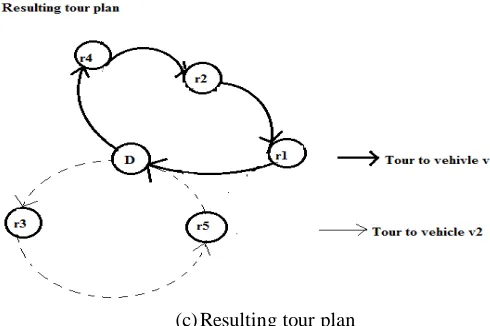
A tour for every vehicle is decided by performing the tasks such as assignmnent and sequencing. These tasks can be performed either progressively or concurrently . Travelling from a specific request to subsequent one, is a step within a tour which is called route. Tour plan is formed by the tours of all vehicles set, which is considered as solution of routing problems. Fig 1.1 shows, process of the tour planning in which two vehicles and five requests are presented..[1]
(a)Assigning request to vehicles
(c)Resulting tour plan
Fig. 1.1 Visualization of the tasks in a routing problem
II. RELATED WORK
Zhao et al. [11] introduced the VRP along with its variants such as Capacitated VRP (CVRP) and the VRP with Time Windows (VRPTW) and ACO algorithm. After that modified MAX-MIN Ant System (MMAS) is represented which is used for solving the variants of VRP. MMAS is a variant of ACO algorithm. The proposed technique not just allows for discovering the optimal tour, although facilitate to discover a global tour effectively through balancing the work out for explore and the work out for exploit. In this paper, proposed method shows that it can perform efficiently in relevance of solution quality.
Wen and Meng [12] distributed the finished goods from depot to customer in satisfying the needs of customer by using an appropriate approach. This distribution problem is usually termed as the VRP (VRP). However, there is an inflexible assumption presented that is only one depot exist there. VRP is not suitable, where a company include more than one depot. To overcome this limitation, this paper concentrates on multiple depots VRP along with the concept of time windows, (MDVRPTW). In this paper an improved PSO is developed for solving the MDVRP. In this paper a demonstration regarding efficiency of the algorithm presented through the experimental results.
Liu et al. [13] proposed a variant of PSO named as a hybrid particle swarm optimization (HPSO) algorithm for solving the VRP. This algorithm makes use of the crossover operation that fundamentally appears in genetic algorithm (GA), so that it prevents to be trapped in local optimal, and at the same time convergence rate of the algorithm is improved, and also the concept of level set theory is added. This paper uses the HPSO algorithm for solving an example of VRP, and performs comparison of its result with the others that are produced by parallel PSO, GA, and PSO algorithms. The result of experimental comparison indicates that the HPSO performance is better to others, and this is an effective approach.
Belemcheri et al. [14] proposed the Particle swarm optimization (PSO) algorithm for solving a variant of VRP. The problem of VRP with Mixed linehauls and Backhauls (VRPMB) describes that some of the goods have to be transfer from depot to a linehaul customers, whereas others have to be picked up from backhaul customers and brought to the depot, this class is combined with heterogeneous fleet and time windows and named as Heterogeneous fleet VRPMB with Time Windows or HVRPMBTW. This paper illustrate the comparison of PSO with exact method (solver CPLEX)and ACO (Ant Colony Optimization), and results shows that the meta-heuristics PSO and ACO are more efficient on small problems as compared to exact method.
(TSP) than Vehicle Routing Problem (VRP).
1) TSP: A well-known problem appearing in transportation planning is the TSP. This is very simple problem to express but however computationally hard (NP-hard). Simply stated as TSP consists of discovering a shortest tour which is passing exactly once over each one of the n vertices of a graph (such a tour is called Hamiltonian). This problem is very eminent in the applications such as in manufacturing (namely in drilling operations and in Very Large-Scale Integration (VLSI) placement problems), in distribution management and in scheduling. Study of the TSP led to the appearance of various popular optimization techniques usually exploit in operational research. Exact algorithms such as bound, cut and branch-and-cut-and-price all come from the study of TSP. The TSP is stated as G = (V, E) on a complete undirected graph, if symmetric or as G=(V, A) on a directed graph if asymmetric. Vertex set is represented as V ={1, . . . , n} , edge set is represented as E ={(i, j ): i, j
[image:4.612.175.442.373.628.2]∈ V, i < j } and arc set is as A={(i, j ): i, j ∈ V, i _= j }. A cost matrix C=(ci j ) is defined on E or on A. ci j = squareroot((Xi− X j )2 + (Yi− Yj )2) [5].
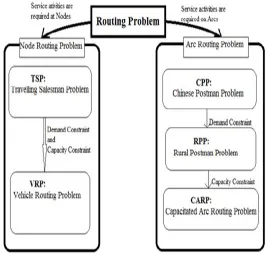
Fig 3.1 Routing problem classification
Fig. 1.3 The tour with A=>B =>C =>E =>D => A is the optimum tour.[6]
The tour through A=>B =>C =>E =>D => A is the optimum tour. In common, the TSP contains two distinct categories, Symmetric TSP and Asymmetric TSP. The symmetric mode is written as STSP in which there is simply one way among two neighboring cities, that is the distance among towns A and B is identical to the distance among towns B and A (Fig. 1.3).However in the ATSP (Asymmetric TSP) no such symmetry is there and it is probable to hold two dissimilar costs or distances among two towns. Therefore, the visits in the ATSP and STSP lying on n vertices (towns) are (n-1)! and (n-1)!/2, correspondingly. Time and space complexity for finding the Hamiltonian cycle or solving TSP is O(2n nO(1)).[6]
2) VRP: Dantzig & Ramser (1959) firstly introduce the ``Truck Dispatching Problem", that models how a fleet of truck could supply the demand for oil in numerous gas stations from a central hub with a least travelled distance. Clarke & Wright (1964) generalized the truck dispatching problem to a linear optimization problem which is commonly used in the field of logistics and transport: i.e., how provide services to a set of customers which are geographically dispersed just about the central depot via utilizing a fleet of trucks having varying capacities. This was recognized as the VRP and also the most widely studied topics in the area of Operations and Research [6]. There are numerous variants in relevance to VRP that are expressed in relevance to the nature of the products to be transported, the quality required by service and on the vehicles and customers characteristics. The VRP also comes under the category of NP-hard type. The VRP was stimulated from the routing of delivery trucks of gasoline between a bulk terminal and several service stations. The distance among any two localities is known and demands for the given product need to be specified for service stations. VRP is extensively studied due to its wide applicability and importance in determining efficient strategies in support of decreasing operational costs within distribution networks [8].
Fig 3.2 : Illustration of the VRP with 16 customers having the unit demand and 4 vehicles with capacity 5 [7]
2) RPP: In CPP all the links have to to be traversed while in RPP just a subset of links called required links of graph has to be traversed. This problem can have a polynomial time solution if defined on an undirected or directed graph also the required edges or arcs produce a connected graph. Or else, this is NP-hard and also its difficulty increases as if the number of the components are produced by the necessary links (R-connected components). Variants of RPP are the Undirected RPP, Directed and Mixed RPP, the Windy RPP, Periodic RPP (PRPP), etc [10].
3) CARP: CARP work out with undirected graph where each edge possesses a predefined traversal cost and certain edges that have to be serviced via some vehicle. Single depot is present there which holds the fleet of the same vehicles, each with having limited capacity. The goal of CARP is to find out a group of viable vehicle trips of least cost, such that each one trip begins and finishes at the depot, the entire covered trip not to go beyond the vehicle’s capacity, and each requisite edge is serviced via a single trip [11].
IV. CONCLUSION AND FUTURE SCOPE
In this paper , As it can be seen from our review, most of the previous solutions for the m TSP reduce the problem into several TSPs, and apply some method to solve their combination. On the other hand, we reviewed several approaches which are capable to solve them TSP without this separation, however, either the number of salesmen is fixed or no additional constraints are presented, like maximum per-salesmen cost or both
REFERENCES
[1]Ferrucci, “Introduction to Tour Planning: Vehicle Routing and Related Problems”, Springer-Verlag Berlin Heidelberg, pp. 15-79, 2013 [2]Burak Eksioglu, Arif Volkan Vural and Arnold Reisman “The VRP: A Taxonomic Review”, Computers & Industrial Engineering, Vol. 57(4), pp.1472–1483,
2009.
[3] Kris Braekers, Katrien Ramaekers and Inneke Van Nieuwenhuyse, “The VRP: State of the Art Classification and Review”, Journal Computers & Industrial Engineering, Vol. 99(C) , pp. 300-313, 2016.
[4]Thibaut VIDAL, “Node, Edge, Arc Routing and Turn Penalties: Multiple problems - Neighborhood Extension”, pp 1-24, 2015.
[5]G Laporte, “A concise guide to the Traveling Salesman Problem”, Journal of the Operational Research Society, Vol 61(1), pp 35—40, 2010.
[6]Mostafa Rahimi Azghadi, Mohammad Reza Bonyadi and Hamed Shah-Hosseini,“Population Based Optimization Algorithms for Solving the Travelling Salesman”, In Tech, pp 1- 34, 2008
[7]Min Wen, “Rich VRPs and Applications”, ACM Computing Surveys, Vol. 47(2), pp. 1-155, 2010
[8]Suresh Nanda Kumar, Ramasamy Panneerselvam, “A Survey on the VRP and Its Variants”, Intelligent Information Management (science research), vol 4, pp 66-74, 2012
[9]Frank W. Takes Walter A. Kosters, “Applying Monte Carlo Techniques to the Capacitated VRP”, Proceedings of 22th Benelux Conference on Artificial Intelligence (BNAIC), pp 1-8, 2010
[10] Angel Corberán and Christian Prins,“Recent Results on Arc Routing Problems: An Annotated Bibliography”,Wiley InterScience, pp 51-69, 2009.
[11] Gang Zhao, Wenjuan Luo , Ruoying Sun and Chunhua Yin “A Modified Max-Min Ant System for VRPs” Wireless Communications, Networking and Mobile Computing, Wicom’08. 4th international conference, pp 1-4 ,2008
[12] Lei Wen and Fanhua Meng “ An Improved PSO for the Multi-Depot VRP with Time Windows” IEEE Pacific - Asia Workshop on Computational Intelligence and Industrial Application , pp 852-856 ,2008
[13] Xiaoxiang Liu, Weigang Jiang and Jianwen Xie “VRP Time Windows: A HybridParticle Swarm Optimization” Fifth International Conference on Natural Computation , pp 502-506, 2009
[14] Farah Belmecheri , Christian Prins, Farouk Yalaoui, Lionel Amodeo “Particle Swarm Optimization to solve the VRP with Heterogeneous fleet , Mixed Backhauls , and Time Windows” Parallel & Distributed Processing, and Phd Forum, Vol 24(4), pp 775–789, 2010