GSJ: Volume 7, Issue 12, December 2019, Online: ISSN 2320-9186
www.globalscientificjournal.com
Effects of Procurement Processes on the Performance of Internationally Financed Projects in Akure Metropolis, Ondo State, Nigeria
H. I. Babalola1 and O. T. Itodo2
Department of Project Management Technology, School of Management Technology,
The Federal University of Technology Akure, Nigeria
Email: [email protected] Phone Number: +2348033916463 Abstract
The study examined the effects of procurement processes on the performance of internationally financed projects in Akure metropolis, Ondo State, Nigeria. Selected internationally financed projects such as Youth Employment and Social Support Operation (YESSO) as well as Community and Social Development Project (CSDP) was used in this study. Forty-five (45) copies of a closed ended questionnaire were distributed and all retrieved. Both descriptive (frequency, table, mean, standard deviation, percentage) and inferential (Pearson correlation) statistics were used to analyse the data collected. The findings revealed that need assessment, specification development, procurement plan, bidding process, bid evaluation, request for proposal, evaluation of request for proposal, contract award as well as consultancy services were procurement processes utilised by internationally financed projects in the study area. The hypothesis was tested using Pearson Product Moment Correlation at 0.01 level of significance. The result showed that r = 0.125, p = 0.414 > 0.01. Based on this, the null hypothesis was accepted while the alternate hypothesis was rejected. The findings revealed that there is a positive linear correlation between procurement processes and performance of internationally financed projects but there is no significant relationship between the effect of procurement processes and the performance of internationally financed projects in the study area. Based on the findings, recommendation were made that methods of reducing lengthy process of procurement should be devised.
Keywords: Procurement Processes, Performance, Internationally Financed Projects, Pearson
1.0 INTRODUCTION
Procurement can be described as the acquisition of raw material, work in progress, or finished
products, goods, services or works for the actualisation of the firm’s objectives. This is
performed either internally or externally by some guiding processes such as sourcing,
purchase, order processing, inventory management, transportation, warehousing, and
customer service that helps promote the effectiveness of procurement activities (Karungani &
Ochiri, 2017). Procurement is a concept that involves a lot of processes and procedures such
that during the procurement processes, a set of regulations are needed not only to govern but
instil sanity, in order to avert the misconducts, uncertain and underhand methods of
procurement (Iregi & Kipkorir, 2017). By so doing, it adds value to the organisation which
enhance its performance (Leenders, Johnson, Flynn & Fearson 2008). Parastatals and other
organisation must therefore adhere to these rules and regulations during their procurement
practices (Iregi & Kipkorir, 2017).
Public procurement is concerned with how the public sector spends taxpayers' money on
goods and services (Hall, 2009). According to Odhiambo and Kamau (2003), Public
procurement originated from the obligation and need for the government to make available
certain infrastructure to improve the lives and status of its citizens. Some of such
infrastructures are; health care, schools, roads, electricity among others. Based on this, the
public procurement sector operates in an environment of increasingly intense scrutiny driven
by technology, program reviews, and public and political expectations for service
improvements (Bolton, 2006). Recent studies have pointed out the significance and need of
moral and ethical behaviour in addition to technical and professional competencies during
procurement (Ndumbi & Okello, 2015).
According to Oduma and Getuno (2017), the aim of public procurement and disposal
professionalism in procurement in public institutions with a view to ensuring effective use of
public funds. However, despite the enactment of the procurement laws and regulations which
were meant to bring about order and sanity in the public procurement sector, many
procurement activities still suffer from neglect, lack of open competition, corruption,
inefficiencies, misuse of public funds as well as delays in delivery of projects, goods and
services (Mburu & Njeru, 2014). Consequently, there are numerous cases of exaggerated
prices, and behind schedule projects which is contrary to the public procurement act.
The study assessed the effect of procurement processes on the performance of internationally
financed projects in Akure metropolis. Internationally financed projects such as Youth
Employment and Social Support Operation (YESSO) as well as Community and Social
Development Project (CSDP) employ these processes when procuring goods, product, work
or service but not all is used at once. The selection of each organisation is dependent on the
sensitivity of the project being embarked upon.
1.1 Objectives of the Study
The general objective of the study assessed the Procurement Processes on the Performance of
Internationally Financed Projects with a view to proffer ways of improving the processes to
maximize output. While the specific objectives are to:
i. identify the procurement processes utilised by internationally financed organisation;
ii. establish the challenges faced by internationally financed projects in the adoption of
the procurement processes; and
iii. examine the effect of procurement processes on the performance of internationally
financed projects.
1.2 Hypothesis
H0 = Procurement processes have no significant effect on the performance of internationally
H1 = Procurement processes have significant effect on the performance of internationally
financed projects.
2.0 LITERATURE REVIEW
2.1 Concept of Procurement Processes and Performance
2.1.1 Procurement and Procurement Processes
Procurement can be defined as “all of those activities such as sourcing and purchasing, order
processing, inventory management, transportation, warehousing, as well as customer service
associated with acquisition of goods, from raw materials stage through to the end products
(Thai, 2001). Though the processes employed by organisation differ from one organisation to
another organisation due to various reasons, there abound some similarities in the processes
that is used by public organisation, especially those that are internationally funded.
Whichever method of procurement is chosen, i.e. either open tendering or restricted
tendering, the processes involved are: Need assessment, Specification Development,
Procurement Plan, Bidding process, Evaluation, Request For Proposal (RFP), Evaluation of
Request For Proposal, Contract Award, and Consultancy services (World Bank, 2004), but
are summarized by Iregi and Kipkorir (2017) into: Specification Development,
Prequalification, Tender Processing, and Contract Award.
2.1.2 Organisational Performance
Organisational performance is the realization of the goals of the organisation. An obvious
measure of performance of any organisation is the amount of money saved by the
organisation through prudent procurement practices. However there are a number of
performance measurements that can be used when measuring organisational performance
such as Cost Management, Product or Service Review, Quality Management, among others
(Oduma and Getuno, 2017). These performance measures typically revolves around
2.2 Theoretical Review of Literature
2.2.1 Agency Theory
This theory invokes the Principal-Agent relationship between staff and the targeted citizens.
The theory thus puts it that it is in the best interest of the staffs to discharge all their duties
with transparency, integrity and accountability to their principals who are the targeted
citizens and consumers of output (Thai, 2006). This theory aligns with the factor of consumer
satisfaction as one of the measures of organisational performance. In addition to the agency
relationship between project staffs and target citizens, there may be a number of internal
stakeholders possibly with conflicting goals, thereby making the procurement process more
complex and possibly biased. These groups of internal stakeholders may include the political
leaders, the citizens, the interest groups operating with the locality, central government,
services recipients and the business interest within the County, (Gull, 2010).
2.3 Empirical Studies
Karungani and Ochiri (2017) carried out a study on the effect of internal procurement
processes on organisational performance. The study employed stratified random sampling
technique, with the use of simple structured questionnaires to collect data. The findings of the
research showed that internal communication on such aspects as quality controls, inventory
management and staff training, development and performance significantly influenced
efficiency of the procurement function and hence overall organisational performance. This
research also revealed that internal procurement processes like order processing, information
sharing and payment processing bring forth improved organisational performance. This
contrasts with views of Lardenoije, Van Raaij and Van Weele (2005) who argue that internal
procurement processes focus on financial aspects neglecting non-financial aspects in effect
Iregi and Kipkorir (2017) studied the effects of procurement processes on the performance of
public sector organisation, using Kenya electricity generating company as a case study. The
study concludes that specification development, prequalification, tender processing steps and
inspection (after the award of the contract) positively affects performance of procurement and
by extension KenGen’s (Kenya Electricity Generating Company Limited) performance by
67.6%.
Odhiambo and Theuri (2015) adopted a descriptive research design and primary data that was
obtained using structured and semi structured questionnaires to research on the effects of
public procurement processes on organisation performance. This allowed for a more specific
direction of response to the structured questions, as well as a degree of freedom of response
to the semi structured questions. The study gave the quantitative relationship between the
quality and skills of manpower, supplier management and stakeholder involvement, and
organisational performance. It showed that stakeholder integration, skill level of the human
resource and supplier management have direct correlation with organisational performance
such that organisational performance increase with each increment in the effectiveness of the
factors. The study concluded that stakeholder integration in the procurement process has the
highest correlation with organisational performance and should be encouraged. And that the
skill level of the human resource is also a vital contributor to organisational performance.
Thus, organisation are encouraged to recruit highly skilled personnel and invest in providing
personnel training.
3.0 METHODOLOGY
The study used the convenience sampling technique to obtain information from 45
respondents of selected internationally financed projects in Akure, metropolis, Ondo State,
Nigeria using structured questionnaire. Information on the demographic characteristics of the
processes utilised in the study area, challenges in adoption of procurement processes were
identified and established. Also, effect of procurement processes on performance of
internationally financed projects was assessed. The data obtained were analysed using the
tables, frequencies, mean, percentages, and Pearson Correlation Analysis.
4.0 RESULTS AND DISCUSSION
Forty-five copies of structured questionnaire were distributed and all which represents
(100%) were returned. Findings revealed that majority of the respondents have spent more
than five years within the current organisation and large percentage of the respondents are
involved in the procurement processes carried out within the organisation.
4.1 Procurement processes of internationally financed organisation
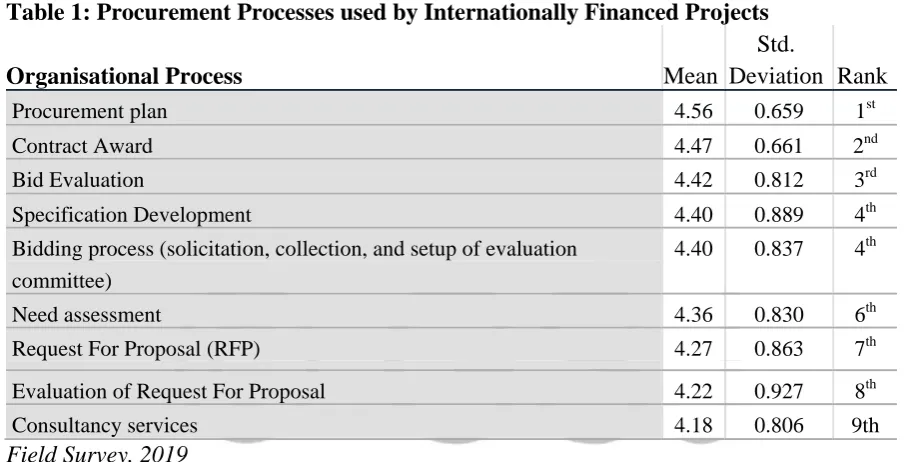
Table 1 presents the procurement processes utilised by internationally financed projects in
Akure metropolis, Ondo state, Nigeria. These processes are arranged in descending order of
their mean value. The procurement processes include: The procurement plan with a mean
value of 4.56 and a standard deviation of 0.659 and was ranked 1st (i.e. most respondents
agree that creating a procurement plan is a vital process in procurement). Contract award was
rated 2nd with a mean value of 4.47 and a standard deviation of 0.661. Bid evaluation was
rated 3rd with a mean value of 4.42 and a standard deviation of 0.812. Specification
development has a mean value of 4.40 and a standard deviation of 0.889 while bidding
process also has a mean value of 4.40 but a standard deviation of 0.837, and both were rated
4th. Need assessment has a mean value of 4.36 and a standard deviation of 0.863. Request for
proposal has a mean value of 4.27 and a standard deviation of 0.863. Evaluation of request
for proposal has a mean value of 4.22 and a standard deviation of 0.927. Consultancy services
has a mean value of 4.18 and a standard deviation of 0.806. The result of the analysis shows
that majority of the respondents agreed with the procurement processes identified. Thus,
during their procurement process. These processes are selected in various combination and
does not necessarily need to involve all processes, rather, the combination of use is dependent
on type of procurement and commodity or service to be procured. The study is in agreement
with Iregi and Kipkorir (2017), and the World Bank (2004) which listed the procurement
process as; need assessment, specification development, procurement plan, bidding process,
bid evaluation, request for proposal, evaluation of request for proposal, contract award, and
consultancy services.
Table 1: Procurement Processes used by Internationally Financed Projects
Organisational Process Mean
Std.
Deviation Rank
Procurement plan 4.56 0.659 1st
Contract Award 4.47 0.661 2nd
Bid Evaluation 4.42 0.812 3rd
Specification Development 4.40 0.889 4th
Bidding process (solicitation, collection, and setup of evaluation committee)
4.40 0.837 4th
Need assessment 4.36 0.830 6th
Request For Proposal (RFP) 4.27 0.863 7th
Evaluation of Request For Proposal 4.22 0.927 8th
Consultancy services 4.18 0.806 9th
Field Survey, 2019
4.2 Challenges faced by internationally financed projects in the adoption of the
public procurement processes
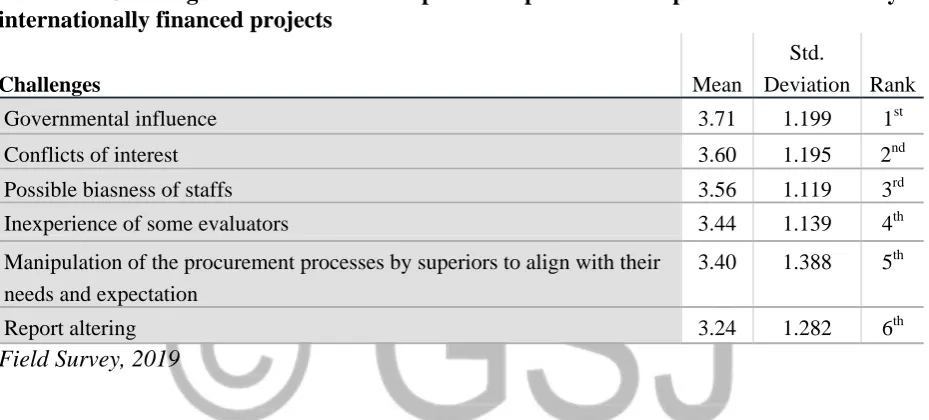
Table 2 depicts challenges faced by internationally financed projects in the adoption of the
procurement processes. Mean ranking was used to analyse the challenges faced by
internationally financed projects in the adoption of the procurement processes. These
include: Governmental influence was ranked 1st with a mean value of 3.71 and a standard
deviation of 1.199. Conflicts of interest has a mean value of 3.60 and a standard deviation of
1.195 and ranked 2nd. Possible biasness of staffs has a mean value of 3.56 and a standard
deviation of 1.119. Inexperience of some evaluators has a mean value of 3.44 and a standard
3.40 and a standard deviation of 1.388. Report altering has a mean value of 3.24 and a
standard deviation of 1.282. The result of the analysis shows that there was a rather
significant number of respondents that disagrees with the challenges, but the larger
proportion that agrees with the challenges indicates that there are scenarios in which each of
the challenges occur and it varies from organisation to organisation. This agrees with Iregi
and Kipkorir (2017) and World Bank (2004) list of challenges inherent in fully adopting the
procurement processes.
Table 2: Challenges faced in the adoption of procurement processes utilized by internationally financed projects
Challenges Mean
Std.
Deviation Rank
Governmental influence 3.71 1.199 1st
Conflicts of interest 3.60 1.195 2nd
Possible biasness of staffs 3.56 1.119 3rd
Inexperience of some evaluators 3.44 1.139 4th
Manipulation of the procurement processes by superiors to align with their needs and expectation
3.40 1.388 5th
Report altering 3.24 1.282 6th
Field Survey, 2019
4.3 The effect of procurement processes on the performance of internationally
financed projects.
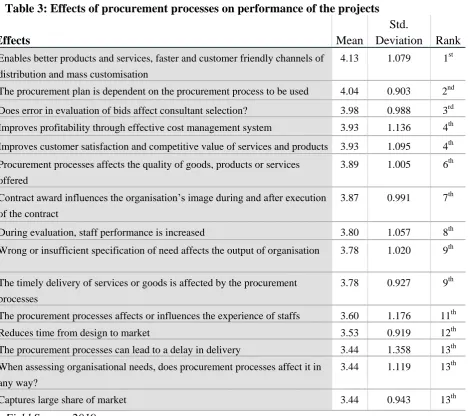
Table 3 measures the effect of procurement processes on the performance of projects that are
internationally financed using mean ranking. Better products and services was ranked 1st with
a mean value of 4.13 and a standard deviation of 1.079. The procurement plan is dependent
on the procurement process to be used has a mean value of 4.04 and a standard deviation of
0.903 and ranked 2nd. Does error in evaluation of bids affect consultant selection has a mean
value of 3.98 and a standard deviation of 0.988. Improves profitability through effective cost
management system has a mean value of 3.93 and a standard deviation of 1.136. Improves
customer satisfaction and competitive value of services and products has a mean value of
products or services offered has a mean value of 3.89 and a standard deviation of 1.005.
Contract award influences the organisation’s image during and after execution of the contract
has a mean value of 3.87 and a standard deviation of 0.991. During evaluation, staff
performance is increased has a mean value of 3.80 and a standard deviation of 1.057. Wrong
or insufficient specification of need affects the output of organisation has a mean value of
3.78 and a standard deviation of 1.020. The timely delivery of services or goods is affected
by the procurement processes has a mean value of 3.78 and a standard deviation of 0.927.
The procurement processes affects or influences the experience of staffs has a mean value of
3.60 and a standard deviation of 1.176. Reduces time from design to market has a mean value
of 3.53 and a standard deviation of 0.919. The procurement processes can lead to a delay in
delivery has a mean value of 3.44 and a standard deviation of 1.358. When assessing
organisational needs, does procurement processes affect it in any way has a mean value of
3.44 and a standard deviation of 1.119. Captures large share of market has a mean value of
3.44 and a standard deviation of 0.943. The result of the analysis shows that an appreciable
number of the respondents (the larger percentage) agreed that the procurement processes
affects various aspects of performance of the organisation. This is in agreement to Oduma
and Getuno, (2017) who used Cost, Quality, Effectiveness and Efficiency as primary
Table 3: Effects of procurement processes on performance of the projects
Effects Mean
Std.
Deviation Rank
Enables better products and services, faster and customer friendly channels of
distribution and mass customisation
4.13 1.079 1st
The procurement plan is dependent on the procurement process to be used 4.04 0.903 2nd
Does error in evaluation of bids affect consultant selection? 3.98 0.988 3rd
Improves profitability through effective cost management system 3.93 1.136 4th
Improves customer satisfaction and competitive value of services and products 3.93 1.095 4th
Procurement processes affects the quality of goods, products or services
offered
3.89 1.005 6th
Contract award influences the organisation’s image during and after execution of the contract
3.87 0.991 7th
During evaluation, staff performance is increased 3.80 1.057 8th
Wrong or insufficient specification of need affects the output of organisation 3.78 1.020 9th
The timely delivery of services or goods is affected by the procurement
processes
3.78 0.927 9th
The procurement processes affects or influences the experience of staffs 3.60 1.176 11th
Reduces time from design to market 3.53 0.919 12th
The procurement processes can lead to a delay in delivery 3.44 1.358 13th
When assessing organisational needs, does procurement processes affect it in
any way?
3.44 1.119 13th
Captures large share of market 3.44 0.943 13th
Field Survey, 2019
4.4 Hypothesis Testing
H0 = Procurement Processes have no significant effect on the Performance of Internationally
Financed Projects
H1 = Procurement Processes have significant effect on the Performance of Internationally
Financed Projects.
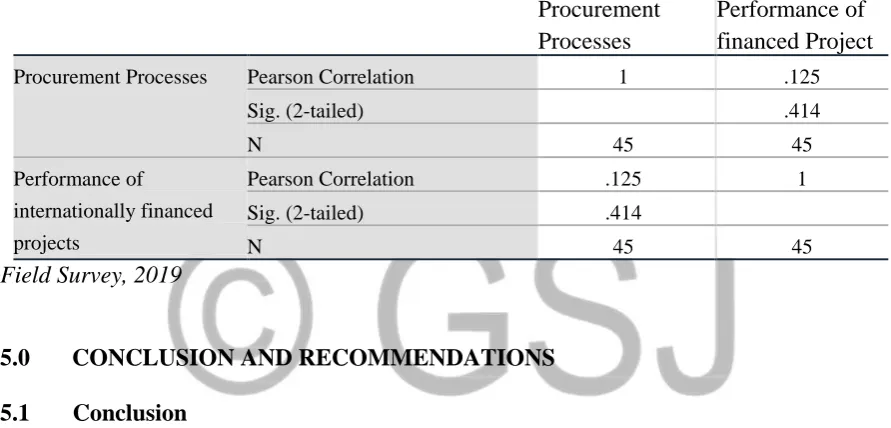
Table 5 shows the outcome of the Pearson Product Correlation Coefficient of the effect of
procurement processes on the performance of internationally financed projects in Akure
metropolis, Ondo State, Nigeria. The table indicates that there is no significant relationship
projects in the study area. Consequently, the null hypothesis was accepted while the alternate
hypothesis was rejected. The result showed that r = 0.125, p = 0.414 > 0.01. This shows that
there is a positive linear correlation between procurement processes and performance of
internationally financed projects but there is no significant relationship between the effect of
procurement processes and the performance of internationally financed projects in the study
area
Table 5: Relationship between Procurement Processes and Performance of selected Internationally Financed Projects
Procurement Processes
Performance of financed Project
Procurement Processes Pearson Correlation 1 .125
Sig. (2-tailed) .414
N 45 45
Performance of
internationally financed
projects
Pearson Correlation .125 1
Sig. (2-tailed) .414
N 45 45
Field Survey, 2019
5.0 CONCLUSION AND RECOMMENDATIONS
5.1 Conclusion
The study assessed the effect of procurement processes on the performance of internationally
financed projects in Akure metropolis, Ondo state, Nigeria. The study revealed the existence
of procurement processes in the study area but concluded that there is no significant
relationship between the effects of procurement processes and the performance of
internationally financed projects. This implied that the performance of internationally
financed projects in Akure is independent on the processes employed for procurement.Based
on the findings, the study recommends that methods of reducing the lengthy process of
procurement should be devised and employed in order to reduce lead time and as well
REFERENCE
Bolton, (2006). The dissemination of information amongst supply chain partners; A New Zealand wine industry perspective. Supply Chain Forum: Int. J., 11(1):56-63.
Gull, (2010). The public purchasing profession revisited. Journal of Public Budgeting,
Accounting & Financial Management, 12(2):272-290.
Hall, J. (2009). Environmental supply chain dynamics. Journal of Production and operation
management.44:143-147.
Ireg, A. N. & Kipkorir, G. (2017). The effects of procurement processes on the performance of public sector organisations: A case study of Kenya electricity generating company limited Naivasha station. Imperial Journal of Interdisciplinary Research, 3 (3):990-1009.
Karungani, W. P. & Ochiri, G. (2017). Effect of internal procurement processes on
organizational performance. Case of Nairobi County. International Journal Of
Economics, Commerce And Management, 5(7):532-539.
Lardenoije, E. J., Van Raaij, E. M., & Van Weele, A. J. (2005). Performance management models and purchasing: relevance still lost. Researches in purchasing and supply management, the 14th IPSERA Conference, 687-697.
Leenders, M. R., Johnson, F. P., Flynn, A. E., & Fearson, H. (2008). Purchasing and Supply Chain Management, (13th Ed.). New York: NY McGraw Hill.
Mburu, S. & Njeru, A. (2014). Factors affecting procurement performance in the milk
processing firms in Kiambu County. International Journal of Science and Research. ISSN (Online): 2319-7064.
Ndumbi, C. W. & Okello, B. (2015). Effect of staff training on level of compliance to public procurement system in parastatals in Kenya. International Journal of Economics,
Commerce and Management, 3(6): 613-626.
Odhiambo, W. & Kamau, P. (2003). Public Procurement: Lessons from Kenya, Tanzania and Uganda. Longhorn Publisher.
Odhiambo, A. C. & Theuri, F. S. (2015). Effects of public procurement processes on
organisation performance. International Journal of Scientific and Research Publications, 5(9):1-5.
Oduma, E. O. & Getuno, P. (2017). Effects of procurement regulations on performance of public secondary schools in Nairobi city, county, Kenya. International Journal of Innovative Social Sciences & Humanities Research 5(3):50-68.
Thai, (2006). Principles of procurement practices, the resurgent of good procurement practices.