©2015 JNAS Journal-2015-4-7/797-803 ISSN 2322-5149 ©2015 JNAS
The Effects of Behavioral Intervention on Mood in
Disabled Professional Basketball Players
Majdeddin Mostaan
1, Afsaneh Sanatkaran
2*and Seyyed Mohialdin Bahari
21- M.Sc in Sport Psychology, Islamic Azad University Karaj Branch, Iran
2- Associate, Department of Physical Education and Sport sciences, Islamic Azad University Karaj Branch, Iran
Corresponding author:
Afsaneh Sanatkaran
ABSTRACT: The statistical population of this study were 80 disabled in wheelchair basketball (Mage=25/10). 30 athletes who had high scores in the mean of mood components and mood disturbances were selected. The experimental group participated in 8 sessions (45 minutes) of intervention for two months. The results showed that the execution of intervention was lead a significant difference (P<0.001) in the decreasing of the on mood scores and this intervention improved the mood in the experimental groups. Also the results were significant in the confusion, anger, depression, tension, and vigor components but those were not significant in the fatigue component (P>0.165).
Keywords: Intervention, behavioral, mood, disabled, basketball.
INTRODUCTION
798
using effective and applied methods since the role of thinking is very clear in the formation of excitements and behaviors. The cognitive behavioral interventions are one of these methods that examine and change the assumptions that lead to develop poor functions and emotions with the identification of thoughts (Ledley, Marx & Heimberg, 2010). This model affects on athletes’ perceptions of situations that it will affect on their performance in these situations as well (Katz and Hemmings, 2010). Also an athlete can create a wide range of useful opposition methods with the building of this ensure in the new thinking thus he/she can overcome the problems (Katz and Hemmings, 2010). The cognitive therapists often apply the behavioral techniques: relaxation, desensitization, reinforcement and punishment, breathings, etc. that those are the supplement of cognitive techniques and reinforce the changes in the intellectual processing. The combination of cognitive and behavioral techniques is useful to intervene in situations where the function is associated with stress (McArdle and Moore, 2012). (Perna, Antoni, Kumar, Cruess & Schneiderman, 1998) examined the Cognitive-behavioral intervention effects on mood and cortisol during exercise training. They concluded that the experimental group had a significant decreasing in the depression, fatigue, and cortisol components. Increase in negative effect and fatigue were also significantly associated with cortisol increase that it had decreased during exercise. Disabled sport is very important professional sports that its community needs to use the services of sport psychology. Disabled athletes who participate in competitive sports in the professional levels need services of sport psychology more than other athletes due to their special condition (Harbalis, Hatzigeorgiadis & Theodorakis, 2008).799
behavioral intervention together on the mood in disabled athletes who have a special condition. Thus, the conducting this study is necessary. In this regards, this study has been done to examine effects of behavioral intervention on disabled professional basketball players’ of mood.MATERIALS AND METHODS
Methods
This study was a semi empirical research and design of it included pre-test, post test with control group.
Participants
The statistical population of this study were 80 disabled athletes in wheelchair basketball sport (Mage=25/10). The subjects’ degree of disability was A1-A5 class that they participated in the premier league competitions. According to the pre-test, 30 athletes who had high scores in the mean of mood components and mood disturbances were selected as sample. Then, they were randomly divided into control (N= 15), and experimental groups (N= 15).
Instruments and Tasks
The instrument was a demographic questionnaire to collect individual data and Brunel Mood Scale (BRUMS), with 24 items to measure athletes’ mood in this study (Terry & Lane, 2003).
Procedure
The purpose and the process of study were explained to subjects. The participants were assured that their data will be kept confidential and those will not be available to anyone. Then all subjects completed a consent form to participant in this study and they attended with the complete satisfaction in this study. The researchers provided the best conditions as much as possible due to the subjects’ specific circumstances (disability), to observe all moral and valuable aspects of study. The researchers could not control the confounding factors and variables such as genetics, marital status, sleep status, nutrition, and regular trainings in this study that these factors may have affected on the results of this study. Then, the experimental group was trained during eight 45-minute sessions (two sessions per week), and the control group had not other physical and mental trainings except its specialized trainings. The intervention was designed in a positive direction for mood changes with pay attention to the present of behavioral technique in behavioral intervention group and on the basis of certain basic principles in behavioral interventions for the experimental group in this study. The content of instructional and training sessions was formulated by related sources and research support by the consultant and researcher as well as the conformation of three experts of counseling psychology. The content of program was based on instruction and training of behavioral restructuring and deep breathing technique. The data was collected in the post-test stage through the questionnaire at the end.
Data Analysis
The collected data were classified by descriptive statistical methods and were analyzed by independent t-Test. The SPSS software (version 21) was used for data analysis (α≤0.05).
RESULTS AND DISCUSSION
Results
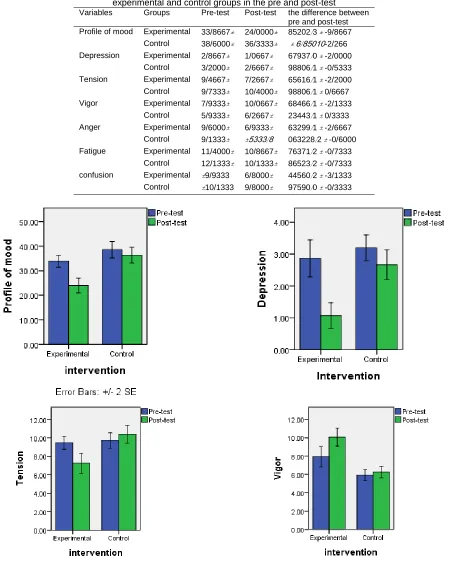
The results of table (1) show the mean and standard deviation of subjects’ age. The results of table (2) show the mean and standard deviation of profile of mood, depression, tension, vigor, anger, fatigue, and confusion of the experimental and control groups in the pre and post-test. Alsofigures (1) Show the results of independent t-test for the analysis of mean scores of profile mood and its subscales in the experimental and control groups.
Table1. The mean and standard deviation of subjects’ age
Variable Mean SD Minimum Maximum
800
Table 2. The mean and standard deviation of profile of mood, depression, tension, vigor, anger, Fatigue, and confusion in theexperimental and control groups in the pre and post-test the difference between pre and post-test Post-test
Pre-test Groups
Variables
85202/3 ±-9/8667 24/0000±
33/8667± Experimental
Profile of mood
01858 / 6 ± -2/266 36/3333± 38/6000± Control
67937/0 ±-2/0000 1/0667±
2/8667± Experimental
Depression
98806/1 ±-0/5333 2/6667±
3/2000± Control
65616/1 ±-2/2000 7/2667±
9/4667± Experimental
Tension
98806/1 ±0/6667 10/4000±
9/7333± Control
68466/1 ±-2/1333 10/0667±
7/9333± Experimental
Vigor
23443/1 ±0/3333 6/2667±
5/9333± Control
63299/1 ±-2/6667 6/9333±
9/6000± Experimental
Anger
063228/2 ±-0/6000 0 / 1555 ± 9/1333± Control
76371/2 ±-0/7333 10/8667±
11/4000± Experimental
Fatigue
86523/2 ±-0/7333 10/1333±
12/1333± Control
44560/2 ±-3/1333 6/8000±
±9/9333 Experimental
confusion
97590/0 ±-0/3333 9/8000±
801
Figures 1. The results of independent t-test for the analysis of mean scores of profile mood and its subscales in theexperimental and control groups
According to figures 1, it is observed that:
There is a significant difference between the experimental and control groups in the profile of mood [t (22.049) = -3.745, P = 0.001]. So this behavioral intervention improved the disabled professional basketball players’ profile of mood states.
There is a significant difference between the experimental and control groups in the tension subscale [t (27.115) = 4.291, P = 0.000]. So this behavioral intervention improved the disabled professional basketball players’ tension.
There is a significant difference between the experimental and control groups in the depression subscale [t (23.249) = -4.280, P= 0.0010. So this behavioral intervention improved the disabled professional basketball players’depression.
There is a significant difference between the experimental and control groups in the anger subscale [t (26.597) = 3.042, P = 0.005]. So this behavioral intervention improved the disabled professional basketball players’ anger. There is no significant difference between the experimental and control groups in the fatigue subscale [t (27.964) = 1.427, P = 0.165]. So this behavioral intervention did not improve the disabled professional basketball players’ fatigue.
There is a significant difference between the experimental and control groups in the vigor subscale [t (25.670) = 3.338, P = 0.002]. So this behavioral intervention improved the disabled professional basketball players’ anger. There is a significant difference between the experimental and control groups in the confusion subscale [t (18.348) = -4.118, P = 0.000]. So this behavioral intervention improved the disabled professional basketball players’ confusion.
Discussion
802
level through the concentration on the present time (Wright, Basco & Thase, 2005). According to that the behavioral techniques have a relaxation role along with the cognitive techniques so the individuals feel relaxation after the performing of them. Thus, they can overcome easily the problems (Wright, Basco & Thase, 2005). This note affirms the James–Lange theory that is about the effectiveness of body on the mind. Because the breathing techniques were used for the intervention in this study so those can be the reason of effectiveness. The cortisol hormone is significantly related to the state of mood. In this regards, Perna, Antoni, Kumar, Cruess & Schneiderman’s (1998), stated about that the effects of cortisol hormone secretion decreased by cognitive behavioral intervention that is due to the stress and fatigue and as well as mood disturbance..
CONCLUSION
The sessions were held in 2 times a week due to the lack of time since camps and competitions were spent in the last months. Therefore these results may have been affected in the fatigue subscale due to the mentioned reasons and the intervention had not effects on the fatigue subscale. This finding is conflict with the results of Ellis, Randall and Punnett (2013); Neil, Hanton, and Mellalieu (2013); Hamzepour (2014); Gregg, Hrycaiko, Mactavish & Martin (2004); Naoi (2005); Lane and Lovejoy (2001); and Perna, Antoni, Kumar, Cruess & Schneiderman’s (1998), study. The lack of this consistent can be due to the subjects’ disability in this study. The behavioral intervention had a significant effect on the subjects’ positive mood except the fatigue subscale in this study according to the limitations such inability to holding a intervention session per week due to the completion of the camps and league competitions, lack of control of subjects’ mental and emotional states during performing of test, lack of control of effective problems on subjects’ personal life, lack of control of genetic effective problems, and inability to selection of people with the same intelligence.
Practical application
We recommend that is used the cognitive behavioral intervention as a strategy to improve the disabled professional basketball players’ profile of mood states and performance in the training camps of competitions.
Acknowledgments
The author thanks the Coaches and Basketball Players with Disabled in this study.
REFERENCES
Ellis NJ, Randall JA and Punnett G. 2013. The effects of a single bout of exercise on mood and self-esteem in clinically diagnosed mental health patients. Open Journal of Medical Psychology, 2(3): 81-85.
Gorely T, Jobling A, Lewise K and Bruce D. 2002. An Evaluative Case Study of a Psychological Skills Training Program for Athletes with Intellectual Disabilities. Adapted Physical Activity Quarterly, 19, 350-363.
Gregg MJ, Hrycaiko D, Mactavish JB and Martin GL. 2004. A mental skills training package for special Olympic athletes: A preliminary study. Adapted Physical Activity Quarterly, 21, 4-18.
Harbalis T, Hatzigeorgiadis A and Theodorakis Y. 2008. Self-talk in wheelchair basketball: The effects of an intervention program on dribbling and passing performance. International Journal of Special Education, 23(3), 63-70.
Hanrahan SJ. 1998. Practical considerations for working with athletes with disabilities. Sport Psychologist, 12, 346–357.
HamzehPour T. 2014. The effect of cognitive behavioural therapy on depression in infertile women. European Journal of Experimental Biology; 4(1):410-414.
Katz J and Hemmings B. 2010. Counselling skills handbook for the sport psychologist. An occasional publication for the Division of Sport & Exercise Psychology of the British Psychological Society. ISBN: 1854334999, 9781854334992.
Ledley DR, Marx BP and Heimberg RG. 2010. Making cognitive-behavioral therapy work (2th ed.), Clinical Process for new practitioners, New York, NY: The Guilford Press, ISBN 9781606239124.
Lane AM and Lovejoy DJ. 2001. The effect of exercise on mood changes: In water polo sport the moderating effect of depressed mood. Presented at the British Association of Sport and Exercise Sciences Conference, Leeds Metropolitan University. J Sports Med Phys Fitness. 2001; 41 (4): 539-45.
McArdle S and Moore P. 2012. Applying evidence-based principles from CBT to sport psychology. Sport Psychologist, Vol (l).26 Issue 2, p 299.
Morgan WP, Brown DR, Ragli nJS, O’Connor PJ and Ellickson KA. 1987. Psychological monitoring of overtrainingand staleness. Br J Sports Med, 21, 107-114.
Naoi Airi EDD. 2005. The effect of cognitive and relaxation interventions on injured athletes’ mood and pain during rehabilitation. Athletic Insight, 8(5): 1029-1044.
803
O’Connor PJ, Morgan WP and Raglin JS. 1989. Mood state and salivary cortisol levels following overtraining in female swimmers.Psycho Neuro Endocrinology, 14: 303-310.
Perna FM, Antoni MH, Kumar M, Cruess DG and Schneiderman N. 1998. Cognitive-behavioral intervention effects on mood and cortisol during exercise training. Annals of Behavioral Medicine, Volume (20), Issue 2, p 92-8.
Raglin JS, Morgan WP and O’Connor PJ. 1991. Changesin mood states during training in female and male college swimmers. International Journal Sports Psychology.12, 585-589.
Szabo A. 2003. Acute psychological benefits of exercise performed at self-selected workloads: Implications for theory and practice. Journal of Sports Science and Medicine, 2(3): 77-87.
Terry PC, Lane AM and Nevill AM. 2005. Mood, self-set goals and examination performance: the moderating effect of depressed mood. Personality and Individual Differences, 39,143-153.
Terry PC, Lane AM and Fogarty GJ. 2003. Construct validity of the Profile of Mood States - Adolescents for use with adults. Psychology of Sport and Exercise, 44, 125-139
Wright JH, Basco MR and Thase ME. 2005. Learning cognitive-behavior therapy: an illustrated guide: United States American Psychiatric Publication, ISBN-10: 1585621536.