7
Abstract
The main objective of the present study is the statistical processing of the results of the examination how effec-tive was the integration of the introductory block into the module structure of physical and colloidal chemistry course. To get reliable results of the level of mathematical material mastering the control test which consists of the fundamental elements of the mathematical processing the results of chemical experiments was carried out. The students of pharmaceutical department from Kuban State Medical University as well as the students of four departments of two other universities and one academy took part in this experiment. The outcome vari-able was completeness of student’s answers. The results of the research were treated by component analyses. Nonparametric criteria were used for statistical estimation. The number of tested students in a single group were from 27 up to 60. The statistical results processing of empirical research proves the effi ciency of introduc-tion of mathematical block into module structure of the physical and colloidal chemistry course.
Key words: physical and colloidal chemistry, introductory block, nonparametric criteria.
Introduction
In the system of pharmaceutical education a course of physical and colloidal chemistry (PCC) is the basis and connecting-link for study other chemistry disciplines, which are part of the curriculum (e.g. analytical, biological, organic, toxicological, and pharmaceutical chemistry), as well as for a number of other courses, which are closely connected with chemistry (physiology, microbiology, pharmacology, hygiene science).
For conscious and actual perception of the PCC course by pharmaceutical students it is necessary to master their mathematical knowledge and skills. However on observation stage of pedagogical experiment we discovered a contradiction between necessary volume and level of the mathematical component of the PCC course and real defi cient mathematical training of students. At the same time the mathematical component of the PCC course not only helps to estimate the results of a chemical experiment, but also contribute to the formation of methods of scientifi c thinking among students, as well as to the variety of intellectual skills, which are used to solve professional tasks.
To solve this contradiction a new block “Foundations of mathematical processing of experi-mental data” (Balachevskaya & Sheldeshov, 2007) was introduced into modular structure (Litvinova, 2001; Balachevskaya & Sheldeshov & Khosroeva, 2007) of the PCC course for the pharmaceutical students developed by us. This block contains educational material on methods of mathematical processing of experimental results. These methods include integration, differentiation, derivation, basic methods of graphical and statistical data processing, methods graph making, determination of parameters of straight line by least-squares method, linearization method. During the PCC course the pharmaceutical students are successively guided by the introductory block in each module with the help of which they actualize their mathematical knowledge and skills on the new level.
APPLYING OF THE COMPONENT
ANALYSES IN COMBINATION WITH
NONPARAMETRIC CRITERIA FOR
STATISTICAL PROCESSING OF THE
RESULTS OF EMPIRICAL RESEARCH
Olga V. Balachevskaya, Nikolay V. Sheldeshov, Tatyana N. Litvinova
effective was the integration into the module structure of the PCC course the introductory block and its usage in the educational process, as well as the comparison of statistical parameters which were obtained by the control test results which was carried out among the pharmaceutical students.
Methodology of Research
To get reliable results of the level of mathematical material mastering we carried out the con-trol test, which consists of the fundamental elements of the mathematical processing the results of chemical experiments.
Version of the control test
1. Calculate the dependence of the derivative with opposite sign on time, use the table
№ t, s с, m mol/L
1 0 38,3
2 100 21,9
3 200 12,9
4 300 6,8
5 400 3,6
6 500 2,1
7 600 1,1
2. The dependence of equilibrium constant on temperature is expressed by the equation:
Calculate the derivative dlnKp/dT.
3. Calculate change of enthalpy of 1 mole ammonia during the process of its heating from
298 to 1000 K by the formula taking into account dependency of molar
heat capacity on temperature
4. Calculate the coeffi cient of straight line ( ) according to the following data:
№ x y
1 0 0,015
2 125 0,0775
3 200 0,115
4 300 0,165
5 400 0,215
6 500 0,265
7 600 0,315
8 700 0,365
9 800 0,415
№ x y
1 0,0300 –2,00
2 0,0310 –2,25
3 0,0320 –2,30
4 0,0330 –2,70
5 0,0340 –2,85
6 0,0350 –2,99
7 0,0360 –3,00
8 0,0370 –3,40
9
Volume 2, 2007 5. Linearize (bring to the linear type ) the equation . Γ and c – are
variables, and Γ∞ and K – are constants in this equation.
The students (from 27 up to 40) of pharmaceutical department from Kuban State Medical Uni-versity (KSMU) took part in this experiment. As a control groups we have chosen students of other universities: from chemistry (58 students) and biological (56 students) departments at Kuban State University (KubSU), pharmaceutical department (60 students) at Yaroslavl State Medical Academia (YSMA), and department of natural studies (31 students) at Adyghe State University (ASU). Total number of students was 303. The volume and the content of PCC course syllabus had similarity with the syllabus at pharmaceutical department at KSMU. The main difference appeared in actualization of mathematical component in the form of introductory component.
The duration of the test was 60 min. Students were disallowed to use any study aids during test. The outcome variable was completeness of student’s answers. It takes three discrete values: 0, 0.5 and 1 in the cases of failing of answer, incomplete answer with mistakes and correct answer accordingly Usova (1986) and Kyveryalg (1980).
On the shaping level of present study the control test was held in one and the same students group from pharmaceutical department at KSMU, which took place at the end of IV semester and at the beginning of V semester (see Table 1), and also at the very end of the learning PCC course (see Table 2).
At the pharmaceutical department at KSMU the control test were held during three years be-fore the beginning of experimental methods (2004) and after it was applied (2006). To process the results of the research we applied component analyses (Usova, 1986) of given data and statistical methods, such as Mann-Whitney and Wilcoxon nonparametric criteria (Sidorenko, 2000), in contrast to traditionally used in the component analyses Fisher’s and Student’s criteria.
To examine the degree of mastering mathematical knowledge and skills we picked out 10 components: 1) method of calculating derivatives by a table; 2) calculation of mean time and tabu-lation; 3) transfer from decimal logarithm to natural one; 4) correct usage of formulas to calculate derivatives; 5) integration rules; 6) plotting; 7) calculation of straight line coeffi cients; 8) method of linearization of equation; 9) correct rounding of numbers; 10) way of writing units. The analyses of each component were held according to Usova (1986) and Kyveryalg (1980) methodics.
Results of Research
The statistical handling (Tyurin & Makarov, 1998) of the empirical research results reveals that the majority of a given data do not submit to normal distribution, therefore to reveal effectiveness of the introductory block we used nonparametric criteria. In the case of small samples for a number of observations 3< n>60 the difference can be revealed based on Mann-Whitney criteria (Sidorenko, 2000), which serves as analogue to Student criteria t for normal distribution (Glantz, 1994).
The results of the control test was held in one and the same students group from pharmaceutical department at KSMU, which took place at the end of IV semester and at the beginning of V semester, and also at the very end of the learning PCC course are shown in Tables 1 and 2.
Table 1. Value of Mann-Whitney criteria, received in the result of comparison of
mathematical knowledge and skills of pharmaceutical students at the end of IV semester (30 students) and at the beginning of V semester (39 stu-dents) of learning the PCC course.
No. Components Ucr
1 2 3 4 5 6 7 8 9 10
KSMU, pharmaceutical
Table 2. Value of Mann-Whitney criteria, received in the result of comparison of mathematical knowledge and skills of pharmaceutical students at the beginning of V semester (30 students) and at the very end of learning the PCC course (39 students).
No. Components Ucr
1 2 3 4 5 6 7 8 9 10
KSMU, pharmaceutical
department 494 540 485 480 509 309 389,5 589 462 582 460
11 Volume 2, 2007
Figure 1. Bar chart comparison of control test results of pharmaceutical department
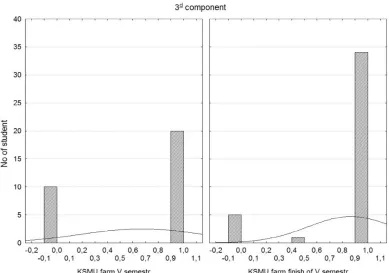
students at the beginning of V semester and at the very end of learning the PCC course (to compare the results on components 3 and 7 are given).
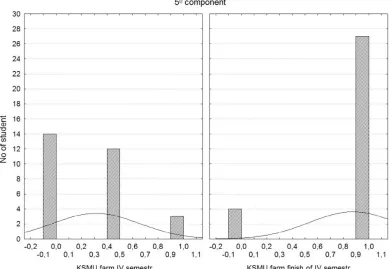
Figure 2. Bar chart comparison of control test results of pharmaceutical department students at the beginning and at the end of IV semester of learning the PCC course (to compare the results on components 5 and 6 are given).
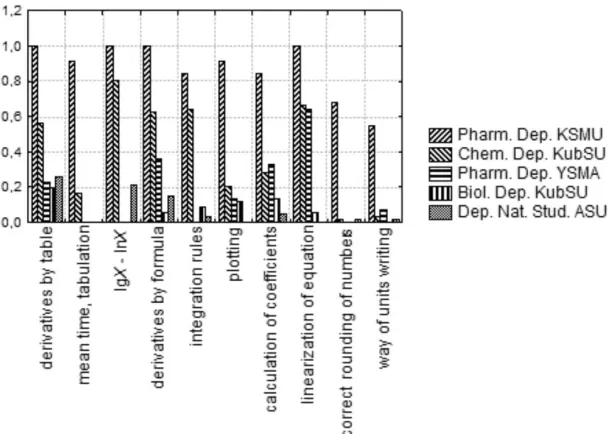
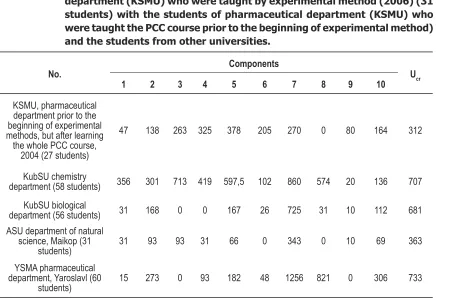
The next stage of our research was the comparison of control test results of the students of phar-maceutical department (KSMU), who we taught by experimental methods (2006) with the students of pharmaceutical department (KSMU) who were taught the PCC course prior to the beginning of experimental methods (2004) and the students from other universities. The component analyses re-vealed the difference between these groups (Figure 3), and the calculation of Mann-Whitney criteria gave an opportunity to judge reliability (Table 3).
Figure 3. Bar chart of the results of control test “Mathematical methods of
13 Volume 2, 2007
Table 3. Values of Mann-Whitney criteria, which were received as a result of
compari-son of mathematical knowledge and skills of the students of pharmaceutical department (KSMU) who were taught by experimental method (2006) (31 students) with the students of pharmaceutical department (KSMU) who were taught the PCC course prior to the beginning of experimental method) and the students from other universities.
No. Components Ucr
1 2 3 4 5 6 7 8 9 10
KSMU, pharmaceutical department prior to the beginning of experimental methods, but after learning
the whole PCC course, 2004 (27 students)
47 138 263 325 378 205 270 0 80 164 312
KubSU chemistry
department (58 students) 356 301 713 419 597,5 102 860 574 20 136 707
KubSU biological
department (56 students) 31 168 0 0 167 26 725 31 10 112 681
ASU department of natural science, Maikop (31
students) 31 93 93 31 66 0 343 0 10 69 363
YSMA pharmaceutical department, Yaroslavl (60
students) 15 273 0 93 182 48 1256 821 0 306 733
According to the results of the Table 3 we can tell that after the introduction of component “Foundations of mathematical processing of experimental data” the achieved level of mathematical knowledge and skills among students of pharmaceutical department (KSMU) is higher than among students of natural science (ASU) through all components, because the empirical value of Mann-Whitney criteria does not exceed its critical value. The students of biological department (KubSU) exceed the pharmaceutical students only according to one component (U(7) = 725 > Ucr = 681). The students of YSMA exceed the pharmaceutical students according to two components: (U(7) = 1256 > Ucr = 733; U(8) = 821 > Ucr = 733). Such high results of students of biological department of KubSU and YSMA according to 7 and 8 component could be explained by the fact that these type of tasks are not included in each module of learning PCC course for the pharmaceutical students. Pretty high value of Mann-Whitney criteria in comparison to the students of chemistry department (KubSU) are evidence of a small difference of two samples. Therefore the level of training for math-ematics of two groups is about the same. Comparing pharmaceutical groups prior to the beginning of method and after it was applied one can see that the value of Mann-Whitney criteria is low. This depicts big distinction of two samples, but high values on component 5 and 6 are evidence of the fact, that students can integrate and differentiate after the end of the PCC course even without the introduction of the component.
Conclusions and Discussions
Balachevskaya, O. V., & Sheldeshov, N. V. (2007). Introductory block. Foundations of mathematical process-ing of experimental data. Krasnodar.
Balachevskaya, O. V., & Sheldeshov, N. V., & Khosroeva, D. A. (2007). Exercises on psychical and colloidal chemistry course. Krasnodar.
Glantz, S. A. (1994). Primer of biostatistics (4th ed.). New York: McGraw-Hill. Kyveryalg, А. А. (1980). Research methods in professional pedagogy. Tallinn: Valgus.
Litvinova, Т. N. (2001). Theory and practice of the integrative module teaching of general chemistry for stu-dents of medical university. Krasnodar: Publishing House of Kuban State Medical Academia.
Sidorenko, E. V. (2000). Methods of mathematical processing in psychology. Saint-Petersburg: LC «Rech». Tyurin, Y. N., & Makarov, А. А. (1998). Statistical data analyses on computer. Moscow: INFRA-М. Usova, А. V. (1986). Formation of scientifi c concepts among students during the education process. Moscow: Pedagogica.