Towards a Context-Aware Framework for Improving
Collaboration of Users in Groupware Systems
Luis G. Montané-Jiménez, Edgard Benítez-Guerrero, Carmen Mezura-Godoy
Facultad de Estadística e Informática, Universidad Veracruzana, Xalapa, Mexico 91020Abstract
A Context-Aware Groupware System (CAGS) enables the members of a team to communicate, cooperate and coordinate their activities to achieve a common goal, by providing them tools that are aware of their current execution context and adapt accordingly. CAGS can be found in several domains such as entertainment, particularly Collaborative First-Person-Shooter (FPS) video games. In CAGS, the means of collaboration traditionally provided to users (e.g. text and audio messaging) are not necessarily adequate: for instance, in a FPS, messages can distract the gamer due to the speed of the game. This paper reports a study that, for Collaborative FPS, identifies advantages/disadvantages of current means of collaboration and social behaviors that arise when players interact face-to-face or remotely. Based on this study, a context-aware conceptual model and architecture is proposed for CAGS aimed to improve user collaboration.
Keywords: Context-Awareness, Groupware Systems, Video Games
1. Introduction
A Groupware System (GS) enables the members of a team to communicate, collaborate and coordinate their activities in order to achieve a common goal, in a loosely-coupled manner, by using a combination of mobile and fixed technologies. With advances on wireless networks and the emergence of new electronic devices (e.g. tablets, smart phones) the demand for GS has increased, causing these systems to become an essential element in several application domains, such as commerce, health, business, and entertainment. It is in this last domain where we are witnessing the proliferation of On-Line Multi-Player Video Games (particularly those of type First-Person Shooter - FPS), where players of a team collaborate to defeat other teams.
Traditional GS provides their users with information and services in predetermined ways: the same data items are presented in the same way to all the users, and the same services are invoked in the same sequence. Although this behavior is enough for some applications, a GS should satisfy more efficiently the information/services needs of its users. A GS can be enhanced if the context of its users is considered in the execution of activities, in order to provide adequate and relevant data and/or services; i.e. it is context-aware. Context variables related to a single user have ∗
Corresponding author. Email:[email protected]
been traditionally used in context-aware groupware systems (CAGS); for instance, in a FPS video game, contextualdataofrelevanceforaplayercanbehis/her energy level, the number of available munitions, and his/her current virtual location. However, context variables related to social aspects have been less studied. Awareness, defineda sa nu nderstandingof the activitiesof others[10],isa classicalconceptthat hasbeen exploredinCAGS; forinstance,a playerof a FPS videogame canknowthecurrentvirtuallocation of his/her teammates and make decisions based on that knowledge.SocialPresence(SP),anotherrelevant concept defineda st hed egreeo fr elevanceo fthe person performing an interaction [34], is also being investigated.
Now, the means of collaboration traditionally offered by current CAGS, particularly FPS videogames (e.g. text and audio messaging) at first sight seem limited. For instance, sending messages requires the user to deviate his/her attention from the game, which can affect his/her performance. It is then necessary to analyze the traditional means of collaboration offered in CAGS, particularly in Video Games of type First-Person-Shooter, in order to identify elements and conditions necessary to improve them. This paper presents a review of the main aspects related to Context-Aware Groupware Systems, and report an exploratory study considering as case study a Video Game of type FPS, which identifies advantages/disadvantages of current means of collaboration. Based on the findings of Received on 07 March 2013, accepted on 28 June 2014, published on 05 September 2014
Copyright © 2014 Luis G. Montané-Jiménez et al., licensed to ICST. This is an open access article distributed under the terms of the Creative Commons Attribution licence (http://creativecommons.org/licenses/by/3.0/), which permits unlimited use, distribution and reproduction in any medium so long as the original work is properly cited.
the exploratory study, a conceptual model and an architecture for CAGS is proposed.
The remainder of this paper is organized as follows. Section 2 introduces Context-Aware Groupware Sys-tems and describes the trends in Context-Aware Col-laborative Video Game Systems. Section3describes the exploratory study and Section 4 defines the context-aware conceptual model and architecture for improving users collaboration. Section5presents a summary and introduces future works. This paper is an extended version of [25]. We have rewritten the “Context-Aware Groupware Systems and Video Games” and “Model and Architecture for CAGS” Sections in order to accom-modate ideas we collected at the conference. Finally, we have added a new section (Section 4.3) describing related works about social presence.
2. Context-Aware Groupware Systems and Video
Games
2.1. Context-Awareness and Groupware
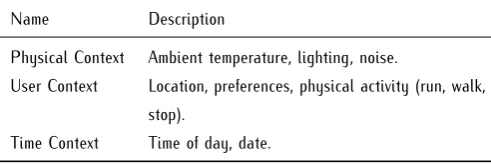
Context-Aware Computing focuses on the creation of systems that use context to provide relevant infor-mation and/or services to the user, where relevancy depends on the user’s task [8]. Let us note that there is no consensual definition of context: Dey [8] defines it as ”any information that can be used to characterize the situation of an entity. An entity is a person, place or object that is considered relevant to the interaction between a user and an application, including the user and applications themselves”, while for Chen [6] is "the set of states and values of the environment that either determine the behavior of an application or in which an application event happens and is of interest to the user". Nowadays, most of the work related to modeling, management and use of context are intended for systems that do not support collaborative work. These works have traditionally considered context variables such as temperature or location (see Table1). However, social context variables such as roles, social rules, status of the group activity, or status of other users, have been not considered in detail [26]. Therefore, it is relevant to explore the use of contextual information in collaborative activities in order to provide tools and mechanisms to make the collaborative process more efficient.
It is possible to define a Context-Aware Groupware System (CAGS) as software that enables the members of a team to communicate, cooperate and coordinate their activities in order to achieve a common goal by providing tools which are sensitive to any contextual information that can enhance collaboration. These tools acquire, manage and use context information produced by individual and group activities (in the form of user preferences, states of activities, physical/virtual
locations, and sequences of activities, for instance) in order to support users to achieve their common goals more effectively and efficiently than in a traditional Groupware System.
Building a CAGS is a challenging task, as it requires considering the traditional aspects of software develop-ment (requiredevelop-ments analysis, design, impledevelop-mentation, and evaluation), but also it is necessary to consider the aspects related to the incorporation of context aware-ness: modeling, acquisition and use of context. With respect to models, some proposals are activity-centered (e.g. [2, 16–18]), while others are user-centered (e.g. [14,24,27,32]). For instance, [3] presents a model for context-aware mobile collaborative systems based on the notions of user and group spaces, where users exe-cute activities under a certain context either in isolation or within a working group, respectively. Let us note that most models do not allow dynamic changes in the rules and conditions that impact the performance of users in a collaborative activity; however, in real world scenarios these variables tend to constantly change. Thus, models considering dynamic changes in protocols and social rules defined and adapted by end users are needed.
With respect to development tools, one can find (a) architectures (e.g. [11, 23, 31]), (b) middlewares (e.g. [12, 13, 38, 39]), and (c) frameworks (e.g. [19– 21,36]). All the aforementioned works are important because they identify variables of collaboration and context awareness to support users to conduct their collaborative activities more efficiently.
2.2. Context-Aware Collaborative Video Games
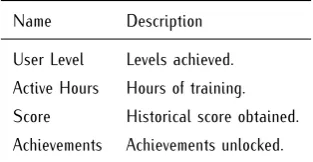
Current Collaborative Video Games can be considered as basic context-aware systems, as they already use information about the performance of their users (points scored or game levels completed) in order to re-adapt the game to offer a more attractive user experience (changing dynamically the difficulty level, for instance). Table 2 shows the traditional variables on Collaborative Videogames. This can be fun but it is limited, as it has already been noticed by researchers whose works are aimed to take collaborative games to the next level. [28] presents a qualitative study to discuss the impact of awareness tools in Quake (a FPS Video Game), while [29] shows that users playTable 1. Traditional variables on Context-Aware Systems [35].
Name Description
Physical Context Ambient temperature, lighting, noise.
User Context Location, preferences, physical activity (run, walk, stop).
better when they use awareness tools. Other related works are [9] which presents an analysis for improving communication tools through the use of user and group information, [40] which proposes a method to design games that support collaborative learning, and [22] which presents a study aimed to analyze collaborative activities performed by students and teachers in a game-based learning environment. So, it is desirable to propose mechanisms to change the behavior of the game depending on the current social context.
The aforementioned works are important because they represent the first efforts aimed to have context-aware collaborative video games. However, they are limited:
(i) User preferences about the Graphical User Interface (GUI) are not considered, so the same GUI is presented to all the players. This can have a negative effect in the performance of a player (for instance a player can get easily distracted when messages are displayed at the upper part of the screen instead of at the bottom part), so user preferences need to be taken into account (see Fig.1).
(ii) Those works consider only awareness as the social aspect (for instance, reporting the presence of nearby enemies in radar); however social aspects are much more than just awareness and, for this reason, it seems attractive to propose models considering roles, group rules, goals, unusual behaviors, objects manipulated, social protocols, types of communication (e.g. visual, physical), actions (e.g. write, speak, etc.) to enable the representation of complex situations.
(iii) It is not clear if the traditional means of collaboration (e.g. voice/text messaging) are sufficient or appropriate to meet the needs of users in a distributed setting. It seems then interesting to investigate if the information generated when players are face-to-face and that is lost when they are geographically distributed can be detected and used in alternative means of collaboration.
Table 2. Traditional players variables on Collaborative Videogames.
Name Description
User Level Levels achieved.
Active Hours Hours of training. Score Historical score obtained. Achievements Achievements unlocked.
Figure 1. Video Game screen. It presents energy level, bonuses, score, munitions.
(iv) The speed and efficiency to collaborate and communicate in a FPS Video Game are important and need to be considered, otherwise there is a high possibility that the players cannot generate a strategy and then can be easily defeated. Thus, solutions to this issue need to be proposed. The study presented in Section 3 was conducted to explore and analyze these issues.
3. Exploratory Study
An exploratory and analytical study was designed and executed in order to identify whether there are additional elements that traditional means of collaboration do not consider. The following describes the design of the experiments considered in the study as well as the materials and methods used to perform them, and finally discusses the obtained results.
3.1. Experimental design
For this study, two different experiments were designed and executed. In the first experiment (e1) a group
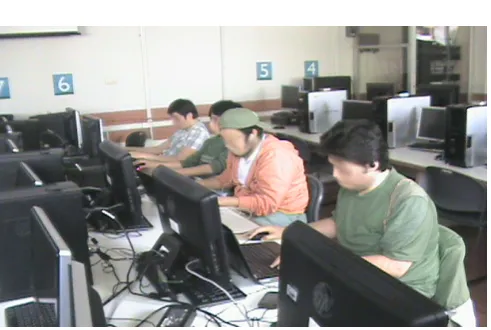
of players were divided in two teams of equal size, and they played a FPS game in a face-to-face setting: they were in the same room and each player knew who were his/her teammates (see Fig. 2). For the second experiment (e2), players were also divided in
two teams of equal size, but this time they played in different physical locations (e.g. home, school, etc.). The intention of defining e1 and e2 was to detect
behaviors that give us indications of the existence of other variables that arise from a face-to-face interaction between players, and these variables are not covered by traditional tools offered in the game (e.g. messages, audio messages predefined). Experiment e1
was performed in a different day than experimente2.
The first experimente1was conducted with 8 players,
Figure 2. Group of players in a face-to-face setting.
all between 19 and 26 years old and with at least one year of experience in playing FPS video games. The second experiment e2 was performed with 8 players,
students and workers, 25% are women and 75% are men, all between 20 and 29 years old and also with at least one year of experience in FPS Video Games.
The following variables were measured per player: number of eliminated enemies, player deaths, and the score generated individually and in group.
3.2. Materials
AssaultCube (AC) [1] is an open source First Person Shooter (FPS) Collaborative Video Game that can be executed in desktop environments and has a server to be executed online. AC provides collaborative sce-narios with tools that users can use to coordinate and communicate (e.g. private and group messaging, pre-determined audio messaging). The chosen collaborative scenario was the mini-game Flag Capture. In this game, the members of a team must keep a yellow flag as long as possible (see Fig.3). Each time a team member holds the flag for a 15-second period, he earns points for his team and for his personal account; therefore, teammates need to protect each other, and they must also eliminate enemies that attempt to recover the flag. However, when the player carrying the flag is eliminated, the flag is available again so the enemy team can recover it to try to earn points.
For both experiments, e1 and e2, an instrument (a
survey) to measure user satisfaction using a Likert scale was prepared. The instrument consists of 12 questions that refer to 6 dimensions related to user satisfaction (see Table 3), such as (D1) Coordination (1-2), (D2) Communication (3-4), (D3) Cooperation (5-6), (D4) Entertainment (7-8), (D5) Ease (9-10) and (D6) Awareness (11-12). The possible answers to the questions go from 1 to 5, where “1” stands for Strongly Disagree, “2” for Disagree, “3” Neither agree nor disagree, “4” Agree and “5” Strongly Agree.
Figure 3. Video Game screen with location map and the flag.
The consistency of this instrument was validated by applying a Cronbach Alpha coefficient to the answers obtained from the players in e1. The Cronbach Alpha
coefficient was applied to each dimension of the scale, and the results were as follows: D1 = 0.7, D2 = 0.5, D3 = 0.6, D4 = 0.8, D5 = 0.5 and D6 = 0.5. As can be seen, values of dimensions D1, D3 and D4 are equal to or greater than 0.6, therefore the questions in these dimensions have a moderate/acceptable reliability. In the case of dimensions D2, D5 and D6, they did not reach a value of 0.6 or higher; however, the obtained data were not significant to discard these items. In addition, the average of all the dimensions was 0.6, which is considered moderately acceptable. For future applications, it is expected to improve the items (D2, D5 and D6) and increase the sample size.
3.3. Procedure
The procedure for observation and evaluation of the video game was the following:
1. The AC Video Game was installed on computers that were involved in the experimental study.
2. During 15 minutes, the participants were pro-vided with a manual of the AC video game with the connection steps in order to connect to the server and operate successfully the means of col-laboration.
3. During 10 minutes, a test mission (Team Death-match) was launched in order to familiarize par-ticipants with the game.
4. During 15 minutes, the activity “Team Keep the flag” (a1) was executed.
3.4. Results
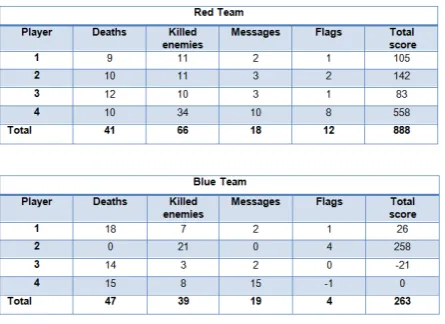
The results obtained during the game ate1can be seen
in Fig.4. In this case the winner was the blue team. The total score in the game is based on: i) accumulated points for every 15 seconds a player keeps the flag, ii) accumulated points for every eliminated enemy, iii) decreased points for every eliminated teammate and iv) decreased points for every dead player of the team.
In the AC video game experiment 1 (e1), the players
did not use the communication tools (e.g. instant messenger, predefined audio messages). This occurred because they were in the same place; therefore, they communicated with their own voice and gestures. For example, some players expressed explicit phrases as: “Protect me, I have the flag!”. So roles (e.g. guards, flag bearer) were created on-the-fly, and constantly changed during the game. Also, in many cases, group behavior
Table 3. Relation of statements in the survey.
No. Dimention Statement
1 D1 Text messages offered by the game were helpful to organize you with your teammates.
2 D1 Location map in the game helped you generate an estrategy with your other teammates. 3 D2 Predefined audio messages were
enough to transmit your emotions in the game. 4 D2 Text messages were useful for transmiting
infor-mation to your teammates during the
collaborative activity.
5 D3 The map locating your teammates is useful to support the group activity.
6 D3 The video game offers suitable collaboration tools to help your team.
7 D4 The video game kept you entertained during the development of the game.
8 D4 Information (e.g. messages, alerts, etc.)
shown on the game interface possively affect your entertainment.
9 D5 The video game makes it easy to
collaborate with your teammates. 10 D5 The video game makes it easy to
eliminate players of the opposite team. 11 D6 Knowing the location of your teammates
on the map helped you to execute game activities
12 D6 Knowing the score of all the players positively changed your behavior during the collaborative activity.
Figure 4. Results of experimente1.
Figure 5. Results of the survey applied to the participants ine1.
depended on reactions of the bearer of the flag. For instance, if his teammates heard and saw that he was in a state of frustration, they protected him even when the bearer did not request help explicitly.
Fig. 5 presents the charts summarizing the results of the survey applied to players in e1. The results
related to dimension (D1) show an adverse opinion regarding the use of text messaging for coordination (item 1), but a positive attitude regarding the use of the map location (item 2). Dimension 2 (D2) shows the adverse opinion regarding for communication of players with AC tools. Dimension 3 (D3), related to cooperation, shows a positive trend in item 5, which is related to location map; however, in item 6, the trend of neutrality and dissatisfaction predominated. In dimension 4 (D4) and dimension 5 (D5), regarding ease of use and entertainment, the trend is strongly in favor. Finally, in dimension 6 (D6), related to awareness, the trend is to accept it positively.
For the results of e2, see Fig. 6. In this case,
an unfavorable opinion regarding the collaboration mechanisms provided by AC. Most messages sent by the teams were not to coordinate and organize their actions, but to joke or threat their enemies. More points were generated ine2 than ine1; this can be explained
if one considers that a more competitive environment is created when players are competing face-to-face, so eliminating enemies or capturing the flag is more difficult.
Fig.7 presents the charts with the results obtained by the application of the survey to players ine2. As can
be seen, D1 and D2 show an attitude of neutrality and dissatisfaction, in D3 only the item 5 is predominant with a positive attitude, in item 6 showing a slight trend in favor. Finally, in D4, D5 and D6 also the point of view was in favor.
Let us note that the group behavior of helping the bearer of the flag without any explicit request was not present in experiment 2 (e2). This was because the tools
currently offer by the video game are not sufficient to transmit states of frustration, so the bearer needed
Figure 6. Results of experiment e2.
Figure 7. Results of the survey applied to the participants ine2
to request help explicitly through text messages or predefined audio messages.
3.5. Discussion
The qualitative results obtained in experimentse1 and
e2 were not in favor of collaboration mechanisms (D1,
D2, D3). This give us evidence that the traditional mechanisms offered in the FPS videogame are not sufficient and are not presented in the best way; therefore, it is interesting to propose tools that include contextual information to enhace collaborations. The evaluation also helped us identify social behaviors that could be studied in greater depth, for example, identification of moods, detection of group patterns, and recognition of social interactions, to name few. This information can be considered as awareness, which helps the users to know the state of the activity undertaken. Therefore, the awareness and social behaviors identified in these experiments can be used to measure the relevance of users (i.e. Social Presence) within a Groupware System, which would allow to have new systems sensitive to such information.
4. Context-Aware Model and Architecture
Based on the findings of the exploratory study, this Section proposes a conceptual model and a generic architecture for CAGS.
4.1. Model
A conceptual model for Context-Aware Groupware Systems is presented in Table4. This model comprises a set of social context variables that we consider of interest for a FPS-like Collaborative Video Game. The variables are categorized in three classes (interactive, cohesive, and affective), and for each of them a description and some examples are given. For instance, a group is a cohesive variable specifying a set of users that executes a collaborative activity, such as a team in a video game.
As complement to these variables, and in order to support the expected proactive behavior of a CAGS, we proposesocial triggers. They are rules of the form Event-Condition-Action, where Event refers specifically to a social event of relevance in the system. For example, Luis (p1) can set a trigger (d1) for the activityTeem keeps
the flag (a1), so that when he takes the flag (ac1) some
actions are automatically triggered, such as sending a predefined message to his closest teammate requesting for assistance (ac2), transmitting a predefined audio
message to all team members to inform them the place to where he is going (ac3), or requesting information
Table 4. Social Context Variables
Category Elements Description Examples
Interactive variables
Objects Artifacts used in an activity. Messages, bonus refills. Tasks Individual actions to achieve goals. Capturing the flag. Events Occurred events in interactions. Captured flag.
Users Entities that perform tasks and belong to a community Players: Hugo and Luis.
Locations Physical or virtual locations of actors Luis is participating in the activity
“Team Keep the Flag” at the university.
Cohesive variables
Groups A collection of users executing an activity. Red team, blue team.
Roles Functions expected by a user. Leader, protector, bearer.
Goals Community objectives. The team must retrieve the flag. Alliances Subset of users in the group. Users with the aim of achieving a record
score.
Activities Activities performed by the group. Participate in the battle to keep the flag.
Rules Behaviors defined by the group. If Luis has a leader role then he will receive
all the messages from the team.
Affective variables Moods Moods of users executing an activity. Frustation, happiness. Gestures Gestures of the users. Laugh or cry of a player.
participation of a player in the game and to avoid possible distractions.
4.2. Architecture
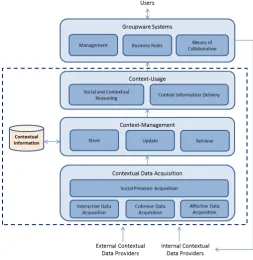
Fig. 8 presents a context-aware architecture based on the proposed model. For incorporating context-awareness into Groupware Systems, it is not only nec-essary to capture individual and social contextual data from different sources, but it is also important to con-sider a reasoning mechanism (logical or probabilistic) being able to infer high-level contextual information, but also to help the users of Groupware Systems to make decisions based on the current context or to proactively take actions. This architecture has four lay-ers that are described below.
Groupware System Layer. This layer has direct
commu-nication with the users through the user interface and the means of collaboration provided by the Groupware System. The Groupware System send events occurred in the group to the Contextual Data Acquisition Layer. Context-Usage Layer. This layer uses information pro-vided by the Context-Management layer in order to infer and reason with social and individual contexts. Once this process is complete, the GS is adapted and manipulated depending on the result of the reasoning process.
Context-Management Layer. The primary functions of
the Context-Management Layer are store, update and retrieve the context information acquired from the Contextual Data Acquisition Layer. Therefore, in this
layer there is a data store that is accessed in order to process information.
Contextual Data Acquisition Layer. It is located at the lowest level; it acquires information directly from internal (wrt to the GS) and external data providers
(such as web services, video capture from video cameras and audio capture from microphones). In this layer, we propose the incorporation of a sensor of Social Presence to determine the level of relevance of users involved in a collaborative activity. The relevance of users will be a composite categorical variable built from basic interactive, cohesive and affective data obtained from the game. For future stages, the data acquisition layer be able to communicate with the groupware through the information delivery via a service platform that provides web services. For information retrieval, we propose retrieve game data for lapses of 15 seconds for each player, therefore, considering that the game of “Team Keep the Flag” lasts 15 minutes, at the end of the game each player will have 60 readings of cohesive and interactive variables.These lapses will be analyzed in order to see the behavior and variability information.
4.3. Discussion
Let us note that several works [4, 5, 34, 37] have explored social presence in educational settings, but few works (as ours) have studied it in gaming scenarios [7]. In the educational domain, [15] presents a critique of how students perceive the social means to support their study activities, and [33] indicates that technological progress has led to the creation of new models for different types of communication, using synchronous and asynchronous methods for online teaching. In game scenarios, [30] explores social presence experimenting with collaborative mobile games. Few works address this problem for different types (face-to-face and computer-mediated) of interactions: the work presented in this paper is aimed to fill this gap.
5. Conclusions and Future Work
This paper presented an exploratory study which had as objective to identify elements and conditions necessary to improve the traditional means of collaboration offered in CAGS, particularly in Video Games of type First-Person-Shooter. Two experiments were executed, one where teams of gamers were playing at the same physical location, and other where they were geographically distributed. As result, it was found that nonverbal information (gestures, feelings, group behavior patterns) that is not captured nor processed is relevant for the collaborative activity. It was also found that gamers needed to deviate his/her attention of the game to send text messages, and that most of the time text messaging were not used to collaborate. Then, faster and more efficient collaboration tools are needed. With this evidence, a model and an architecture for CAGS that takes into account these findings were proposed.
In future works, we will modify AssaultCube to integrate elements of context-awareness in order to support users to achieve their goals more efficiently. It is expected that the game will automatically provide appropriate means of collaboration (e.g. messages, maps) depending on the executed interaction (e.g. player captures the flag on the battlefield), without requiring the user to invoke such tools in an explicit manner. In order to accomplish this, we will implement a service layer based on the conceptual architecture. Finally, we will design and execute an experimental study to compare both the regular version of the game and its context-aware version.
Acknowledgements. The authors thank the reviewers of this paper for their useful comments. The first author gratefully acknowledges to CONACYT for scholarship No. 350124 for graduate studies.
References
[1] AssaultCube, P. (2013) What is assaultcube?,http://
assault.cubers.net/.
[2] Bardram, J.E. andChristensen, H.B. (2007) Pervasive
computing support for hospitals: An overview of the activity-based computing project. Pervasive Computing, IEEE6(1): 44–51.
[3] Benítez, E., Mezura, C. and Montané, L. (2012)
Context-aware mobile collaborative systems: Conceptual modeling and case study.Sensors12(10): 13491–13507. [4] Biocca, F.,Harms, C.andBurgoon, J.K.(2003) Toward
a more robust theory and measure of social presence: review and suggested criteria.Presence: Teleoperators and Virtual Environments12(5): 456–480.
[5] Bulu, S.T. (2012) Place presence, social presence,
co-presence, and satisfaction in virtual worlds. Computers and Education58(1): 154–161.
[6] Chen, G.andKotz, D.(2000)A Survey of Context-Aware Mobile Computing Research. Technical Report TR2000-381, Department of Computer Science, Darthmouth College.
[7] de Kort, Y.A.W.,IJsselsteijn, W.A.andPoels, K.(2007)
Digital games as social presence technology: Develop-ment of the social presence in gaming questionnaire (spgq). In Proc. of the 10th International Workshop on Presence (PRESENCE’07)(Barcelona, Spain): 195–203. [8] Dey, A.K. (2001) Understanding and using context.
Personal Ubiquitous Computing5(1): 4–7.
[9] Diamantaki, K., Rizopoulos, C., Charitos, D. and
Tsianos, N. (2011) Theoretical and methodological
implications of designing and implementing multiuser location-based games.Personal and Ubiquitous Comput-ing15(1): 37–49.
[10] Dourish, P. and Bellotti, V. (1992) Awareness and
coordination in shared workspaces. InProc. of the ACM conference on Computer-supported cooperative work (CSCW ’92)(New York, NY, USA): 107–114.
[11] Duran-Limon, H.A., Blair, G.S., Friday, A., Grace,
Context-aware middleware for pervasive and ad hoc environments. Tech. rep.
[12] Favela, J., Alba, M. and Rodríguez, M. (2002)
Autonomous agents for ubiquitous collaborative envi-ronments. In Coello Coello, C., de Albornoz, A., Sucar, L.andBattistutti, O.[eds.]Proc. of the Second Mexican International Conference on Artificial Intelligence: Advances in Artificial Intelligence (MICAI’02) (Springer Berlin-Heidelberg), Lecture Notes in Computer Science
2313, 351–360.
[13] Gu, T., Pung, H.K. and Zhang, D.Q. (2005) A
service-oriented middleware for building context-aware services.Network and Computer Applications28(1): 1–18. [14] Hervás, R.,Bravo, J.andFontecha, J.(2010) A context
model based on ontological languages: A proposal for information visualization. Universal Computer Science
16(12): 1539–1555.
[15] Hrastinski, S. and Aghaee, N.M. (2012) How are
campus students using social media to support their studies? an explorative interview study.Education and Information Technologies17(4): 451–464.
[16] Hung, L.X.,Lee, S.,Lee, Y.K.andLee, H.(2007)
Activity-based access control model to hospital information. In Proc. IEEE Conference on Embedded and Real-Time Computing Systems and Applications (RTCSA’07)(Daegu): 488–496.
[17] Kaenampornpan, M. and O’Neill, E. (2004) An
integrated context model: Bringing activity to context. InProc. of the Workshop On Advanced Context Modelling, Reasoning and Management (UBICOMP’04)(Nottingham, UK).
[18] Kofod-Petersen, A. and Cassens, J. (2006) Using
activity theory to model context awareness. InModeling and Retrieval of Context: Second International Workshop (MRC’05) (Springer-Verlag), Lecture Notes in Computer Science3946: 1–17.
[19] Kulkarni, D., Ahmed, T. and Tripathi, A. (2012)
A generative programming framework for context-aware cscw applications.ACM Transactions on Software Engineering and Methodology21(2): 11:1–11:35.
[20] László Kovács, Péter Mátételki, B.P. (2009)
Service-oriented context-aware framework. InProc. of the Fourth European Young Researchers Workshop on Service Oriented Computing (YR-SOC’09)(Pisa, Italy).
[21] Lu, C.,Chang, M.,Kinshuk,Huang, E.andof
Context-Aware Mobile Educational Game, U.(2011) Usability
of context-aware mobile educational game. Knowledge Management & E-Learning3.
[22] Marty, J.C.andCarron, T. (2011) Observation of
col-laborative activities in a game-based learning platform.
IEEE Transactions on Learning Technologies4(1): 98–110.
[23] Mayrhofer, R.(2004) An architecture for context
pre-diction. In Advances in Pervasive Computing (Austrian Computer Society (OCG)),176, 65–72. Part of the Sec-ond International Conference on Pervasive Computing (PERVASIVE’04).
[24] Messeguer, Medina, R. and J.Fave(2010) Supporting
context-aware collaborative learning through automatic group formation. In Proc. of the 4th International Symposium on Ubiquitous Computing and Ambient Intelligence (UCAmI’10)(Valencia, España).
[25] Montane-Jimenez, L., Benitez-Guerrero, E. and
Mezura-Godoy, C.(2013) A context-aware architecture
for improving collaboration of users in groupware systems. In Proc. of the 9th International Conference Conference on Collaborative Computing: Networking, Applications and Worksharing (Collaboratecom’ 2013): 70–76.
[26] Montane-Jimenez, L.G., Benitez-Guerrero, E. and
Mezura-Godoy, C. (2013) Context-aware groupware
systems and video games: State of the art. Proc. of the Mexican International Conference on Computer Science (ENC’13): 55–59.
[27] Mowafi, Y. and Zhang, D. (2007) A user-centered
approach to context-awareness in mobile computing. In
Proc. of the 2007 Fourth Annual International Conference on Mobile and Ubiquitous Systems: Networking&Services (MobiQuitous’07)(DC, USA: IEEE Computer Society): 1– 3.
[28] Nova, N.(2001) Awareness tools: lessons from
quake-like. InProc. of the Playing with the Future Conference.
[29] Nova, N., Wehrle, T., Goslin, J., Bourquin, Y. and
Dillenbourg, P. (2007) Collaboration in a multi-user
game: impacts of an awareness tool on mutual modeling.
Multimedia Tools Applications32(2): 161–183.
[30] Nova, N., Girardin, F. and Dillenbourg, P. (2010)
The effects of mutual location-awareness on group coordination.Human-Computer Studies68(7): 451–467.
[31] Olivares, A.,Mendoza, S. andde Luca, A.(2011) An
architecture to support context of use in groupware systems. InProc. 8th International Conference on Electrical Engineering Computing Science and Automatic Control (CCE’11)(Merida City): 1–6.
[32] Romsaiyud, W. and Premchaiswadi, W. (2010) Soa
context-aware mobile data model for emergency situ-ation. In Proc. IEEE Conference on ICT and Knowledge Engineering’10(Bangkok): 93–97.
[33] Roseth, C.,Akcaoglu, M.andZellner, A.(2013)
Blend-ing synchronous face-to-face and computer-supported cooperative learning in a hybrid doctoral seminar.
TechTrends57(3): 54–59.
[34] Rourke, L., Anderson, T.,Garrison, D.R.andArcher,
W. (1999) Assessing social presence in asynchronous
text-based computer conferencing. Distance Education
14(2): 50–71.
[35] Schilit, B. and Theimer, M.M. (1994) Disseminating
active map information to mobile hosts. IEEE Network
8(5): 22–32.
[36] Schroyen, J., Luyten, K., Gabriels, K., Robert, K., Teunkens, D., Coninx, K., Flerackers, E.et al. (2009)
The design of context-specific educational mobile games. InTrant, J.andBearman, D.[eds.]Proc. of the Workshop on Museums and the Web: The International Conference for Culture and Heritage Online(Indianapolis, USA: Toronto: Archives and Museum Informatics).
[37] Shen, K.N. and Khalifa, M. (2008) Design for social
[38] Siegemund, F. (2004) A context-aware communication
platform for smart objects. InProc. of the Second Inter-national Conference on Pervasive Computing (PERVA-SIVE’04) (Vienna, Austria: Springer-Verlag Berlin Hei-delberg),3001, 69–86.
[39] Yau, S.S.andKarim, F.(2004) An adaptive middleware
for context-sensitive communications for real-time applications in ubiquitous computing environments.
Real-Time Systems26: 29–61.
[40] Zea, N.P., Sanchez, J.L.G. and Gutierrez, F.L. (2009)
Collaborative learning by means of video games: An entertainment system in the learning processes. In