(PLATES
73-75)
INTRODUCTIONE
XCAVATIONS by C. W. Blegen at the site of Korakou, a small prehistoric
mound just west of New Corinth, were a milestone in the study of the Greek
Bronze Age. The results of these investigations were presented in 1921 in the classic
volume Korakou: A Prehistoric Settlement Near Corinth.' Blegen was able to outline
the phases of the Bronze Age on the Mainland and the development of their pottery
styles largely on the basis of the stratigraphy which he found at this site.
The excavation report, although exemplary and still indispensable, includes only
the more striking vases and sherds found, and these are not presented separately by
deposit. It is impossible, therefore, to modify or refine Blegen's sequence at Korakou
without re-examination of the notebooks and finds.
Fortunately this is possible. Pottery from two soundings at Korakou is preserved
in the museum at Corinth. The first, Test P, consists of Early Helladic, early Middle
1 Hereafter abbreviated Korakou. The following other special abbreviations are used in this article:
Buck - R. J. Buck, " Middle Helladic Mattpainted Pottery," Hesperia 33, 1964, pp. 231- 308.
Circle B = G. Mylonas, 'O Ta4tKuc KvKXOg B rwv MVK-Vv6v, Athens 1972, 1973.
Definition - 0. T. P. K. Dickinson, " The Definition of Late Helladic I," BSA 69, 1974, pp. 109-120.
Eutresis = H. Goldman, Excavations at Eutresis in Boeotia, Cambridge, Mass. 1931.
FM, FS - motives and shapes in A. Furumark, The Mycenaean Pottery: Analysis and Classification, Stockholm 1941.
Fortifications = J. L. Davis, Fortifications at Ayia Irini, Keos: Evidence for History and Relative Chronology, Univ. of Cincinnati diss. 1977.
"Keos II " = J. L. Caskey, " Investigations in Keos: Part II, A Conspectus of the Pot- tery," Hesperia 41, 1972, pp. 357-401.
Origins = 0. T. P. K. Dickinson, The Origins of Mycenaean Civilisation, Goteborg 1977.
PPGCG = D. French, Notes on Prehistoric Pottery Groups from Central Greece, Athens 1972 (privately circulated).
Tiryns V = D. and E. French, " Prehistoric Pottery from the Area of the Agricultural Prison at Tiryns," Tiryns V, Mainz 1971, pp. 21-40.
Transition = J. B. and S. H. Rutter, The Transition to Mycenaean, Los Angeles 1976. S. Andreou, P. P. Betancourt, J. L. Caskey, 0. T. P. K. Dickinson, J. B. Rutter, C. K. Williams, II and C. Zerner have kindly examined this manuscript and have offered me their comments. Mr. Williams permitted me to study material from Korakou at Corinth in the summers of 1977 and 1978. Prof. Caskey has allowed me to refer often in this report to the finds from Shaft Graves I and II at Lerna (cf. Hesperia 24, 1955, pls. 16, 17; Archae- ology 13, 1960, pp. 130-133; not yet fully published).
American School of Classical Studies at Athens is collaborating with JSTOR to digitize, preserve, and extend access to
Hesperia
,0G
016~~~~~~~~~~~~~~~~~~~01
X~~~~~~A
c w0 l
W S
--
<
6 4 W \
5~~~~~~~~~CALE H"~- ---- -i -t--sMETRES
Helladic, and LH IIIC levels. The second, East Alley, is composed of nineteen levels
ranging in date from the Early Helladic period to LH IIIB.2
The finds from levels XII-XVI of the East Alley sounding form a homogeneous
deposit which should be dated to LH I. The purpose of this article is to present the
pottery from these five levels. Few closed deposits of this period have yet been exca-
vated from settlement contexts,8 especially in the Northeast Peloponnesos where finds
from domestic contexts have been overshadowed by the more spectacular burial goods
of the Grave Circles at Mycenae.4
The excavation of the sounding in East Alley between Houses L and M (Fig.
1) was carried out between June 7 and July 3, 1916 under the general supervision of
R. W. Scott.5 Entries in his notebooks ' contain elevations of levels with rough notes
on the character of the pottery from each, a scale plan, and a sectional drawing.7
The sounding was excavated in nineteen arbitrary levels, one above the other
(Fig. 2); only the southernmost part of the area was continued beneath level III.
The uppermost levels (I-IV) are of the LH IIIB period.8 Dickinson has dated the
next lowest (V-X) to LH IJJ9 XI is mixed and contains sherds of both LH I and
LH II types.
Levels XII-XVI mostly lay between two ash layers (labeled ash etc. and ash,
carbon in the sectional drawing); they were associated with no architectural remains.
The highest of these (XII) has a few intrusive LH II sherds. The lowest (XVI)
is mixed with early Middle Helladic and Early Helladic pottery of types which pre-
dominate in levels XVII and XVIII. It is clear from examination of the sectional
drawing (Fig. 2) why XII and XVI are contaminated. Neither followed the strata
and both included material from above and below ash layers. On the other hand,
levels XIII, XIV, and XV which lay totally between the ash layers contain no later
intrusions and only a few earlier pieces: sherds of Middle Helladic Lustrous Dark-
on-Light, Gray Minyan, and Matt-painted wares together with sherds of various
Early Helladic wares. It seems likely, therefore, that originally the levels between
2 J. B. Rutter has published the LH IIIB and IIIC pottery from both soundings in The Late
Helladic IIIB and IIIC Periods at Korakou and Gonia in the Corinthia, Univ. of Pennsylvania diss. 1972 . The LH II pottery from the East Alley sounding is discussed by 0. T. P. K. Dickinson in " Late Helladic IIA and IIB: Some Evidence from Korakou," BSA 67, 1972, pp. 103-112.
3 Dickinson (Origins, pp. 22-26) has reviewed the closed settlement deposits of this period.
4 Cf. G. Karo, Die Schachtgrdber von Mykenai, Munich 1930; G. Mylonas, Circle B.
,Fellow of the Anmerican School of Classical Studies in Archaeology, 1915-1917; see L. E. Lord, A History of the American School of Classical Studies at Athens 1882-1942, Cambridge, Mass. 1947, p. 390.
8 Record of the excavation is contained in Corinth Notebook (hereafter C.N.) 83, pp. 15, 16,
29, 32-34, 37, 41-42, 47, 53; on file in the Corinth Museum. W. W. Cummer lhas kindly prepared for me the plan in Figure 1.
7 The sectional drawing, redrawn by Blegen (C.N. 85, p. 54), was subsequently adapted for
the final publication, Korakou, p. 128, fig. 134.
8 Dated by Rutter, op. cit. (footnote 2 above).
LATE HELLADIC I POTTERY FROM KORAKOU 237
ploughed earth
wall of L
Iv
former surface
Im.
VII
VI
Vill-
former surface
ix
x
xi
ash etc.
Xi]
xIII
ash,
carbon
XIV
xv
pp
clI
ay, ash
XvL
XVII
greenish clay
,
XVII'
XIX K.~.
lrl
im.
the two ash layers were a single stratigraphic unit. The similarities among the sherds
from the five levels, with the exception of the intrusions in levels XII and XVI, leave
no doubt that they were laid down at the same time.
THE POTTERY
The following is a presentation of the pottery from East Alley levels XII through
XVI.'
More detailed descriptions of the color of selected sherds are included in
Appendix III (pp. 262-263 below). Much of the pottery seems handmade.
All sherds from these levels which remain in the museum at Corinth (ca. 1200)
were considered in this study. Representative pieces have been selected for illustra-
tion. Some intrusions (of the kind mentioned above) have been omitted from discus-
sion.
It seems that little pottery from the East Alley sounding has been misplaced
since 1921. Sherd counts in Blegen's notebook (C.N. 85, p. 54), later published in
tabular form in the final report,"' correspond closely to the quantities still in trays
in the museum. The scarcity of coarse and undecorated body sherds from these levels,
however, is surprising and it seems likely that some preliminary selection had taken
place before Blegen made his notes. No statistical study of the collection, therefore,
was attempted here.
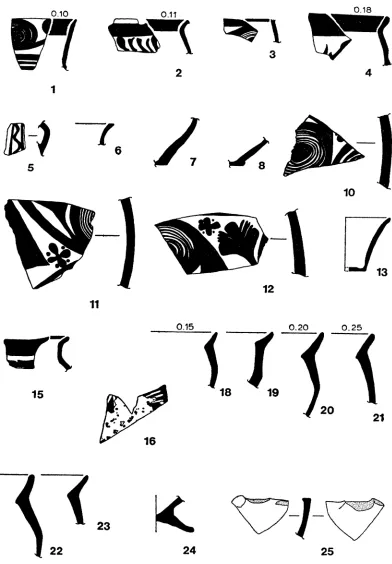
LUSTROUS PAINTED (Plate 73; Figures 3-5)
A. Mycenaean
12Paste: Fine. Usually pink.
Surface: Pink to reddish yellow. Often slipped.
Evenly burnished. Main decoration in the LH I style with red or black paint; subsidiary decoration in white.
Shapes and Designs:
1. Keftiu cup. Rim (1). Outside: spiral with dot-filled tangents (small white dots on
large dot in center of spiral, traces of added white on dot over tangent) and broad band (over-painted with thin white bands) at mid- rib. Inside: broad rim band.'3
2. Teacups. Rim (2, 3). Broad rim bands inside and out. Designs include spirals and foliate bands.14
3. Goblet? Rim (4) ; base (notillustrated). Carinated rim with floral pattern perhaps from goblet; pedestaled base probably from
same vase (D. est. 0.07 m).
4. Open vessels. A thin strap handle (5) with a zigzag band may be from a teacup.
'0 The pottery is of kinds familiar in the Northeast Peloponnesos. I have followed, whenever
suitable, the typology set forth by D. French in Tiryns V and PPGCG. Standard color names sug- gested in the Munsell Soil Color Charts (Baltimore 1975) are used throughout this article.
"1 Korakou, p. 127, table I. See also C.N. 85, pp. 42-54 where Blegen mentions that sherds
were discarded from levels IV and VI.
12 Early Mycenaean ware in general is described by Rutter (Transition, p. 13). Dickinson
(Definition, p. 114) discusses specifically the LH I style. See also Furumark, op. cit. (footnote 1 above), pp. 13-14; also pp. 252-253 below.
13 Cf. Transition, p. 55, no. 866.
LATE HELLADIC I POTTERY FROM KORAKOU 239
0.10
0.110.18
2 4
1
10
12
0.1
__ _0.20
0
15 916 18
(23 K
22 24 25
5. Squat jug/alabastron.'5 Rim (6). Solid black inside and out.'I
6. Closed vessels. Bases (7, 8); body sherds (Th. 0.003 to 0.007 m.) from at least three other closed vessels with horizontal bands (W. 0.012 to 0.014m.).
B. Minoan17
Paste: Coarse with dark inclusions. Reddish yellow.
Surface: Pink. Burnished. Main decoration in black or red with added decoration in white.
Shapes and Designs:
1. Keftiu cup. Fragment of handle and wall. Handle (W. 0.023 m.) decorated with thin black bands on a light ground; wall painted solid black inside.
2. Jug. Rim (9). Plastic " eye " on each side of spout; neck molding.'8 Broad band inside rim; solid black outside. Traces of white paint outside; traces of red paint inside and out.
3. Closed vessels. About half a dozen body sherds (including 10-12) from large vase with spirals, crocuses, and rosettes in the LM IA
style: '9 lower part of pot decorated with
black bands, some over-painted with thin white bands (not illustrated). A large round horizontal handle and a body sherd with a black band on a light ground (not illustrated) are from a second large vase. A single sherd
from a third large vase, probably a pithos; lustrous red outside with traces of white paint and a plastic band with diagonal slashes.
C. Light on Dark 20
Paste: Fine. Light red to pink.
Surface: Red or black painted ground. White decoration.
Shapes and Designs:
1. Keftiu cup. Complete profile without
handle (13). Pendent double semicircles
with dot centers; bands.2'
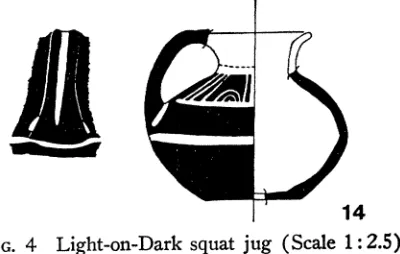
2. Squat jugs/alabastra.22 Examples in- clude a nearly complete vessel (14) decorated with concentric semicircles in panels separated by vertical bars, a rim sherd (15), and a body sherd (16) probably with palmettes. 14 has a plastic rivet on the top attachment for the handle.
14
FIG. 4 Light-on-Dark squat jug (Scale 1: 2.5)
15 Profiles of squat jugs (FS 87) and alabastra (FS 80) are similar and in levels XII-XVI
the one shape could not be distinguished from the other.
1" This sherd could equally well have been classified with Lustrous Light-on-Dark ware. Rims
of LH I style squat jugs and alabastra with broad rim bands (e. g. Circle B, pls. 43: a; 65:y)
cannot be distinguished from rims of Light-on-Dark squat jugs and alabastra (e. g. ibid., pl. 15: y).
17 Blegen in Korakou did not identify any sherds as Minoan. See also pp. 252-253 below.
18 Large jugs with neck moldings and spouts of this kind are features typical of Middle Minoan
ceramics (see G. Walberg, Kamares, Uppsala 1976, pp. 36-38). Similar jugs continue to be found
in LM IA contexts (e. g. S. Marinatos, Thera VI, Athens 1974, pl. 8: b).
19 I have not found close parallels for the design. See M. Popham, " Late Minoan Pottery: A Summary," BSA 62, 1967, pp. 337-351, for characteristic LM IA motives.
20 Equivalent to Blegen's Class D I (Korakou, pp. 32-33). See also p. 254 below. D. French's
White-on-Lustrous-Dark category (PPGCG, p. 36) contains not only this ware but also much
coarser and earlier Minoanizing pottery with light-on-dark decoration, as Rutter observed (Transi-
tion, p. 10, note 13).
21 Cf. Korakou, p. 33, no. 4.
LATE HELLADIC I POTTERY FROM KORAKOU 241
D. Dark-coated23
Paste: Fine to semicoarse. Dark gray to reddish yellow.
Surface: Well smoothed and painted red or black. Frequently burnished.
Shapes:
1. Goblets/kraters. 24A bridge spout (17)
and a horizontal handle (not illustrated) are certainly from kraters. Broad everted rims (e. g. 18-23) and low pedestaled bases (e. g. 24), however, may come from either shape. Strap handles, probably from goblets, are also found.
2. Saucer. Rim (25). Flat with attach-
ment for high-swung loop or strap handle.
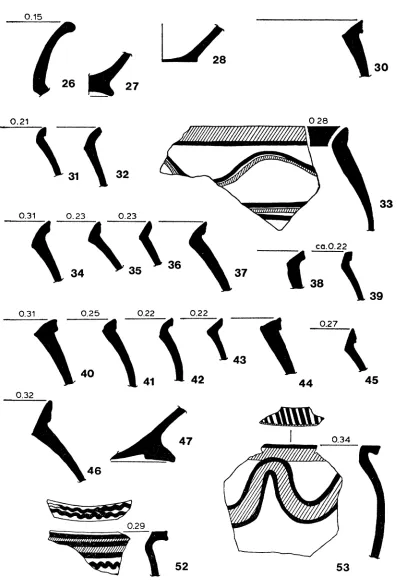
3. Hydria/stamnos. Rim (26). Profile
like those of matt-painted hydriai. 4. Closed vessels. Bases (27, 28).
POLYCHROME MATT-PAINTED225
(Plate 73, 74; Figures 5, 6)
A. "Aigina" 28
Paste: Usually semicoarse with white inclu-
sions. Red to reddish yellow or pink. Gray core in thick parts of walls.
Surface: Red or reddish brown to pink. Sometimes slipped. Unevenly burnished to low luster. Decoration in red and black matt paint; lustrous rim bands.
Shapes and Designs:
1. Kraters.27 Rims (e.g. 29-46); base
(e. g. 47); spout (e. g. 48); handles (e. g. 49, 50). Most have red or black rim bands inside and out, double wavy bands on the shoulder (upper red, lower black) above double black bands, black figures-of-eight around the attachments for the handles, and a black band around the foot. One example (29) has chevrons on the shoulder instead of wavy bands.28
2. Closed vessel.29 Body sherd (51). Red
and black chevrons?
B. " Mainland " "
Paste: Fine to semifine. Light red to red- dish yellow.
Surface: Pink to light red or reddish yellow.
2- Defined by Caskey " Keos II ", p. 392). The ware resembles Red Slipped: "Aigina " as de-
fined by D. French (PPGCG, p. 26: Tiryns V, p. 25). Rim profiles of the kraters typical of Red- slipped "Aigina ", however, are much different from the characteristic Dark-coated-ware goblet and krater profiles of levels XII-XVI.
24 Cf. Circle B, pl. 117: a (goblet).
25 All three polychrome matt-painted wares distinguished here were lumped together by Blegen
into his Matt-painted III group (= Class B III: Polychrome Matt-painted Ware); see Korakou, pp. 28-30.
28 In Korakou this ware was included in Class B III among " sherds with poorer fabric " (p.
30). It was first defined as a separate ware by D. French (PPGCG, p. 35, and Tiryns V, p. 27). For publications of pottery of this ware more recent than French's catalogues (loc. cit.), see: H. Dohl, "Tiryns-Stadt: Sondage 1968," Tiryns VIII, Mainz 1975, pl. 73: 3 and p. 140, fig. 2: 9; Transition, p. 9, note 11 and p. 51, nos. 723-725; Fortifications, pp. 170-171; S. Hiller, Alt-Agina, IV, i, Mykenische Keramik, Mainz 1975, nos. 4-6; and J. L. Davis, " Brauron and Keos in the Shaft Grave Period," AAA 10, 1978, pp. 270-272. See also p. 258 below.
27 A nearly complete krater of this kind is on display in the Argos Museum (Lerna, no. 246).
28 The range of designs on "Aigina " ware kraters from the fillings of the Lerna shaft graves
is much broader than at Korakou. Included are foliate bands, filled pendent semicircles, freestanding foliate derivatives (Buck motive no. 65), double saltires (Buck motive no. 28), and chevrons, in addition to double wavy bands. At Ayios Stephanos (Transition, p. 51, no. 724) triple zigzags are found, at Zygouries, a possible lily (C. W. Blegen, Zygouries, Cambridge, Mass. 1928, p. 135, fig.
127: 2), and at Tiryns (Dohl, op. cit. [footnote 26 above], pl. 73: 3, lower right) chevrons.
29 At Lerna, as at Korakou, shapes other than kraters are not common.
30 In Korakou this ware was included in Class B III under the heading " fine ". The charac-
0.15
28 130
26 27
0.21 0_28
33
0,31 0.23 0.23 ____
x
~~~~~~~~~~~~~~~CQ.0.22
\34 X \3536 37 {8
(~~~~~~~~~38
S39
0.31 0.25 0.22 0.22
40 41 42 0 45.27
0.32
>' ~~~~~~~47
0r3
46
s
52
53LATE HELLADIC I POTTERY FROM KORAKOU 243
Sometimes slipped. Burnished evenly to high luster. Decoration in red and black.
Shapes and Designs: 31
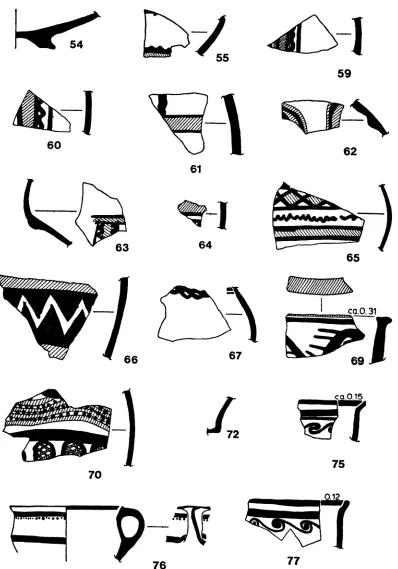
1. Kraters.32 Rims (52, 53). Designs in- clude broad straight and wavy red bands bordered by thin black bands; thin wavy black bands; and diagonal black bars.
2. Open vessels. Base (54); body sherds (e. g. 55, 56). Designs include black zigzag bands, black wavy bands, and broad red bands bordered by thin bands.
3. Closed vessels. Handles (57, 58) ; body sherds (e. g. 59-68). Designs include broad red bands (straight or wavy) bordered by thin black bands, red lozenges outlined in black, a zigzag band reserved within a black band, a black guilloche bordering a red band, black wavy bands, and black vertical bars.
C. Other
A few sherds do not belong to either of the above wares. A rim sherd from a basin (69) has polychrome decoration on a light unbur- nished ground. Two body sherds (70, 71)
from closed vessels have decoration in black and red matt paint on a lightly burnished ground.
MATT-PAINTED
(Plates 74, 75; Figures 6-8)
A. Matt-painted II 33
Paste: Fine or coarse depending on size of vessel. Light gray to reddish yellow.
Surface: Pinkish white to reddish yellow. Sometimes slipped. Burnished. Decoration in black.
Shapes and Designs:
1. Keftiu cup. Base (72) with bands of unequal thickness.34
2. Mainland Panelled cup. Body sherd (73) with rosettes and festoons.""
3. Kantharos.36 A rim comes from a kan- tharos with high-swung handles (74). Three parallel bars inside at attachment of handle to rim. Groups of bars pendent from rim in- side.
4. Open vessels. A series of outturned
rims and body sherds (75-81) are from
style or Ledervasen) have been set out by D. French (PPGCG, p. 33, and Tiryns V, p. 27). For recent discussions and publications as well as omissions from French's catalogue, see: E. Andreou,
?ME wrpo'ovs CK ?vpcv?, AS 7, 1974, pp. 416-422; J. L. Davis, " Polychrome Bird Jugs: A Note,"
AAA 9, 1976, pp. 81-83; idem, loc. cit. (footnote 26 above); Transition, p. 51, note 38; Eutresis, pp. 170-174; 0. Rubensohn, " Die prahistorische und friihgeschichtliche Funde auf dem Burghiigel von Paros," AthMitt 42, 1917, pp. 65-67; and Hiller, op. cit. (footnote 26 above), nos. 7-11.
I" Most designs at Korakou are common at other sites. For lozenges outlined in black (65), cf. Eutresis, p. 168, fig. 235: 3, and Circle B, K-10, fig. 105: a.
32 The shape is the same as Blegen's " deep bowls with wide opening and heavy flat rim"
(Korakou, p. 30, no. 3). Similar kraters have been published from Mycenae (A. J. B. Wace, " Ex- cavations at Mycenae," BSA 25, 1921-23, pl. XXX) and Tiryns (Tiryns V, fig. 4: 15, 16). The shape is like that of one variety of Yellow Minyan krater (below, p. 247 and footnote 56).
S3 Class B II (Korakou, pp. 24-28). As Blegen observed, small vases with fine pastes are most
characteristic of this ware. Levels XII-XVI also contain a few sherds from vases which are larger and coarser than those published in Korakou.
84 This cup may have had Mainland Panelled decoration (see J. L. Davis, " The Mainland
Panelled Cup and Panelled Style," AJA 82, 1978, pp. 216-222) as did many Keftiu cups in this period; too little decoration is preserved to be certain.
35 Too little of the design is preserved to be certain that this cup was decorated in the Panelled
style (Davis, loc. cit., footnote 34 above). Rosette motives of this might be Minoan in origin (cf. Transition, p. 61, no. 993) and are also found in the Cyclades (T. D. Atkinson et al., Phylakopi, London 1904, pl. XVIII: 1).
86 Probably similar in shape to matt-painted and Yellow Minyan kantharoi from Mycenae
54
41
55
59
60 62
61
K
963 664
65
_1~~~~~~~~~~~~~~~~~~~~~~~~~~~~a 0\. c31
66 67 69
e9 \ ~~~~~~~72
75 70
9
1~~~~~~~~~~~~~~~~~~~~~~~.
76 77
LATE HELLADIC I POTTERY FROM KORAKOU 245
0.12C
78
79
87 890.14
91
0.13 O.t5 0.12 0.12 0.15
(1197 v 98 99 100 0
0.13 0.13 0.14
(03
~~~~105
102
104
106
107 108 109 110
small bowls or CUpS.37 Strap handles are com-
mon (not illustrated). Some are decorated with horizontal or diagonal bars; the edges of others are outlined. Both raised and pedestaled bases (not illustrated) are also found.
5. Jugs.38 In addition to the upper part of a breasted jug (82), part of a spout (83) with a thin rim band inside and strap handles
(e. g. 84, 85) from high-spouted jugs are represented. A shoulder fragment decorated with straight and wavy bands also seems to come from a jug of this shape (86).
6. Bridge-spouted jars.39 Rim sherd (87)
with running spiral.
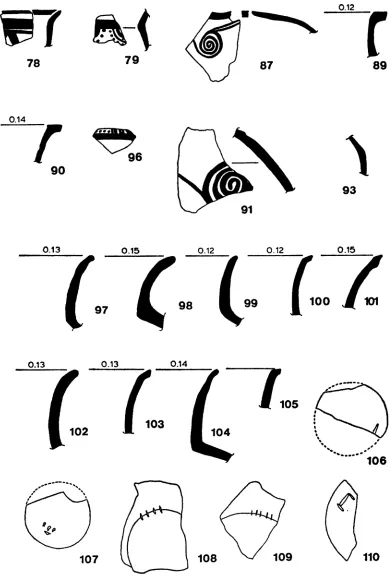
7. Closed vessels. Two body sherds (88 a, b) come from a jar which had a side spout (now broken away); both were decorated with palmettes."' Two rim sherds (89, 90) are from large jars with flat rims. Patterns on various other body sherds include guilloche (not illustrated), spirals (91, 92), straight and wavy bands (93, 94),41 rows of W's
(95), and dots and bars (96). Strap and
round handles as well as raised and flattened bases occur but cannot be assigned to a par- ticular shape.
B. Light Gray Unburnished 42
Paste: Semifine with white inclusions. Red- dish yellow.
Surface: Light gray. Sometimes slipped. Outer surface wiped and striations (from cloth?) prominent. Decoration in black.
Shapes and Designs:
1. Hydriai/stamnoi.43 Rims (e.g. 97-105);
bases (e. g. 106-113); handles (e. g. 114,
115) ; body sherds (e. g. 116-118). The most common decoration consists of a band at the rim inside and out, a band at the base of the neck, double concentric circles on the shoul- ders, figures-of-eight around the belly han- dles, double concentric circles around the lower attachments for the neck handle, and a crescent over the upper attachment. Vari- ations on this general scheme are found (117,
118). Potters' marks are common on the
bases." There are also several large flat, horizontally pierced lug handles (not illus- trated).
C. Other 4B
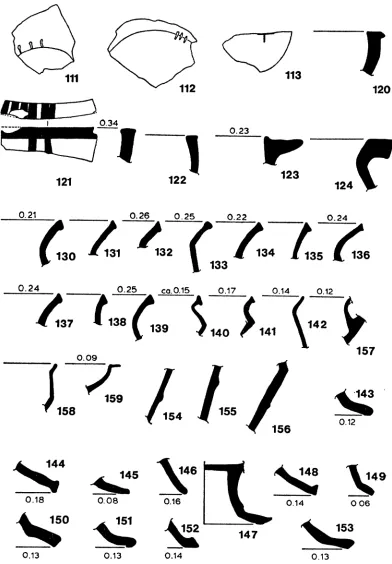
A few rim sherds are decorated in black on a light unburnished ground in styles of the earlier Middle Helladic period. Four are from basins or bowls (119-122) ; two probably come
37 It is not possible to determine the precise shape of the pots from which these sherds come.
Rims from small kantharoi (e. g. Circle B, pl. 15: a), teacups (ibid., pl. 92: ,8), and small bowls
have similar profiles.
88 Cf. Circle B, pls. 14: y, S; 45:13; 47: a; 89:,8; 91:,8; Korakou, p. 25, no. 2. '3 Cf. Circle B, pl. 97: A; Korakou, p. 27, no. 4.
40 This design is common at Korakou (cf. 16 and 81 above, and an example with the palmette
completely preserved, Korakou, p. 33, fig. 47: 10).
*1 93 may be from a jug. Bodies of jugs in this period are sometimes carinated (cf. an example from Lerna on display in the Argos Museum).
42 Class B I, no. 5 (Korakou, pp. 22-24). Decoration of examples in levels XII-XVI is simpler than that of vases published by Blegen (ibid., p. 23, figs. 32, 33). At Keos and Lerna, Caskey has described similar water jugs with sparse decoration (" Keos II," p. 393, no. 5). The paste typical of this ware at Korakou may correspond to D. French's matt-painted clay no. 2 (Tiryns
V, p. 27).
43 Stamnoi (cf. Circle B, r-38) have two belly handles, hydriai (ibid., r-17) two belly handles
and a neck handle. In other respects, their shapes are often identical and their decoration the same.
44A. Bikaki has kindly examined the potters' marks from Korakou with me and will com- ment on them in her forthcoming publication of potters' marks from Ayia Irini, Keos.
LATE HELLADIC I POTTERY FROM KORAKOU 247
from pithoi (123, 124) .46 Closed vessels: body
sherd at handle (125); body sherds (e. g. 126-
129) .47
BURNISHED
(Plate 75; Figures 8-11)
A. Gray Minyan 48
Paste: Fine to semifine. Gray to reddish gray.
Surface: Gray to reddish gray. Burnished evenly to high luster.
Shapes:
1. Goblets/kraters.49 No complete profiles are restorable. Pedestaled bases (e. g. 143- 153) come probably from goblets; torus bases (not illustrated) from kraters. Carinated and non-carinated rims, some with strap handles attached, may be from either shape (e. g. 130-
142). Some body sherds (e. g. 154-156)
have a plastic band at the bottom of the bowl."
2. Kantharos.51 Rims (157, 158). 3. Saucer. Rim (159).
4. Closed vessel. Fragment of torus base (D. 0.10 im.; not illustrated).
5. Other. A few sherds, including ring stems and body sherds with incised festoons, are of Middle Helladic types.
B. Yellow Minyan 52
Paste: Fine to coarse depending on size of vessel. Reddish yellow to light red.
Surface: Very pale brown to reddish yellow. Burnished, sometimes to high luster.
Shapes:
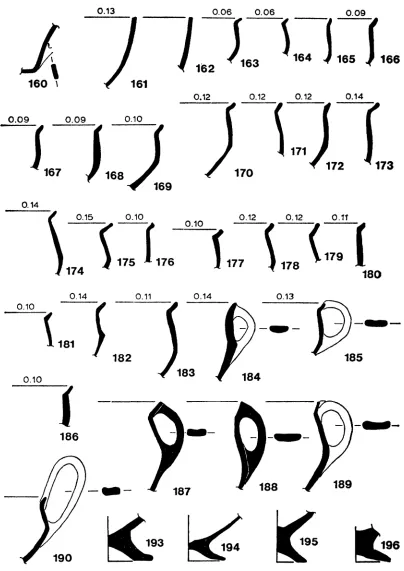
1. Keftiu cup. Base (160). Few other
body sherds.
2. Mainland Panelled CUp.53 Rims (161,
162).
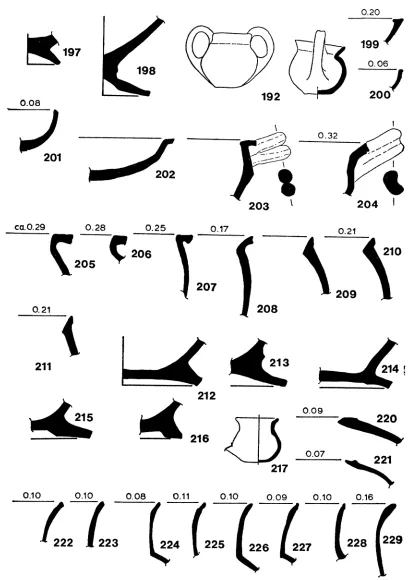
3. Goblets/kantharoi/dippers/cups.54 Some rims (e. g. 163-183) may be from any of these four shapes. A few, however, probably are from goblets specifically (e. g. 184-189) and one with a high-swung strap handle is certainly from a kantharos (190). One small two-handled cup (192) is nearly complete. Some handles are certainly from dippers (191). Flattened bases (not illustrated) may belong to cups, dippers, or kantharoi; low pedestaled bases are probably from goblets or kantharoi (e. g. 193-198). A ring around the stem is characteristic of many of the pedestaled bases (e. g. 198).65
4. Shallow bowls. Rims (e. g. 199-202).
201 has an attachment for a horizontal strap handle.
5. Kraters/basins.5 Carinated rims with horizontal double handles are from large basins (e. g. 203, 204). Flattened and mold- ed rims come from spouted kraters with hori- zontal round handles (e. g. 205-211). 5 Large torus bases may be associated with either shape (e. g. 212-216).
6. Squat jug. Nearly complete; handle missing (e.g. 217).
6"Cf. basins and bowls (Korakou, p. 21, fig. 29; p. 22, fig. 30) and pithoi (ibid., pp. 19-20; p. 21, fig. 28) published by Blegen.
47 Cf. similar designs on closed vessels (Korakou, p. 20, fig. 27; p. 21, fig. 28). 48 See PPGCG, p. 24; Tiryns V, p. 24.
49 For goblets, cf. Eutresis, pp. 136-137, figs. 183-185; for kraters, ibid., p. 140, figs. 190, 191. 50 Cf. Eutresis, p. 140, fig. 190: 2, 3.
51 Cf. Eutresis, p. 139, fig. 187: 2-4.
52 See PPGCG, p. 28; Tiryns V, p. 26.
53 See Davis, op. cit. (footnote 34 above).
54 Cf. goblets (Circle B, pls. 214-217) ; kantharoi (Eutresis, p. 163, fig. 227); dippers (Korakou,
p. 19, fig. 26), and cups (Eutresis, p. 163, fig. 226; Circle B, pl. 232, 1 1-187).
55 Cf. Circle B, p1. 216, 0-209.
5" Rim profiles of the Yellow Minyan kraters fall into two groups. Profiles of the first (205-
207) resemble those of " Mainland " polychrome kraters (see above, p. 243) ; profiles of the second (208-211) are similar to those of "Aigina " polychrome kraters (see above, p. 241). Cf. also Yellow Minyan kraters at Eutresis (Eutresis, p. 165, fig. 231).
112 120
I
t!EIEI
0.340.23
121
122
123
124
0.2! 0.26 0.25 0.22 0.24
130
131
132
4
135
136
0.24 0.25 Co.0.15 0.17 0.14 0.12
157
J Jl~~59 /
<
3
158
54
155
/ 0.1214;4 <4546 8
1484
~~~4~~~:
15
\49f
0.18 0.08 0.16 0.14 0 06
_ ? < > < 147 _
0.13 0.13 0.14 0.13
LATE HELLADIC I POTTERY FROM KORAKOU 249
0.13 0.06 0.06 _ 0.09
160 /21
1162
J163
164
$165J166
160 1 161
0.12 0.12 0.12 0.14
0.09 0.09 0.10
171
|
167
16817
1169
0.140.15 0.10 0.12 0.12 0.tt
) 174 * 175 176 177
7178
9 1800.14 0.11 0.14 0.13
0.10 1 5 k - - -
181
}
\
|)~-
182
185
0.10 83 184
186 -
_-__ - 187 188 189
f1/ ~93 9195 190
0.20
19719
~~)
~~0.06
198/
0.08 192 200
.0.08
201 _____ 0.32
201 -
202 I
203 ' 204 1
ca0.29 0.28 0.25 0.17 0.21
v
~~
205 ~~206
? ~~206~207
N209
210s N0.21 208
211 3 1 214
212
0.09
4215
2
j5
216 ,/ 5_
0.07 221
217
0.10 0.10 0.08 0.11 0.10 0.09 0.10 0.16
222 223 (24 225 w6 227 (228 229
LATE HELLADIC I POTTERY FROM KORAKOU 251
233 234 235 236 237
0.13 0.12
s238 VV
239
240
241
0.11 0.11 0.11 0.23 0.22 0.13
S 243 244
242 246
245 247
0.25
248 (249 50 251 252 z53
254 51 252 250
7. Jugs. Fragments from spouts of jugs with cut-away necks are represented (e.g. 218, 219).558
8. Hole-mouthed jars. Rims (220, 221).
9. Hydriai/stamnoi. Rims (238, 239).
Profiles are like those of matt-painted hydriai and stamnoi.
10. Other. A group of rims (222-229) of similar size and profile are probably from jugs or small jars; some have strap handles attached. Many handles cannot be assigned to a particular shape (e. g. 230-232). Ap- plied pellets are common on strap handles (e. g. 230, 231).r9 Bases (e. g. 233-237) are from closed vessels.
UNDECORATED
(Figure 11)
A. Cooking Ware ?
Paste: Semicoarse to coarse depending on size of vase. Dark reddish brown to weak red. Sometimes with dark gray cores.
Surface: Dark reddish brown to weak red; rarely gray.
Shapes:
1. Cooking pots.6< Rims (e. g. 240-249), some with round or flattened handle attached. Both conical (e. g. 250-254) and tripod (with round or oval legs; not illustrated) bases are found. Potters' marks are found on some of of the conical bases (250-252; 254).
ANALYSIS OF THE POTTERY
Pottery of the LH I and LM IA Styles and the Date of the Deposit
Of the pottery in levels XII through XVI, Mycenaean and Minoan wares can
be most closely dated. Although sherds of these wares are scarce, their shapes and
designs demonstrate that the deposit belongs to the LH I period as defined by Dickin-
son
62and is contemporary
with LM IA in Crete.
Two sherds from a goblet and a strap handle with a vertical wavy band (4, 5)
are unusual, but small shapes most characteristic of LH I, the teacup, squat jar,
and Keftiu cup, are present and the decoration of these shapes is regular.3 The single
sherd from a Keftiu cup (1) has a deep band inside the rim, a spiral with dot-flanked
tangents in the upper zone outside, and a pronounced mid-rib painted black and over-
painted with two thin white bands."4 Keftiu cups with deep rim bands outside, which
some have suggested are characteristic of the very earliest stage of LH I, are not
found."5
58 Cf. Circle B, pl. 220, Z-85, A-5.
" Pellets of this kind were applied to handles of some vases from Mycenae (e. g. Circle B, pl.
220, Z-85) and are common on strap handles at Lerna.
'0 Only a few coarse undecorated vases of the pre- and early Mycenaean periods were pub-
lished by Blegen (see Korakou, pp. 30-31).
61 None of the published vases from Korakou are of these shapes. Cf. Circle B, pl. 172, /8 (with
conical base). Dickinson (Origins, p. 25) suggests that the tripod-cooking-pot shape is of Minoan derivation.
ff2 Definition, passim.
63 Ibid., pp. 109-110.
'"Ibid., p. 110, fig. l;p. 115.
LATE HELLADIC I POTTERY FROM KORAKOU
253
Dickinson has observed that large vases in the LH I style are very rare and has
argued that some previously thought to be LH I are, in fact, LM IA.6" This seems
to be the case at Korakou. Nearly all the large closed vases with lustrous-painted
decoration in Minoan or Minoanizing styles in levels XII through XVI seem to be
Cretan (10-12 clearly in the LM IA style
67).If this deposit is typical of the site as
a whole, it would seem that the people at Korakou were acquiring large vases of this
kind from Crete but were not often copying them themselves.
Two explanations for scarcity of large vases in the LH I style come to mind.
Matt-painted hydriai and stamnoi, special shapes for the drawing and storage
of water, have capacities comparable to those of larger LM IA vases and may have
been preferred. Most modern Greeks have strong opinions about what area of the
Aegean produces the best water jars (judged both for effectiveness in cooling and
taste imparted to the contents); most show considerable reluctance to surrender
their old style stamnes for new-fangled glass or metal creations. Similar conservatism
in antiquity might partly account for hesitation of Mainland potters to begin imitation
of large Minoan vases. Another factor could be the unequal breakage and replace-
ment rate of large and small vases. Recent studies in the American Southwest sug-
gest that vases for pouring and storing are usually much longer-lived than vases used
for table service.68 There might, therefore, have been initially less demand for larger
LH I vases to replace old matt-painted storage jars.
The Other Pottery
Major studies of pottery of the LH I period have been mainly concerned with
the LH I style, not pottery of the period as a whole."9 Both Furumark and Dickinson
have been especially interested in the origins of the style, the earliest on the Mainland
to execute Minoanizing motives in lustrous paint on a light burnished ground. Its
inception marks by definition the beginning of the first phase of the Late Bronze
Age on the Mainland, the Late Helladic I period.
Both scholars realized, however, that the LH I style was not the only style cur-
rent at that time. It has been clear since the publication by Wace and Blegen of the
article entitled " The Pre-Mycenaean Pottery of the Greek Mainland "
7that in the
initial phases of the Late Helladic period much pottery continued to be produced in
Middle Helladic ways and was little influenced by Minoan fashions. Dickinson com-
ments that LH I made its appearance as just another fine ware.71
These wares which follow Middle Helladic traditions have not been given much
66 Definition, p. 113.
6t7 Ithank C. Zerner for examining these sherds with me.
68 Cf. S. F. Cook, " Can Pottery Residues be Used as an Index to Population?" Contribu-
tions of the University of California Archaeological Research Facility 14, 1972, pp. 17-39.
69 Furumark, (FM, FS, footnote 1 above); Definition, passim.
attention in discussions of pottery of the LH I period. Furumark chose to call them
19 73
"MH
;
Dickinson lumped them together as " Late Phase fine wares
.It is clear that often, especially in the case of simple, more plain types, no fine
distinctions can be drawn between pottery of the later Middle Helladic and earlier
Late Helladic periods. The date of many pieces cannot be precisely determined with-
out knowledge of their context. It is, therefore, unfortunate that settlement deposits
and homogeneous tomb groups of the LH I period are so rare and so sketchily pub-
lished. The publication of the pottery from levels XII-XVI is especially valuable since
it allows us to examine all components of an LH I settlement deposit, not only the
LH I style. As the following outline shows, pottery from deposits of this period is
diverse in fabric, form, and decoration.
1. Lustrous Painted (above, pp. 238-241)
Decoration in lustrous paint is a feature of two wares other than Minoan and
Mycenaean. The first, Lustrous Light-on-Dark ware, has been described at length
by both Blegen and Dickinson.74 It is clearly related to both LH I and Matt-painted
II and bridges the gulf between Middle Helladic and Minoanizing traditions. The
paste of Lustrous Light-on-Dark ware is similar to that of Mycenaean ware and
generally the same shapes are found in each. Designs, on the other hand, are identical
to those used in Matt-painted II. Pottery of this kind is rare and, from its distribu-
bution, as Dickinson has suggested, was probably manufactured in the Northeast
Peloponnesos. On the evidence of levels XII-XVI at Korakou, there is no doubt that
the style was in use in LH I; whether it began to be produced earlier, however, re-
mains uncertain. Few examples have been published from other sites and the contexts
of most have not been closely described.
The second, Dark-coated ware (above, p. 241), was not discussed by Blegen in
the Korakou report. Evidence for its chronology, as for Lustrous Light on Dark, is
not abundant and it cannot be determined how much earlier than LH I, if at all, such
pottery was
produced."52. Minyan (above, pp. 247-252)
The general stylistic development of Minyan wares is clear." Gray Minyan, most
popular at the beginning of the Middle Helladic period, was gradually supplanted by
Yellow Minyan as the period progressed.77 Both types survived the transition to the
72 See FM, FS (footnote 1 above), pp. 232, 482, 505.
73 Definition, p. 112; Origins, pp. 22-23.
74KKorakou, pp. 32-33; Definition, p. 112.
5 At Keos and Lerna this ware is also found in LH I contexts (" Keos II ," p. 392).
76 Cf. R. Howell, " The Origins of the Middle Helladic Culture," in Bronze Age Migrations
in the Aegean, R. A. Crossland and A. Birchall, edd., London 1973, pp. 73 if.; Origins, pp. 19-23.
LATE HELLADIC I POTTERY FROM KORAKOU 255
Late Helladic period and are found in contexts so late as LH
I.78Yellow Minyan, as
Rutter has emphasized, " merged imperceptibly " into early Mycenaean unpainted
ware.79 Gray Minyan, on the other hand, left no successor on the Mainland.
Few aspects of Minyan changed radically enough in the Late Helladic period to
allow them to be diagnostic of LH I or later. In Gray Minyan a new shape, it seems,
appeared for the first time: a one-handled cup with a sharply everted rim.' " Late "
features characteristic of East Alley levels XII-XVI, however, such as the scarcity
of Gray Minyan ring-stemmed goblets and the presence of scoring on the stems of
Yellow Minyan goblets can be assigned only generally to the late Middle Helladic
period or the early Late Helladic period.
3. Matt-painted (above, pp. 243-247)
The popularity of pottery with matt-painted decoration on an unburnished ground
had waned considerably by the end of the Middle Helladic period. This has been
most dramatically demonstrated at Ayios Stephanos where the percentage of sherds
(per kilo of recovered pottery) of the most abundant matt-painted ware of this kind
(called Dull Painted by Rutter) falls from a maximum of 30% per lot in MH II to
a maximum of 5% in MH III.8`
The most significant innovation in matt-painted pottery at this time was the de-
velopment of Matt-painted II, a ware which employed matt-painted decoration on
a burnished ground. Such pottery is first found at Ayios Stephanos in MH III, the
local Lakonian phase which is contemporary with early LM IA but antedates LH
I;82it is clear that Matt-painted II continued to circulate elsewhere in the Aegean, as at
Korakou, after the emergence of the LH I style.83
In levels XII-XVI most sherds with matt-painted decoration on an unburnished
ground are of Light Gray Unburnished ware. At Keos and Lerna pottery of this
kind is characteristic of LH I deposits.84 The contexts in which it has been found at
other sites are not clear and it is uncertain how long before LH I the~ style started.
4. Undecorated (above, p. 252)
Undecorated pottery of this period has received little attention. Many of the
undecorated sherds from levels XII-XVI, as noted above (p. 238), were probably
discarded by the excavators. Among the remaining pottery fragments there are two
varieties of cooking pot. No other shapes can be recognized.
78 E. g. on Keos (" Keos II," p. 393).
79 Transition, p. 9, note 10.
80 " Keos II," p. 393: G63; Transition, p. 50, note 35. 81 Transition, pp. 24, 34.
82 Transition, p. 63.
83 Transition, pp. 50-51; " Keos II," p. 392 (not so scarce in recently studied deposits as im-
plied by Caskey in 1972); and also in the Lerna shaft graves (cf. footnote 1 above).
Precise chronological limits for cooking pots of this kind cannot be set. Examples
have been found at Mycenae in the filling of Shaft Grave 0 and at Lerna in the fillings
of Shaft Graves I and
II.85The shape, however, is not much different from that of
the usual Middle Helladic cooking pot
88and, as Blegen commented in his report, the
shapes of coarse and undecorated vases at Korakou in general changed little during
the Bronze Age.87
On the basis of the preceding discussion, it seems that it is correct to call Gray
and Yellow Minyan, as well as certain undecorated and matt-painted wares, transi-
tional since they continued to be used from the Middle Helladic period into the Late
Helladic period without undergoing major changes at or soon after the start of the
LH I style. We cannot determine on present evidence if Lustrous Light-on-Dark
and Dark-coated wares were also transitional or first were made in LH I.
Polychrome Matt-painted Wares
Levels XII-XVI contain examples of two kinds of polychrome matt-painted
pottery, " Mainland " and " Aigina ", which belong predominantly to the early phases
of the Late Helladic period and should probably not be considered transitional.
1. "Mainland " (above, pp. 241-243)
Vases with matt black and red decoration on a burnished ground of the kind
called " Mainland " by French, were first recognized as a distinct class by Wace and
Blegen.88 They believed, because of the prominence of the ware in the Sixth Shaft
Grave at Mycenae, that such pottery was used in the latter part of MM III and the
early part of LM IA.
It was clear from later work in the Aegean that this date was in the main correct.
At Korakou Blegen found that the " Mainland " ware (MH class III fine ware) be-
longed to the upper levels of the stratum which he called Middle Helladic
J."89He
recognized, however, that early Mycenaean ware of the LH I style was also charac-
teristic of this stratum.9" This is quite contrary to the modern definition of the Late
Bronze Age on the Mainland according to which the Late Helladic period begins with
the start of the LH I style. It was because these LH I style sherds were found with
an abundance of matt-painted and Minyan wares that Blegen considered the upper
levels of the second stratum to be Middle Helladic rather than Late Helladic. Blegen
clearly chose to use the disappearance of matt-painted and Minyan wares rather than
the appearance of LH I style pottery as the dividing line between the Middle and
Late Helladic periods.
85
Circle B, pl. 172: ,8; footnote 1 above.
8B Eutresis, p. 178, fig. 246.
87 Korakou, p. 30.
88 Op. cit. (footnote 70 above), p. 185.
89 Korakou, p. 28.
LATE HELLADIC I POTTERY FROM KORAKOU
257
The " Mainland " style has been found at many other sites on the Greek Mainland
and in the Cyclades but only a few excavators have reported its contexts. At Eutresis
it was typical of the third level of the Middle Helladic period.9' But, as at Korakou,
Late Helladic I and II styles were found in this stratum together with Minyan and
other matt-painted wares. Goldman explains the apparent contradiction more explicit-
ly than Blegen:
Such sherds of Late Helladic I and II as were found, came, with
a single exception, from levels in which the Yellow Minyan pre-
dominated, showing that the flourishing period of Yellow Minyan
is chronologically Late Helladic I and II. In other words, Eutresis
has, so far as the pottery goes, no genuine Late Helladic I and II
periods. It seemed to me, however, that it would be confusing in
view of the persistence in such large quantities of Gray Minyan
and Matt, and the fact that the designs on the Yellow Minyan are
closely related to Middle Helladic Matt-painted ware and, indeed,
show practically no influence of the Cretan designs, to classify this
pottery under Late Helladic I and II. It must simply be borne in
mind that culturally it belongs to Middle Helladic, and chrono-
logically, while Yellow Minyan with Matt decoration may begin in
Middle Helladic, at Eutresis it certainly is the distinctive pottery
of the period corresponding to Late Helladic I and II.
Vessels of " Mainland " polychrome ware from the shaft graves at Mycenae have
attracted much attention. Examples have been published by Mylonas from graves
r, A, E, K, N, and 0 of Circle B.92 In three of the graves (E, K, and N) it appears
that no LH I or LM IA pottery was found, either in the burial chamber or in the
filling of the shaft. We have seen, however, that, even in the heartland of the My-
cenaeans at Korakou, LH I pottery is rare in the LH I period compared to matt-
painted and Minyan wares (pp. 252-253 above).
The absence, therefore, of LH I pottery from these graves, especially since all
three contained relatively few terracotta vessels (in the case of K, none from the
filling) and since only complete pots from the fillings of the shafts were published,
need not mean that the burials are chronologically earlier than the Late Helladic I
period. Evidence from graves
r
and 0 speak to contrary. In
r
a large " Mainland
"
jar (r-37) was found in the filling of the grave together with two LH I cups and an
LC I jug. In 0 two large jars in this ware and an LH I bridge-spouted jar were
associated with the second burial in the tomb. The case in grave A is not so clear.
A large " Mainland " jar was found in this tomb together with an LH I jar, the only
91Eutresis, pp. 124-125.
92 Circle B, r-37, A-63, E-71, E-72, K-109, K-lO, N-158, 0-193, 0-194; see also Origins, pp.
other terracotta vase reported from inside the tomb. It is uncertain, however, that
both belong to the same burial.
Vases in " Mainland " ware were found in graves II, IV, V, and VI of Circle
A, but we are uncertain of their relationship to individual burials and to other pottery
in the graves. In any case, LH I pottery has been published from each of these
tombs.93
Near by in the Argolid at Lerna sherds of the same ware were found in abun-
dance with LH I style pottery in the fillings of the two shaft graves dug down through
the ruins of the House of the Tiles.94
Evidence from the Cyclades bears out that from the Mainland. At Ayia Irini
on Keos this ware is not found before the advent of LC
I."9This is also the case on
Melos. Two stratified LC I phases have been distinguished in the new excavations at
Phylakopi. The earlier contains LM IA imports and local imitations. The LH I style
is found first in the succeeding phase together with " Mainland " ware and more ad-
vanced LM IA."8
2. "Aigina " (above, p. 241)
D. French was first to distinguish from other polychrome matt-painted pottery
a group of vases (almost exclusively kraters) with red and black decoration on a
light ground. The kraters are usually decorated with double wavy bands (the upper
black, the lower red).
This ware has a more narrow distribution than " Mainland " ware. It has been
found in the Northeast Peloponnesos, Lakonia, Aigina, Keos, and Brauron but has
not yet been reported from Central Greece or the Western Peloponnesos.
There is no proof that "Aigina" ware was produced earlier than the LH I
period. It has been found associated with LH I style pottery at Lerna and Ayia Irini,
and in a slightly later context at Ayios Stephanos.97
Although, as we have seen above, both the " Mainland " and "Aigina " styles have
been consistently found in LH I contexts and there is little reason to believe they be-
gan earlier, scholars have persisted in calling them transitional. It is obvious that
these two polychrome matt-painted wares continue Middle Helladic traditions, but
only in the sense that they reflect that continuity may we consider them to be " Middle
93 Karo, op. cit. (footnote 4 above), nos. 200, 590, 591, 858, 941, 943, 944, 946, 947, 950, 952,
954; see also Origins pp. 46-50.
94 Cf. footnote 1 above. 5 Fortifications, p. 170.
A conspectus of the LC I pottery is being prepared by J. Cherry, C. MacFarlane, and myself. 0. T. P. K. Dickinson is writing a report on Mainland imports. Mr. Dickinson has informed me that a sherd of a polychrome ware similar to " Mainland " polychrome but without a burnished ground has been found in Middle Cycladic levels at Phylakopi. On Keos and in Boiotia, also, there are sherds from Middle Bronze Age strata which lack burnished grounds but in pastes and decora- tion resemble " Mainland" ware (Fortifications, p. 149; Eutresis, p. 175).
LATE HELLADIC I POTTERY FROM KORAKOU 259
Helladic ". Chronologically, the evidence from Korakou together with that from the
other sites reviewed above demonstrates that both wares are characteristic of the
Late Helladic I period and are nearly as diagnostic of LH I as the LH I style itself.
CONCLUSIONSAnalysis of settlement deposits such as levels XII-XVI of East Alley is essential,
not only for a clearer understanding of the early Mycenaean ceramic sequence but
also because diachronic studies of settlement patterns, burial customs, architecture,
and most other classes of artifacts depend on ceramics for dating. We may not rely
solely upon the Minoan-inspired LH I style for the chronology of the period. The
LH I style is basically a Peloponnesian phenomenon and has a limited distribution,
especially north of the Isthmus.98 Even at Korakou near the center of the Mycenaean
world examples of the style in levels XII-XVI are greatly outnumbered by pottery in
the Middle Helladic tradition. It is possible that, outside the Mycenaean heartlands,
sherds of the LH I style may be absent from deposits of the LH I period (i. e. deposits
which are contemporary with the LH I style elsewhere).
Without knowledge of the development of all styles of pottery in use in LH I we
shall remain lost. The presentation of levels XII-XVI, I hope, provides the first step
toward an all-inclusive classification of pottery of the LH I period.
JACK L.
DAVIS UNIVERSITY OF ILLINOISAT CHICAGO CIRCLE
APPENDIX I
Concordance of Catalogue and Level Numbers 1. XIV
2. XIII 3. XIII 4. XII 5. XV 6. XIII 7. XV 8. XVI 9. XIV
10. XV
11. XIV 12. XIV 13. XVI
14. XIV and XV 15. XIII
16. XVI 17. XVI 18. XII 19. XII 20. XIV 21. XVI 22. XIV 23. XVI 24. XIII 25. XIII 26. XVI 27. XIV 28. XIV 29. XII 30. XII 31. XII 32. XII 33. XIV 34. XIII 35. XIV 36. XIV 37. XIV 38. XV 39. XVI 40. XVI 41. XVI 42. XII
43. XII 44. XV 45. XII 46. XII 47. XVI 48. XII 49. XII 50. XIII 51. XIV 52. XV 53. XVI 54. XVI 55. XV 56. XIII 57. XVI 58. XV 59. XV 60. XV 61. XVI 62. XIII 63. XIV 64. XV 65. XV
66. XV and XVI 67. XII
68. XIII 69. XII 70. XIV 71. XVI 72. XIII 73. XII 74. XII 75. XVI 76. XIII 77. XII 78. XVI 79. XIII 80. XIII 81. XV 82. XV 83. XVI 84. XV
85. XV 86. XV 87. XV 88. XIII 89. XIII 90. XII 91. XVI 92. XII 93. XVI 94. XV 95. XVI 96. XVI 97. XII 98. XII 99. XIII 100. XIII 101. XIII 102. XVI 103. XIV
104. XV
105. XVI 106. XII 107. XII 108. XIII 109. XIV 110. XIV 111. XIV 112. XVI 113. XVI 114. XIII 115. XII 116. XII 117. XII 118. XII 119. XVI 120. XV 121. XV 122. XVI 123. XV 124. XV 125. XV 126. XVI
LATE HELLADIC I POTTERY FROM KORAKOU 261 169. XVI
170. XIII 171. XIII 172. XIV 173. XIII 174. XVI 175. XVI 176. XIII 177. XIII 178. XIII 179. XIII 180. XV 181. XV 182. XV 183. XV 184. XV 185. XII 186. XV 187. XIII 188. XIV 189. XIV 190. XII
191. undetermined 192. undetermined 193. XVI
194. XIV 195. XVI
196. XVI 197. XVI 198. XV
199. XV
200. XII 201. XVI 202. XII 203. XVI 204. XIV 205. XIV 206. XV
207. undetermined
208. XV
209. XV
210. XII 211. XII 212. XVI
213. XII 214. XVI 215. XVI 216. XVI 217. XII 218. XII 219. XV 220. XIII 221. XV 222. XII 223. XII 224. XIII 225. XIV 226. XV 227. XV 228. XVI 229. XV 230. XVI 231. XII 232. XV 233. XV 234. XV
235. XVI 236. XV 237. XVI 238. XIV 239. XV 240. XV 241. XIV 242. XII 243. XIV 244. XIV 245. XIV 246. XIV 247. XV 248. XVI 249. XVI 250. XII 251. XIII 252. XIV 253. XV 254. XV
APPENDIX II
Concordance of Catalogue Numbers and Illustrations in Korakou
Some of the pottery published in this article was previously illustrated by Blegen in the original excavation report (see footnote 1 above).
Cat. No. Korakou Cat. No. Korakou
2 fig. 49:5 80 fig. 35:11
53 fig. 40: top,1. 81 fig. 35:6
65 fig. 41: top, r. 82 fig. 35:3
66 fig. 41: bottom, r. 87 fig. 35:8; pl. II:3
73 fig. 34: 5; pl. III: 3 88b fig. 35: 10
75 fig. 35:4 92 fig. 36:15; pl. II:1