Research Article
Using Science Fiction Prototyping to Decrease the
Decline of Interest in STEM Topics at the High School
Level
Mary de Lepe
1,*,
Connor Russell
1, William Olmstead
11San Diego State University, San Diego, CA, USA
Abstract
In order to address the lack of student interest in STEM subjects and the dwindling number of students pursuing STEM careers, the Creative Science Foundation (CSF) has developed an easy to deploy educational strategy. This strategy, effectively titled Science Fiction Prototyping, utilizes science fiction stories and material to “explore the possible implications of research and technology on humans, societies, and the world.” It is also possible that these prototypes can be used to increase STEM motivation in students. The researchers will first perform a meta-analysis and literature review to determine the present outlook of STEM curriculum, student interest in STEM careers, and student enrolment in STEM careers after graduation. Other parts of the research project include a pilot study to explore the feasibility of using science fiction prototypes within a high school environment to increase student interest and attraction to STEM related careers.
Keywords: Science Fiction Prototyping, STEM, Science, Technology, Engineering, Mathematics
Received on 30 May 2015, accepted on 2 June 2015, published on 16 June 2015
Copyright © 2015M. de Lepeet al., licensed to ICST. This is an open access article distributed under the terms of the
Creative Commons Attribution licence (http://creativecommons.org/licenses/by/3.0/), which permits unlimited use,
distribution and reproduction in any medium so long as the original work is properly cited.
doi: 10.4108/fiee.1.2.e5
1. Introduction
In recent years, high school student interest in Science, Technology, Engineering, and Mathematics disciplines declined. This study was conducted in an attempt to determine the cause of the decline and the validity of Science Fiction Prototyping as a strategy for motivating and increasing student interest in STEM topics. This is a follow-up to previous studies conducted by Professor Vic Callaghan, Director of the Creative Science Foundation and Professor Emeritus of Computer Science at Essex University in Colchester, United Kingdom, and Brian David Johnson, a futurist at Intel Corporation, whose future casting, the process of using ethnographic field
studies, technology research, trend data, and Science Fiction to provide Intel with a pragmatic vision of consumers and computing, made him a pioneer in development of artificial intelligence, robotics, and Science Fiction Prototyping.
After the research team reviewed existing literature and hosted a small Science Fiction Prototyping (SFP) workshop, the research team found that while SFP can be a fun activity, SFP did not affect student’s interest or motivation towards STEM disciplines. Results were limited due to time constraints and a lack of diversity in the samples. However, the findings highlighted appropriate methods to test the validity of SFP.
EAI Endorsed Transactions
on Future Intelligent Educational Environments
2. Impact of the Literature Review
A review of existing research reveals that the diminishing interest in Science, Technology, Engineering, and Mathematics (STEM) disciplines can be attributed to numerous environmental, educational, cultural, and societal barriers. Students are also not pushed to connect everyday technologies, like mobile phones, computers, and other innovations, to STEM disciplines. Without an understanding of how STEM disciplines influence our electronically interwoven society, students become users of technology rather than innovators [10].
Numerous barriers exist that impede the creative thought processes of students. The high school level of science literacy is declining in the United States, which now ranks below the world average in producing STEM graduates [7]. One study claims that the problem began with the implementation of the No Child Left Behind policy, as the policy reduced the science curriculum and the lessoned the importance of science related test scores [1].
More barriers to student interest in STEM are the student’s environments. Their socioeconomic background, race and ethnicity, gender and parents’ academic level all heavily influence interest in STEM careers [8], [9], [5]. Low socioeconomic levels prevent students from being able to tap into resources that wealthier students have readily available for learning [9]. Parents’ personal educational achievements also correlate highly with a child likeliness to explore STEM topics throughout their life.
Gender, race, and ethnicity challenges have the greatest impact on student interest in STEM disciplines because certain cultures have practices that discourage education. For example, minority women are often less encouraged to pursue STEM careers as both the scientific community and culture often ostracize women that pursue STEM fields [8]. Low-income communities have fewer resources available and teachers who are qualified to teach STEM subjects. In addition, teachers in low-income communities are required to teach science and mathematics, subjects in which they may not be subject matter experts [5].
Science Fiction Prototyping (SFP) is a possible solution to declining interest in STEM fields and pursuit of STEM careers. [3], [4]. SFP is presented as a learning activity where facts and imaginations are combined to create a story of how an innovation used in a future setting would affect the people of that time socially and economically [3], [4]. The student is encouraged to imagine how the people would interact with the new technology, what problems would the technology solve, and what new problems could it solve [3], [4].
SFP enrolls students as active learners to challenge them to critically think about the interaction between society and emerging technologies. Emphasis should be placed on the use of science to provide testing for possible scenarios [3], [4], [6].
3. Contextual Factors
There are several factors that impacted the design and implementation of this study, the biggest being time. When the research team progressed to the point of data collection, local area schools were on spring break, so connecting with teachers and convincing them to allow researchers precious instructional time proved challenging. In addition, the research team did not have a previous relationship with the teacher that agreed to be apart of the project. The lack of prior relationship hindered access to preparation and support. For example, the research team would have preferred to administer the pre-survey a few days prior to the SFP workshop, instead of immediately before.
Though the single teacher was generous enough to offer up two of her class sessions, it also meant the entire population came from the same school, taught by the same teacher, and in the same grade level and content area. This created a small sample size with little diversity.
Each of the two class sessions were less than an hour, requiring the pre-survey, the presentation, and the post-survey to be delivered together. To fit within the class period, the presentation had to be concise. In retrospect, it felt rushed, as there was not enough time to explain all concepts completely, and students were given only a shallow overview.
There was also not enough time to allow students to deeply engage with prototyping activities. In the time available, students were pushed to get into groups to write Micro-SFP samples, and share them with the rest of the class.
Post survey had to be given directly after presentation, which didn’t allow for students to absorb the experience and truly consider impact of prototyping.
Another limiting factor was the students struggled with the survey. They asked several questions about the survey ranging from, “What if I like science sometimes, but I don’t like math?” to, “What do I write if I don’t know what my parents do for a living?” Student statements indicated that they felt constrained trying to express their opinions through the rigid survey format.
The research team underestimated just how much context students would need to be able to understand the impact of the prototyping methodology on their motivation toward STEM, especially because there were multiple concepts to cover (e.g. What is STEM, What exactly is a STEM career, etc.). The concept of “prototype” was particularly difficult for the participants to grasp.
4. Methodology
4.1. Research Design
towards STEM disciplines. The pre-survey asked questions that categorized students previous experience with and current interest in STEM fields. It also asked students to rate their satisfaction and enjoyment of STEM activities and clubs. The primary goal of the pre-survey was to understand current inhibitions towards STEM and develop a baseline that could be used in comparison with the post survey. After the pre survey was distributed, a member of the research team led an in-class presentation and activity. Immediately after the in-class presentation and activity, the post survey was distributed. The post survey asked similarly worded questions to the pre survey in order to easily quantify a decrease or increase in interest and motivation of STEM. Compared to the pre survey, the post survey had more Likert questions that asked students to rate their satisfaction, interest, and motivation towards STEM. The primary goal of the post survey was to expand upon the baseline set through the pre survey to gauge any change after the STEM activity. The students were asked to mark their pre and post surveys with a small icon, drawing, or other mark in an effect to match surveys without identifying individual students.
4.2. Participants
The audience was comprised of two high school classrooms of Earth Science, one with 28 total students, and the other with 26 total students, giving a total of 54. Luckily, the male to female ratio was nearly even as the classes sampled had a total of 28 boys and 26 girls. All the students came from similar socioeconomic backgrounds, ranging from low to middle class, most of them, not having much experience with STEM classes, except for their shared Earth Science class, and a few varied mathematics classes such as Algebra and Trigonometry. The surveyed classes were also mostly comprised of 14 year olds (64.8%) and 15 year olds (35.2%), though there is no evidence yet of this being significant in the study.
A pre-survey was administered on paper at the start of each class session directly after a very brief introduction of the researcher and purpose. The teacher helped facilitate distribution and collection of the survey, as well as respond to student questions about how to address survey questions. Students were asked to mark their pre-surveys with a small icon, drawing, or other mark that would also be added to the post-survey. This strategy allowed for matching of pre and post-surveys without identifying individual students, and proved to be very effective.
4.3. Instruments
As part of the data collection process, a presentation that included an opportunity to explore the prototyping strategy was designed. The presentation covered concepts such as science fiction prototyping and the various ways
the methodology can be employed, who uses SFP and why, an explanation of STEM, what constitutes STEM fields and careers, and the idea that prototyping can impact students’ lives or motivation toward STEM.
The presentation was organized as follows:
• Introduced Brian David Johnson, and Vic
Callaghan, and how they use SFP.
• Introduced prototype concept by providing an
overview of prototype examples:
o Presented premise of Nebulous Mechanisms.
o Held a class discussion about Jurassic Park, the science it presented, and how the story explored the possible impact through the narrative.
o Showed a video prototype (A Day In the Life of Glass) to deepen understanding.
• Showed examples of other ways prototypes are
used.
• Had students engage in a class brainstorm exploring a prototype idea.
• Navigated to the Creative Science Foundation
website and described the Micro-SFP process and the competition opportunities.
• Organized students into groups to write their
own Micro-SFP samples, as described by Brian David Johnson [10] and Vic Callaghan [11].
• Share the Micro-SFP samples with the class.
The post-survey was administered and collected directly after the session during the same class period.
4.4. Data Collection and Analysis
After both of the surveys were answered and collected, the quantitative information from questions 1 through 7 on the pre survey, and questions 4 to 7 on the post survey, were documented in an Excel sheet for further comparison. With the aid of the attachment application Analyse-it, the research team analyzed the data.
5. Findings
As previously stated in the instruments section, the research team created two surveys. The first survey, a pre survey, was distributed prior to the Science Fiction Prototyping (SFP) activity, while the second survey, a post survey, was distributed after the SFP activity to effectiveness on SFP increasing the audience’s interest in STEM.
displayed in this table where the students were asked to rate each category from 1-6 (whenever the standard deviation is bigger than 1, it means the students’ opinion varied a great deal).
Table 1. Descriptive Analysis of Survey Responses
SurveyQuestion for pre and post survey
Mean Standard Deviation
Pre
Survey Post Survey Pre Survey Post Survey
Current interest in required STEM classes
3.7 1.1 4.0 0.9
Current interest in required STEM electives
3.7 1.3 4.3 1.1
Current interest in STEM Clubs
3.6 1.5 4.1 1.4 Future interest in
Required STEM classes
4.0 1.0 4.2 0.9
Future interest in STEM Electives
3.8 1.4 4.4 1.0 Future interest in
STEM Clubs
3.8 1.4 4.1 1.3 Enjoyment in
Current
Required STEM classes
3.9 1.1 4.0 0.9
Enjoyment in Current STEM electives
4.0 1.4 4.1 1.2
Enjoyment in Current STEM Clubs
4.0 1.6 4.1 1.3
N=54
From the pre to the post survey, most of the means increased, albeit very slightly, when in most cases at the pre survey the standard deviation was more than 1 (except for Future interest in Required STEM classes), the research team observed a slight decline in the post survey standard deviation, showing the opinion of the students varied less once they went through the activity.
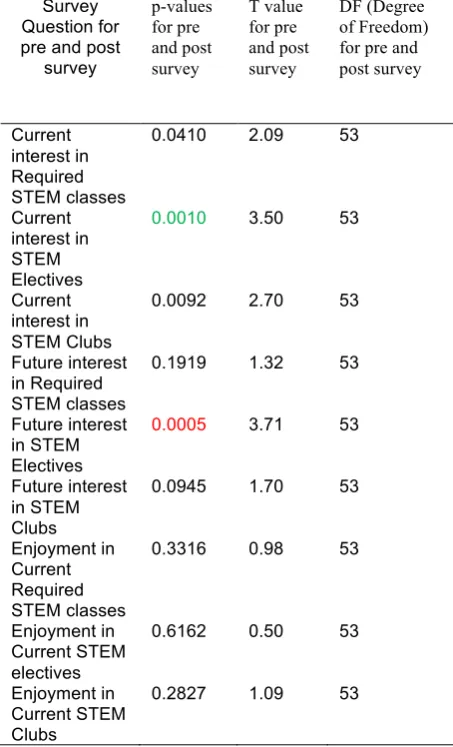
Aside from observing the variations of opinion between students, the main objective was to measure student’s reactions towards STEM once the Science Fiction Prototype was administered. T tests (with α=0.05) were conducted to compare the mean rating differences on the above survey questions. If there was such a p-value less than α=0.05, then there is evidence of change in STEM attitudes after the activity.
Table 2. Paired T test Results of the Nine Quantitative Responses
Survey Question for pre and post
survey p-values for pre and post survey T value for pre and post survey DF (Degree of Freedom) for pre and post survey
Current interest in Required STEM classes
0.0410 2.09 53
Current interest in STEM Electives
0.0010 3.50 53
Current interest in STEM Clubs
0.0092 2.70 53
Future interest in Required STEM classes
0.1919 1.32 53
Future interest in STEM Electives
0.0005 3.71 53
Future interest in STEM Clubs
0.0945 1.70 53
Enjoyment in Current Required STEM classes
0.3316 0.98 53
Enjoyment in Current STEM electives
0.6162 0.50 53
Enjoyment in Current STEM Clubs
0.2827 1.09 53
As Table 2 shows, the most significant change occurred in the current interest in STEM questions (0.0010, in green), which shows that the activity was a fun and motivating option for STEM education at the high school level. The SFP workshop does not appear to be motivating enough to increase interest in required STEM classes, but it did seem to increase interest in optional STEM electives (0.0005, in red). Despite increased interest in optional STEM electives, the students enjoyment in STEM fields did not seem to increase.
It is evident through the student’s disappointment and lack of interest in pursuing future STEM classes that the activity did not last long enough. The research team surmises that Science Fiction Prototyping is a good way to inspire high school students to enjoy STEM classes if applied from early on and for longer periods than the 40 minutes allotted for our test experiment.
can set the groundwork for further studies. Since this is the first time SFP has been tested at the high school level, the research team considers the results to be as expected. Science Fiction Prototyping alone will not eradicate STEM antipathy, yet it could be a useful tool to shake the monotony of lectures and standardized testing.
Even though, not precisely quantitative, pre survey questions 8 through 11, also gave a glimpse of what the mindset of the students was before the activity. Most of the students did not enjoy STEM, or just went along because they either liked their teacher, or their friends were in the class. They tended to complain that the class was either too difficult, boring, or even had a hard time finding relevance to the subject. After all this being asked if they had plans for college, came as no surprise that a great deal of them were not sure or not decided to continue furthering their education. Moreover, if a major in college was suggested, it usually was not a STEM-related career.
After the activity however, the post survey proved that the students enjoyed the activity, felt at the time motivated by it, and regretted the lack of time to develop their own prototypes.
6. Conclusion
It will be important in future research to include the following:
6.1. Work with teachers prior to engaging
with the students.
Engaging with the teachers in order to help them fully understand the goals and process of the research will ensure that the class is prepped and ready for researchers to come in and get started without having to lay significant groundwork. It also may encourage teachers to grant researchers more class time for investigation and study. Teachers know and understand their students, so it will behove researchers to enlist their support, as they can propose suggestions or changes to the planned methodology that will elicit more effective or valuable data. For example, after the first presentation, the teacher involved in this study provided context and information on what the students needed that greatly improved student response in the second presentation. Although all of the students in this project were in ninth grade, future student samples should span the grade levels. Teacher input would be necessary to ensure grade-level appropriateness of presentation content.
6.2. Perform focus groups for data
collection.
When given the opportunity to speak freely about their opinions toward STEM, the student participants expressed
their feelings more comprehensively than the survey would allow. When students struggled to articulate an idea, others would chime in to help complete thoughts.
It should be noted that when the students were verbally questioned about engaging in the prototyping activity, the response was overwhelmingly positive. They said they wished they had more time to come up with prototype ideas and time to develop the stories. When asked by the facilitator if they had a choice to take science fiction prototyping as a class, the students gave a resounding, “Yes!” The student participants also spoke about how they would be more apt to like STEM classes if they were to incorporate prototyping, because it would make the class content more relevant to them.
6.3. Utilize current and emerging
technologies to engage the learner in the
prototyping methodology.
As the study suggests, future iterations of Science Fiction Prototyping (SFP) workshops could be greatly improved by utilizing current and emerging intelligent environment technologies. By utilizing intelligent technologies students would be more engaged with SFP activities and methodology. Activities promoted by the SFP methodology, including Micro-SFP where students write short stories small enough to fit within a series of tweets (called Micro-SFP), could be enhanced through intelligent uses of mobile devices. Mobile devices would allow students to easily share their Micro-SFP stories with other students locally and globally. Mobile devices would also allow students to participate in global contests on the Creative Science Foundation’s (CSF) website.
Two additional intelligent technologies that could enhance Science Fiction Prototyping (SFP) workshops are augmented reality and virtual reality. With rapid prototyping models and easy to use software, students could design, build, and share SFP prototypes with other students on a local and global scale. With augmented technology, students could augment everyday objects with videos, pictures, text, animations, and web links. Virtual reality would allow students to become completely immersed in different worlds.
6.4. Future implications and significance of
the findings.
Appendix A. STEM Science Fiction
Prototyping Pre Survey
STEM stands for Science, Technology, Engineering, and Mathematics. If you have ever taken a Science,
Technology, Engineering, or Mathematics class, you have taken a STEM class. STEM careers can range from Biologists, Chemists, Physicists, and Doctors, to
Computer Programmers, Electrical Engineers, Mechanical Engineers, and Information Technology.
Please write your first name and the date at the top of each page.
Q1 How old are you?
______________________________________________
Q2 Are you a boy or girl? ! Boy (1)
! Girl (2)
Q3 What are your parents or primary caregivers occupations? Occupations may include doctor, nurse, engineer, teacher, scientist, etc.
Mother or primary caregiver: ___________ Father or primary caregiver: ____________
Q4 What STEM classes are you currently taking?
______________________________________________ ______________________________________________ ______________________________________________ ______________________________________________ __________________________
Q5 Please rate your interest in current Science, Technology, Engineering, and Mathematics classes, electives, and clubs or extracurricular activities.
Very Poor
(1) Poor
(2) Fair (3) Good (4) Good Very (5)
Not Applicable
(6)
Required STEM Classes
(Biology, Chemistry,
etc) (1)
! ! ! ! ! !
STEM
Electives (2) ! ! ! ! ! !
STEM Clubs or Extracurricular Activities (3)
! ! ! ! ! !
Q6 Please rate your interest in
future Science, Technology, Engineering, and Mathematics classes, electives, and clubs or extracurricular activities.
Very Poor (1)
Poor
(2) Fair (3) Good (4) Good Very (5)
Not Applicable
(6)
Required STEM Classes
(Biology, Chemistry,
etc) (1)
! ! ! ! ! !
STEM
Electives (2) ! ! ! ! ! !
STEM Clubs or Extracurricular Activities (3)
! ! ! ! ! !
Q7 Please rate your enjoyment of Science, Technology, Engineering, and Mathematics classes, electives, and clubs or extracurricular activities.
Very Poor (1)
Poor
(2) Fair (3) Good (4) Good Very (5)
Not Applicable
(6)
Required STEM Classes
(Biology, Chemistry,
etc) (1)
! ! ! ! ! !
STEM
Electives (2) ! ! ! ! ! !
STEM Clubs or Extracurricular Activities (3)
! ! ! ! ! !
Q8 What do you enjoy
about Science, Technology, Engineering, and Mathematics classes?
! I like the teacher. (1)
! I like the subject matter. (2)
! I think the class is easy. (3)
! My friends are in the class. (4)
! It is relevant to my future studies. (5)
Q9 What don't you enjoy
about Science, Technology, Engineering, and Mathematics classes?
! I think the class is too difficult. (1)
! I don't like the teacher. (2)
! I think the subject is boring. (3)
! I don't think the subject is relevant. (4)
! I was obliged to take the class. (5)
! Other. Please specify. (6) ____________________
Q10 Do you plan to go to college, university, or trade school?
! Yes (1)
! Not sure at this point. (2)
! No (skip last question) (3)
Q11 What major are you planning to pursue in college, university, or trade school?
______________________________________________ ______________________________________________ ______________________________________________
Appendix B. STEM Science Fiction
Prototyping Post Survey
Thank you for participating in the activity. Please answer the following questions about your enjoyment of the activity and your interest in STEM. As a reminder, STEM stands for Science, Technology, Engineering,
and Mathematics. If you have ever taken a Science, Technology, Engineering, or Mathematics class, you have taken a STEM class. STEM careers can range from Biologists, Chemists, Physicists, and Doctors, to
Computer Programmers, Electrical Engineers, Mechanical Engineers, and Information Technology.
Please write your first name and the date at the top of each page.
Q1 Please rate your enjoyment of the in-class activity. ! Very Poor (1)
! Poor (2)
! Fair (3)
! Good (4)
! Very Good (5)
Q2 What did you enjoy about the in-class activity? Select all that apply.
" I thought the in-‐class activity was relevant to my interests. (1)
" I thought the in-‐class activity was challenging. (2)
" I thought the in-‐class activity was creative. (3)
" I thought the in-‐class activity was interesting. (4)
" Other. Please Specify. (5) ____________________
Q3 What did you dislike about the in-class activity? Select all that apply.
" I thought the in-‐class activity was boring. (1)
" I thought the in-‐class activity was not interesting. (2)
" I thought the in-‐class activity was not relevant to my interests. (3)
" I thought the in-‐class activity was too long. (4)
" Other. Please Specify. (5) ____________________
Q4 Please rate your interest in
current Science, Technology, Engineering, and Mathematics classes, electives, and clubs or extracurricular activities.
Very Poor (1)
Poor
(2) Fair (3) Good (4) Good Very (5)
Not Applicable
(6)
Required STEM Classes
(Biology, Chemistry,
etc) (1)
! ! ! ! ! !
STEM
Electives (2) ! ! ! ! ! !
STEM Clubs or Extracurricular Activities (3)
Q5 Please rate your interest in
future Science, Technology, Engineering, and Mathematics classes, electives, and clubs or extracurricular activities.
Very Poor (1)
Poor
(2) Fair (3) Good (4) Good Very (5)
Not Applicable
(6)
Required STEM Classes
(Biology, Chemistry,
etc) (1)
! ! ! ! ! !
STEM
Electives (2) ! ! ! ! ! !
STEM Clubs or Extracurricular Activities (3)
! ! ! ! ! !
Q6 Please rate your enjoyment of
current Science, Technology, Engineering, and Mathematics classes, electives, and clubs or extracurricular activities.
Very Poor (1)
Poor
(2) Fair (3) Good (4) Good Very (5)
Not Applicable
(6)
Required STEM Classes
(Biology, Chemistry,
etc) (1)
! ! ! ! ! !
STEM
Electives (2) ! ! ! ! ! !
STEM Clubs or Extracurricular
Activities (3) ! ! ! ! ! !
Q7 Please rate your ability to succeed in Science, Technology, Engineering,
and Mathematics classes, electives, and clubs or extracurricular activities.
Very Poor (1)
Poor
(2) Fair (3) Good (4) Good Very (5)
Not Applicable
(6)
Required STEM classes
(Biology, Chemistry,
etc) (1)
! ! ! ! ! !
STEM
Electives (2) ! ! ! ! ! !
STEM related clubs or extracurricular
activities (3)
! ! ! ! ! !
Q8 Would you consider joining a STEM related club? ! I am already a member of at least one STEM club. (1)
! Yes. Why? (2) ____________________
! No. Why? (3) ____________________
Q9 Would you consider taking a STEM elective? ! I already take at least one STEM elective. (1)
! Yes. Why? (2) ____________________
! No. Why? (3) ____________________
Q10 What else would you like us to know, related to this activity and how it influenced your interest in STEM?
Appendix C. Tables from Analyse-it with
results from the T-test with promising
p-values (less than
α
=0.05)
Current interest in STEM Electives
Mean difference 0.6
95% CI 0.2 to 0.9
SE 0.16
μΔ = μInterest STEM Electives-‐Post -‐ μInterest STEM Electives-‐Pre
Student t test
Hypothesized
difference 0
t statistic 3.50
DF 53
p-‐value 0.0010
H0: δ = 0
The difference between the means of the populations is equal to 0.
H1: δ ≠ 0
The difference between the means of the populations is not equal to 0.
Current Interest in STEM Clubs
Mean difference 0.4
95% CI 0.1 to
0.7
SE 0.15
μΔ = μInterest STEM Clubs-‐Post -‐ μInterest STEM Clubs-‐Pre
Student t test
Hypothesized
difference 0
t statistic 2.70
DF 53
p-‐value 0.0092
H0: δ = 0
The difference between the means of the populations is equal to 0.
H1: δ ≠ 0
The difference between the means of the populations is not equal to 0.
Future Interest in STEM Electives
Mean difference 0.6
95% CI 0.3 to 1.0
SE 0.17
μΔ = μFuture STEM Electives-‐Post -‐ μFuture STEM Electives-‐Pre
Student t test
Hypothesized
difference 0
t statistic 3.71
DF 53
p-‐value 0.0005
H0: δ = 0
The difference between the means of the populations is equal to 0.
H1: δ ≠ 0
The difference between the means of the populations is not equal to 0.
Acknowledgements.
We sincerely thank Professor Vic Callaghan and Dr. Brian Johnson (Intel inc.) for their guidance to this study. This paper is also supported by the Oriental Scholar program of the Shanghai Municipal Education Committee (TPKY052WMJ).
References
[1] R.W. Bybee, What Is STEM Education? Science [Online],
(2010) 996–996. doi:10.1126/science.1194998
[2] G.M. Faitar and S.L. Faitar, Gender Gap and Stem Career
Choices in 21st Century American Education, Procedia
-Social and Behavioral Sciences (2013), 1265–1270.
doi:10.1016/j.sbspro.2013.12.142
[3] G. Graham et al., Exploring business visions using creative fictional prototypes, Futures [Online], (2013), 1-4. doi:10.1016/j.futures.2013.04.001
[4] G. Graham. Et al., Technological Forecasting and Social
Change Special Issue: Creative prototyping, Technological
Forecasting and Social Change, (2013).
doi:10.1016/j.techfore.2013.11.007
[5] L.S. Hagedorn and A.V. Purnamasari, A Realistic Look at
STEM and the Role of Community Colleges, Community
College Review. [Online], (2012) 145-164.
doi:10.1177/0091552112443701
[6] T. Kohno and B.D. Jonhson. Science Fiction Prototyping and Security Education: Cultivating Contextual and Societal Thinking in Computer Security Education and Beyond. New York, NY, In Proceedings of the 42nd ACM Technical Symposium on Computer Science Education (2011), 9-14. doi:10.1145/1953163.1953173
[7] J. Kuenzi, Science, Technology, Engineering, and Mathematics (STEM) Education: Background, Federal Policy, and Legislative Action. Congressional Research
Service Reports [Online] (2008).
[8] L.E. Malcom and S.M. Malcom, The Double Bind: The Next Generation. Harvard, Mass. Harvard Educational Review (2011), 81(2), 162–171,388–389.
[9] M.M. Subramaniam, et al., Reimagining the Role of School Libraries in STEM Education: Creating Hybrid Spaces for Exploration. The Library Quarterly [Online] (2012), 161–182. doi:10.1086/664578
[10] Johnson, Brian David (April 20, 2011). Science Fiction Prototyping: Designing the Future with Science Fiction. Morgan & Claypool. ISBN 978-1608456550
[11] Callaghan, Vic. Micro-Future. Shanghai Jiaotong University, China, Creative-Science 2014, (2014). [12] Shumei Zhang, Vic Callaghan “Using Science-fiction