STABILIZATION OF BLACK COTTON SOIL
USING PLASTIC WASTE
1SK. Mehruddin, 2Dr.D.Srinivas, 3 P.Ranga Ramesh, 1 UG Student, 2 Prof.& Head, 3 Assistant Professor,
1Department of Civil Engineering,
1NBKR Institute of Science & Technology, Nellore, India
DOI: http://doi.one/10.1729/Journal.19954
Abstract:
Black cotton soil is very good for agriculture, horticulture, sericulture and aquaculture. Black cotton soils are one of the major soil deposits of India. Black cotton soils cause serious construction problems without stabilization. Soil stabilization is the process which improves the physical properties of the soil. Such as shear strength, bearing capacity which can do by the use of plastic strip, apart from the conventional methods.
The plastic used in this study was polypropylene which is thermoplastic polymer resistance to heat, chemical attack, solvents, glues and resistant to moisture absorption.
The project involves the detailed study on possible use of plastic waste for soil improvement with plastic strips obtained from stationery material. Standard proctor test, CBR test and unconfined compression tests were performed by varying the plastic waste content from 0 % to 8 %. The optimum content of plastic waste to be added for improving each of the three said tests were determined and found to be 2 % by weight of black cotton soil.
Keywords: Stabilization, Black cotton soil and polypropylene 1. INTRODUCTION:
Black cotton soils are major problematic soils of some tropical countries especially in Africa and India. They are poor materials by temperate zone standards and difficult to use for road and air field construction because they are often expansive due to the presence of large percentages of expansive clay minerals, i.e. montmorillonite. These soils swell when in contact with water and shrink on drying. The soil deposits are usually extensive making it impossible to avoid or by pass during construction of engineering projects. Many roads and foundations of light buildings have been reported distressed due to the seasonal volume change (i.e. swell and shrinkage) of these soils (Chen, 1988). These soils have reportedly inflicted enormous financial damages and repairs annually to earth structures and facilities.
Black clays or tropical black earth or black cottons are known to be potentially expansive soils which are “black” or “greyish black” or in their eroded phase “greyish white” heavy loam or clay (usually 50%), with predominant clay mineral of the smectite group, rich in alkali earth elements and the horizons sometimes contain calcium carbonate or magnesium oxide concretions. The main characteristics of black cotton soils among others are:
1. Black or darkish grey to brown colour
2. High content of expansive clay mineral montmorillonite
3. Poses the tendency to shrink and swell with change in moisture condition 4. Exhibits heave and crack as geo-environmental phenomena.
Black cotton soils have been identified on igneous, sedimentary and metamorphic rocks. They are formed mainly by the chemical weathering of mafic (basic) igneous rocks such as basalt, norite, andesites, diabases, dolerites, gabbros and volcanic rocks and their metamorphic derivatives (e.g. gneisses) which are made up calcium rich feldspars and dark minerals which are high in the weathering order, in poorly drained areas with well defined wet and dry seasons. All constituents weather to form amorphous hydrous oxides, and under suitable conditions clay minerals develop. The absence of quartz leads to the formation of fine grained, mostly clay size, plastic soils which are highly impermeable and easily becomes waterlogged. In addition, abundant magnesium and calcium present in the rock adds to the possibility of formation of black cotton soil with its attendant swelling problem (Ola, 1983). The black cotton soils have also formed over sedimentary materials such as shales, limestones, slates etc. Ahmad (1983) found that although the parent materials are diverse, one striking feature which is common to all is the fact that the parent materials are rich in feldspar and ferromagnesian minerals which yield clay residue on weathering. It was also noted that where the parent rock is not mafic (basic), alkali earth elements can be added through seepage or by flooding waters.
2. OBJECTIVES AND SCOPE OF INVESTIGATION Objectives:
1. To study the geotechnical properties of untreated black cotton soil.
2. To compare the geotechnical properties of the untreated soil with those of soil treated with plastic waste (in the form of strips).
3. To suggest the maximum strength of plastic strips for overall improvement of geotechnical properties of black cotton soil.
Scope:
In order to achieve the above objectives, the soil properties are investigated after replacing the soil with plastic strips in the range 0% to 8% by weight of soil. The following basic geotechnical properties were considered for the study.
2. Strength characteristics
3. LITERATURE REVIEW
V Mallikarjuna and T Bindu Mani [2016] reported that CBR percentage goes on increasing up to 4% plastic content in the soil and thereon it decreases with increase in plastic content.
Mohammad M. Khabiri [2014],suggested that when the plastic waste carpets are added to soil and granular materials their various properties as compressive and tensile strength are improved.
Pragyan Bhattarai et al. [2014] suggested that expensive methods for stabilization can be replaced by the reinforcement with plastic strips which will make the construction purposes economical and also make the proper arrangement of plastic waste conserving the various component of the environment. Their study showed a major increase in CBR value of soil reinforced with plastic waste.
Priti Mishraet et al.[2014] reported that the fiber inclusion in soil changes the behavior of waste recycled product from brittle to ductile. The unconfined compressive strength increases with increase in fiber content.
Akshat Malhotra et.al. [2014] demonstrated the potential of HDPE plastic waste on the UCS of soil. In a proportion of 1.5 %, 3%, 4.5 % and 6% of the weight of dry soil HDPE plastic (40 micron) waste was added. They concluded that the UCS of black cotton soil increased on addition of plastic waste. When 4.5 % plastic waste was added, 287.32 KN/m2 soil strength ofthe soil was obtained which was more than untreated soil.
Rajkumar Nagle et al[2014] analyzed that the result of the CBR demonstrated that inclusion of waste plastic waste material in soil with appropriate amounts improved strength and deformation behavior of sub grade soils. The waste plastic material taken as 2%,4%,6%,8% by dry weight of each soil sample and corresponding to each plastic content and unsoaked CBR tests were conducted in the laboratory.
4.MATERIALS:
4.1 Polypropylene Plastic Waste
Polypropylene (PP) is a thermoplastic addition polymer made from the combination of propylene monomers. Polypropylene is classified as a “thermoplastic” (as opposed to “thermo set”) material which has to do with the way the plastic responds to heat. Thermoplastic materials become liquid at their melting point (roughly 130 degrees Celsius in the case of polypropylene). A major useful attribute about thermoplastics is that they can be heated to their melting point, cooled, and reheated again without significant degradation. Instead of burning, thermoplastics like polypropylene liquefy, which allows them to be easily injection moldedand then subsequently recycled. By contrast, thermo set plastics can only be heated once (typically during the injection molding process). The first heating causes thermo set materials to set (similar to a 2-part epoxy) resulting in a chemical change that cannot be reversed. On the other hand, a thermo set plastic simply burn when heated to high temperature for a second time. This characteristic makes thermo set materials poor candidates for recycling.
4.2 Characteristics of Polypropylene:
1. Chemical Resistance: Diluted bases and acids don’t react readily with polypropylene, which makes it a good choice for containers of such liquids, such as cleaning agents, first-aid products, and more.
2. Elasticity and Toughness: Polypropylene will act with elasticity over a certain range of deflection (like all materials), but it will also experience plastic deformation early on in the deformation process, so it is generally considered a "tough" material. Toughness is an engineering term which is defined as a material's ability to deform (plastically, not elastically) without breaking.
3. Fatigue Resistance: Polypropylene retains its shape after a lot of torsion, bending, and/or flexing. This property is especially valuable for making living hinges.
4. Insulation: Polypropylene has a very high resistance to electricity and is very useful for electronic components.
5. Transmissivity: Although Polypropylene can be made transparent, it is normally produced to be naturally opaque in color. Polypropylene can be used for applications where some transfer of light is important or where it is of aesthetic value.
Table 1.Properties of Polyproplene: Property Value Technical Name Polypropylene (PP)
Chemical Formula
(C3H6)n
Resin Identification Code (Used For Recycling)
Melt Temperature 130°C (266°F)
Typical Injection Mold Temperature 32 - 66 °C (90 - 150 °F)
Heat Deflection Temperature (HDT) 100 °C (212 °F) at 0.46 MPa (66 PSI)
Tensile Strength 32 MPa
Flexural Strength 41 MPa
Specific Gravity 0.91
Shrink Rate 1.5 - 2.0 %
5. GEOTECHNICAL INVESTIGATIONS
The basic properties of soil have been determined through laboratory tests. Tests have been conducted with the inclusion of variant percentages of plastic waste to soil to analyze the soil behavior. The test include specific gravity, atterberg limits, grain size analysis, free swell index, permeability, compaction, CBR and unconfined compression test.
6. EXPERIMENTAL ANALYSIS 6.1 Strength Characteristics
6.1.1 Standard Proctor Test (Light Compaction)
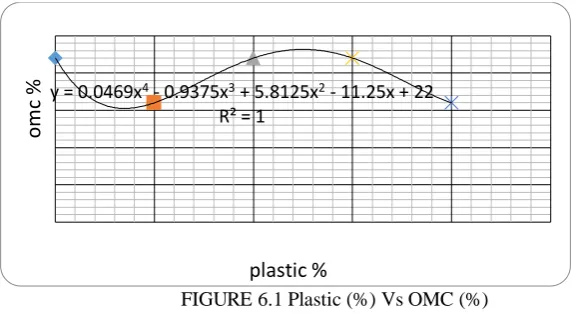
FIGURE 6.1 Plastic (%) Vs OMC (%)
From the Figure 6.1 it was observed that the optimum moisture content increases from the initial value of 0% plastic. Then the
optimum moisture content decreases at 2% of plastic and the optimum moisture content remains constant at 4% and 6% plastic and
there is a decrease of OMC at 8% plastic.
y = 0.0469x4- 0.9375x3+ 5.8125x2- 11.25x + 22 R² = 1
o
m
c
%
6.1.2 California Bearing Ratio Test
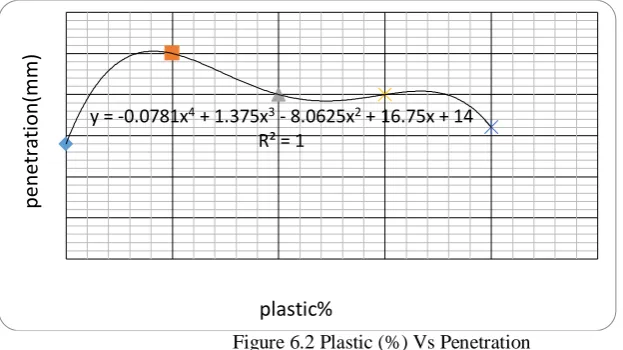
Figure 6.2 Plastic (%) Vs Penetration
From the figure 6.2, the CBR test values for various percentages of plastic strips were observed that there was an increase in the
CBR value from 13.94% at 0% plastic to 25.87% at 2% plastic and then decreases 4% ,6% ,8% plastic by this figure it was concluded
that the strength increases with the addition the plastic strips.
6.1.3 Unconfined Compression Test
Figure 6.3 Percentage Plastic Vs compressive stress (kg/cm2)
The UCS test values for various percentages of plastic strips were observed and concluded compressive strength increases with the plastic content. The compressive strength increased at 2%.
6.2 Overall Test Results
Table 2 Properties of the Soil
y = -0.0781x4+ 1.375x3- 8.0625x2+ 16.75x + 14 R² = 1
p
enet
rat
io
n
(m
m
)
plastic%
y = -0.013x4+ 0.2242x3- 1.3406x2+ 3.1883x + 2.36 R² = 1
co
m
p
ressi
ve
st
reng
th
(kg
/c
m
^2
)
Percentage plastic
Liquid limit 56 %
Plastic limit 20.35 %
Plasticity index 36.365 %
Free swell index 40 %
Unconfined compressive strength 2.36 kg/cm2
𝑐𝑚
2Maximum dry density 1.54 g/cc
Optimum moisture content 22 %
CBR value 13.94%
Clay fraction 72.62%
Silt fraction 27.38%
Specific gravity 2.5
Table 3 Strength Characteristics
% plastic
Proctor test Unconfined compressive test CBR value (%) OMC
(%)
MDD (g/cc)
Strength (kg/cm2)
Cohesion (kg/cm2)
Density (g/cc)
0 22 1.54 2.36 1.18 2.02 13.94
2 16 1.74 4.96 2.48 2.1 25.87
4 22 1.55 4.69 2.34 2.09 19.9
6 22 1.46 4.84 2.42 2.0 19.91
8 16 1.48 3.72 1.86 1.99 15.92
6.3 Conclusions
From the standard proctor test carried out, it has been observed that the OMC values initially decreases with 2% plastic waste replacement. However, beyond 2% plastic, OMC was observed to increase up to 5% plastic and then decreased. The OMC value at 2% and 4% plastic was nearly the same. An increase in the MDD value was observed with 2% plastic, which is also the highest MDD value of 1.47 g/cc among all the various tests conducted. Hence, it may be concluded that for best compaction with the plastic strips considered in this study, the optimum content of plastic is 2%.
The CBR value increased from 14 % at 0% plastic to 26 % at 2 % plastic. Beyond 2% plastic, the CBR value was observed to decrease. It may be inferred that the strength of the soil increases with plastic strip reinforcement. Hence, it may be concluded that the optimum content of plastic for improving the CBR is also 2%.
From the unconfined compression test conducted with varying percentage of plastic strips, it was observed that compressive strength of the soil was maximum at 2 % plastic. Without any plastic replacement, the unconfined compressive strength was 2.36 kg/cm2 and at 2% plastic unconfined compressive strength value nearly doubled to 4.96 kg/cm2.
Hence from the present study it may be concluded that plastic waste material from stationery items can be effectively used to improve the strength characteristics of black cotton soil. The use of plastic in this manner will also ensure prevention of environmental hazards.
REFERENCES
1. Arpan laskar (2014),Dr.sujit kumar pal effects of waste plastic fibres on compaction and consolidation behavior of reinforced soil.
2. Gray DH.and Al-Refeai T., (1968),(Behavior of fabric verses fibre reinforced sand), journal of geotechnical engineering,ASCE;112(8):804-826.
3. Choudary A.k., Jha J.N.and Gill K.S.,(2010)(A study on CBR Behavior of waste plastic strip reinforced ), Emirates Journal for engineering Research,15(1),51-57.
4. Pragan Bhattarai, Bharat Kumar, Engineering behavior of soil reinforced with plastic strips, international journal of civil.structutural, Environmental and infrastructural engineering research and development (IJCSEIERD) ISSN 2249-6866 Vol.3,issue 2,june 2013, 83-88
5. Yetimoglu, T., Inaner, M., Inanir, O.E., 2005. A study on bearing capacity of randomly distributed fiberreinforced sand fills overlying soft clay. Geotextiles and Geomembranes 23 (2), 174183.
6. Akshat Malhotra,et.al.,“Effect of HDPE plastic on the unconfined compressive strength of black cotton soil” Int. J. of Innovative Res. in Science Engineering. and Technology, Vol.3, Issue.1,2014.
7. V Mallikarjuna and T Bindu mani, “Soil stabilization using plastic waste”, International Journal of Research in Engineering and Technology, Volume: 05 Issue: 05, May-2016, pp. 391-394.