GENERATIONS IN THE INDIAN
WORKFORCE
1
Punita Malik
1Research Scholar,
Department of Management Studies,
Deenbandhu Chhotu Ram University of Science and Technology, Murthal, India
Abstract : This paper attempts to explore the theoretical as well as empirical background concerning the determination of generations in the workforce, specifically in India as it has been successfully acknowledged in other countries of the west. Thus, the paper first proceeds to discover how generation came to be recognized as a dimension of workforce diversity, in general. Hereby explaining the process of inclusion of generation in the scope of workforce diversity as it not only facilitates better management of human resource but further leads to better management of talent, knowledge, and other variants of organizational resources. Thus, the paper demonstrates the significance that generational diversity holds in the corporate scenario, globally. But as all countries don’t have the same set of historic events or past, the generations cannot possibly have the same life experiences across different countries. Hence, diversity cannot be uniformly applicable for all the countries across the world which leads to the need of fostering country-specific generational cohorts. Lastly, the paper studies the salient generational groups ascertained with respect to the Indian workforce and attempts to provide a review of the literature in this regard.
IndexTerms - Generation, generational cohorts, generational diversity, generations in Indian workforce, workforce diversity.
I.INTRODUCTION
Scholars from multiple academic fields have been studying generation and how it is a formed construct. Social psychologists have researched and provided a better understanding of the numerous socio-psychological influences that have molded generational attitudes and behaviors. A section of scholars like Giancola (2006) elucidate that “generational approach may be a more popular culture than social science”, but still generational studies have an extensive and eminent place in the field of social sciences. Scholars have tried to research for the exclusive and idiosyncratic traits of generations for quite a few decades. In the previous decade management scholars have attempted to clarify “generational attitudes, values, behaviors”, (Gibson et al., 2011) “motivators and their effect on team work, learning orientation” (D’Amato & Herzfeldt, 2008), “retention policies” (Gabriel, 1999), “leadership expectations, and organizational policies at large” (Westerman & Yamamura., 2007).
E-Gen (Born between 1971 – 80) and Gen Y (Born between 1981 – 90). But they majorly focused their study around four generations leaving the Veterans, as they are not a part of the Indian workforce anymore. The most recent study has been given by Dokadia (2015), eradicating the dearth of empirical study in this area, the author based her study on empirical evidence of collectivity of memory and gave three generations, namely, “Senior Generation” (born in or before 1968), “Middle Generation” (born from 1971– 1986) and “Young Generation” (born in or after 1987).
II. OBJECTIVE
The study attempts to explore the theoretical and empirical background regarding generations in the Indian workforce. Thus, in order to arrive at this objective, a series of other objectives are observed. First, to discover how generation came to be acknowledged as an element of workforce diversity, to know the significance of generational diversity and the need for country-specific generational cohorts. Lastly, the main resolve of the paper is to exhibit the various generational cohorts and their characteristics, identified in the framework of Indian workforce.
III. GENERATION: AN UNEXPLORED DIMENSION OF WORKFORCE DIVERSITY
Workplaces in the present times are vastly diversified due to the varying backgrounds of the employees and this forms what is called workforce diversity. Gender, race, nationality, different regions, age groups, religions, ethnicities, cultures, color and disability are some of the commonly used criteria for employee segmentation and diversity definitions. But it is interesting to note that present workplaces still have one more unmapped basis of diversity which is that of the generation.
Generation is described as a coherent assemblage, in which all the entities are born in the same restricted time period, which measures around 22 years, and have generational attributes which are formed and recognized by common age, region, sensitivities and behavioral outlook (Strauss and Howe, 1992).
Kupperschmidt (2000) ascribes generation as an exclusive organized crowd that not only shares birth years, but also has a shared age, region, and substantial life happenings at important developmental stages. Some researchers have described generation as a group which shares a similar outlook due to analogous events that they have shared in their lifetime (Mannheim, 1972; Kupperschmidt, 2000; and Dencker, Joshi & Martocchio, 2007). A generational group, frequently represented as a cohort, is inclusive of those who have a noteworthy mutual social or historical life event, the aftereffects of which ring in their life throughout. Kupperschmidt (2000) further asserted that a cohort significantly effects in the formation of a personality that impacts a person's outlooks toward authority and organizations.
Hence, this has prompted many research studies, specifically in the previous decade. Management researchers have attempted to decipher generational attitudes, values, behavior and have worked towards providing a combined ground of emotions, attitudes, and preferences which have impact professional characteristics of an employee.
IV. WHY GENERATIONAL DIVERSITY?
The Western countries have had an extensive research in the field of generational influences in the management arena and, more recently, India has followed up on the research as well. The scholars of management have been attempting to comprehend the multilayered impacts of intergenerational dissimilarities in numerous parts, for instance organizational policies (Westerman & Yamamura, 2007) in general and specific regions including but not restricted to motivators, fellowship, knowledge orientation (D’Amato & Herzfeldt, 2008), retention policies (Gabriel, 1999) and generational attitudes, values and behaviours. Research hints that generational diversity has an effect on employees’ professional characteristics and social interactions (McDonald, 2003; Pitt-Catsouphes & Matz-Costa, 2008), which reinforces on the necessity for employers or managers to have an emphatic understanding of the employee requirements of each generation, and the interplay among these generations.
Research puts forward the observation that employers or managers ought to give their employees fitting prospects and credit according to their requirements, and create a professional space that nurtures efficiency in each generation (Saunderson, 2009; Macon & Artley, 2009).
Generational diversity has been proved to influence various facets of work, including professional attributes (Gursoy, Chi & Karadag, 2013; Kapoor & Solomon, 2011), including coordination, communication and training (Macon & Artley, 2009), employees’ professional expectations (Dencker, Joshi & Martocchio, 2008) and employee relations (Gursoy et al., 2013). Manifestly, this elucidates the requirement to scrutinize these alterations closely so that managers and employers consider them critically during development and application of cooperation policies.
When every professional apprehends this dynamic form of diversity affecting the present professional spaces, the productivity of the organisation will evidently rise (Lancaster & Stillman, 2003). Comprehending and supervising generational diversity brings the possibility of a range of benefits and standpoints to the professional space, like enhanced talent attraction, retention and engagement, increased workstation efficiency, amplified competitive gain that keeps customers or consumers faithful and provides a broadened understanding of succession planning and developing authorial bench strength, reports one more study of relevance (Kelly, 2009).
V. GENERATIONAL DIVERSITY: A BIG CHALLENGE FOR MANAGERS
In the present professional scenario, the issue generational diversity is considered an engrossing and current theme for a researcher which is a critical challenge to the management (Mannheim, 1972; Rousseau, 1990; Maurer, 2001; Noble & Schewe, 2003 and Collins et al., 2009). Research has discovered that the prevailing of numerous inconsistencies among all generations of a workplace which creates professional impediments and struggles (Lawrence, 1988; Gedde & Jackson, 2002; Lancaster & Stillman, 2003; Griffin, 2004 and Bush et al., 2008).
The generational differences steer multidimensional influences on various aspects of organizational behavior and this makes understanding generational diversity a crucial element for better management of human resource in an organization. Therefore, it has been repetitively stressed that efficiently managing generational differences in the work staff is among the major challenges encountered by managers in the present day (Lester, Standifer, Schultz & Windsor, 2012).
As generational diversity has an effect on professional qualities (Kapoor & Solomon, 2011; Gursoy, et al., 2013), researchers suggest that these characteristics affect employees’ professional expectations (Dencker, Joshi, & Martocchio, 2008) and shape employee relations (Gursoy, et al., 2013). Macon & Artley (2009) suggest that these variances impact on some critical arenas such as cooperation, communication, and training, due to which it is imperative for employers to have a clear understanding of the complex nature of generational influences. Furthermore, the cooperation among generations needs to be established as the differences can result in conflict in the workspace (Gursoy, et al., 2013).
Differences prevail in each and every generation which has individual views, attitudes and, concerns. These variations are based on their respective life experiences in accordance to their temporal age which develops their beliefs, ideals, prejudices and, prospects discretely. These facets are reflected in their interactive behavior and work ethics which consequently pressurizes HR departments to maneuver policies in accordance to the context (Hobbs & Stoops 2002; Dencker, Joshi & Martocchio, 2007).
VI. IDENTIFYING GENERATIONS IN INDIAN WORKFORCE
A generation is described as an “identifiable group that shares birth years, age location, and significant life events at critical developmental stages” (Kupperschmidt, 2000). A number of researches (e.g., Cekada, 2012; Dries, Pepermans & Kerpel, 2008; Dwyer, 2009; Lester et al., 2012) have used diverse categorizations of generations. The most common among those is the silent generation (born 1925-1945), baby boomers (1946-1964), generation X (1965-1980) and generation Y (born in or after 1981). Nonetheless, considering Mannheim’s and others (1952) research on generational identities in workspace (Griffin, 2004; Schuman & Scott, 1989), it is devised that generational identities are influenced by socio-cultural outlooks, in addition to the critical historic happenings that people had witnessed in their developmental stage. Consequently, numerous scholars have recognized the necessity to apply culture-specific categorizations for reviewing generations (Erickson, 2009; Hole, Zhong & Schwartz, 2010; Turner, Mitchell, Hastings & Mitchell, 2011).
Readings scrutinizing generational diversity of the Indian employees have only begun emerging whereas western social scientists have already demystified the generational categorizations of their employees (Matthew Legas & Cynthia Sims, 2011). The aim of such studies is to recognize and create prototypes of various mutual facets that define a majority of individuals which belong to the same generation. The research will result in a better understanding of varying employees segments which are significantly altered in relation to the other and has shared attributes adept of generating influence. The year of birth can demonstrate discretionary enough in generational groups as their facets can be attributed to their mutual social, technological, economic, cultural and political climates. For instance, the employees of the United States are classified into four generations namely, the traditional generation (born before 1945), the baby boomers (born 1946-1964), the Gen X (1968-1979) and Gen Y (1980-1999) (Tolbize, 2008).
According to the US Society for Human Resource Management (SHRM, 2004), four demographic segments prevail in professional space and these are narrowed on the basis of age as follows: Veterans – born amid 1925-1940; Baby boomers –1941-1960; Generation X –1961-1976; Millennial –1977-1992.
But each nation has its own set of events which are responsible for influencing a generation, or is as previously argued that location of the employees is a crucial factor while studying demographic generational relations in a workspace, and thus it is very much needed that a similar extensive research is conducted on Indian subjects as well.
Thus, as the previous literature has emphasized that generations is a region-based notion as socio-economic changes of one country singularly effect the generations of region. This generational localization amalgamates beings of a specific generational segment with a shared socio-historical background. Based on this understanding, many eminent scholars have proposed the following generational groups in India.
Table 1. Erickson’s comparison of generations in India and USA
Traditionalists (1928-1945)
United States of America India Life Events Boom in the post war economy that was
characterized by rapid suburbanization, increasing demand and availability of consumer (FMCG) goods and massive jump in white collar jobs
National level movements led by Mahatma Gandhi that brought an end to the British rule. Poor economic, social and health conditions leading to poverty, deaths, low literacy, degrading situations in agriculture and industrial sector. Gandhi’s murder and India-Pakistan war in 1947
Attributes Loyal, obedient, financial achievements ere the parameter of success
Patriotic, loyal, participation towards reforming India, obedience to traditional practices was a parameter for success
Boomers – Born from 1946 to 1960/1964
United States of America India Life Events The Civil Rights movement, Vietnam War,
murder of John F Kennedy(PM) and Martin Luther King, the two idealistic leaders of that time that led to protests and resignation of public democrats
Indira Gandhi as PM that was characterized by a socialistic and economic approach that lead to nationalization of industries, reforms, Break from the non-alignment.
Three major wars with China and Pakistan. Monetary reforms like rupee devaluation. Advent of green revolution to boost agriculture, declaration of Emergency and Indira Gandhi’s accusation on corruption charges, opposition party comes to power Attributes Competitive, idealistic, social identification
and questioning towards authority
Decision making was majorly influenced by family, caste or community, skeptic of authority and higher institutions, success was measured by migrating abroad
Generation X – Born from 1961/1965 to 1979
United States of America India Life Events Bad economic conditions led to layoffs and
downsizing, growth of internet and electronic gadgets and games, women empowerment and rising divorce rates
Murder of Indira Gandhi and her son takes over as PM, Rajiv Gandhi is the youngest PM of India who reformed India by promoting business and foreign investments, expansion of telecommunications industry, space and IT sector. Bofors scandal and assassination of Rajiv Gandhi. Further economic liberalization and increasing migration abroad
Attributes Loyalty towards friends, emphasis on good parenting and skeptic towards higher institutions
Opinionated, reformative and evaluative and success was still linked to moving abroad
Generation Y – Born from 1980 to 1995 (most globally similar generations) United States of America India Life Events Acts of terrorism and school violence,
unprecedented bull market and a strong pro-child culture
Suburbanization and increased demand and supply of consumer FMCG goods, stability and prosperity in the economy, educationally developed with IT talent and fast developing companies with global rankings
Attributes Sense of immediacy, optimistic, goal-oriented, very family-centric, and attitude to live life fully
Impatient, massive economic opportunities, youth oriented population, business and techno savvy employees, appreciative of democracy, acceptance of diversity among the people, equipped for globalization
Ghosh & Chaudhari (2009) categorized the prevailing generations of India into three subheads of “the conservatives, integrators and Y2K”, which is more so a representation of urban India. Though the topic has been extensively researched on in the West, this is the first localizing of it by the Indian scholars into an Indian outlook. Their main attention was on the cultural and social change in India and its transforming implications on Indian industrial workforce.
preferred socialism in the 1960s-'70s because of the increased government intervention. The industrial sector was suffocated with bureaucratic red tape which resulted in immense corruption and inefficacy. Other factors staple to this period is the dominance of Congress in the political arena, joint family as the norm, avid saving, authorial fear and respect, rigid caste system influences occupational choices of an individual, negligence of personal achievements in favor of hereditary, emphasis on nationalist identity resulting in avoidance of foreign trade or technology and stress on communal strife rather than individual suffering.
2. Integrators (1970-1984): During this period, the focus shifted from economic and physical security towards a self-expressive and qualitative lifestyle. Poverty had been minimized through economic reforms and liberalization changed societal structure. With increasing integration, the middle class gained prominence in the workspace which reduced the undue importance give to caste, region and religion as marriage happened interlinking the previous distinguished categories. Migration became a norm as rural subjects, in pursuit of better opportunities, shifted to urban locations. Globalization made the youth less conservative of foreign prospects leading to social, economic, and political liberalization causing immense monetary benefits. The lifestyle of this generation included technological advances like cable television, surplus of food, heavy consumers, and inclination towards private technological jobs over the earlier bias of government jobs. It was an overall a fusion of traditional ethics of India and western values which were seen as modern.
3. Y2K (1985-1995): This generation played a key role in recalibrating the reputation of our nation on a universal demographic sphere. It transformed the earlier conception of the country as a land of snake charmers, poverty and Mother Teresa to a hub of technological experts and avid scholars. India was further modified with the economic reforms of 1991 and was recognized among the fastest expanding economies in the world. The youth of this generation was inherently progressive with inkling towards latest games, technologies, and devices. Growing up on surging salaries and economic boom, they view the world as flat and do not care much for geographical boundaries.
Their facets of their ideologies includes: importance to connectivity as internet is integral for them, future credit possibility as a money to spend, loan as a resource, balance of personal and professional and, definite and uncompromising choices in aspirations and occupations. Decent education and jobs are readily available to them which provides them with ample of prospects and promises.
Similarly, Hole, Zhong, & Schwartz (2010) suggested three generations: the traditional (1948–1968), the nontraditional (1969– 1980), and generation Y (1981 onwards). Their study revolved around the need to differentiate the generational cohorts of the Asian countries from those of the western countries and began defining generations from 1950 onwards unlike the generations in the west. They developed on the works of Ghosh and Chaudhari (2009) in order to provide Indian contextualization of generational cohorts. The changing moment for the nation was its independence from British Rule in 1947. Thus the generational cohorts are defined as follows:
1. Traditional generation (1948-1968): After independence, India gave immense importance to the protection of individual rights through various legal frameworks. In the initial three decades after independence, the workforce readily engaged with cooperation related to manufacturing, public investment and infrastructure development. Not keen on change, the employees of this generation have an increased loyalty to their managers in expectance of lifetime employment. They do not seek a lot of cash but await the perks and benefits of a long tenure of serving in a particular firm.
2. Non- traditional generation (1969-1980): They have seen the effect of economic liberalization at a nascent stage of their careers and have profited from the early boom in experimental outsourcing. Therefore, they are relatively more risk-taking in contrast to the Traditional generation and prefer career advancement on the basis of merit instead of time period.
3. Gen Y (1981 0nwards): The consequences of the economic boom displayed an increasing need of career progression which has led to a disregard for company loyalty and boom in seeking better wages. Employee aspiration amplified with this generation as they don’t mind a rotation of employers if it helps in advancing their careers. Additionally, they normally prefer opportunities that suit their progress requirements (for instance, prospects of working globally).
Srinivasan (2012) suggested four different employee generations based on phases of economic development, who started working during or before liberalization in India. This study was done in collaboration with Society for Human Resource Management India. The study used a very systematic research methodology that consisted of phases, which would subsequently lead towards identification of generational cohorts in the Indian context. The phases involved exploring the literature and presenting those findings to the top management leaders, discovering generations through inputs from researchers and primary research and lastly, validating and integrating the findings by holding in-depth interviews and focus group discussions. Thus, the four generations that came into place after such a systematic research study are:
1. Pre-Liberalization Generation (Pre-1991): Agricultural production and heavy industries mainly formed the economic demography of the country during this period and the growth rates averaged about 3%. The period was categorized into two diverse periods namely, Independence to Emergency (1947-1975), which characterized centralized planning, establishment of public sector enterprises, and interested economic investments by the government of the nation in infrastructure; and the post Emergency period, which was characterized by bureaucratic organizations, constrained prospects, and preferentialism. This generation is known for attributes like allegiance, nationalist spirit, and dedication. 2. Early Liberalization Generation (1992 –2001): Due to the structural changes in the framework traditional organizations,
array of prospective jobs increased with technology advancements, modernized work ethics, and an upsurge in private organizations. But these new opportunities were only limited to urban areas and thus the rural population had to migrate to cities, leaving behind their home town, in search of better prospects. This also led to the increase in nuclear families. The shifting of employers for career advancement was accepted and encouraged during this period. Job mobility and changing careers were acceptable during this period as employees strived to prove their worth at a global level.
3. Rapid Growth Generation (2002–2006): This phase was regarded for its outset of MNC’s, skewed labour market, demand outstripping supply with growth rates ranging from 4%–9.5%, establishment of offices in Tier 1 and Tier 2 cities which consequently led to a rapid growth in India. While better education and learning facilities, the supply of trained workforce was still limited in regards to the increasing demand. Women entered the selected arenas of the workplace and in particular in the sectors of hospitality, financial services, and IT services. There was a change in corporate culture and the collective perception of employees. There was a fractured or rather lop-sided change in the cooperate framework as there was increment in the specific sections of workplace due to the limited availability of skilled workers while there was underpayment in the other sections where surplus of entrants were available.
4. Plateaued Growth Generation (2007–2012): Global crisis of 2008 made the organizations resort to relatively more rigid performance criteria. In order to deal with the crisis in an ideal manner, organizations became stricter in their hiring procedure and took tight steps like not recruiting the job applications of the graduates/postgraduates who they had earlier offered jobs to. The current hired employees were also evaluated under stringent performance framework and larger focus was given to training. In these circumstances, employees had learnt to scrutinize their own worth to the cooperation in order to understand their career prospects better and adapt to their circumstances accordingly.
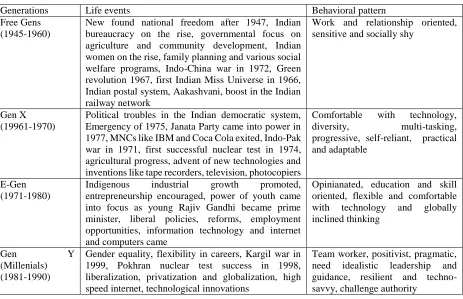
Saundarya and Ekambaram (2014) gave four categories of generations into which the Indian labor force can be catalogued. Their study included focus group discussions with 250 corporate representatives to aid in the recognition of the demographics which differentiate the four unique generational groups in corporate workspace of India. The discussions aimed to comprehend a set of life events unique to every birth year window which would become pointers to common attitudes of a particular generational group. Table 2 describes the four generations, their life events and subsequent behavioral patterns.
Table 2. Saundarya and Ekamabaram’s classification of generational cohorts in Indian workforce
Generations Life events Behavioral pattern
Free Gens (1945-1960)
New found national freedom after 1947, Indian bureaucracy on the rise, governmental focus on agriculture and community development, Indian women on the rise, family planning and various social welfare programs, Indo-China war in 1972, Green revolution 1967, first Indian Miss Universe in 1966, Indian postal system, Aakashvani, boost in the Indian railway network
Work and relationship oriented, sensitive and socially shy
Gen X (19961-1970)
Political troubles in the Indian democratic system, Emergency of 1975, Janata Party came into power in 1977, MNCs like IBM and Coca Cola exited, Indo-Pak war in 1971, first successful nuclear test in 1974, agricultural progress, advent of new technologies and inventions like tape recorders, television, photocopiers
Comfortable with technology, diversity, multi-tasking, progressive, self-reliant, practical and adaptable
E-Gen (1971-1980)
Indigenous industrial growth promoted, entrepreneurship encouraged, power of youth came into focus as young Rajiv Gandhi became prime minister, liberal policies, reforms, employment opportunities, information technology and internet and computers came
Opinianated, education and skill oriented, flexible and comfortable with technology and globally inclined thinking
Gen Y
(Millenials) (1981-1990)
Gender equality, flexibility in careers, Kargil war in 1999, Pokhran nuclear test success in 1998, liberalization, privatization and globalization, high speed internet, technological innovations
Team worker, positivist, pragmatic, need idealistic leadership and guidance, resilient and techno-savvy, challenge authority
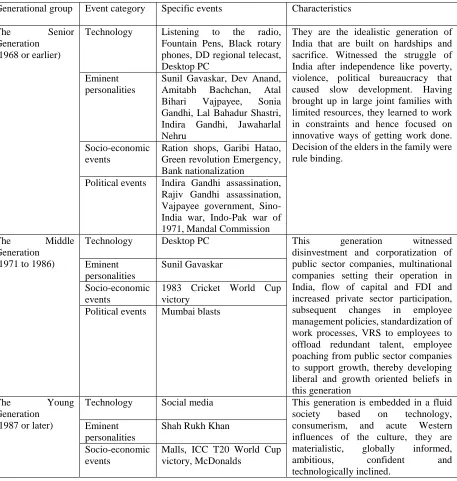
Table 3. Dokadia’s identification of generations in India
Generational group Event category Specific events Characteristics
The Senior Generation
(1968 or earlier)
Technology Listening to the radio, Fountain Pens, Black rotary phones, DD regional telecast, Desktop PC
They are the idealistic generation of India that are built on hardships and sacrifice. Witnessed the struggle of India after independence like poverty, violence, political bureaucracy that caused slow development. Having brought up in large joint families with limited resources, they learned to work in constraints and hence focused on innovative ways of getting work done. Decision of the elders in the family were rule binding.
Eminent personalities
Sunil Gavaskar, Dev Anand, Amitabh Bachchan, Atal Bihari Vajpayee, Sonia Gandhi, Lal Bahadur Shastri, Indira Gandhi, Jawaharlal Nehru
Socio-economic events
Ration shops, Garibi Hatao, Green revolution Emergency, Bank nationalization
Political events Indira Gandhi assassination, Rajiv Gandhi assassination, Vajpayee government, Sino-India war, Indo-Pak war of 1971, Mandal Commission The Middle
Generation (1971 to 1986)
Technology Desktop PC This generation witnessed disinvestment and corporatization of public sector companies, multinational companies setting their operation in India, flow of capital and FDI and increased private sector participation, subsequent changes in employee management policies, standardization of work processes, VRS to employees to offload redundant talent, employee poaching from public sector companies to support growth, thereby developing liberal and growth oriented beliefs in this generation Eminent personalities Sunil Gavaskar Socio-economic events
1983 Cricket World Cup victory
Political events Mumbai blasts
The Young
Generation (1987 or later)
Technology Social media This generation is embedded in a fluid society based on technology, consumerism, and acute Western influences of the culture, they are materialistic, globally informed, ambitious, confident and technologically inclined.
Eminent personalities
Shah Rukh Khan
Socio-economic events
Malls, ICC T20 World Cup victory, McDonalds
VII. CONCLUSION
the industrial experiential knowledge and academia. Hence, to this end the paper aimed to collectively exhibit all the studies done to identify generational cohorts and their characteristics in the Indian context.
REFERENCES
[1] Bush et al., (2008). Generational Differences in Soft Knowledge Situations: Status, Need for Recognition, Workplace Commitment and Idealism. Knowledge and Process Management, 15(1), 45-58.
[2] Cekada, T.L. (2012). Training a multigenerational workforce: Understanding key needs and learning styles. Professional Safety,
57(3), 40–44.
[3] Collins et al., (2009). The Older- Worker-Younger-Supervisor Dyad: A test of the reverse Pygmalion effect. Human Resource Development Quarterly, 20(1), 21-41.
[4] D’Amato, A., & Herzfeldt, R. (2008). Learning orientation, organizational commitment and talent retention across generations: A study of European managers. Journal of Managerial Psychology, 23(8), 929–953.
[5] Dencker, Joshi & Martocchio, (2007). Employee benefits as a context for intergenerational conflict. Human Resource Management Review, 17(1), 208−220.
[6] Dokadia, A. (2015). Exploring multi-generational perspectives of career, learning, and leadership. Unpublished Doctoral Thesis, Tata Institute of Social Sciences, Mumbai.
[7] Dries, N., Pepermans, R., & De Kerpel, E. (2008). Exploring four generations’ beliefs about career. Journal of Managerial Psychology, 23(8), 907–928.
[8] Erickson, T. (2009). Generational differences between India and the US. Retrieved 20 October2018, from http://blogs.harvardbusiness.org/erickson/2009/02/global_generations_focus_on_in.html
[9] Gabriel, A.R. (1999). Retaining Gen Xers: Not such a mystery any more. Commercial Law Bulletin, 14(4), 32–33
[10]Gedde & Jackson, (2002). Age Diversity in Hospitality – Making a Case for the Mature Employee. Journal of Human Resources in Hospitality & Tourism, 1(2), 71-83.
[11]Ghosh, R. & Chaudhuri, S. (2009). Inter-Generational Differences in Individualism/ Collectivism Orientations: Implications for Outlook towards HRD/HRM Practices in India and the United States. New Horizons in Adult Education and Human Resource Development, 23(4), 5-21.
[12]Giancola, F (2006). The generation gap: More myth than reality. Human Resource Planning, 29 (4), 32–37.
[13]Gibson, C., H. Hardy III, J. & Buckley, R. M. (2014). Understanding the role of networking in organizations. Career Development International, 19(2), 146-61.
[14]Griffin W. (2004). Generations and collective memory revisited: Race, region, and memory of Civil Rights. American Sociological Review, 69, 544−577.
[15]Gursoy, D., Chi, C. G. Q. & Karadag, E. (2013). Generational Differences in Work Values and Attitudes among Frontline and Service Contact Employees. International Journal of Hospitality Management, 32, 40-48.
[16]Hole, D., Zhong, L. & Schwartz, J. (2010). Talking about Whose Generation? Why Western Generational Models Can’t Account for a Global Workforce. Deloitte Review, 6, 84-97. Retrieved from http:// www.deloitte.com/view/en_US/us/Services/additional-services/talenthuman-capital-hr/5d6e2bb18ef26210VgnVCM
100000ba42f00aRCRD.html.
[17]Kapoor, C. & Solomon, N. (2011). Understanding and Managing Generational Differences in the Workplace. Worldwide Hospitality and Tourism Themes, 3(4), 308-18.
[18]Kelly. (2009). Understanding and Leveraging Generational Diversity. Kelly Services.
[19]Kupperschmidt, B. R. (2000). Multigenerational employees: Strategies for effective management. The Health Care Manager, 19(1), 65-76.
[20]Lancaster & Stillman (2003). When Generations Collide. Harper-Collins. New York, NY.
[21]Lawrence, (1988). New wrinkles in the theory of age: Demography, norms, and performance ratings. Academy of Management Journal, 31, 309−337.
[22]Lester, S.W., Standifer, R.L., Schultz, N.J., & Windsor, J.M. (2012). Actual versus perceived generational differences at work: An empirical examination. Journal of Leadership & Organizational Studies, 19(3), 341–345.
[23]Macky, K., Gardner, D. & Forsyth, S. (2008). Generational differences at work: Introduction and overview. Journal of Managerial Psychology, 23(8), 857-61.
[24]Macon, M. & Artley, J. (2009). Can’t We All Just Get Along? A Review of the Challenges and Opportunities in a Multi-generational Workforce. International Journal of Business Research, 9(6), 90-94.
[25]Mannheim, K. (1952). The problem of generations. In P. Kecskemeti (Ed.), Essays on the sociology of knowledge (pp. 276– 322). London: Routledge & Kegan Paul.
[26]Mannheim, (1972). The problems of generations. In P. Kecskemeti (Ed.), Essays on the sociology of knowledge, 276-320). London: Routledge and Kegan Paul.
[27]Matthew Legas, M., & Cynthia Sims, E. (2011). Leveraging generational diversity in today’s workplace. Online Journal for Workforce Education and Development, 5 (3).
[28]Maurer, (2001). Career-relevant learning and development, worker age, and beliefs about self- efficacy for development.
Journal of Management, 27, 123-140.
[29]McDonald, D (2003). Strategic human resource management approaches to workforce diversity in Japan: Harnessing corporate culture for organizational competitiveness. Global Business Review, 4(1), 99–114.
[30]Noble & Schewe, (2003). Cohort segmentation: An exploration of its validity. Journal of Business Research, 56, 979−987.
[31]Pitt-Catsouphes, M., & Matz-Costa, C. (2008). The multi-generational workforce: Workplace flexibility and engagement.
[32]Rousseau, (1990). New hire perceptions of their own and their employer's obligations: A study of psychological contracts.
Journal of Organizational Behavior, 11, 389−400.
[33]Saundarya R. and Ekambaram K. (2014). Generational diversity in the Indian workforce: An exploratory study. International Journal of Managerial Studies and Research, 2(7), 54-64.
[34]Saunderson, R. (2009). Is It Really So Hard to Reward and Recognize a Multi-generation Workforce? Employee Benefit Plan Review, 63(8), 6-8.
[35]Schuman, H., & Scott, J. (1989). Generations and collective memories. American Sociological Review, 54(3), 359.
[36]Singh, V. (2013). Exploring the concept of work across generations. Journal of Intergenerational Relationships, 11(3), 272– 285.
[37]Society for Human Resource Management (SHRM) (2004). Generational differences survey. Society for Human resources Management. Alexandria, Virginia, VA.
[38]Sonnenberg, D. M. (2011). Talent – Key ingredients. Accenture.
[39]Strauss and Howe, (1992). Generations: The History of America’s Future, 1584 to 2069. New York, NY: Harper Perennial. [40]Srinivasan,V.(2012). Multi-generations in the Workforce: Building Collaboration. IIMB Management Review, 24(1), 48-66. [41]Tolbize, A. (2008). Generational differences in the workplace. University of Minnesota.
[42]Turner, G., Mitchell, M., Hastings, B., & Mitchell, S. (2011). Generation X: Americans and Koreans evaluate the importance of education and occupation. Retrieved 22 October 2018, from http://www.siue.edu/EASTASIA/ Turner_1001.html.