_____________________________________________________________________________________________________
*Corresponding author: E-mail: [email protected];
(Past name: American Chemical Science Journal, Past ISSN: 2249-0205)
Evaluation of Synergistic Effect of Different
Compositions of Liquid Extract of
Citrus limonium
and Its Linkage with β-cyclodextrin for the One-pot
Multicomponent Synthesis of Pharmacological
Bioactive Compounds with Application of
Exploratory Analysis
Deepali Agarwal
1*, Jyotsna Dhanik
1, Ankita Verma
1and Virendra Kumar Kasana
11
Department of Chemistry, College of Basic Sciences and Humanities, G.B. Pant University of Agriculture and Technology, Pantnagar- 263145, Uttarakhand, India.
Authors’ contributions
This research work was carried out in collaboration between all authors. Author DA designed the study, performed the synthesis and wrote the first draft of the manuscript under the supervision of author VKK. Authors DA, AV and JD managed the spectral and statistical analysis of the study. Authors AV and JD managed the literature searches. All authors read and approved the final manuscript.
Article Information
DOI: 10.9734/CSJI/2018/42134 Editor(s): (1)Dr. T. P. West, Professor, Department of Chemistry, Texas A&M University-Commerce, USA. Reviewers: (1)Esraa Ashraf Ahmed ElHawary, Ain Shams University, Egypt. (2)Ann N. Kanu, National Root Crops Research Institute, Nigeria. (3)Fatma Kandemirli, Kastamonu University, Turkey. (4)Daniela Hanganu, Iuliu Hațieganu University of Medicine and Pharmacy, Romania. Complete Peer review History:http://www.sciencedomain.org/review-history/25356
Received 19th April 2018 Accepted 26th June 2018
Published 2nd July 2018
ABSTRACT
The ability of liquid extract of Citrus limonium and Citrus limonium-β-cyclodextrin composite to promote multicomponent reactions of pharmacologically bioactive compounds from a diversity of
aromatic aldehydes has been described. Development of Citrus limonium-β-cyclodextrin composite
was characterized using scanning electron microscopy (SEM) and X-ray diffraction pattern (XRD).
Liquid extract of Citrus limonium efficiently catalyzed one pot two and three component reaction of
α-aminophosphonates, 1H-benzo[d]imidazoles and 9,10-dihydrobenzo[a]xanthen-11(12H)-ones,
whereas, Citrus limonium-β-cyclodextrin composite showed a higher catalytic activity for four
component reaction of 6-amino-2,4-dihydro-3-methylpyrano[2,3-c]pyrazole-5-carbonitriles and
3,4-dihydro-2H-indazolo[2,1-b]phthalazine-1,6,11(13H)-triones. The method is superior to the existing methods as catalysts provide less reaction time, easier workup and afford good to excellent yields under solvent-free condition. Application of principal component analysis and variable correlation analysis extract the information and further evaluate the catalytic efficiency of liquid extract of Citrus limonium and Citrus limonium-β-cyclodextrin composite. Also, PCA applied on catalytic activity of different constituents of liquid extract of Citrus limonium and their different ratios gave the idea of their synergistic effect for the synthesis of above pharmacological compounds.
Keywords: Citrus limonium; Citrus limonium-β-cyclodextrin composite; pharmacologically bioactive compounds; principal component analysis; variable correlation analysis.
1. INTRODUCTION
Synthetic drugs have successfully been used to protect human beings from diseases. α-aminophosphonates, 1H-benzo [d]imidazoles,
6-amino-2, 4-dihydro-3-methylpyrano
[2,3-c]pyrazole-5-carbonitriles, 9,10-dihydrobenzo [a]
xan then-11(12H)-ones, 3,4-dihydro-2H
-indazolo[2,1-b]phthalazine-1,6,11(13H)-triones
are known for their broad spectrum
pharmacological activities such as, antineoplastic activity [1], anti-inflammatory and analgesic activity [2], antiulcer, antipsychotic, antiprotozoal,
antifungal [3-5], antimicrobial, anticancer,
anticonvulsant, vasodilator and molluscicidal activity [6], enzyme inhibitors [7], etc.
In recent years, numerous methods have been reported for the synthesis of these biologically active compounds. Generally, catalysts such as NaHSO4.SiO2 [8], strontium triflate [9],
12-tungstophosphoric acid [10], p-TSA [11,12],
Ce(SO4)2.4H2O [13], p -TsOH [14], sodium
hydrogen sulfite [15], zinc acetate [16],
dibutylamine [17], trifluroacetic acid [18],
ZrOCl2.8H2O [19] have been reported for their
synthesis. However, these methods have drawbacks such as application of expensive, thermally unstable and toxic catalyst, long reaction time, harsh reaction conditions, tedious workup and purification of the products. Thus, a mild, convenient and high yielding procedure using inexpensive and non toxic catalyst would be desirable.
Lemons are the important commercial citrus fruit indigenous to north- west regions of India. They have been widely cultivated in tropical and sub-tropical parts of the world. Citrus aurantium, Citrus indica, Citrus limonium are some important species of lemon. Lemons have particularly high concentrations of citric acid, which can constitute
as much as 8% of the dry weight of these fruits (about 47 g/L in the liquid extract) [20]; the liquid extract of the lemon contains about 5% to 6% citric acid. Other main ingredients of lemon liquid extract are moisture (85%), carbohydrates (11.2%), protein (1%), vitamin-C (0.5%), fat (0.9%), minerals (0.3%), fibers (1.6%) and some other organic acids [21]. Herein, keeping in view, the broad spectrum pharmacological activities of α-aminophosphonates, 1H-benzo [d] imidazoles,
6-amino-2, 4-dihydro-3-methylpyrano
[2,3-c]pyrazole -5-carbonitriles,
9,10-dihydrobenzo[a]xanthen-11(12H)-ones and
3,4-dihydro-2H-indazolo [2,1-b]
phthalazine-1,6,11(13H)-triones; and in continuation of our
programme [22-24] i.e. development of
convenient and environmentally benign
procedures using green catalysts, we report
liquid extract of Citrus limonium and Citrus
limonium-β-cyclodextrin composite as a catalyst. In addition, principal component analysis and variable correlation analysis were applied to evaluate the catalytic efficiency of catalysts and
main constituents of liquid extract of Citrus
limonium for the synthesis of above pharmacologically bioactive compounds.
2. EXPERIMENTAL
All the reagents and chemicals were obtained from Hi-media and used without further purification. The purity of new synthesized compounds and development of reactions was monitored by thin layer chromatography (TLC) on Merck pre-coated silica gel G and visualized by UV light.
2.1 General Procedure for Liquid Extraction from Citrus limonium
Fresh lemon (Citrus limonium) of variety Pant
Research Center, G.B. Pant University of
Agriculture and Technology, Pantnagar,
Uttarakhand, India. The lemon was sliced using a knife and then liquid was extracted immediately using domestic presser by pressing the pieces manually. Liquid extract was filtered through muslin cloth and then through an ordinary filter paper to remove solid material and to get liquid lemon extract. For each reaction, fresh liquid was extracted.
2.2 General Procedure for Linking Liquid Extract of Citrus limonium with β-cyclodextrin (Citrus limonium -Cyclodextrin Composite)
2 g/5 mL aqueous β-cyclodextrin was taken in 50 mL beaker on hot plate with magnetic stirrer at
300 rpm. To this, 10 mL of fresh liquid extract of
Citrus limonium was added drop by drop and slowly temperature was raised to 55°C with continuous stirring for 6 hr. The composite formed was then sieved and oven dried at 55°C for 24 hr.
2.3 General Procedure for Synthesis of α-Aminophosphonate Derivatives
A mixture of substituted benzaldehyde (2 mmol), aniline (2 mmol), triethyl phosphite (3 mmol) and one drop of fresh liquid extract of Citrus limonium
(0.07 g)/ Citrus limonium-cyclodextrin composite
(0.3 mmol) were taken in 100 mL round bottom flask and was stirred at room temperature (Scheme 1). After completion of the reaction as indicated by TLC using hexane and ethyl acetate (80:20) solvent system, the reaction mixture was extracted with water and dichloromethane to give pure α- aminophosphonate.
2.4 General Procedure for Synthesis of 1H-benzo[d]imidazole Derivatives
4 mmol substituted benzaldehyde, 4 mmol benzene-1,2-diamine and one drop of fresh liquid
extract of Citrus limonium (0.07 g)/ Citrus
limonium-cyclodextrin composite (0.3 mmol) were taken in 100 mL round bottom flask and stirred on magnetic stirrer at room temperature (Scheme 2). After completion of reaction, as
indicated by silica gel TLC plates using hexane and ethyl acetate (70:30) solvent
system, solid product formed was washed with water and dried. Recrystallization was done using ethanol.
2.5 General Procedure for Synthesis of
6-amino-2,4-dihydro-3-methylpyrano[2,3-c ]pyrazole-5-carbonitrile Derivatives
To a 100 mL round bottom flask, 5 mmol substituted benzaldehyde, 5 mmol methyl 3-oxobutanoate, 5 mmol hydrazine hydrate,
Scheme 1. Synthesis of α-aminophosphonate derivatives
5 mmol malononitrile and one drop of fresh liquid
extract of Citrus limonium (0.07 g)/ Citrus
limonium-cyclodextrin composite (0.3 mmol) were taken and stirred at room temperature (Scheme 3). Reaction progress was monitored over silica gel TLC plates using hexane and ethyl acetate (80:20) solvent system. After completion of reaction, the crude solid product of the reaction mixture was washed with deionized water and crystallized with ethanol to get pure product.
2.6 General Procedure for Synthesis of 9,10-dihydrobenzo[a
]xanthen-11(12H)-one Derivatives
A mixture of 5 mmol substituted benzaldehyde, 5
mmol β-naphthol and 5 mmol
5,5-dimethylcyclohexane-1,3-dione in presence of one drop of fresh liquid extract of Citrus limonium
(0.07 g)/ Citrus limonium-cyclodextrin composite (0.3 mmol) was taken in 100 mL round bottom flask and stirred vigorously at 60oC (Scheme 4). After completion of the reaction, as observed by TLC plates using hexane and ethyl acetate (80:20) solvent system, ice cold water was added
to facilitate the precipitation of the product. The
precipitate obtained was then washed
successively with cold aqueous ethanol. The
crude product was recrystallized with
dichloromethane to afford pure product.
2.7 General Procedure for Synthesis of 3,4-dihydro-2H
-indazolo[2,1-b]phthalazine-1,6,11(13H)-trione Derivatives
4 mmol phthalic anhydride, 6 mmol hydrazine hydrate and 2 mL distilled water were mixed in 100 mL round bottom flask and stirred on magnetic stirrer. Then, 4 mmol substituted benzaldehyde, 4 mmol cyclohexane-1,3-dione and one drop of fresh liquid extract of Citrus limonium (0.07 g)/ Citrus limonium-cyclodextrin composite (0.3 mmol) were added to this
mixture (Scheme 5). The completion of
reaction, as monitored on TLC using hexane and ethyl acetate (80:20) solvent system, the
solid residue was collected and was dissolved in warm ethanol. The solid crude product was purified by recrystallization in aqueous
ethanol.
Scheme 3. Synthesis of 6-amino-2,4-dihydro-3-methylpyrano[2,3-c]pyrazole-5-carbonitrile derivatives
Scheme 5. Synthesis of 3,4-dihydro-2H-indazolo[2,1-b]phthalazine-1,6,11(13H)-trione derivatives
2.8 Scanning Electron Microscopy (SEM) and X-ray Diffraction (XRD)
The morphology of samples was determined by scanning electron microscopy using BRUKER- JEOL JSM-6610LV. XRD patterns were obtained using powder X- ray diffractometer- BRUKER- D8 ADVANCE.
2.9 Statistical Analysis
All values represented in Table 1 are mean of three replicates (n=3) with standard deviation ranging from ±0.7 to ±1.8. Statistical analysis was performed using software The Unscrambler X 10.5. Entire data were analyzed using principal component analysis to evaluate the catalytic efficiency of liquid extract of Citrus limonium and
main components present in it, and Citrus
limonium-cyclodextrin composite for the
synthesis of α-aminophosphonates, 1H
-benzo[d]imidazoles,
6-amino-2,4-dihydro-3-methylpyrano[2,3-c] pyrazole-5-carbonitriles,
9,10-dihydrobenzo[a]xanthen-11(12H)- ones,
3,4-dihydro-2H-indazolo [2,1-b]
phthalazine-1,6,11(13H)-triones.
3. RESULTS AND DISCUSSION
Table 1 represents the percent (%) yield and reaction time for α-aminophosphonates (1a-1c),
1H-benzo[d]imidazoles (2a-2c),
6-amino-2,4-dihydro-3-methylpyrano[2,3-c
]pyrazole-5-carbonitriles (3a-3c),
9,10-dihydrobenzo[a]xanthen-11(12H)- ones (4a-4c)
and 3,4-dihydro-2H-indazolo[2,1-b
]phthalazine-1,6,11(13H)-triones (5a-5c) obtained by
multicomponent reaction using liquid extract of
Citrus limonium and Citrus limonium-cyclodextrin
composite. Liquid extract of Citrus limonium
effectively catalyze two and three component reactions, and gave α-aminophosphonates (1a-1c), 1H-benzo[d]imidazoles (2a-2c) and 9,10-dihydrobenzo[a]xanthen-11(12H)-ones (4a-4c) in
excellent yield, whereas, Citrus limonium
-cyclodextrin composite exhibit higher catalytic efficiency for four component reactions, i.e.
6-amino-2,4-dihydro-3-methylpyrano [2,3-c]
pyrazole -5-carbonitriles (3a-3c) and 3,4-dihydro-2H-indazolo[2,1-b]phthalazine-1,6,11(13H )-triones (5a-5c).
Further, to explore the possibility of catalytic activity of the main constituents of liquid extract of Citrus limonium, the reaction was carried out for the synthesis of diethyl [1-(2-methoxyphenyl)-1phenylamino] methylphosphonate (1a),
2-(3-methoxyphenyl)-1H-benzo[d]imidazole (2a) and
12-(4-methoxyphenyl)-9,10-dihydro-9,9-dimethyl-8H-benzo[a]xanthen-11(12H)-one (4a), using
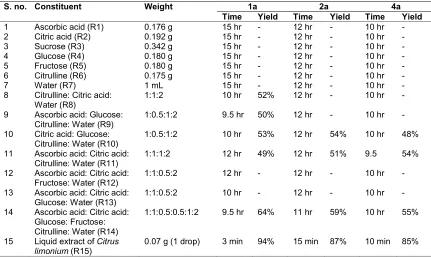
some of its major constituents as catalyst (Table 2). The perusal of Table 2 reveals that no major constituent was able to catalyze the reaction individually. Using different combinations of constituents catalyze selective reactions with low yield and long reaction time. Combination of ascorbic acid, citric acid, glucose, fructose, citrulline and water in the ratio 1:1:0.5:0.5:1:2 gave 1a, 2a and 4a in 64%, 59% and 55% yield in 9.5 hr, 11 hr and 10 hr respectively (Table 2). It may be concluded that some synergistic effect is responsible for the unprecedented catalytic activity of Citrus limonium for one pot two and
three component synthesis of
α-aminophosphonates, 1H-benzo[d]imidazoles and
Table 1. % Yield and reaction time of synthesized bioactive compounds using liquid extract of Citrus limonium and Citrus limonium-cyclodextrin composite
Entry Liquid extract of Citrus limonium Citrus limonium-β-cyclodextrin composite
Time (min) % Yield Time (min) % Yield
1a 3 94 35 76
1b 5 91 30 71
1c 10 88 40 79
2a 15 87 30 69
2b 20 90 35 66
2c 20 92 20 74
3a 40 77 15 92
3b 45 75 25 91
3c 30 78 35 88
4a 10 85 20 71
4b 15 84 25 75
4c 25 90 30 68
5a 35 74 20 85
5b 20 69 30 88
5c 40 72 35 90
1a:Diethyl [1-(2-methoxyphenyl)-1phenylamino] methylphosphonate; 1b:Diethyl [1-(3-nitrophenyl)-1phenylamino] methylphosphonate
1c:Diethyl [1-(4-methylphenyl)-1phenylamino] methylphosphonate; 2a:2-(3-methoxyphenyl)-1H-benzo[d]imidazole 2b:2-(3-nitrophenyl)-1H-benzo[d]imidazole; 2c:2-(4-chlorophenyl)-1H-benzo[d]imidazole
3a:6-amino-4-(4-methoxyphenyl)-2,4-dihydro-3-methylpyrano[2,3-c]pyrazole-5-carbonitrile; 3b:6-amino-4-(3-chlorophenyl)-2,4-dihydro-3-methylpyrano[2,3-c]pyrazole-5-carbonitrile
3c:6-amino-4-(4-fluororophenyl)-2,4-dihydro-3-methylpyrano[2,3-c]pysrazole-5-carbonitrile ; 4a:12-(4-methoxyphenyl)-9,10-dihydro-9,9 dimethyl-8H-benzo[a]xanthen-11(12H)-one
4b:12-(4-chlorophenyl)-9,10-dihydro-9,9-dimethyl-8H-benzo[a]xanthen-11(12H)-one;4c:12-(3-nitrophenyl)-9,10-dihydro-9,9-dimethyl-8H-benzo[a]xanthen-11(12H)-one
5a:13-(3-methoxyphenyl)-3,4-dihydro-2H-indazolo[2,1-b]phthalaine-1,6,11(13H)-trione; 5b:13-(4-chlorophenyl)-3,4-dihydro-2H-indazolo[2,1-b]phthalazine-1,6,11(13H)-trione
5c:13-(4-nitrophenyl)-3,4-dihydro-2H-indazolo[2,1-b]phthalazine-1,6,11(13H)-trione
Table 2. Synthesis of Compound 1a, 2a and 4a using main constituents of liquid extract of Citrus limonium
S. no. Constituent Weight 1a 2a 4a
Time Yield Time Yield Time Yield
1 Ascorbic acid (R1) 0.176 g 15 hr - 12 hr - 10 hr -
2 Citric acid (R2) 0.192 g 15 hr - 12 hr - 10 hr -
3 Sucrose (R3) 0.342 g 15 hr - 12 hr - 10 hr -
4 Glucose (R4) 0.180 g 15 hr - 12 hr - 10 hr -
5 Fructose (R5) 0.180 g 15 hr - 12 hr - 10 hr -
6 Citrulline (R6) 0.175 g 15 hr - 12 hr - 10 hr -
7 Water (R7) 1 mL 15 hr - 12 hr - 10 hr -
8 Citrulline: Citric acid:
Water (R8)
1:1:2 10 hr 52% 12 hr - 10 hr -
9 Ascorbic acid: Glucose:
Citrulline: Water (R9)
1:0.5:1:2 9.5 hr 50% 12 hr - 10 hr -
10 Citric acid: Glucose:
Citrulline: Water (R10)
1:0.5:1:2 10 hr 53% 12 hr 54% 10 hr 48%
11 Ascorbic acid: Citric acid:
Citrulline: Water (R11)
1:1:1:2 12 hr 49% 12 hr 51% 9.5 54%
12 Ascorbic acid: Citric acid:
Fructose: Water (R12)
1:1:0.5:2 12 hr - 12 hr - 10 hr -
13 Ascorbic acid: Citric acid:
Glucose: Water (R13)
1:1:0.5:2 10 hr - 12 hr - 10 hr -
14 Ascorbic acid: Citric acid:
Glucose: Fructose: Citrulline: Water (R14)
1:1:0.5:0.5:1:2 9.5 hr 64% 11 hr 59% 10 hr 55%
15 Liquid extract of Citrus
limonium (R15)
3.1 Characterization of Citrus limonium -β-cyclodextrin Composite
3.1.1 SEM analysis
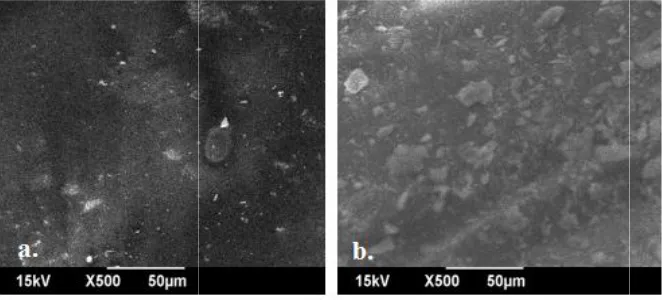
The SEM images of β-cyclodextrin and Citrus
limonium-β-cyclodextrin composite are shown in Fig. 1a and 1b respectively. SEM micrograph of β-cyclodextrin has smooth homogeneous surface
(Fig. 1a), whereas, Citrus limonium
-β-cyclodextrin composite has rough surface with cracks and heterogeneous crystalline particles of different sizes (Fig. 1b) [25]. The morphological
modification observed for Citrus limonium
-β-cyclodextrin composite indicated the linking of
liquid extract of Citrus limonium with
β-cyclodextrin.
3.1.2 X-ray diffraction (XRD) analysis
The formation of Citrus limonium-β-cyclodextrin composite was further confirmed by XRD pattern on the basis of degree of crystallinity. The XRD
pattern of Citrus limonium-β-cyclodextrin
composite shown in Fig. 2b exhibited numerous peaks with high intensity as compared to XRD pattern of β-cyclodextrin, Fig. 2a [25]. The change in XRD pattern confirmed the linking of
Citrus limonium with β-cyclodextrin, since crystallinity shifted to more crystalline structure which thereby resulted in increase in number and intensity of peaks (Fig. 2b) [26-27].
3.2 Characterization of Synthesized Compounds
1
H NMR spectra were recorded at ambient temperature on a Bruker Avance II 400MHz NMR
spectrophotometer using CDCl3 or DMSO as a
solvent and TMS as an internal standard.
Table 1, Entry 1a: Diethyl [1-(2-methoxyphenyl)-1phenylamino]
methylphosphonate
1
H NMR (CDCl3, TMS, 400 MHz): δ (ppm) 1.2
(3H, t, OCH2-CH3), 1.4 (3H, t, OCH2-CH3),
3.3-3.5 (1H, m, OCH2-CH3), 3.7-3.85 (1H, m, OCH2
-CH3), 4.2 (3H, s, OCH3), 4.35-4.5 (2H, m, OCH2
-CH3), 4.7 (1H, br s, N-H), 5.4 (1H, dd, NH-CH-),
6.7-7.6 (9H, m, Ar-H).
Table 1, Entry 1b: Diethyl [1-(3-nitrophenyl)-1phenylamino] methylphosphonate
1H NMR (CDCl
3, TMS, 400 MHz): δ (ppm) 1.25
(3H, t, OCH2-CH3), 1.35 (3H, t, OCH2-CH3),
3.7-3.85 (1H, m, OCH2-CH3), 4.05-4.15 (1H, m,
OCH2-CH3), 4.2-4.35 (2H, m, OCH2-CH3), 5.2
(1H, br s, N-H), 4.9 (1H, dd, NH-CH-), 6.7-7.4 (9H, m, Ar-H).
Table 1, Entry 1c: Diethyl [1-(4-methylphenyl)-1phenylamino] methylphosphonate
1H NMR (CDCl
3, TMS, 400 MHz): δ (ppm) 1.25
(3H, t, OCH2-CH3), 1.35 (3H, t, OCH2-CH3), 3.65
(2H, q, OCH2-CH3), 4.25 (2H, q, OCH2-CH3), 2.5
(3H, s, CH3), 4.25 (1H, br s, N-H), 4.65 (1H, dd,
NH-CH), 6.55-7.35 (9H, m, Ar-H).
Table 1, Entry 2a: 2-(3-methoxyphenyl)-1H -benzo[d]imidazole
1H NMR (CDCl
3, TMS, 400 MHz): δ (ppm) 3.55
(3H, s, -OCH3), 6.55-7.4 (4H, m, Ar-H), 7.7-8.2
(4H, m, Ar-H).
Table 1, Entry 2b: 2-(3-nitrophenyl)-1H -benzo[d]imidazole
1H NMR (CDCl
3, TMS, 400 MHz): δ (ppm)
6.6-7.25 (4H, m, Ar-H), 7.6-8.15 (4H, m, Ar-H).
Table 1, Entry 2c: 2-(4-chlorophenyl)-1H -benzo[d]imidazole
1
H NMR (CDCl3, TMS, 400 MHz): δ (ppm)
6.7-7.5 (4H, m, Ar-H), 7.65-8.25 (4H, m, Ar-H).
Table 1, Entry 3a:
6-amino-4-(4-
methoxyphenyl)-2,4-dihydro-3-methylpyrano[2,3-c]pyrazole-5-carbonitrile
1H NMR (DMSO, TMS, 400 MHz): δ (ppm) 1.55
(3H, s, -OCH3), 2.5 (3H, s, -CH3), 5.15 (1H, s,
-CH), 6.5 (2H, br s, -NH2), 7.2-7.55 (4H, m, Ar-H),
12.05 (1H, s, -NH).
Table 1, Entry 3b: 6-amino-4-(3-chlorophenyl)-2,4-dihydro-3-methylpyrano[2,3-c ]pyrazole-5-carbonitrile
1H NMR (DMSO, TMS, 400 MHz): δ (ppm) 2.7
(3H, s, -CH3), 5.3 (1H, s, CH), 6.4 (2H, br s,
-NH2), 7.25-7.6 (4H, m, Ar-H), 12.1 (1H, s, -NH).
Table 1, Entry 3c:
6-amino-4-(4-
fluororophenyl)-2,4-dihydro-3-methylpyrano[2,3-c]pysrazole-5-carbonitrile
1H NMR (DMSO, TMS, 400 MHz): δ (ppm) 2.6
(3H, s, -CH3), 5.25 (1H, s, CH), 6.45 (2H, br s,
Table 1, Entry 4a: 12-(4-methoxyphenyl)-9,10-dihydro-9,9-dimethyl-8H-benzo[a ]xanthen-11(12H)-one
1H NMR (CDCl
3, TMS, 400 MHz): δ (ppm) 0.85
(3H, s, -CH3), 1.05 (3H, s, -CH3), 1.4 (3H, s,
-OCH3), 2.45 (2H, s, -CH2), 2.6 (2H, s, -CH2), 5.7
(1H, s, -CH), 6.6-7.95 (10H, m, Ar-H).
Table 1, Entry 4b: 12-(4-chlorophenyl)-9,10-dihydro-9,9-dimethyl-8H-benzo[a ]xanthen-11(12H)-one
1
H NMR (CDCl3, TMS, 400 MHz): δ (ppm) 1.1
(3H, s, -CH3), 1.25 (3H, s, -CH3), 2.5 (2H, s,
-CH2), 2.7 (2H, s, -CH2), 5.55 (1H, s, -CH), 6.7-8.1
(10H, m, Ar-H).
Table 1, Entry 4c: 12-(3-nitrophenyl)-9,10-dihydro-9,9-dimethyl-8H-benzo[a ]xanthen-11(12H)-one
1
H NMR (CDCl3, TMS, 400 MHz): δ (ppm) 1.2
(3H, s, -CH3), 1.4 (3H, s, -CH3), 2.35 (2H, s,
-CH2), 2.65 (2H, s, -CH2), 5.6 (1H, s, -CH),
6.55-8.2 (10H, m, Ar-H).
Table 1, Entry 5a: 13-(3-methoxyphenyl)-3,4-dihydro-2H-indazolo[2,1-b ]phthalazine-1,6,11(13H)-trione
1H NMR (CDCl
3, TMS, 400 MHz): δ (ppm) 1.3
(2H, m, -CH2), 1.55 (2H, t, -CH2), 3.05 (2H, t,
-CH2), 3.8 (3H, s, -OCH3), 5.25 (1H, s, -CH),
6.3-6.8 (4H, m, Ar-H), 7.45-8.15 (4H, m, Ar-H).
Table 1, Entry 5b: 13-(4-chlorophenyl)-3,4-dihydro-2H-indazolo[2,1-b ]phthalazine-1,6,11(13H)-trione
1
H NMR (CDCl3, TMS, 400 MHz): δ (ppm) 1.15
(2H, m, -CH2), 1.4 (2H, t, -CH2), 3.2 (2H, t, -CH2),
5.4 (1H, s, -CH), 6.5-7.1 (4H, m, Ar-H), 7.5-8.3 (4H, m, Ar-H).
Table 1, Entry 5c: 13-(4-nitrophenyl)-3,4-dihydro-2H-indazolo[2,1-b ]phthalazine-1,6,11(13H)-trione
1H NMR (CDCl
3, TMS, 400 MHz): δ (ppm) 1.3
(2H, m, -CH2), 1.55 (2H, t, -CH2), 3.45 (2H, t,
-CH2), 5.65 (1H, s, -CH), 6.65-7.35 (4H, m, Ar-H),
7.75-8.5 (4H, m, Ar-H).
3.3 Principal Component Analysis
Entire data of Tables 1 and 2 were analyzed separately using principal component analysis.
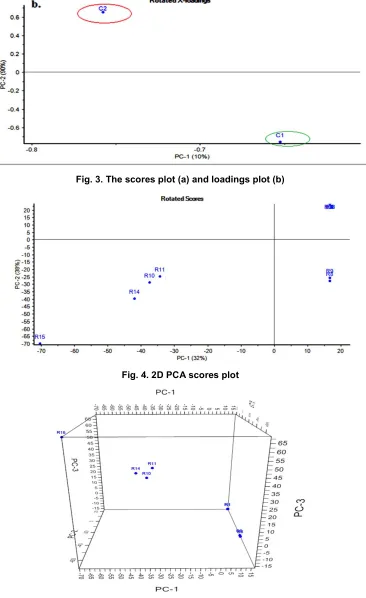
PCA on Table 1 generated scores and loadings plots of two principal components (Fig. 3), which
showed the distribution of synthesized
pharmacologically active compounds using liquid
extract of Citrus limonium (C1) and Citrus
limonium-cyclodextrin composite (C2). Plots reveals that C1 grouped with 1a-1c, 2a-2c and 4a-4c, whereas, C2 grouped with 3a-3c and
5a-5c; showing high catalytic activity of Citrus
limonium (C1) for the synthesis of
α-aminophosphonates (1a-1c), 1H
-benzo[d]imidazoles (2a-2c) and
9,10-dihydrobenzo[a]xanthen-11(12H)-ones (4a-4c);
and of Citrus limonium-cyclodextrin composite (C2) for the synthesis of
6-amino-2,4-dihydro-3-methylpyrano[2,3-c]pyrazole-5-carbonitriles
(3a-3c) and 3,4-dihydro-2H
-indazolo[2,1-b]phthalazine-1,6,11(13H)-triones (5a-5c).
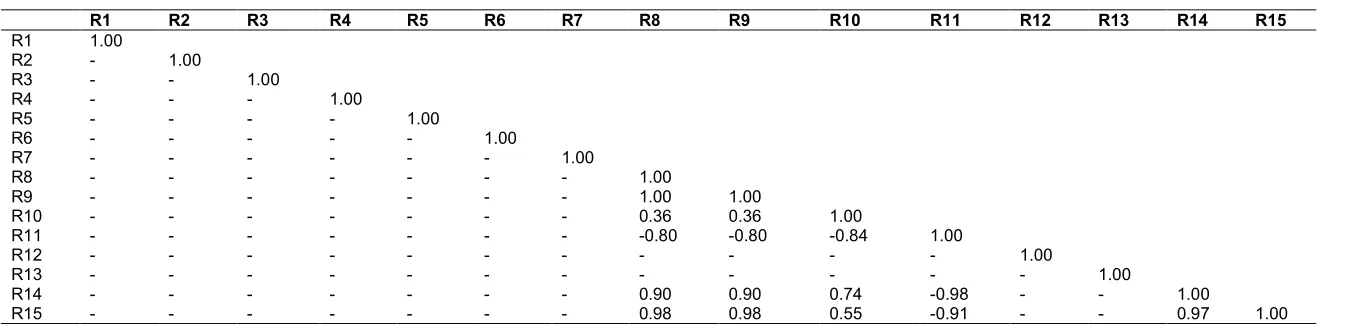
Correlation coefficient matrix of catalytic activity of the main constituents of liquid extract of Citrus limonium and its different combinations (Table 3) obtained via PCA technique on Table 2 shows correlation in two groups as:
Group 1- R11, R8, R9, R10, R14 Group 2- R15, R8, R9, R11, R14
Perusal of Table 3 evaluate that R11 has negative correlation with R8, R9 and R10; while R15 is negatively correlated with R11. Fig. 4 and Fig. 5 represents 2D (PC1-2) and 3D (PC1-2-3) scores plots of three principal components respectively and distributed main constituents of liquid extract of Citrus limonium and its different combinations into four clusters as:
Cluster I- R1, R2, R3, R4, R5, R6, R7, R12, R13 Cluster II- R8, R9
Cluster III- R10, R11, R14 Cluster IV- R15
Constituents in cluster I was not able to catalyze
the reactions. All the combinations of
constituents in cluster II and III contain citrulline in common, which further describe its synergistic role for the synthesis of 1a, 2a and 4a. Citrulline in combination with citric and ascorbic acid increases its catalytic activity (R14). R15 (liquid
extract of Citrus limonium) contributed to
separate cluster (cluster IV) due to its unprecedented catalytic activity as a function of synergistic effects of its constituents for
the synthesis of α-aminophosphonates,
1H-benzo[d]imidazoles and
Fig. 1. a). SEM micrograph of β
Fig. 2. a). XRD of β-cyclodextrin, b). XRD of
Fig. 1. a). SEM micrograph of β-cyclodextrin, b). SEM micrograph of Citrus limonium cyclodextrin composite
cyclodextrin, b). XRD of Citrus limonium-β-cyclodextrin composite Citrus
Fig. 3. The scores plot (a) and loadings plot (b)
Fig. 4. 2D PCA scores plot
11
Table 3. Correlation matrix for catalytic activity of main constituents and their combinations of liquid extract of Citrus limonium
R1 R2 R3 R4 R5 R6 R7 R8 R9 R10 R11 R12 R13 R14 R15
R1 1.00
R2 - 1.00
R3 - - 1.00
R4 - - - 1.00
R5 - - - - 1.00
R6 - - - 1.00
R7 - - - 1.00
R8 - - - 1.00
R9 - - - 1.00 1.00
R10 - - - 0.36 0.36 1.00
R11 - - - -0.80 -0.80 -0.84 1.00
R12 - - - 1.00
R13 - - - 1.00
R14 - - - 0.90 0.90 0.74 -0.98 - - 1.00
R15 - - - 0.98 0.98 0.55 -0.91 - - 0.97 1.00
4. CONCLUSION
In conclusion, liquid extract of Citrus limonium
and Citrus limonium-β-cyclodextrin composite permits the convenient, environmentally benign and cost-effective one-pot synthesis of
α-aminophosphonates, 1H-benzo[d]imidazoles,
9,10-dihydrobenzo[a]xanthen-11(12H)-ones,
6-amino-2,4-dihydro-3-methylpyrano
[2,3-c]pyrazole-5-carbonitriles and 3,4-dihydro-2H
-indazolo[2,1-b]phthalazine-1,6,11(13H) -triones. The major advantages of this method are totally nonpolluting solvent free green approach for one-pot synthesis of pharmacologically bioactive compounds within very short reaction time
affording high yield. Principal component
analysis and variable correlation analysis on data gave a significant approach to evaluate the catalytic efficiency of liquid extract of Citrus limonium and Citrus limonium-β-cyclodextrin composite, also, different constituents and their ratios of liquid extract of Citrus limonium were classified on the basis of its catalytic activity.
ACKNOWLEDGEMENT
Authors are sincerely thankful to DST, New Delhi for the award of DST-INSPIRE Fellowship.
Authors gratefully acknowledge Jawaharlal
Nehru University, Delhi, India for spectral analysis.
COMPETING INTERESTS
Authors have declared that no competing interests exist.
REFERENCES
1. Schwaebe MK, Moran TJ, Whitten JP.
Total synthesis of psorospermin.
Tetrahedron Lett. 2005;46:827-829.
2. Hafez HN, Hegab MI, Ahmed-Farag IS,
EI-Gazzar ABA. A facile regioselective synthesis of novel spiro-thioxanthene and spiro-xanthene-9’,2-[1,3,4]thiadiazole derivatives as potential analgesic and anti-inflammatory agents. Bioorg. Med. Chem. Lett. 2008;18:4538.
3. Kalyankar TM, Pekamwar SS, Wadher SJ,
Tiprale PS, Shinde GH. Review on Benzimidazole Derivative. Int. Journal of Chem. and Pharm. Sciences. 2012;3(4): 1-10.
4. Pandeya SN, Rai P. Review: Synthesis
and biological activity of benzimidazole
Derivatives. J. Sci. Res. Pharm. 2012; 1(4):1-4.
5. Ryu CK, Park RE, Ma MY, Nho JH.
Synthesis and antifungal activity of
6-arylamino-phthalazine-5,8-diones and
6,7-bis(arylthio)-phthalazine-5,8-diones. Bioorg. Med. Chem. Lett. 2007;17:2577– 2580.
6. Das D, Banerjee R, Mitra A. Bioactive and
pharmacologically important
pyrano[2,3-c]pyrazoles. J. Chem. Pharm. Res. 2014;
6(11):108-116.
7. Allen MC, Fuhrer W, Tuck B, Wade R,
Wood JM. Renin inhibitors. Synthesis of transition-state analog inhibitors containing phosphorus acid derivatives at the scissile bond. J. Med. Chem. 1989;32:1652-1661.
8. Das B, Laxminarayana K, Krishinaiah
M, Srinivas Y. An Efficient and
Convenient Protocol for the Synthesis of
Novel 12-Aryl- or
12-Alkyl-8,9,10,12-tetrahydrobenzo[a]xanthen-11-one
Derivatives. Synlett. 2007;20:3107-3112.
9. Li J, Tang W, Lu L, Su W. Strontium triflate
catalyzed one-pot condensation of β-naphthol, aldehydes and cyclic 1,3-dicarbonyl compounds. Tetrahedron Lett. 2008;49:7117-7120.
10. Wang HJ, Ren XQ, Zhang YY, Zhang ZH.
Synthesis 12-Aryl or 12-Alkyl-8,9,10,12-tetrahydrobenzo[a]xanthen-11-one
Derivatives Catalyzed by
Dodecatungstophosphoric acid. J. Braz. Chem. Soc. 2009;20:1939-1943.
11. Bazgir A, Seyyedhamzeh M, Yasaei Z,
Mirzaei P. A novel three-component method for the synthesis of
triazolo[1,2-a]indazole-triones. Tetrahedron Lett. 2007;
48:8790–8794.
12. Jitender MK, Devanshi M. p-TSA-catalyzed
one-pot synthesis of
12-aryl-8,9,10,12-tetrahydrobenzo[a]xanthen-11-ones in
ionic liquid and neat conditions
Tetrahedron Lett. 2009;50: 4777-4780.
13. Mosaddegh E, Hassankhani A. A rapid,
one-pot, four-component route to 2 H-indazolo[2,1-b]-phthalazine-triones. Tetrahedron Lett. 2011;52: 488–490.
14. Xiangming H, Huiqiang M, Yulu W.
p-TsOH Catalyzed synthesis of
2-arylsubstituted benzimidazoles. ARKIVOC. 2007;Xiii:150-154.
15. Lopez SE, Restrepo J, Prerez B, Ortiz S, Salazar J. One Pot Microwave Promoted
Synthesis of 2-Aryl-1H-Benzimidazoles
16. Patil VD, Medha G, Sharmesha M, Jaiswal A. A mild and efficient synthesis of benzimidazole by using lead peroxide under solvent free condition. Dev Chemica Sinica. 2010;1(2):125-129.
17. Kalla RM, Kim RM, Kim I.
Dibutylamine-catalysed efficient one-pot synthesis of biologically potent pyrans. Tetrahedron Lett. 2015;56:717-720.
18. Borse AU, Patil NL, Patil MN, Mali RS.
Synthetic utility of Kabachnik-Fields
reaction: A convenient one-pot
three-component synthesis of N -phenyl
isoquinolone-1-phosphonates Tetrahedron Lett. 2012;53:6940-6942.
19. Bhanushali MJ, Nandurkar NS, Jagtap SR,
Bhanage BM. ZrOCl28H2O: An efficient
catalyst for one-pot synthesis of α-amino
phosphonates under solvent-free
conditions. Synth. Commun. 2009;39:845-859.
20. Penniston KL, Nakada SY, Holmes RP,
Assimos DG. Quantitative assessment of citric acid in lemon juice, lime juice, and commercially-available fruit juice products. J. Endourol. 2008;22(3):567-570.
21. Patil S, Jadhav SD, Deshmukh MB.
Natural Acid Catalyzed Multi-component Reactions as a Green Approach. Arch. Appl. Sci. Res. 2011;3(1):203-208.
22. Agarwal D, Agrwal A, Bairagi A, Kasana
VK. Hydroxylamine Hydrochloride as an effective Catalyst for Formamide derivative Synthesis and their DPPH scavenging
activity. Res. J. Chem. Sci. 2014;4(10):54-57.
23. Agarwal, D., Verma, A., Dhanik, J. and
Kasana, V.K. Chemometric approach to evaluate catalytic activity of [CTAB/ 18-Crown-6]: A binary catalytic system for one pot green synthesis of 4-benzylidene-3-methylisoxazol-5(4H)-one derivatives at room temperature. Int. J. Chem. Stud. 2018;6(2):3003-3007.
24. Agrwal, A., Agarwal, D., Bairagi, A. and
Kasana, V.K. A Mild and Environmentally
benign Synthesis of Benzimidazoles:
Relevance to the pectin hetero
Polysaccharide as a Catalyst. Res. J. Recent. Sci. 2014;3:64-67.
25. Xi J, Qian D, Duan J, Liu P, Zhu Z, Guo J,
Zhang Y, Pan Y. Preparation,
Characterization and Pharmacokinetic
Study of Xiangfu Siwu Decoction Essential Oil/β-Cyclodextrin Inclusion Complex. Molecules. 2015;20:10705-10720.
26. Eid EM, Abdul AB, Suliman FEO, Sukari
MA, Rasedeo A, Fatah SS.
Characterization of the inclusion complex of zerumbone with hydroxypropylβ -cyclodextrin. Carbohydr. Polym. 2011;83: 1707–1714.
27. Periasamy R, Kothainayaki S, Rajamohan
R, Sivakumar K. Spectral investigation and characterization of host-guest inclusion
complex of 4,4 ′-methylene-bis
(2-chloroaniline) with beta- cyclodextrin. Carbohydr. Polym. 2014;114:558–566. _________________________________________________________________________________
© 2018 Agarwal et al.; This is an Open Access article distributed under the terms of the Creative Commons Attribution License
(http://creativecommons.org/licenses/by/4.0), which permits unrestricted use, distribution, and reproduction in any medium,
provided the original work is properly cited.
Peer-review history:
![Table 1 represents the percent (%) yield and reaction time for α-aminophosphonates (1a-1c), 1H-benzo[d]imidazoles (2a-2c), 6-amino-2,4-dihydro-3-methylpyrano[2,3-c]pyrazole-5-carbonitriles (3a-3c), 9,10-dihydrobenzo[a]xanthen-11(12H)- ones (4a-4c) and 3,4-dihydro-2H-indazolo[2,1-b]phthalazine-1,6,11(13H)-triones (5a-5c) obtained by multicomponent reaction using liquid extract of](https://thumb-us.123doks.com/thumbv2/123dok_us/8418265.1693177/5.612.112.505.93.247/represents-aminophosphonates-imidazoles-methylpyrano-carbonitriles-dihydrobenzo-phthalazine-multicomponent.webp)