Original Research Article
Determinants of menstrual hygiene among school going adolescent
girls in urban areas of Hyderabad
Sunil Pal Singh Chajhlana
1, Sai Ram Amaravadhi
2*,
Sai Deepika Mazodi
3, Venkata Sravani Kolusu
3INTRODUCTION
Menstrual hygiene is an essential aspect of hygiene for adolescent girls and women between menarche and menopause. Despite being an important issue concerning women and girls in the menstruating age group menstrual hygiene is often overlooked in the society. It continues to be amongst the most challenging development issues today. Not only do deep-rooted taboos, myths and misinformation create the illusion that menstruation is
inherently shameful but in countries like India, women and girls often lack access to hygienic sanitary materials and basic facilities Sanitary. Adolescence is a period between childhood and adulthood. World Health Organization (WHO) defines adolescents as individual between 10-19. The word adolescent is derived from the Latin word “adolescere”, which means to grow into maturity. Menarche is defined as onset on menstrual cycle. It is the hallmark of female pubertal development.1
ABSTRACT
Background: The word adolescent is derived from the Latin word “adolescere”, which means to grow into maturity. The adolescent girls get debarred due to various social misconceptions, lack of privacy, illiteracy of parents, especially mother, low socioeconomic conditions, and lack of proper health awareness and education about this sensitive issue which ultimately results this age group into vulnerability to reproductive tract infections, which can be reduced by improving the knowledge about the menstrual hygiene.
Methods: A cross sectional study was conducted among school going adolescent girls during the month of November 2018. Data was collected using a questionnaire which includes socio-demographic variables and menstrual hygiene practices. Sample size of the study was 69 students. The assessment of knowledge was done as good knowledge (score: >5/10) poor knowledge (score <5/10). The of data and the. All the data collected was entered and analysed with MS excel software 2007.
Results: 28.1% girls were aware of menstruation prior to attainment of menarche.. Major source of information about menstruation is mother (53.6%). More than 80% of adolescent girls are using sanitary pads as an absorbent. Lack of disposal facility and lack of water supply are reasons for school absenteeism.
Conclusions: In this study the knowledge of menstruation hygiene among the study population is significantly associated with mother’s education and occupation.
Keywords: Menstruation hygiene, Menarche, Reproductive tract infections, Vulnerability
Department of Community Medicine, 1Kamineni Academy of Medical Sciences and Research Centre, LB Nagar, Hyderabad, 2Kamineni Institute of Medical Sciences, Narkaptally, Nalgonda, Telangana, India
3
Kamineni Academy of medical sciences & Research centre, LB Nagar, Hyderabad, Telangana, India
Received: 29 March 2019
Revised: 12 April 2019
Accepted: 16 April 2019
*Correspondence:
Dr. Sai Ram Amaravadhi,
E-mail: [email protected]
Copyright: © the author(s), publisher and licensee Medip Academy. This is an open-access article distributed under the terms of the Creative Commons Attribution Non-Commercial License, which permits unrestricted non-commercial use, distribution, and reproduction in any medium, provided the original work is properly cited.
Menstruation may be defined as a periodic and cyclical shedding of endometrium accompanied by loss of blood. It takes place at approximately 28‑day intervals between the menarche (onset of menstruation) and cessation of menstruation is termed as Menopause.2
Menstruation is such an issue which is often clouded by various myths and misconceptions in our society.
Inspite of a normal physiological phenomenon, this topic is not discussed openly. The adolescent girls get debarred due to various social misconceptions, lack of privacy,
illiteracy of parents, especially mother, low
socioeconomic conditions, and lack of proper health awareness and education about this sensitive issue which ultimately results this age group into vulnerability to reproductive tract infections, which can be reduced by improving the knowledge about the menstrual hygiene Poor menstrual hygiene.
The reproductive health decisions of these generations will affect the health and wellbeing of their next generations and their community as this generation becomes the parents of next generation.
The restrictions like diet, cultural taboos are main reasons for adolescent girls not seeking help or discuss the issues during menstruation.3-5
Aim
To evaluate the menstrual hygiene practices among school going adolescent girls in urban area of Hyderabad.
Objectives
To study the socio demographic profile among
adolescent girls in Government high schools in urban field practice area of Community medicine.
To find out the factors associated with hygiene status of the study population.
METHODS
Study population: School going adolescent girls (VI to X standard).
Study area: Government High school, Urban filed
practice area of Dept. of Community Medicine.
Study design: A cross sectional study
Study variables: Socio-demographic variables (age,
caste, religion, parent’s education, occupation, income), menstrual hygiene practices.
Sample size: 69 students.
Study period
This study was conducted from 24-09-2018 to 29-09-2018.
Inclusion criteria
Those students who attained menarche. Students who has given the consent and are willing to participate in the study.
Exclusion criteria
Students who are not willing to participate in the study and who were seriously ill were excluded from the study.
Data collection
By using pre designed and pre tested and pre coded schedule which includes socio demographic data, perception, knowledge and practices during menstrual cycle. Permission of the school principal was obtained before the initiating the study and permission from head of institution was taken. Ethical clearance: obtained from Institutional ethical committee. Health awareness regarding menstrual hygiene and practices was given by medical officer and interns to the study population.
Scoring system was made on the basis of the questions in questionnaire. The assessment of knowledge was done as good knowledge (score: >5/10) poor knowledge (score <5/10).
Data compilation and analysis
All the data collected was entered and analyzed with MS excel software 2007. All tests were considered significant at p<0.05 level.
RESULTS
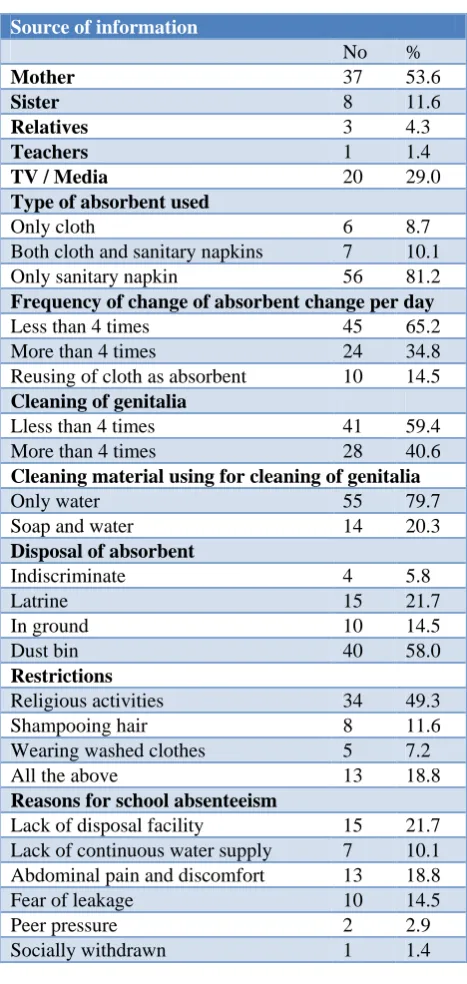
absorbent for more than 4 times a day during cycle. In the study 8.7% and 10.1% were using only cloth and both the cloth and sanitary pad as absorbent respectively. Only 14.5% were reutilizing the cloth. Present study reveals that only 40% are the girls are maintain genital hygiene by cleaning for more four times in a day and only 20.3% were using soap and water for cleaning purpose. In this study, 58.0% were disposing the absorbent in dust bin, 21.7% in latrine and 14.5% in ground and 5.8% in discriminate. Majority (around 50%) of the study participant were restricted form religious activities during the menstruation period. Majority of the girls have to keep themselves absent from the school and the abdominal pain, Lack of disposal facility and lack of water supply are reasons for school absenteeism (Table 1 and 2).
Table 1: Socio demographic factors and knowledge about menstruation among the study population
(n=69).
Variable N %
Age in years
13-14 33 47.8
14-15 27 39.1
15-16 9 13.0
Class of schooling
6.00 11 15.9
7.00 16 23.2
8.00 20 29.0
9.00 12 17.4
10.00 10 14.5
Father’s education
Illiterate 35 50.7
Primary schooling 9 13.0
secondary schooling 25 36.2
Mother’ s education
Illiterate 55 79.7
Primary schooling 14 20.3
Father’s occupation
Unskilled worker 41 59.4
Semiskilled 23 33.3
Skilled 5 7.2
Mother’s occupation
Housewife 29 42.0
Unskilled worker 40 58.0
Family income per month
5000-10000 51 73.9
10000-15000 18 26.1
Knowledge about menstruation
Normal physiological phenomenon 37 53.6
Don’t know 26 37.7
Disease 6 8.7
Don’t know 43 62.3
Stomach 14 20.3
Urinary tract 6 8.7
Uterus 6 8.7
Table 2: Knowledge, source of information and practices of menstrual hygiene among study
population (n=69).
Source of information
No %
Mother 37 53.6
Sister 8 11.6
Relatives 3 4.3
Teachers 1 1.4
TV / Media 20 29.0
Type of absorbent used
Only cloth 6 8.7
Both cloth and sanitary napkins 7 10.1
Only sanitary napkin 56 81.2
Frequency of change of absorbent change per day
Less than 4 times 45 65.2
More than 4 times 24 34.8
Reusing of cloth as absorbent 10 14.5
Cleaning of genitalia
Lless than 4 times 41 59.4
More than 4 times 28 40.6
Cleaning material using for cleaning of genitalia
Only water 55 79.7
Soap and water 14 20.3
Disposal of absorbent
Indiscriminate 4 5.8
Latrine 15 21.7
In ground 10 14.5
Dust bin 40 58.0
Restrictions
Religious activities 34 49.3
Shampooing hair 8 11.6
Wearing washed clothes 5 7.2
All the above 13 18.8
Reasons for school absenteeism
Lack of disposal facility 15 21.7
Lack of continuous water supply 7 10.1
Abdominal pain and discomfort 13 18.8
Fear of leakage 10 14.5
Peer pressure 2 2.9
Socially withdrawn 1 1.4
In this study the knowledge of menstruation hygiene among the study population is significantly associated with mother’s education and occupation (Table 3).
DISCUSSION
The present shows that 28.1% girls were aware of menstruation prior to attainment of menarche. Study conducted by Gupta et al.6
Table 3: Factor associate the knowledge of menstrual hygiene among the study population (n=69).
Variable
Good knowledge (n=37)
Poor Knowledge (n=32)
N (%) N (%)
Educational status of mothers
Illiterate (55) 24 (43.6) 31 (56.4)
Primary schooling (14) 13 (92.9) 1 (7.1)
Total (69) 37 (53.6) 32 (46.4)
P value Pearson Chi-Square10.871
a,
df 1 p<0.001
Occupation of mothers
Housewives (29) 11 (37.9) 18 (62.1)
Unskilled workers (40) 26 (65.0) 14 (35.0)
Total (69) 37 (53.6) 32 (46.4)
P value Pearson Chi-Square 4.953,
df 1, p<0.026
In this study the maximum number of girls (47.8%) attained menarche between 13-14 years of age in the study. Study conducted by Hemapriya et al.8 Found that the maximum number of girls (53.8%) attained menarche between 12-14 years of age. Similar range of menarche age was observed by Shabnam et al.9
More than 50% of the participants are aware that menstruation is a normal physiological phenomenon, 37.7% are not aware that it is a physiological phenomenon and 8.7% said that it is a disease condition.
Results found in the study conducted in Rajasthan by Khanna et al where 86.25% girls believed it to be a physiological process and Dasgupta et al observed that 86.25% girls believed it to be a physiological process.1,10
In present study, only 8.7% of the study participant is aware that menstrual blood originates from the uterus.
Study conducted by Ray et alfound that only 17.9% of the adolescent girls knew that uterus was the source of blood in menstruation.11
Present study reveals that major source of information about menstruation is mother (53.6%) followed by TV/media (29.0%).
Mother was the main source of information about menstruation.7 Study done in Nagpur also show that mothers were the first informants for 71.33% of the girls.12
More than 80% of adolescent girls are using sanitary pads as absorbent and majority of the study participants change the absorbent for more than 4 times a day during cycle. In this study 8.7% and 10.7% were using only cloth and both the cloth and sanitary pad as absorbent respectively in the present study Findings of study 8
show that89.2% were using pads as menstrual absorbent and the changing times of soaked absorbent were satisfactory (2-5 times in a day) in majority (65.3%) of the girls during menstruation, on other hand 5.8% girls mentioned they change according to the need. Study conducted in Punjab by Kamaljit et al reported that, majority of the girls (69%) used sanitary pad, whereas 23% used fresh cloth and 10% used old cloth, rag, cotton.13
Present study reveals that only 40% are the girls are maintain genital hygiene by cleaning for more four times in a day and only 20.3% were using soap and water for cleaning purpose. In study 8 cleaning of the genitals during menstruation was satisfactory (during micturition) in 67.9% whereas it was unsatisfactory (only during bath) in 12.2% of the girls, 8.8% and 11.2% girls stated that they cleaned less than and more than 3 times a day respectively.
In this study, 58.0% were disposing the absorbent in dust bin, 21.7% in latrine and 14.5% in ground and 5.8% in discriminate. Study 8 reports that disposing the used absorbent, majority of the girls (60.8%), burnt or buried their used menstrual absorbent, 29.1% girls threw it in the dust bin and 4.2% girls were washing and reusing the cloth material, whereas 6% girls disposed by flushing in the toilet.
Reusing the cloth material was reported in 7.4% girls by Shabnam et al,and 73.75% girls by and Dasgupta et al.1,9
Majority (around 50%) of the study participant were
restricted form religious activities during the
menstruation period. Shubhas et al showed that 73.64% and Dasgupta et al found that (85%) girls practiced different restrictions during menstruation.1,12 Majority of the girls suffer from abdominal pain, and.body pains and along with this reasons, lack of disposal facility, lack of water supply and various restrictions are reasons for school absenteeism.
Study 8 found that pain in abdomen was reported in 70.5% of the girls, followed by lower abdominal pain, muscle cramps, nausea or vomiting during menstruation
In this study the knowledge of menstruation hygiene among the study population is significantly associated with mother’s education and occupation similar finding were observed in the study conducted bySarkar.14
CONCLUSION
statistically significantly with mother’s education and occupation.
Hence, the students and the parents particularly mother should have a health awareness program regarding menstrual hygiene in the schools.
ACKNOWLEDGEMENTS
We would like to thank Principal, Government High school, Masoorabad; Mr. Hari Krishna, MSW, Dept. of Community medicine, KAMSRC, LB Nagar, Hyderabad; Mr. NagaRaju, MSW, UHTC, Dept. of Community medicine, KAMSRC, LB Nagar, Hyderabad.
Funding: No funding sources Conflict of interest: None declared
Ethical approval: The study was approved by the Institutional Ethics Committee
REFERENCES
1. Dasgupta A, Sarkar M. How hygienic is the
adolescent girl? Indian J Community Med. 2008;33(2):77-80.
2. Dutta DC. Menstrual cycle. In: Textbook of
Gynaecology. 5th ed. New central book agency (P) Ltd; 2008: 93.
3. Chothe V, Khubchandani J, Seabert D, Asalkar M, Rakshe S, Firke A, et al. Students’ perceptions and doubts about menstruation in developing countries: a case study from India. Health Promot Pract. 2014;15:319–26.
4. Narayan KA, Srinivasa DK, Pelto PJ, et al. Puberty rituals reproductive knowledge and health of adolescent school girls in south India. Asia Pac Popul J 2001;16:225–38.
5. Garg S, Sharma N, Sahay R. Socio-cultural aspects
of menstruation in an urban slum in Delhi, India. Reprod Health Matters.2001;9:16–25.
6. Gupta J, Gupta H. Adolescence and menstruation. J
Family Welfare. 2001;47:1–13.
7. Paria B, Bhattacharyya A, Das S. A Comparative Study on Menstrual Hygiene Among Urban and Rural. J Family Med Prim Care. 2014;3(4):413–7. 8. Hema Priya S, Nandi P, Seetharaman N, Ramya
MR, Nishanthini N, Lokeshmaran A. A study of menstrual hygiene and related personal hygiene
practices among adolescent girls in rural
Puducherry. Int J Community Med Public Health. 2017;4:2348-55.
9. Omidvar S, Begum K. Factors influencing hygienic
practices during menses among girls from south India- A cross sectional study. Int J Collaborative Res Intern Med Public Health. 2010;2(12):411-23. 10. Khanna A, Goyal RS, Bhawsar R. Menstrual and
reproductive problems: A study of adolescent girls in Rajasthan. J Health Manag. 2005;7:91–107. 11. Ray Sudeshna, Dasgupta Aparajita.Determinants of
menstrual hygiene among Adolescent girls: a multivariate analysis. National J Comm Med. 2012;3(2):294-301.
12. Thakre SB, Thakre SS, Reddy M, Rathi N, Pathak K, Ughade S. Menstrual hygiene: Knowledge and practice among adolescent school girls of Saoner, Nagpur district. J Clin Diagn Res. 2011;5:1027–33. 13. Kamaljit K, Arora B, Singh GK, Neki NS. Social
Beliefs and Practices associated with Menstrual Hygiene among Adolescent Girls of Amritsar, Punjab, India. JIMSA. 2012;25(2):69-70.
14. Sarkar I, Dobe M, Dasgupta A, Basu R, Shahbabu B. Determinants of menstrual hygiene among school going adolescent girls in a rural area of West Bengal. J Family Med Prim Care. 2017;6:583-8.