Original Research Article
Waterpipe smoking: prevalence and associated factors among Jazan
University students, Kingdom of Saudi Arabia
Ahmed A. Bahri
1, Ibrahim M. Gosadi
2*, Mohamed S. Mahfouz
1, Osama B. Albasheer
1,
Yahya H. Mawkili
3, Hamzah A. Mawkili
3, Hassan A. Yaqoub
3, Ahmed K. Alwan
3,
Mohammed A. Jawahy
3, Osama M. Jabbari
3INTRODUCTION
Waterpipe (WP) smoking is a form of tobacco smoking which is widely practised globally.1 The global spread gave the WP multiple names according to the place: "shisha""ma’assel" or "Goza" in Saudi Arabia and Egypt, "Argyle" or "Nargile” in Lebanon, Jordan and Syria, and "hookah" in Africa.2,3 The trend for WP smoking has
increased among the Middle East countries where the prevalence varies between 6% and 34%.2,4
According to the WHO report on the global tobacco epidemic (2011), tobacco smoking is responsible for the death of 6 million people on a yearly basis.5 Most of these fatalities occur in low and middle income countries.
ABSTRACT
Background: Waterpipe (WP) smoking exposes smokers to high levels of tobacco and toxins. This investigation is aiming to assess the prevalence of WP smoking among Jazan University students and to related influencing factors.
Methods: This is a cross-sectional study. Multistage random sampling was utilized to target several colleges in Jazan University. Data were collected using a self-administered questionnaire where information about demographics, knowledge, attitude, and practice were collected. Chi square test and T Students test were used to assess statistical difference of measured variable among studied groups.
Results: A total of 610 Jazan University students were recruited in this survey. The prevalence of students who had ever tried WP smoking (even once) was 52% and the proportion of participants who were current smokers at the time of recruitment was 34%. Being a male student, older than 21, related to health speciality and non-smoker was found to have a higher level of knowledge concerning WP smoking. A higher proportion of smokers were found to agree that WP smoking made them more attractive, agree that smoking WP is cheaper than cigarettes and agree that flavoured WP is less harmful than unflavoured WP when compared to non-smokers. Influence of gender smoking practice was apparent where most female student smokers were found to prefer to smoke with friends but not in the home or a cafe.
Conclusions: The prevalence of WP smoking detected among Jazan University students was relatively high which mandates appropriate implementation of educational health campaigns with targeting influencing social determinants.
Keywords: Waterpipe, Smoking, Tobacco, Prevalence, Jazan, Saudi Arabia
Department of Family and Community Medicine, Faculty of Medicine, 1Jazan University, Jazan, 2King Saud University, Riyadh, Kingdom of Saudi Arabia
3Faculty of Medicine, Jazan University, Jazan, Kingdom of Saudi Arabia
Received: 17 October 2018
Revised: 01 November 2018
Accepted: 02 November 2018
*Correspondence:
Dr. Ibrahim M. Gosadi, E-mail: [email protected]
Copyright: © the author(s), publisher and licensee Medip Academy. This is an open-access article distributed under the terms of the Creative Commons Attribution Non-Commercial License, which permits unrestricted non-commercial use, distribution, and reproduction in any medium, provided the original work is properly cited.
WP smoking may have a higher impact on the health of its smokers in comparison to cigarette smoking.
Ramifications posed by WP smoking originate from exposing WP smokers to higher levels of tobacco and toxins.2 WP smokers inhale larger amounts of smoke than the amount inhaled by cigarette smoking.6 Additionally, the public health significance of WP smoking stems from the fact that younger people are more likely to favour consuming tobacco via WP in comparison to other alternatives of tobacco consumption.2
WP smoking has a higher appeal among the younger population for various reasons. WP tobacco can have several sweet fruity flavours which makes it a more interesting alternative to cigarettes among the younger population.2,7 Additionally, with the wide use of social media, social activists can promote WP smoking as a lifestyle in cafés, at parties and in restaurants.8 Nonetheless, a misconception claiming that WP is less hazardous than cigarette smoking may induce the higher prevalence of WP smoking among the young.
A nationwide survey conducted by the Saudi Arabian Ministry of Health in 2013 included a sample of 10,735 individuals aged 15 years or older. This survey reported that 4.3% of the population are daily WP smokers. Additionally, it was observed that prevalence of WP smoking was higher in males compared to females in the surveyed Saudi population.9
The review by Schweisfurth and Kanaan reported a higher prevalence of WP smokers among the Saudi population than the prevalence reported by the Saudi Arabian Ministry of Health.2,9 This variation is mainly due to the difference in selected age groups. Based on these findings, it is possible to argue that younger populations in Saudi Arabia are at higher risk of engaging in WP smoking when compared to older people.
This investigation is aiming to assess the prevalence of WP smoking among Jazan University students. In addition, the association between social determinants and WP smoking is assessed. Finally, assessment of knowledge and misconception toward WP smoking, comparison of attitudes of WP smokers and non-smokers, and factors influencing the practice of smokers was conducted.
METHODS
This is a cross-sectional study conducted in Jazan, Saudi Arabia between March and April 2017. The study targeted Jazan University students. Ethical approval to conduct the study was provided by the Jazan Hospital Institutional Review Board, Jazan, Saudi Arabia.
Multistage random sampling was utilized. Initially, six colleges were selected randomly including health related
and non-health related colleges to test the influence of area of study on WP smoking. Since college campuses are separated by gender in Saudi Arabia, the second stage of sampling ensured equal recruitment of participants from both male and female campuses to assess the influence of gender on WP smoking. Finally, the number of recruited subjects from each college was weighted according to the total number of students registered in designated colleges. Assuming 50% prevalence of factors influencing WP smoking among university students, with 95% confidence interval and precision of 4, the sample size was estimated at 600, which was further increased to 660 with 10% non-response rate.
Data were collected using a self-administered questionnaire. The components of the questionnaire were acquired by reviewing relevant literature assessing WP smoking in Saudi populations. The questionnaire was developed in Arabic language and involved sections related to demographics, knowledge and misconceptions about WP smoking, attitudes towards WP smoking and practice of WP smokers with special emphasis on habits and socio-demographic characteristics pertaining to Jazan region such as Khat chewing. The questionnaire was reviewed by experts in the field of epidemiology and behavioural and social sciences to test the content validity. Additionally, face validity was tested via piloting the questionnaire on a sample of 10 male and 10 female students to ensure clarity and ability of the participants to fill in the questionnaire.
Knowledge components of the questionnaire asked the participants about health consequences of smoking WP and whether smoking WP is less harmful than cigarette smoking. A scoring system was developed where each correct answer was given one point. Points were then summed up to handle knowledge as a continuous variable and tested against measured study variables. Attitudes of the participants concerning cost, attractiveness, availability of flavoured tobacco and educational programs about WP were measured and compared between smokers and non-smokers. Smokers were asked about frequency, place, and smoking sessions duration. Additionally, smoking cigarettes and Khat chewing habits were recorded. Finally, smokers were asked about factors that might have influenced WP smoking initiation and attempts by the smokers to quit WP smoking.
RESULTS
A total of 610 Jazan University students were recruited in this survey. Table 1 illustrates the demographic characteristics of the recruited sample and their smoking status. Participants from both genders were equally recruited. The majority of recruited students were older than 21 years, living in rural areas and related to non-health specialities.
The prevalence of students who had ever tried WP smoking (even once) was 52%. The majority of those who tried smoking were males, older than 21, living in urban areas and related to non-health specialities. However, the proportion of participants who were current smokers at the time of recruitment was 34% of the total sample.
Table 1: Demographic characteristics of 610 Jazan University students and their WP smoking status.
All sample N (%)
Smokers * N (%)
Non smokers
N (%) P value**
Gender Males 305 (50) 192 (63) 111 (37) <0.001
Females 305 (50) 126 (41) 177 (59)
Age Under 21 238 (39.5) 105 (44) 132 (56) 0.001
Over 21 364 (60.5) 209 (57) 152 (43)
Residence Urban 274 (46.5) 157 (57) 115 (43) 0.027
Rural 315 (53.5) 152 (48) 161 (52)
Faculty Health 120 (19.7) 53 (44) 67 (56) 0.042
Non health 490 (80.3) 265 (54) 221 (46)
*Including those who tried smoking WP even once; **Chi square test.
Table 2: Influence of having a smoking family members, smoker friends and invitation to smoking according to WP smoking and age at initiation among a sample of 610 Jazan University students.
Tried WP smoking P value* Age at initiation P value*
Yes No <20 >20
Smoking family member Yes 181 92 <0.001 118 64 0.438
No 123 181 85 38
Friends Yes 277 164 <0.001 183 95 0.076
No 36 105 29 7
Invitation Yes 266 104 <0.001 176 90 0.310
No 50 183 38 12
*Chi square test.
Table 3: Knowledge of participants concerning WP smoking according to measured characteristics among a sample of 610 Jazan University students.
Variable Mean [SD] P value*
Gender Males 4.28 [1.2] 0.008
Females 4.00 [1.3]
Age Under 21 3.99 [1.3] 0.036
Over 21 4.22 [1.3]
Residence Urban 4.16 [1.3] 0.735
Rural 4.12 [1.3]
Faculty Health 4.49 [1.2] 0.001
Non health 4.05 [1.3]
Smoking status Smoker 4.00 [1.3] 0.006
Non-smoker 4.29 [1.2]
*Students T test.
The high proportion of those who tried smoking WP indicates the appeal of WP smoking among this study sample. In Table 2, the study assessed factors that may attract students to WP smoking such as having a smoking family member or a friend and being invited to smoke.
have friends who smoke when compared to those who do not have smoker friends with marginal statistical significance (p=0.07).
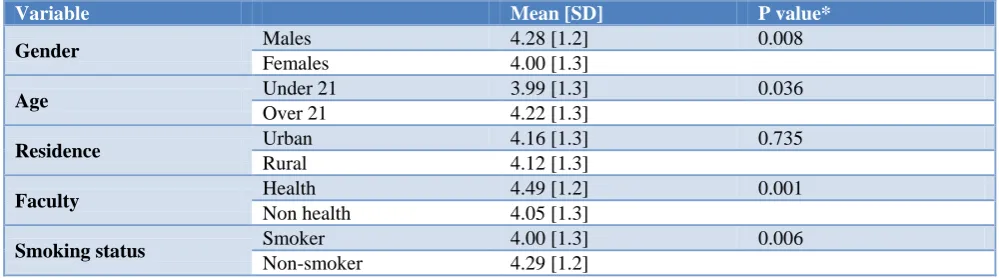
Table 3 illustrates knowledge level concerning WP smoking among the study sample. The mean score was 4.14 where the minimum score was 0 and the maximum
score was 6. The strongest factor influencing level of knowledge was type of faculty. Non-smokers scored higher knowledge scores in comparison to smokers. Additionally, male subjects performed better than females in the applied knowledge test. Nonetheless, only area of residence appeared to have no influence on level of knowledge of the studied sample.
Table 4: Comparison of attitudes of those who tried smoking to non-smokers among a sample of 610 Jazan University students.
Smokers Non-smokers P value*
I think WP smoking would make me attractive
Agree 36 9 <0.001
Disagree 259 272 Neutral 23 5
I think WP smoking cost less than cigarette smoking
Agree 126 54 <0.001 Disagree 93 99
Neutral 39 92
I think flavoured WP is less harmful than the unflavoured ones
Agree 104 37 <0.001 Disagree 101 128
Neutral 108 123
I think there are enough educational programs concerning WP smoking
Agree 66 50 0.539
Disagree 213 204 Neutral 38 34
*Chi square test.
Table 5: Influence of gender and residence on WP smoking behaviour among 208 Jazan University students who were current WP smoker.
Gender P value* Residence P value*
Male Female Urban Rural
Smoking frequency Once or less a week 72 40 0.379 64 47 0.359
more than once a week 56 40 45 43
Place of smoking
Home 22 12 <0.001 17 14 0.959
Cafe 53 11 33 29
Friends meetings 49 54 55 44
Smoking duration in a session
Less than an hour 56 52 0.739 61 42 0.609 More than an hour 27 28 28 23
Smoking cigarettes Yes 44 19 0.105 32 29 0.663
No 84 61 77 61
Khat chewing Yes 47 8 <0.001 22 32 0.013
No 81 71 87 57
Trying to quit smoking
Yes 52 39 0.074 48 40 0.346
No 31 41 41 25
*Chi square test.
Attitudes of those who tried smoking are compared to non-smokers in Table 4. The proportion of students who agree that WP smoking is attractive, agree that WP smoking is cheaper than cigarettes and agree that flavoured WP is less harmful than unflavoured ones is higher among smokers compared to non-smokers (p<0.001). The majority of the participants including smokers and non-smokers believe that there is a lack of educational programs concerning WP smoking.
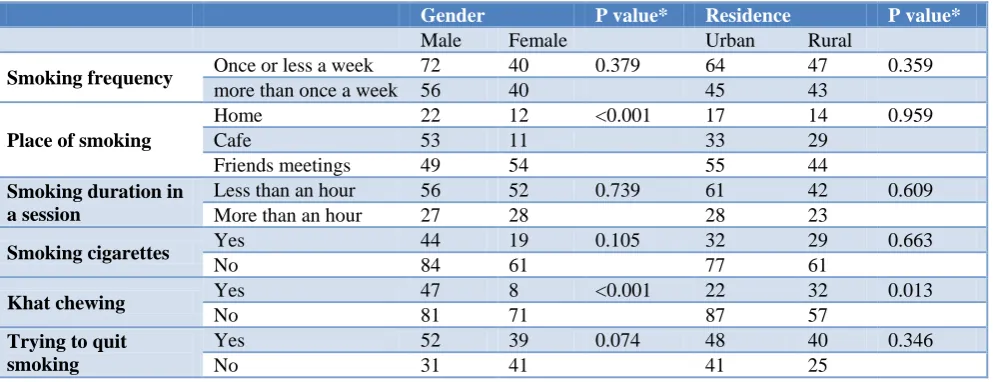
The influence of gender and area of residence on WP smoking behaviour is demonstrated in Table 5. The
students from rural areas were more likely to chew Khat in comparison to students from urban areas.
DISCUSSION
This study was aiming to investigate the prevalence of WP smoking among Jazan University students and to assess socio-demographic factors, knowledge, attitudes and practice related to WP smoking in this sample. The prevalence of students who tried WP smoking reached 52% and the prevalence of students who were current WP smokers was 34%. WP smoking was found to be more prevalent among males, those who are older than 21, students living in urban areas and related to non-health speciality. The strongest social factor which was found to encourage smoking WP was to have a smoker friend.
Being a male student, older than 21, related to health speciality and non-smoker was found to have a higher level of knowledge concerning WP smoking. A higher proportion of smokers were found to agree that WP smoking made them more attractive, agree that smoking WP is cheaper than cigarettes and agree that flavoured WP is less harmful than unflavoured WP when compared to non-smokers. Most female student smokers were found to prefer to smoke with friends but not in the home or a cafe. Most smokers who chew Khat were males and students from rural areas.
The prevalence of current WP smokers found in this study can be considered as relatively high when compared to older investigations conducted in the same community. A larger, older study conducted in Jazan University in 2011 and 2012 by Mahfouz et al. to investigate prevalence of smoking included a sample of 4,100 undergraduate university students and reported an overall prevalence of cigarette smoking of 11.4% and overall prevalence of WP smoking of 7.7%.10 The detected prevalence found in this study is exceedingly high. Although there are methodological differences between the current investigation and the previous study conducted by Mahfouz et al, which mainly stems from the difference in sample size, we cannot neglect the possibility of increase in prevalence of WP smoking during the subsequent period.
The consumption of tobacco products has been suggested to increase in Saudi Arabia. According to Moradi-Lakeh et al, the overall prevalence of smoking in Saudi Arabia increased from 12.2% in 2005 to 15.3% in 2013. This trend involved WP smoking where the prevalence increased among both genders.9
The study conducted by Al-Mohamed and Amin investigated patterns and prevalence of smoking among King Faisal University male students in Eastern province in Saudi Arabia.11 The prevalence of WP smoking among students registered in 2006/2007 academic year at King Faisal University was 14.6% which is lower than the prevalence found among our sample of male students.
However, the influence of demographic and social characteristics on WP smoking found in the study by Al-Mohamed and Amin was similar to the findings of our current investigation where being older, living in urban areas, having a smoking family member or a friend increased the risk of being a smoker. Additionally, the influence of a smoking friend was stronger than the influence of a smoking family member which is consistent with the findings of our study.
Students who were related to health specialities were found to be more knowledgeable about WP smoking in the current investigation. This notion is expected as those who are enrolled into health schools are likely to receive education concerning tobacco consumption ramifications as part of their curricular activities. This was similarly noted in a study investigating WP smoking knowledge of medical students in Lebanon.12
An Iraqi study involving 150 medical students reported that around half of the participants were active WP smokers.13 The measured attitudes concerning WP smoking in this Iraqi sample indicated that around one third of the Iraqi sample found WP smoking to be socially acceptable, about half of the sample think WP smoking is a sign of manhood and almost two thirds of the sample think that WP smoking is cheaper than cigarette smoking. The findings of the Iraqi study concerning attitudes towards WP smoking indicate a stronger positive attitude towards WP smoking when compared to our investigation. This reflects a possible role of cultural background in influencing attitudes towards WP smoking.
The findings of our investigation concerning the practice of WP smokers were contradicted by another Syrian study. The majority of female smokers in our sample preferred to smoke with friends but not in the home or in public places such as cafes. However, a Syrian study involving 587 university students reported that the majority of female student smokers preferred to smoke in public places such as cafes and restaurants.14 Similar to what was noted when comparing attitudes concerning WP smoking in an Iraqi sample to our Saudi sample, the observed difference in practice of WP smoking strengthens the claim about the influence of cultural variation of different populations on influencing different prevalence patterns of WP smoking.
This study has several areas of strength and weakness. The main strength of the study is the assessment of social factors influencing WP smoking in the studied community such as influence of friends, age and gender. These finding may change methods of health education programs concerning WP smoking when acknowledging the influence of social determinants. The weakness of this study stems from the use of self-administered questionnaires rather than interviews. Using qualitative approaches in this matter may shed light on social areas not explored using quantitative approaches.
In conclusion, the prevalence of WP smoking detected among Jazan University students was relatively high. Several social factors appeared to influence WP smoking where the strongest factor influencing smoking initiation was having a smoking friend. Participants’ knowledge and attitudes varied according to several factors. However, there is an overall agreement concerning the lack of educational programs related to WP smoking in this community. It is recommended to adopt new measures when designing health education campaigns to hinder the spread of WP smoking in this population, such as targeting youth, clarifying misconceptions about WP smoking and treating a smoking friend as a risk factor.
ACKNOWLEDGEMENTS
The authors acknowledge the valuable contribution of Khadijah A. Alfaifi and Samiah H. Mawkili in data collection.
Funding: No funding sources Conflict of interest: None declared
Ethical approval: The study was approved by the Jazan Hospital Institutional Review Board, Jazan, Saudi Arabia
REFERENCES
1. Menezes A, Wehrmeister F, Horta B, Szwarcwald C, Vieira M, Malta D. Frequency of the use of hookah among adults and its distribution according to sociodemographic characteristics, urban or rural area and federative units: National Health Survey, 2013. Rev Bras Epidemiol. 2015;18:57–67.
2. Schweisfurth, Kanaan A. Prevalence and Health Effects of Water Pipe (Shisha) Tobacco Smoking. Tob Use Insights. 2013: 75-84.
3. Al Moamary M, Al Ghobain M, Al Shehri S, Alfayez A, Gasmelseed A, Al-Hajjaj A. The prevalence and characteristics of water-pipe smoking among high school students in Saudi Arabia. J Infect Public Health. 2012;5(2):159–68.
4. Azab M, Khabour A, Alkaraki A, Eissenberg T, Alzoubi K, Primack B. Water pipe tobacco smoking among university students in Jordan. Nicotine Tob. Res. 2010;12(6):606-12.
5. WHO REPORT on the global TOBACCO epidemic, 2011 Warning about the dangers of tobacco. 2011.
6. Anjum Q, Ahmed F, Ashfaq T. Knowledge, attitude and perception of water pipe smoking (Shisha) among adolescents aged 14-19 years. J Pak Med Assoc. 2008;58(6):312–7.
7. Morton J, Song Y, Fouad H, El Awa F, Abou El Naga R, Zhao L, et al. Cross-country comparison of waterpipe use: nationally representative data from 13 low and middle-income countries from the Global Adult Tobacco Survey (GATS). Tob Control. 2014;23(5):419–27.
8. Cakmak V, Cinar N. Turkish adolescent perceptions about the effects of water pipe smoking on their health. Asian Pacific J Cancer Prev. 2016;16(18):8645–52.
9. Moradi-Lakeh M, Bcheraoui C, Tuffaha M, Daoud F, Al Saeedi M, Basulaiman M, et al. Tobacco consumption in the Kingdom of Saudi Arabia, 2013: findings from a national survey. BMC Public Health, 2015.
10. Mahfouz M, Alsanosy R, Gaffar A, Makeen A. Tobacco Use among University Students of Jazan Region : Gender Differences and Associated Factors. BioMed Res Int. 2014:2014.
11. Al-Mohamed A. Pattern and prevalence of smoking among students at King Faisal University, Al Hassa, Saudi Arabia. East Mediterr Health J. 2010;16(1):56-64.
12. Jradi F, Wewers M, Pirie P, Binkley P. Cigarette and waterpipe smoking associated knowledge and behaviour among medical students in Lebanon. East Mediterr Heal J. 2013;19(10):861–868.
13. Thabit M, Mohsin M, Niazy S. Water pipe (Shisha) smoking among a sample of Iraqi male college students : knowledge and attitudes. J Nurs Health Sci. 2015;4(6):50-4.
14. Maziak W, Fouad F, Asfar T, Hammal F, Bachir E, Rastam S, et al. Prevalence and characteristics of narghile smoking among university students in Syria. Int J Tuberc Lung Dis. 2003;8:882–9.