Original Research Article
A study on the work profile of ASHA workers in a district
of Odisha in eastern India
Mayadhar Panda, Sikata Nanda*, Rama Chandra Giri
INTRODUCTION
National Rural Health Mission (NRHM) was launched on 12th April 2005 by the Govt. of India to provide primary health care targeting the poor and vulnerable section of the community.1 The introduction of the Accredited Social Health Activist (ASHA) workers by the Ministry of Health and Family Welfare Department in 2005 was to improve the accessibility, availability and acceptability of the existing health facilities particularly in rural areas.2 ASHA workers were the female health volunteers, promoters of health services or a new group of community level health workers who were the key force
of action at the grass root level. NRHM projects ASHA worker as a health activist, to whom the community accepts and she bridges the gap between the health system and the community.3
The SRS 2016 data reveals that MMR (infant mortality ratio) in India is 130 per 100000 live births and that of Odisha is 180 per 100000 live births and according to NFHS-IV (2015-16), the IMR (infant mortality rate) of India 41/1000 live births and that of Odisha is 40/1000 live birth. In order to reduce the IMR and MMR as a part of achievement of the MDG goal besides reduction in specific disease and improvement of the nutritional
ABSTRACT
Background: Our aim was to study the socio demographic determinants of ASHA workers, to study the work profile of the ASHA workers, to assess the knowledge, awareness and practice of their roles and responsibilities in the delivery of health care services and to suggest specific recommendations on the ASHA scheme based on the study findings.
Methods: The type of study was a cross sectional study, placed at Khordha district in Odisha. Time Period of this study was March to June 2018. 1218 ASHAs were finally included in the study. On the days of the monthly sector / block level meetings with ASHA workers they were appraised and accordingly a predesigned, pretested questionnaire was implemented to them.
Results: Nearly 93% of ASHA workers were trained with module 1 to 5, first AID and DOTs training. Refresher training was given to 34% of ASHA workers, FTD/Malaria training was given to 88.4% of ASHA workers. 1218 (100%) ASHA’s helped in immunization. Majority of them 1199 (98.4%) accompanied delivery cases and 1198 (98.3%) were aware about family planning activities.
Conclusions: Activities of ASHA’s should be increased with a corresponding increase in incentives, so that she can get up to Rs. 10000-15000 per month. IEC/BCC skills to ASHA may be built by short course certification. Other services like strengthening the role of ASHA on promotive and preventive health care particularly age at marriage, nutrition, home based care delay in first child birth and spacing between 1st and 2nd birth.
Keywords: Work profile, ASHA, Workers
Department ofCommunity Medicine, SCBMCH, Cuttack, Odisha, India
Received: 17 November 2018
Accepted: 22 December 2018
*Correspondence:
Dr. Sikata Nanda,
E-mail: [email protected]
Copyright: © the author(s), publisher and licensee Medip Academy. This is an open-access article distributed under the terms of the Creative Commons Attribution Non-Commercial License, which permits unrestricted non-commercial use, distribution, and reproduction in any medium, provided the original work is properly cited.
status, the identified ASHA workers are trained along with regular reorientation for organized and adequate skill development.
Thirteen years down the line, with these existing linkage workers role, it is now time to assess their overall work profile. Therefore this study was conducted to get an overall information about the ASHAs’ work profile and to identify gaps if existing, so that we can recommend the NRHM, now called NHM (National Health Mission) to improve change in their working pattern. ASHAs’ work is not salary based, rather it is incentive based. Each ASHA worker is given 2000 as remuneration for the mandatory and ensured services which she provides to the community. Besides this, work based incentive is given based on their performance and that to never by cash. ASHAs are either daughter/daughter in laws of the same village.
Objectives
To study the socio demographic determinants of ASHA worker.
To study the work profile of the ASHA workers.
To assess the knowledge, awareness and practice of their roles and responsibilities in the delivery of health care services.
To suggest specific recommendations on the ASHA scheme based on the study findings.
METHODS
Type of study
Cross Sectional
Place of the study
Khordha district in Odisha.
Time period
January 2018 to June 2018.
The present study was conducted in Khordha district in the state of Odisha in India. The entire district caters to a population of 22,46,341 according to 2011 Census. (Present population of the district as per head count is 23,94,821). Out of which nearly about 52% of the total population reside in the rural areas of the village. There are a total of 10 blocks in the district, out of which 2 blocks having municipality areas, contain urban slums. The present study was carried out in all the 10 blocks of Khordha district. The total ASHAs working in every village/urban slums and the list of blocks, subcenters and sectors with details of every village was available from the chief district authority. Total number of ASHAs working in the 10 blocks including both rural villages & urban slums were 1228, out of which 23 were working in urban area and 1205 in rural villages. A total of 1205
ASHAs were positioned in 1775 villages, in the rural area. All the ASHA workers in the district were enrolled in the study. However, 1218 were finally included in the study because 10 could not be contacted.
The sector medical officer in-charge of the respective sectors were appraised about our and on the days of the monthly sector/block level meeting with ASHA workers were ascertained. (ASHA sector meeting was scheduled in each sector from 20th to 25th of every month as per the guideline) and accordingly a predesigned, pretested questionnaire was implemented to the ASHA worker after an informed written consent. The questions were given by different field level investigators who were trained. The questions was designed in English initially & and later translated to Odia and back retranslated to English to check the validity of the translated questions. The collected data was entered in Microsoft Excel, coding of the variables was done and SPSS version 21 was used for data analysis and thereby interpretation of the collected data was done by using appropriate statistical methods like percentage, proportion, chi square test and Fischer’s Exact test.
RESULTS
Table 1 depicts that out of a total 1218 ASHA’s working in Khordha district, majority of ASHA’s i.e. 1195 (98.84%) were working in rural areas and only 23 (1.9%) were working in urban area.
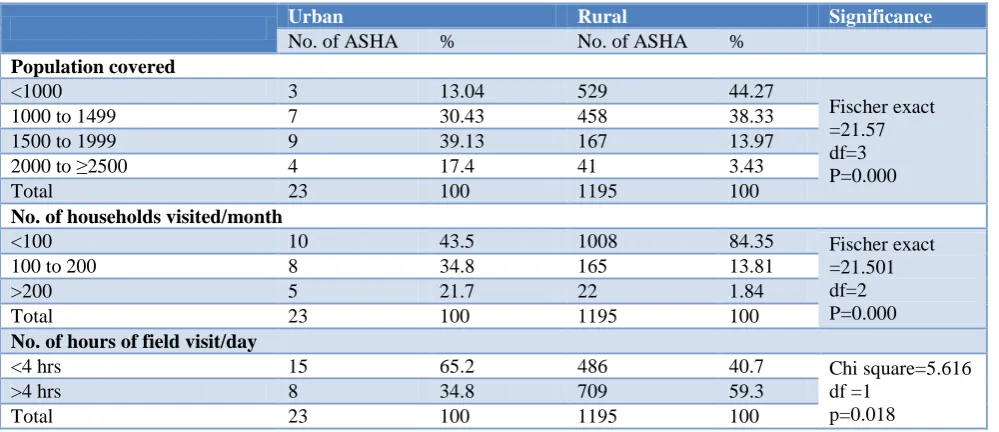
Table 2 shows the distribution of population & duties of ASHA workers. 529 (44.27%) of ASHA workers covered a population of <1000 in rural area. 744 (61%) of ASHA workers were assigned to work in 1 village followed by 474 in 2 or more villages.
Table 3 shows the relationship between educational status and place of residence. Out of a total of 1195 ASHA’s in rural area, 920 (76.98%) were educated to less than 10th class and 275 (23.01%) were educated to more than equal to 10th class. In urban area, out of 23 ASHA’s 15 (65.21%) were educated to more than equal to 10th standard. This difference in place of residence with educational status was found to be statistically significant.
Table 1: Distribution of ASHA workers according to socio economic profile.
Variables Urban (n=23) Rural (n=1195) Total (1218)
1. Age of participants in yrs.
No. % No. % No. %
<30 2 8.7 28 2.34 30 2.46
31-40 12 52.17 342 28.62 354 29.06
41-50 9 39.13 621 51.97 630 51.72
51-60 0 0 192 16.07 192 16.07
>60 0 0 12 1 12 1
2. Marital status
Married 14 60.9 923 77.24 937 76.92
Unmarried 7 30.4 69 5.77 76 6.23
Widow 2 8.7 195 16.32 197 16.17
Divorced 0 0 8 0.67 8 0.67
3. Type of family
Nuclear 8 34.8 195 16.32 203 16.66
3-generation 7 30.4 370 30.9 377 30.95
Joint 8 34.8 630 52.71 638 52.38
4. Education
Just Literate 0 0 49 4.1 49 4.1
Neo-literate 0 0 58 4.86 58 4.86
Primary 0 0 323 27.03 323 27.03
Middle 8 34.78 490 41 49 4.02
Secondary 8 34.78 220 18.41 228 18.71
Higher Sec 2 8.69 39 3.26 41 3.36
Graduation 5 21.74 16 1.34 21 1.72
5. Having child <5 yrs of age
Yes 7 30.43 112 7.37 119 9.77
P=0.003
No 16 69.56 1083 90.63 1099 90.22
6. House hold income in Rupees
5,000-10,000 7 30.43 904 75.64 911 74.99 𝑥2=24.47
df=1 p=0.000
10,000-20,000 16 69.56 291 24.3 307 25.2
7. Working in the same village/area of residence
Yes 9 39.13 919 76.9 928 76.19 𝑥2=17.749
df=1 p=0.000
No 14 60.86 276 23.09 290 23.8
8. ASHA workers working in assigned village/slum
≥2 village/slum 17 74 457 38.2 474 39 𝑥2=12.08
df=1 p=0.000
1 village/slum 6 26 738 61.8 744 61
Table 2: Distribution of duties of ASHA workers (n=1218).
Urban Rural Significance
No. of ASHA % No. of ASHA %
Population covered
<1000 3 13.04 529 44.27
Fischer exact =21.57 df=3 P=0.000
1000 to 1499 7 30.43 458 38.33
1500 to 1999 9 39.13 167 13.97
2000 to ≥2500 4 17.4 41 3.43
Total 23 100 1195 100
No. of households visited/month
<100 10 43.5 1008 84.35 Fischer exact
=21.501 df=2 P=0.000
100 to 200 8 34.8 165 13.81
>200 5 21.7 22 1.84
Total 23 100 1195 100
No. of hours of field visit/day
<4 hrs 15 65.2 486 40.7 Chi square=5.616
df =1 p=0.018
>4 hrs 8 34.8 709 59.3
Table 3: Relationship between educational status and place of residence of ASHA workers.
Place of residence Urban Rural Significance
No. of ASHA % No. of ASHA %
Educational level ≥10th 15 65.2 275 23 𝑥2=22.158,
df=1 P=0.000
Educational level <10th 8 34.8 920 77
Total 23 100 1195 100
Table 4: Relationship between monthly family income of ASHA workers and place of residence.
Monthly income Urban Rural Significance
No. of ASHA % No. of ASHA %
5,000 – 10,000 7 30.4 904 75.7 𝑥2=24.47
df=1 P=0.000
10,000 – 15,000 16 69.6 291 24.3
Total 23 100 1195 100
Table 5: Relationship between years of experience and monthly income amongst ASHA’s working in rural area.
Monthly income
Monthly income (n=1195, Rural)
Significance
<10,000/- >10,000/-
No. of ASHA % No. of ASHA %
Chi square=8.038 df=1, P=0.005
<10 yr 167 18.5 33 11.3
>10 yr 737 81.5 258 88.7
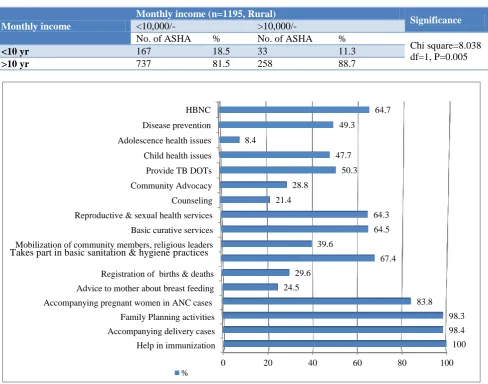
Figure 1: Awareness regarding the responsibilities of ASHA worker (multiple responses).
Table 5 shows the relationship between years of experience and monthly income. Amongst the total 1195 ASHA’s working in rural areas, 904 had monthly income less than 10,000/- and 291 had income >Rs. 10,000/-. Out of 904 ASHA’s having income <Rs.10,000/-, 737
(81.5%) had >10 years experience. Similarly, out of total 291 ASHA’s having >Rs.10,000/- monthly income 258 (88.7%) had >10 years of experience. Hence it was found that ASHA’s having more years of work experience had more income and which was found to be significant.
0 20 40 60 80 100
Help in immunization Accompanying delivery cases Family Planning activities Accompanying pregnant women in ANC cases
Advice to mother about breast feeding Registration of births & deaths Mobilization of community members, religious leaders Basic curative services Reproductive & sexual health services Counseling Community Advocacy Provide TB DOTs Child health issues Adolescence health issues Disease prevention HBNC
100 98.4 98.3 83.8 24.5
29.6
67.4 39.6
64.5 64.3 21.4
28.8
50.3 47.7 8.4
49.3
64.7
%
The awareness level of the responsibilities of ASHA worker is represented in Figure 1, wherein all 1218 (100%) ASHA’s helped in immunization. Majority of them 1199 (99.17%) accompanied delivery cases and 1198 (98.3%) were aware about family planning activities. 1021 (83.8%) were aware about accompanying pregnant women for ANC care, but only 24.65% gave advice to mothers about breast feeding and 361 (29.86%) registered births and deaths.
Table 6 depicts the provision of accessories and remuneration to ASHA workers. Payment to ASHAs was done in time according to 100% of the respondents and that to by e-transfer both in urban and rural areas
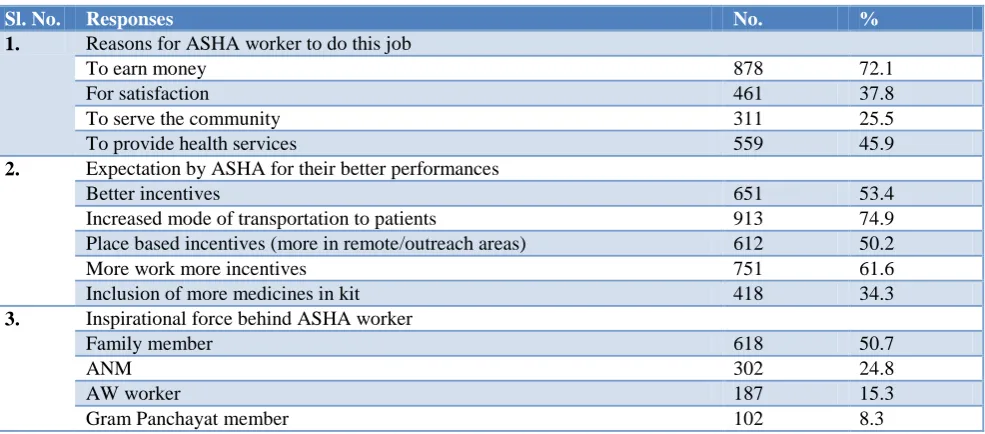
The different motivational factors & expectations of ASHA workers are reflected in Table 7. Regarding reasons for an ASHA worker to perform and take this job as a profession about 878 (72%) reported that earning money was the main reason.
Table 6: Provision of accessories and remuneration given to ASHA workers.
Sl. No. Characteristics Urban (n=23) Rural (n=1195)
No. % No. %
1.
Payment done in time
Yes 23 100 1195 100
No 0 0 0 0
2.
Mode of payment
E-transfer 23 100 1195 100
Cheque 0 0 0 0
Cash 0 0 0 0
3. Accessories given to ASHA
Umbrella 0 0 1167 97.6
Bicycle 0 0 1167 97.6
Mobile 10 43.5 763 63.8
Drug Kit 12 52.2 1031 86.3
Torch 0 0 56 4.6
Radio 0 0 23 1.9
HBNC Kit 14 60.9 1163 97.3
*Multiple responses.
Table 7: Different motivational factors and expectations of ASHA workers (n=1218).
Sl. No. Responses No. %
1. Reasons for ASHA worker to do this job
To earn money 878 72.1
For satisfaction 461 37.8
To serve the community 311 25.5
To provide health services 559 45.9
2. Expectation by ASHA for their better performances
Better incentives 651 53.4
Increased mode of transportation to patients 913 74.9
Place based incentives (more in remote/outreach areas) 612 50.2
More work more incentives 751 61.6
Inclusion of more medicines in kit 418 34.3
3. Inspirational force behind ASHA worker
Family member 618 50.7
ANM 302 24.8
AW worker 187 15.3
Gram Panchayat member 102 8.3
*Multiple responses.
The practice of ASHA workers in regard to their record keeping is represented in Table 8 wherein nearly 602 (49.4%) of ASHA workers maintained the drugs register, 50.3% household survey register, ANC record in 34%, meeting register by 34% workers. The immunization and
family planning record each was maintained by18% and 17.8% of ASHA workers respectively.
hurdles like overburden of work and 710 (58.3%) felt that there was no compensation or reward for their performances. 591 (48.5%) felt that that the time spent in the field was the greatest obstacle for them. Besides this
612 (50.2%) ASHA’s felt that activity based incentive and 42% felt that involvement in each & every health programme was the greatest challenge for them for their performance.
Table 8: Practice of ASHA’s regarding their record keeping (n=1218).
Sl. No. Various record keeping by ASHA worker No. %
1. ANC records 413 34.0
2. Immunization record 219 18
3. Family planning record 218 17.8
4. Household survey register 613 50.3
5. Birth & death register record (vital statistic record) 328 27.0
6. Delivery record 331 27.2
7. Meeting register 415 34
7. Drug register 602 49.4
8. Patient register 101 8.3
*Multiple responses.
Table 9: Challenges faced by ASHA workers (n=1218)*.
Sl. No. Variables No. %
1. Activity based incentives 612 50.24
2. No compensation or reward for performances 710 58.3
3. Overburden of work 617 50.6
4. Training session 410 33.6
5. Spending time on hot days in field 591 48.5
6. Involvement in each and every health programme 513 42.1
*Multiple responses.
DISCUSSION
Out of 1218 ASHA’s only 119 (9.77%) had 1 or more children of <5 yrs of age. 911 (74.79%) of ASHA’s had household income between Rs. 5,000-10,000. Similarly majority of ASHA workers, i.e. 928 (76.19%) were working in the same village/area of residence. In this study majority of ASHA workers were in the age group of (41-50) yrs. However in two studies conducted by Washel et al and Srivastava et al revealed that (20-29) yrs was the age group for enrolment of ASHA workers.4,5 Regarding ASHA’s education selection criteria is 8th
class but in certain circumstances reduced due to non-availability, as it is the need of the hour. Similar results are also seen by a study done by Jain et al.6 Surti et al in their study showed that females from joint families had less work stress than women from nuclear families.7 744 (61%) ASHA workers were working in assigned 1 village/slum and 474 (39%) were working in 2 or more villages/slums. This was found more so in urban areas because of less numbers of ASHAs were working in the urban slum areas which was also found to be statistically significant. Shet et al in a study at Karnataka revealed that 69% of ASHA workers covered a population size of 1000-1500 and 94% of them were covering a single village. 61% conducted (0-100) house visits and 89% visited the field for 2.30 to 5 hrs per day.8
In rural areas, 1008 (84.35%) of ASHA’s made <100 household visit followed by 165 (13.81%) made 100 to
200 visits per month. 10 (43.47%) urban ASHAs made <100 visits per month, more no. of ASHAs made <100 home visits in rural area than urban ASHAs comparatively and this difference was found to be significant. Similarly, out of 1195 ASHAs in rural areas, 709 (59.3%) conducted >4 hours field visit/day whereas in urban areas out of 23 ASHA’s 15 (65.21%) conducted field visit <4 hrs a day and this difference was observed to be significant.
Garg et al in a study in rural Haryana about awareness & practice of ASHA workers on their job responsibilities showed that all (100%) of ASHA workers helped in immunization, 98% accompanied delivery cases, 96.40% helped in family planning and 17% in registration of births and deaths.9 In the same study when ASHA’s were asked about knowledge on complications during pregnancy 85 (80.95%) could correctly mention vomiting, 73 (69.5%) swelling of hands and feet, 27 (25.71%) anemia and only 11 (10.47%) about visual disturbances. In the same study very few ASHAs mentioned assisting ANM in village health planning, creating awareness on basic sanitation, personal hygiene the results of which happens to be similar to our study.
visits, role plays in participation in village health and nutrition day, participation and individual roles on village health and sanitation committee.
Kumar et al in his study on work performance of ASHA’s under NRHM, reflected the knowledge, practices of ASHA’s and found that only 68 (81%) agreed on visiting the newborn.13 In the same study 130 (98.5%) actually accompanied the pregnant women to hospital, 85 (78.%) gave DOTs therapy, 66 (73.3%) mobilized community to access health services at different facilities. Majority of them 92 (92.2%) counseled pregnant lady on safe delivery, ANC, breast feeding, contraception etc and 29 (61.7%) created community awareness on determinants of health.
Swain et al have reported that only 48% of ASHA’s were aware about various health determinants as a part of the job responsibility.14 Shet et al in her study reveals that the most important demand of the ASHA workers were their monthly salary in the place of activity based performance incentive.8 Activity based incentives was one of the de-motivating factors for them in the long run. In a study conducted by Sasina et al and Want et al, ASHA worker complained about delay in paying incentives.11,12
Activities of ASHA’s should be increased with a corresponding increase in incentives, so that she can get up to Rs. 10000-15000 per month. IEC/BCC skills to ASHA may be built by short course certification. A small subject of ASHA like ASHA A/B can be created and provided training on higher skill set on home delivery, asphyxia management and home based care at home.13,14
CONCLUSION
Services like strengthening the role of ASHA on promotive and preventive health care particularly age at marriage, nutrition, home based care delay in first child birth and spacing between 1st and 2nd birth. Joint training of ASHA and ICDS worker should be done as a part of all national programmes. Aspirant ASHA for higher learning should be given opportunity for career building i.e. ANM and GNM courses and with support of PIP (age relaxation). Training modules should be more on demonstration rather than theory, so that they get a deep insight on the motivation factors to improve ASHA’s performance.
Funding: No funding sources Conflict of interest: None declared
Ethical approval: The study was approved by the Institutional Ethics Committee
REFERENCES
1. Government of India, National Rural Health
Mission: Mission document. Available at:
http://mohfw.nic.in/NRHM/Documents/Mission_do cument.pdf. Accessed on 28th Nov 2012.
2. Kori S, Bhatia M, Mishra A. A cross sectional assessment of knowledge of ASHA worker. J Krishna Instit Med Sci Univ. 2015;4(4):25-9. 3. Darshan K. Vanshi M, Patel M, Kartha G, Purani S,
Nagar S, et al. A cross sectional study of the knowledge, attitude and practice of ASHA worker regarding child health (under 5 years of age) in Surendranagar district. Health line. 2011;2(2):50-3.
4. Waskel B, Dixit S Singodia R. Evaluation of ASHA
programme in selected block of Raisen district of Madhya Pradesh under the National Rural Health Mission. J Evol Med Dental Serv. 2014;3(3):689-94.
5. Srivastava DK, Prakash S, Adhish V, Nair KS, Gupta S, Nandan D. A study of interface of ASHA with the community and the service providers in Eastern Uttar Pradesh: Indian J Public Health. 2009;53(3):133-6.
6. Jain N. Srivastava NK, Khan AM, Dhar N, Manon S, Adhish V, et al. Assessment of functioning of ASHA under NRHM in Uttar Pradesh. Health Population Perspectives Issues. 2008;31(2):132-40. 7. Surti K, Supriya D. Psychological factors affecting
women entrepreneurs :some findings. Indian J Social Work. 1983;5:287-95.
8. Shet S, Sumit S, Phadnis S. A study on assessment of ASHA’s work profile in the contest of Udupi Taluk, Karnataka, India. Clin Epidemiol Global Health. 2017;8(4):1-5.
9. Garg P, Bhardwaj A, Singh A, Alluwalia S. An evaluation of ASHA workers awareness and practice of their responsibilities in rural Haryana. National J Community Med. 2013;4(1):33-7. 10. Gosavi SV, Raut AV, Desmukh PR, Meh endale
AM. ASHA’s awareness & perception about their roles and responsibilities; A study from rural Wardha. J Inst Med Sci. 2011;1(16):21-7.
11. Saxena V, Kakkar R, Semwal VD. A study on ASHA – a change agent of the society. Indian J. Community Health. 2012;24(1):15-8.
12. Wang H, Juyal RK, Miner SA, Fischer E.
Performance based payment system for ASHA’s in India; What does international experience tell us? Intra Health. 2012: 1-36.
13. Kumar S, Kausik A, Kansal S. Factors influencing the work performance of ASHA under NRHM – A cross sectional study from eastern Uttar Pradesh; Indian J Community Health. 2012;24(4):325-31. 14. Swain S, Swain P, Nair KS, Dhar N, Gupta S,
Nandan D. A rapid appraisal of functioning of ASHA under NRHM in Odisha: Health and Population: Perspectives Iss. 2008;31(2):73-9.