http://www.ijcmph.com pISSN 2394-6032 | eISSN 2394-6040
Original Research Article
Assessment of knowledge and practice on plastics among the
professional course students of Annamalai University, Tamil Nadu
N. Srinivasan, V. Swarnapriya*, A. J. W. Felix, T. Pravin
INTRODUCTION
Plastic is a miracle material and it is ubiquitous, resulting in one of our planet’s greatest environmental challenges. Our oceans have been used as a dumping ground, choking marine life and transforming some marine areas into a plastic soup. In cities around the world, plastic waste clogs drains, causing floods and breeding disease. Consumed by livestock, it also finds its way into the food chain1.Burning of plastics cause emissions of toxic gases and release a toxic carcinogen called dioxin. The dioxin affects the function of the reproductive and immune system. It is also associated with skin and respiratory problems resulting from exposure to and inhalation of toxic fumes, especially hydrocarbons and residues released during the process.2 Plastic bag wastes pose serious environmental pollutions and health problems in
humans and animals. Accumulation of plastic bag wastes causes environmental pollution that can be manifested in number of ways.3 Due to non-biodegradable nature they cause hazardous negative impact on the environment. Disposal of plastic waste which is a major cause of environment pollution becomes carcinogenic to human, birth defects, impaired immunity, endocrine disruption, development and reproductive effect. In addition to dumping of plastic material into marine, a large number of species are known to be harmed or killed which could jeopardize their survival, especially since many are already endangered by other forms of anthropogenic activities.4 A range of chemicals that are used in the manufacture of plastics are known to be toxic.5 The toxic chemicals along with its carcinogenicity will cause social and health impacts by affecting the respiratory, nervous and reproductive systems. The United Nations
ABSTRACT
Background: The use of plastics made life easy in day to day life. However, the disposal of it remains a public health problem worldwide. Plastic waste are major cause of environment pollution becomes carcinogenic to human, birth defects, impaired immunity, endocrine disruption, development and reproductive effect. Raising the awareness of the different stake holders is suggested by United Nations Environment Programme. Assessing the knowledge and practice of the student community, especially of the professional courses, in this regard is considered as a vital one.
Methods: A total of 563 students of professional courses were included in the study. Their knowledge in terms general aspects, ill effects, reuse and practice in terms of usage and disposal were assessed with a questionnaire.
Results: 46% of the students found having good knowledge. Only 27.6% were found to have good practice. Though the students have good knowledge on ill effects of plastics, their practice in terms of disposal was less. Significant variations were observed among the students of different courses.
Conclusions: Addressing the gap between knowledge and practice in terms of designing messages for proper disposal and avoiding usage of single use plastics at individual and collective level is required.
Keywords: Plastics, Components of knowledge and practice
Department ofCommunity Medicine, Rajah Muthiah Medical College, Annamalai University, Tamil Nadu, India
Received: 02 January 2019
Accepted: 17 January 2019
*Correspondence:
Dr. V. Swarnapriya,
E-mail: [email protected]
Copyright: © the author(s), publisher and licensee Medip Academy. This is an open-access article distributed under the terms of the Creative Commons Attribution Non-Commercial License, which permits unrestricted non-commercial use, distribution, and reproduction in any medium, provided the original work is properly cited.
Environment Programme document suggests a 10 steps roadmap for policy makers while imposing ban on single use plastics. One among them is raising awareness of the users.1
Many attempts have been made to address the negative impacts of usage of plastics by recycling and banning of the production of one time use plastics. Recently, the government of Tamil Nadu has banned the one time use of plastics, numbering 14 items, from January 1, 2019.
With this background, this cross sectional study was carried out to determine the level of knowledge and practice of students, with regard to plastics, pursuing professional courses (Medicine, Dentistry, Physiotherapy, Agriculture and Engineering) in Annamalai University.
Objective
The study was carried out to find out the level of knowledge and practice of first year professional course students with regard to plastics.
METHODS
In this cross sectional study, all the students of first year MBBS, Dentistry, Physiotherapy students studying in Annamalai University, Annamalainagar, were included. This study was conducted between September 2018 and November 2018. With regard to agriculture and engineering streams a sample of 10 percent were included as the number of students is large. Thus, the total participants are 563.
Data collection
Data collection was carried out using a pre-tested, structured questionnaire. This questionnaire consists of 3 sections. The knowledge was assessed in terms of general aspects (4 questions), ill effects (15 questions), and reuse (3 questions). Practice was assessed in terms of usage (4 questions) and disposal (6 questions). All the answers were coded 1 for correct answers and marked 0 for wrong responses. The range of score for knowledge is 0 to 22 and 0 to 14 for practice.
Scoring and interpretation
Knowledge on plastics was classified as good if the score is above 70% (16 -22), satisfactory with a score of 50-69% (11-15) and poor with a score of less than 50% (<11). Practice was classified as good if the score is above 70% (10-14), satisfactory with a score of 50-69% (7-9) and poor with a score of less than 50% (<7).
Data analysis
The data were analysed using SPSS software for windows (Statistical Package for Social Sciences) version
20. P value less than 0.01 was considered as statistically significant.
RESULTS
Among the 576 subjects of the study, female constitute 51.2% followed by male students. With regard to the course of the study subjects, a majority were from agriculture followed by medicine, engineering, dentistry and physiotherapy (Table 1).
Table 1: Distribution of the respondents according to sex and course (n=576).
Variables Frequency %
Sex Female 295 51.2
Male 281 48.8
Course
Engineering 97 16.8
Agriculture 216 37.5
Medicine 146 25.3
Dentistry 73 12.7
Physiotherapy 44 7.6
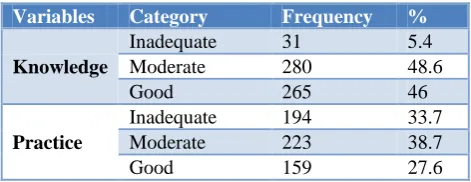
Table 2: Distribution of the respondents according to level of knowledge and practice (n=576).
Variables Category Frequency %
Knowledge
Inadequate 31 5.4
Moderate 280 48.6
Good 265 46
Practice
Inadequate 194 33.7
Moderate 223 38.7
Good 159 27.6
A majority of the study subjects were found to have moderate knowledge followed by good knowledge. However, 5.4% were having inadequate knowledge. Regarding practice, 33.7% have reported moderate level of practice and 22.7% good practice. However, one third of the study subjects have reported poor level of practice (Table 2).
Table 3: Analysis of variance: knowledge and practice by sex.
Variable Sex Mean Std. dev F Sig
Knowledge
Female 295 14.88
0.401 0.527 Male 281 15.03
Total 576 14.95
Practice
Female 295 7.95
0.652 0.420 Male 281 7.79
Total 576 7.87
Examining for variations among the study subjects with respect to the course, significant differences were
observed both in knowledge and practice among the subjects from the five courses (Table 4).
Table 4: Analysis of variance: knowledge and practice by course.
Variable Course Number Mean Std. dev F Sig
Knowledge
Engineering 97 13.20 2.64
21.334 <0.001
Agriculture 216 14.74 2.79
Medicine 146 15.85 2.45
Dentistry 73 16.37 2.31
Physiotherapy 44 14.55 2.54
Total 576 14.95 2.78
Practice
Engineering 97 6.82 2.00
9.117 <0.001
Agriculture 216 7.71 2.25
Medicine 146 8.47 2.68
Dentistry 73 8.59 2.39
Physiotherapy 44 7.80 2.27
Total 576 7.87 2.41
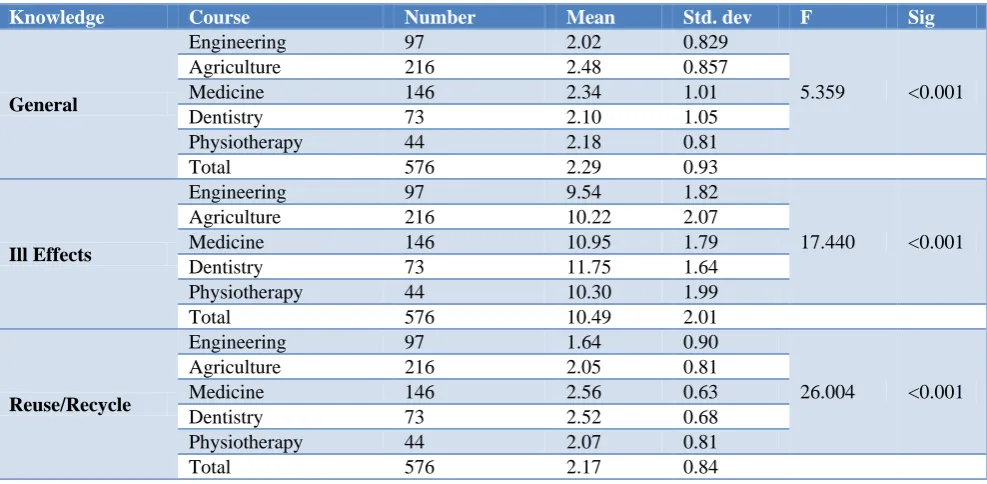
Table 5: Analysis of variance: components of knowledge by course.
Knowledge Course Number Mean Std. dev F Sig
General
Engineering 97 2.02 0.829
5.359 <0.001
Agriculture 216 2.48 0.857
Medicine 146 2.34 1.01
Dentistry 73 2.10 1.05
Physiotherapy 44 2.18 0.81
Total 576 2.29 0.93
Ill Effects
Engineering 97 9.54 1.82
17.440 <0.001
Agriculture 216 10.22 2.07
Medicine 146 10.95 1.79
Dentistry 73 11.75 1.64
Physiotherapy 44 10.30 1.99
Total 576 10.49 2.01
Reuse/Recycle
Engineering 97 1.64 0.90
26.004 <0.001
Agriculture 216 2.05 0.81
Medicine 146 2.56 0.63
Dentistry 73 2.52 0.68
Physiotherapy 44 2.07 0.81
Total 576 2.17 0.84
Table 6: Analysis of variance: components of practice by course.
Knowledge Course Number Mean Std .dev F Sig
Usage
Engineering 97 4.47 1.19
1.256 0.286
Agriculture 216 4.73 1.37
Medicine 146 4.78 1.72
Dentistry 73 4.96 1.50
Physiotherapy 44 4.82 1.48
Total 576 4.74 1.47
Disposal
Engineering 97 2.35 1.32
15.429 <0.001
Agriculture 216 2.98 1.42
Medicine 146 3.68 1.52
Dentistry 73 3.63 1.47
Physiotherapy 44 2.98 1.40
Analysis of variations among the study subjects with regard to the components of knowledge, significant differences were observed in all the three components of knowledge tested, general, ill effects and reuse/recycle (Table 5).
Analysis of variations among the study subjects with regard to the components of practice, significant differences were observed only in the disposal aspects of practice. As regards the usage of plastics, all were found to be practicing at same level (Table 6).
DISCUSSION
This study is based on assessment of knowledge and practice on plastic usage among professional students of Annamalai University. The study questionnaire had 3 components in knowledge aspect and 2 components in the practice aspect. In this study, the number of female respondents is slightly more than that of the male and observed that knowledge and practice level among them doesn’t have significant differences. In contrast to this, studies have reported relationship between socio demographic variables such as sex, age, education and environment behaviour practices.6,7
With regard to the knowledge level as a whole, only 46% of students had good knowledge on plastic and significant differences found among the students in terms of courses (p<0.001). Studies conducted among school students in Sharjah and Singapore showed knowledge level of 52% and 70.9% respectively while that in Hungary and Malaysia had 74% and 74.4% respectively.8,9 With regard to the components of knowledge which includes general aspects of plastic, ill- effects, reuse/recycle, the students found to have better knowledge in ill effects (M=10.49) and reuse/recycle options (M=2.17) of plastic wastes whereas the level of knowledge on types of plastics and on single use plastics(M=2.29) was low.
Adequate knowledge and awareness among students is very essential for successful outcome of any program in a community level. Being professional students, it is expected that an adequate knowledge on various public health issues concerning the society and environment which includes harmful effects of plastic too.10 They can henceforth be a resourceful person in any health education related activities at field level. This in turn helps the government and voluntary organizations in reaching out to the public thereby avoiding extra financial burden in training additional personnel.11
Knowledge level as such impacts students self-learning, managing behavior, situation awareness and decision making.12 Education system always tends to transfer knowledge to better influence a person, so also the society.13 Having significant knowledge on a particular subject will definitely have an influence on one’s attitude towards it.14
With regards to practice, significant differences were found among students of various disciplines (p<0.001) and with a mean practice of 7.87. This is comparatively less with that of the knowledge level thereby clearly implying that though the students have knowledge on plastic usage, its ill effects and its reuse options, the practice was at lower level. A study by Tanima Ferous et al conducted among school students concluded with similar results where their study had only half the percentage of practice level when compared to knowledge level of the study subjects.6 There is a gap between knowledge and behaviour in terms of their practice on plastic usage. Kennedy in the year 2004 had observed that one of the reasons behind the gap could be that the knowledge acquired is often forgotten shortly after it is acquired.15
The component study on practice of plastic pertaining to usage among the students of all disciplines studied found no significant difference of plastic (p=0.286), whereas the disposal aspects of practice showed significant difference among them (p<0.001). The usage and disposal aspects of practice had a mean of 4.74 and 3.13 respectively. Similar results were reported that though the students had a better knowledge on availability of alternates to the plastic bag they tend to use plastic bags, the main reasons quoted being easy availability of plastic bags, low or no cost, easy to store and carry.16 A study by Fransson et al concluded that environmental problems are usually the result of people acting in self-interest rather than in the collective interest.17
CONCLUSION
In this context, it is concluded that efforts are needed not only to raise awareness and knowledge on plastics but targeting the practice in particular avoiding one time use of plastics, to bring real impact on the ground level.
ACKNOWLEDGEMENTS
The authors thank the authorities and the participants.
Funding: No funding sources Conflict of interest: None declared
Ethical approval: The study was approved by the Institutional Ethics Committee
REFERENCES
1. UNEP. Single-use plastics: A Roadmap for Sustainability, 2018.
2. Kakoti R. Uses of plastic bags and environmental hazard- A study in Guwahati city. Int J Appl Res. 2017;3(4 6):1088–94.
3. Adane L, Muleta D. Survey on the usage of plastic bags, their disposal and adverse impacts on environment : A case study in Jimma City, Southwestern Ethiopia. J Toxicol Environ Heal Sci. 2011;3(8):234–48.
4. Rajeswari TR. Impact of plastics on environmental pollution. J Chem Pharm Sci. 2014;(3):87–93. 5. Thompson RC, Moore CJ, Saal FS, Swan SH.
Plastics, the environment and human health : current consensus and future trends. Phil Trans R Soc B. 2009;364(1526):2153–66.
6. Jones RE, Dunlap RE. The social bases of environmental concern. Have they changed over time? Rural Social. 1992;57(1):134-44.
7. Scott D, Willets FK. Environmental attitudes and behaviour. Environ Behaviour. 1994;26(2):239-26. 8. Ivy T, Road K, Lee C, Chuan G. A survey of
environmental knowledge, attitudes and behaviour of students in Singapore. Int Res Geo Environ Educ. 1998;7(3):181–202.
9. Stevens E. Green plastics: an introduction to the new science of biodegradable plastics. Princeton: Princeton University Press; 2002: 15–30.
10. Ferdous T, Das T. A study about the attitude of grade eight students for the use of plastic in Gwarko, Balkumari, Lalitpur district. Proceida- Social Behavioral Sci. 2014;116:3754-9.
11. Sanghi S. Use of plastic bags: factors affecting ecologically oriented behavior in consumers. Delhi:
Foundation for Organisational Research and Education; Abhigyan, 2008.
12. Lorenz M, Gehrke JD, Hammer J, Langer H, Timm IJ. Knowledge Management to Support Situation-aware Risk Management in Autonomous, Self-managing Agents. In: Czap H, Unland R, Branki C, Tianfield H, eds. Self-Organization and Autonomic Informatics. Netherlands: IOS Press. 2005: 114-128. 13. Clark BR. The higher education system: Academic organization in cross-national perspective, 1986. Available at: http://books.google.no/books?hl=en &lr=&id=j_-YKg7DuqAC&oi=fnd&pg=PR11&dq= The+higher+education+system:+Academic+organiz ation+in+crossnational+perspective.&ots=upAJ1W-DSL&sig=PDFjIPkYud6bik-VbEMT3eaXgHo&re dir_esc=y. Accessed on 4 October 2018.
14. Ramzan M. Does Level of Knowledge Impact Librarians’ Attitude Toward Information Technology (IT) Applications? 2004. Available at: http://ir.inflibnet.ac.in/dxml/bitstream/handle/1944/ 311/04cali_5.pdf?sequence=1. Accessed on 4 October 2018.
15. Kennedy T, Regehr G, Rosenfield J, Roberts SW, Lingard L. Exploring the gap between knowledge and behavior: a qualitative study of clinician action following an educational intervention. Acad Med: J Assoc Am Med Coll. 2004;79(5):386-93.
16. Hammami MBA, Mohammed EQ, Hashem AM, Al-Khafaji MA, Alqahtani F, Alzaabi S. Survey on awareness and attitudes of secondary school students regarding plastic pollution: implications for environmental education and public health in Sharjah city, UAE. Environ Sci Pollut Res Int. 2017;24(25):20626-33.
17. Fransson N, Garling T. Environmental concern: conceptual definitions, measurements, methods and research findinds. J Environ Psychol. 1999;19:369-582.
18. Adeolu AT, Enesi DO, Adeolu MO. Assessment of Secondary School Students’ Knowledge, Attitude and Practice towards Waste Management in Ibadan, Oyo State, Nigeria. J Res Environ Sci Toxicol. 2014;3(5):66-73.
19. Sutton J, Turner B. Plastic bags: Hazards and mitigation. California: Social sciences department, California Polytechnic State University; 2012.