Original Research Article
Assessment of hand hygiene practices among health care providers in a
government tertiary care hospital
Richa Semwal
1, Shiv Kumar Yadav
1*, A. R. Piyush
2, Bhola Nath
1INTRODUCTION
Health Care-Associated Infections (HCAIs) also
commonly known as nosocomial infection–is defined as “an infection occurring in a patient during the process of care in a hospital or other health-care facility that was not present or incubating at the time of admission. This also includes infections acquired in the hospital but appearing after discharge and occupational infections among staff of the facility”.1 HCAIs is a rising alarm in whole world
be it developing countries or developed nations. The
estimated risk is 2-to-20 folds higher in developing nations that is greater than 25% as compared to
developed nations.1 When Similar studies were
systemically reviewed, they revealed that amongst hospital-born babies the occurrence of neonatal infections were 3-20 folds higher in developing countries than developed countries.2 Evaluation Studies exploring causes of HCAIs revealed association with longer stay in the hospital, surgical procedure, medications and improper hand hygiene.3,4
ABSTRACT
Background: Hand hygiene practices either by hand rub by disinfectant or hand washing by soap and water are very important for preventing Health care-associated infections (HCAIs). WHO have devised guidelines for hand rub and hand wash and advocated “My five moments for hand hygiene” as the approach for appropriate performance, teaching and evaluation of hand hygiene. The objective of this study is toobserve hand hygiene practices, among health care providers in a tertiary care govt. hospital and document facilities available at the point of patient care for hand hygiene practices.
Methods: A cross sectional observation study was conducted in 8 departments of a Government Tertiary care Hospital for observation of hand hygiene practices as Per WHO Guideline on “5 Moment of Care”. Total of 600 observations were made and one Health care provider was observed once at a point of time. Data Entry was done in MS excel and was analysed in Open Epi software.
Results: Among 600 moments observed, 354 (59%) moments were those where hand hygiene practices were missed by HCPs. Among various HCPs 63% Doctors, 62% Nurses, 52% Medical students and 59% nursing students missed the hand hygiene practices. Lack of antimicrobial soap, alcohol based agents, sterile towel and hand drier were perceived barriers for hand hygiene Practices.
Conclusions: There lies a huge gap in practice of hand hygiene among all cadres of health care providers. The study is able to identify the lack of infrastructure which can be improved to promote hand hygiene in wards.
Keywords: Hand hygiene, Perceived barriers, Health care providers, Health care-associated infections
1Department of Community Medicine, 2Department of Pathology, Government Doon Medical College, Dehradun,
Uttarkhand, India
Received: 17 July 2019
Revised: 30 August 2019
Accepted: 04 September 2019
*Correspondence:
Dr. Shiv Kumar Yadav,
E-mail: [email protected]
Copyright: © the author(s), publisher and licensee Medip Academy. This is an open-access article distributed under the terms of the Creative Commons Attribution Non-Commercial License, which permits unrestricted non-commercial use, distribution, and reproduction in any medium, provided the original work is properly cited.
As a fact, among 1 out of 20 admitted patient acquires HCAIs.5 University of Geneva Hospital firstly reported that good compliance with hand hygiene practice leads to significant reduction in HCAIs.5 Rationally the hands of Health care providers during patients care become colonized by germs and potential pathogen. Hence longer extent of patient care with neglected hand hygiene practices leads to higher degree of hand contamination and possess high risk to patients safety.1 HCAIs are also a cause of morbidity in patients, and give away physical and moral suffering to both the patient and their relatives. The resources which could have been utilised on preventive actions or other health priorities are used to treat HCAIs, which surely put a financial burden to the health system. HCAIs can be prevented by proper hand hygiene practices either by hand rub or through disinfectant or hand washing by soap and water.6 WHO have devised guidelines for hand rub and hand wash and advocated “My five moments for hand hygiene” as shown in Figure 1, as the approach for appropriate performance, teaching and evaluation of hand hygiene.1
Figure 1:- Five (5) moments of hand hygiene.
Source: World Health Organisation. WHO guidelines on hand hygiene in health care. WHO Press, Geneva, Switzerland 2009.
This study is planned to observe hand hygiene practices among Health care providers (Doctors, Nurses, Medical Students, and Nursing Students) and available facilities for hand hygiene Practices available at the point of patient care.
Objectives
The objective of this study is to observe and document the practice of hand hygiene among health care providers document the available facilities for practice of hand hygiene available at the site of Patient care.
METHODS
This was a cross sectional observation study conducted in a Government Tertiary care Hospital situated in the capital of state Uttarakhand. Eight departments (Medicine, Surgery, Obstetrics and Gynaecology, Orthopaedics, Paediatrics, TB and Chest, Skin and VD and ENT) where indoor patients are treated were identified and assessed for 600 opportunities (5 Moments of Hand Hygiene) where hand hygiene should be practiced by HCP were observed and documented on observation Performa as per WHO checklist.1 The study was carried out for a period of two months (Mid Aug-Mid October 2018). Laboratory departments and departments where indoor facility was not available were excluded from study. Observations were done on one health care provider at one point of time at the site of patient care (wards). Simultaneously observations regarding available facilities of hand wash/hand rub available at the point of patient care (wards) were made. Data entry was done in MS excel and was analysed in SPSS software. Data regarding observation was analysed to determine the compliance to hand hygiene practice. Categorical variables were expressed in frequency and percentage and extrapolated on Graphs and Tables. Chi square test was applied to identify association between variables.
RESULTS
During this study 600 observations were captured (during 5 moments of hand hygiene) to assess the hand hygiene practice among different health care providers (Figure 2). Maximum observation where hand hygiene practices were missed were during moment 1 (before touching the patient) when 175 occasion were those out of 189 where hand hygiene practice not done. Although “after touching the patient (moment 4)” out of 264 observations captured only 71 were those when hand hygiene were missed.
Figure 2: Comparison between observations made and hand hygiene practice missed during “5 moments of hand hygiene”.
Before Touching a
Patient
Before Clean/Aseptic
Procedure
After Body Fluid Exposure
Risk
After Touching a Patient
After Touching Patient,s Surroundings 189
38 18
264
91 175
37 14 71 57
Figure 3: Hand hygiene practices among observation done (n=600).
Figure 4: Distribution of observations done on health care provider (n=600).
Among 600 observation captured, 354 (59%) moments were those when hand hygiene should be practiced were missed, and rest 125 (21%) moments involved practice of hand rub and 121 (20%) were of hand washing (Figure 3).
Health care providers observed during the study were from 4 different cadre, 182 (30%) were doctors, 123 (21%) were nurses, 199 (33%) were medical students and 96 (16%) were nursing students involved in patient care (Figure 4).
Statistical analysis was done to elicit the difference in hand hygiene practices in different cadres of health care providers. Statistical analysis showed there is a significant difference in hand hygiene practice among different health care provider (p value less the 0.05) (Table 1).
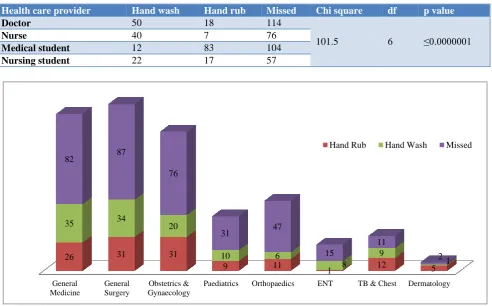
Out of 8 departments, the hand hygiene practices were missed by health care providers, 82 times (57%) in Medicine, 87 times (57%) in Surgery, 76 times (60%) in Obstetrics and Gynaecology, 47 times (73%) in Orthopaedics and 31 times (62%) in Paediatrics (Figure 5). Statistical analysis showed significant difference in practice of hand hygiene among health care provider in various departments of the hospital (p value <0.05).
Table 1: Statistical analysis on health care provider.
Health care provider Hand wash Hand rub Missed Chi square df p value
Doctor 50 18 114
101.5 6 ≤0.0000001
Nurse 40 7 76
Medical student 12 83 104
Nursing student 22 17 57
Figure 5: Distribution of hand hygiene practices as per the departments where observations done (n=600).
Chi Square: 33.03; Degrees of freedom: 14; p value: 0.002848. 125
121 354
Hand Rubbing Hand Washing Missed
182
123 199
96
Doctor Nurse Medical Student Nursing Student
General Medicine
General Surgery
Obstetrics & Gynaecology
Paediatrics Orthopaedics ENT TB & Chest Dermatology
26 31 31
9 11
1 12 5
35 34 20
10 6
8
9
1
82 87
76
31 47
15
11
Table 2: Distribution of hand hygiene practice by health care providers during “5 moments of hand hygiene” (n=600).
Health care provider 5 Moments of Hand Hygiene Action done
Hand wash Hand rub Missed
Doctor
Before touching a patient 4 5 47
Before clean or aseptic procedure 1 0 8
After body fluid exposure risk 1 0 6
After touching a patient 40 11 33
After touching patients surroundings 4 2 21
Total observation 50 18 115
Nurse
Before touching a patient 4 1 34
Before clean or aseptic procedure 0 0 10
After body fluid exposure risk 2 1 3
After touching a patient 31 5 13
After touching patients surroundings 3 0 17
Total observation 40 7 77
Medical student
Before touching a patient 0 0 67
Before clean/aseptic procedure 0 0 10
After body fluid exposure risk 0 2 2
After touching a patient 10 62 16
After touching patients surroundings 2 19 10
Total observation 12 83 105
Nursing student
Before touching a patient 0 0 27
Before clean or aseptic procedure 0 0 9
After body fluid exposure risk 0 1 3
After touching a patient 19 15 9
After touching patients surroundings 3 1 9
Total observation 22 17 57
Table 3: Facilities available to promote hand hygiene in the wards.
Department Pediatrics Obst. &
Gynae Medicine
Surgery
Ortho-
paedics ENT
TB & chest
Skin & VD
Number of wards 3 4 3 2 2 1 1 1
Facilities for hand washing available at the site of patient care (Y/N)
Yes Yes Yes Yes Yes Yes Yes Yes
Antimicrobial soap 100% 75% 66% 50% 100% 0% 100% 0%
Alcohol based agents NA NA NA NA NA NA NA NA
Sterile towel NA NA NA NA NA NA NA NA
Sterile gloves Yes Yes Yes Yes Yes Yes Yes Yes
Hand drier NA NA NA NA NA NA NA NA
Continuous water supply at
sink 100% 100% 100% 100% 100% 100% 100% 100%
Poster explaining hand
washing technique NA 25% NA 50% NA NA NA NA
Sinks 100% 100% 100% 100% 100% 100% 100% 100%
Sink bed ratio 1:8/1:8/
1:6
1:14/ 1:14/ 1:14/ 1:32
1:18/ 1:18/ 1:24
1:18/ 1:18
1:12/
1:8 01:08 01:07 1:4
During this study observation were made on different cadres of health care provider. During 183 observations captured on doctors, 63% missed the hand hygiene practice, out of them 41% observation showed missing of
missed after touching patients and patients surroundings. During 200 observations made on medical students, 52% students missed the hand hygiene practice, out of them 64% were missed before touching the patient. During 96 observations made on nursing students, 59% students missed the hand hygiene, out of them 27 were missed before touching the patient (Table 2).
This study also explored the availability of facilities which promotes hand hygiene practices at the wards of 8 departments (Table 3). Antimicrobial soap was not available in ENT and skin and VD wards and available only in 50% of surgery wards, 66% of medicine and 75% of obstetrics and gynaecology wards. Alcohol Based agents, Sterile towel and Hand Drier were not available in the wards of all the departments. Poster explaining hand washing technique was not available in paediatrics, medicine, orthopaedics, ENT, TB and chest and skin and VD wards. Sink Bed Ratio was high in wards of Obstetrics and Gynaecology, Surgery and Medicine wards.
DISCUSSION
Various studies have provided substantial evidence that hand hygiene practices by health care providers reduces the transmission of health care-associated pathogens and the incidence of HCAIs.7-9 In 1847 Semmelweis et al demonstrated that the mortality rate among mothers delivering at the First Obstetrics Clinic at the General Hospital of Vienna was significantly lower when hospital staff cleaned their hands with an antiseptic agent as compared to hands washed with plain soap and water.8
This study was carried out in a tertiary care Government hospital and 8 departments were used as study setting to make observation of hand hygiene practice among health care providers. Health care provider observed during the study were from 4 different cadre (belonging to 8 department), 182 (30%) were doctors, 123 (21%) were nurses, 199 (33%) were medical students and 96 (16%) were nursing students who were at that time involved in patient care.
During this study 600 observations were documented according to WHO guidelines of “5 Moments of Hand Hygiene” when hand hygiene should be practiced by health care provider. In the present study among 600 observation captured, 354 (59%) moments were those when hand hygiene should be practiced were missed, and rest 125 (21%) moments involved practice of hand rub and 121 (20%) were of hand washing. Statistical analysis showed there is significant difference in hand hygiene practice among different cadre of health care provider (p value <0.05).
Hand Hygiene practice was missed 82 times (57%) in medicine department, 87 times (57%) in surgery
department, 76 times (60%) in obstetrics and
gynaecology department, 47 times (73%) in orthopaedics department, 31 times (62%) in paediatrics department.
There was significant difference in practice of hand hygiene among health care provider in various departments of the hospital (p value <0.05).
There is no standard for measuring adherence to hand hygiene. Directly observing adherence to hand hygiene is the method used in most studies.10-12 WHO guidelines recommend the use of direct observation for monitoring HH compliance. It provides qualitative and quantitative information about why and when failures occur.1,13 In a study by Randle et ala 24 h observational study, it was found that out of the total of 823 hand hygiene opportunities (health care workers, n=659; patient and visitors, n=164) compliance was 47% for doctors, 75% for nurses, 78% for allied health professionals, and 59%for ancillary and other staff (p<0.001).14
Data was compared as per the moment when hand hygiene practice was missed and it was found that maximum compliance to hand hygiene 73% (193/264) was seen in moment 4 where health workers were more concerned with hand hygiene practice after touching the patient contrast to this in a study done by Chavali et al showed that maximum compliance was for moment 3, that is, the staffs were very careful after body fluid contact as it was perceived important for self-protection and same study also showed minimum compliance towards hand hygiene was for moment 5 that is, after touching patient surroundings while contrast to present study which showed minimum compliance to moment 1 (7.5%).5 In present study nurses had an overall compliance of 69% towards hand hygiene practice which is better as compared to various studies where nurses had compliance rate of 38%13,14,16,17. In a study done by Marra et al comparison of observational method, product use method and electronic surveillance was done and it was found that the overall rate of Hand Hygiene adherence was 62.3% (there were 2,249 opportunities for HH observed, and representing 1,402 cleansing episodes).16
The method of adherence used in this study is direct observation but direct observations have limitations which are more time-consuming, requires manpower, do not facilitate continuous monitoring. Direct observation provides information about a very low percentage of all hand hygiene opportunities. If staff is aware, direct observation may affect health care workers behavior (Hawthorne effect).12
CONCLUSION
This study is able to identify existence of huge gap in practice of hand hygiene among all cadres of health care providers. The study is also able to identify the lack of infrastructure at the point of patient care in wards which can be improved to promote hand hygiene practices.
Funding: No funding sources Conflict of interest: None declared
REFERENCES
1. World Health Organisation. WHO guidelines on
hand hygiene in health care. Geneva, Switzerland: WHO Press; 2009.
2. Zaidi AK1, Huskins WC, Thaver D, Bhutta ZA,
Abbas Z, Goldmann DA. Hospital-acquired
neonatal infections in developing countries. Lancet. 2005;365:1175–88.
3. Metintas S, Akgun Y, Durmaz G, Kalyoncu C.
Prevalence and characteristics of nosocomial infections in a Turkish university hospital. Ame J Infec Control. 2004;32(7):409-13.
4. de Almeida e Borges LF, Rocha LA, Nunes MJ, GontijoFilho PP. Low compliance to handwashing program and high nosocomial infection in a brazilian hospital. Interdisciplinary Perspectives Infect Dis. 2012;2012:5.
5. Pittet D, Hugonnet S, Harbarth S, Mourouga P, Sauvan V, Touveneau S, et al. Effectiveness of a hospital-wide programme to improve compliance with hand hygiene. Lancet. 2000;356(9238):1307-12.
6. Mahfouz A, Al-Zaydani I, Abdelaziz A, El-Gamal M, Assiri A. Changes in hand hygiene compliance after a multimodal intervention among health-care workers from intensive care units in Southwestern Saudi Arabia. J Epidemiol Global Health. 2014;4(4):315-21.
7. Boyce J, Pittet D. Guideline for Hand Hygiene in Health‐Care Settings: recommendations of the Healthcare Infection Control Practices Advisory Committee and the HICPAC/SHEA/APIC/IDSA Hand Hygiene Task Force. Infect Control Hosp Epidemiol. 2002;23(S12):S3-40.
8. Larson E. A causal link between handwashing and risk of infection? Examination of the evidence. Infec Control Hospital Epidemiol. 1988;9:28–36.
9. Larson EL. Skin hygiene and infection prevention: more of the same or different approaches? Clin Infec Dis. 1999;29:1287–94.
10. Mathai E, Allegranzi B, Kilpatrick C, Pittet D. Prevention and control of health care-associated infections through improved hand hygiene. Indian J Med Microb. 2010;28:100–6.
11. Rupp ME, Fitzgerald T, Puumala S, Anderson JR,
Craig R, Iwen PC, et al. Prospective,
controlled,cross-over trial of alcohol-based hand gel in critical care units. Infect Control Hosp Epidemiol. 2008;29:8–15.
12. Kohli E, Ptak J, Smith R, Taylor E, Talbot EA, Kirkland KB. Variability in the Hawthorne effect withregard to hand hygiene performance in high- and low-performing inpatient care units. Infect Control Hosp Epidemiol. 2009;30:222–5.
13. Stewardson A, Pittet D. Quicker, easier, and
cheaper. The promise of automated hand
hygienemonitoring?. Infect Control Hosp
Epidemiol. 2011;32:1029–31.
14. Randle J, Arthur A, Vaughan N. Twenty-four-hour observational study of hospital hand hygiene compliance. J Hosp Infect. 2010;76:252–5.
15. Chavali S, Menon V, Shukl U. Hand hygiene
compliance among healthcare workers in an accredited tertiary care hospital. Indian J Crit Care Med. 2014;18(10):689–93.
16. Marra AR, Moura DF, Paes AT, dos Santos OF, Edmond MB. Measuring rates of hand hygiene adherence in the intensive care setting: A comparative study of direct observation, product usage, and electronic counting devices. Infect Control Hosp Epidemiol. 2010;31:796–801.
17. Heczko PB, Kleszcz P. Handwashing practices in Polish hospitals: results of a survey conducted by polish society of hospital infection. J Hosp Infect. 2001;48(SA):S47–9.