22
The influence of morphological and geographical traits
on yield of Miscanthus sinensis during the first two
years
Nuananong Purente1, Qiang Li1, Lanming Cui1, Jing Zhang2, Junhua Peng3, Miao He1
1Department of Landscape Architecture, Northeast Forestry University, 26 Hexing Road, Harbin, Heilongjiang 150040, China, 2Luohe Municipal Engineering Design Institute, 162 Jiaotong Road, Yuanhui District, Luohe, Henan, 462099, China, 3China National Seed Group CO., LTD., A2 Fuxingmenwai Street, Xicheng District, Beijing, 100045, China
(Iqbal and Lewandowski, 2014; Lewandowski et al., 2003; Lewandowski and Heinz, 2003; Lewandowski and Kicherer, 1997). M. sinensis is a promising fiber yielding plants which having high potential in temperate climates for sustainable biomass production (Heaton et al., 2010). It is a perennial
energy crop by high annual biomass production and high resource-use efficiency (Heaton et al., 2004; Heaton et al.,
2008; Lewandowski et al., 2003; Long et al., 2001; Weijde et al., 2013). Miscanthus has a high yielding potential up to
40 tones ha-1 year-1, with low input lignocellulosic feedstock.
In biomass use yield for a plethora of applications, it shows growing interest, particularly for the production of bioenergy and biofuels (Brosses et al., 2012). Heaton et al. (2004) reported that switchgrass production approximately
12 tons ha-1 lower or half that of Miscanthus production observed in Europe. M. sinensis is high yield and, relative ease of husbandry using conventional equipment, therefore, it is a target species to renewable energy producers
Miscanthus is a C4 perennial energy crop distributed in various regions of China. Miscanthus sinensis has a high potential for biomass production, great adaptability to marginal land and tolerance to stress environmental. It’s very important for the production and development of biofuel to review both the morphological and geographical traits on yield. However, the relevance of biomass yield and the geographical position of habitat are still not well known. In the present study, investigations of heading date, plant height, stem number and dry biomass
per plant were carried out to calculate the influence of the morphological traits on yield. The investigation was based on 327 Miscanthus sinensis accessions collected from 21 provinces from all over China. The analysis was carried out on the basis of the two-year field experiment. The data for the second year was used to perform the analysis of variance and regression. Statistical data analysis was also performed on the variation of the biomass and morphological traits over successive period of study. The results showed that the growth included plant height and stem number in the following year was much better than the first year, particularly the biomass. Regression analysis revealed that latitude, plant height, and stem number were the key morphological traits that influence the biomass production. Also, heading date and elevation were found to be highly correlated to yield structure. These results demonstrated that the growth and yield were strongly influenced by geographical location, and apart from morphological traits, geographical traits were important factors that affect biomass.
Keywords: Biomass; Geographical traits; Heading date; Miscanthus sinensis; Morphological traits
Plants height (cm)
Biomass (g)
A B S T R A C T
*Corresponding author:
Nuananong Purente, Department of Landscape Architecture, Northeast Forestry University, 26 Hexing Road, Harbin, Heilongjiang 150040, China. Email: [email protected]
Received: 01 December 2018; Accepted: 18 January 2019
INTRODUCTION
M. sinensis, one kind of Miscanthus, originated in the east of
Asia and wildly distributed all over China. M. sinensis can
grow beside river bank, agricultural land and even in the hilly areas from lower to the higher elevations (Chou, 2009). In the past decades, the reduction of non-regenerated energy and the increase in energy demand have attracted much interest in the research of an alternative energy. Besides, bioenergy study is the most prevalent topic and attracts wide attention. High-yield perennial grasses are considered as one of the most promising species for commercial bio-energy productions, due to low energy inputs and high outputs (Pyter et al., 2010). At present, production of biomass is significant breeding objective in bioenergy crops such as
miscanthus (Heaton et al., 2010; Weijde et al., 2013). Field management practices like fertilization and harvest time
can be very promising to improve the biomass quality Emirates Journal of Food and Agriculture. 2019. 31(1): 22-28
doi: 10.9755/ejfa.2019.v31.i1.1896 http://www.ejfa.me/
Purente, et al.
Miscanthus is a C4 perennial energy crop distributed in various regions of China. Miscanthus sinensis has a high potential for biomass production, great adaptability to marginal land and tolerance to stress environmental. It’s very important for the production and development of biofuel to review both the morphological and geographical traits on yield. However, the relevance of biomass yield and the geographical position of habitat are still not well known. In the present study, investigations of heading date, plant height, stem number and dry biomass
per plant were carried out to calculate the influence of the morphological traits on yield. The investigation was based on 327 Miscanthus sinensis accessions collected from 21 provinces from all over China. The analysis was carried out on the basis of the two-year field experiment. The data for the second year was used to perform the analysis of variance and regression. Statistical data analysis was also performed on the variation of the biomass and morphological traits over successive period of study. The results showed that the growth included plant height and stem number in the following year was much better than the first year, particularly the biomass. Regression analysis revealed that latitude, plant height, and stem number were the key morphological traits that influence the biomass production. Also, heading date and elevation were found to be highly correlated to yield structure. These results demonstrated that the growth and yield were strongly influenced by geographical location, and apart from morphological traits, geographical traits were important factors that affect biomass.
Keywords: Biomass; Geographical traits; Heading date; Miscanthus sinensis; Morphological traits
Biomass (g) (Atkinson, 2009). M. sinensis takes in atmospheric CO2 and
assimilating it as plant tissue, and shares with its microbial
partners in the soil (Clifton-Brown et al., 2007), or on
the soil surface as leaf litter or other dead plant matter, which making it a plants carbon sequester (Heaton et al.,
2009). Clifton-Brown et al. (2007) report a sequestration
of 0.6 tones Cha-1 year-1. M. sinensis is also a crop with low
nitrogen requirement showing a very impact on biomass
production from fertilization (Himken et al., 1997). It
also played a major role in reducing nitrogen from surface
runoff (Heaton et al., 2008). Its broad range of variation
of habitat indicates its adaptability on different kinds of
extreme environment. It is one of the parents of Miscanthus x giganteus having higher yields than switchgrass (Heaton
et al., 2008) a perennial grass as received for its potential
as a model bioenergy crop. M. sinensis stores approximately 30% of its total dry matter in root and rhizome (Bullard et al., 1995). According to Clifton-Brown et al. (2004), annual yields of M. sinensis across Europe depends on
types of soil and climatic condition. Its production can
range from 10 to 40 tones ha-1 year-1. Clifton-Brown et al.
(2001) indicated that an average yield of M. sinensis could reach 13.4 tones ha-1 year-1. According to Clifton-Brown et
al. (2001) and Lewandowski et al. (2003), the highest yields
without irrigation were observed in autumn (17.9 tones ha-1) and winter (13 tones ha-1) for M. sinensis hybrids and 14.3 and 8.9 tones ha-1 for M. sinensis (non-hybrid) in the
autumn and winter harvests respectively. Work done by Jeżowski (2008) in Poland revealed that winter yields during the third year reached 20.5, 14.9 and 9.8 tones ha-1 for a
hybrid between M. sinensis (2x) and M. sacchariflorus (4x),
a hybrid between M. sinensis (2x) and M. sacchariflorus (2x)
and a hybrid between two M. sinensis (2x) respectively. It
is possible that M. sinensis can provide a genetic base for breeding because of the wide geographical distribution and
genetic diversity and other characteristics. Several studies on traits, biomass yield, crop age, plant height, and tiller have been conducted worldwide (Huang et al., 2011; Jeżowski, 2008; Jeżowski et al., 2011; Zub et al., 2011). Although there
have been numerous studies related in the literature, the
relevance of biomass yield and the geographical position of
habitat is still not well known. The aim of this study is to
determine the variation of morphological and geographical
traits during the first two years and find out the connections between the traits measured and dry biomass to confirm the key traits of biomass production.
MATERIALS AND METHODS
Plant materials
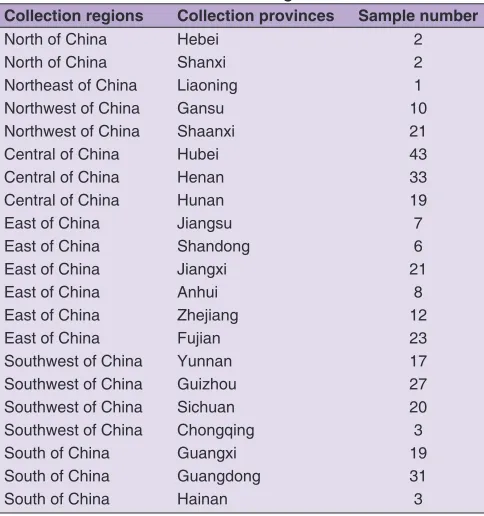
A total of 327 M. sinensis genotypes were collected from 21 provinces in China (Table 1). The geographical locations of these provinces ranged from 18°39.872N - 45°22.671N
and 100°10.027E - 127°34.816E covering north, northeast,
south, southeast, southwest and central of China. All the resource samples were conserved in Wuhan Botanical
Garden.
Field trials
The field experiments were conducted from 2015 to 2016
in a random designed plot of 23m×28m, with proper
irrigation and timely weed control in Wuhan Botanical Garden at Chinese Academy of Sciences. Fertilizer was
not used during the observation period. The materials were planted during spring period in 2015 and harvested
in winter of 2015 and 2016. Analysis of variance of yield
structure traits was conducted on plant height (the distance from surface of the soil to the apex of spikelet), tillering (the number of shoots 20 cm above the ground per plant)
and ripening time following the description by Jeżowski et al. (2011). Maturity was defined by the heading date. The data was defined the days between March 1st the date of planting and the beginning of flowering. Heading date (the days between March 1st and the beginning of heading) and flowering date (the days between March 1st and the date that more than 50% headed) were added to the survey data the second year. The yield was defined in the form of plant
biomass. Measurements were taken after harvest of each
year. Biomass (plant weight of dry yield) was determined by the average weight of each plant.
Statistical analyses
The data from planting until peak yield in the second year of cultivation were taken for analysis. In order to compare
Table 1: The information on collecting areas
Collection regions Collection provinces Sample number
North of China Hebei 2
North of China Shanxi 2
Northeast of China Liaoning 1
Northwest of China Gansu 10
Northwest of China Shaanxi 21
Central of China Hubei 43
Central of China Henan 33
Central of China Hunan 19
East of China Jiangsu 7
East of China Shandong 6
East of China Jiangxi 21
East of China Anhui 8
East of China Zhejiang 12
East of China Fujian 23
Southwest of China Yunnan 17
Southwest of China Guizhou 27
Southwest of China Sichuan 20
Southwest of China Chongqing 3
South of China Guangxi 19
South of China Guangdong 31
Purente, et al.
24
the samples from each years of the study, the results of the measurements were used to conduct a variance of analysis and two-factor analysis of variance. In the least significance difference (LSD) test was conducted at the 0.05 level of significance. Moreover, hypotheses of the geographical position of habitat were tested concerning the differences
in the morphological traits obtained between the first and second years. The correlation between the traits affecting
production and geographical factors were explored by
excel. The correlations between the traits measured in
this study were also analyzed. Multiple regression analysis were carried out using SPSS 13.0 (SPSS Inc., USA) to confirm the key traits that influence the biomass production (Soleymanifard et al., 2012).
RESULTS
Agronomic traits
The date on vegetative growth phase of M. sinensis
collected started from June and lasted to November which
is considered to be early winter in Wuhan. Most samples headed from about 150 days to 260 days after germination in the two years. Heading peak was observed on day 240 after
germination (Fig. 1A). Samples collected from Liaoning, Shandong, Gansu, Shanxi, Henan and Hubei provinces
headed earliest while samples from Guangdong, Hainan, Yunnan, and Fujian provinces entered the mating season at the latest. Fig. 1B presents the analysis of plant height, the result showed that plant height mainly concentrated in
the range from 19 to 27.5 cm. Most samples were more
than 15 cm and up to 33.5 cm maximum for the second
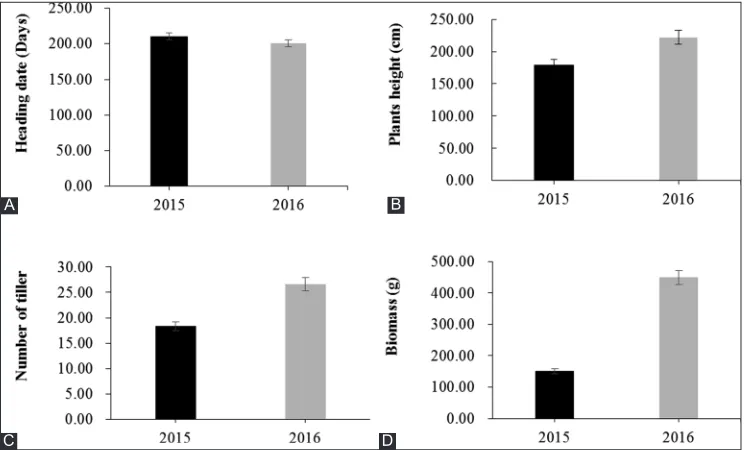
year. Higher samples were from Sichuan (Southwest of china), Guangdong (South of China), Guangxi (South of China), and Fujian (East of China). Generally, samples were taller than the first year, with 35 cm equally, even up to 2m partly. At the same time, the number of tillers per plant of each genotype showed a significant difference during the successive year of survey (Fig. 1C). The minimum of tillers per plant was only 10, but the maximum was up to 95. The result proved the strong variation of tiller ability. Interestingly, tiller has the same situation as plant height that the genotypes with more tillers concentrated in the same
province. The biomass ranged from 200 gram to more than
800 gram in the first year but increased many folds the next year (Fig. 1D). Outstanding performance on plant height,
tiller and biomass were reported from the samples collected
from Sichuan, Guangdong, Guangxi and Fujian provinces.
The samples collected from Guangdong were even up to
4000 gram in the second year. In order to understand how the variations of traits affect biomass over successive years of cultivation, it is reasonable to analyze the differences in these traits between the two experimental years. Generally,
heading date, plant height, tiller, and biomass all showed
significant differences (Table 2). The decrease of heading
Table 2: Traits comparison between the first and second year
Contrast Heading date Plant height Tiller Biomass
Y2-Y1 64.428** 5.478* 8.321** 102.758**
Y1‑ The first year of the experiment Y2‑ The second year of the experiment
*Significant at the 0.05 level, **Significant at the 0.01 level Fig 1. The distribution of frequency of heading date (A), plant height (B), tiller(C), biomass (D) in the two years.
A B
date for the second year indicated that samples headed earlier in the second year probably due to the adaptive process to the environment change. But the same trend in the two years suggested that the length of the growth period was considered to be decided by genetic evolution year in year out. The plant height of the second year was significantly higher than the first year. The large increase in biomass in the second year was probably due to the
augment of tiller and plant height (Figure 2).
Correlation analysis of the morphological traits
The correlation analysis was performed and the results are
presented on Table 3. The results showed no correlation between plant height and heading date, full heading date,
flowering date. Vegetative traits and plant height have a highly significant influence on leaf weight, stem weight, and
biomass. The results of the main effect were positive. At the
same time, it was noticed that there was a highly significant
correlation between the heading date and the ratio of leaf and stem weight. The strong correlation between stem number and plant height suggested that higher altitude was
accompanied by more vigorous tillers. Moreover, the ratio
of leaf and stem weight showed significantly positive effect
on biomass. It indicated that the heading date could affect the composition of biomass. The late heading will lead to
a higher ratio, more leaves and less stem, and finally higher
biomass further. The stable interaction between biomass and the ratio of leaf and stem weight suggested that the
composition of biomass could affect yield. It could be
inferred that heading date, plant height and stem number
which are supposed to be the key factors affecting biomass.
Correlation between morphological and geographical traits
From the correlation analysis of geographical parameter and individual traits, heading date and ratio of leaf/stem
were strongly negatively correlated with both longitude and
latitude (Table4). Latitude had a strong negative influence
on all individual traits. With exception of leaf/stem, all
traits were negatively correlated with elevation. These results proved that the growth and yield were strongly influenced by geographical location. It inferred that populations at lower latitude and elevation would enter the reproductive stage later and had a longer vegetative
Fig 2. Bar graph showing (A) Heading date, (B) Plant height, (C) Tiller and (D) Biomass of successive year of survey.
Biomass (g)
Table 3: Correlation analysis of morphological traits and yield Heading
date Full heading date Flowering date heightPlant numberStem weightLeaf weightStem leaf/stemRatio of
Full heading 0.979**
Flowering date 0.991** 0.975**
Plant height 0.094 0.094 0.099
Stem number 0.103 0.106 0.122* 0.200**
Leaf weight 0.511** 0.512** 0.505** 0.480** 0.514**
Stem weight 0.382** 0.325** 0.323** 0.628** 0.582** 0.841**
Ratio of leaf/stem 0.369** 0.361** 0.353** ‑0.228** ‑0.072 0.314** ‑0.198**
Biomass 0.462** 0.461** 0.456** 0.552** 0.558** 0.977** 0.931** 0.138* *Correlation is significant at the 0.05 level, **Correlation is significant at the 0.01 level
A B
Purente, et al.
26
growth. Similarly, the plants with higher plant height and biomass most likely appeared in the lower latitude and elevation areas. The inference may due to the higher growth
temperature in those areas. Moreover, we could get both
materials propagated early in the high latitude and elevation
areas and materials with great biomass in the low latitude
and elevation areas. Both latitude and elevation were
important factors of growth. The investigation conducted
in the successive years of vegetation confirmed that the materials collected from southern China grew higher and lusher, but late heading. Differently, the materials from
northern areas enter into the reproductive period earlier.
Key traits for biomass production
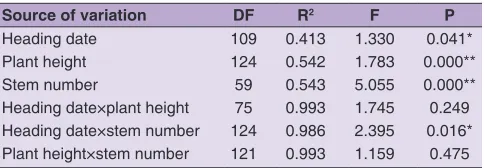
In order to understand the key traits that influence biomass production, further analysis of all production traits was conducted. The result of multivariate analysis of variance
in table 5 demonstrates the strong impact of biomass which
verified the inference that heading date, plant height and stem number supposed to be the key traits for biomass. There is no significant effect of the interaction between the heading
date and plant height on the biomass. The interaction of plant height and stem number presented no apparent value of the
main effect either. On the contrary, the interaction of heading date and stem number showed a significant effect of biomass.
Based on the analysis above, all traits measured that may affect the biomass were treated simultaneously in
order to obtain the regression equation on biomass.
Regression equation was conducted with biomass(Y) as the dependent variable and heading date(X1), full heading date(X2), flowering date(X3), latitude(X4), longitude(X5), elevation(X6), plant height(X7) and stem number(X8) as the
independent variables. The correlation coefficient R was 0.743, and the coefficient of determination R2 was 0.553.
The analysis of variance showed F was 121.130, P<0.01
which meant the equation was effective. The equation Y=244.056-35.922X4+3.521X7+14.111X8 indicated that there was a linear relationship between biomass and latitude, plant height and stem number. When the plant
height and stem numbers were fixed, biomass increased
279.978 as latitude reduced one degree. When the latitude
and stem number were fixed, biomass increased 247.577 as plant height increased one unit. Similarly, when the latitude and stem number were fixed, biomass increased 258.167 as stem number increased by one.
DISCUSSIONS
The temperature difference for a year is very big between North and South of China, for the lowest temperature is -22 °C and the highest temperature is 44 °C. The influence of geographical from different temperature
showed that the samples headed earlier mostly came from the north and northeast areas of China probably due to the low temperature and windy. On the contrary, the samples that came from the south of China headed at the latest likely because of perennial high temperature and sufficient sunlight. The North China area has short sunshine time
and fast cooling, so the plants there reproduce earlier and are shorter hence the problem of plant breaking as a result of strong wind is mitigated. The environmental conditions
in the southern parts of China make the plants have a long growth and enter into reproductive period very late. The
samples which had better plant height, tiller and biomass
were from Sichuan, Guangdong, Guangxi and Fujian
provinces which indicated that the materials which came from these areas had the most potential. In addition, this situation suggested the correlation between plant height,
tiller, and biomass. Important character especially biomass showed great changes between the first and second years
of cultivation. The result showed that most samples grew
better and provided a higher yield in the second year of cultivation. This is inconsistent with the findings of Clifton-Brown et al. (2001) and Jeżowski et al. (2011).
The increase of plant height along with the increase of
tiller may be the main reason for the significantly increase of biomass yield. Plant height increases the efficiency in the use of light. The ratio of leaf/stem had a significant
positive effect on biomass, so it could be speculated that
samples with more leaves could harvest more presumably due to the more leaves and the stronger photosynthesis.
Table 4: Correlation analysis of geographical and
morphological traits North
latitude longitudeEast Elevation (m)
Heading date ‑0.898** ‑0.109* ‑0.186**
Full heading ‑0.902** ‑0.105 ‑0.165**
Flowering date ‑0.904** ‑0.083 ‑0.192**
Plant height ‑0.126* 0.033 ‑0.244**
Stem number ‑0.124* ‑0.023 ‑0.078
Leaf weight ‑0.536** ‑0.015 ‑0.251**
Stem weight ‑0.363** 0.061 ‑0.309**
Ratio of leaf/stem ‑0.357** ‑0.188** 0.127* Biomass ‑0.491** 0.008 ‑0.276** *Correlation is significant at the 0.05 level, **Correlation is significant at the
0.01 level
Table 5: Multivariate analysis of variance of morphological
traits on biomass
Source of variation DF R2 F P
Heading date 109 0.413 1.330 0.041*
Plant height 124 0.542 1.783 0.000**
Stem number 59 0.543 5.055 0.000**
Heading date×plant height 75 0.993 1.745 0.249 Heading date×stem number 124 0.986 2.395 0.016* Plant height×stem number 121 0.993 1.159 0.475
R2: coefficient of determination; DF: degree of freedom; F: F value;
Considering the factors related to biomass, the crop age
turns out to be one important factor. The biomass increase
accompanied by the growth. Our results concur to that of Zub et al. (2011) and Jeżowski et al. (2011) that there is a significant augment between the two consecutive years
of cultivation which indicated the connection between
yield and crop age. Moreover, an increase in yield from the first year of cultivation to second was reported by Clifton-Brown et al. (2001). Lewandowski et al. (2003) further proved that peak yields can be attained in two years. Our results further revealed that plant height and tiller were key factors for biomass which agrees with the findings of Jeżowski (2008) and Huang et al. (2011). In their study, Jeżowski (2008) and Huang et al. (2011) noted that biomass of Miscanthus species had a significantly positive
correlation to plant height and tiller number. According to Huang et al. (2011), elevation is an important variable that
can influence the biomass of Miscanthus species. Our study
reveals that apart from morphological traits, geographical traits were also important factors that affect biomass. This
could be explained by the low temperature in high altitude
area and also temperatures variations with latitude changes.
CONCLUSION
As one of the most potential energy crop, Miscanthus sinensis
has attracted much attention worldwide. M. sinensis is widely distributed in China. The 327 samples collected from various parts of China basically representative populations of Chinese. There are lots of diversities of each individual
trait. The wealth of resources provides a guarantee to develop new varieties. The observed morphological traits
variation in the two years indicates that M. sinensis grow
rapidly from the second year. Although the growth was very rapid within the two years, a question still remains about the year where the peak is reached. This, therefore, creates a gap for future research. In our study, we concluded that latitude, plant height, and stem number are the key factors that directly influenced the biomass. In addition, heading date and elevation also played key role in the resulting biomass.
ACKNOWLEDGMENT
The authors would like to acknowledge the financial support from the Fundamental Research Funds for the
Central Universities (2572015EY03 and DL14C01).
Authors’ Contributions
Nuananong Purente, Qiang Li, Jing Zhang; Designed and performed experiments, analysed data and co-wrote the
paper. Junhua Peng; Performed transporter experiments.
Lanming Cui; Co-analysed data. Miao He.; Supervised the
research.
REFERENCES
Atkinson, C. J. 2009. Establishing perennial grass energy crops in the UK: A review of current propagation options for Miscanthus. Biomass Bioenergy. 33: 752-759.
Brosse, N., A. Dufour, X. Meng, Q. Sun and A. Ragauskas. 2012. Miscanthus: A fast-growing crop for biofuels and chemicals production. Biofuel. Bioprod. Biorefin. 6: 580-598.
Bullard, M. J., M. C. Heath and P. I. Nixon. 1995. Shoot growth, radiation interception and dry matter production and partitioning during the establishment phase of Miscanthus sinensis ‘Giganteus’ grown at two densities in the UK. Ann. Appl. Biol. 126: 365-378.
Chou, C. H. 2009. Miscanthus plants used as an alternative biofuel material: The basic studies on ecology and molecular evolution. Renew. Energy. 34: 1908-1912.
Clifton-Brown, J. C., I. Lewandowski, B. Andersson, G. Basch, D. G. Christian, J. B. Kjeldsen and K. U. Schwarz. 2001. Performance of 15 miscanthus genotypes at five sites in Europe. Agron. J. 93: 1013-1019.
Clifton-Brown, J. C., J. Breuer and M. B. Jones. 2007. Carbon mitigation by the energy crop, miscanthus. Glob. Chang. Biol. 13: 2296-2307.
Clifton-Brown, J. C., P. F. Stampfl and M. B. Jones. 2004. Miscanthus biomass production for energy in Europe and its potential contribution to decreasing fossil fuel carbon emissions. Glob. Chang. Biol. 10: 509-518.
Heaton, E. A., T. Voigt and S. P. Long. 2004. A quantitative review comparing the yields of two candidate C4 perennial biomass crops in relation to nitrogen, temperature and water. Biomass Bioenergy. 27: 21-30.
Heaton, E. A., F. G. Dohleman and S. P. Long. 2008. Meeting US biofuel goals with less land: The potential of miscanthus. Glob. Chang. Biol. 14: 2000-2014.
Heaton, E. A., F. G. Dohleman and S. P. Long. 2009. Seasonal nitrogen dynamics of miscanthus x giganteus and Panicum virgatum. GCB Bioenergy. 1: 297-307.
Heaton, E. A., F. G. Dohleman, A. F. Miguez, J. A. Juvik, V. Lozovaya, J. Widholm and T. B. Voigt. 2010. Miscanthus: A promising biomass crop. Adv. Bot. Res. 56: 75-137.
Himken, M., J. Lammel, D. Neukirchen, U. Czypionka-Krause and H. W. Olfs. 1997. Cultivation of miscanthus under West European conditions: Seasonal changes in dry matter production, nutrient uptake and remobilization. Plant Soil. 189: 117-126.
Huang, C. L., W. C. Liao and Y. C. Lai. 2011. Cultivation studies of Taiwanese native Miscanthus floridulus lines. Biomass Bioenergy. 35: 1873-1877.
Iqbal, Y. and I. Lewandowski. 2014. Inter-annual variation in biomass combustion quality traits over five years in fifteen miscanthus genotypes in South Germany. Fuel Process. Technol. 121: 47-55. Jeżowski, S. 2008. Yield traits of six clones of miscanthus in the first
3 years following planting in Poland. Ind. Crops Prod. 27: 65-68. Jeżowski, S., K. Głowacka and Z. Kaczmarek. 2011. Variation on
biomass yield and morphological traits of energy grasses from the genus miscanthus durig the first years of crop establishment. Biomass Bioenergy. 35: 814-821.
Lewandowski, I., J. C. Clifton-Brown, B. Andesson, G. Basch, D. G. Christian, U. Jørgensen and K. Tayebi. 2003. Environment and harvest time affects the combustion qualities of miscanthus genotypes. Agron. J. 95: 1274-1280.
Purente, et al.
28
impacts of energy production. Eur. J. Agron. 19: 45-63.
Lewandowski, I. and A. Kicherer. 1997. Combustion quality of biomass: Ptatical relavance and experiments to modify the biomass quality of Miscanthus x giganteus. Eur. J. Agron. 6: 163-177.
Lewandowski, I., J. M. Scurlock, E. Lindvall and M. Christou. 2003. The development and current status of perennial rhizomatous grasses as energy crops in the US and Europe. Biomass Bioenergy. 25: 335-361.
Long, S. P., C. V. Beale and P. K. Farang. 2001. Resource capture by miscanthus. In: Miscanthus for Energy and Fiber, James and James Ltd., London, UK, p. 10-20.
Pyter, R. J., F. G. Dohleman and T. B. Voigt. 2010. Effects of rhizome size, depth of planting and cold storage on Miscanthus x
giganteus establishment in the Midwestern USA. Biomass Bioenergy. 34: 1466-1470.
Soleymanifard, A., R. Naseri and M. Meysam. 2012. The study genetic variation and factor analysis for agronomic traits of Durum wheat genotypes using cluster analysis and path analysis under drought stress condition in western of Iran. Int. Res. J. Appl. Basic. Sci. 3: 479-485.
Weijde, T. V. D., C. L. A. Kamei, A. F. Torres, W. Vermerris, O. Dolstra, R. G. F. Visser and L. M. Trindade. 2013. The potential of C4 grasses for cellulosic biofuel production. Front. Plant Sci. 4: 107. Zub, H. W., S. Arnoult and M. Brancourt-Hulmel. 2011. Key traits for